
Our readers keep the lights on and my morning glass full of iced black tea. As an Amazon Associate, I earn from qualifying purchases.
Specs are compiled from manufacturer listings and verified buyer reviews and can change over time — please confirm the key details on the product page before buying.
Foam rollers are simple tools with one job — pressing into tight muscle to break up knots and speed recovery. But pick the wrong density, and you either get zero pressure that does nothing, or a torture device you avoid using.
I’m Min — the founder and writer behind Gadgets Feed. This guide is built by comparing the manufacturers’ published specifications and the patterns across verified customer reviews, so you get each pick’s real strengths and trade-offs instead of marketing spin.
A smart foam roller choice depends on matching its firmness and size to your specific muscle depth and pain tolerance, not just buying the most popular option on the shelf.
Quick Picks
- Black Mountain Products High Density Extra Firm Foam Roller — Best Overall
- Teeter Massage Foam Roller — Texture Specialist
- High Density EVA Foam Roller for Physical Therapy – Deep Tissue Massager — Budget Champion
- OPTP AXIS Firm Foam Roller — Deep Therapy
- TriggerPoint Carbon Deep Tissue Foam Roller — Nodule Power
- Brazyn Morph Collapsible Foam Roller — Travel Genius
- MELT Method 36 Inch Soft Foam Roller — Gentle Recovery
How To Choose The Best Foam Roller
Sad truth: most people buy a roller that is either too soft to do anything, or so firm they only use it once. The three specs that decide everything are firmness, size, and surface texture. Here is what each one means for your actual body.
Firmness — The Single Most Important Choice
Density runs from soft (low-density foam that compresses easily) to extra-firm (almost hard, like a dense EPP or EVA material). A soft roller works for sensitive areas like your neck and calves. An extra-firm roller penetrates deep into the glutes and IT bands. If you are new, start with a medium-firm and work up — jumping straight to extra-firm can cause bruising.
Size — Length and Diameter
Longer rollers (36 inches) give you stability for your entire spine and let you roll both legs at once. Shorter ones (12 to 13 inches) are portable but require more balance. Diameter matters too — a 6-inch diameter lifts your body higher for deeper pressure compared to a 5-inch, which is gentler and easier to control on smaller areas like your arms.
Surface — Smooth vs. Textured
Smooth rollers apply even pressure across a wide surface, ideal for general stretching and beginners. Textured rollers — with bumps, ridges, or nodules — act more like a massage therapist’s knuckles, digging into specific trigger points. The trade-off: texture is more effective for knots but can be too intense if you have a low pain tolerance.
Quick Comparison
On smaller screens, swipe sideways to see the full table.
| Model | Best For | Length | Weight | Surface | Amazon |
|---|---|---|---|---|---|
| Black Mountain Products High Density | All-around value and firm pressure | 36 inches | 1.8 lb | Smooth | Amazon |
| Teeter Massage Foam Roller | Durable texture for home gyms | 26 inches | 4.5 lb | Textured / Bumpy | Amazon |
| High Density EVA Half Foam Roller | Targeted lower-back mobility | 36 inches | 12 oz | Textured bumps | Amazon |
| OPTP AXIS Firm Foam Roller | Maximum firmness for deep therapy | 36 inches | 5 oz | Smooth | Amazon |
| TriggerPoint Carbon Deep Tissue | Advanced users needing deep nodules | 13.13 inches | 1.5 lb | High-profile nodules | Amazon |
| Brazyn Morph Collapsible | Travel and gym-bag portability | 16 inches | 1.5 lb | Textured nubs | Amazon |
| MELT Method Soft Foam Roller | Gentle fascia work for sensitive bodies | 36 inches | 1.81 lb | Smooth | $84.99Amazon |
In‑Depth Reviews
1. Black Mountain Products High Density Extra Firm Foam Roller

The 36-inch workhorse gives you chiropractor-level firmness without the chiropractor bill.
Its 6-inch diameter, versus the Teeter’s 5-inch design, lifts your body higher, so your own weight drives deeper pressure into your hamstrings and back. The extra-firm density matches what many physical therapists recommend. Buyers confirm it works for physical therapy. At 36 inches long, it stays planted under your whole spine, so you do not wobble while rolling out your IT bands. Unlike the 5-ounce OPTP AXIS (also 36 x 6 inches but made of light EPP foam), this Black Mountain roller uses a denser foam weighing 1.8 pounds — you feel the solidity immediately. The smooth surface is beginner-friendly; no painful nodules to scare you off. It is made in the USA and phthalate-free, so no chemical smells while you stretch. The trade-off: it is unforgiving on bony areas like shins or elbows, and some buyers wish it came in a softer option for neck work.
Why It Dominates
- Extra-firm density matches what chiropractors actually use
- 6-inch diameter gives deeper muscle penetration than 5-inch rollers
- 36-inch length supports full spine and both legs at once
- Made in the USA with phthalate-free foam
The Trade-Offs
- Too firm for necks and sensitive bony areas
- Smooth surface won’t hit trigger points as effectively as textured options
Reach for this if: You want one roller that covers full-body stretching, physical therapy recovery, and gym warm-ups without needing a second purchase.
Look elsewhere if: You need a softer roller for light fascia work or have a low tolerance for firm pressure on your spine.
2. Teeter Massage Foam Roller
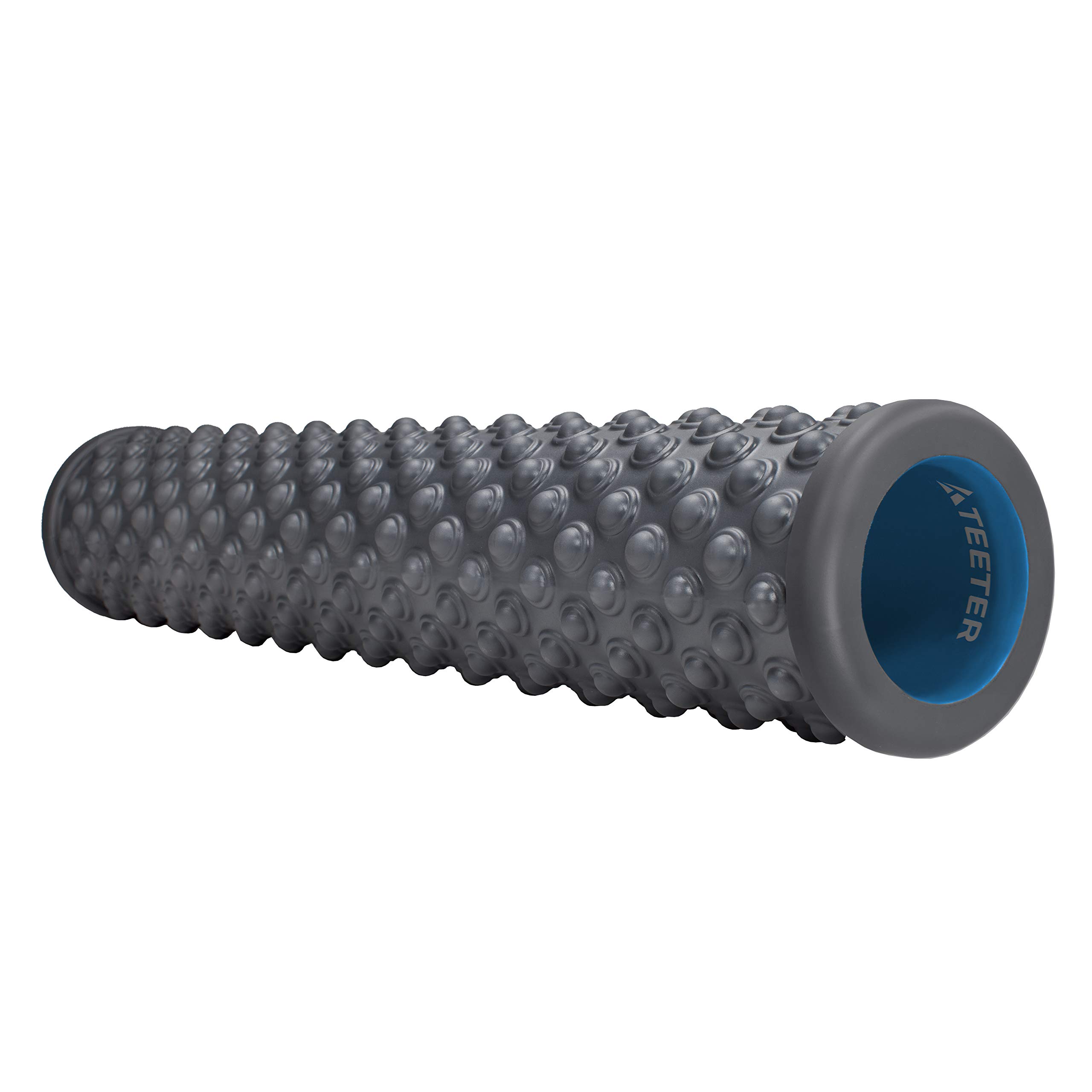
Bumpy texture that mimics fingers digging into knots, no partner required.
At 4.5 pounds, this Teeter is the heaviest roller here — compared with the 1.5-pound TriggerPoint Carbon. That weight comes from a firm plastic hollow core wrapped in coated PU foam. Buyers confirm it looks brand new after a year of use. Its 5-inch diameter makes it easier to control on smaller muscle groups like your calves and arms compared to the 6-inch Black Mountain. The 26-inch length lets you roll both legs at once without the full 36-inch footprint. Teeter sells two versions: a gray bumpy one (more firm) and a blue wavy one (less firm). The gray option, reviewed here, replicates fingertips pressing into trigger points. Some buyers report the surface can feel slick when wearing clothes, so direct skin contact works best for grip. The hollow core prevents sagging over time, unlike solid-foam rollers that soften after a year. The catch: at 26 inches, it is too short to cover your entire spine in one motion, so you will shift positions more often than with a 36-inch roller.
Built to Last
- Plastic hollow core prevents sagging and maintains shape over years
- Bumpy texture provides focused trigger-point relief class-leading by smooth rollers
- 26-inch length is a practical middle ground for home and gym use
What Holds It Back
- Heavier than every other roller here at 4.5 pounds
- Surface can slide on clothing, requiring bare-skin use for best grip
Best suited for: Gym-goers who want a durable, textured roller that delivers consistent deep pressure without flattening out.
Not ideal if: You need portability for travel — this is a heavy roller that stays at home or in the gym bag.
3. High Density EVA Foam Roller for Physical Therapy – Deep Tissue Massager

A half-round shape that slides under your lower back without lifting your hips too high.
This EVA roller is a half-cylinder — flat on one side, textured on the other — which solves a specific problem: a 6-inch full-round roller can overextend your lower back when you lie on it. The half-round shape keeps your spine more neutral. Owners mention it works well for lower backs when a 6-inch roller is too large. At 12 ounces, it is light enough to carry easily, though it weighs more than the 5-ounce OPTP AXIS. The textured bumps provide grip for your toes during hamstring stretches and offer light myofascial release without the extreme intensity of the TriggerPoint Carbon’s nodules. Made from EVA foam, it resists cracking — one reviewer noted it softens slightly with heavy use but does not break down. The biggest limit: at 3 inches tall (half the height of a full round), the pressure you can generate is shallower, so it is less effective for deep glute or IT band work compared to a 6-inch full round like the Black Mountain.
Why It Wins for Sensitive Backs
- Half-round shape keeps lower back in a neutral position
- Lightweight at 12 ounces — easy to bring to the gym or studio
- Textured bumps offer grip and light release without extreme pain
Where It Falls Short
- Shallow depth limits pressure on thick muscle groups like glutes
- Softens slightly over months of frequent use
Grab this for: Anyone with lower back sensitivity who found full-round rollers too aggressive or painful to use.
skip it if: You need deep, penetrating pressure into large muscles — pick a full-round extra-firm roller instead.
4. OPTP AXIS Firm Foam Roller

The physical-therapy standard so firm some call it borderline hard.
This is the firmest smooth roller in this list — made from closed-cell EPP foam that does not compress under 250-plus pounds. Customers note daily 5-minute sessions eliminated back aches and shoulder strains. At 36 x 6 inches, it matches the Black Mountain in dimensions, but weighs only 5 ounces because EPP foam is extremely light. That makes it easy to carry to the clinic despite its large size. The catch is real: “very, very firm, may be painful to some” is a direct buyer quote. For users with chronic back pain from conditions like degenerative arthritis, it initially hurts on muscle knots before providing relief. This is not a beginner’s roller. It is designed for people who need consistent, unyielding pressure — the kind that releases deep trigger points that softer rollers cannot touch. Unlike textured rollers that concentrate pressure into small points, the OPTP’s smooth surface distributes force evenly, which some users prefer for general stretching of the hamstrings and quads.
Pro-Grade Pressure
- Extremely firm EPP foam supports over 250 pounds without flattening
- 36-inch length provides stable positioning for tall users
- Ultra-light 5-ounce weight defies its large size
The Hard Truth
- Too firm for beginners or anyone with low pain tolerance
- Smooth surface may not dig into knots as effectively as textured rollers
This is for: Experienced rollers and physical therapy patients who need maximum, consistent firmness to release chronic muscle tension.
Avoid if: You are new to foam rolling or have sensitive bony areas — this will hurt more than it helps at first.
5. TriggerPoint Carbon Deep Tissue Foam Roller

High-profile nodules that go deep enough to make you wince — and that is the point.
The TriggerPoint Carbon is built for experienced users with dense muscle tissue who find standard textured rollers too mild. Its raised nodules stand much higher than the Teeter’s bumps, and the flat spaces between them allow soft tissue to displace. At just 13.13 inches long and 1.5 pounds, it is the smallest and lightest roller in the premium tier. Buyers describe it as very intense, not for those avoiding deep pressure. Compared to the 36-inch OPTP AXIS (extra firm but smooth), the Carbon’s nodules create pinpoint pressure into trigger points rather than broad compression. It is especially effective for the glutes and IT bands, where thick muscle needs focused force. One buyer mentioned it eliminated knee pain by aggressively working the IT band, leaving temporary bruising but resolving the issue. The caveat: at roughly 5.5 inches in diameter, it is slightly narrower than the Black Mountain’s 6 inches, so you get less lift and stability for full-back rolling.
Deep-Release Machine
- High-profile nodules reach deeper into connective tissue than any smooth or bumpy roller
- Compact 13-inch size makes it easy to target specific spots and travel with
- Flat zones between nodules allow tissue to spread during compression
Intensity Warning
- Can cause bruising on first uses — ramp up slowly
- Too aggressive for beginners or anyone with low pain tolerance
Designed for: Athletes, bodybuilders, and heavy trainers who need maximum myofascial release and are comfortable with significant discomfort during rolling.
Not for: Casual users who just want a gentle post-workout stretch — this roller demands commitment.
6. Brazyn Morph Collapsible Foam Roller

The only roller here that collapses flat enough to slip into a backpack.
When open, the Morph forms a 16-inch textured cylinder with nubs for self-myofascial release. Press a button, and it collapses to a flat 1.5-inch-thick disc that fits in a gym bag or carry-on. It supports up to 350 pounds despite weighing just 1.5 pounds. One buyer confirmed the foam is still firm after 3 years of use. The textured nubs are less aggressive than the TriggerPoint Carbon’s nodules but more effective than a smooth surface for finding tender spots. The trade-off for collapsibility is firmness. Some reviewers point out it is “a bit on the soft side” compared to solid foam rollers, so it may not deliver the deep pressure that extra-firm rollers like the OPTP AXIS provide. At 16 inches, you cannot roll your full spine in one pass — you will need to reposition. But for frequent travel or limited storage, no other roller here competes with the Morph’s portability. The locking mechanism is sturdy; shoppers say it holds up under bodyweight after 1.5 years of daily use.
Portability King
- Collapses to 1.5 inches flat for easy packing in luggage or gym bags
- Supports up to 350 pounds in its locked-open position
- Textured nubs provide effective trigger-point release without extreme pain
Built-In Limit
- Softer than solid foam rollers — not enough pressure for deep muscle work
- 16-inch length means you cannot roll your entire back in one motion
Ideal for: Frequent travelers, commuters, and anyone who wants to roll at the office or in a hotel room without carrying a bulky cylinder.
Pass on this if: You need serious deep-tissue pressure at home — get a solid extra-firm roller as your primary and this as a travel backup.
7. MELT Method 36 Inch Soft Foam Roller
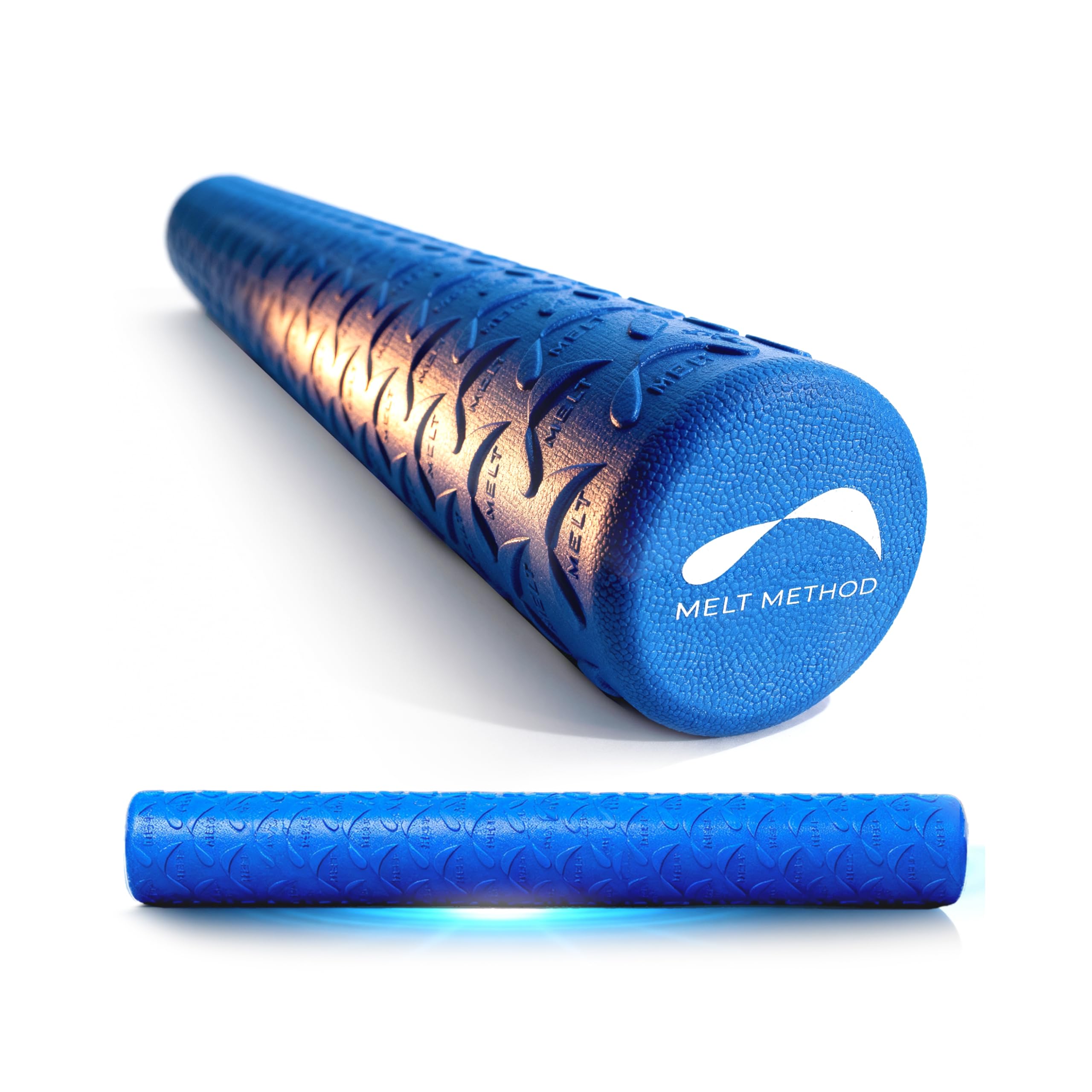
Soft foam that works with your nervous system instead of fighting your muscles.
Everything else on this list is designed to press hard into muscle. The MELT Method roller does the opposite — it provides gentle compression that targets the fascia (the connective tissue wrapping your muscles) and calms the nervous system. It is 5 inches in diameter (narrower than the 6-inch Black Mountain), which reduces pressure on sensitive areas like your neck and lower back. Buyers report it is “soft enough for neck/sensitive areas” but “firm enough for back/shoulders” — a balancing act most rollers fail at. The 36-inch length covers your full spine, and the low density lets you sink into it for a massage-like effect. Developed by fascia expert Sue Hitzmann, the roller comes with access to instructional videos teaching sequences called Rebalance, Release, and Rehydrate. The honest limitation: if you have very tight, knotted muscles, this soft roller will not provide the deep release that an extra-firm or textured roller can. One buyer summed it up: “I was looking for something a bit more firm” — but also noted it is “definitely worth it” for its intended use.
Nervous-System Friendly
- Soft density is safe for neck, ribs, and other bony areas that hurt on firm rollers
- Long 36-inch length supports full-body use without repositioning
- Fascia-focused design can improve mobility without bruising or intense pain
Not for Deep Knots
- Too soft to release deep muscle tension in glutes and IT bands
- Higher price point for a simpler product compared to denser options
Your pick if: You have chronic pain or sensitivity and need a roller you can use daily without wincing — especially for your neck and lower back.
Not the right choice if: You want to aggressively work out deep trigger points in large leg muscles — choose an extra-firm or textured roller.
Understanding the Specs
Density and Firmness
This is the single spec that decides whether a roller helps or hurts. Density is measured by the material: low-density EVA foam (soft, compresses easily, good for necks), high-density EVA or EPP foam (firm, supports heavy weight, good for legs and back), and extra-firm or “carbon” foam (almost hard, for deep tissue work). Never judge firmness by brand — read the “Item Firmness Description” in the technical specs. A medium-firm roller is the safest starting point for most people; you can always size up to extra-firm later.
Length and Diameter
Length determines stability: a 36-inch roller stays put under your whole spine, while a 12- to 16-inch roller requires more balance and is better for spot-treating small areas like your calves. Diameter controls how much your bodyweight presses in: a 6-inch diameter lifts you higher and creates deeper pressure, while a 5-inch diameter is gentler and fits smaller hands for controlled rolling. If you are over 5-foot-10, favor a 36-inch length so your head and tailbone both contact the roller during back work.
FAQ
How firm should my foam roller be for back pain?
Can a foam roller worsen my injury?
How long should I roll each muscle group?
Is a textured or smooth foam roller better?
What is the difference between a half-round and full-round foam roller?
Will a foam roller help with IT band tightness?
How do I clean a foam roller?
Can I use a foam roller on my neck?
What is the best foam roller for a beginner?
How long does a foam roller last before it flattens?
Final Thoughts: The Verdict
For most users, a foam roller winner is the Black Mountain Products High Density because it delivers the right firmness, full 36-inch length, and 6-inch diameter at a price that beats anything with similar specs. If you want deep trigger-point release with textured nodules, grab the TriggerPoint Carbon — but only if you are ready for serious intensity. And for gentle daily use on sensitive backs and necks, the MELT Method Soft Roller is the only choice that works with your nervous system instead of against it.
How We Picked
We do not accept paid placement, and we did not hands-on test every unit. Instead, we match each pick to a real buyer and use-case by comparing the manufacturers’ published specifications against the patterns in verified customer reviews — so you get each pick’s real strengths and trade-offs instead of marketing copy.
Sources & Methodology
Specifications: manufacturer listings and product documentation. Review insights: verified customer reviews, as of July 2026. Pricing: not shown on this page (it changes often); check the current price via the retailer link.
As an Amazon Associate, Gadgets Feed earns from qualifying purchases. This does not affect which products we feature.
Product prices and availability are accurate as of the date/time indicated and are subject to change. Any price and availability information displayed on Amazon at the time of purchase will apply to the purchase of this product. As an Amazon Associate I earn from qualifying purchases.
CERTAIN CONTENT THAT APPEARS ON THIS SITE COMES FROM AMAZON. THIS CONTENT IS PROVIDED "AS IS" AND IS SUBJECT TO CHANGE OR REMOVAL AT ANY TIME.
Amazon and the Amazon logo are trademarks of Amazon.com, Inc. or its affiliates.