
Our readers keep the lights on and my morning glass full of iced black tea. As an Amazon Associate, I earn from qualifying purchases.
Specs are compiled from manufacturer listings and verified buyer reviews and can change over time — please confirm the key details on the product page before buying.
A freezer fails quietly. No beep, no warning — just a slow thaw you discover when the ice cream turns to soup and the meat is warm. A freezer alarm fixes that one problem. It watches the temperature inside, and the moment things drift out of range, it tells you by phone, by beep, or both, so you find out in minutes instead of days.
I’m Min — the founder and writer behind Gadgets Feed. This guide is built by comparing the manufacturers’ published specifications and the patterns across verified customer reviews, so you get each pick’s real strengths and trade-offs instead of marketing spin.
Whether your freezer sits in the garage or in the kitchen, this guide covers how each alarm connects and alerts you. Here are the strongest options for the best freezer alarm.
Our Picks at a Glance

How To Choose The Best Freezer Alarm
Buying a freezer alarm is really about one question: when the temperature drifts, how do you actually find out? Everything else — the sensors, the app, the beeps — exists to answer that. Below are the four things that separate a helpful alarm from a gadget you forget you own.
Match the alert channel to how you live
A freezer alarm can reach you three ways: a phone push notification over the internet, an email, or a loud buzzer built into the device itself. If you are usually home, a loud buzzer on the unit is enough. If you travel or keep a freezer in a garage or second home, you want alerts that reach your phone wherever you are — that means the alarm needs Wi-Fi or its own wireless network, not just a short-range radio link to a display on your counter.
Check how far the signal travels and what it has to pass through
Radio waves weaken when they cross a fridge wall, a garage, or several floors. Some systems use ordinary Wi-Fi and politely ask your router to carry the load; others use a dedicated long-range radio standard that does not touch your Wi-Fi at all. Whichever you pick, the range figure only tells the honest story in open air, so a sensor headed into a steel box in a detached garage needs the longer, more penetrating option.
Decide how many zones you need watched at once
Most buyers start with one freezer, then realize the fridge matters too. A kit that supports extra sensors lets you add the kitchen fridge, the garage chest freezer, and a second fridge later without buying a whole new system. If you already know you have two or three cold spots, a multi-sensor kit saves you from re-buying.
Look at battery type and probe design for cold storage
Regular batteries struggle in a freezer, so many of these kits ship with freeze-resistant cells and promise long life between swaps. The probe matters too: a thin, flat cable slides under the door seal without crushing it, which keeps cold air from leaking out and keeps frost from building up. A thick round cable can hold the door ajar just enough to waste energy and trigger false alerts.
Quick Comparison
| Model | Best For | Alert Method | Sensors Included | Wireless Type | Amazon |
|---|---|---|---|---|---|
| YoLink Freezer Temperature Sensor Kit★ Best Overall | Remote garages and second homes | App push, email, text | 1 sensor + hub | LoRa | Amazon |
| GoveeLife WiFi Refrigerator ThermometerTop Performer | Loud local alarm plus phone alerts | App, email, 80dB buzzer | 2 sensors + gateway | 2.4G Wi-Fi + Bluetooth | Amazon |
| MOCREO WiFi Freezer Thermometer (H5Lite)Most Versatile | Display you can glance at without a phone | App, email, 80dB hub alarm | 2 sensors + hub | Wi-Fi | Amazon |
| MOCREO WiFi Freezer Thermometer Alarm (H5Lite-MS2D) | Monitoring several freezers at once | App, email, 80dB hub alarm | 2 sensors + hub | Wi-Fi | Amazon |
| AcuRite (00523M) Wireless Fridge and Freezer Thermometer | Basic fridge and freezer monitoring | Display alarm with high/low records | 1 fridge + 1 freezer sensor | Wireless radio | Amazon |
| La Crosse Technology 308-04747-INT | Compact color-matched counter unit | Hi/Lo alert with history | 2 sensors | Radio Frequency | Amazon |
| Digital Wireless Refrigerator Freezer Thermometer (BaldrTherm) | Budget multi-zone viewing | Screen flash and alarm | 3 sensors | Wireless | Amazon |
| WiFi Freezer Thermometer with App Alarm (PHYSEN) | App alerts on a tighter budget | App push notifications | 2 sensors | 2.4GHz Wi-Fi + Bluetooth | Amazon |
| KeeKit Refrigerator Thermometer | Simple fridge/freezer/room display | Audible alarm with min/max record | 2 sensors | Wireless | Amazon |
In‑Depth Reviews
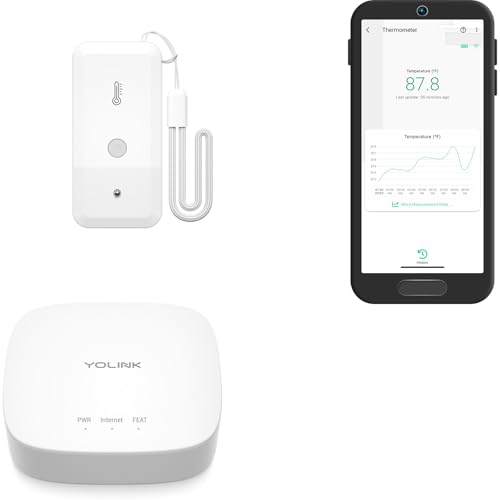
1. YoLink Freezer Temperature Sensor Kit: 1-Pack + Hub
Our pick — over 4.5★ from 550+ verified ratings; the strongest balance of quality and price.
It leaves your Wi-Fi alone entirely and still reaches a freezer floors away.
If your freezer lives in a detached garage, a barn, or a second home you only visit now and then, this is the kit built for exactly that. It uses LoRa (a long-range, low-power radio standard) instead of your home Wi-Fi, so it does not crowd or slow your network. That radio reaches up to 2,034 feet in open air — far enough to cover a freezer that sits well beyond your router’s reach.
Accuracy is the quiet strength here. The thermometer holds ±0.36°F between 32°F and 129°F, and ±0.72°F from -20°F up to 32°F, which is the range your freezer actually lives in. It measures from -4°F to 122°F overall. Alerts come three ways — app push, email, or text — and you set your own temperature threshold. The included hub and sensor give you 15 free SMS messages a month. Power comes from two AA batteries rated for up to 5 years, with a low-battery alert in the app so a dead cell never sneaks up on you.
What wins owners over is reliability — it is the trait they bring up far more than any other, and the readings stay steady across multiple freezers. The scenario that keeps coming up is a door left slightly open: the sensor caught the obstruction through temperature trends that a basic door alarm missed entirely. Setup is quick and the app keeps a history you can look back on. The one honest wrinkle is that this is a single sensor and hub, so if you want your kitchen fridge covered too, you add sensors rather than getting them in the box.
Where it pulls ahead
- LoRa radio sidesteps Wi-Fi congestion and reaches up to 2,034 feet in open air
- ±0.36°F accuracy across the freezer’s working range
- Up to 5 years on two AA batteries with a low-battery alert
- Push, email, and text alerts with custom thresholds
Worth knowing first
- One sensor and one hub only — extra zones cost extra
- Text alerts are capped, so lean on app and email for volume
Reach for this if: your freezer sits far from the house or you want live monitoring of a place you are not standing in.
Think twice if: you wanted several sensors in the box from day one — this kit starts you with one.
2. GoveeLife WiFi Refrigerator Thermometer Sensor with Alarm, 2-Pack & Gateway
Two sensors, a gateway, and a buzzer loud enough to pull you off the couch.
Where the YoLink leans on its own radio, this one leans on alert volume. It fires off three alert types at once — an app push, an email, and a built-in 80dB buzzer — so at least one of them reaches you. The buzzer is the headline: it is loud enough to be heard from another room, and you mute it by pressing the button on the side of the device, or set it to stay silent if you prefer phone-only alerts.
The sensing side is sharp, too. A 2.7mm NTC probe (a small temperature-sensing element) delivers ±0.9°F / ±0.5°C precision with a 2-second response time, covering -40°F to 158°F. Two sensors come in the box along with a gateway, and one gateway handles up to 10 sensors within a 230 ft range, so you can grow the network to cover more fridges and freezers later. It runs on four AAA batteries included, and it sets up in about five minutes with a magnetic or hanging mount plus a probe holder to keep the cable tidy.
The reliable, accurate tracking is what owners keep coming back to, and it is the aspect they praise most by a wide margin. Breast-milk storage is a common use — one power outage hit the same night a buyer set it up, and the phone alert plus the device beeper both fired. The trade-offs are real but manageable: some units need a little patience connecting over Wi-Fi, and the included adhesive holds for only a few days in the wet, cold inside a fridge, so plan on the magnet or a shelf placement instead.
The alert-volume case: with three channels and a genuinely loud buzzer, this is the pick when you want to be un-missable, not just internet-reachable.
The mounting caveat: the magnets are strong, but most fridge interiors are plastic, so the lanyards or a shelf spot do the real work.
Suits you when: you want a siren-in-the-kitchen backup alongside phone alerts, with two sensors to split between fridge and freezer.
Less ideal if: you dislike app setup fiddling — Wi-Fi pairing trips up the occasional unit.
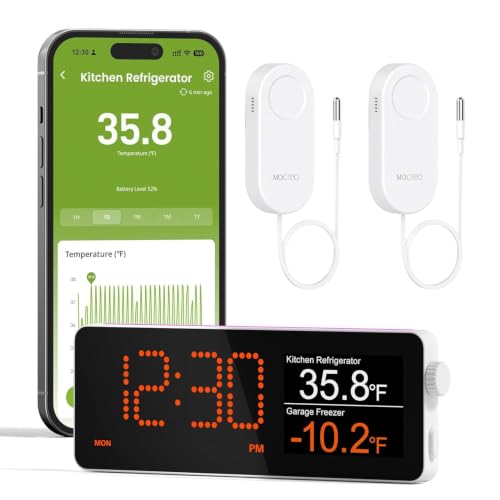
3. MOCREO WiFi Freezer Thermometer with Freezer Alarm, Screen Display, 2 Sensors
The alarm that tells you the power went out, not just that the freezer got warm.
Most freezer alarms watch temperature. This one watches time without power, too. If an outage lasts more than 30 minutes, it sends an app and email alert telling you exactly when the power dropped, then pings you again the moment it comes back. That matters for anyone whose real fear is a breaker tripping while they are away, not a door left cracked open.
The hardware backs it up. Two MS1 wireless thermometers arrive with the H5-Lite hub, each using a 0.9mm ultra-flat cable that slides under the door seal — thin enough to avoid cold-air leakage and frost buildup. Accuracy is industrial-grade at ±0.9°F across a -40°F to 221°F range. Alerts come three ways simultaneously: app push, email, and a loud 80dB hub alarm. One hub can manage up to 30 sensors. Batteries run up to 2 years on three AAA cells, and temperature history is stored and exportable for free for up to 2 years. Alexa support lets you ask for the current temperature by voice.
What owners value first is how straightforward setup is, and the built-in display is a recurring reason they pick this over screenless hubs — you can glance at the fridge and freezer temps without pulling out a phone. The alert delay setting is the unsung feature: it filters out the harmless warmth from an open door or a defrost cycle so you are not buzzed every time someone grabs ice. The honest snag is the instructions, which tripped up a couple of buyers during setup even though the app itself is easy once you are in.
Why it earns its spot
- Power outage alert with the exact time power dropped
- 0.9mm flat cable slips under the door seal without leaking cold air
- Local hub display so you can check temps without your phone
- Up to 2 years of battery life and free data export
Small print to weigh
- Setup instructions confused a couple of owners at first
- Wi-Fi pairing is steady for most, uneven for a few
Pick this if: extended trips and power worries are your main concern and you want a screen on the hub for quick local checks.
Look elsewhere if: you have no Wi-Fi at the freezer’s location — this one needs it.
4. MOCREO WiFi Freezer Thermometer Alarm with Digital Monitor Hub (H5Lite-MS2D)
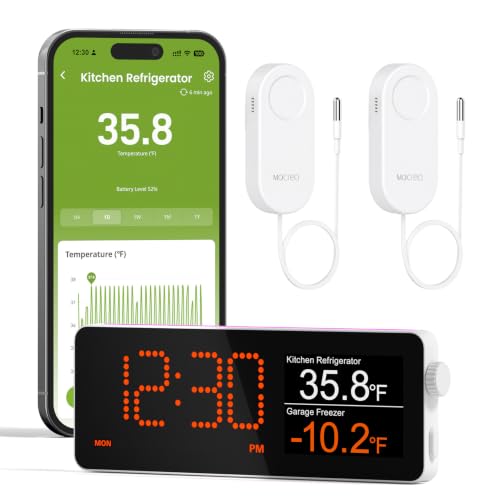
A 7.5-inch hub that turns your cold-storage corner into a live status board.
This is the fuller version of the MOCREO system, and the difference shows up in the box: the H5Lite hub here arrives with two wireless thermometers, two probe clips, an adapter, and a power cable, versus the slimmer kit’s two thermometers and stand. The hub’s LCD is the centerpiece — it shows the clock, sensor temperatures, trend charts, alerts, a calendar, and weather, all readable without opening the fridge or reaching for your phone.
The sensing spec is the same solid core: a probe rated for ±0.9°F across -40°F to 158°F, with a 0.9mm ultra-thin flat cable that passes under the door seal. It runs on three AAA batteries claimed to last up to 2 years, with a low-battery alert once they drop below 10%. Beyond the standard app push, email, and 80dB hub alarm, it adds a Hub Offline Alert for power-outage moments and anti-false-alarm settings. One hub talks to up to 30 MOCREO BLE sensors across a maximum 230 ft open-area range, so expanding coverage is just adding sensors. iOS Critical Alerts bypass Do Not Disturb, and you can silence the hub from the app instead of walking over to it.
Setup is what owners single out more than anything, and the peace-of-mind angle is what they actually bought it for. The freezer-door-a-jar scenario is the classic save: the alert fires and you find the door had drifted open just a little. A practical touch owners mention is using it as a diagnostic tool — one buyer traced a deep freezer that cooled fine but would not cycle back on until it got too warm, swapped a thermostat, and fixed it. The connectivity is a mixed bag across the wider field, with a few buyers hitting pairing hiccups, though most are up and running in minutes.
The dashboard argument: a 7.5-inch hub screen that shows clock, weather, and temperature curves turns a single-purpose alarm into something you actually look at daily.
One thing to expect: that larger hub takes up real counter space — fine on a desk or shelf, less so on a crowded kitchen counter.
Best matched to: a household running two or more freezers who wants a local display and remote alerts in one system.
skip it if: you want the smallest possible footprint and never glance at a screen — the compact version covers you.
5. AcuRite (00523M) Wireless Fridge and Freezer Thermometer with Alarm
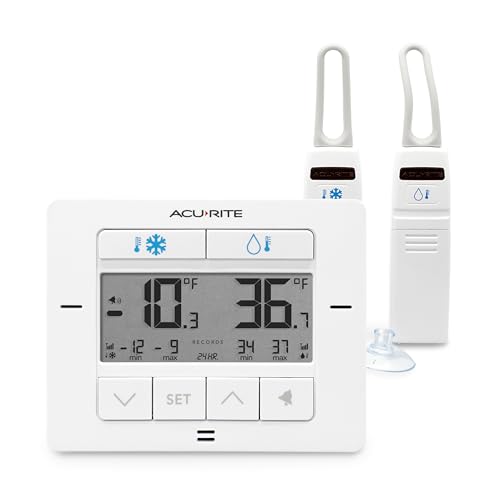
Accuracy is the whole pitch here — it is the trait owners name more than any other.
For buyers who want a straight, dependable fridge-and-freezer monitor without an app in the loop, this is the well-known name. It ships with one refrigerator sensor and one freezer sensor that transmit wirelessly to a digital display. You get high/low temperature records, customizable alarms for temperature spikes, and a low-battery indicator. Mounting is flexible: a magnetic back for the fridge door, a keyhole for the wall, or a fold-out stand for the counter. The silicone sensor straps work with the included suction cups or wrap around a wire shelf.
Real-world saves are the theme. The alarm caught a fridge losing temperature from a leaking seal before the contents spoiled, and the high/low memory is what made the difference — you can see the swing, not just the moment. It can even plug into a smart home setup, auto-detecting on battery insert over the rtl_433 radio bridge for Home Assistant users. Range held up when tested to 20m, with temperature updates roughly once a minute.
Two practical notes from long-term owners. The included magnets are on the weaker side and can slide off a fridge over time — adding a heavier magnet solves it. And like any freezer sensor, this one calls for lithium AA batteries, which last longer in the cold than standard alkaline cells. If you want a no-subscription, no-account monitor that runs on a counter display, this is the one.
The no-app case: everything shows on the included display, so there is no phone, no account, and no Wi-Fi dependency to manage.
Plan for batteries: lithium AAs are the smart call for the freezer sensor, since cold drains ordinary cells faster.
Made for: the buyer who wants proven accuracy and a local display with zero app setup.
Not for you if: you travel often and need alerts on your phone — this one lives on your counter.
6. La Crosse Technology 308-04747-INT Wireless Refrigerator/Freezer Thermometer

The one that practically disappears on your counter and reads two zones at once.
La Crosse is the quiet, understated option, and owners notice the looks. The display unit weighs just 3.2 ounces and comes in black — a small detail that matters if you do not want a bright white gadget stuck to your fridge. It reads temperatures from two included wireless sensors in either Fahrenheit or Celsius, and you can show the numbers with or without decimal points. Hi/Lo alerts and a history view are built in, along with signal-strength icons and a sensor search. The display mounts by magnet, wall keyhole, or kickstand; the sensors mount vertically with a movable wall bracket.
Accuracy is what owners trust most, and functionality comes right behind it. The RV crowd likes it especially — real-time fridge and freezer temps mean you catch a failing fridge before the food is ruined. The convenience of seeing inside temperatures without opening the door is the everyday win, and it is genuinely useful during a power loss when you want to know how fast things are warming.
The honest snag: setup can be fiddly. The fragile “+” button is known to break if pressed hard while setting the date and time, and that button also controls alerts and sensor search — so treat it gently, and note that a resync means pulling the batteries and redoing everything. Budget four AA and two AAA batteries, which are not included.
Ideal for: anyone who wants a compact, good-looking display reading two cold zones without an app.
Be careful if: you want to set it up once and forget it — the delicate button and battery-resync routine ask for a light touch.
7. Digital Wireless Refrigerator Freezer Thermometer, 3 Remote Sensors (BaldrTherm)

Three sensors on one screen, with a backlight that adjusts itself to the room.
Three zones for the price of what some brands charge for one sensor is the entire appeal here. The main unit displays temperature and humidity for several cold-storage zones at once, and the oversized digits are easy to read from across a room. You set your own temp and humidity thresholds, and the screen flashes when a reading slips outside the safe range. The wireless transmission covers 330 feet (100m) with ±1°C accuracy, and readings refresh every 30 seconds.
The clever bit is the power system. A photovoltaic cell (a small panel that turns light into power) absorbs ambient light to extend service life up to 12 months without constant battery swaps, and a built-in light sensor auto-adjusts screen brightness — bright for daytime, a soft anti-glare backlight at night. The sensors arrive with a recommended coffee run — they need three AA batteries for the main unit and two AA per sensor, none included.
The thing owners rave about most is build quality, and precision is right behind it. One detail worth knowing: the three sensors can read several degrees apart right from the start, then self-calibrate to match within a day or two — so do not panic at the first reading. It works in both fridge and freezer, and it proves its worth after a power outage when you want to confirm the food is still in the safe zone.
Why three sensors win: monitoring the fridge, the freezer, and a third zone on a single screen beats juggling separate units.
Give it a day: initial readings can differ between sensors before they settle into agreement — this is normal, not a defect.
Great for: households juggling three cold spots who want one screen to watch them all.
Less of a fit if: you want phone alerts when away — this one is a local display, not a remote notifier.
8. WiFi Freezer Thermometer with App Alarm, 2 Wireless Sensors (PHYSEN)

App alerts and two waterproof sensors for buyers who want the basics done well.
This is the value-minded entrance into app-based monitoring. It connects to 2.4GHz Wi-Fi and pushes a free notification to your phone the moment temperatures leave your set range — the kind of alert that catches a door left open before the food is gone. Two IP65 waterproof sensors (rated to resist water spray) cover temperature and humidity with no wired probes trailing out of the fridge, which keeps the door seal intact.
The numbers hold up for the price. It tracks -4°F to 140°F (-20°C to 60°C) at ±1.8°F accuracy, plus humidity from 0% to 99% RH. Range reaches 492 feet (150m), so a garage or basement fridge stays in contact, and it supports up to nine sensors. The included freeze-resistant AAA batteries run up to 2 years, and you get a year of free data export to CSV for tracking trends. One hard limit to note: it cannot read below -20°C, so it is not built for deep-freeze territory that goes colder than that.
Owners who have used it for weeks report it performing well, with the sensors calibratable right inside the app. The upside is that a working unit is a solid, affordable monitor. The recurring friction is connectivity — pairing the sensors over Wi-Fi trips up some buyers, and a few units never paired at all. If you are patient through Wi-Fi pairing and your freezer stays above -20°C, it earns its keep.
What you get for less
- Free app notifications over 2.4GHz Wi-Fi
- Two IP65 waterproof sensors for temp and humidity
- 492 ft range covering garage and basement
- Up to 2-year freeze-resistant battery and 1-year free data export
The honest limits
- Cannot read below -20°C, so not for ultra-cold storage
- Wi-Fi pairing proves stubborn for a minority of units
Right for you if: you want phone alerts and two sensors on a tighter budget and your freezer stays above -20°C.
Avoid if: you run a deep freezer that dips colder, or you want the simplest possible pairing — this one asks for some patience.
9. KeeKit Refrigerator Thermometer, Indoor Outdoor Thermometer with 2 Sensors

A simple three-reading display that covers the fridge, the freezer, and the room.
If you want a three-reading display with a manual audible alarm and no app, this is the budget pick. The console shows the indoor temperature plus two groups of outdoor readings from the two included remote sensors at once, and it works in the fridge, freezer, or outside. Indoor range runs 14°F to 140°F and outdoor range -40°F to 140°F, with a transmission range of 328 feet in open area. Max/min memory captures the highs and lows, and up, down, or parallel arrows show which way the temperature is trending right now.
The alarm is manual and straightforward: you set your own maximum and minimum values, and it rings when the reading hits either limit — a useful nudge for anyone who wants a cheap early warning without a phone. Six function keys on the main unit handle the alarm on/off, Celsius and Fahrenheit switching, and clearing the max/min records. Mounting options are generous: integrated magnets, a hanging hole, and a bracket for the main unit; clamps and rear holes for the two transmitters.
Two things to know before buying. First, this is a wireless radio display at 4.1 inches long, so it is a compact counter or door unit rather than a remote-alert system. Second, the durability is uneven — the freezer sensor can fail if it ices up, since it is not built for wet or frozen conditions, though a couple of owners revived a stuck sensor by pulling and reinserting the battery. The display is also dim in bright light and reads best from a low angle.
The simple-display case: three readings, max/min memory, and a manual alarm — no Wi-Fi, no account, no pairing.
The durability caveat: keep the freezer sensor dry and it lasts; icing is what can take one down.
Good fit for: budget shoppers who want a straightforward multi-zone display with a basic audible alarm.
pass on it if: you need remote phone alerts — this is a local readout that lives on your counter.
Understanding the Specs
Alert Channels — Push, Email, Buzz, or Text
How an alarm reaches you matters more than any other feature. A display-only unit beeps on your counter, which is fine when you are home but useless on vacation. A Wi-Fi or LoRa unit pushes a notification to your phone wherever you are, and the strongest options layer in email and a loud buzzer so at least one channel gets through. When you compare units, count the channels — three beats one when a freezer full of food is on the line.
Wireless Range and What It Has to Cross
The range figure you see is measured in open air, so treat it as a best case. A sensor inside a steel fridge door in a detached garage needs a signal that penetrates walls, which is why LoRa-based systems and 492-foot Wi-Fi setups exist. Short-range radio displays are perfectly fine for a kitchen fridge, but for a freezer across the property, look for a longer, lower-power standard that does not lean on your router.
Accuracy and Min/Max Memory
Accuracy (say ±0.9°F versus ±1.8°F) tells you how close the reading is to reality, which matters when a few degrees is the line between safe and spoiled. Min/max memory is the sleeper feature — it records the highest and lowest points so you can spot a temperature swing that happened overnight, not just the number on the screen this second. Together they turn a thermometer into a diagnostic tool.
Probe Design and Battery Type for Cold Storage
A thin, flat probe cable slides under the door seal without breaking the airtight line, which keeps cold air in and frost out; a thick round cable can hold the door ajar. On batteries, ordinary alkaline cells lose their edge in freezing temperatures, so kits that ship with freeze-resistant cells and multi-year life save you the hassle of swapping them in a cold box. Low-battery alerts mean you never discover a dead sensor at the worst time.
FAQ
Will a freezer alarm work if there is no Wi-Fi near my garage freezer?
What temperature should I set the alarm to for a freezer?
Can these alarms handle a deep freezer or a second home?
Do these freezer thermometers need a subscription fee?
How long do the batteries last inside a freezer?
What is the difference between a Wi-Fi freezer alarm and a LoRa one?
Will a thin probe cable really slip through my fridge door seal?
Can I monitor more than one freezer at the same time?
Do these alarms work during a power outage?
Is an app-based freezer alarm worth it over a simple display unit?
Final Thoughts: The Verdict
Across the board, the freezer alarm winner is the YoLink Freezer Temperature Sensor Kit because its LoRa radio reaches freezers your Wi-Fi never will, with ±0.36°F accuracy and up to 5 years on two AA batteries. If you want an 80dB buzzer plus two sensors and instant phone alerts, grab the GoveeLife WiFi Refrigerator Thermometer with its 80dB alarm and ±0.9°F probe. And for power-outage coverage with a built-in dashboard screen, the MOCREO WiFi Freezer Thermometer (H5Lite) is the one to reach for. If your budget is the deciding factor and your freezer stays above -20°C, the value-minded PHYSEN WiFi Freezer Thermometer covers the basics without asking much — which is why it holds strong owner satisfaction for the money.
How We Picked
We do not accept paid placement. Every pick is matched to a real buyer and a real use-case; we do not hands-on test units.
Sources & Methodology
Specifications: manufacturer listings and product documentation. Review insights: verified customer reviews, as of September 2026. Pricing: not shown on this page (it changes often); check the current price via the retailer link.
As an Amazon Associate, Gadgets Feed earns from qualifying purchases. This does not affect which products we feature.