
The dead zone on a worn analog stick is the quiet killer of competitive aim — that fractional millimeter of slack before the game registers your input is the difference between a headshot and a miss. Finding a controller that maintains precision beyond the first hundred hours of use is the real battle most buyers ignore until it’s too late.
I’m Min — the co-founder and writer behind Gadgets Feed. I’ve spent hundreds of hours cross-referencing latency charts, polling rate specs, and joystick sensor durability claims to separate the controllers that genuinely outperform from the ones coasting on brand reputation.
After analyzing sensor technologies, trigger mechanisms, and wireless protocols across seven distinct models, I’ve assembled a definitive ranking of the best gaming controller options available right now for players who refuse to compromise on input fidelity.
How To Choose The Best Gaming Controller
Not all controllers deliver the same input latency or sensor durability. The internal components — specifically the joystick sensor type and trigger mechanism — determine whether your controller feels tight in week one or loose by week ten. Prioritize models with either Hall Effect or TMR sensors if you want your aiming to stay consistent beyond the first battery cycle.
Joystick Sensors: Hall Effect vs TMR vs Potentiometer
Traditional potentiometer sticks wear down mechanically, causing the dead zone to expand and drift to appear. Hall Effect sensors use magnets and have no physical contact, eliminating wear entirely. TMR (Tunnel Magnetoresistance) sensors are a newer evolution — they offer even higher sensitivity and lower power draw than standard Hall Effect, with zero dead zone capability out of the box. For competitive shooters, TMR is the current ceiling.
Polling Rate and Wireless Protocol
A controller’s polling rate — measured in Hz — dictates how often it reports its position to your PC or console. Standard controllers run at 125Hz (8ms report interval). Premium contenders now hit 1000Hz (1ms interval). That 7ms gap matters when you’re flicking to a target. Wireless technology also matters: 2.4GHz dongles deliver the lowest latency on PC, while Bluetooth 5.3 offers convenience at a slight trade-off in response time.
Trigger Technology: Linear Hall Effect vs Tactile Micro-Switch
Linear Hall Effect triggers provide smooth, progressive input ideal for racing games where throttle modulation matters. Tactile micro-switch triggers offer a mechanical click at the end of the pull, giving faster actuation for shooters where every millisecond counts. The best controllers let you switch between both modes for the same trigger set.
Quick Comparison
On smaller screens, swipe sideways to see the full table.
| Model | Category | Best For | Key Spec | Amazon |
|---|---|---|---|---|
| GameSir G7 Pro | Premium | Xbox & PC competitive shooters | 1000Hz Polling Rate | Amazon |
| EasySMX D10 | Mid-Range | Cross-platform PC & Switch | TMR Joysticks | Amazon |
| 8Bitdo Ultimate 2 | Mid-Range | PC & Steam Deck | 1ms 2.4G Wireless | Amazon |
| Xbox Wireless Controller | Mid-Range | Console & PC general use | Textured Grip | Amazon |
| PlayStation DualSense Starlight Blue | Premium | PS5 & PC immersive play | Haptic Feedback | Amazon |
| PlayStation DualSense Midnight Black | Premium | PS5 & PC immersive play | Adaptive Triggers | Amazon |
| JDDWIN LED Wireless | Budget | PS5 budget entry | Hall Effect Joystick | Amazon |
In‑Depth Reviews
1. GameSir G7 Pro Wireless Controller

The GameSir G7 Pro is the first officially licensed wireless controller for Xbox that doesn’t compromise on internal specs. It uses TMR joysticks — the same sensor class found in premium enthusiast boards — combined with Hall Effect analog triggers that include a hair trigger mode activated by holding M+LT/RT. The result is a controller that offers zero dead zone potential and no stick drift over its lifespan.
At 1000Hz polling in both wired and 2.4GHz wireless modes, this controller matches the input latency of high-end wired peripherals. The smart charging station with a 1200mAh battery means you never have to plug the controller in directly — just drop it on the dock. The tri-mode connectivity switch lets you toggle between Xbox, PC, and Android without re-pairing, and the one-press wake on Xbox consoles simplifies daily use.
User feedback consistently highlights the mouse-click feel of the face buttons and triggers, though the D-pad is noted as overly responsive for precise fighting game inputs. The controller is slightly more compact than a standard Xbox pad, which some users with larger hands may notice, but the textured grip and back paddle placement earn high marks for competitive shooters and racing titles alike.
Why it’s great
- TMR joysticks deliver zero drift and exceptional precision out of the box
- 1000Hz polling rate across wired and 2.4GHz wireless modes
- Editable button mapping and raw stick trajectory via companion app
Good to know
- D-pad is too sensitive for precise fighting game directional inputs
- Only two back buttons instead of four
- Bumpers lack the mechanical click found on face buttons
2. EasySMX D10 Wireless Game Controller

The EasySMX D10 packs TMR anti-drift joysticks, full mechanical buttons with 1.0mm actuation, and a 1000Hz polling rate into a package that includes a magnetic charging dock. The TMR sensors are rated for over 5 million cycles and outperform traditional Hall Effect sticks in sensitivity, meaning your aim stays tight for thousands of hours without developing a dead zone. The dock stores the 2.4GHz dongle internally, so you won’t lose the receiver.
The standout feature is the dual-mode trigger system — you can switch between Hall Effect linear triggers for racing games and micro-switch tactile triggers for shooters using a physical toggle. This gives you the progressive throttle modulation of a racing wheel when you need it and the snappy click of a mouse button when you don’t. The two remappable back buttons and adjustable RGB lighting add further customization without requiring software.
Customers praise the sturdy build and comfortable texture, but note that the circular D-pad requires using the outer edge for clean quarter-circle inputs in fighting games. The ABXY buttons are slightly flat, which can hinder thumb rolls during rapid sequences. However, the raw input capability, zero dead zone calibration, and lack of connection issues via 2.4GHz make this a legitimate contender for competitive PC and Switch players on a mid-range budget.
Why it’s great
- TMR joysticks with zero dead zone and no drift after 1000+ hours of use
- Switchable linear/tactile triggers adapt to racing and shooter genres
- 1000Hz polling in wired and 2.4GHz modes with included charging dock
Good to know
- Circular D-pad demands angled inputs for precise fighting game motions
- ABXY buttons are flat and less responsive to thumb rolls
- Gyro functionality only works in Switch mode, not via 2.4GHz dongle
3. 8Bitdo Ultimate 2 Wireless Gaming Controller

The 8Bitdo Ultimate 2 upgrades its predecessor by moving to TMR joysticks, which offer higher sensitivity and lower power consumption than the previous Hall Effect generation. The switchable trigger system lets you toggle between linear Hall Effect triggers for racing and tactile triggers for action games. The 8Speed wireless technology delivers a 2.4GHz connection with latency as low as 1ms and a 10-meter range with strong anti-interference — meaning no dropped inputs in crowded wireless environments.
Compatibility is broad: the controller works with Windows PC via 2.4GHz or wired mode, and with Android via Bluetooth. For Steam Deck and Steam OS users, the Bluetooth mode enables full use of the extra shoulder buttons (L4/R4) and back paddles (M1/M2) for remapping, while the dongle mode offers slightly lower latency for competitive PC play. The charging dock keeps the controller topped off, and the RGB Fire Ring adds visual feedback without draining the battery excessively.
Reviewers consistently praise the D-pad and the satisfying, non-intrusive feel of the back paddles and extra bumpers. The controller is comfortable at weight and the rumble is well-tuned. The main criticism is battery life — running with RGB on, the controller lasts only 3-4 hours, and the face buttons are notably loud and clicky. Additionally, Bluetooth connections can occasionally drop or introduce stick quirks, making the 2.4GHz dongle the recommended mode for serious play.
Why it’s great
- TMR joysticks deliver precise, low-power sensor performance
- 1ms 2.4GHz wireless with strong interference resistance
- Excellent D-pad and well-placed back paddles for PC and Steam Deck
Good to know
- Battery life is limited to 3-4 hours with RGB lighting activated
- Bluetooth mode can have occasional connection and stick quirks
- Face buttons are clicky and loud — not ideal for quiet environments
4. Xbox Wireless Gaming Controller + USB-C Cable
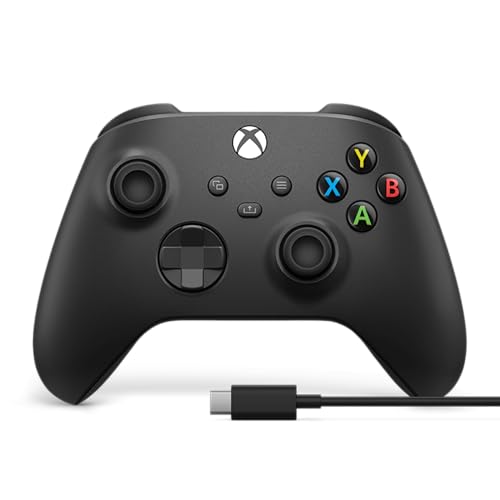
The standard Xbox Wireless Controller remains the baseline for PC and console gaming — and the bundled USB-C cable version removes the friction of pairing. The hybrid D-pad combines the precision of a traditional cross shape with the rolling comfort of a disc, making it suitable for fighting games and platformers. The textured grip on the triggers, bumpers, and back case keeps the controller secure during extended sessions without adding bulk.
Playback flexibility is the controller’s core strength. It works wirelessly with Xbox consoles via proprietary protocol, with PC via Bluetooth or the included 9-foot USB-C cable, and with mobile devices and smart TVs through Xbox Cloud Gaming. The 3.5mm audio jack supports direct headset connection, and the Xbox Accessories app allows button remapping and custom profile creation. Battery life reaches up to 40 hours on standard AA batteries.
Customer feedback is overwhelmingly positive on durability and ergonomics, with many users reporting the controller surviving drops and bag jostling without damage. The refined geometry reduces hand fatigue over long sessions. The one recurring issue is stick drift — some users report the left analog stick developing a dead zone lag after 6-12 months of use, which is the inevitable outcome of the potentiometer-based sensor design. For budget-conscious buyers who prioritize immediate comfort over long-term sensor durability, this remains a reliable workhorse.
Why it’s great
- Textured grip on triggers, bumpers, and back reduces hand fatigue
- Hybrid D-pad works well across fighting, platformer, and shooter genres
- 40-hour battery life on AA batteries with included USB-C cable
Good to know
- Potentiometer sticks are susceptible to drift after extended use
- No built-in rechargeable battery — requires AA batteries or separate recharge pack
- Bluetooth polling rate is lower than 2.4GHz dedicated dongle solutions
5. PlayStation DualSense Wireless Controller – Starlight Blue
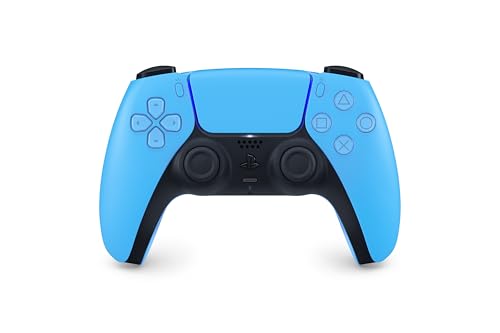
The DualSense controller is the most sensorically immersive gamepad on the market, thanks to its haptic feedback and adaptive trigger system. The haptic motors can simulate surface textures, rainfall, and weapon recoil with a fidelity that standard rumble motors cannot match. The adaptive triggers provide variable resistance — the trigger pull gets tighter as you draw a bowstring or heavier as your weapon jams, adding a physical dimension to gameplay that goes beyond visual feedback.
Connectivity is versatile: the controller pairs with PlayStation 5 via Bluetooth or USB-C, and works with Windows PC and Mac computers with full haptic and trigger support in supported titles. The built-in microphone lets you chat without a headset, and the 3.5mm audio jack supports wired headsets for higher-quality voice communication. The create button simplifies recording and broadcasting gameplay clips. The Starlight Blue color option offers a metallic pastel finish that stands out without being garish.
Reviewers consistently note the exceptional durability — many users report the controller working perfectly after several years of heavy use, with only the rubber on the left analog stick showing wear. The battery life is noticeably better on newer production runs compared to launch units. The controller is comfortable for long sessions and the textured grip on the sticks and triggers provides secure contact. For PC gamers who play titles like Returnal, Ratchet & Clank, or Metro Exodus, the DualSense offers an experience no other controller can replicate.
Why it’s great
- Haptic feedback delivers unmatched sensory immersion in supported games
- Adaptive triggers provide variable resistance for realistic in-game actions
- Built-in microphone and speaker enable chat without a headset
Good to know
- Battery life is shorter than Xbox controllers, especially with haptics enabled
- PC support for haptic and adaptive triggers is limited to specific titles
- No back paddles or extra remappable buttons for competitive play
6. PlayStation DualSense Wireless Controller – Midnight Black

The Midnight Black DualSense offers the same haptic feedback and adaptive trigger technology as the Starlight Blue variant, but in a stealthier matte finish that resists fingerprints and smudges. The symmetrical stick layout remains divisive among players accustomed to offset Xbox designs, but the controller’s internal specs — 6-axis motion sensing, built-in speaker, and touchpad — make it the most feature-dense gamepad for PlayStation 5 users. The haptic motors can differentiate between walking on glass versus walking on gravel, and the adaptive triggers can simulate the tension of a rope or the resistance of a deep mud puddle.
Cross-platform support extends to Windows PC and Mac via Bluetooth or USB-C, though the full haptic and trigger experience requires developer implementation on PC. The controller pairs seamlessly with Tesla vehicles for in-car gaming, a niche use case that multiple users have confirmed works without issues. The built-in microphone is serviceable for voice chat in casual sessions, and the USB-C port supports both charging and wired low-latency play.
Customer feedback highlights the improved battery life on newer units compared to the launch-era DualSense, with the controller lasting through extended gaming sessions on a single charge. The Midnight Black color is described as sleek and professional, and the controller maintains OEM quality without any manufacturing defects reported. The only compromise versus third-party premium controllers is the lack of back paddles or remappable extra buttons — for competitive play that requires more than two hand positions on the face buttons, you will need to invest in aftermarket paddle attachments.
Why it’s great
- Adaptive triggers and haptic feedback provide genre-defining immersion
- Midnight Black finish resists fingerprints and looks premium
- Works with PS5, PC, Mac, and even Tesla vehicles without issues
Good to know
- No back paddles or extra buttons for advanced competitive controls
- Symmetrical stick layout may feel unnatural for offset-stick veterans
- PC haptic/trigger support is inconsistent across game libraries
7. JDDWIN LED Wireless Gaming Controller

The JDDWIN LED Wireless Controller delivers Hall Effect joysticks at a price point where most competitors still use traditional potentiometer sticks. This means you get drift-free aiming from day one, even on a budget allocation. The controller supports Bluetooth wireless up to 10 meters and also offers USB-C wired mode for low-latency play. The built-in 3-axis gyroscope and 3-axis accelerometer provide 6-axis motion sensing for games that support tilt controls.
Compatibility extends to PS5, PC, Steam Deck, Android, and iOS — though initial activation on PS5 requires a wired USB-C connection to the console using the included data cable. The multi-color light bar distinguishes player identity and provides in-game notifications like health changes. Dual vibration motors deliver haptic feedback during weapon use and collisions, and the built-in speaker outputs in-game audio effects, though it lacks a microphone — headset connection via the 3.5mm jack is required for voice chat.
Customer reviews are mixed but skew positive for the price. Multiple users confirm the controller works with PS5 and feels comparable to or better than the official Sony controller in hand feel. The main criticism is reliability — a subset of users report random disconnections and the controller being unrecognized by the PS5 after initial use. The instruction manual must be read carefully, and firmware updates via USB to a PC are available to fix connectivity issues. For budget buyers who are willing to troubleshoot, the Hall Effect sticks alone justify the spend.
Why it’s great
- Hall Effect joysticks eliminate drift at a budget-friendly price point
- Multi-platform compatibility includes PS5, PC, Android, and iOS
- 6-axis gyroscope and accelerometer for motion-controlled gameplay
Good to know
- Firmware and connection issues reported by some PS5 users
- No built-in microphone — external headset required for voice chat
- Initial PS5 activation requires wired USB-C connection with specific cable
FAQ
Does a 1000Hz polling rate actually make a difference in gaming?
What is the practical lifespan difference between TMR and Hall Effect joysticks?
Can I use a PS5 DualSense controller on Xbox console?
Why do some controllers include a charging dock while others don’t?
Final Thoughts: The Verdict
For most users, the best gaming controller winner is the GameSir G7 Pro because it combines TMR joysticks, 1000Hz polling, and Xbox wireless certification in a package that competes with controllers costing significantly more. If you want the best cross-platform value with a charging dock and switchable triggers, grab the EasySMX D10. And for immersive single-player experiences on PS5 or PC, nothing beats the PlayStation DualSense with its adaptive triggers and haptic feedback.