
Standing over your approach shot, the only number that matters is the exact distance to the pin, but pulling out a rangefinder slows the pace and breaks your rhythm. A proper golf watch puts that yardage—plus hazard distances, green shapes, and slope compensation—directly on your wrist, keeping your eyes on the course and your hands free for the next swing.
I’m Min — the co-founder and writer behind Gadgets Feed. This guide is built on hundreds of hours comparing GPS acquisition speeds, display readability under direct sun, battery endurance across 18-hole rounds, and the accuracy of preloaded course databases to separate the watches that genuinely improve your round from those that just look the part.
Whether you need automatic shot tracking or a simple front/middle/back yardage readout, I’ve compiled the definitive lineup of the best golf watch options to match your playing style and budget.
How To Choose The Best Golf Watch
A golf watch is a tool you wear for four hours in sun, sweat, and occasional rain. Nailing the right one means prioritizing the features that actually affect your scorecard rather than getting dazzled by flashy smartwatch extras you’ll never use on the course.
Course Database & GPS Lock Speed
A watch with 40,000 preloaded courses is useless if it takes five minutes to find a satellite signal at the first tee. Look for dual-band or multi-constellation GPS (GPS + GLONASS + Galileo) that locks within 30 seconds and holds that lock through tree-lined fairways. The course database should update regularly — ideally through a free app or USB connection — so that newly remodeled greens appear before you reach them.
Display Technology & Sunlight Readability
High-contrast monochrome LCD panels sip battery and stay legible under direct glare, but they lack the visual depth of a 1.2-inch AMOLED screen. Color displays make hazard views and green undulation maps pop, but they drain power faster. The best compromise is an AMOLED with an always-on mode that dims when you aren’t actively checking it, preserving battery for two full rounds without a charge.
Slope Compensation & Green Undulation
Slope-adjusted yardage recalculates distance based on elevation change, giving you the “plays like” number instead of the flat-line figure. Green undulation data shows the tilt and contours of the putting surface, a major advantage when reading break from 150 yards out. Make sure any slope feature can be toggled off for tournament play where it would violate the Rules of Golf.
Battery Life & Charging Convenience
A golf watch should survive at least 18 holes (12+ hours of GPS mode) without anxiety. Premium models push to 15 hours or more, covering 36-hole days and weekend travel. USB-C magnetic chargers are now the standard — avoid proprietary pogo-pin cables that are easy to lose. Watches that also serve as daily fitness trackers need smartwatch battery life of at least 7 days so they aren’t dead when you reach the course.
Quick Comparison
On smaller screens, swipe sideways to see the full table.
| Model | Category | Best For | Key Spec | Amazon |
|---|---|---|---|---|
| Garmin Approach S50 | Premium | Full-featured course management | 15 hrs GPS / 10 days smartwatch | Amazon |
| Garmin Approach S44 | Premium | AMOLED + lightweight design | 15 hrs GPS, 1.2″ AMOLED display | Amazon |
| Amazfit Balance 2 | Premium | Dual-band GPS + offline maps | 21 days battery, 1.5″ AMOLED | Amazon |
| Shot Scope V5 | Mid-Range | Automatic shot tracking + analytics | 8 hrs GPS, 36k courses | Amazon |
| Bushnell iON Elite | Mid-Range | Slope-adjusted yardages on color screen | 12 hrs GPS, USB-C magnetic charger | Amazon |
| Voice Caddie A3 | Mid-Range | Green undulation data at low price | 10 days battery, slope mode | Amazon |
| Canmore TW411 | Budget-Friendly | Reliable yardage with fitness extras | 14 hrs GPS, 41k courses | Amazon |
| Canmore TW410G | Budget-Friendly | Ultra-light, high-contrast LCD | 12 hrs GPS, 52g weight | Amazon |
| Rad Golf Watch | Budget-Friendly | Entry-level touchscreen GPS | 6 hrs GPS, 42k courses | Amazon |
In‑Depth Reviews
1. Garmin Approach S50

The Approach S50 is Garmin’s most complete golf watch, combining a vivid 1.2-inch AMOLED display with the PlayLike Distance slope compensation that adjusts yardage for every uphill and downhill lie. The lightweight ComfortFit nylon strap breathes well in summer heat, and the 15-hour GPS battery reliably covers two full rounds without a top-up. Preloaded with 43,000 courses, the S50 auto-advances holes and delivers hazard view data — including bunkers, water, and layup zones — without any subscription fee.
Beyond the course, wrist-based heart rate, Body Battery energy monitoring, and advanced sleep tracking make this a genuine 24/7 smartwatch. You can download playlists from Spotify or Amazon Music for headphone-free audio on the go, and Garmin Pay covers post-round snacks. The silicone band complaints from earlier Garmin models are solved here with the included nylon strap, though the premium feel comes at a premium price point that may push budget-focused buyers toward the S44 or other alternatives.
Post-launch firmware updates have smoothed out the occasional GPS drop-out that early reviewers noted, and the Garmin Golf app ecosystem is the best in the business for handicapping, stat tracking, and course previews. If you want one watch that does everything from fairway management to recovery tracking, the S50 is the undisputed leader in this category.
Why it’s great
- PlayLike Distance gives true elevation-adjusted yardage with a single glance.
- AMOLED display is sharp, bright, and readable even in full sun.
- 15-hour GPS battery handles two rounds comfortably.
Good to know
- Premium price may be overkill if you only need basic yardage.
- Advanced course maps and slope data require a Garmin Golf membership.
2. Garmin Approach S44

The Approach S44 brings the same 1.2-inch AMOLED display found in the S50 to a slightly simpler package, shaving weight and cost while keeping the core on-course features that matter most. The silver aluminum bezel with black silicone band looks sharp at the clubhouse, and the 43,000 preloaded courses cover every municipal track and private club you’ll encounter. Hazard view, dogleg distances, and adjustable pin placement are all present, and the 15-hour GPS battery matches the flagship model round for round.
You lose the PlayLike Distance slope compensation and wrist-based heart rate of the S50, but the S44 still delivers smart notifications when paired with your phone, letting you leave the device in the cart. The band is the weak point — several users report it feels cheap and fits short, so budget for a third-party replacement on day one. Garmin’s post-release firmware version 6.18 resolved earlier reliability complaints, making the S44 a stable performer after a rocky launch.
For the golfer who wants a brilliant AMOLED screen with fast GPS lock and doesn’t need advanced health metrics or slope data, the S44 is the sweet spot in Garmin’s lineup. It’s also the better choice if you’re buying for a junior or occasional player who will value the bright screen and ease of use over premium analytics tiers.
Why it’s great
- Stunning AMOLED display that’s easy to read in direct sunlight.
- Lightweight at under 40g and comfortable for all-day wear.
- 15-hour GPS battery with fast charging in 30 minutes.
Good to know
- Stock band is too short and feels low quality.
- No slope-adjusted yardage out of the box.
3. Amazfit Balance 2

The Amazfit Balance 2 is a hybrid smartwatch that doubles as a capable golf GPS with downloadable maps for 40,000 courses. The 1.5-inch sapphire crystal AMOLED is the largest display in this roundup, and the 658 mAh battery delivers up to 21 days in typical smartwatch mode — a figure that dwarfs every other watch here. Dual-band GPS locks onto six satellite systems simultaneously, maintaining accuracy even under dense tree cover where single-band watches drift.
Zepp Flow voice control lets you check distances, start activities, or get real-time stats mid-round without touching the screen, and the 10 ATM water resistance means it survives deep dunks and heavy rain. The golf mode is functional but not as refined as Garmin’s — you get front/middle/back distances and basic hazard info, but no slope adjustment or green undulation data. The silicone band is comfortable, though users with larger wrists say it runs slightly short.
As a daily fitness tracker, the Balance 2 excels with 170+ sport modes, HRV recovery metrics, and accurate sleep staging. For the golfer who wants a single watch for training, running, and weekend rounds — and values multi-week battery life over specialized course analytics — this is a compelling package that undercuts dedicated golf watches on price while delivering more overall utility.
Why it’s great
- 21-day battery means you won’t worry about charging before a round.
- Sapphire crystal is highly scratch-resistant for rugged daily wear.
- Dual-band GPS locks quickly and holds position well.
Good to know
- No slope compensation or green undulation for golf mode.
- Course selection interface is less intuitive than Garmin’s.
4. Shot Scope V5

The Shot Scope V5 is built for data-driven golfers who want to know their true on-course statistics without any subscription fees. It uses small screw-in tags that attach to the end of each club grip — the watch automatically detects which club you’re using and records every shot location. Post-round, the platform delivers over 100 statistics including Strokes Gained, handicap benchmarking, and full round analysis with detailed maps showing every shot dispersion.
The 36,000 preloaded courses load via GPS, and the display shows front, middle, and rear green distances plus full hole maps with hazard and layup points. The button-only interface is deliberate for gloved hands, though users report the shot tracking occasionally misses a shot or misattributes it — requiring manual corrections in the app that can feel laborious after a long round. Battery life is rated at 8 hours, which is enough for 18 holes but requires a charge before a second round the same day.
Compared to the previous X5 model, the V5 picks up shots more reliably and the improved accelerometer reduces missed putts and chips. The level of analytical depth available at this price point — with no ongoing fees — is unmatched. The V5 is the right choice for the golfer who treats improvement like a science and wants hard numbers to guide practice sessions.
Why it’s great
- Automatic shot tracking with club identification via grip tags.
- Deep analytics platform with Strokes Gained and handicap benchmarking.
- No subscription fees ever, unlike Garmin’s premium tier.
Good to know
- Shot tracking may miss occasional shots requiring manual correction.
- Proprietary charging cable is easy to misplace.
5. Bushnell iON Elite
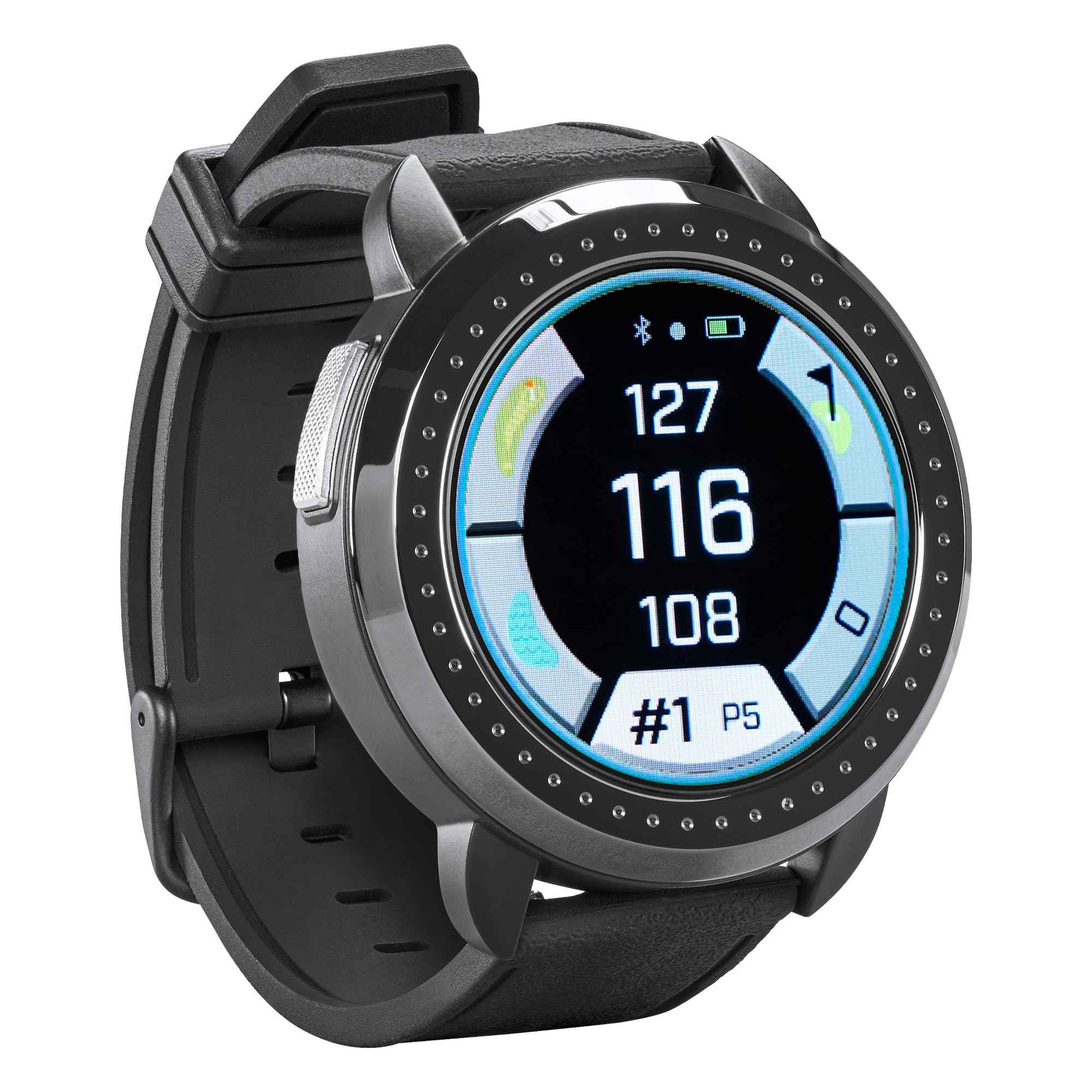
Bushnell brings its reputation for laser rangefinder accuracy to the wrist with the iON Elite, a color touchscreen GPS watch that delivers slope-adjusted yardages at a competitive price point. The 1.28-inch display is bright and readable, and the single-button interface is intuitive enough that you can operate it one-handed while holding a club. The slope toggle switch lets you comply with tournament rules — just flip it off before competitive rounds.
HoleView and GreenView mapping give you a clear picture of the hole layout, and you can tap to adjust pin placement for precise yardage to the actual flag position. The 38,000 preloaded course database is slightly smaller than Garmin’s, but Bushnell updates regularly and the auto-advance works reliably. The 12-hour GPS battery comfortably covers a full day on the course, and the USB-C magnetic charger is a major convenience improvement over proprietary pogo-pin cables used by competitors.
The most consistent complaint in user reviews is charger failure — several units experienced melted or non-functional charging cables within months. Bushnell’s warranty support is slow but eventually responsive, offering replacements after significant delays. If you get a unit that holds up, the iON Elite is a strong contender with excellent slope accuracy. For peace of mind, consider buying through a retailer with a generous return policy.
Why it’s great
- Slope-adjusted yardages toggle on/off for tournament legality.
- USB-C magnetic charger is fast and standardized.
- Color touchscreen remains readable in full sun.
Good to know
- Charger reliability issues reported by multiple users.
- Customer service is slow to respond to warranty claims.
6. Voice Caddie A3

The Voice Caddie A3 punches above its weight class by including green undulation data and slope-adjusted yardage — features typically reserved for watches costing twice as much. The 1.3-inch color touchscreen is bright enough for sunny rounds, and the 40,000 preloaded courses update regularly with no subscription. The slope mode accounts for elevation changes, giving you true “plays like” numbers for uphill approaches and downhill risk-reward shots.
Green undulation is the standout feature here: the watch displays the actual tilt and contour of the putting surface, which helps you decide whether to fly the ball to a front pin or play for a back stop. The fitness mode tracks walking steps and estimates calories, but the watch is primarily a golf tool rather than a multi-sport device. Battery life is rated at 10 days in standby, but heavy GPS use will drain it faster — expect around 18 holes before needing a charge.
The interface isn’t as polished as Garmin’s — some users find the touch response sluggish and the course auto-detection slow — and the charger is a basic USB cable rather than a magnetic dock. For the golfer who wants undulation maps and slope without entering premium territory, the A3 is a smart value play that puts advanced data on your wrist at a mid-range price.
Why it’s great
- Green undulation data is rare at this price point.
- Slope mode provides accurate elevation-adjusted yardage.
- Color touchscreen with customizable pin placement.
Good to know
- Touchscreen can feel laggy compared to premium rivals.
- Course auto-detection is occasionally slow at the first tee.
7. Canmore TW411

The Canmore TW411 is the upgraded version of the popular TW410G, featuring a faster GPS chip, 50% longer battery life (14 hours in GPS mode), and a high-contrast 1.36-inch monochrome LCD that stays crisp even under harsh glare. Preloaded with 41,000 courses worldwide, the TW411 delivers front, middle, and back green distances, hazard yardages, and shot distance tracking — all without any subscription or hidden fees. At 52 grams, it’s light enough to forget you’re wearing it during your swing.
Course updates are handled via USB connection to the Canmore website, which supports Windows, Mac, and Linux — a rare courtesy for non-Windows users. The touchscreen interface is replaced by physical buttons, which is actually a positive for gloved hands, though the buttons can be oversensitive and accidentally trigger scorecard edits or lost round data if pressed against your bag. The step counter, bubble level, and alarm extras are useful beyond the course but lack the sophistication of dedicated fitness wearables.
Build quality is decent for the price, but customer service is a known weak spot — users report slow responses and difficult return processes for units that fail prematurely. The magnetic charging cable is a nice upgrade over the TW410G’s clip, though some early batches had connectivity issues. For the budget-conscious golfer who wants reliable yardage and long battery life without subscription costs, the TW411 delivers strong fundamentals.
Why it’s great
- 14-hour GPS battery easily covers 36 holes.
- 41,000 courses with free lifetime updates.
- Ultra-light at 52 grams, doesn’t affect swing feel.
Good to know
- Buttons can be accidentally pressed during the round.
- Customer support is slow and complicated for warranty issues.
8. Canmore TW410G

The Canmore TW410G was the original entry-level standout from Canmore and remains a viable option for minimalists who just want distances — no touchscreen fuss, no smartphone pairing, no app subscriptions. The 1.36-inch monochrome LCD uses black-on-white pixels that are aggressively readable in full sunlight, and the 52-gram weight is the lightest in this roundup, making it virtually unnoticeable during the swing. Preloaded with 41,000 courses, the TW410G provides front, middle, back distances, hazard yardages, and shot distance measurement via simple button navigation.
The battery life is rated at 12 hours, and real-world reports confirm it lasts through an 18-hole round with charge to spare — charging is done via a proprietary USB clip that has been known to fail on some units after a few months. The TW410G lacks the magnetic charger of the newer TW411 and uses buttons-only control, which means no touchscreen to smudge, but the interface is dated and requires memorizing button presses for different functions. The time resets to GMT when the battery dies, which is an annoyance multiple users note.
Build quality is acceptable for the price, but the failure rate — particularly the charger and battery — is higher than average. If you can find the TW411 for only a small premium, the upgraded chip and magnetic charging make it the better buy. The TW410G is best reserved for someone who needs the absolute cheapest dedicated golf watch with a proven course database and doesn’t mind the occasional quirk.
Why it’s great
- 52-gram weight is the lightest, won’t affect swing balance.
- Monochrome LCD is perfectly readable in direct glare.
- 41,000 courses with free lifetime updates.
Good to know
- Charging clip is fragile and prone to breaking.
- Button-only interface is less intuitive than a touchscreen.
9. Rad Golf Watch

The Rad Golf Watch is the most affordable touchscreen option in this lineup, offering a color display with finger-adjustable pin positioning that lets you dial in the exact flag location for precise yardage. The 42,000 preloaded courses cover most public and private tracks, and the auto-course detection loads the correct layout automatically at the first tee. The IPX7 waterproof rating means it survives torrential downpours, and the redesigned charging cable adds a magnetic connection that feels more secure than the previous generation’s clip.
The 6-hour GPS battery life is the lowest in this roundup — it will barely complete 18 holes if you play at a slow pace, and it won’t make it through a second round. Real-world reviews show the GPS sometimes fails to load courses at all, leaving you with a watch that shows the wrong time and can’t hold a satellite lock. The side button is easily pressed by a gloved wrist, accidentally ending your round data. Customer reviews are polarized between “excellent value” and “defective out of the box,” suggesting inconsistent quality control.
For the occasional golfer who plays fewer than once a month and wants the absolute lowest entry point to wrist-based GPS — and is willing to risk some inconsistency — the Rad watch is functional enough for basic yardage. For anyone playing weekly or in tournaments, the extra investment in a Canmore or Voice Caddie watch will return far more reliability and longer battery life.
Why it’s great
- Touchscreen pin placement is intuitive and rare at this price.
- IPX7 waterproofing handles heavy rain without issue.
- Redesigned magnetic charger is a thoughtful upgrade.
Good to know
- 6-hour GPS battery barely covers a full round.
- GPS course loading can fail entirely on some units.
FAQ
Can I use a golf watch in a tournament with slope adjustment?
How often do I need to update the course database?
Do I need a smartphone to use a golf watch on the course?
What is the difference between a golf watch and a rangefinder?
Can I wear a golf watch as my everyday smartwatch?
Final Thoughts: The Verdict
For most golfers, the clear winner for the best golf watch is the Garmin Approach S50 because it combines a stunning AMOLED display, slope-adjusted yardage, and 15-hour GPS battery with genuine daily smartwatch capabilities. If you want automatic shot tracking and deep analytics without paying for a subscription, grab the Shot Scope V5. And for budget-friendly green undulation data that rivals watches costing twice as much, nothing beats the Voice Caddie A3.