
Our readers keep the lights on and my morning glass full of iced black tea. As an Amazon Associate, I earn from qualifying purchases.
Specs are compiled from manufacturer listings and verified buyer reviews and can change over time — please confirm the key details on the product page before buying.
If you’re replacing a Group 24 battery, the real question is simple: do you stay with old-school lead-acid, or move to lithium and cut the weight while gaining usable runtime? A Group 24 is a physical size standard — it’s the box dimensions your RV, boat, or trolling motor tray was built around — so any battery you pick has to drop into that same footprint before anything else matters. This guide walks through nine batteries that all fit that Group 24 space, from heavy sealed-lead options to light lithium packs, and explains in plain terms which one suits which job.
I’m Min — the founder and writer behind Gadgets Feed. This guide is built by comparing the manufacturers’ published specifications and the patterns across verified customer reviews, so you get each pick’s real strengths and trade-offs instead of marketing spin.
Chemistry matters more than brand here: lithium runs lighter and deeper, while lead-acid runs cheaper upfront. Below you’ll find clear breakdowns so you can match one to your boat, RV, or backup system, all built around the group 24 battery.
Our Picks at a Glance

How To Choose The Best Group 24 Battery
Buying a Group 24 battery isn’t like buying a phone case — it has to fit a specific physical slot, meet your power draw, and last through repeated charge cycles. Get the fit wrong and nothing else matters. Get the chemistry wrong and you’ll either carry too much weight or run out of power halfway through your trip.
Confirm the Group 24 fit before anything else
Group 24 is a size standard, not a brand. A true Group 24 battery measures roughly 10 to 11 inches long, about 6.6 to 6.8 inches wide, and around 8 to 9 inches tall. Every battery on this list meets that footprint, so it will drop into a standard Group 24 box or tray. Some lithium models also fit Group 27 or 31 boxes, which gives you a little wiggle room if your compartment is slightly oversized.
Decide between lithium and lead-acid
Lithium iron phosphate (LiFePO4) batteries are the new default for deep-cycle work — trolling motors, RV house power, solar storage. They’re lighter, let you use nearly all of the rated capacity, and last far more cycles than lead-acid. Sealed lead-acid (AGM) batteries are heavier and cheaper upfront, and they’re still the right call for pure engine-starting duty or when your charging system was built for lead-acid only. Match chemistry to your charger and your job.
Match amp-hours and watt-hours to your load
Amp-hours (Ah) tells you the battery’s capacity at 12 volts — a 100Ah lithium battery holds about 1,280 watt-hours of usable energy. Watt-hours (Wh) is simply volts times amp-hours, and it’s the number that predicts how long your gear will run. A trolling motor drawing 30 amps from a 100Ah battery should run a bit over three hours at full speed, though real-world draw varies. Lead-acid batteries should only be discharged to about 50% before recharging, so a 70Ah AGM gives you closer to 35Ah of usable power.
Quick Comparison
| Model | Best For | Chemistry | Capacity | Weight | Amazon |
|---|---|---|---|---|---|
| MARSENERGY 12V 100Ah LiFePO4★ Best Overall | RV & solar deep-cycle upgrade | Lithium-Phosphate | 100 amp_hours | 21 pounds | Amazon |
| Mighty Max MM-G24 AGMBest for Cranking | Car starting & engine cranking | Lead Acid | 70 amp_hours | 47.9 pounds | Amazon |
| GrenerPower 12V 100Ah LiFePO4Best for RV Trailers | RV & boat deep-cycle power | Lithium Ion | 100 amp_hours | 22.6 pounds | Amazon |
| HumsiENK 12V 100Ah LiFePO4 Bluetooth | App-monitored RV & solar systems | Lithium Ion | 100 amp_hours | 19.73 pounds | Amazon |
| Wattcycle 12V 100Ah LiFePO4 | Trolling motors & marine use | Lithium Ion | 100 amp_hours | 23.2 pounds | Amazon |
| Power Queen 12V 100Ah LiFePO4 | RV drop-in with carry handles | Lithium-Phosphate | 100 amp_hours | 20 pounds | Amazon |
| Redodo 12V 100Ah LiFePO4 Bluetooth | Trolling motor & marine trolling use | Lithium Ion | 100 amp_hours | 22.2 pounds | Amazon |
| LiTime 12V 100Ah LiFePO4 | Long-term RV & camper reliability | Lithium Ion | 100 amp_hours | 21 pounds | Amazon |
| NPP NPD12-80Ah AGM (2 Pack) | UPS, sump pump & wheelchair backup | Lead Acid | 80 amp_hours | 55.8 pounds | Amazon |
In‑Depth Reviews
1. MARSENERGY 12V 100Ah LiFePO4 Lithium Battery, BCI Group 24 Size, 100A BMS
Our pick — over 4.5★ from 250+ verified ratings; the strongest balance of quality and price.
The one that lets a full-size RV or trolling rig run all day — with a fully replaceable power source that’s a fraction of the old lead weight.
If you’re replacing a tired Group 24 lead-acid battery in a camper or boat, this is the front-runner for good reason. It’s a true Group 24 size replacement — 10.16 by 6.54 by 8.64 inches — so it drops straight into your existing battery box. And at 21 pounds versus the Mighty Max’s 47.9 pounds, you’re shedding serious tongue weight every time you hook up. That weight cut isn’t just about towing — it’s about being able to lift the battery out and carry it to a bench for a top-up charge without having to pull the whole vehicle around.
What wins people over is the runtime. A solid rated capacity of 100 amp-hours means the same physical box that used to hold a 70Ah lead battery now holds well over a third more energy. Owners describe running all-day loads with energy to spare, and one of them put it simply: “Excellent product, lasted all day only used half a charge.” The cells are rated for 4,500 deep cycles at full discharge before dropping to 80% capacity — a serious step up from the 300 to 500 cycles a traditional lead-acid battery usually gives you. If you’re sizing this for a trolling motor, that means more trips on the water before the battery starts fading.
The catch is the trade-off in charging culture. A lithium battery like this needs a lithium-capable charger matching the LiFePO4 profile — and the BMS (battery management system) will shut the battery down in cold conditions, cutting off discharge at -4°F or charging at 32°F. That cold-cutoff is a safety feature, but it does mean you should think about winter storage. On the positive side, the built-in protection board also cuts off on over-voltage, short circuit, or abnormal temperature and drops the battery into sleep mode rather than frying it. The cells also include low-temp additives that help them weather cold better than standard lithium, though the operating cutoff still applies.
Where the MARSENERGY Wins
- Drops straight into a Group 24 box — no wiring changes needed to upgrade from lead-acid.
- 21 pounds against the Mighty Max’s 47.9 pounds means far less weight on your hitch.
- 100Ah capacity delivers well over a third more energy than a 70Ah lead-acid replacement.
- Rated for 4,500 deep cycles at 100% depth of discharge; higher states of partial discharge extend it further.
Where It Falls Short
- Needs a LiFePO4-compatible charger — standard lead-acid chargers won’t work.
- BMS cuts off discharge at -4°F and charging at 32°F, so winter use takes planning.
- If it drops into sleep mode, you’ll need to activate it before use again.
Best fit for: RV owners or trolling-motor fishers replacing a lead-acid Group 24 who want maximum runtime and far less weight.
skip it if: you’re cranking a car engine — this is a deep-cycle battery, not a starting battery.
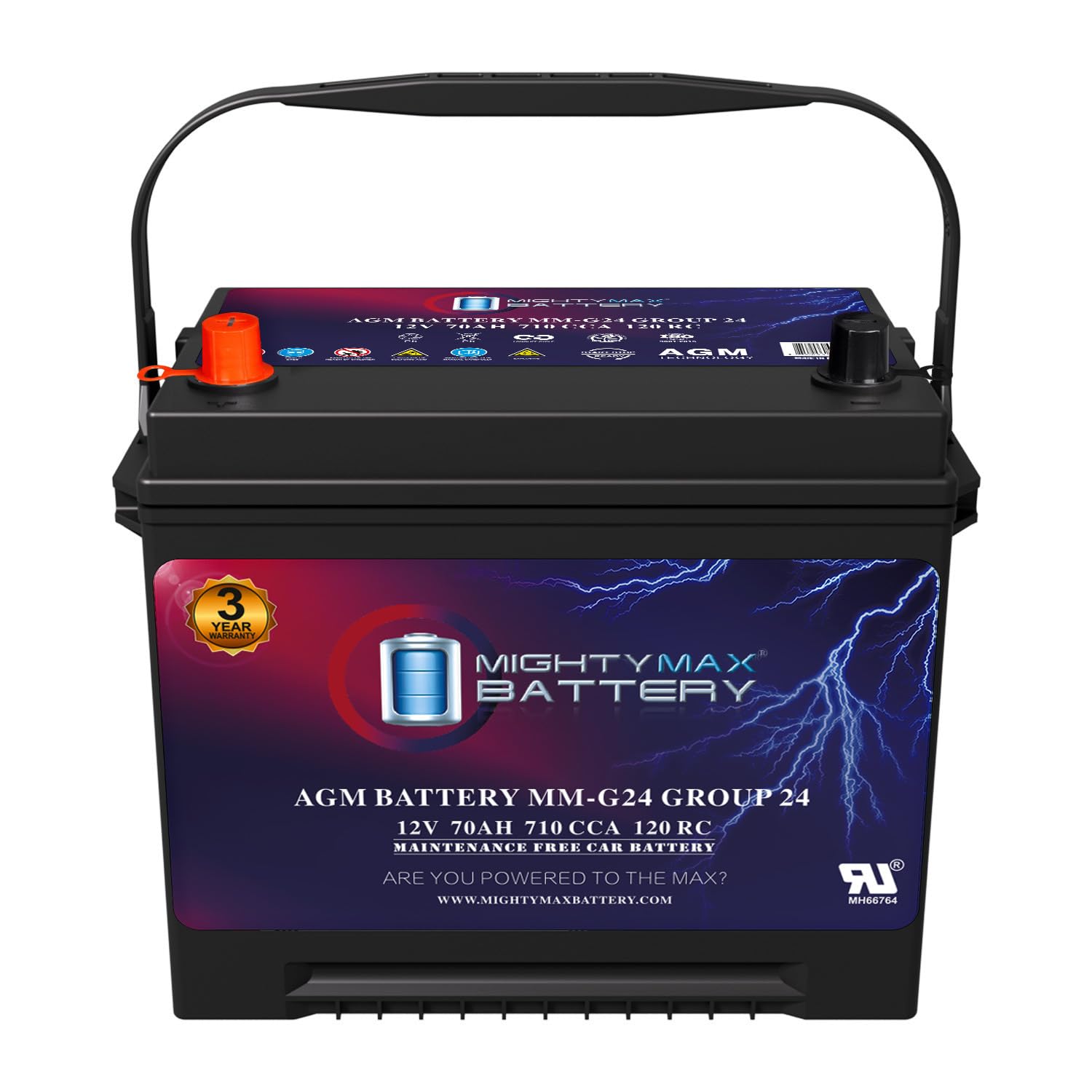
2. Mighty Max Battery MM-G24 Start and Stop Car BCI Group Size 24 12V 70Ah, 120RC, 710 CCA Rechargeable AGM Car battery
The one built to fire an engine in subzero weather — 710 cold-cranking amps and a sealed AGM design that won’t spill in the trunk.
This is the odd one out on the list — and that’s deliberate. Most Group 24 batteries here are built for deep-cycle work like running a trolling motor over many hours. This Mighty Max is built for the opposite job: dumping a short, massive burst of current to spin a starter motor on a cold morning. Cold-cranking amps (CCA) measure how much starting muscle a battery delivers at 0°F. At 710 CCA and a 120-minute reserve capacity, this battery cranks a car engine reliably and keeps the lights on if the alternator ever quits. It’s a genuine starting battery, not a deep-cycle unit.
The sealed Absorbent Glass Mat (AGM) design means no liquid acid to slosh or spill — a real advantage in a Jeep, tractor, or any vehicle that sees rough terrain. Fitment is where this battery shines, and the pattern across its reviews says so: owners overwhelmingly talk about how well it slots into the vehicle they bought it for. One reviewer noted that it fit their Jeep perfectly, arrived well-packaged, and started strong right from the start. Another put it in a tractor and had no complaints. It’s also sealed against vibration and shock, mounts in multiple positions (just not upside down), and comes with mounting screws in the box. A 3-year warranty covers it.
Here’s where the honest caveat lands. This battery’s reviews are more mixed than the lithium units on the list — and the biggest caution is about long-term life. A few owners found their units aging faster than expected, including one who said, “First unit arrived dead (0 volts). Second lasted just over a year.” That said, this is a well-reviewed battery overall with fitment being by far its strongest suit. If you keep it on a maintainer between drives and don’t deep-discharge it (which will wreck any lead-acid starting battery), you’re playing to its strengths: reliable first-turn cranking and a proper Group 24 drop-in fit, including for start-stop vehicles.
Why it earns its spot: For pure engine-starting duty in a car, truck, tractor, or Jeep, 710 CCA and 120 minutes of reserve capacity is exactly the shape of battery you want. AGM construction resists shock and vibration far better than a flooded lead-acid unit.
What to know before buying: This is not the battery for trolling motors, RV house power, or solar storage — those jobs need deep-cycle capacity, which the lead plates here aren’t designed to deliver. Keep it topped up between uses and it will serve its purpose.
This is your battery if: you want a Group 24 starting battery sealed against spills, with strong cold-weather cranking and a proper warranty.
Look elsewhere if: you need continuous deep-cycle power for accessories — check the lithium picks instead.
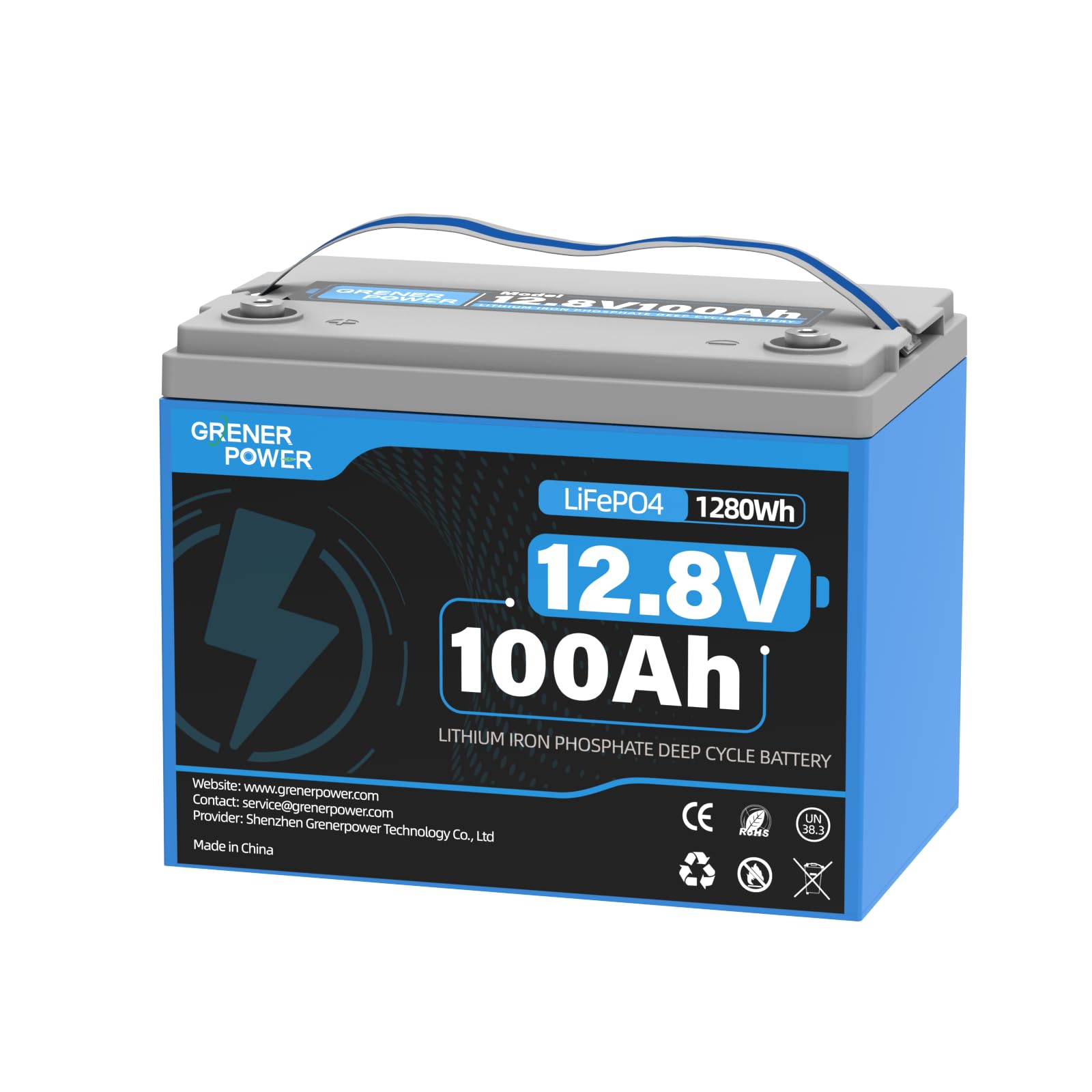
3. GrenerPower 12V 100Ah LiFePO4 Lithium Battery, Group 24, 15000 Cycles
Rated for a 15,000-cycle service life, and built around cells designed to hold up in marine and RV environments.
When an RV owner swaps flooded lead-acid for lithium, the first thing they notice isn’t the weight — it’s that the fridge stops killing the battery overnight. That’s the exact change buyers of this GrenerPower describe. In a 16-foot camper, two of these units reportedly ran the rig for two days with barely any voltage drop. In a 25-foot travel trailer, a buyer replaced a single flooded lead-acid 4D battery with three of these wired in parallel for a combined 300A and cut significant tongue weight out of the equation. That parallel setup is one of the strongest arguments for this battery: it allows up to 4S4P expansion, meaning you can build a 20.48kWh bank with 16 units if you ever want a full home energy storage setup.
The physical package is a straight Group 24 replacement — 10.23 by 6.61 by 8.3 inches — and it also drops into Group 27 and 31 boxes if you have a slightly larger compartment. The cells are cylindrical A+ grade rather than prismatic, and cylindrical cells are generally more tolerant of vibration, which is one reason this battery carries a low-temperature additive spec and a 5-layer BMS protection system (overcharge, overdischarge, short circuit, overcurrent, overheat). That’s the kind of durability you want on a boat that sees rough water. Its 15,000-cycle rating is the highest on this list.
The trade-off is one you’ll see repeated across lithium batteries: this is a deep-cycle energy storage battery, not a starting battery. The manufacturer states clearly that it is not for car battery, starting, or golf cart applications. So if you were hoping for a single battery that does both trolling motor and car cranking, this isn’t it. But for RV, boat, and solar trolling motor duty, it’s an excellent fit — and the review pattern here mirrors what you’d want: buyers consistently mention working all day, easy installation, and quick recharging from a 20-amp solar setup.
Long-cycle specialist: At 15,000 rated cycles, this is a battery built to still be working years after a lead-acid unit would have been replaced two or three times over. It’s a smart pick for the buyer who hates the “replace every 2 years” cycle.
Pick this one when: you want a lithium battery for a travel trailer, camper, or trolling motor that will outlast the vehicle.
Don’t pick it for: engine starting or golf carts — the manufacturer specifically excludes those uses.
4. HumsiENK 12V 100Ah LiFePO4 Lithium Battery with Bluetooth (Group 24) 1280Wh
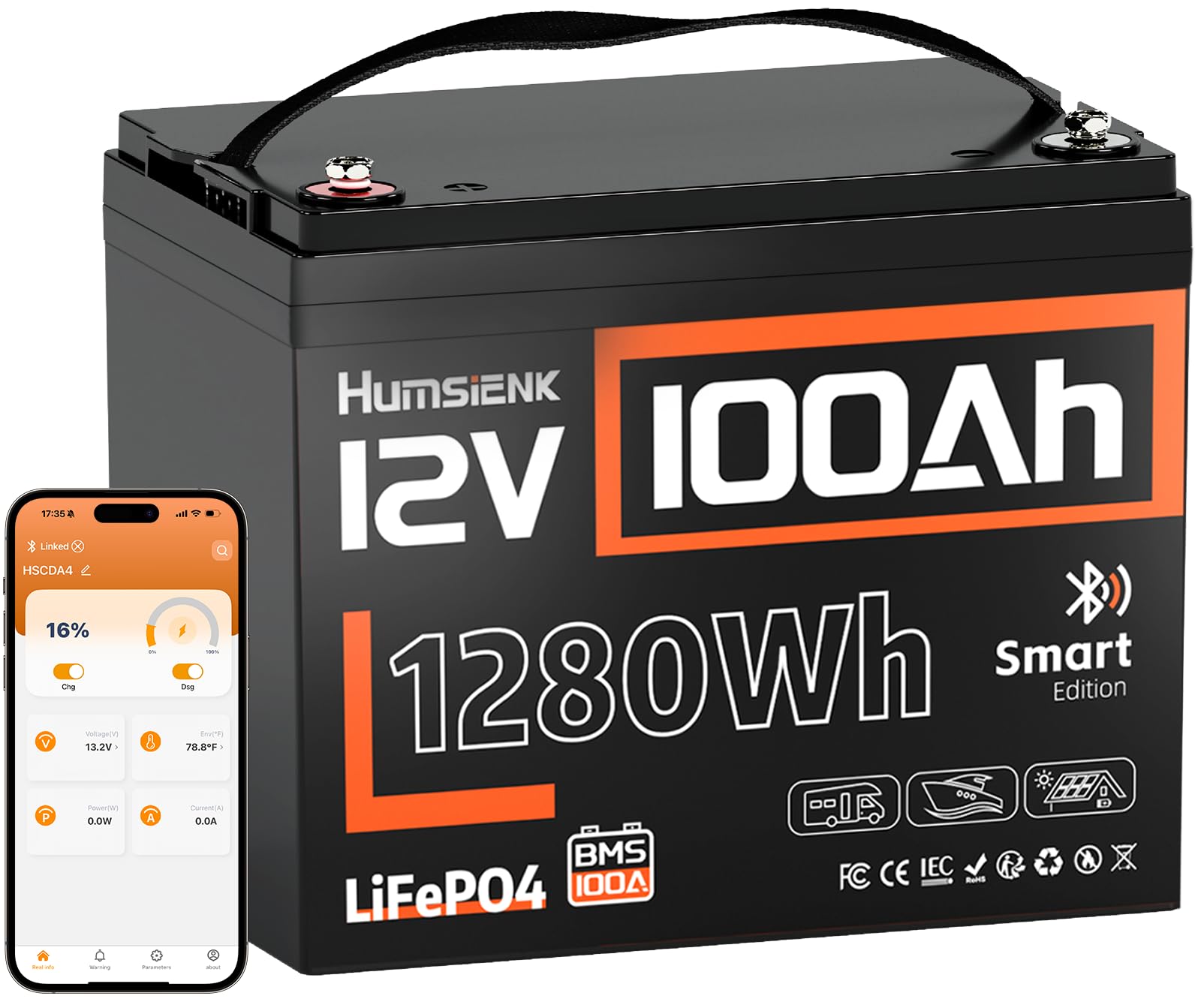
App-monitored power in a 19.73-pound package — the lightest lithium on this list, with real-time data from your phone.
If you hate guessing how much charge is left, this is the pick for you. The HumsiENK pairs with a dedicated Bluetooth app that shows voltage, temperature, state of charge, and current draw in real time — so you know exactly how much juice is left before you point the trolling motor out of the cove. The BMS is an upgraded 100A smart version, and users describe the app as updating several times per second with useful per-cell detail. The Bluetooth connection itself is one of the aspects most discussed in reviews, and it earns mostly positive notes — but it’s flagged as mixed, meaning a few buyers have had connection hiccups. The app side isn’t perfect, but it’s a genuinely useful tool when it works.
Physically this is the lightest LiFePO4 battery on the list at 19.73 pounds — noticeably lighter than the MARSENERGY at 21 pounds and well under the Wattcycle at 23.2 pounds. It self-describes as over 60% lighter than a comparable lead-acid battery. The shape is a straight Group 24 fit at 10.2 by 6.6 by 8.2 inches, and it drops into Group 24 through 31 boxes. It’s rated IP65 waterproof (spray-rated, not submersible), carries A+ grade LiFePO4 cells, and supports up to 4S4P expansion for a 48V, 20.48 kWh system. The manufacturer rates it for up to 15,000 cycles and a 10-year lifespan.
One real-world note from the buying pool: these batteries can accept more amperage to an inverter than lead-acid units of similar rating, which makes them genuinely useful for DIY power station builds. One buyer ran an 8,000-BTU window air conditioner in Eco mode for eleven hours before it hit 50%. A separate buyer did flag that an overheated terminal occurred while running a 780W shop vac for fifteen minutes — the seller’s diagnosis was a short terminal bolt reducing contact area, and recommended using the longer bolts included in the box. So make sure you bolt up terminals properly with good contact area.
What Buyers report Works
- Bluetooth app provides a live data dash for voltage, current, temperature, and state of charge.
- At 19.73 pounds, the lightest lithium option on this list for a Group 24 footprint.
- IP65 waterproof rating and low-temp cutoff make it suitable for marine and RV duty.
- Compatible with Group 24 through Group 31 boxes.
What to Keep in Mind
- Bluetooth connectivity is called out as mixed in reviews — most connections work, but a few buyers hit hiccups.
- Simplicity isn’t the point here; if you don’t want an app, the manual approach works fine too.
Go with this if: you want live battery data from your phone, the lightest possible factory footprint, and marine-ready waterproofing.
Consider something else if: you’d rather not deal with an app — the plain-Jane LiTime and GrenerPower units skip the Bluetooth altogether.
5. Wattcycle 12V 100Ah LiFePO4 Battery, BCI Group 24

Value-priced lithium that gets the fundamentals right — 100Ah of usable power, A+ grade cells, and reliable repeat performance.
For a mid-tier price, this WattCycle fights well above its weight class on paper. You get 100 amp-hours of usable capacity, a 100A BMS (rated to disconnect automatically if discharge current exceeds 300±50A), A+ grade cells rated for up to 15,000 cycles, low-temperature protection down to -4°F, and certifications including SDS, UN38.3, FCC, CE, and ROHS. Its compact footprint — 10.2 by 6.6 by 8.2 inches at 23.2 pounds — is a straight Group 24 fit and also compatible with 27 and 31 boxes. That’s a lot of the same specs as the pricier batteries on this list at a mid-tier price point.
What owners consistently mention is that the battery simply works — reliable power delivery, consistent charging behavior, and performance that matches expectations. It’s the battery a buyer reaches for when they need a dependable trolling motor assist or medium-draw RV appliance power without paying top of the stack. One buyer mentioned that even after a difficult experience with a BMS cold-shutdown, WattCycle honored the five-year warranty and replaced the affected batteries — which speaks to the brand standing behind the product when things go sideways.
The honest caveat here is that the brand is younger than the legacy lead-acid names, and a few buyers have had BMS issues — most notably after a firmware update to the companion Bluetooth app, which in some cases caused connection failures and, in isolated instances, BMS lockups after a year of use. That’s a real risk with any newer lithium brand, and it’s why a warranty matters. But the majority of owners mention the batteries hold strong, especially for trolling-motor and medium-draw duty. Worth noting: this battery supports up to 4 batteries in series or 4 packs in parallel, scaling to a 20.48kWh system.
What you get for the tier: A genuine 100Ah lithium battery with a 100A BMS, up to 15,000 cycle rating, low-temp protection, and multiple safety certifications — without paying the premium the top-tier units demand.
Where the risk sits: WattCycle is a newer name. A few long-term owners have had BMS glitches, but the five-year warranty covers the failure cases that come up.
Suits you if: you want lithium’s weight and runtime benefits at a friendly price, and you’re using it for trolling motors or medium-draw RV appliances.
Look elsewhere if: you want the longest-proven long-term reliability — LiTime’s more established reputation may suit you better.
6. Power Queen 12V 100Ah LiFePO4 Battery, Group 24 RV Lithium Battery

The one with grab handles — you can actually carry it across the field without needing two hands and a spotter.
If your Group 24 battery gets moved around a lot — between vehicles, into a truck bed, onto a boat, into a tent — this is the pick that solves a problem nobody talks about until they experience it: hauling the thing. The Power Queen weighs just 20 pounds, but the feature buyers keep mentioning is the built-in carry handles. Field users love it — one HAM radio operator noted the handles make moving it around genuinely easy and said the size is right.
The core delivery is still the same 100Ah LiFePO4 package as its peers. It’s a true drop-in Group 24 replacement — the manufacturer states fitting a standard Group 24 box is instantaneous with no wiring changes. Usable energy is stated as 1,280Wh, all of which is usable because LiFePO4 can be discharged nearly 100% without harming the battery. The BMS uses 20+ protective circuits, the cells are EV-grade LiFePO4, and the battery supports 4P4S expansion up to a 51.2V 400Ah bank — 20.48kWh in total. It carries a 5-year warranty and a 10-year design life.
One honest caveat: this is specifically an energy-storage battery, and the manufacturer states plainly it’s not for engines or golf carts. There’s also a small installation note worth reading — the included screws should be paired with gaskets under 2mm to prevent loosening or overheating at the terminals. Some owners have also used this for interesting off-grid jobs — one buyer running a CPAP machine with humidifier during hurricane season reported it lasted the night on a single charge, and separately powers their Starlink Mini. For a battery that’s usually marketed to RV and trolling motor buyers, that kind of flexibility is a bonus.
Portability payoff: The carry handles aren’t a gimmick — they’re a real convenience for anyone who regularly lifts and moves their battery between jobs, like the HAM radio field operator who called it a “great field battery.”
Choose it if: you move your battery around frequently and want the easiest possible lithium Group 24 to heft and relocate.
Rule it out if: you need engine-starting power — this is deep-cycle duty only.
7. Redodo 12V 100Ah Group 24 LiFePO4 Lithium Battery Bluetooth for RVs

Built with a marine-grade upgrade for the trolling-motor owner — waterproof, salt-spray resistant, and app-monitored from the dock.
This is the battery for the angler. Redodo built the BMS here specifically for trolling motor service, with waterproofing plus salt spray and corrosion protection — features you don’t find emphasized on the general-purpose lithium batteries on this list. That matters if you’re regularly launching into saltwater or fishing in humid coastal environments. Beyond the environmental protection there’s a low-temperature cut-off function, so discharging stops safely when the temperature swings cold. The Bluetooth 5.0 module pairs with the Redodo phone app and shows voltage, current, power, and remaining capacity. Range is limited — you need to be within about 30 feet of the battery — but for a boat or RV, that’s plenty.
Runtime on real-world trolling duty is where the reviews get specific. One buyer ran a 55-pound-thrust trolling motor for four hours in high wind at 40% to 80% speed and finished at 78% charge. That’s the kind of real-world shaping you can’t fake. The same buyer noted it outperformed lead-acid, which would typically be down to about half charge after five hours in the same conditions and start delivering weak thrust. The battery also charges fast with a compatible lithium charger.
Two things to know before you commit. First, the app-monitoring part is not frictionless — you need to be within Bluetooth range, and the extended range on some setups may not survive rough weather. Second, this battery specifically says it arrives partially charged (one owner reported about 20%), and the manufacturer recommends a dedicated lithium charger with 0V capability to wake it up properly. Buy a proper charger at the same time. One buyer also found that older Noco Genius chargers aren’t compatible — the G7200 v2’s lithium mode delivered only 3A output and the battery dropped to standby after about 30 seconds. Make sure your charger supports the LiFePO4 profile.
The marine specialist: Waterproofing plus salt spray and corrosion protection is a meaningful upgrade for saltwater anglers, and the low-temp cutoff means it won’t take damage in a cold garage.
Charger reality check: This battery needs a dedicated LiFePO4 charger that supports 0V wake. If you’re still using a lead-acid charger, factor in getting the right one before you buy.
Built for you if: your battery lives on a fishing boat that sees saltwater or humid air, and you want Bluetooth monitoring from the helm.
pass on it if: you can’t justify the marine-grade upcharge — the indoor-and-trailer users will do fine with the Wattcycle or MARSENERGY.
8. LiTime 12V 100Ah RV Lithium Battery, Group 24 Rechargeable LiFePO4

The premium LiTime — same Group 24 fit as the rest, but with a reputation for capacity that actually matches its label.
LiTime has built a name for itself in the lithium battery space, and this Group 24 unit is their entry into that fitment. It pairs 100Ah (1,280Wh) with an automotive-grade BMS, 4,000+ cycles at 100% depth of discharge, and a 10-year design life. Crucially, this battery is the only pick on the list that mentions AIG product liability insurance coverage — an additional, verifiable layer of protection beyond a standard warranty. That’s a subtle but real differentiator for anyone nervous about putting a lithium battery in their camper or boat.
The physical package is a straightforward Group 24 drop-in — 10.24 by 6.61 by 8.27 inches, 21 pounds — with no Bluetooth and no app, and the manufacturer is explicit that it’s not for starting engines, golf carts, or jacks. This is pure energy storage. In the field, the pattern that emerges is capacity testing out to spec. One owner who tested their battery down to the watt-hour reported it hit exactly what was advertised, and another described it as the best value of the lithium batteries they’d tried. Campers running these alongside solar arrays have used them for six months and reported no drop-off. And unlike the budget tier — some of whom have had BMS issues after a year — LiTime’s reviews uniformly describe steady, consistent performance.
Two honest notes: this battery does not come with Bluetooth monitoring, so you don’t get the live data view you’d find on the HumsiENK or Redodo units. And there’s a small compatibility caveat for marine users: the manufacturer notes it’s not compatible with MerCruiser or Mercury motors without a current regulator. For most RV, camper, and trolling-motor uses, that won’t matter. It also expands up to 4P4S for a 20.48kWh bank if you want to scale up later.
Why It Stands Out
- Capacity that tests out to the advertised spec — the pattern buyers consistently describe.
- Backed by AIG product liability insurance, the only such coverage on this list.
- 10-year design life and 4,000+ cycles at 100% depth of discharge.
- Straight Group 24 drop-in with expandability to a 20.48kWh bank via 4P4S wiring.
Where It Stumbles
- No Bluetooth and no app — if you want live monitoring, look at the HumsiENK or Redodo instead.
- Not compatible with MerCruiser or Mercury motors without a current regulator.
- Premium tier pricing reflects the brand’s reliability reputation.
Worth considering if: you want the lithium battery with the strongest track record for capacity that matches the label and a genuine extra layer of insurance coverage.
Alternative pick: if monitoring matters to you, spend the difference on the HumsiENK’s Bluetooth dashboard instead.
9. NPP 12V 80Ah AGM Deep Cycle Battery, Group 24 Sealed Lead Acid (2 Pack)

The heavy sealed AGM pair for stationary backup duty — no Bluetooth, no app, just simple lead-acid reliability where the battery stays put.
Here’s the case for staying with lead-acid: some jobs don’t need lithium’s light weight or deep discharge depth. If a battery is going to sit in a UPS cabinet, on a sump pump, or inside an electric wheelchair and rarely move, then a sealed AGM is a perfectly sensible and often cheaper answer. This NPP unit is a Group 24 sealed VRLA (valve-regulated lead-acid) battery, sized at 10.76 by 8.46 by 6.61 inches with T14 terminals, and it’s rated for 700A of surge current for up to five seconds — enough for pumps and motor-driven equipment that briefly spike on startup. Rated at 80Ah, in a two-pack.
The advantages of AGM here are practical: sealed design means no watering and no leaks, low self-discharge of about 3% per month means it holds charge during long storage, and the operating range spans 5°F to 122°F. It’s also backed by UL, CE, ISO9001, and ISO14001 certifications — one of the few batteries on this list calling out multiple standards bodies. And the physical design (deep-cycle, low internal resistance around 5mΩ) makes it a natural fit for repetitive discharge jobs like sump pump backup or mobility wheelchair duty.
Two realities to accept if you go this route. First, at 55.8 pounds for the pair, this is the heaviest option on the list — you’re trading portability for cost, though hopefully the installation is a one-and-done situation. Second, an owner did flag that these batteries are “not intended for large current draw applications” — so for a winch motor or a high-draw inverter, this isn’t the right pick. For their intended uses — UPS backup, home security panels, sump pumps, RVs, and mobility wheelchairs — the review pattern is solid. One wheelchair owner said it was a perfect fit for a Quantum Q-6 electric wheelchair, lasting longer between charges. Another user running them for two years in an RV reported no issues and good amp-hours with their solar panel.
Where AGM wins: No charging-system conversion needed, no cold-temperature BMS surprises, and a lower upfront cost. For stationary backup jobs, that’s plenty.
Right for you if: the battery is going to stay in one place and power UPS, sump pump, security, or wheelchair duty.
Move on if: you want a lightweight battery you carry between uses — any of the lithium picks will suit you far better.
Understanding the Specs
Amp-Hours vs Watt-Hours
Amp-hours (Ah) tells you how much current the battery can deliver over time — a 100Ah battery will roughly run a 1-amp load for 100 hours, or a 10-amp load for 10 hours. Watt-hours (Wh) is volts times amp-hours, and it’s the number that really predicts runtime for mixed loads. A 12V, 100Ah battery stores about 1,280Wh of usable energy. A 70Ah lead-acid battery holds around 840Wh on the label, but since lead-acid should only be discharged to about 50%, you actually get closer to 420Wh of usable power from it. That gap — 1,280Wh vs. 420Wh in the same Group 24 box — is the single strongest argument for going lithium over lead-acid.
BMS and Cycle Ratings
A BMS (battery management system) is the electronic guardian inside a lithium battery that shuts the pack off when something goes wrong — overcharge, over-discharge, over-current, short circuit, or abnormal temperature. A 100A BMS means the battery can deliver up to 100 amps continuously before the protection circuit engages. Cycle ratings tell you how many times you can charge and discharge the battery before it degrades to 80% of its original capacity — 4,000 cycles at 100% depth of discharge is common for a good LiFePO4, while a lead-acid battery typically gives 300 to 500 cycles. In plain terms, that’s a battery you replace once versus one you replace five or six times over the same period.
FAQ
Will any Group 24 battery drop into my existing battery box?
Do I need a special charger for a Group 24 lithium battery?
Can a Group 24 lithium battery be used to start a car engine?
Is a Group 24 battery safe to keep in a cold garage over winter?
How long will a 100Ah battery actually run my trolling motor?
What is a BMS and why does it matter on a Group 24 lithium battery?
Can I connect multiple Group 24 batteries together for more power?
Is it worth upgrading from a Group 24 lead-acid battery to lithium?
Do Group 24 lithium batteries have Bluetooth, and is it worth it?
What size Group 24 battery do I need for an RV versus a trolling motor?
Final Thoughts: The Verdict
If you are replacing a Group 24 battery in a camper, boat, or solar setup and want the best combination of runtime, weight savings, and price, the MARSENERGY 12V 100Ah LiFePO4 is the pick. It drops into a standard Group 24 box, cuts close to half the weight versus a comparable lead-acid unit, and gives you well over a third more usable energy than its direct AGM equivalent. It holds a 4.8-star rating across 200+ owners, a sign it delivers on its spec sheet.
If Bluetooth monitoring matters to you, the HumsiENK 12V 100Ah with Bluetooth gives you the lightest 100Ah footprint here plus a live app dashboard. If your battery lives on a fishing boat that sees salt and spray, the Redodo 12V 100Ah Bluetooth adds marine-grade waterproofing and salt-spray protection that the others do not. And if your job is stationary backup — a sump pump, a UPS, or a wheelchair that stays put — the NPP 12V 80Ah AGM keeps things simple and affordable without a lithium-specific charger to buy. Match the battery to the job, and you will not need to think about it again for years.
How We Picked
We do not accept paid placement. Every pick is matched to a real buyer and a real use-case; we do not hands-on test units.
Sources & Methodology
Specifications: manufacturer listings and product documentation. Review insights: verified customer reviews, as of September 2026. Pricing: not shown on this page (it changes often); check the current price via the retailer link.
As an Amazon Associate, Gadgets Feed earns from qualifying purchases. This does not affect which products we feature.