
Our readers keep the lights on and my morning glass full of iced black tea. As an Amazon Associate, I earn from qualifying purchases.
Specs are compiled from manufacturer listings and verified buyer reviews and can change over time — please confirm the key details on the product page before buying.
Finding the right accessories for your instrument can feel more confusing than learning a new chord progression. A bad set of strings can kill your tone, a flimsy cable can hum on stage, and a missing tool can halt a practice session. This guide cuts through the noise to highlight the gear that actually makes a difference in your playing, from rock-solid hardware to smart maintenance tools.
I’m Min — the founder and writer behind Gadgets Feed. This guide is built by comparing the manufacturers’ published specifications and the patterns across verified customer reviews, so you get each pick’s real strengths and trade-offs instead of marketing spin.
The nine products below represent the essentials for any player looking to upgrade their setup, from strings that define the industry standard to a pick that refuses to drop. Whether you are a bedroom player or a weekend gigger, these are the guitarist accessories that deliver on their promise.
Our Picks at a Glance


How To Choose The Best Guitarist Accessories
Not all accessories are created equal. The right gear can improve your sound, protect your instrument, and make practice more enjoyable. Focus on a few key areas when you shop.
Strings: Material, Gauge, and Tone
The string is where your sound starts. Most electric players start with nickel-wound strings in a 10-46 gauge (meaning the high E is 0.010 inches thick and the low E is 0.046 inches). This is the industry standard for a reason: it strikes a balance between bendability and punch. Thicker strings give more volume and tension, while thinner strings are easier to press down and bend. The material also matters — nickel-wound strings have a warm, balanced tone, while pure steel or stainless steel are brighter.
Cables: Shielding and Conductors
A good instrument cable is your sonic lifeline. The most important spec is the conductor gauge (thickness). A 20 AWG (American Wire Gauge) conductor is thicker than the standard 22 AWG, which means lower resistance and less signal loss over distance. Look for 99.99% oxygen-free copper (OFC) which offers better conductivity than standard copper. Dual-layer shielding, often a combination of foil and a braided wrap, keeps out the hum and radio interference that can ruin a quiet passage.
Tuners and Maintenance
You do not need to spend a fortune to keep your guitar in tune and looking great. A clip-on tuner works by sensing vibrations through the body of the guitar, so it is accurate even in a noisy room. For maintenance, look for kits that include a fretboard conditioner (like lemon oil to moisturize the wood) and a polish that is safe for your guitar’s finish. A dedicated string cleaner can extend the life of a fresh set by removing sweat and grime.
Quick Comparison
| Model | Best For | Gauge / Spec | Material | Weight | Amazon |
|---|---|---|---|---|---|
| Ernie Ball Regular Slinky 3-Pack★ Best Overall | Industry Standard Tone | 10-46 (3-pack) | Nickel-Wound Steel | 3.2 oz per set | Amazon |
| Guitar Cleaning Kit 8-PackTop Performer | Complete Care Setup | 8-Piece Kit | Surfactants, Carnauba Wax | 1.12 lbs | Amazon |
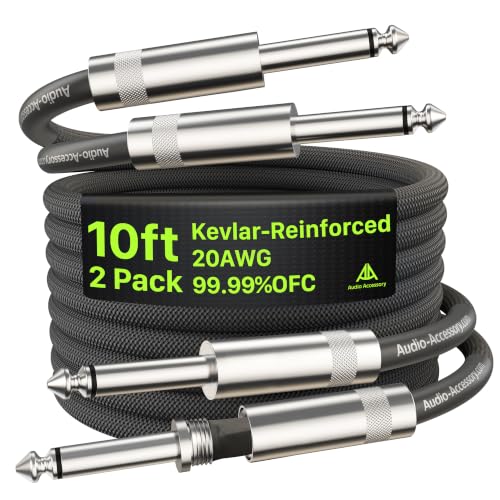
| Guitar Cable 10 ft 2-PackPremium Pick | Noise-Free Signal | 20 AWG, 10 ft | 99.99% OFC, Kevlar | — | Amazon |
| Fender GRIP Hand Exerciser | Finger Strength | 5-9 Lbs (3 levels) | Plastic, Rubber | — | Amazon |
| Fender FT-1 Clip-On Tuner | Quick Tuning | Full Chromatic | Plastic | 22.68 g | Amazon |
| Amazon Basics Guitar Stand | Portable Storage | Adjustable Width | Metal | 3.5 lbs | Amazon |
| Ernie Ball Guitar Polish Kit | Premium Cleaning | 3-Piece Kit + Cloth | Oil-Free Polish | 8.4 oz | Amazon |
| TIMDAM Guitar Tool Kit 28Pcs | DIY Setup & Repair | 28 Pieces | Metal, Rubber, Silicone | 1.03 lbs | Amazon |
| TIK PIK Celluloid Picks 6-Pack | No-Slip Grip | 0.46, 0.71, 0.96 mm | Celluloid | — | Amazon |
In‑Depth Reviews
1. Ernie Ball Regular Slinky Nickel Wound Electric Guitar Strings 3-pack, 10-46 Gauge (P03221)
Our pick — over 4.5★ from 131,000+ verified ratings; the strongest balance of quality and price.
The gold standard string that defines the sound of modern guitar.
This is the string you hear on thousands of records. The Regular Slinky 10-46 set has become the industry standard for electric guitar, played by legends like Slash, Jimmy Page, and Metallica. You get three individually wrapped sets in this pack, so you are prepared for a few months of regular playing. The nickel-wound steel construction delivers a bright, balanced tone that sits perfectly in a mix without fighting the bass or vocals.
The thing everyone raves about is the quality — it is the most-discussed aspect by a huge margin, and for good reason. The strings feel smooth to the touch, almost silk-like on the fingers, which makes bending and sliding easy. The sound quality is praised almost as much, with buyers noting the warmth it adds to the bass end while keeping clear treble. The 10-46 gauge is also ideal for drop tuning, holding tuning well even when you take the low E down a step or two. Durability is a mixed point, but given the value of a three-pack, swapping them more often is hardly a burden.
As owners put it: “they are the only strings I’ve ever used.” That kind of loyalty does not happen by accident. This 3-pack offers the best price per set of any premium string on the market, making it an easy choice for any electric player.
Why it wins: The combination of legendary tone, balanced tension, and unbeatable value (three full sets) makes this the single best upgrade for any electric guitar.
The honest nod: If you prefer a very bright, cutting sound (like pure steel strings), these will sound a bit warmer and rounder than you expect.
The perfect foundation: Any electric guitarist who wants the sound heard on countless iconic recordings.
Think twice if: you strictly play acoustic guitar or prefer the brighter attack of stainless steel strings.
2. Guitar Cleaning Kit – 8-Pack Complete Care Set with Innovative Sponge Applicator
Everything you need to make your guitar look and play like new.
This is an all-in-one care package that covers every inch of your instrument. The kit includes a fretboard oil formulated with lemon oil to clean the wood surface while keeping it soft and shining, a guitar polish wax made from Brazilian carnauba wax, beeswax, and natural plant oils, and a 2-in-1 string cleaner and conditioner that protects against rust and moisture. The sponge-tip applicators mean you get precise dispensing with no messy drips.
The cleaning performance is the top reason buyers pick this up. One owner used it to “restore shine on a 60s classical guitar,” and another noted the lemon oil revived a tarnished fretboard effectively. The kit works on electric and acoustic guitars, basses, ukuleles, and more. The only small hiccup some folks note is that the included brush is less useful than an extra microfiber towel. But for the price of a single lesson, you get everything you need for months of maintenance.
The full-service advantage
- Covers every part of the guitar (body, fretboard, and strings) in one box.
- Sponge-tip applicator minimizes waste and mess.
- Works on a wide range of instruments, not just electric guitar.
The trade-off
- Some users prefer a spare microfiber cloth over the included brush.
Best for: Anyone who wants a single box solution for keeping their instrument clean and maintained.
skip it if: you already own separate fretboard oil and polish and just need a simple string cleaner.
3. Guitar Cable 10 ft/3M 2 Pack, Kevlar-Reinforced 20AWG 99.99% OFC, 10X Heavy-Duty Nylon Braided
A noise-free signal path built tough enough to survive the road.
Standard guitar cables often hum and hiss, especially in rooms full of fluorescent lights or other electronics. This cable fights that with dual-layer shielding — a foil wrap combined with a braided shield that blocks 95% of interference. The conductor is a thick 20 AWG oxygen-free copper wire (99.99% pure), which offers 60% more cross-sectional area than a standard 22 AWG cable, reducing resistance and preserving your high-end clarity over the full 10-foot length.
The build quality is the standout feature here. The cable is reinforced with Kevlar, making it 10x more durable than standard cords, and the connectors are protected by internal heat-shrink tubing that keeps the solder joints from failing. Buyers report “clean, noise-free sound” and “strong signal transmission.” The nylon braided jacket resists tangling and kinking, though a few owners note it can tangle if you are not careful. This 2-pack gives you one for your main rig and a backup, both backed by a lifetime warranty.
The professional edge
- Dual-layer shielding for near-silent operation.
- Thicker 20 AWG conductor for low signal loss.
- Kevlar reinforcement with a lifetime warranty.
A note on handling
- Some users find the braided jacket can tangle if coiled carelessly.
Reach for this if: you play live, record at home, or just want a dead-silent connection that won’t die on you mid-song.
Look elsewhere if: you only need a short 3-foot cable for a practice amp in a quiet room.
4. Fender GRIP Hand and Finger Exerciser

Dedicated finger strength for faster, cleaner playing.
Your fingers need conditioning just like any other muscle. This Fender-branded exerciser isolates each finger individually, allowing you to target the weaker digits that often lag behind during fast runs or barre chords. It comes in three resistance levels: a white 5-lb, a red 7-lb, and a black 9-lb model. The soft, non-allergenic rubber finger caps keep your fingers in place and feel comfortable during extended use.
The biggest compliment buyers give is how it improves finger strength and dexterity — the top-cited benefit. One player mentioned it helps “warm up some of those muscles, or stretch after a long night of playing.” It was designed under the supervision of certified hand therapists, so the ergonomics are solid. A few note that the plastic parts can stick together and that the 5-lb version may feel too light for experienced players. Upgrading to the 9-lb model solves that quickly.
The strength builder: Isolated finger training that helps with speed, stamina, and control for any stringed instrument.
The honest limit: The 5-lb tension is best for beginners or warm-ups; stronger players should jump straight to 7 or 9 lbs.
Best for: Guitarists of any level who want to build finger independence and prevent fatigue during long sessions.
pass on it if: you have very large hands that might feel cramped on the device.
5. Fender FT-1 Professional Guitar Tuner Clip On

Quick, accurate tuning that fits in a gig bag pocket.
This compact tuner clips onto your headstock and uses dual-rotating hinges so you can position the LCD display exactly where you can see it, even on an oddly shaped headstock. It is a full-range chromatic tuner, meaning it works for standard tuning, open tunings, and alternate tunings on electric, acoustic, bass, and even mandolin. The backlight turns green when you hit the note dead-on, which is a great visual cue for noisy environments.
Buyers consistently call it easy to use — that is the second most-praised aspect after its core functionality. The 440 Hz tuning is described as dead-on accurate. It comes with a CR2032 battery included, so you can clip it on right from the start. The build feels solid despite weighing only 22.68 grams. Some users note that the accuracy for E-flat tunings can feel slightly off, and the screw holding the clip is a minor point of concern for some. But for a brand-name tuner at this price, the FT-1 is a reliable workhorse.
The practical advantage
- Dual-rotating hinge for flexible viewing angle.
- Backlight display turns green when in tune.
- Very lightweight at 22.68 g, with battery included.
The small complaint
- A handful of users find the tuning for E-flat less precise without manual adjustment.
Best for: Any guitarist who wants a simple, reliable clip-on tuner that works in noisy rooms and on stage.
it’s not for you if: you need a tuner that handles flat tuning accurately without manual configuration.
6. Amazon Basics Portable Adjustable Folding Guitar Stand

A sturdy, fold-flat stand that is ready to hold any guitar from the start.
This A-frame stand is fully assembled the moment you open the box — there is zero setup required. It has three adjustable width settings so it can securely cradle everything from a thin electric to a bulky dreadnought acoustic. The metal construction is lightweight but durable at 3.5 pounds, and the soft foam arms and backrest prevent scratches. Non-slip rubber feet keep it planted on hardwood or carpet.
The quality and sturdiness are the top two things owners praise, and the sheer volume of satisfied buyers is massive. It holds guitars with a load capacity of 10 kg, so even a heavy Les Paul is safe. The stand folds flat for transport, slipping into a closet or a car trunk without hassle. One caveat: the top foam pad can miss the body of some thinner electric guitars, so those shapes are supported lower down. But for the price and convenience, this stand is a no-brainer for a second guitar or a practice room.
The workhorse stand: Simple, strong, and portable. It is tough to top at this price point for a reliable home stand.
The electric guitar fit: Be aware that the top pad might not perfectly contact the body of a solid-body electric; the lower arms do the heavy lifting.
Best for: players who need a no-fuss, portable stand for home practice or gigging.
Think twice if: you have an unusually shaped or very large acoustic that might exceed the adjustable width.
7. Ernie Ball Guitar Polish, Fretboard Conditioner, and String Cleaner with Polish Cloth

Streak-free shine from the brand you trust with your strings.
This kit bundles the three core products you need to keep your guitar looking and playing well: a string cleaner that removes grime and extends string life, an instrument polish that cuts through haze and fingerprints, and a fretboard conditioner that cleans and moisturizes the wood. The included microfiber cloth ensures no-mar application. The polish is oil-free, meaning it won’t leave that greasy haze that makes the guitar feel slippery.
Owners of this kit love the quality and cleaning performance. One reviewer noted it “put a bunch of shine on both my fretboard and the body.” Another noted it is “better than disposable wipes” because you can control exactly how much product you use. The bottles last a decent while since you only need a small amount. The only thing to watch for is using the fretboard oil sparingly and only during string changes to avoid over-saturating the wood.
The care trifecta
- Three dedicated products for strings, fretboard, and body.
- Oil-free polish prevents the greasy feel of some alternative cleaners.
- Trusted Ernie Ball quality at a fair price.
The usage tip
- Apply the fretboard conditioner sparingly to avoid a sticky residue.
Best for: players who want a dedicated Ernie Ball-branded care system that won’t damage their finish.
look elsewhere if: you already have a multi-surface cleaner you are happy with and just need a string lubricant.
8. 28Pcs Guitar Tool Kit, TIMDAM Guitar Setup Kit

A complete repair shop in a zippered case for the DIY player.
This is the toolkit for when you want to go beyond changing strings and start adjusting your guitar’s action, intonation, and fretwork. It includes 28 pieces: hex wrenches, files, screwdrivers, a steel ruler, a string action ruler, a string winder with a cutter and pin puller, nut and bridge saddle groove files, fingerboard guards, a fret crowning file, a fret rocker leveling tool, understring radius gauges, and fretboard stickers. Almost every common repair job is covered.
The quality is praised by buyers, especially for the price. One beginner guitarist used the screwdriver, hex wrench, string winder, and ruler to fix fret buzz on their first setup. The versatility is a highlight — the kit works on acoustic and electric guitars, bass, mandolin, banjo, and ukulele. The zip case is sturdy enough to keep everything organized. Some of the tools, particularly the fret crowning file, are described as mediocre, and this is not a set for professional luthiers doing daily work. But for a beginner or intermediate player wanting to learn basic maintenance, it is a fantastic starting point.
The starter shop: Covers nearly every tool needed for string changes, action adjustments, and basic fretwork.
The honest take: The fret crowning file is the weakest link; it works for occasional use but don’t expect pro-level precision.
Best for: Players who want to stop paying for setups and learn to do their own maintenance.
steer clear if: you are a professional luthier who needs high-end, daily-use tools.
9. TIK PIK Celluloid Guitar Picks 6-Pack – Thin, Medium & Heavy w/Case

The pick that sticks to your guitar so you never lose it again.
The defining feature of this pick is the nano-suction pad on the back. Thousands of micro suction cups let the pick stick directly to the body of your guitar without any adhesive or residue. Between songs, just press it onto the pickguard or top — it stays there until you need it. This solves the age-old problem of a pick disappearing into the depths of a gig bag or falling through the soundhole of an acoustic.
The grip is the most-praised aspect by a wide margin — over a hundred buyers single it out. The nano-suction feels like memory foam on your fingertips, giving you a secure hold even with sweaty hands during a live performance. This 6-pack includes all three thicknesses: thin 0.46mm for acoustic strumming, medium 0.71mm for all-around play, and heavy 0.96mm for electric leads and bass. They come in a protective travel case. Durability is mixed — thin picks can wear out fast, and some report the tip breaking off with aggressive playing. But the convenience and grip innovation make them a fun and practical upgrade.
The grip advantage
- Sticks to the guitar body with no sticky residue.
- Memory-foam-like pad for a secure, non-slip hold.
- Includes all three key gauges (0.46, 0.71, 0.96 mm).
The durability note
- Thin picks can wear or break faster than standard celluloid picks.
Best for: Players who constantly lose picks, or anyone who wants to switch quickly between strumming and fingerpicking.
skip it if: you are a very aggressive player who goes through picks quickly, or prefer a traditional heavy gauge.
Understanding the Specs
String Gauge (10-46, etc.)
This is the thickness of each string, measured in thousandths of an inch. A “10-46” set means the high E string is 0.010 inches thick and the low E is 0.046 inches thick. Thicker strings produce more volume and sustain, but require more finger strength to bend. Thinner strings are easier to play and bend but can sound thinner and break more easily. The 10-46 set, often called “Regular Slinky” gauge, is the standard because it works well for almost every style.
Oxygen-Free Copper (OFC) in Cables
OFC stands for oxygen-free copper, a type of copper with very low oxygen content (99.99% pure). Regular copper has more impurities that increase electrical resistance. In a guitar cable, lower resistance means your high frequencies pass through the cable without being dulled, so your tone stays clear and bright over a longer distance. A 20 AWG (American Wire Gauge) conductor is thicker than the common 22 AWG, providing even less resistance and better signal strength.
Chromatic Tuners and Clip-On Design
A chromatic tuner detects all 12 notes of the musical scale, so you can tune to any note you choose. Clip-on tuners sense the vibration of the string through the instrument’s body rather than through a microphone. This makes them extremely accurate even in loud environments. The “dual-rotating hinge” on a tuner allows you to tilt and rotate the display so you can always see it, regardless of the headstock angle.
Finger Exerciser Resistance (Lbs)
This measures the force required to press each button on the exerciser, measured in pounds (lbs). A 5-lb resistance is very light and good for beginners or warm-ups, while a 9-lb resistance provides a significant workout for building strength. Isolated finger exercisers let you train each finger individually, which is important because the ring and pinky fingers are naturally weaker and can lag behind during fast playing.
FAQ
How often should I change my guitar strings?
Will a clip-on tuner work on a bass guitar?
Can I use any guitar polish on any finish?
What is the difference between thin, medium, and heavy guitar picks?
How long does a guitar cable last?
Can a guitar stand damage the finish of my guitar?
Is a finger exerciser really necessary for guitar?
Will the TIK PIK stick to any guitar surface?
What tools do I need for a basic guitar setup?
How do I clean my guitar fretboard?
Final Thoughts: The Verdict
Across the board, the guitarist accessories winner is the Ernie Ball Regular Slinky 3-Pack because it is the trusted foundation of tone for legends and beginners alike. If you want a rock-solid signal path with professional noise rejection, grab the Guitar Cable 10 ft 2-Pack. And for the player who always drops a pick mid-song, the TIK PIK Celluloid 6-Pack is the one to reach for.
How We Picked
We do not accept paid placement. Every pick is matched to a real buyer and a real use-case; we do not hands-on test units.
Sources & Methodology
Specifications: manufacturer listings and product documentation. Review insights: verified customer reviews, as of July 2026. Pricing: not shown on this page (it changes often); check the current price via the retailer link.
As an Amazon Associate, Gadgets Feed earns from qualifying purchases. This does not affect which products we feature.