
Our readers keep the lights on and my morning glass full of iced black tea. As an Amazon Associate, I earn from qualifying purchases.
Specs are compiled from manufacturer listings and verified buyer reviews and can change over time — please confirm the key details on the product page before buying.
If you keep cupping your hand behind your ear at family dinners, you already know the real problem: most gadgets either amplify everything into a wall of noise or die before lunch. Personal sound amplifiers come in two shapes: pocket amps you point at whoever is talking, and in-ear devices that sit in your canal. This guide ranks eight amplifiers by what each does best, so you can match one to your situation.
I’m Min — the founder and writer behind Gadgets Feed. This guide is built by comparing the manufacturers’ published specifications and the patterns across verified customer reviews, so you get each pick’s real strengths and trade-offs instead of marketing spin.
The trick is matching the device’s shape and controls to your daily routine, and the picks below cover both in-ear and pocket designs.
Our Picks at a Glance
How To Choose The Best Hearing Aid Amplifier
An amp that excels at TV can be useless at a restaurant table, and the loudest model is often the wrong pick for quiet rooms. Name the one place you struggle most, then use these five factors to narrow the field.
Fit type: in-ear, behind-the-ear, or pocket
In-ear devices sit inside your canal and stay hidden. Behind-the-ear models hook over the top of your ear and stay put during chores. Pocket amplifiers carry the mic in your hand, which means you point them at whoever is talking — invaluable in a lecture hall, awkward in a moving car.
Gain and channels
Gain, measured in decibels (dB), is how much the device boosts sound. A 50dB amp gently lifts quiet speech; a 120dB pocket amp pushes far louder and suits deeper loss. Channels split sound into frequency bands, so a 16-channel processor can lift the high consonants that make words readable without blasting the whole room.
Power and charging
Rechargeable cases are the modern default, and the numbers swing widely — from 25 hours of single use to full case totals in the triple digits. A quick-charge feature that gives hours of runtime from a short top-up is worth more on a travel day than a bigger tank that takes all night.
Quick Comparison
| Model | Best For | Fit Type | Battery Claim | Volume Levels | Amazon |
|---|---|---|---|---|---|
| OTC Hearing Aids for Seniors with Noise Cancelling★ Best Overall | Crowded rooms and TV | In-Ear | 100+ hrs with case | 5 | Amazon |
| Hearing Aids for Seniors, RechargeableBest Value | Simple one-touch daily wear | In-Ear | 40 hrs standby | 4 | Amazon |
| Reizen Loud Ear 120dB GainPoint-and-Listen Pick | Pointing at one speaker | In-Ear | 2 AAA batteries | — | Amazon |
| Glorified Mary BTE 2-Pack | Both-ears wear and TV | Behind-the-Ear | Up to 60 hrs | 4 | Amazon |
| UV Cleaning Rechargeable Aids | easy daily upkeep | In-Ear | Up to 120 hrs | 5 | Amazon |
| SuperEar SE9000HP | TV and household talk | In-Ear | Up to 40 hrs | — | Amazon |
| Williams Sound Pocketalker 2.0 | One-on-one conversations | In-Ear | 2 AAA batteries | — | Amazon |
| ELEHEAR-Beyond OTC | App-tuned all-day wear | Behind-the-Ear | 100 hrs with case | — | Amazon |
In‑Depth Reviews
1. OTC Hearing Aids for Seniors with Noise Cancelling, 100 Hours Battery Life
Our pick — over 4.5★ from 550+ verified ratings; the strongest balance of quality and price.
The featherweight that sorts speech from restaurant clatter — three grams per ear, sixteen channels deep.
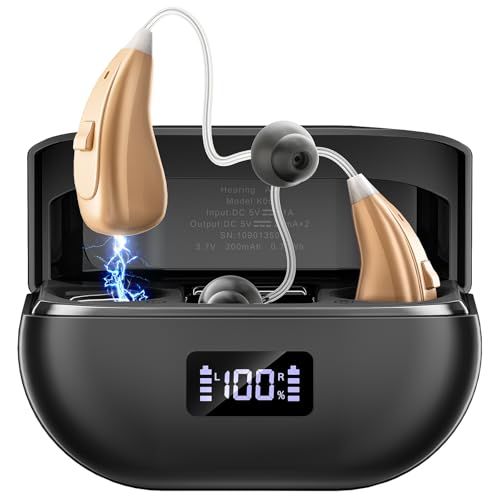
If dinner conversation is where you lose the thread, start here. Each aid weighs just 3 grams, so they sit almost unnoticed in your ear canal, and the 16-channel processor splits sound into separate frequency bands so voices stay crisp while the room hums underneath. The crowd favorite of this bunch — 4.8 stars across 590+ owners — and the praise centers on exactly that clarity.
The charging story is the other standout. You get 25+ hours of single use, or 100+ hours when you dock them in the case, and a full top-up lands in about 2 hours. A smart LED display shows the remaining power, so you are never guessing before an outing. Volume runs on five levels through one button, and the automatic memory brings back your last setting the moment you switch on.
The catch here is fit, not function. These are in-ear units with silicone tips, so getting a secure seal takes a little patience at first, and a loose seal is where feedback creeps in — the recurring gripe in this shape of device. It is a sizing job, not a defect, and once the tip matches your canal the aids stay put through chores.
Where it wins
- 16-channel processing keeps speech readable in noisy rooms
- 3 grams per aid for near-invisible in-ear wear
- 100+ hours total power with the charging case
- Five volume levels and one-button control
What to accept
- In-ear fit needs the right tip seal to avoid feedback
- Soft silicone build asks for gentle handling
Reach for this if: you want maximum speech clarity and all-day power in an almost invisible in-ear aid.
Look elsewhere if: you prefer a behind-the-ear hook, which the SuperEar and Pocketalker designs below handle differently.
2. Hearing Aids for Seniors, Hearing Amplifiers Device Rechargeable
One touch, four volume steps, and a charging case that remembers where you left off.
The pitch here is simplicity for hands that are tired of tiny dials. A single press runs through four volume levels, and the charging case turns the aids on and off automatically so there is nothing to fumble. Owners who bought the sharper-priced ZHANZHSQL above get those five levels; this one trades that extra step for a lighter, more compact package.
Power is the headline number to know: a 2-3 hour charge stores 40 hours of standby, and the case carries a second charging cable for travel. The ergonomic shell is designed to sit steady in the canal through chores and exercise alike, holding the sound where it belongs.
“These hearing aids work very well in fact they work better than the subscription ones that i have, i can hear high pitched sounds that i could not hear before” — that is the kind of report that keeps coming back on this model. A noise-reduction chip (a small processor that lowers background sound) does the quiet lifting in crowded settings, so voices stand out in a busy room. The trade-off is the volume ceiling: four levels suit mild loss well, but a deeper loss may want more headroom, and the soft silicone tips ask the same careful handling as any in-ear aid.
The buyer fit: someone who wants a light, pocketable rechargeable set with the fewest possible buttons to learn.
Worth knowing: the four-level control is the whole volume story, so match it to mild-to-moderate needs before committing.
The simple answer: ideal if you want easy one-touch control and a standby-ready case for away days.
Second thought: if you need more granular volume steps, the ZHANZHSQL’s five levels give you finer control.
3. Elite Package: Reizen Loud Ear 120dB Gain Personal Amplifier
A pocket bullhorn that grabs sound from across the room — point it, and the conversation lands in your ears.
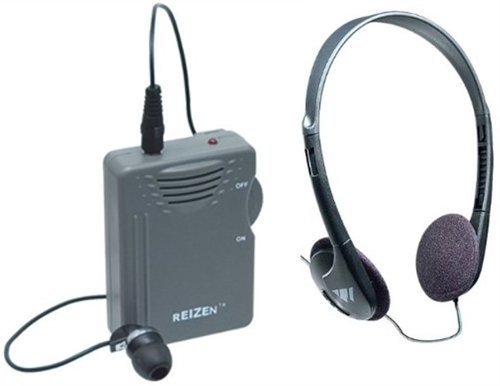
Where the in-ear aids above live quietly inside your canal, this Reizen works the opposite way. It packs a 120dB gain figure and a built-in microphone that picks up sound at a distance of up to 100 feet, so you aim the unit at the person speaking and listen through the supplied earphone. That makes it the tool for sermons, announcements, and one voice in a quiet hall.
At 1.76 ounces it is a 3.8x lighter carry than the 6.74-ounce Rechargeable set above, and it runs on two AAA batteries rather than a charging case. The stereo headphones stay on comfortably, and users find the sound cleaner when they run less amplification — the quiet setting is often the better one. Long-time owners trust it enough to secure it with safety pins so it never wanders.
The honest trade-off is distance and batteries. Sound quality is mixed across the field: close-range sounds come through loud and clear, but external voices at range can be harder to pull in, and swapping those AAA cells takes a firm hand. Enjoyment is the bright spot owners keep coming back to.
The one-voice tool: its 100-foot pickup range is the reason to pick it for single-speaker settings.
The honest limits: battery changes need dexterity, and it shines most in quieter spaces rather than loud rooms.
Made for: pointing at a speaker or TV from across a quiet room with a kit that includes headphones and batteries.
Not the fit if: you want invisible in-ear wear or rechargeable convenience.
4. Rechargeable Hearing Aid for Seniors Digital Hearing Amplifier, Noise Cancelling with Magnetic Charging Base, Behind The Ear, BTE, TV, 2-Pack

A two-pack of behind-the-ear aids that hide on top of your ear instead of filling your canal.
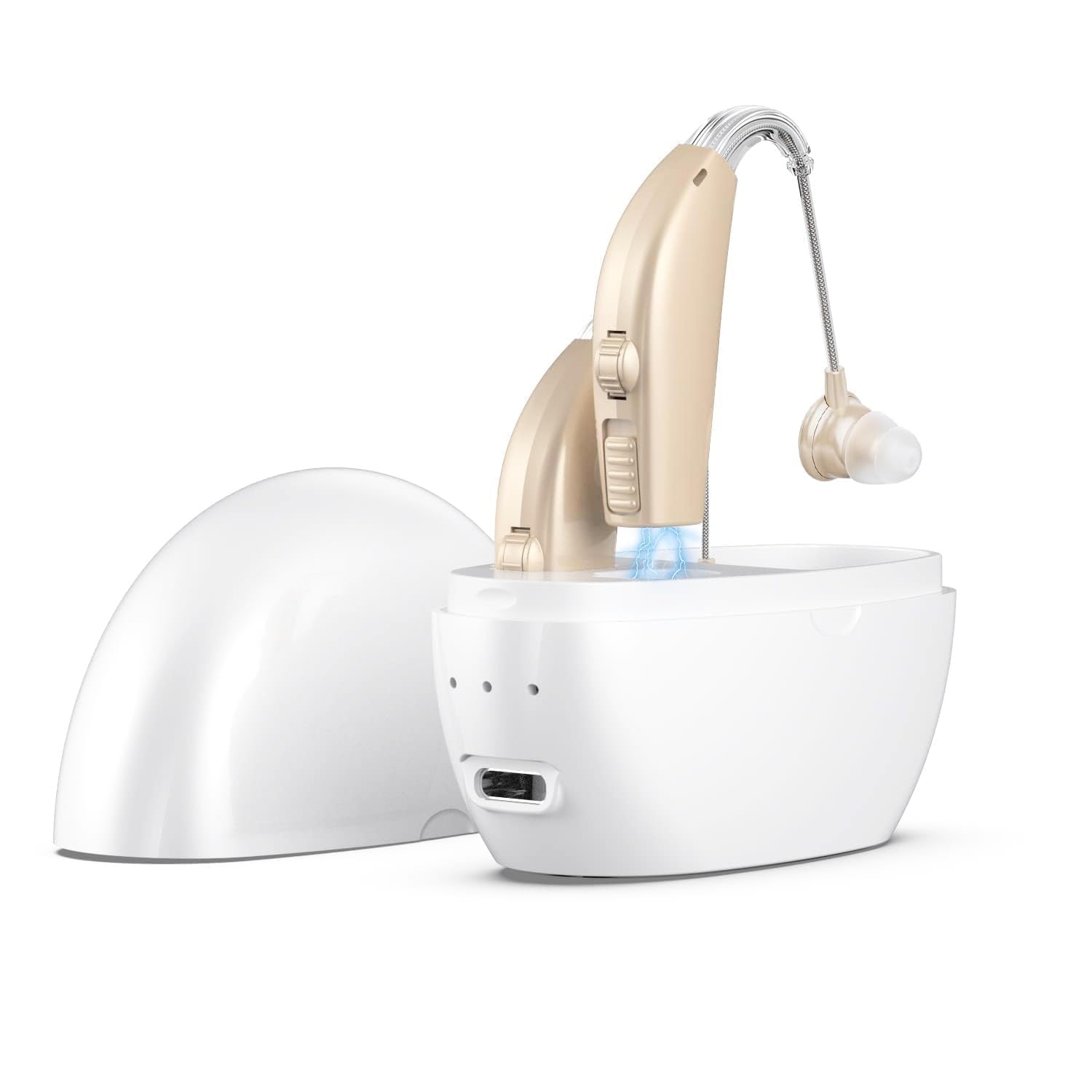
This is the shape shift in the lineup. Instead of sitting in the canal like the ZHANZHSQL, these hook behind your ear with an air tube reaching down, and the set includes two interchangeable units so you can wear one on each ear. A full charge runs up to 60 hours, and the Type-C magnetic charging base makes topping up a drop-and-go job.
Sound is handled by a digital noise-reduction chip across a 20Hz–12,000Hz frequency range, with four selectable amplification modes to match different rooms. The on-ear program switch and rotating volume control are the kind of tactile controls that suit busy hands. Five sizes of soft ear domes let you dial in the seal.
The honest side is real, though. A few units arrive and stop holding a charge within weeks, and some owners find the sound quality does not justify the price against cheaper aids — that is the caveat worth weighing. When a unit works, the reports are glowing: owners describe nearly invisible wear behind the ear, comfortable all-day use, and controls that respond well.
Who it serves: buyers who want both ears amplified with a behind-the-ear hook and a magnetic charging cradle.
The real caveat: a handful of units fail to charge after a few weeks, so test yours thoroughly on arrival.
Clear match for: anyone who prefers two devices, a discreet BTE profile, and a 60-hour charge.
The one to pass on: if you cannot risk a charge failure so soon, the UV-case set below offers a steadier record.
5. Hearing Aids for Seniors with Automatic UV Cleaning Rechargeable
Drop them in, close the lid, and the case cleans and charges them while you sleep.
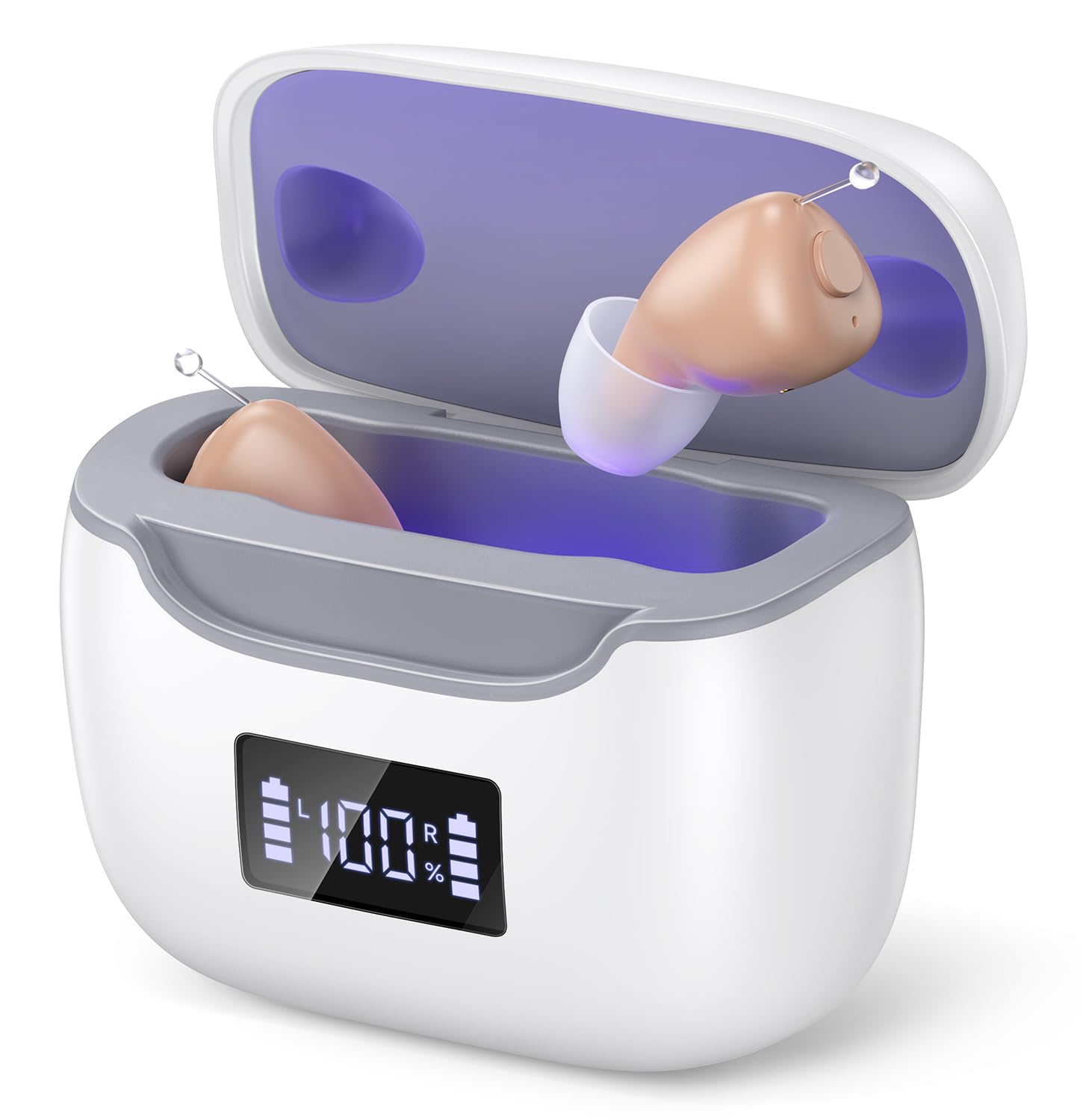
The star of this set is the case, not the aid. Every time you return both units and shut the lid, they power down, begin charging, and run a one-minute UV cleaning cycle automatically — no extra button, no separate step. That alone flips daily upkeep from a chore into a habit.
Power is generous: each aid gives 15–20 hours of use, and the fully charged case supplies multiple recharges for up to 120 total hours. A digital display shows exactly how much case power remains. Both aids are interchangeable, so there is no left or right to sort out, and five volume levels work right on the devices without a phone or app.
What wins people over is the build and comfort. The units earn the strongest quality praise in this lineup, and buyers repeatedly highlight clear, crisp audio, a snug fit that adapts to the ear, and a battery that simply keeps going. A grandparent gift that produces a happy face is the recurring scene on the review pages.
The one thing to plan for is a short break-in on fit. Getting the right silicone eartip can take a little experimentation, and the correct tip is what delivers the clarity and keeps feedback controlled. Once matched, the aids stay comfortable through long wearing sessions.
Straight answer: the pick for anyone who wants cleaning and charging handled automatically in one closed-lid motion.
The fine print: budget a little time on eartip sizing to lock in the best sound and fit.
6. SuperEar SE9000HP Hearing Amplifier for Seniors, Personal Sound Amplifier
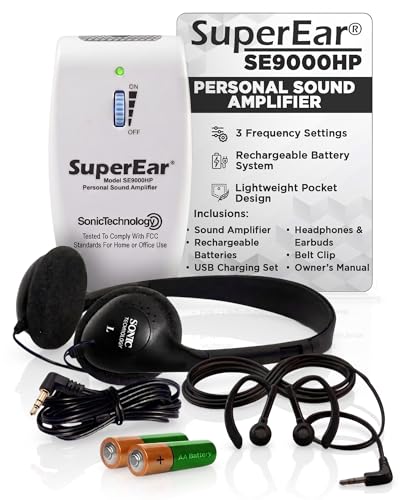
A complete listening station in a box — headphones, earbuds, belt clip, and a battery that runs 40 hours.
This is the fullest kit on the list. You get the SE9000HP unit plus rechargeable AA batteries, a charging cube, a USB cable, stereo headphones, ergonomic earbuds, and a belt clip. The 3-position High-Medium-Low frequency switch lets you tune the tone for a noisy room or a quiet TV session, and the tactile volume wheel is easy to find without looking.
Power is a strong suit: up to 40 hours of operation per charge, so a week of evening TV listening fits comfortably between top-ups. The illuminated ON/OFF button and pocket-friendly shell make it a natural travel companion.
Owners say it works better than costly hearing aids for TV and conversation, and the ability to learn it in a few minutes is a recurring note — even for someone with no technical background. Functionality and sound quality are the aspects buyers mention most. The caveat sits on the loud end: turn it up and you will hear everything, including the trucks going by outside, and the included buds may want upgrading to over-ear headphones for the best result.
Why it earns a slot
- Up to 40 hours per charge on rechargeable AA batteries
- High-Medium-Low frequency switch for different rooms
- Complete kit with headphones, earbuds, and belt clip
- Simple ON/OFF and volume wheel for quick learning
What not to expect
- Amplifies everything — background noise included
- Bundled buds can be upgraded for better sound
Top choice when: you want one box that covers TV, conversations, and travel with a long battery and clear controls.
Think again if: you need noise isolation, since this one boosts the whole soundscape.
7. Williams Sound Pocketalker 2.0 Hearing Amplifier

The pocket amplifier people keep recommending when hearing aids stop being enough.
This Williams unit carries a 104dB audio sensitivity figure and runs on two AAA alkaline batteries that rechargeables can replace. It is a pocket design, so you hold the mic and point it at whoever is speaking, and the 3.5mm jack opens up use with other audio gear. A tone dial lets you tilt treble or bass to taste.
The scene that recurs is a stubborn one: expensive hearing aids fall short, and this device restores full conversation anyway. A husband with severe loss rejoining group discussions, a 95-year-old mother hearing across the house again — those are the reports owners share. Quality and functionality are the two aspects that come up most by far, and a lanyard plus fastener keeps the unit on hand.
The honest tension is durability and value. Some units develop crackling or buzzing after a few weeks of use, cables can loosen at the jack over months, and the price sits high for a pocket amp. When it works it clearly works, and the stock headphone cord is the part owners most often flag as fragile.
The case for it: a pocket mic with a tone dial that turns failed-hearing-aid situations around.
The trade-off: the build can wear at the jack, so handle the cable gently to get the longest life.
Best for: a single speaker in a quiet spot where hearing aids have not done the job.
Look around if: you want a rugged daily accessory, since the connector is the wear point.
8. ELEHEAR-Beyond OTC Hearing Aids for Seniors, 50dB, AI Noise Cancellation

The app-tuned premium option — 50dB of gain, four scene modes, and a phone that reshapes the sound.
This is the most feature-rich pick, and the price reflects it. VocClear AI processing boosts speech clarity and trims background noise, while four scene modes switch with a tap in the companion app. Volume, frequency, sound directionality, and environment profiles all adjust through the app, so you can shape the aid to a crowded cafe or a quiet call.
Power runs up to 20 hours per charge with four extra charges from the case for 100 hours total, and a 15-minute top-up delivers 6 hours of runtime for a quick rescue. Nine dome sizes are included for a snug fit, and the aids nestle discreetly behind the ear. Bluetooth connectivity reaches about 30 to 40 feet, and the aids double as a streaming tool for calls and audio.
Owners call it a strong value against far pricier aids, with performance and value the aspects mentioned most. The caveat is that heavy AI tuning cuts both ways: some find the sound crisp and clear, while others hear unnatural tone or a flood of ambient noise they never noticed before. Noisy restaurants remain hard, as they are for most aids in this price band, and the app’s EQ is a bright/deep slider rather than a full equalizer.
Where it excels: four scene modes and app-level control make it the most adaptable aid on the list.
Where it strains: the tuning is not for everyone, so give yourself the return window to test it in your own rooms.
The premium bet: worth it if you want app-based control, Bluetooth streaming, and 100-hour total power.
Reconsider if: you want a simple one-button aid, since this one lives in its app.
Understanding the Specs
Gain and sensitivity in decibels
Gain is how hard the device pushes sound up — a 120dB pocket amp like the Reizen lifts far more than a 50dB aid like the ELEHEAR. Sensitivity, such as the 104dB rating on the Pocketalker, describes how gently it hears a faint signal. Higher numbers suit deeper loss but also raise the risk of pulling in room noise, so match the figure to your actual need.
Channels, modes, and noise processing
Channels split sound into frequency bands so speech stays sharp while the room stays quiet, and a 16-channel processor gives finer control than a single-band amp. Scene modes and switches do a similar job on the fly. UV cleaning cases and digital displays are the maintenance layer that keeps daily use light.
FAQ
Will a hearing aid amplifier work for severe hearing loss?
What is the difference between a hearing aid amplifier and a prescription hearing aid?
How long do the rechargeable aids last on a charge?
Can I wear these aids while exercising or doing chores?
Do I need a smartphone app to use these devices?
Will a pocket amplifier pick up voices across a room?
How do I stop the whistling feedback sound?
Do I need to clean my hearing aid amplifier every day?
Are battery-powered amps better than rechargeable ones?
Can I wear a hearing aid amplifier on one ear only?
Final Thoughts: The Verdict
For most people chasing the hearing aid amplifier, the OTC Hearing Aids for Seniors with Noise Cancelling is the one to start with — it pairs 16-channel processing (16 separate sound bands tuned one by one) with 100+ hours of case power and a near-invisible in-ear fit, so you charge it about once a week and hardly anyone sees it. If you want daily care to take no effort, the UV Cleaning Rechargeable set cleans and charges the moment you close the lid. And if hearing aids have stopped being enough for a single speaker across the room, reach for the Williams Sound Pocketalker 2.0. Match the shape to your routine and the clarity follows.
How We Picked
We do not accept paid placement. Every pick is matched to a real buyer and a real use-case; we do not hands-on test units.
Sources & Methodology
Specifications: manufacturer listings and product documentation. Review insights: verified customer reviews, as of September 2026. Pricing: not shown on this page (it changes often); check the current price via the retailer link.
As an Amazon Associate, Gadgets Feed earns from qualifying purchases. This does not affect which products we feature.