
Forgetting audio compression and battery anxiety, in-ear headphones remain the purest path from source to ear. That wired signal chain, free of buffering and codec loss, delivers the transient speed and harmonic texture that wireless buds simply cannot replicate. Whether you are hunting mic-level detail for live monitoring or craving the full weight of a symphony orchestra, the right pair puts the recording studio in your pocket.
I’m Min — the co-founder and writer behind Gadgets Feed. This guide is the result of weeks spent cross-referencing driver topologies, impedance curves, and cable materials across dozens of models to isolate the seven pairs that actually justify their place on your desk or stage.
Stick to the seven models ranked below because they each solve a specific listening problem. If you want a single definitive reference, read every review to see why the best in ear headphones must balance driver configuration, fit security, and detachable cabling to earn their keep.
How To Choose The Best In Ear Headphones
The in-ear market splits into two fundamental camps: dynamic driver models that deliver punchy, full-bodied bass and balanced armature designs that excel in detail retrieval and treble extension. Hybrid configurations combine both, but each topology imposes a trade-off in timbre, impedance, and soundstage width. Your budget, source gear, and ear shape will narrow the field faster than any spec sheet alone.
Driver Topology and Its Sonic Signature
A single 10mm dynamic driver can move enough air for authoritative low-end, but it may smear transient attack in complex passages. Multiple balanced armatures split the frequency load — one for lows, one for mids, two for highs — yielding superior separation at the cost of a potentially thinner bass presentation. Hybrid designs (like a dual dynamic plus a single armature) try to merge both worlds. Listen for coherency: drivers that cross over poorly create a disjointed sound where cymbals and kick drums feel disconnected.
Fit, Seal, and Passive Noise Isolation
An in-ear headphone is only as good as its acoustic seal. A poor seal robs bass extension and lets external noise bleed into your mix. Look for ergonomic housings with angled nozzles (the standard is 45 degrees) and multiple tip materials — silicone for balanced isolation and memory foam for deeper passive attenuation, often rated up to 37 dB. Over-ear cable routing with preformed earhooks adds mechanical stability during movement, essential for stage use or gym sessions.
Cable Connector Standards and Upgrade Path
MMCX and 0.78mm 2-pin are the two dominant detachable standards. MMCX connectors rotate 360 degrees, reducing stress on the cable termination, while 2-pin connectors offer a more rigid lock. Both allow you to swap stock cables for braided, silver-plated, or balanced alternatives. A model with a captive, non-detachable cable effectively caps its lifespan — if the wire breaks near the Y-split or jack, the entire earphone becomes e-waste.
Quick Comparison
On smaller screens, swipe sideways to see the full table.
| Model | Category | Best For | Key Spec | Amazon |
|---|---|---|---|---|
| Sennheiser IE 200 | Premium Wired | Audiophile neutral listening | 7mm TrueResponse transducer | Amazon |
| Shure SE215-CL | Premium Wired | Stage monitoring & isolation | Sound isolating sleeves (up to 37 dB) | Amazon |
| Sennheiser IE 100 PRO | Mid-Range Wired | Live performance monitoring | 10mm dynamic broadband driver | Amazon |
| BASN Bmaster Pro | Mid-Range Wired | Gaming & positional audio | Hybrid 1 BA + dual 10mm dynamic | Amazon |
| KZ AS10 | Mid-Range Wired | Balanced armature detail retrieval | 5 balanced armature drivers | Amazon |
| JBL Vibe Beam | Budget Wireless | Casual daily commutes | 8mm dynamic driver, BT 5.2 | Amazon |
| Vibes 202 | Budget Wired | Musician practice & travel | 1-Tesla dynamic driver | Amazon |
In‑Depth Reviews
1. Sennheiser IE 200

The IE 200 employs Sennheiser’s 7mm TrueResponse transducer — the same driver technology found in its flagship IE 900 — tuned for a neutral, highly resolving sound. Its dual-position ear-tip mounting lets you toggle between a tighter, controlled bass shelf and a fuller, warmer low-end without any DSP trickery. The result is a monitor that reveals micro-detail in cymbal decay and vocal breath while maintaining coherence across busy orchestral passages.
The compact, ergonomic housing fits shallow or deep ear canals equally well, and the braided MMCX cable reduces handling noise to near silence. Both silicone and memory foam tips are included, with three sizes each, so achieving a proper seal is straightforward. At only 7mm driver diameter, the IE 200 also pairs gracefully with low-output dongle DACs, requiring minimal power to reach satisfying listening levels.
Where the IE 200 truly separates itself is in long-session comfort — the housing is light enough that you can wear it for eight-hour desktop shifts without concha fatigue. The trade-off is a stock cable that some find slightly microphonic when rubbed against clothing, and the MMCX connectors, while standard, are recessed and may not accept every aftermarket cable without modification. For the listener who wants reference-grade neutrality in a portable, fatigue-free package, this is the benchmark.
Why it’s great
- Reference-grade neutral tonality with adjustable bass via tip position
- Lightweight, fatigue-free fit for all-day monitoring or desktop listening
- Detachable MMCX cable for easy replacement or upgrade
Good to know
- Stock cable can transmit some handling noise; aftermarket options solve this
- Requires careful tip selection to achieve full bass extension
2. Shure SE215-CL

The over-ear cable routing with preformed memory wire keeps the housing locked in place during head-banging performances, and the detachable cable means a broken wire doesn’t kill the earphone.
Sound-wise, the SE215 is intentionally voiced with a mild bass emphasis and a recessed upper midrange — a tuning that masks sibilance and harshness from wedges and floor monitors. This makes it excellent for drummers and bassists who need to feel the low-end pulse, but treble-sensitive listeners may find the rolled-off highs lacking sparkle on cymbal-heavy tracks. The included foam and flex sleeves (S, M, L) give you three isolation levels, with the foam tips reaching roughly 37 dB of attenuation.
The clear housing shows the internal driver layout, and the rugged plastic shell has survived years of tour abuse in reviews. The main caveat is the proprietary MMCX connector — Shure uses a slightly wider barrel than some aftermarket cables, so not all third-party replacements fit without sanding. For a one-box stage solution with proven durability and outstanding isolation, the SE215 remains the safe bet.
Why it’s great
- Exceptional passive isolation (up to 37 dB) for loud stage environments
- Punchy, bass-forward tuning that cuts through mix noise
- Proven durability and detachable cable for long-term service
Good to know
- Recessed upper mids and treble may sound veiled to audiophiles
- Proprietary MMCX barrel limits third-party cable compatibility
3. Sennheiser IE 100 PRO
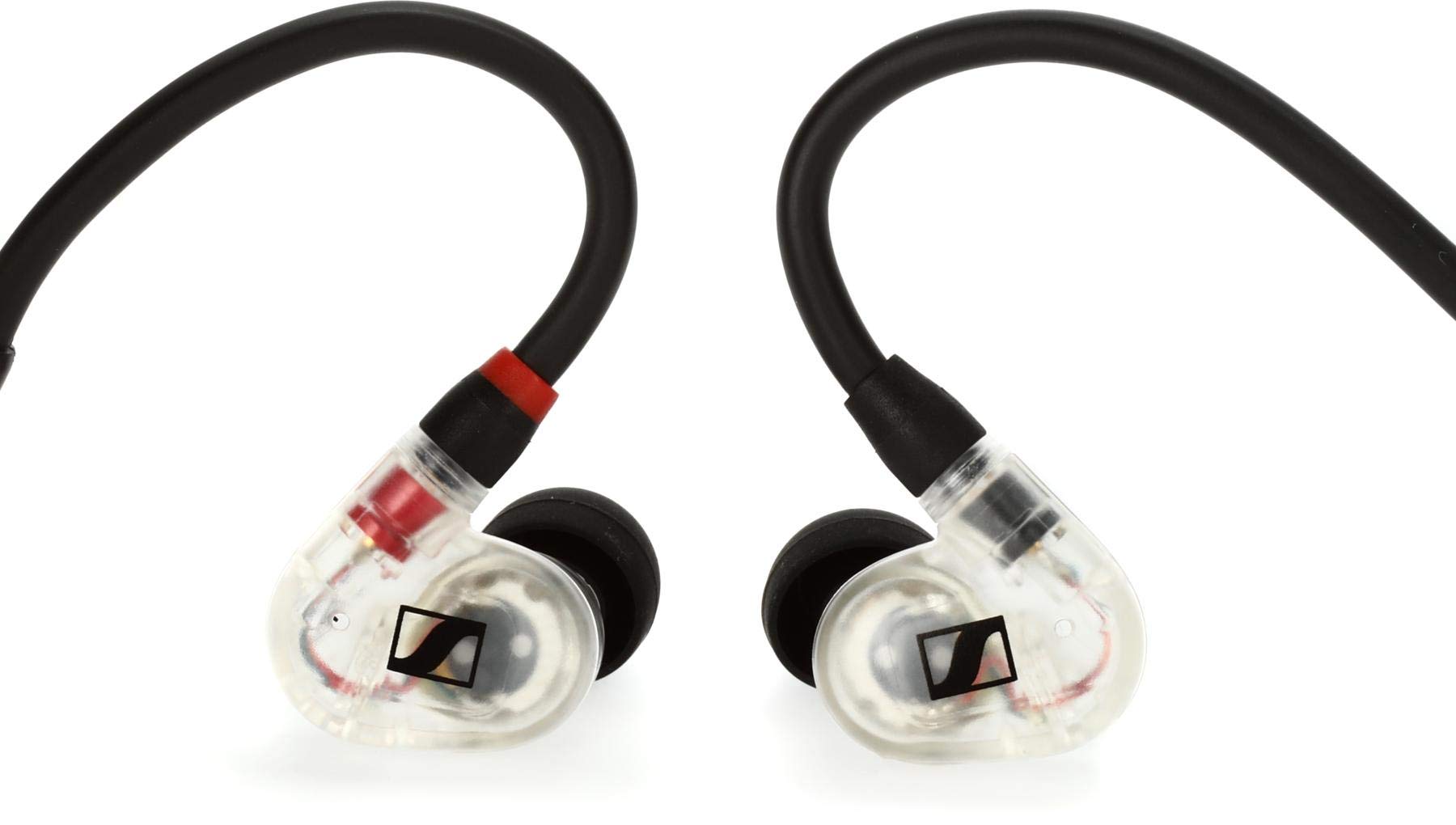
The IE 100 PRO uses a 10mm dynamic driver tuned for a balanced, neutral presentation with a slight treble lift that helps vocalists hear their own pitch without straining. Unlike the bassier Shure SE215, the Sennheiser delivers a more linear frequency response, making it easier to EQ in a monitor mix. The slim, ergonomic shell fits small ear canals especially well, and the included foam and silicone tips in multiple sizes cover most anatomies.
The stage-ready cable features an internal duct that routes the wire through the earhook, reducing visible bulk and snag risk. The MMCX connectors are standard and accept third-party balanced cables without issue. Battery life is irrelevant here — this is a wired monitor — but the passive nature means zero latency, which is critical for in-ear monitoring where timing offsets cause vocal drift.
Several users note that the IE 100 PRO’s treble can sound slightly aggressive on poorly mastered tracks, and the dynamic driver’s bass extension is polite compared to multi-driver hybrids. For the gigging musician who needs reliable, intelligible monitoring without fatigue, the IE 100 PRO is a direct, honest tool. The carrying case and cleaning tool included in the box add practical value for a performer on the move.
Why it’s great
- Neutral, revealing sound with a treble lift ideal for vocal monitoring
- Ergonomic slim housing fits small ear canals comfortably
- Stage-tested MMCX cable with internal duct reduces snag risk
Good to know
- Treble can be harsh on poorly recorded sources
- Bass is controlled rather than thumpy; not for bassheads
4. BASN Bmaster Pro

The Bmaster Pro uses a hybrid driver configuration — one balanced armature for mids and highs, plus dual 10mm dynamic drivers for low-end — to deliver a V-shaped sound signature that gamers praise for its spatial separation in competitive titles like Escape from Tarkov. The bass extension is generous without bleeding into the mid-bass, and the treble is smooth enough that gunshots and footsteps remain distinct rather than blurring into a wall of noise.
Two detachable MMCX cables are included in the box: one standard 3.5mm cable and another with an in-line microphone for calls or in-game chat. The ergonomic over-ear design uses preformed memory wire to stay in place, and the kit includes 12 pairs of ear tips — silicone, foam, and double-flange — for exhaustive fit customization. The white and black shell is visually distinctive but still understated enough for public use.
The main trade-off is comfort for those with larger ear conchae; the housing is slightly bulkier than single-driver models, and long sessions beyond three hours may cause pressure points. The stock cable is straight rather than pre-curved over the ear, which some users find awkward for the first week. With its hybrid driver advantage, wide accessory bundle, and sub-premium price point, the Bmaster Pro is a strong contender for anyone who values soundstage over absolute neutrality.
Why it’s great
- Hybrid BA + dual dynamic drivers provide wide soundstage and clear imaging
- 12 pairs of ear tips ensure a reliable acoustic seal
- Two detachable MMCX cables (one with mic) for gaming and calls
Good to know
- Bulkier housing may cause concha fatigue in extended sessions
- Straight cable requires bending to over-ear shape; some find it fiddly
5. KZ AS10

The AS10 packs five balanced armature drivers into a transparent plastic shell, splitting frequency duty across a dedicated low, mid, dual high, and a mid-high hybrid driver. The result is a resolving, fast sound with exceptional clarity in the upper registers — cymbal crashes, string harmonics, and vocal sibilance are rendered with precision that single-dynamic drivers cannot match. Bass is present and tight, but BA bass lacks the physical slam of a moving-coil driver.
The 2-pin detachable cable is the standard KZ connector, which means a huge aftermarket of upgrade cables exists if the stock wire fails or you want a balanced termination. The green shell is polarizing in appearance, but the clear variation is subtler. The included silicone tips are adequate, but many users report better isolation and tone with foam replacements, which also help the AS10 fit more securely for active use.
Reviews consistently note that the AS10 excels in pop music where vocal separation and treble sparkle matter most, but the laid-back mids can make rock and acoustic guitar sound slightly recessed. The preformed ear hooks are comfortable for most, though some users with smaller ears find the shells protrude. For the listener who prioritizes micro-detail retrieval over tonal warmth, the AS10 delivers five-driver performance at a price that undercuts single-driver competitors.
Why it’s great
- Five BA drivers deliver exceptional treble detail and separation
- Standard 2-pin connector opens wide cable upgrade options
- Tight, controlled bass that doesn’t bleed into mids
Good to know
- Bass lacks sub-bass punch compared to dynamic driver models
- Recessed mids may make rock and acoustic sound thin
6. JBL Vibe Beam

The Vibe Beam shifts the conversation from wired transparency to wireless convenience, offering 8 hours of playback per charge plus 24 hours from the case — enough for a work week of commutes. The IP54-rated earbuds shrug off rain and sweat, making them viable for gym sessions, and the IPX2 case provides basic splash protection. Bluetooth 5.2 ensures stable connectivity up to 10 meters, and the JBL Headphones app lets you adjust the EQ to tame the stock treble peak.
Sound quality via the 8mm dynamic driver is JBL’s signature deep bass tilt, which works well for pop, hip-hop, and podcast clarity. The stick-closed design provides decent passive isolation even without active noise cancellation, and the VoiceAware feature balances your own voice during calls so you don’t shout. Reviews confirm that the earbuds survive washer-and-dryer cycles with the case — a testament to their build resilience.
The caveats: stock silicone ear tips may not lock securely for everyone; replacing them with foam tips improves retention and bass response. The 100-millisecond audio latency precludes serious gaming use, and the charging case lacks wireless charging. For the listener who values battery life, durability, and a bass-forward profile over critical listening fidelity, the Vibe Beam is a practical daily driver.
Why it’s great
- 32-hour total battery life with quick 10-minute charge for 2 hours
- IP54 water and dust resistance for active, all-weather use
- JBL Deep Bass tuning with app-based EQ customization
Good to know
- 100 ms audio latency limits gaming and video sync
- Stock tips may not seal securely; foam replacements recommended
7. Vibes 202

The Vibes 202 punches well above its weight class with a 1-Tesla dynamic driver housed in a durable resin shell — a build approach more common in + IEMs. The cable is a silver-plated Litz-braided MMCX design that reduces signal loss and stays tangle-free. The frequency response spans 8 Hz to 23 kHz, delivering a bass-heavy, v-shaped signature that customers describe as “aggressive” and “impactful.” Drummers and guitarists find it useful for practice monitoring where note definition matters more than neutrality.
Six pairs of ear tips (two colors, three sizes) and an over-ear preformed earhook design ensure a secure, isolating fit. The included hard carrying case with a carabiner adds portability. Many users specifically recommend the Vibes 202 for motorcycle helmet use because the flat profile and deep ear insertion block wind noise effectively. The wire routing behind the ears keeps the cable out of the way, and no battery or Bluetooth chip means zero downtime.
Where the Vibes 202 falls short is in tonal balance — the bass shelf is noticeably elevated, and the upper treble is rolled off, so cymbal detail and airiness are sacrificed for low-end thump. The MMCX connector is also slightly recessed, which may require sanding for certain aftermarket cables. For a budget-priced, no-BS wired earphone with upgrade potential and impressive build quality, the Vibes 202 offers remarkable value for bass-focused listeners.
Why it’s great
- 1-Tesla dynamic driver delivers powerful, deep bass response
- Silver-plated Litz-braided MMCX cable reduces signal degradation
- Durable resin shell with hard carrying case for travel
Good to know
- Bass-heavy tuning masks upper treble detail and air
- Recessed MMCX port may not fit all aftermarket cables cleanly
FAQ
Do more balanced armature drivers always mean better sound?
Can I use in-ear headphones for gaming without latency?
How do I clean silicone or foam ear tips safely?
Final Thoughts: The Verdict
For most users, the best in ear headphones winner is the Sennheiser IE 200 because it combines reference-grade neutrality, dual-bass adjustability, and a lightweight fit that works for both studio and casual listening. If you need stage-proven isolation and a bass-forward signature, grab the Shure SE215-CL. And for budget-conscious gamers who want hybrid driver soundstage, nothing beats the BASN Bmaster Pro.