
Our readers keep the lights on and my morning glass full of iced black tea. As an Amazon Associate, I earn from qualifying purchases.
Specs are compiled from manufacturer listings and verified buyer reviews and can change over time — please confirm the key details on the product page before buying.
If you are paying every month for channels that float through the air for free, an indoor aerial is the cheapest fix in home entertainment. You plug a flat panel or a bar into your TV’s antenna socket, run a channel scan, and pick up local news, sport and weather without a subscription. The catch is that no aerial works the same in every house: distance from the tower, intervening walls and which window you face all change what you get. This guide sorts the strong performers from the panel that looks tidy but pulls in nothing.
I’m Min — the founder and writer behind Gadgets Feed. This guide is built by comparing the manufacturers’ published specifications and the patterns across verified customer reviews, so you get each pick’s real strengths and trade-offs instead of marketing spin.
Aerial shopping is mostly about matching range and amplifier to your distance from the transmitter, so the picks below are grouped by how far they reach and how much control you get over the signal. Every option here is designed to sit inside your home, and a handful stretch the near-indoor market further than the rest — which is exactly what this breakdown of the indoor tv aerial market covers first.
Our Picks at a Glance


How To Choose The Best Indoor TV Aerial
Start with your distance from the transmitter, because that single fact rules out half the market before you look at anything else. An aerial rated for 30 miles will struggle at 50, no matter how sleek the panel looks on your wall. Check your postcode on a coverage map first, then buy an aerial whose quoted range comfortably clears that number.
Distance and the amplifier switch
An amplifier is a small powered booster that lifts a weak signal before it reaches your TV. Close to a tower, that boost can flood the tuner and cost you channels — so the useful models let you unplug the booster and rescan. A detachable amplifier is worth more than a bigger quoted range, because it lets you fix a bad scan without buying again.
Where the aerial actually sits
Indoor reception depends almost entirely on placement. A flat panel taped high on a window facing the towers will usually beat the same panel hidden behind a bookshelf. Look at the included coax length before you commit — a short cable forces the aerial into a corner you did not want, while a longer run lets you chase the best spot in the room.
Quick Comparison
| Model | Best For | Quoted Range | Amplifier | Included Coax | Amazon |
|---|---|---|---|---|---|
| Indoor TV Antenna, 4K Ultra HD Free Channels with Amplifier★ Best Overall | Small rooms and tight budgets | 24000 meters | Yes, with 4G/5G filter | — | Amazon |
| Vansky Digital Amplified Indoor HDTV AntennaBest Cable Run | Long cable runs to a window | — | Yes, detachable | 16.5 ft | Amazon |
| GE TV Antenna for Smart TV IndoorTunable Dipoles | Adjustable dipole tuning | 50 miles | Yes, with 4G/5G filter | Included | Amazon |
| GE Indoor TV Antenna, Bar Design | Decor-friendly wall mounting | 30 miles | No | Included | Amazon |
| RCA Amplified Indoor Flat HDTV Antenna | Signals from every direction | 40 miles | Yes, dual-stage | 15 ft | Amazon |
| Channel Master FLATenna | Reliable everyday reception | 35 miles | No | 12 ft | Amazon |
| Antennas Direct ClearStream Flex | Switchable boost on demand | 50 miles | Yes, Jolt Switch | 12 ft | Amazon |
| Winegard FlatWave FL5500A | City and suburban homes | 60 miles | Yes | — | Amazon |
| Mohu Leaf Supreme Pro | Large panels in weak spots | 65 miles | Yes, USB power injector | 12 ft | Amazon |
In‑Depth Reviews
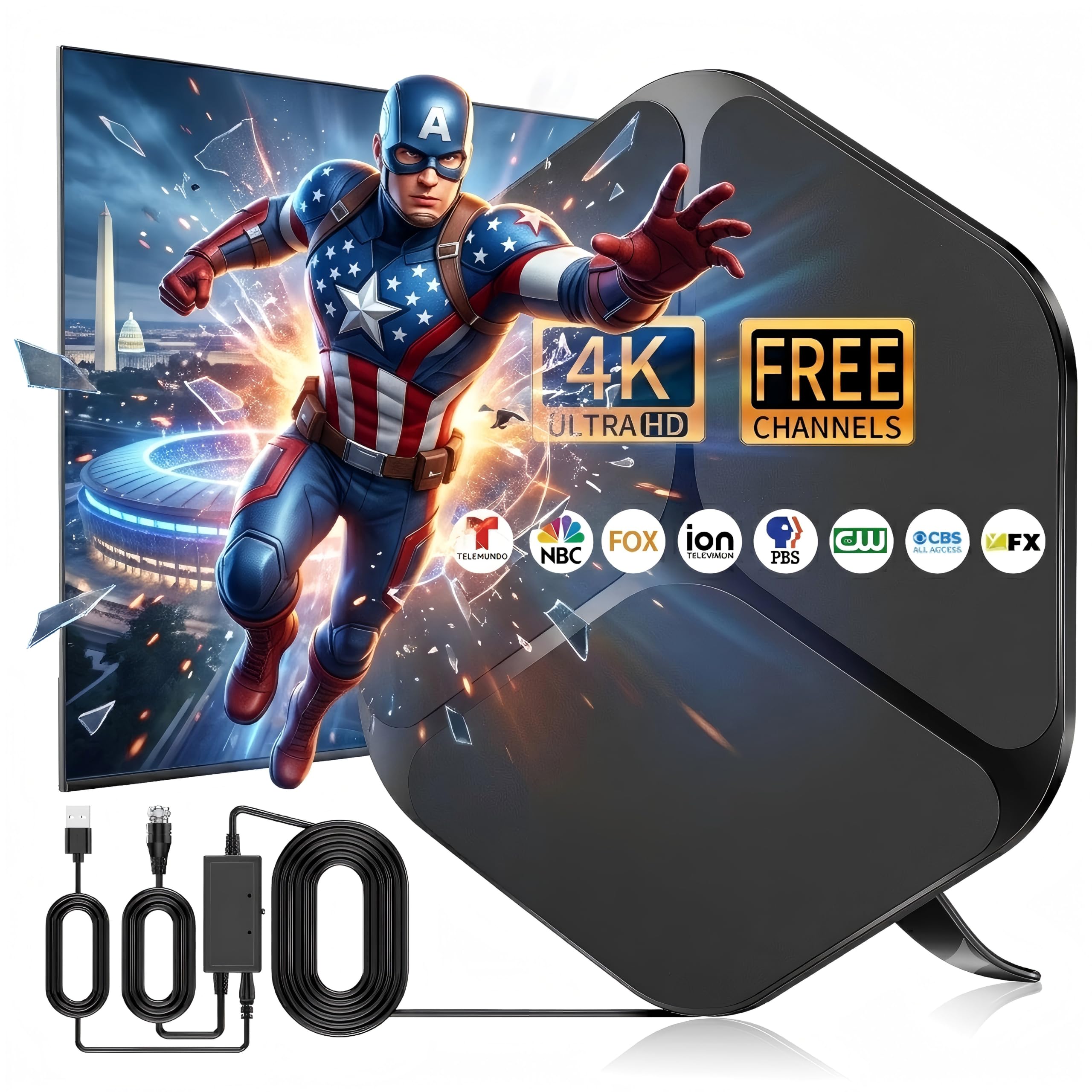
1. Indoor TV Antenna, 4K Ultra HD Free Channels with Amplifier
Our pick — 4.5+★ from 250+ verified ratings; the strongest balance of quality and price.
The cheap flat panel that filters out phone interference and still finds channels.
What wins people over here is how cleanly this aerial locks onto a signal for a thin, flexible panel. The boosted version runs an amplifier chip with a filter tuned to block 4G and 5G mobile interference — the stray signal that can smear a picture on channels low in the band. Owners consistently land on quality as the standout trait, and they call it strong value for the money too.
You get a quoted maximum range of 24000 meters and a listed capacity of 100 channels, which puts it in the comfortable end of the near-indoor market rather than the reach-anything tier. Its impedance sits at 75 ohm — the standard match for a TV antenna socket, so the coax simply plugs into the “ANT IN” port with no adapter. The maker quotes a three-minute setup: connect the coax, scan for channels, mount the panel.
Placement is where this panel earns its keep. The flexible sheet mounts on a wall, sits on a window, or hides behind the TV, and the maker lists basements, RVs and cabins among the spots it suits. The honest trade-off is durability — the panel is thin enough to crease if it is stuffed into a bag or yanked off a window, so treat the mounting tabs gently. Heavy walls and long cable runs will also cost you channels, as with any indoor aerial.
What holds up
- 4G/5G filter keeps phone interference down where the signal is crowded.
- 100 listed channels and 24000 meters of quoted range suit most suburban homes.
- Full HD 1080p and NextGen TV support, plus 4K when the broadcast offers it.
Where it falls short
- The thin panel creases under rough handling or repeated re-mounting.
- No coax length is listed, so check your cable run before ordering.
Buy this if: you want a low-cost panel for a bedroom, basement or camper and you face the towers.
skip it if: your window faces away from the transmitter and you need the reach of a longer-range pick.
2. Vansky Digital Amplified Indoor HDTV Antenna
Sixteen feet of cable is the headline here — enough to chase the window.
The Vansky is built around a generous 16.5ft high-quality coaxial cable, so you can place the aerial on the best signal spot in the room instead of wherever the socket happens to be. That long run is the single most useful thing about it for anyone whose TV sits on an interior wall. On impedance, this aerial lists 140 ohm against the 75 ohm of the ZCSSQZ pick above — a different match value, so check it against what your TV and any splitter expect.
The detachable signal amplifier is the feature that turns this into a setup you can tune rather than just plug in. The maker’s own advice is blunt: if the amplifier on gives you no stable lock, take the booster off and rescan. Buyers report the quality of the pick is the thing they prize most, with channel count close behind. The panel also carries a flame-retardant build claim and supports 720p, 1080i, 1080p and 4K ATSC broadcasts.
Reception is the honest caveat, and the maker says why: thick walls and valleys cut what an indoor aerial can grab. Views split down the middle — plenty of homes get every local they wanted, others lock onto nothing. A quick scan with the booster off, then on, tells you which camp you are in before the return window closes.
Long-cable advantage: 16.5ft of coax is the best run in this group for window placement, and the detachable booster gives you two scans in one device.
Reality check: the 140 ohm listed impedance is not the usual 75 ohm match, so confirm your splitter expects it; and reception depends entirely on what your postcode can receive.
Reach for this if: your TV socket sits far from the only window that faces the towers.
Look elsewhere if: you want a fixed, tune-it-once aerial and no second scan.
3. GE TV Antenna for Smart TV Indoor
Adjustable arms you can actually point at the tower, not just stick on glass.
This GE model trades the flat-panel look for a slightly curved body with adjustable dipoles — the two metal arms that pick up the broadcast signal. Being able to angle those arms toward the transmitter is the reason to pick it over a fixed sheet. The quoted reach is 50 miles from the broadcast source, and a 4G/5G LTE filter blocks mobile interference along the way, so busy urban airwaves have less chance to chew the picture.
Compare that reach with the GE bar design below, which lists 30 miles, and the extra 20 miles of quoted range is why this one carries the higher sticker. It also carries a NEXTGEN TV (ATSC 3.0) tag, a newer broadcast standard that promises a stronger signal and richer audio when your area transmits it, plus 1080p and 4K/8K support.
Setup is a flat surface, the included coax, the included AC adapter and a channel scan, then you nudge the arms until the picture settles. Functionality earns the most praise here, and picture quality is the second thing people bring up. Where it divides buyers is raw signal strength — a weak transmitter still means a weak result. One picky detail worth knowing is that the coax length draws the toughest comments of any detail on this model, so measure your run before it arrives.
Reasons to choose it
- Adjustable dipoles let you aim at the tower instead of hoping.
- 50 mile quoted range beats the 30 mile GE bar design in this list.
- 4G/5G LTE filtering and ATSC 3.0 NextGen TV support.
What to weigh
- Needs a wall outlet for the included AC adapter.
- Short coax draws the strongest criticism of any detail on this model.
Best match for: homes with one dominant transmitter direction where aiming makes the difference.
Think twice if: your aerial spot has no nearby mains socket.
4. GE Indoor TV Antenna, Bar Design, Smart TV, Reversible Black/White

A slim bar you mount above the TV, with a black or white face to match your wall.
Most indoor aerials make you choose between strong reception and a panel you want on the wall. This one goes after the second half of that problem with a long, sleek bar that replaces the traditional dipoles entirely and sits above your TV or on the included stand. The reversible black or white finish means it can disappear against either a dark media wall or a pale one, and the whole thing weighs 13.92 ounces — light enough for a single hook.
On reach, it lists 30 miles from the broadcast source. Compare that with the 50 miles of the GE dipoles above and the bar design gives up ground on distance to win on appearance — a fair trade if your transmitter is close. The bar is engineered to strengthen VHF reception, the lower band where some local stations live, and it carries the same NEXTGEN TV (ATSC 3.0) compatibility for when your area switches over.
Quality is the aspect that wins people over, with value next. Signal is the variable: a white face toward the window helps in some rooms, and others get nothing at all, which is the usual indoor-aerial gamble rather than a fault in the bar. If your towers sit far away, look at the longer-range picks instead of fighting this one.
Where it earns its place: VHF-focused bar design, 30 mile quoted range, and a reversible finish that lets it vanish above a wall-mounted TV.
Pick it for: a visible living-room install where the aerial has to look deliberate.
Not the one for: fringe areas far from the towers, where 30 miles will not stretch.
5. RCA Amplified Indoor Flat HDTV Antenna

Catches signals from every direction, so you stop twisting the panel around.
Most flat panels need to face the broadcast tower, and you may not know which way that is. The RCA solves that with a patented 360° multi-directional design (it picks up signals from every side), so you stop fiddling with the angle. Dual-Stage Amplification (a two-step signal booster) and Auto Gain Control (it turns the boost down when the signal gets too strong) work together. That keeps the signal from overloading your tuner (the part of your TV that reads the channel). The result is a set-and-leave aerial for a room with no clear line to the tower.
The quoted reach is 40 miles and the flat profile is paintable, so it can hang on a wall, lie flat, or stand on a shelf using the built-in easel. You get a lot in the box: the flat antenna, the 15 foot coax, the amplifier, and a 3 inch USB power cable with adapter. Channel coverage is what buyers praise most here, with value for money close behind, and the aerial handles 4K/8K and 1080 HDTV across both UHF and VHF.
The catch is the powered setup — you need a free USB or mains point near the aerial, which some wall mounts will not offer. There is also a listed capacity of 82 channels and a 50 ohm impedance figure that differs from the 75 ohm on several picks here, so match it to your kit. Reception still splits along the usual line: strong in some areas, weak in others.
Stands out for
- 360° multidirectional pickup kills the adjust-constantly routine.
- 15 foot coax, easel stand and USB adapter all included.
- Auto Gain Control trims the boost to suit your tuner.
Worth knowing
- Needs power at the aerial, so plan where the USB lead will go.
- The 50 ohm impedance is an unusual match against a 75 ohm setup.
Ideal if: you have no clear line to the towers and want an aerial that does not need aiming.
Reconsider if: there is no spare power outlet near where the panel hangs.
6. Channel Master FLATenna
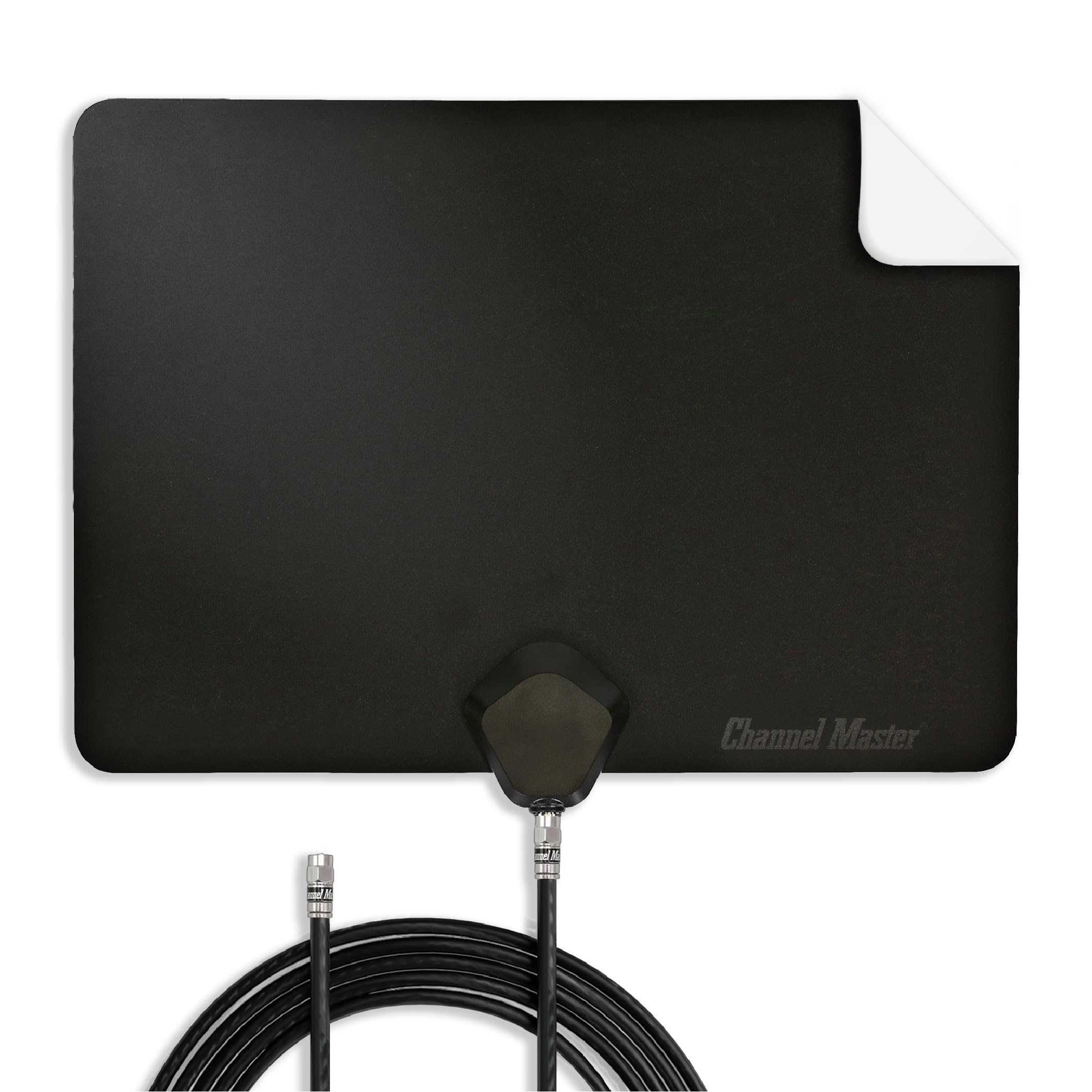
The panel that pairs a thin sheet with the pro-grade cable you would buy separately.
Channel Master has built antenna gear since 1949, and the FLATenna ships with a 12 foot professional-grade RG6 coax cable with enhanced shielding. That is the heavy-duty cable that usually costs extra. The shielding keeps a good signal clean on the way to the TV, so fewer channels drop out. The quoted range is a deliberately modest 35 miles, pitched for real-world urban and suburban conditions rather than a lab number.
The ultra-thin, lightweight and reversible black-and-white panel mounts on a wall, window or tabletop. It lists 75 ohm impedance, matches ATSC 3.0 NextGen TV and 4K broadcasts, and weighs 113 g, so it hangs on a window without a heavy bracket. Functionality is what wins people over most here, with channel count right behind, and UHF reception gets singled out as where it performs best.
The one fault worth flagging is the mounting kit: the sticky pads struggle to hold on glass, so plan on push pins, tape or a stand if your window is the spot. Picture quality holds up well once the panel stays put, and the 35 mile range is realistic rather than inflated. It is the steady, unglamorous choice for a home that wants a passive panel with pro-grade coax and no booster to tune.
The case for it: professional-grade RG6 coax in the box, 75 ohm impedance, ATSC 3.0 support and a genuinely realistic 35 mile range.
The one flaw: the adhesive pads do not grip glass well, so budget for a different fixing.
The confident pick for: a set-and-forget install where the supplied cable matters as much as the panel.
Not ideal for: renters who cannot add a pin or stand to a window frame.
7. Antennas Direct ClearStream Flex

An on/off switch for the boost, so you can test both in a single evening.
Here is the feature that sets the Flex apart: the Jolt Switch, an in-line amplifier with a real on/off switch you can flip while sitting on the sofa. If the signal is strong and the boost is making things worse, you switch it off and rescan — no unplugging the aerial, no scrabbling behind the TV.
The panel itself is paper-thin at 0.04 inches deep and measures 12 inches high by 16 inches wide, with patented loop elements for UHF and Hi-VHF reception. The quoted reach is 50 miles, and it supports NextGen TV, 4K, 8K UHD and 1080p without needing an internet connection. Channel reception is the thing buyers praise most here, with build quality close behind — the aerial pulls in a wide spread of stations once the switch is in the right position.
The catch is price — this one sits in the premium tier, and some buyers feel the cost is hard to justify when a cheaper panel does the same job. The reversible black-or-white finish is paintable, so it can be made to match a wall, and the 12 ft detachable coax gives you room to place it. It is engineered in the USA by a St. Louis-based maker, if buying domestically matters to you.
Where it wins
- The Jolt Switch gives you real-time boost control with a flip of a switch.
- Paper-thin 0.04 inch panel with a 50 mile quoted range.
- Handles NextGen TV, 4K and 8K UHD with no internet needed.
The honest downside
- Sits in the premium tier, and value for money divides opinion.
- The 6 ft USB power lead limits where the switch can sit.
Choose it when: you want to experiment with the boost without re-cabling every time.
Pass if: you are on a tight budget and a simpler fixed panel would do the same job.
8. Winegard FlatWave FL5500A

Sixty miles of stated reach for the house sitting well outside town.
Most indoor aerials top out around the 30 to 50 mile mark. The FlatWave FL5500A pushes to a quoted 60 miles, aimed at urban and suburban homes that sit further from the transmitters and need every bit of that lift. It picks up both VHF and UHF over-the-air signals, and the ultra-thin panel has a low-profile dual-color finish that blends into most interiors without complicated hardware.
Setup is coax to the TV, a channel scan, and the Winegard app to walk you through it — no tools. It plays with NextGen TV broadcasts and connects to most smart TVs and streaming devices, so it works alongside a Roku or Fire Stick rather than replacing one. A 74.99 ohm impedance figure sits right next to the standard 75 ohm match, and the panel weighs 5.44 ounces for easy wall or window mounting.
Quality is the aspect that wins people over most, with functionality right behind it. The variable is station pickup — some homes report excellent reception and every local station, while others hit a signal gap and struggle. That split is a fact of live broadcast, not a single fault, and the 60 mile reach is what gives this aerial the best shot in the fringe cases.
Why it earns a spot: 60 mile quoted range, VHF and UHF bands, and a 5.44 ounce ultra-thin panel with an app-guided scan.
Made for: a home on the edge of a broadcast area that keeps losing channels to distance.
Overkill if: you are close in and a 30 mile panel already gets you every station you want.
9. Mohu Leaf Supreme Pro
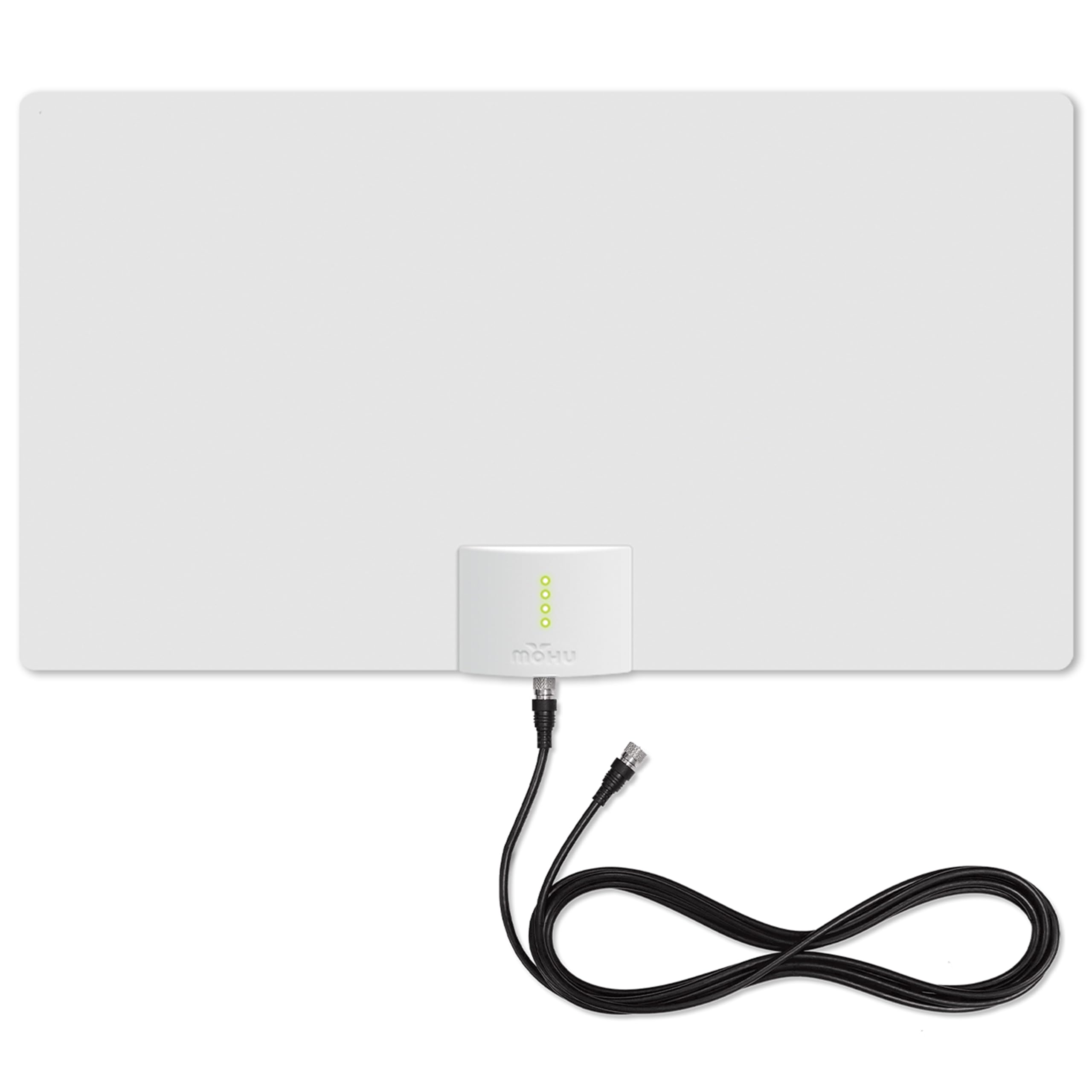
A bigger sheet with little signal lights that tell you when you have found the spot.
The Leaf Supreme Pro expects you to hunt for the right patch of wall, and gives you a way to know when you have found it. Signal indicator lights show how strong the reception is at each spot, so you can slide the panel along a window and watch the lights climb instead of guessing. The panel is a large 21.5 inches by 12 inches of multi-directional UHF and Hi-VHF element, with a quoted 65 mile range — the longest reach here.
That reach is aimed at harder-to-serve homes. In the box you get a 12 foot detachable coax and a USB power injector (it feeds power to the aerial through the USB cable) with a 6 foot USB cable. You also get hook-and-loop tabs and push pins for a flat wall or window mount. The reversible white or black finish can be painted to match your wall. The maker builds it in the same family as Antennas Direct, engineered in the USA, with a one-year warranty. On the technical side it handles 1080p, 4K, 8K and NextGen TV (the newer broadcast standard) where coverage allows.
What holds up best here is how quickly you get it running — ease of installation is the standout praise. What divides buyers is everything downstream: channel count, reception, picture quality and value all split toward the middle. Some homes pull in a wide spread of stations, others get none. At its size and range, treat this as the aerial you buy when you have already tried a smaller one and want the maximum crack at a weak signal.
Strong points
- Signal indicator lights speed up finding the best spot.
- 65 mile quoted range is the longest reach in this group.
- Large 21.5 inch by 12 inch multi-directional element with full accessory kit.
Trade-offs
- Results vary widely by area — some homes get stations, others get none.
- The big panel needs real wall or window space to mount flat.
Go for it if: you have already tried a smaller aerial and want lights that guide your placement plus the longest stated reach.
Leave it if: you want a budget set-and-forget and are close to the towers.
Understanding the Specs
Quoted range in miles
The range figure is the distance the maker says the aerial can pick up a broadcast signal before obstructions cut it down. Walls, trees, hills and the building you are in all eat into that number, so treat a 30 mile rating as a figure for an open line of sight and shorten it for anything in the way. Pick an aerial whose quoted range comfortably clears your real distance to the transmitter.
Amplified versus passive
An amplifier is a powered booster that lifts a weak signal before it reaches your TV. Close to a tower a strong boost can overload the tuner and cost you channels, which is why a detachable or switchable amplifier matters — it lets you run the aerial passive and rescan. If your set struggles far from the towers, the boost helps; if you are near them, try it off first.
UHF and VHF bands
Broadcast TV travels on two groups of frequencies: UHF at higher frequencies and VHF at lower ones. Many locals sit in the UHF range, while some legacy stations live on VHF, so the aerial’s design decides which it catches best. A flat panel with UHF and Hi-VHF elements covers more ground than one tuned to a single band.
Impedance and coax
Impedance is the electrical match between the aerial, the coax and the TV socket, measured in ohms. The standard TV match is 75 ohm, and a mismatch can cost you clean signal. The coax length in the box matters just as much — a longer run lets you place the aerial near a window instead of a corner far from where the signal lives.
FAQ
Can an indoor aerial pick up channels if I live far from the towers?
Do I need the amplifier switched on or off?
Will an indoor aerial work with a 4K or 8K TV?
How long does an indoor aerial last?
What does the ohm rating on an aerial mean?
Where should I place a flat indoor aerial for best reception?
Can I use an indoor aerial alongside a streaming stick?
Why does one aerial get more channels than another in the same house?
Does an indoor aerial need a power outlet?
Is a longer listed range always better?
Final Thoughts: The Verdict
For most homes, the indoor tv aerial winner is the Indoor TV Antenna, 4K Ultra HD Free Channels with Amplifier. Its 4G/5G filter (it blocks mobile-phone signals that crowd the airwaves) keeps your picture clean, and it lists 100 channels with a 24000 meter quoted range. If you have a long run to a window, grab the Vansky Digital Amplified Indoor HDTV Antenna with its 16.5ft coax. For a home on the edge of coverage, reach for the Winegard FlatWave FL5500A with its 60 mile quoted reach. Whichever you pick, scan with the amplifier off, then on.
How We Picked
We do not accept paid placement. Every pick is matched to a real buyer and a real use-case; we do not hands-on test units.
Sources & Methodology
Specifications: manufacturer listings and product documentation. Review insights: verified customer reviews, as of November 2026. Pricing: not shown on this page (it changes often); check the current price via the retailer link.
As an Amazon Associate, Gadgets Feed earns from qualifying purchases. This does not affect which products we feature.