
Our readers keep the lights on and my morning glass full of iced black tea. As an Amazon Associate, I earn from qualifying purchases.
Specs are compiled from manufacturer listings and verified buyer reviews and can change over time — please confirm the key details on the product page before buying.
Japanese wall outlets take two flat parallel pins — that is it. So when you arrive in Tokyo with a three-prong laptop charger, a CPAP machine, or a hair dryer, you’re holding a plug that physically will not go in. A Japan plug adapter fixes that in seconds: it accepts your American flat-pin plug and lets it seat in a Type A socket (the two-flat-pin outlet used in Japan). The real decision is which one: a bare pass-through adapter gives you one outlet, while a seven-device charging block turns one socket into a bedside power station. Below are the nine worth carrying, chosen on outlet count, USB output, plug type, and how they behave in a hotel room.
I’m Min — the founder and writer behind Gadgets Feed. This guide is built by comparing the manufacturers’ published specifications and the patterns across verified customer reviews, so you get each pick’s real strengths and trade-offs instead of marketing spin.
Most travelers pack a converter they don’t need and forget the one thing that matters: a voltage converter changes the electricity, an adapter only changes the shape of the plug. Almost every phone, laptop, and camera charger you own is dual-voltage already, which is why a simple Type A adapter is usually all you need. Here is how to pick the right japan plug adapter without overpaying for hardware your devices never asked for.
Our Picks at a Glance

How To Choose The Best Japan Plug Adapter
Start with the plug, not the brand. Japan uses Type A outlets — two flat parallel pins — and the adapters here all present that pin shape on the wall side. From there, the buying decision splits into three questions: how many devices you need to power at once, whether those devices charge by USB or by their own wall plug, and how much room you have around the socket.
Adapter vs. converter — get this right first
An adapter only reshapes the plug. It does not change voltage. Japan runs on a lower household voltage than the US, which is why a dual-voltage device — the kind marked 100V-250V on its label — works fine on a Type A adapter alone. A single-voltage appliance like many hair dryers and straighteners is a different story. Those need a voltage converter, and forcing them onto an adapter can damage them. Almost every adapter on this list carries an explicit “not a voltage converter” note for exactly that reason.
Count your outlets and your USB ports separately
An adapter with four AC outlets is not the same as one with four USB ports, and the specs here list both. USB-C ports matter more each year because phones and laptops have moved to that connector, while USB-A still covers older cameras and watches. Check the total USB output too, since several small ports sharing a modest output charge slowly when everything is plugged in at once.
Look at the plug’s geometry
A hotel socket is often jammed behind a nightstand or sunk into a recessed panel. A flat plug, a rotating plug, or a folding plug solves that. So does a short extension cord, which moves the outlets out from the wall entirely. Wider-spaced AC outlets also stop one chunky charger from blocking the socket next to it — a small detail that decides whether a four-outlet adapter is really four outlets in practice.
Quick Comparison
| Model | Best For | Outlets | USB Ports | Plug Type | Amazon |
|---|---|---|---|---|---|
| 2 Pack US to Japan Plug Adapter (One Beat)★ Best Overall | Charging seven devices at once | 3 | 4 (2 USB-A, 2 USB-C) | Type A | Amazon |
| Ceptics Japan Travel Plug Adapter SetTop Performer | Checking voltage at a glance | 2 | 2 (1 USB-A, 1 USB-C) | Type A and B | Amazon |
| meta-ant US to Japan AdapterBest Corded Reach | Reaching far-off outlets | 3 | 4 (2 USB-A, 2 USB-C) | Type A | Amazon |
| US to Japan Adapter Extension Cord (kakahigh) | Tight spaces behind furniture | 4 | 5 | Type A | Amazon |
| LENCENT Foldable US to Japan Travel Plug Adapter | Folding flat into a bag | 4 | 4 (2 USB-A, 2 USB-C) | Type A | Amazon |
| VINTAR US to Japan Plug Adapter, 2 Pack | Two travelers, two bags | 3 | 3 (1 USB-A, 2 USB-C) | Type A | Amazon |
| TESSAN US to Japan Plug Adapter | Sliding into a pocket | 4 | 3 (2 USB-A, 1 USB-C) | Type A | Amazon |
| LENCENT US to Japan Plug Adapter | Four-sided plug clearance | 4 | 4 (2 USB-A, 2 USB-C) | Type A | Amazon |
| OREI Japan, Philippines Power Plug Adapter (3 Pack) | A simple adapter for every bag | 2 | — | Type A | Amazon |
In‑Depth Reviews
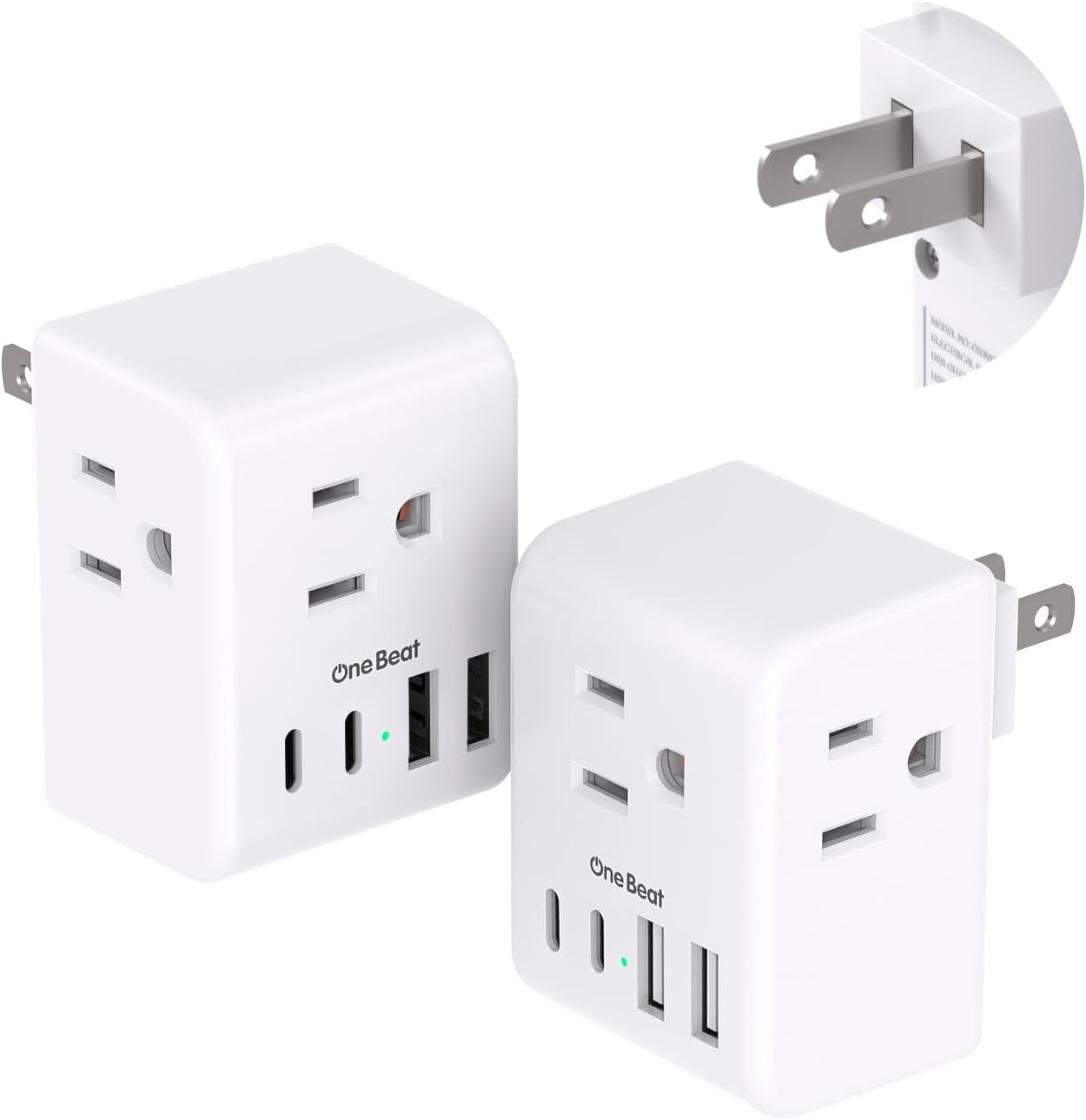
1. 2 Pack US to Japan Plug Adapter, 2 Prong to 3 Prong Outlet Adapter
Our pick — 4.5+★ from 6,500+ verified ratings; the strongest balance of quality and price.
Three AC outlets and four USB ports per block — the adapter that turns one hotel socket into a full nightstand station.
That combination of three outlets plus four USB ports (2 USB-A, 2 USB-C) is the whole argument here. Each block lets you charge up to 7 devices simultaneously from a single wall socket, which is a genuinely different job than a bare pass-through adapter. The two-pack structure means one lives in your travel bag and one stays plugged in at home, so the 3 prong to 2 prong conversion is already handled wherever you land.
Power handling is spelled out plainly: a maximum capacity of 1875 Watt at 125 Volt and 15 A, with the USB bank delivering up to 3.1A total. The housing is made of 1382℉ fireproof material, and a blue indicator tells you the power is live before you start hunting for the switch. No surge protection and no cord also makes it a fully cruise-ship-approved pick, which matters if your trip includes a ship rather than just a plane.
The honest catch is the USB-C port’s 3.1A shared output, which is a convenience port rather than a fast-charge one. One Beat states clearly that it is not Quick Charge 3.0 and will not run devices needing 9~22V, so your USB-C port is a convenience port, not a fast-charge one. For phones, tablets, power banks, and watches — the jobs most people actually hand it — the arrangement works exactly as promised. Tested against the OREI three-pack below, this unit gives you three outlets against its two, and four USB ports against its none.
What earns its place
- Three outlets plus four USB ports (2 USB-A, 2 USB-C) per block, up to 7 devices at once.
- 1875 Watt / 15 A capacity at 125 Volt handles laptop chargers and small appliances together.
- Fireproof 1382℉ housing and a blue power indicator.
- Two-pack, so home and suitcase are both covered.
Where it stops short
- The USB-C port is not Quick Charge 3.0 and won’t run anything needing 9~22V.
- Four USB ports share a single 3.1A total, so speeds drop when everything is filled.
Built for: anyone whose hotel room has one working socket and four gadgets that need it — families and long trips especially.
Think twice if: your only USB-C device is a laptop that demands high-voltage fast charging, which this port won’t deliver.
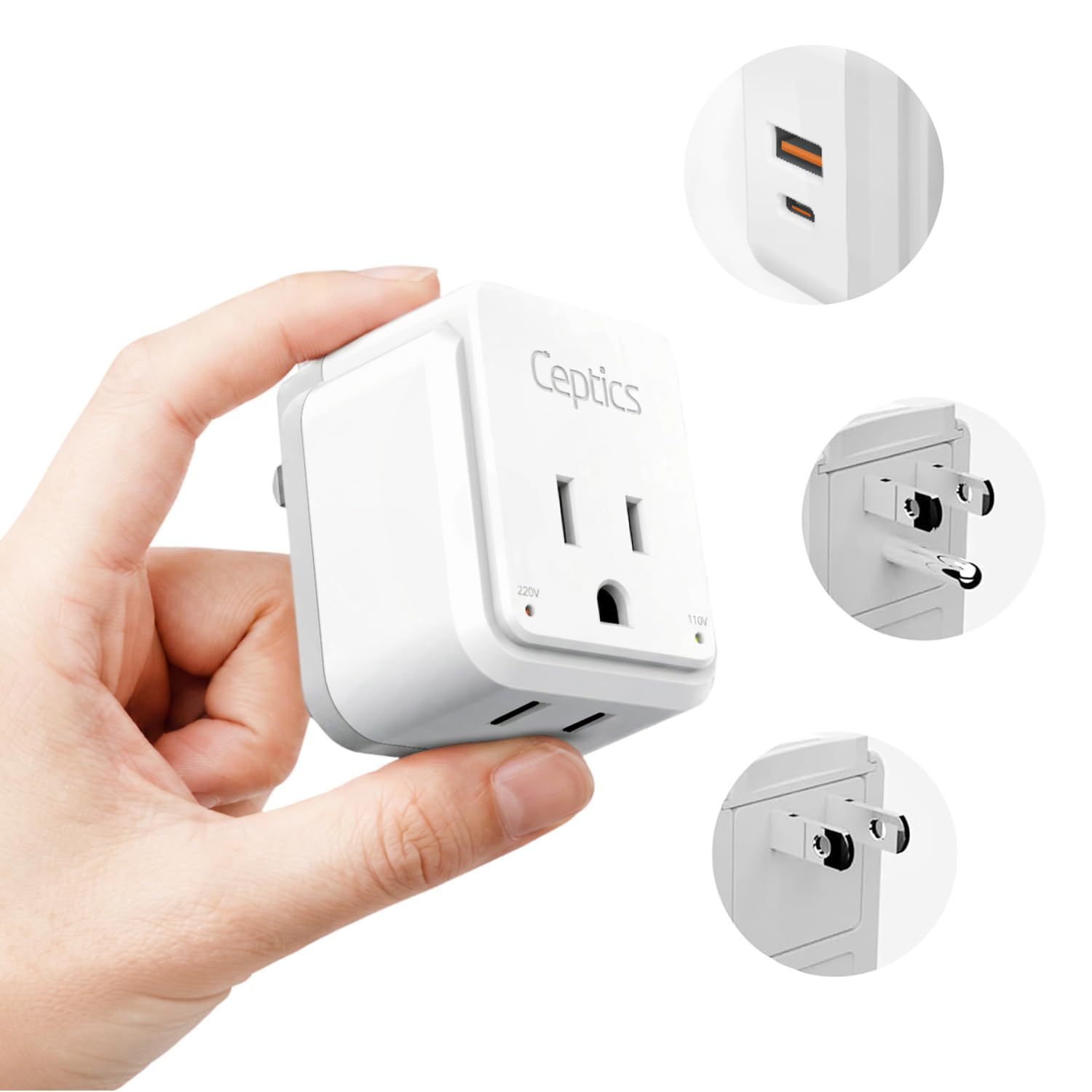
2. Ceptics Japan, Philippines Power Travel Plug Adapter Set, 20W PD & QC
Little indicator lights that tell you what voltage the wall is feeding you — before your device finds out the hard way.
Two LEDs do the work here. One lights up for 110V, both light up for 220V, so you know what you’re plugged into just by looking. That’s a small feature with an outsized payoff for anyone who has ever hesitated in front of a foreign socket wondering what would happen next. Max amps reach 10A and max voltage reaches 250V, and the two SWadAPt attachments — Type A and Type B — swap out depending on the country.
Device count is four: two US standard outlets that accept NEMA 5-15 plugs including polarized ones, plus one USB and one USB-C port sharing a 3.1A total. The body measures 1.9 x 1.6 x 2.1 inches and weighs 2.1 ounces, which Ceptics describes as 20% more compact than competitors. It also arrives with a pouch, so it doesn’t rattle loose in a carry-on.
Compare it with the TESSAN below and the trade is clear: TESSAN measures 3.15 x 2.24 x 1.18 inches, so the Ceptics is the more compact of the two on two of three dimensions and lighter by a wide margin at 2.1 ounces against TESSAN’s 3.4 ounces. What it gives up is outlet count — two AC outlets here against four on the TESSAN and the larger multi-port blocks. If you’re traveling with a laptop, a phone, and a camera battery, two outlets and two USB ports is exactly the right size. If you’re the family charging hub, it isn’t.
The voltage-visibility case: the 110V/220V LEDs are the genuine standout — a quick glance answers the question most travelers get wrong, and the 250V ceiling with 10A max covers dual-voltage gear safely.
The count trade-off: two AC outlets and two USB ports total, and the SWadAPt attachments are extra pieces to keep track of in a bag. Pack them in the included pouch and this stays a tidy kit.
Fits: the careful traveler carrying a laptop, a phone, and a single camera — two outlets covers that list precisely.
Less suited to: a group that needs four wall chargers live at once, where a wider block makes more sense.
3. meta-ant US to Japan Adapter, 2 Prong to 3 Prong Outlet Adapter
When the socket is buried behind the nightstand, five feet of cord is the feature that actually matters.
The 5ft white extension cord is the reason to pick this one. It reaches sockets that are pushed behind furniture or sunk into an awkward corner, and the two-prong power strip ends in a 180-degree swivel plug that mounts flat in tight spaces. Three widely-spaced outlets then sit out in the open where you can actually use them, which is the whole point of the cord in the first place.
Seven devices in total: three AC outlets rated 1875W at 125V plus four USB ports (2 USB-A, 2 USB-C) with smart charging that detects the device and delivers up to 3.1A/15.5W. Maximum current is 15 A. There’s no surge protector inside, which is what makes it cruise-friendly for operators that ban surge strips — though the manufacturer’s own note says to check the cruise line’s site if you plan to bring an extension cord aboard, since some forbid them.
Against the kakahigh corded strip below, meta-ant leads on cord length — 5 feet against 3 feet — while giving up one AC outlet and one USB port. The compact body measures 4.33 x 3.93 x 1.22 inches at 207 g, so it packs reasonably well for something with a cord attached. The furniture-friendly angle is real: the 180-degree swivel plug mounts flat against a nightstand, desk edge, or narrow corner instead of jutting out of the wall.
The case for five feet
- 5ft cord reaches outlets behind beds, dressers, and couches.
- 180-degree swivel plug mounts flat in tight spots.
- Three widely-spaced outlets plus four USB ports (2 USB-A, 2 USB-C).
- No surge protector, so it passes cruise-ship rules that ban surge strips.
Where it leaves you short
- One fewer AC outlet than the kakahigh strip (three against four).
- Some cruise lines forbid extension cords outright — check before boarding.
Ideal for: the traveler who ends up in a room where the only socket sits a metre and a half behind a headboard.
Buy a different one if: you’re boarding a cruise line with a no-cords policy — a plug-in block without a cord clears that rule more easily.
4. US to Japan Adapter, 2 Prong Extension Cord 3 FT with Flat Plug, 15A

Nine devices off one socket — the highest device count in this lineup, thanks to a three-foot flat-plug cord.
Two American AC outlets, two American two-prong outlets, and five USB ports add up to nine devices charging at once, which is more than any other pick here. The dual input range runs 100V-250V with 3750W max (1875W at 125V), and the USB bank delivers 5V/3.4A at 17W max. Amperage is rated 15 A, so a laptop charger and a small appliance can share the strip without tripping anything.
The 3-foot short extension cord is designed to keep the power strip out of sight while still reaching your devices, and the rotating plug fits behind a couch, dresser, wardrobe, or bookshelf pressed against the wall. The 2.3-inch widely-spaced outlets mean a chunky adapter can’t block its neighbour. At just 9 oz and 4.6 x 1.7 x 1.1 inches, it’s smaller than a full power strip, which is why it lives comfortably in a dorm room, a hotel bag, or an office drawer.
Two things are openly noted by the maker, and both are worth knowing. The 3 prong adapter does not convert voltage, so dual-voltage devices only — your hair dryer and straightener need a converter if they aren’t marked 100V-250V. And while most cruise ships allow non-surge-protector strips, some forbid power strips with extension cords, so check your operator’s site. Durability and charging speed are the mixed reports in the review pool; the cord length split opinion too, with some finding 3 feet short and others exactly right for a nightstand.
The device-count argument: nine simultaneous charges is the highest total on this page, and the 15 A / 3750W ceiling means it isn’t a toy — it handles real chargers, not just phone bricks.
Straight from the listing: the maker’s own note flagging that some cruise lines ban cords is the single most useful line in the spec sheet — read it before you pack this for a sailing.
Worth it for: dorm rooms, home offices, and hotel stays where nine things need charging and the socket is stuck behind the furniture.
Look elsewhere if: you’re cruising on a line that bans cords, or you need fast-charge USB-C at high voltage.
5. LENCENT Foldable US to Japan Travel Plug Adapter, Type A Power Adapter
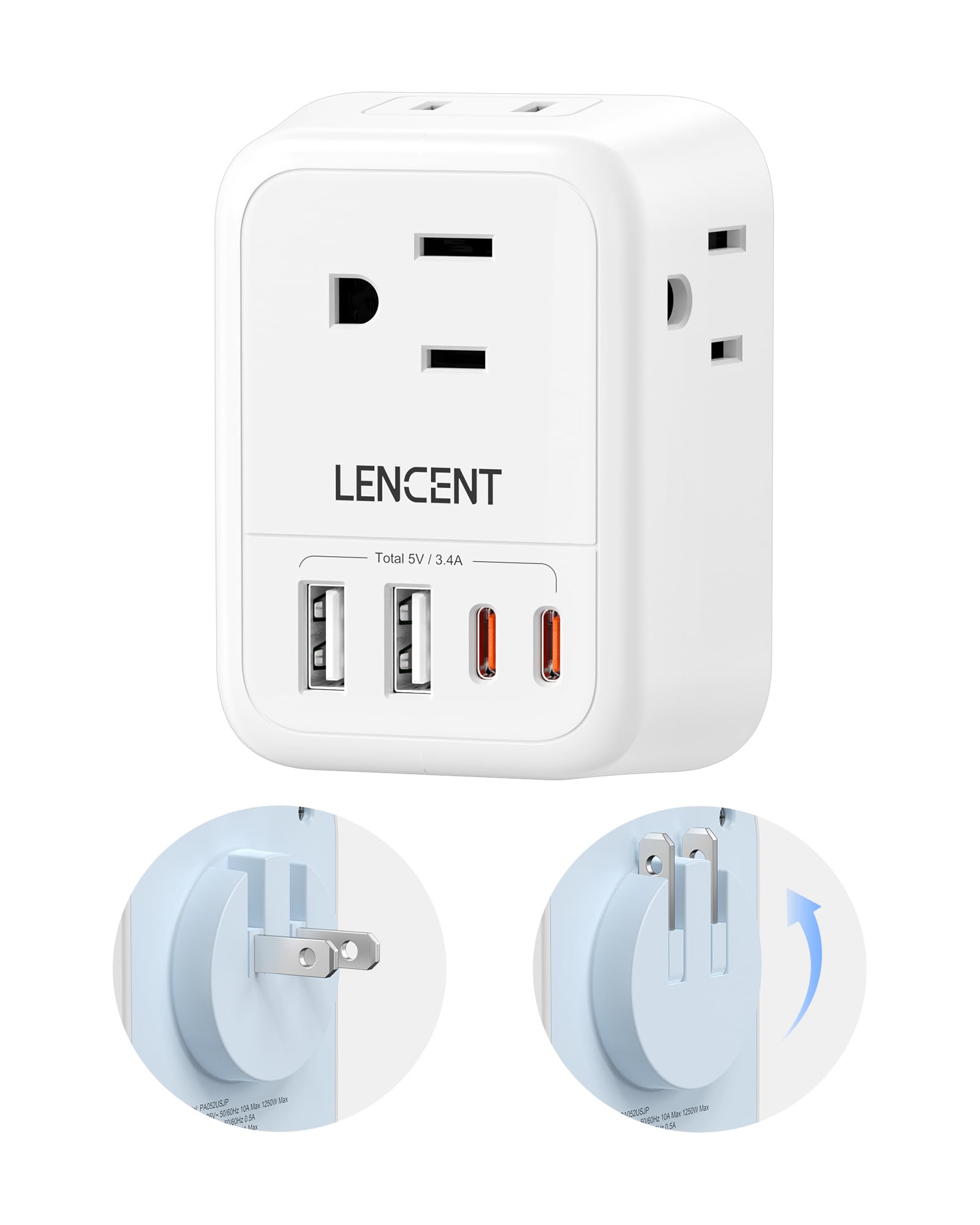
Prongs that fold away flat so the adapter slips into a side pocket instead of snagging on your clothes.
The foldable plug design is the distinguishing feature, and it’s a practical one: folded, the adapter stops poking holes in whatever it shares a bag with. It measures 3.1 x 2.5 x 1.8 inches and weighs 3.2 ounces, so it isn’t the smallest block here, but it packs more tidily than one with fixed prongs sticking out.
The count is generous for the size. Four standard AC outlets — both 2-prong and 3-prong at 10A max — plus two USB-A ports (5V/2.4A, 12W) and two USB-C ports (5V/3A, 15W), for a total USB output of 17W at 5V/3.4A. LENCENT also calls out stable power support for CPAP machines during overseas trips, which is the kind of specific use case that matters to a traveler who can’t leave medical equipment at home. Safety features include a fireproof shell, automatic device detection, and power distribution that guards against over-current, over-voltage, over-heating, and short circuits.
It carries the standard warning that it doesn’t convert voltage — a 110V-only device in a 220V country is a bad pairing — so check your labels. Compared with the TESSAN below, this one adds a fourth AC outlet and folds, at the cost of being lighter (3.2 ounces against 3.4 ounces) but bulkier in the hand. Between the two, the LENCENT suits the traveler who wants maximum outlet count in a bag-friendly shape.
Why the fold matters: fixed prongs are what tear linings and scrape against laptops in a carry-on. Folding them solves a small problem cleanly, and you still get four AC outlets plus four USB ports.
The right fit: frequent flyers who repack a bag every week and want their adapter to disappear into it.
Not the fit for: anyone who needs a cable to reach a distant socket — there’s no cord here, so it must plug straight in.
6. VINTAR US to Japan Plug Adapter, 2 Pack Foldable Japan Outlet Adapter
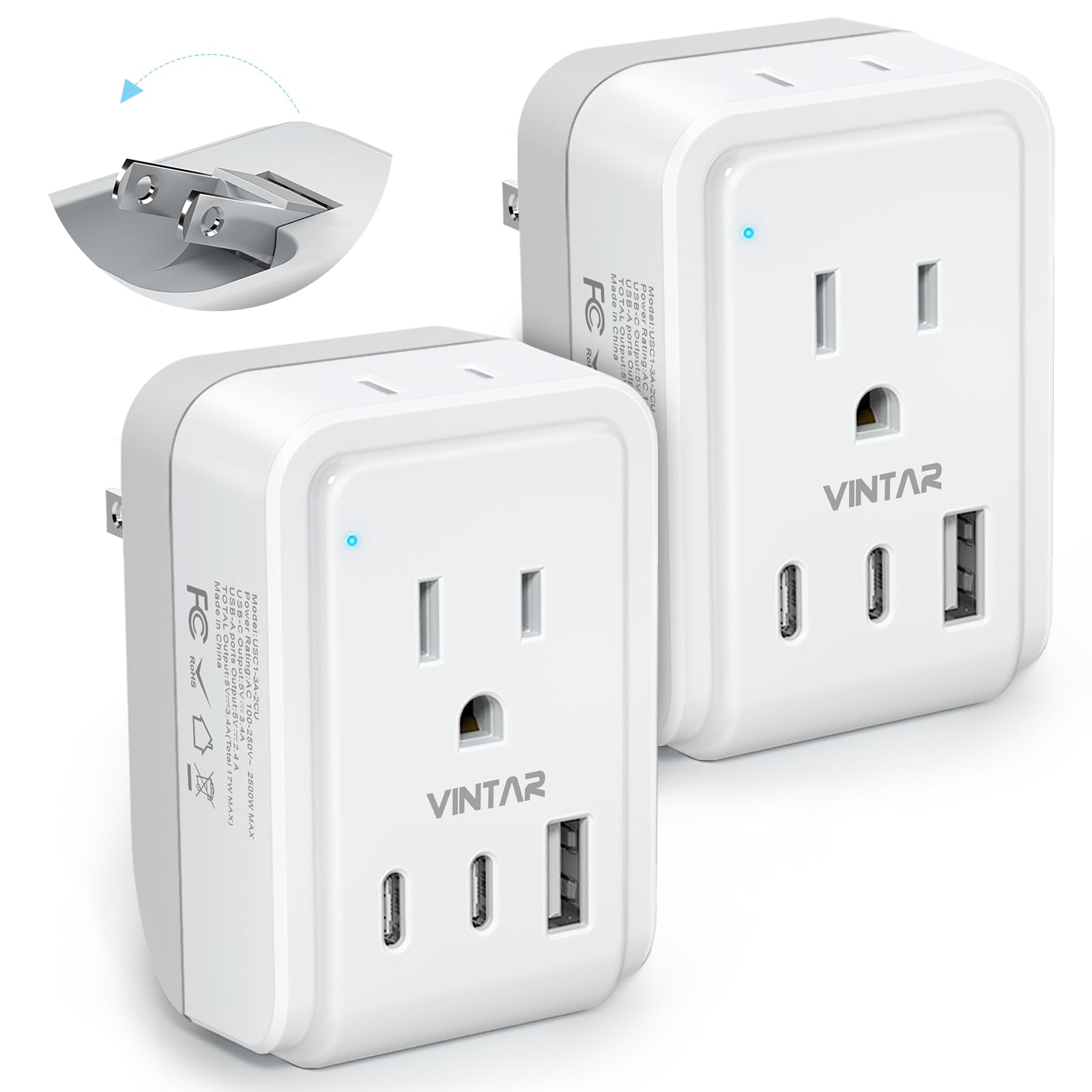
Two folding adapters in one box — one for your bag, one for whoever is traveling with you.
Two units is the pitch, and it’s a sensible one for couples or families splitting a suitcase. Each adapter offers a 5-in-1 layout: two AC outlets plus three USB ports (2 USB-C, 1 USB-A). The USB-C ports deliver up to 17W max at 5V/3.4A, which VINTAR describes as 50% faster than other adapters — a manufacturer claim, and one paired with the caveat that the USB-C port is not Quick Charge 3.0 (a fast-charging standard) and won’t run devices needing 9V to 22V.
The plug folds 90 degrees, which protects the prongs and saves suitcase space. At 2.9 x 1.9 x 1.7 inches and 6.8 ounces for the pair, it’s compact for a two-pack, and the shell is built for heat dissipation and flame retardancy. Certification is CE and FCC, each unit is tested before shipment, and there’s a 12-month warranty. Like every adapter on this list, it doesn’t convert voltage — the 100V-250V dual-voltage requirement applies to your hair dryer and straightener too.
Against the One Beat two-pack at the top, VINTAR gives up an AC outlet per block (two against three) and one USB port (three against four), but it does fold and it does carry the CE and FCC certifications (safety and interference approvals) along with a 12-month warranty. If you want the smallest possible pair that still charges a phone, a watch, and a camera off two wall plugs, this is the cleaner fit.
Worth knowing
- Two folding adapters per box, each 5-in-1 with two AC outlets and three USB ports.
- USB-C output up to 17W at 5V/3.4A.
- CE and FCC certified, tested before shipment, 12-month warranty.
- 90-degree folding prongs protect the pins in transit.
Limits to plan around
- The USB-C port is not Quick Charge 3.0 and won’t handle 9V-22V devices.
- Two AC outlets per block is modest if you’re charging laptops and appliances together.
Suits: two people sharing a room who each want their own adapter and a few USB ports to fight over.
Choose another if: you need four wall outlets live at once — this gives you two per block.
7. TESSAN US to Japan Plug Adapter, 2 Prong to 3 Prong Outlet Adapter

Four outlets and three USB ports in a block that drops into a trouser pocket at 3.4 ounces.
Pocketability is the headliner. At 3.4 ounces and 3.15 x 2.24 x 1.18 inches, the TESSAN is the sort of adapter you forget is in your bag until you need it, and its 18-month warranty is longer than most here. It turns one Type A socket into four outlets and three USB ports — seven devices, with a single USB-C port pushing 15W max and two USB-A ports covering the rest.
The claim that matters is about blocking: this only occupies one socket on the wall panel, so it doesn’t interfere with the plugs next to it. That’s the detail hotel room sockets punish you for ignoring. No surge protection and no cords also make it a cruise-ship essential for lines that ban surge strips. The wide-voltage note is standard: it only works on 100V-250V devices, so hair dryers and curling irons need to be dual-voltage or get a converter.
The trade against the Ceptics above is size and light weight in exchange for a fourth AC outlet and one extra USB-A port. At 3.4 ounces it’s the lightest multi-port block here, edging the LENCENT Foldable at 3.2 ounces. Where the TESSAN falls is at 15W USB-C: plenty for a phone, not the fastest phone charge on this page.
The pocket case: 3.4 ounces and a shape that won’t bulge in a pocket make this the one most likely to actually be in your bag when you need it.
Four outlets, real ones: because the block only claims one wall socket, you get four usable AC outlets plus three USB ports without blocking the neighbour plug.
Packs for: minimalists and business travelers who want a single, light block in a laptop bag.
Skip if: you need more than 15W out of the USB-C port, or a fourth USB-A charge point.
8. LENCENT US to Japan Plug Adapter, 2 Prong to 3 Prong Outlet Adapter
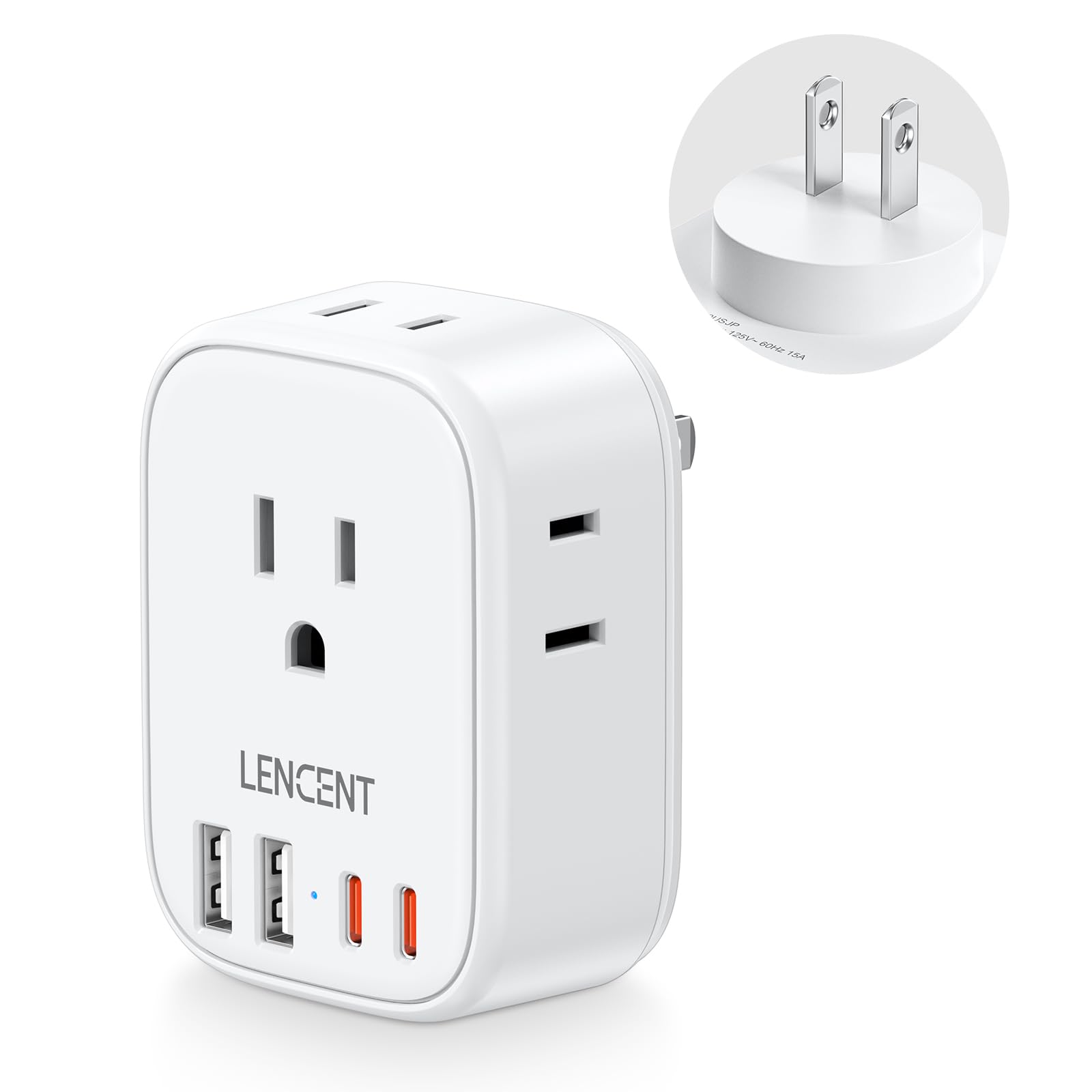
Built on all four sides so a bulky charger can’t block the outlet next to it.
That four-sided layout is the specific problem this solves: plug in one oversized power brick and on a flat adapter it can cover the neighbouring outlet entirely. Here the sockets spread around the body, so four AC outlets stay usable even when one is taken by something chunky. Four USB ports — 2 USB-C and 2 USB-A — share a total output of up to 17.5W, which LENCENT describes as 50% faster than standard travel adapters, a manufacturer claim rather than a measured one.
It measures 2.3 x 2.4 x 3.1 inches and weighs 102.6 grams, mid-size among the blocks here. The device list is broad — iPhones, cameras, power banks, Steam Decks, shavers, CPAP machines — and the no-surge, no-cord build makes it a simple plug-in for hotel rooms, dorms, and offices. There’s the usual note that it isn’t a voltage converter and only suits dual-voltage devices.
The comparison worth making is with the TESSAN above, because they’re close cousins. LENCENT offers four AC outlets plus four USB ports against the TESSAN’s four outlets plus three, and a higher 17.5W USB ceiling against 15W. The TESSAN is the heavier of the two at 3.4 ounces, though, so on a strict weight basis the LENCENT wins.
Where it wins
- Four-sided outlet layout keeps all four sockets usable with bulky plugs.
- Four USB ports (2 USB-A, 2 USB-C) at up to 17.5W total.
- No surge protection and no cord, for straightforward hotel and cruise use.
Where it’s ordinary
- At 102.6 grams it’s heavier than the pocket-sized TESSAN.
- The USB-C ports share a 17.5W total, so speed drops when several are filled.
Goes well with: a bedside that has one socket and several brick-style chargers that keep blocking each other.
Not for: minimalists counting grams — the TESSAN does a similar job lighter.
9. OREI Japan, Philippines Power Plug Adapter with 2 USA Inputs, 3 Pack

Three small adapters, no USB, no fuss — the one you tuck into every bag and forget about.
No USB ports here, and that’s the honest starting point. What you get instead is three compact adapters, each accepting a standard North American 2 or 3 prong flat pin plug — polarized or not — in the back, plus an American 2 prong socket on the bottom. Two inputs per unit, and one of them on the side is what keeps a bulky plug from crowding the main one.
Size is the point: 1.65 x 1.75 x 1.75 inches and 1.6 ounces each, small enough that a spare can live in a coat pocket. The max load rating is 10A/250V, the adapters are CE approved and RoHS compliant, and OREI backs them with a limited lifetime warranty. In blue, black, and green, they’re also easy to tell apart when three people are sharing one hotel room. The maker is explicit that these only work with dual-voltage products — phones, chargers, laptops — and that devices needing a voltage converter won’t work through them.
The buy-in here is quantity over ports. One multi-port block gives you more outlets in one body, but three separate adapters give you redundancy — leave one in the suitcase, one at home, one in a laptop sleeve. The honest limit is that there’s no USB at all, so phones need their own wall charger.
Three for redundancy: 1.6 ounces and 1.65 x 1.75 x 1.75 inches per adapter means you can genuinely keep one in every bag — and the limited lifetime warranty covers the lot.
A dual-voltage ceiling: the 10A/250V rating handles laptop and phone chargers fine, but the maker’s own note that these won’t work with voltage converters is the line to read before packing a hair dryer.
Makes sense for: households that travel often and want a spare adapter permanently in every case, without USB complexity.
Better served elsewhere: if you need to charge phones, watches, and laptops from one plug without bringing cables and bricks.
Understanding the Specs
Type A plug shape
Type A is the two-flat-parallel-pin plug that Japan, the US, Canada, and Mexico use — plus a spread of other countries. Because the shape is shared, a US flat-pin plug already fits a Japanese wall socket. An adapter earns its keep when you need to convert a 3-prong grounded American plug into a 2-prong one, or when you want extra outlets and USB ports off a single socket. Adapters on this list also serve the Philippines, China, Thailand, and a long list of other Type A countries.
Dual voltage versus converter
The label to look for on your device is “100V-250V” — that marks it as dual-voltage and safe on an adapter alone. Phones, laptops, camera chargers, and most CPAP machines fall into this group. A single-voltage appliance, like many hair dryers and straighteners, does not, and feeding it foreign voltage can damage it. The adapters here are shape-changers only. Several makers print that warning on the listing for exactly this reason: an adapter is not a converter, and no outlet count or USB total changes that.
USB port count and shared output
The USB numbers matter twice. First, how many ports: a block with 4 USB ports charges more devices than one with 2. Second, the total output all those ports share. A 3.1A or 17.5W total spread across 4 ports gives each device less than when one is plugged in alone. USB-C ports are increasingly the ones that matter for phones and laptops, while USB-A still covers older cameras and watches. Check both counts before you buy — the table above lists them for every pick.
Wattage, amperage, and socket clearance
A 15 A, 1875W rating covers a laptop charger and a small appliance on the same strip. A 10A rating covers phones and laptops comfortably. The number that gets overlooked is physical: widely-spaced or four-sided outlets keep a chunky brick from covering the socket next door, and a flat, rotating, or folding plug is what lets the block sit flush behind furniture or in a recessed hotel socket.
FAQ
Do I need a converter or just an adapter for Japan?
Will a US three-prong plug fit a Japanese two-pin outlet?
Is a Japan plug adapter safe on a cruise ship?
Why does my USB-C port charge so slowly?
Can I plug my hair dryer into one of these adapters?
What’s the difference between Type A and Type B on the Ceptics set?
How many devices can one adapter charge at the same time?
Do these adapters work in the Philippines and other Asian countries?
Does an adapter with four outlets work for a CPAP machine?
Can I leave a Japan plug adapter plugged in at home?
Final Thoughts: The Verdict
For most travelers, the japan plug adapter that earns its bag space is the One Beat 2 Pack. Three AC outlets plus four USB ports per block handles up to 7 devices from one socket, and the two-pack means home and suitcase are both sorted. Its 1875 Watt, 15 A capacity and fireproof 1382℉ housing handle laptop chargers and small appliances, not just phones, and it holds 4.5+ stars across 6,900+ ratings.
Want voltage verification built in? The Ceptics set flashes 110V or 220V before you commit, at 2.1 ounces in the hand. Need to reach a socket buried behind a headboard? The meta-ant 5ft cord is the pick. And for a spare adapter in every bag with no USB at all, the OREI three-pack is the simplest route.
One thing to settle before you buy anything: read the label on your hair dryer and straightener. If they don’t say 100V-250V, no adapter on this page will help, and you’ll need a voltage converter instead. Everything else — phone, laptop, camera, CPAP — just needs its plug reshaped, and any of these nine will do it.
How We Picked
We do not accept paid placement. Every pick is matched to a real buyer and a real use-case; we do not hands-on test units.
Sources & Methodology
Specifications: manufacturer listings and product documentation. Review insights: verified customer reviews, as of November 2026. Pricing: not shown on this page (it changes often); check the current price via the retailer link.
As an Amazon Associate, Gadgets Feed earns from qualifying purchases. This does not affect which products we feature.