
Our readers keep the lights on and my morning glass full of iced black tea. As an Amazon Associate, I earn from qualifying purchases.
Specs are compiled from manufacturer listings and verified buyer reviews and can change over time — please confirm the key details on the product page before buying.
If you are swapping a heavy lead-acid battery out of a boat, camper, or solar setup, the short answer is simple: buy a lithium iron phosphate (LiFePO4) battery with a smart battery management system (a built-in circuit board that stops overcharging and overheating), and size it to the job. A well-built 100Ah unit gives you the full amp-hours you paid for instead of the roughly half that lead-acid actually delivers, so you get more usable power from a lighter box.
I’m Min — the founder and writer behind Gadgets Feed. This guide is built by comparing the manufacturers’ published specifications and the patterns across verified customer reviews, so you get each pick’s real strengths and trade-offs instead of marketing spin.
Lithium iron phosphate chemistry is the safe, long-cycle choice for deep-cycle duty, but capacity, BMS rating, and cold-weather behavior vary hugely between models. These are the lithium batteries worth your money, ranked by what each one genuinely does best when you turn the key — read on for the best Lithium 12V Battery.
Our Picks at a Glance
How To Choose The Best Lithium 12V Battery
A 12V lithium battery is a long-term purchase, so the choice you make now decides how your boat, van, or cabin behaves for years. Getting these four things right removes almost all of the guesswork.
Capacity and usable amp-hours
Amp-hours (Ah) measure how much charge the battery stores. A 100Ah lithium battery delivers close to all 100Ah, while a lead-acid battery of the same rating only gives you about half before voltage sags. That is the single biggest reason people switch, because you get more real power without carrying a heavier box.
BMS rating and protections
The BMS (battery management system — the small circuit board inside that watches and protects the cells) sets the ceiling on how hard you can pull power. A 100A BMS suits most trolling motors and RV loads, while a 200A BMS is the pick for high-draw appliances and bigger inverters. Look for overcharge, over-discharge, overcurrent, overheating, and short-circuit protection as a baseline.
Group size and physical fit
Group 24, 27, and 31 are standard battery footprints. A battery that matches your existing tray drops straight in, while a wider or taller unit may need new brackets or trays. Check the terminal layout too, since front-facing terminals can be easier to wire in tight compartments.
Cold-weather honesty
Charging a lithium battery below freezing can damage the cells, so low-temperature cutoff protection matters if you camp or fish in winter. Some models add a built-in heater that warms the cells so charging can continue in the cold — useful if you run your setup year-round.
Quick Comparison
| Model | Best For | Capacity | BMS Rating | Weight | Amazon |
|---|---|---|---|---|---|
| Litime 12V 100Ah Trolling Motor★ Best Overall | Boat and marine use | 100Ah | — | 22.2 lb | Amazon |
| GrenerPower 12V 100Ah Group 24Best Value | DIY drop-in replacement | 100Ah | 100A | 22.6 lb | Amazon |
| WattCycle 12V 100Ah MiniCompact Pick | Compact builds | 100Ah | 100A | 20.94 lb | Amazon |
| Renogy 12V 100Ah Mini Core | Tight spaces | 100Ah | 100A | 22.7 lb | Amazon |
| Marsenergy Self-Heating 12V 100Ah | Cold-weather use | 100Ah | — | 21 lb | Amazon |
| Power Queen 12V 100Ah Group 31 | RV and solar | 100Ah | 100A | 24.3 lb | Amazon |
| Power Queen 12V 125Ah Group 27 | Longer runtime | 125Ah | 100A | 25.1 lb | Amazon |
| Redodo 12V 100Ah Group 31 | Value leadership | 100Ah | 100A | 22 lb | Amazon |
| ECO-WORTHY EnergyRock 12V 280Ah | High-capacity off-grid | 280Ah | 200A | — | Amazon |
| ECO-WORTHY 12V 314Ah | Home backup | 314Ah | 200A | 60.4 lb | Amazon |
| DUMFUME 12V 600Ah | Massive storage banks | 600Ah | 200A | 107.8 lb | Amazon |
In‑Depth Reviews
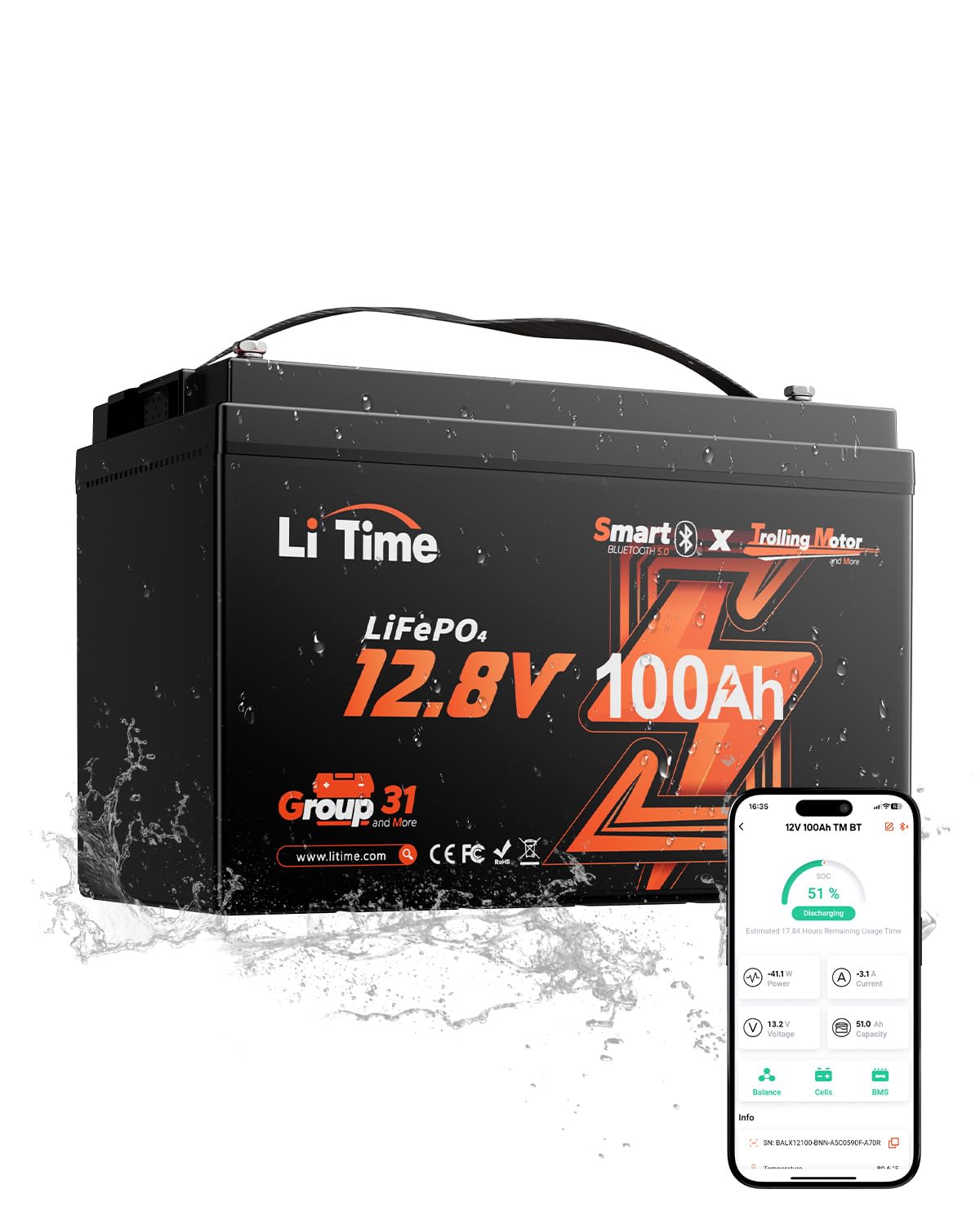
1. Litime 12V 100Ah Trolling Motor LiFePO4 Battery for Marine, Boat, Yacht
Our pick — over 4.5★ from 600+ verified ratings; the strongest balance of quality and price.
The trolling-motor battery that reports its own status straight to your phone
Anglers running a bow-mount trolling motor want one thing above all: power that does not fade as the afternoon wears on. This Litime unit is built for exactly that job, and it earns its place at the top by doing the small things well. The built-in Bluetooth pairs automatically, letting you watch state of charge, control the discharge, and run system checks from the boat seat instead of crawling into the bilge.
Double the range claim aside, the honest number here is the 1280Wh energy capacity, which the makers say delivers twice the range of a traditional lead-acid battery of the same nominal size. The chemistry backs that up with 4000 deep cycles at 100% depth of discharge, stepping up to 6000 at 80% and a maximum of 15,000 at 60%. That is a huge margin over the lead-acid batteries that only manage a few hundred cycles before they fade — the Litime leads the group here on rated longevity.
What wins owners over is the raw quality of the power delivery, backed by reliability and Bluetooth monitoring that owners clearly lean on. As for the honest catch: LiTime’s own paperwork is blunt that this is an energy-storage battery, not a starting battery for a car, golf cart, or jack, and it needs an activation charge with a compatible charger before first use. The 5-year warranty softens the risk, and the IP65 rating (a dust-tight, splash-resistant seal) means dust and splashes are not a worry on deck.
Why boaters keep buying it
- Bluetooth app pairs in seconds for live state-of-charge readings
- 1280Wh capacity with 4000 deep cycles at 100% depth of discharge
- IP65 waterproof and salt-resistant for marine use
- 22.2 lb, light enough to swap between two battery trays
Where it stops
- Not a starting battery — no car, golf cart, or jack duty
- Needs a lithium-activation or MPPT charger to wake the Bluetooth on first use
- Charging can feel slow if you are used to topping off lead-acid
Built for: the trolling-motor and marine crowd who want a lighter boat and live battery data on their phone.
Not for: anyone who needs a starter battery or expects Bluetooth to work straight from the start without an activation charge.
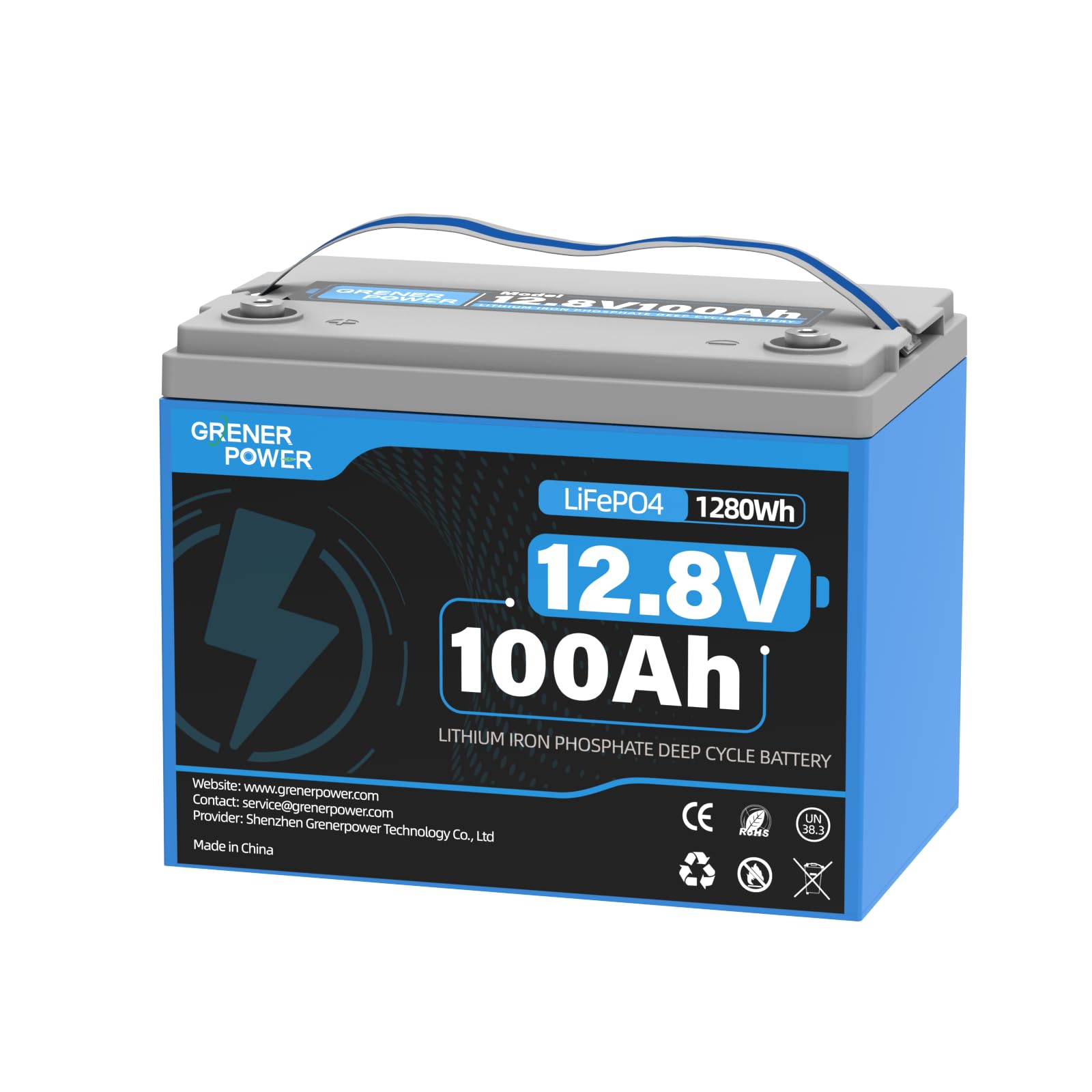
2. GrenerPower 12V 100Ah LiFePO4 Lithium Battery – Group 24 LiFePO4 Battery
The cycle-life overachiever that drops straight into a Group 31 tray
For the DIY crowd swapping lead-acid out of an RV compartment, the headline figure here is 15,000 deep cycles (full charge-and-drain rounds) — a striking number for the money, and roughly a 3.8x gap over the Litime’s 4000 cycles at 100% depth of discharge (draining the battery all the way down). It is a Group 24 battery (a standard size code) that, per the maker, drops into the same footprint as a Group 27 or Group 31 lead-acid unit, so the swap often needs no new tray at all.
The build hides behind that easy fit. Inside are A-grade cylindrical cells and a 100A BMS (the protection board watching the cells) with 5-layer protection covering overcharge, overdischarge, short circuit, overcurrent, and overheat. It packs 1280Wh into 22.6 lb, about the same carry weight as the Litime, and it is designed to mount without a battery box in most RV compartments.
The trade-off a buyer should weigh is scale — this is a solo 100Ah unit, so running a fridge for days means buying multiple and wiring 4S4P yourself if you want the full 20.48kWh. For a straight one-for-one replacement in a boat or camper, though, the value is hard to argue with, and the maker backs it with a 5-year warranty and a 5-to-10-year service window.
Sized for the job: the 30-to-70-lb trolling-motor range and most RV battery boxes are the balance, and the 1280W output (watts measure how much power flows at once) keeps steady power flowing as the charge drops.
Honest limit: like nearly every battery in this tier, it is an energy-storage cell — no car battery, starting duty, or golf cart use.
Grab it if: you want the longest rated life per dollar and an easy Group-sized drop-in.
Size up instead if: you need one battery to run a big appliance bank for days without paralleling units.
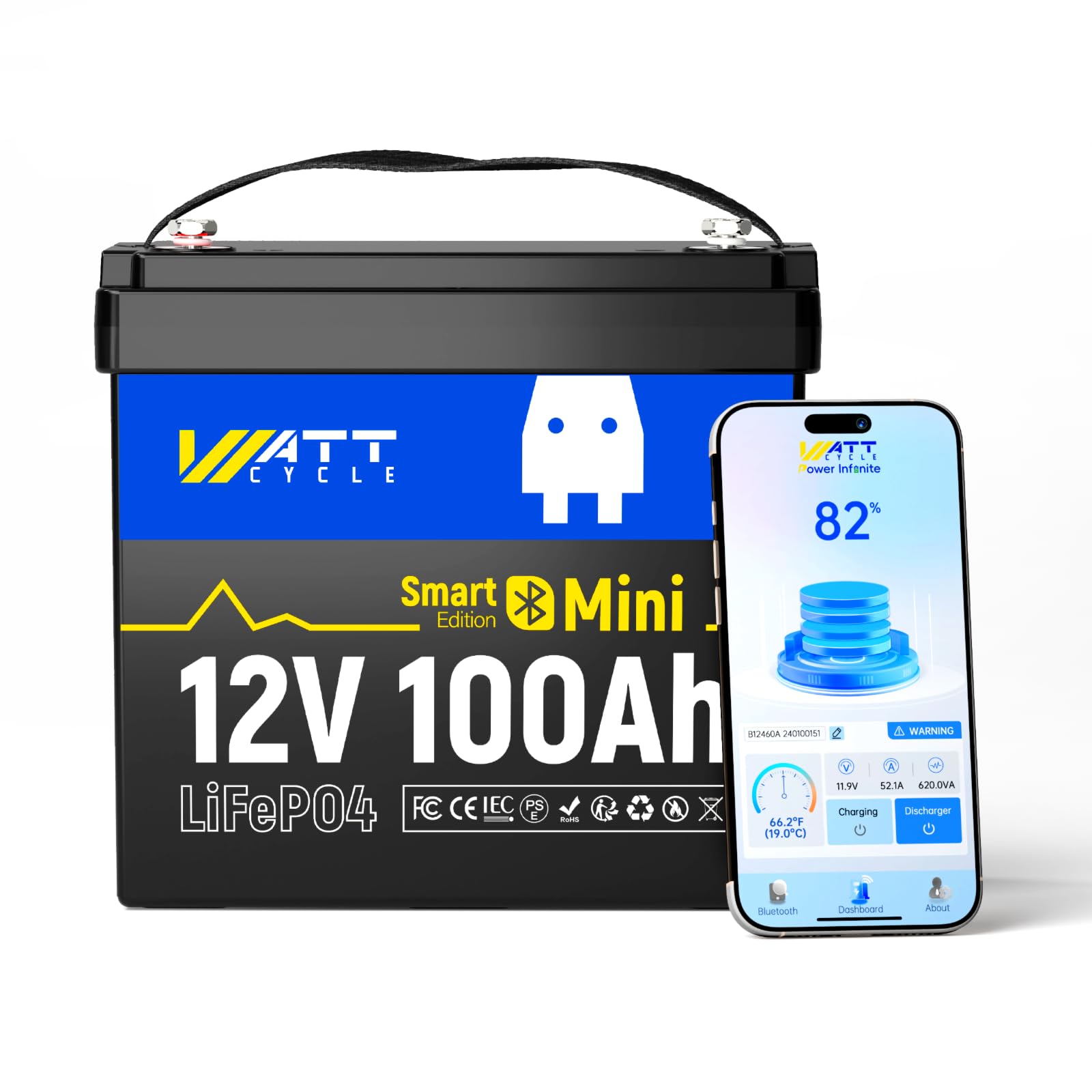
3. WattCycle 12V 100Ah Mini LiFePO4 Battery with Bluetooth 100A BMS Group 24
A featherweight Mini that trades brand polish for outright lightness
WattCycle claims an 11% weight cut and 39% smaller volume than its first-generation model, at up to 63Wh/lb.
Bluetooth is included and lets you rename the battery in the app and read voltage, current, low-temperature status, alarm prompts, and temperature parameters in real time. The cells are EV-grade A+, rated to withstand 15,000 cycles and support a 4S4P, 20.48kWh expansion. Low-temperature protection kicks in automatically, shutting charging at low temps.
Now the honest part: this one has a louder community split than the rest. The recurring gripe is the BMS and app — updates have caused connection failures, some early units locked up in cold weather, and the newer brand has unproven long-term reliability. Charging, battery life, and Bluetooth all show mixed feedback. Owners who get a good unit love the power delivery; the risk is on the electronics side rather than the cells. If you want the absolute lightest 100Ah and can accept some firmware growing pains, it is a fair bet; if rock-solid BMS dependability is your priority, look elsewhere.
Where it shines
- 20.94 lb — the lightest 100Ah here
- 15,000 rated cycles on EV-grade A+ cells
- Renamable Bluetooth with full parameter readout
- Rated for -4°F to 158°F operating range
Where it wobbles
- BMS and app reliability is the recurring complaint
- Newer brand with less of a long-term track record
- Occasional early shutdowns reported in cold weather
Reach for it if: minimum weight is your top priority and you can handle a firmware-driven brand.
Look elsewhere if: you have burned by BMS quirks before and want the electronics track record of a more established name.
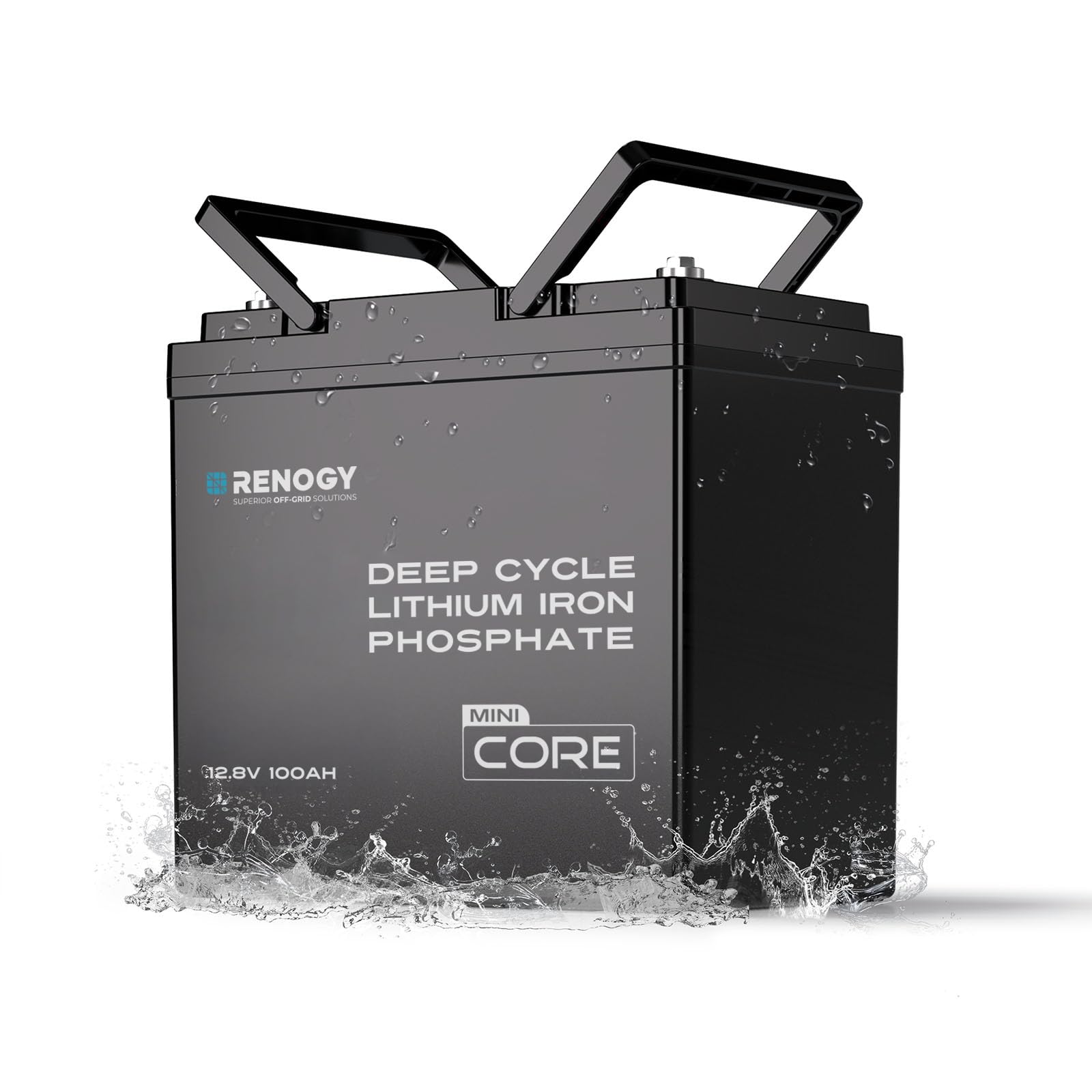
4. Renogy 12V 100Ah LiFePO4 Lithium Battery Mini Size
The Mini built for teardrop trailers and kayaks where space is the real constraint
Tight installs are what the Renogy Core Mini is for. It is a Group 22NF unit, up to 50% smaller than a Group 31 and 13% smaller than other 12.8V 100Ah minis. If your teardrop, kayak, or cabinet barely fits a stock battery, this one squeezes in where the boxier picks do not.
The safety story matches the size: a 100A BMS guards against low-temperature charging, high temperature, overvoltage, undervoltage, overcurrent, and short circuits. The casing is IP65-rated, meaning splashes and dust roll off it, and inside are UL-listed, EV-grade prismatic cells held in place by metallic spacers so rough roads and choppy water do not shift them. You can mount it in any orientation — tipping it fully upside down is the one thing the maker warns against.
The catch is that the fancy remote monitoring is optional and separate — you need the Renogy 300A Battery Shunt, sold on its own, to read live status through the DC Home app or a Renogy ONE monitor. Without that add-on, you are flying blind on state of charge. Power and quality are the aspects owners rave about most, with one owner reporting their off-grid setup simply runs. It is also worth sizing up if you need more than 100Ah, since a single unit will not run a big appliance load overnight.
Best fit: teardrop trailers, kayaks, and cramped cabinets where every inch of tray space counts.
Watch out: remote monitoring needs the sold-separately shunt — budget for it or accept reading the battery the old-fashioned way.
Pick it when: a Group 31 will not fit and you want UL-listed cells with a waterproof case.
skip it if: you expect app monitoring without buying the extra shunt, or you need more than 100Ah in one box.
5. Marsenergy Self-Heating 12V 100Ah LiFePO4 Lithium Battery with Bluetooth
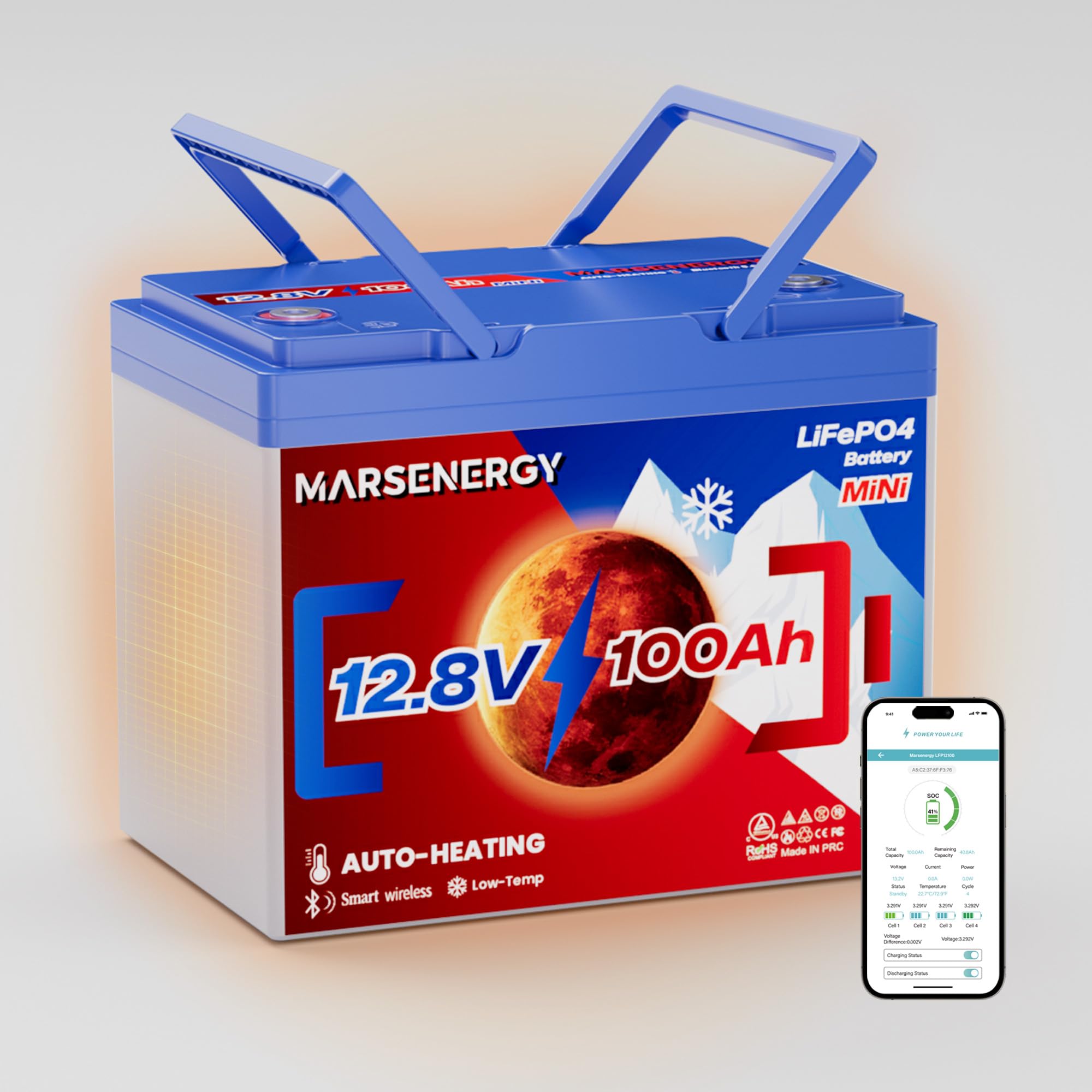
The winter-proof battery that heats its own cells so charging never stalls
Camping and fishing do not stop when the temperature drops, so the self-heating feature on this Marsenergy unit earns it a place strictly as the cold-weather pick. The built-in 60W heating system activates automatically between -4°F and 32°F, warming the cells so they can accept a charge instead of shutting off. Below -4°F the BMS cuts charging entirely to protect the cells.
The rest of the spec confirms the fit: 21 lb in a Group 24 footprint, dropping straight into Group 24, 27, and 31 boxes you already own. The cycle rating is stated as 4500 deep cycles at 100% depth of discharge, 8000 at 80%, and 15000 at 60% — the maker frames that as a 10-year lifespan and roughly ten times the service life of a lead-acid battery. Bluetooth monitoring covers voltage, current, state of charge, and temperature through a companion app.
The catch: heating draws 5A from the charger, so charging is slower in deep cold than in mild weather — a fair trade for being able to charge at all. Otherwise, owners describe constant power all day and easy installation. The trade-off is simply that self-heating is a specialist feature; if you never camp below freezing, you are paying for capability you will not use, and a lighter non-heated unit fits the same tray for less.
What it does best
- 60W heater keeps the cells chargeable down to -4°F
- 21 lb and a Group 24 fit works in 24, 27, and 31 boxes
- Bluetooth covers voltage, current, state of charge, and temperature
- 15,000 rated cycles at 60% depth of discharge
What to know
- Heating pulls 5A from the charger, slowing cold-weather charging
- The self-heating premium is wasted on warm-climate buyers
- Overkill if you only ever use it in mild weather
Right for: anyone camping, ice fishing, or living off-grid where winter charging is a real problem.
Overkill for: warm-climate buyers who will never see a 32°F morning and can save weight with a basic unit.
6. Power Queen 12V 100Ah Group 31 LiFePO4 Lithium Battery for RV, Marine
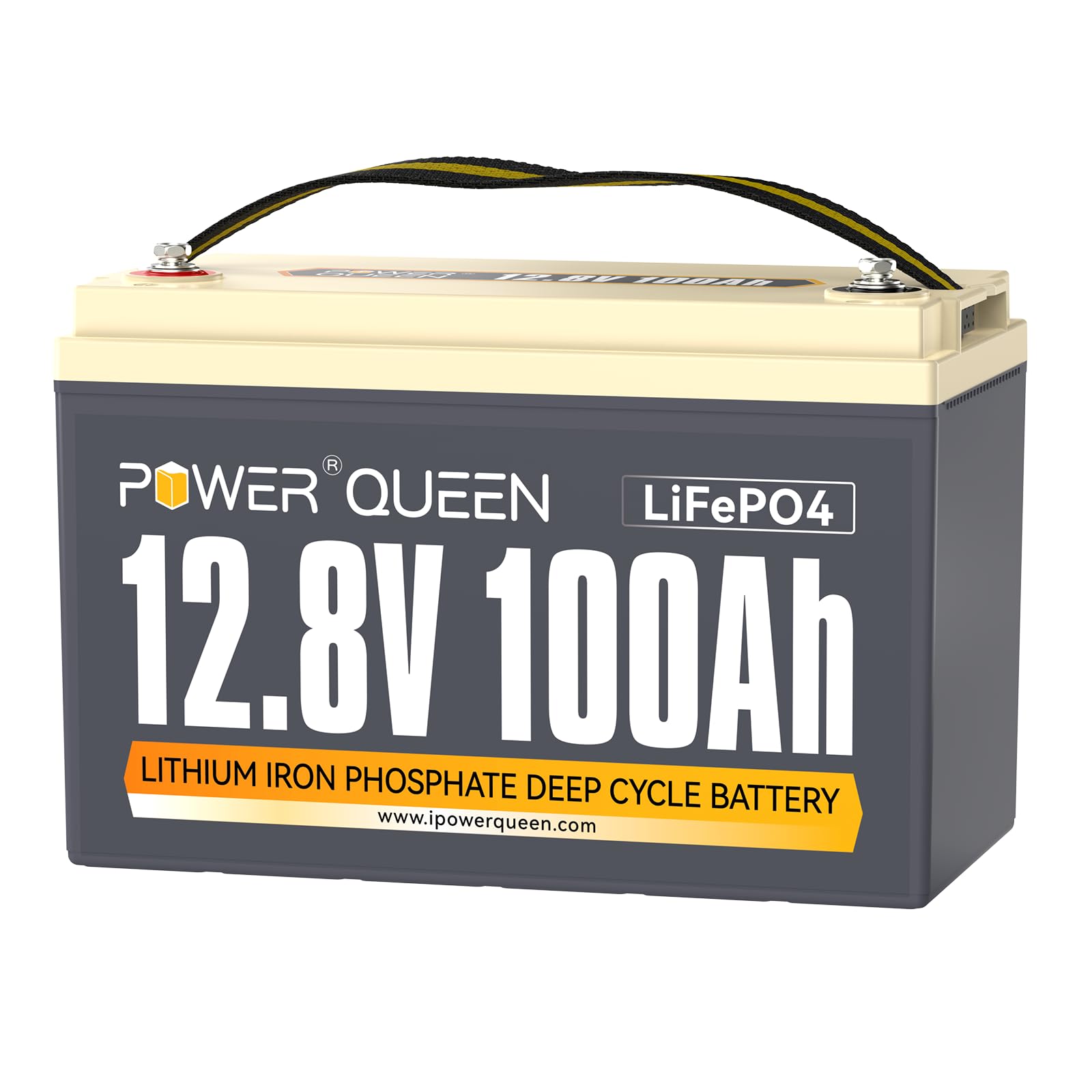
The workhorse RV battery that lets you bolt on more capacity as you grow
The defining trait here is expandability: this Group 31 unit supports 4S4P for a maximum of 51.2V 400Ah, which is 20.48kWh of storage you can scale into over time. That makes it a sensible backbone for an RV or solar build rather than a single-purpose battery. At 24 lb it is about a third the weight of the lead-acid equivalent, so lifting it into a tongue box is a one-person job.
Grade-A LiFePO4 cells deliver stable voltage, and the 100A BMS covers overcharge, over-discharge, short circuits, and overheat. The rated life claims are aggressive — the maker rates it at 13 times the cycles of lead-acid, three times the lifespan, and double the energy density, with 3% self-discharge. It suits 30-to-70-lb trolling motors as well as RV house loads.
What buyers love is the sheer reliability of the power, with a solid mid-tier value read. The one caveat worth knowing: the small 6mm terminal bolts have a 13mm head that some owners find prone to cross-threading if you stack multiple lugs, so be gentle when you wire it up. Battery life drew mixed feedback across the crowd, though the bulk of the experience is a battery that just keeps working. If you want a proven Group 31 that scales, this earns its spot.
Why it earns its place: 4S4P expandability means you can start with one and build a bigger bank without buying a different model.
Handle with care: the 13mm-head terminal bolts reward a light touch — cross-threading is the noted risk when stacking lugs.
Good for: RV owners and solar builders who want a Group 31 that grows with their system.
Think twice if: you are stacking lots of lugs on the terminals and would rather not fuss with small bolts.
7. Power Queen 12V 125Ah LiFePO4 Lithium Battery Group 27 Bluetooth for RV
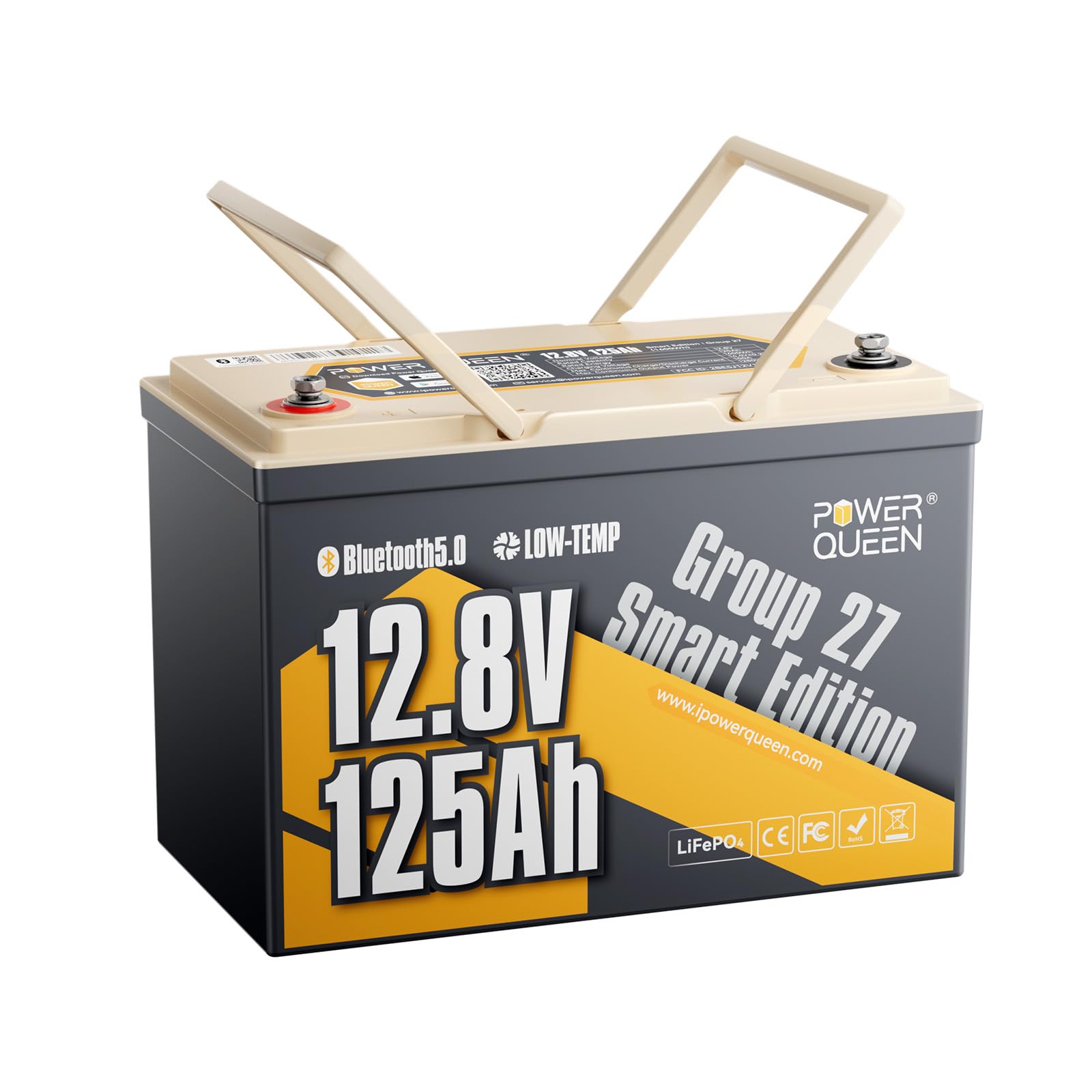
Extra amp-hours in a Group 27 shell for boats that stay out all day
For a pontoon or bass boat running electronics, graphs, and a trolling motor, that extra margin is the whole point.
Bluetooth 5.0 lets you read state of charge, voltage, current, power, temperature, and protection status on your phone, and remotely control discharge and power-off within 10 meters. The self-developed 20+ protection BMS includes low-temperature charge cut-off below 32°F and discharge cut-off below -4°F, and it auto-resumes power within 30s after overload protection. The 1600Wh pack supports 15,000 cycles per the maker, and it carries multi-international certifications including FCC, CE, RoHS, and UN38.3.
Runtime is what owners rave about — one owner ran a 45-lb thrust trolling motor for 16 hours on low settings. The niggle is the Bluetooth app itself, which has drawn the occasional report of connection hiccups even though the battery holds up. If you need the extra amp-hours and want Group 27 fit, this is a natural step up; if 100Ah already covers your trips, you are adding capacity you may not need.
Where the extra shows
- 125Ah in a Group 27 footprint — 320Wh more than a 100Ah unit
- Bluetooth 5.0 monitoring with 10-meter remote control
- Auto-resumes within 30s after overload protection
- Multi-certified: FCC, CE, RoHS, UN38.3
The fine print
- The Bluetooth app has drawn occasional connection complaints
- Energy-storage design — not for starting duty
- The extra capacity is wasted if 100Ah already covers your day
Suits: all-day boaters and RVers who need more than 100Ah in a familiar Group 27 size.
Pass if: you already have enough runtime at 100Ah and would rather not pay for headroom.
8. Redodo 12V 100Ah LiFePO4 Battery, Group 31, for RV, Marine
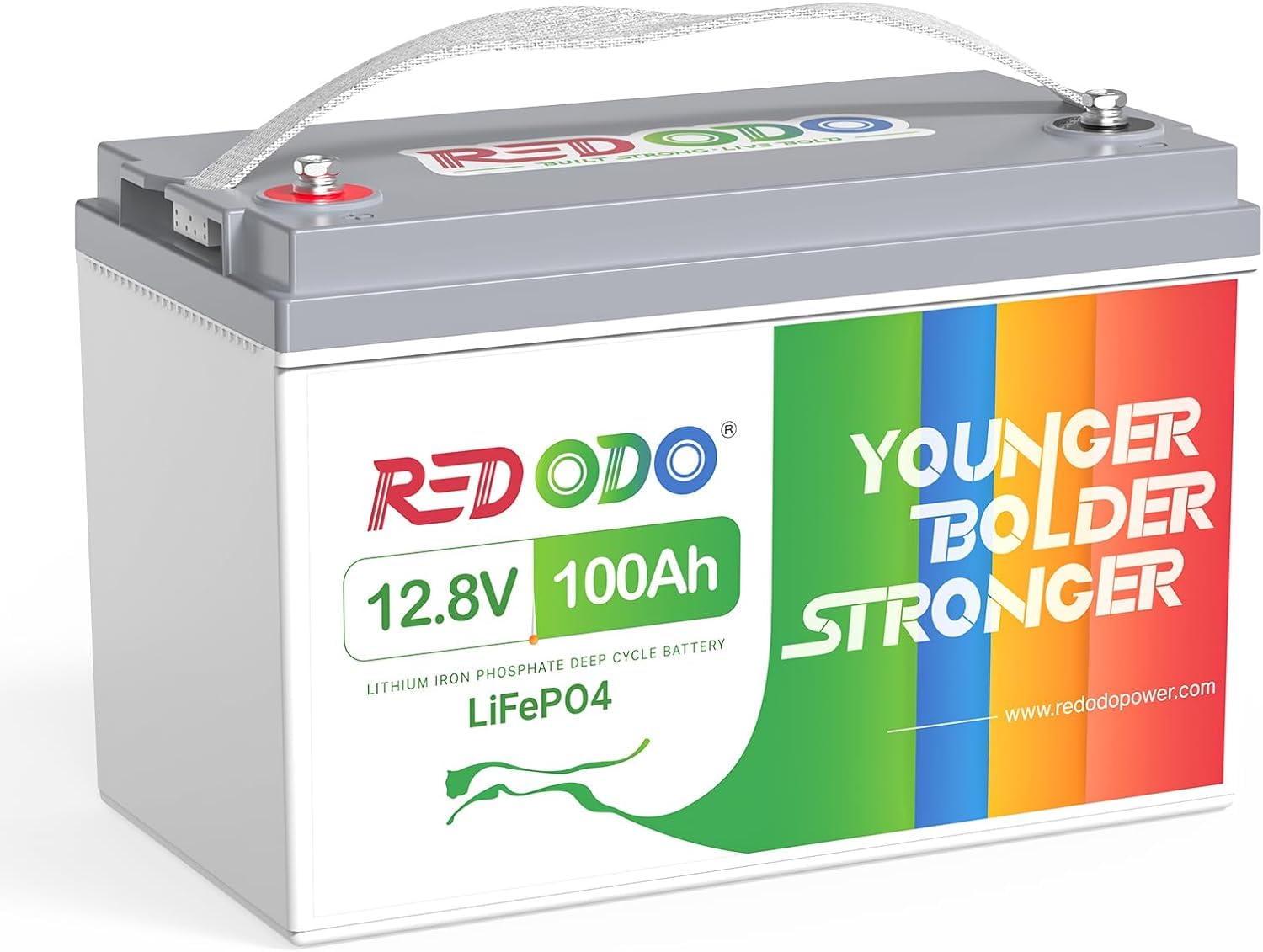
The affordable 100Ah that trades extra features for a straight value proposition
Redodo has built its name on being the inexpensive lithium option, and this Group 31 unit plays to that strength. It uses automotive-grade LiFePO4 cells with a stated 3% self-discharge rate, delivering 4000 cycles at 100% depth of discharge, 6000 at 80%, and 15000 at 60%. At 22 lb it suits a Group 31 box perfectly, and the maker says it weighs about 60% less than a same-capacity lead-acid battery.
Now the honest numbers: the spec sheet claims 58Wh/lb, against roughly 20Wh/lb for lead-acid, and a 100A BMS guards against overcharge, over-discharge, overcurrent, short circuits, and high temperature. The battery supports 4S or 4P expansion up to 400Ah or 51.2V, and charges four ways — a LiFePO4 charger, solar with a controller, alternator, or generator. The suggested trolling-motor range is 30 to 70 lb of thrust.
What earns it “budget champion” is the value read — it delivers the same 100Ah as pricier units without the premium. The trade-off buyers should know is on longevity variance: while many report multi-year service and 4000-plus cycles, some report a unit failing after a few years, and the warranty is a prorated discount rather than a flat replacement. It is a strong value for the money; just weigh the warranty terms against how hard you plan to run it.
The value case: 4000 cycles at 100% depth of discharge and 58Wh/lb energy density at an entry-level price point.
Know before you buy: the warranty is a prorated discount rather than a straight swap, so factor that in if you run your batteries hard.
Worth grabbing if: your priority is the lowest cost for a solid 100Ah and you are comfortable with a discount-style warranty.
Pay more instead if: you want a flat-replacement warranty and a longer consistent service record.
9. ECO-WORTHY EnergyRock 12V 280Ah Metal Case LiFePO4 Lithium Battery
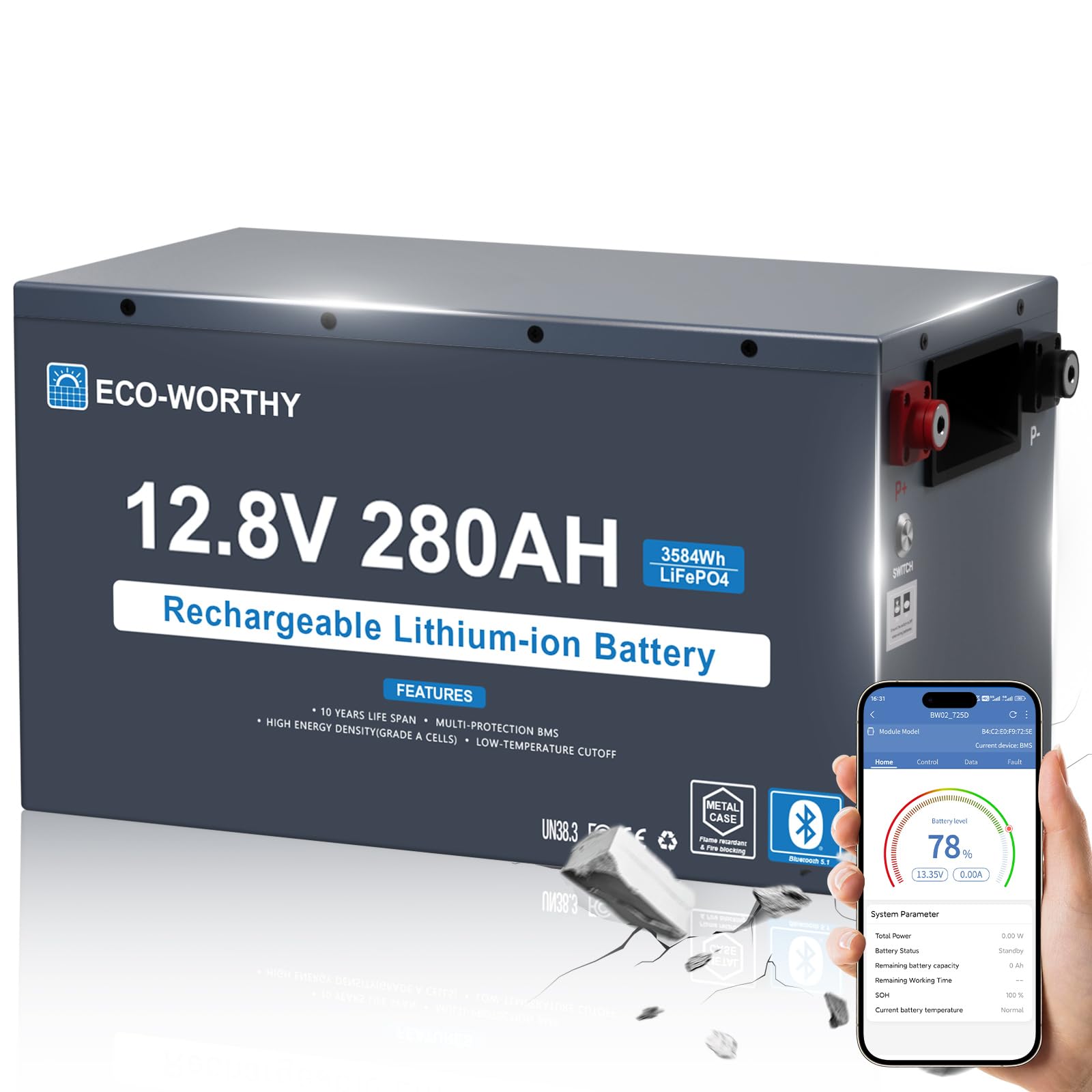
A metal-cased 280Ah power block built for vans and off-grid cabins
At 280Ah, this is the battery you buy when a single 100Ah will not run a fridge for days. The defining feature is the heavy-duty metal enclosure, with 4 mounting feet that let you bolt it directly inside an RV or camper without a separate battery box. The reinforced case and internal cell holders resist road vibration and impacts — a genuine advantage for vans and off-road rigs.
The safety switch is a small touch that pays off at install time: one press disconnects the discharge circuit, so you can work on the wiring without sparking. The built-in 200A BMS (which is double the amp ceiling of the 100A boards on the smaller picks) supports high-draw appliances and includes low-temperature protection that stops charging in the cold. Bluetooth lets you watch voltage, capacity, and charge status in real time.
The honest note from owners: at around 60-plus pounds this is a two-person lift, and one buyer simply returned it because of the weight. It is also slightly wider than standard batteries, so a small bracket modification may be needed in some trays. For the build quality and sturdiness it brings — frequently praised alongside its long runtime — that is a reasonable trade for a permanent install you will not move often.
What the metal case buys you
- No extra battery box needed — mounts with built-in feet
- 200A BMS handles high-draw appliances and inverters
- One-touch safety switch cuts output for safe maintenance
- Shock and vibration resistant for vans and off-road
Where it asks more
- Heavy enough to be a two-person lift
- Slightly wider than standard batteries — check your tray
- Overkill for a single 100Ah job
Made for: van builds, campervans, and off-grid cabins where you install the battery once and leave it.
Not for: anyone who wants a portable battery to move between jobs, or whose tray is already tight at standard width.
10. ECO-WORTHY 12V 314Ah LiFePO4 Lithium Battery Bluetooth with SOC LEDs
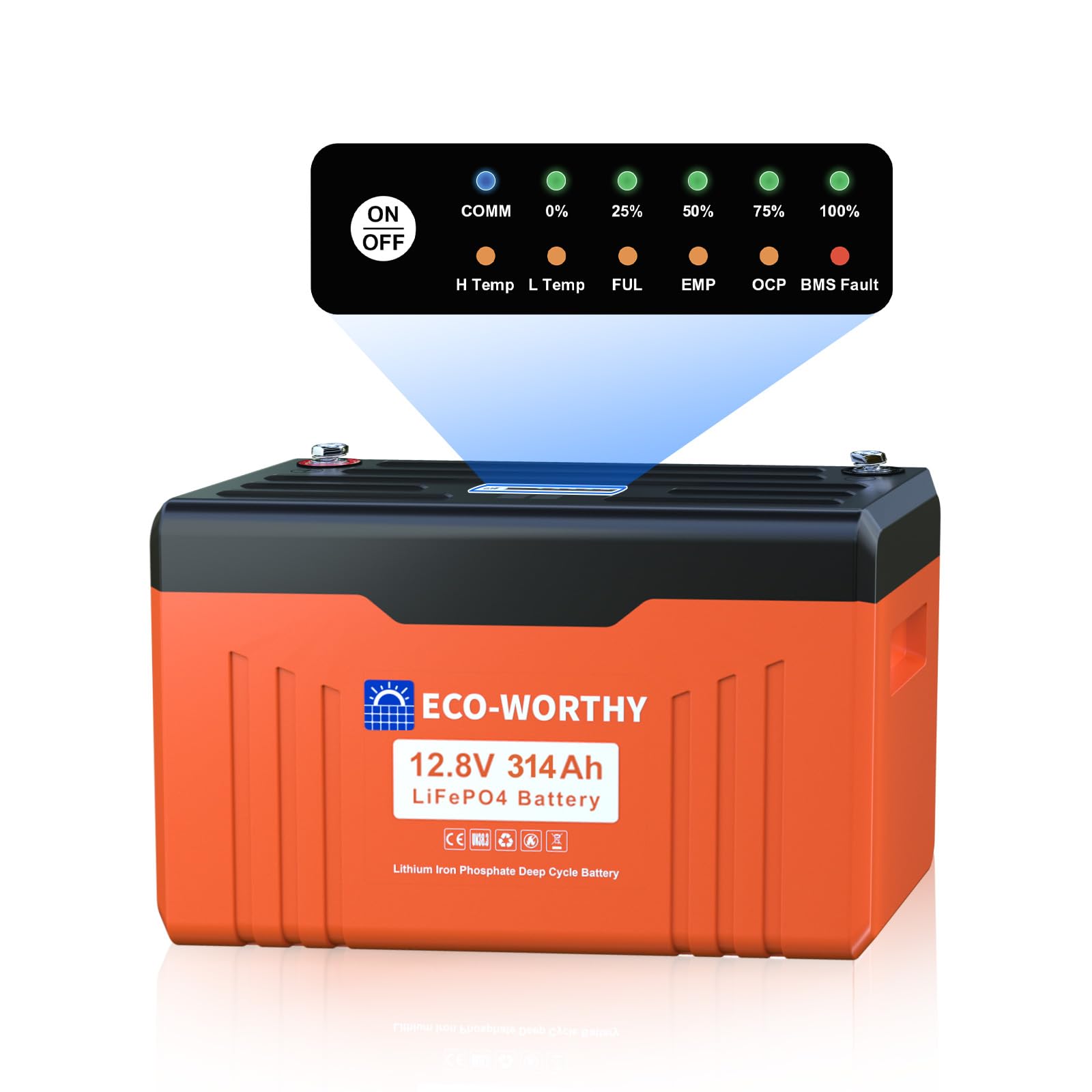
A 314Ah house battery with an on-board LED that shows state of charge at a glance
Home backup and extended off-grid living are what a 314Ah pack is for, and this ECO-WORTHY stores 4019.2Wh in a single unit. The maker upgraded it from 300Ah to 314Ah, keeping the same design. A built-in LED screen displays battery level and status so you can read the state of charge without opening an app, and a built-in buzzer alerts you to faults.
Expansion is flexible — it supports 4P2S or 2P4S for a total of 32.15kWh, enough to build a serious bank. The 200A BMS includes low-temperature protection that cuts charging below 19.4°F, plus high and low voltage, overload, and temperature protection. At 60.4 lb in a 16.3-inch-long case, it is lighter than other LiFePO4 batteries of similar capacity and about a third the weight of comparable lead-acid units. Grade-A cells are rated at more than three times the lifespan of lead-acid.
Where it gets honest: battery life, Bluetooth, and value all show mixed feedback, with some owners reporting the app shows inaccurate state-of-charge readings and occasional connection issues. The build quality and performance are the consistent high points. The 3-year warranty is shorter than the 5-year coverage on most of the smaller batteries here, which is worth weighing if long-term coverage matters to you. For raw storage in a home-backup role, the capacity per unit is hard to match.
The draw: 4019.2Wh in one box with an LED state-of-charge readout and expandability to 32.15kWh.
Factor in: a 3-year warranty (shorter than the 5-year norm here) and app-reported state-of-charge that some owners find inaccurate.
Choose it if: you want huge per-unit storage for a home-backup or big solar bank and value the on-battery LED display.
Reconsider if: you depend on app accuracy for daily decisions or want a longer warranty window.
11. DUMFUME 12V 600Ah LiFePO4 Lithium Battery Built-in 200A BMS
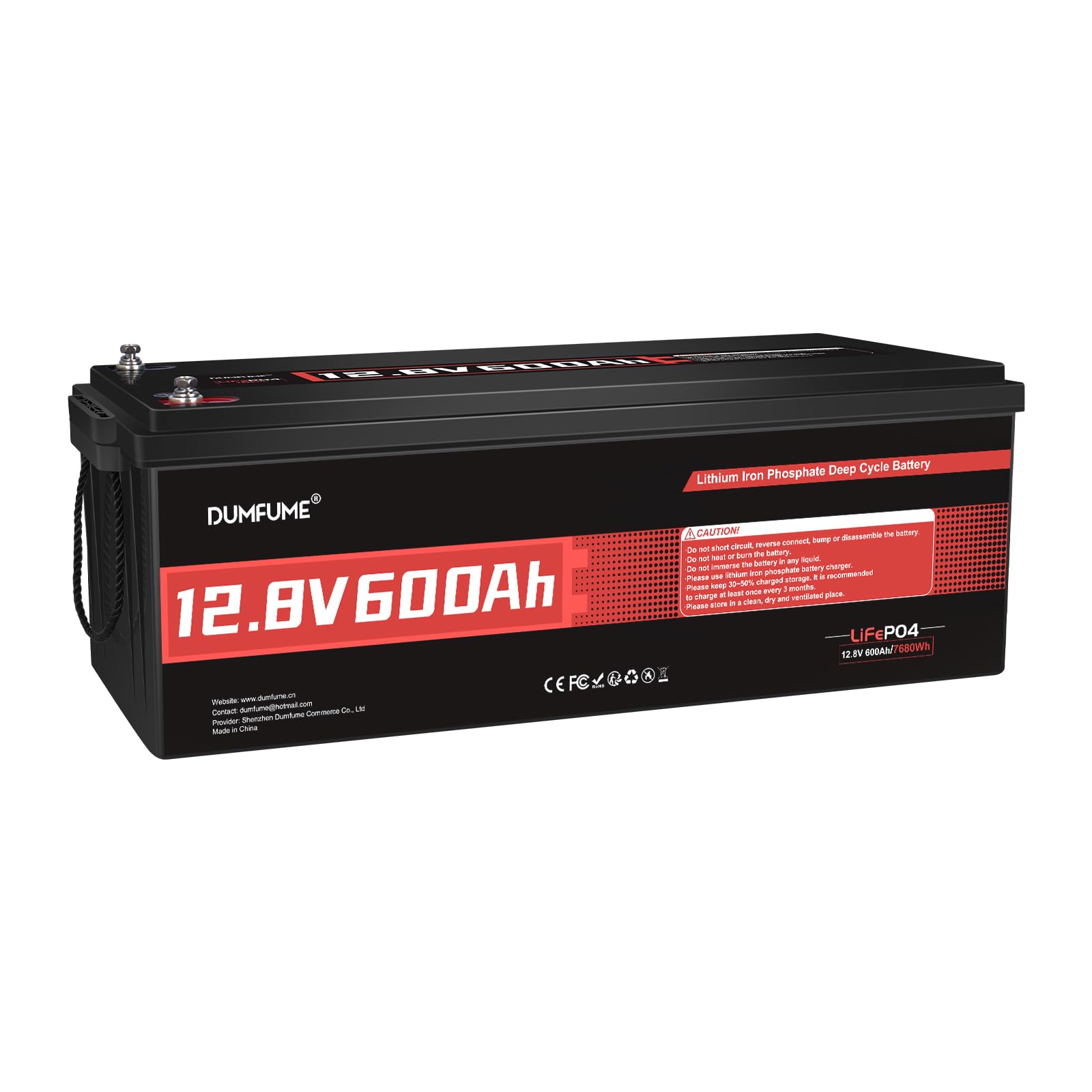
Enough stored energy to run a small home’s essentials through a rough day
The 600Ah rating packs 7.2 kWh of reserve (kilowatt-hours measure total energy stored) — the maker says that is about a day of lighting, fridge, and small-appliance use. At 107.8 lb it is the heaviest unit in this group by a wide margin, and the maker is upfront that a different model is often the smarter buy for a boat or camper where you would not want to move it. This is a stationary-storage battery.
The 200A BMS covers overcharge, over-discharge, over-current, overheating, and short circuits, and adds low-temperature cutoff that disconnects charging below 0°C and discharging below -20°C. The cells are rated at 4000-plus cycles at 100% depth of discharge, 6000 at 80%, and 15000 at 60%, rated for a 10-year service life. It supports parallel and series expansion to 24V or 48V for a larger bank.
The honest caveat is that charging capacity and battery life both show mixed feedback, and the maker notes that performance requires temperatures of 5°C or higher — low-temperature charging issues are explicitly excluded from return shipping. It also needs a charge/discharge cycle every six months to prevent damage from disuse, so it rewards owners who are engaged with their system rather than set-and-forget users. For sheer storage, though, few single batteries come close.
Built for scale
- 7.2 kWh of reserve in a single 600Ah unit
- 200A BMS with low-temperature cutoff at 0°C
- Expands to 24V or 48V for a bigger bank
- Rated 15,000 cycles at 60% depth of discharge
Know going in
- 107.8 lb — stationary use only
- Needs temperatures of 5°C or higher to perform
- Low-temp charging issues are excluded from return shipping
- Requires a cycle every six months to avoid damage from disuse
Made for: home-backup and off-grid banks that need massive stored energy in one stationary unit.
Look away if: you need something portable, camp in the cold, or want a battery you can simply leave for a year without checking.
Understanding the Specs
Usable amp-hours and watt-hours
Amp-hours (Ah) tell you how much charge the pack stores; watt-hours (Wh) tell you how much actual energy that equals, and the two are directly related. A 100Ah battery is 1280Wh, a 314Ah battery is 4019.2Wh, and a 600Ah battery is 7.2kWh. The number that matters for real use is usable capacity, and lithium delivers close to the full rated figure where lead-acid only gives up roughly half. That is why a straight 100Ah swap so often doubles your runtime without a bigger box.
BMS rating and low-temperature protection
The BMS (the internal protection board) sets how much current you can safely pull, so a 100A board suits most trolling motors and RV loads while a 200A board is the pick for high-draw inverters and appliances. Beyond current, the BMS guards against overcharge, over-discharge, overheating, and shorts. Many models also cut charging below freezing, since cold charging can damage lithium cells — some go further and add a built-in heater so the battery stays chargeable in winter. If you camp or fish in the cold, this single feature decides whether a battery works for you.
Group size and physical fit
Group 24, 27, and 31 are standard battery footprints, and matching yours means a drop-in swap with no new tray. Larger packs like a 280Ah or 314Ah unit often need their own dedicated space, and some come with a metal case that mounts directly with feet. Terminal layout matters too — front-facing terminals and the bolt size can make the difference between a five-minute install and an afternoon of wrestling with cables.
Cycle life and chemistry
Cycle life is the number of full charge-and-discharge rounds the battery is rated to survive, and LiFePO4 chemistry typically lasts far longer than lead-acid. Ratings here range from 4000 deep cycles at 100% depth of discharge up to 15,000 at lighter loads. Buying more cycles than you need is rarely worth it, but buying too few means replacing the battery sooner — the rated figure is the clearest signal of how long your investment holds up.
FAQ
Can I use a 12V LiFePO4 battery as a car starter battery?
How many amp-hours do I need for a trolling motor?
Is a 100Ah lithium battery really better than a 100Ah lead-acid battery?
What happens to a lithium battery in cold weather?
Can I connect two 12V lithium batteries to make 24V?
Do I need a special charger for a LiFePO4 battery?
How long will a 12V 100Ah lithium battery last?
Can I mount a lithium battery sideways or upside down?
How do I monitor the battery if it does not have Bluetooth?
Is the lighter battery always the better choice?
Final Thoughts: The Verdict
For most buyers, the lithium 12v battery winner is the Litime 12V 100Ah Trolling Motor LiFePO4 Battery because it pairs Bluetooth monitoring, 1280Wh of capacity, and 4000-plus rated cycles in a marine-ready IP65 package that suits the widest range of boats and RVs. If you want the longest rated cycle life at a value price, grab the GrenerPower 12V 100Ah Group 24. And for cold-weather charging that keeps working in winter, the Marsenergy Self-Heating 12V 100Ah is the one to reach for. One nudge before you commit: the Litime holds 4.7 stars across hundreds of owners and earns the most consistent reliability of the group, so if you are undecided, start there.
How We Picked
We do not accept paid placement. Every pick is matched to a real buyer and a real use-case; we do not hands-on test units.
Sources & Methodology
Specifications: manufacturer listings and product documentation. Review insights: verified customer reviews, as of September 2026. Pricing: not shown on this page (it changes often); check the current price via the retailer link.
As an Amazon Associate, Gadgets Feed earns from qualifying purchases. This does not affect which products we feature.