
Fog, nightfall, and heavy traffic turn a peaceful cruise into a high-stakes guessing game. A marine AIS (Automatic Identification System) transceiver or receiver is the only way to replace that guesswork with real-time vessel tracking, collision-avoidance data, and the confidence that other boats know exactly where you are.
I’m Min — the co-founder and writer behind Gadgets Feed. I spend hundreds of hours cross-referencing marine-electronics datasheets, NMEA 2000 protocol specs, and real-world range tests to separate true safety equipment from gear that just looks the part.
Whether you’re an offshore cruiser, a weekend angler, or a commercial operator, picking the right setup involves understanding transmit power, GPS integration, and NMEA compatibility. This guide breaks down the truly reliable best marine ais system choices on the market right now.
How To Choose The Best Marine AIS System
Choosing an AIS system for your boat isn’t just about finding a box that “talks to satellites.” You need to match the device’s transmit capability, integration method, and power requirements to your specific vessel and cruising area. Beginners often mistake a receiver-only AIS for a full transceiver, or they ignore the NMEA networking standard their chartplotter uses.
Transceiver vs. Receiver: The Core Safety Decision
A receiver-only AIS (like the one inside some VHF radios) lets you see other vessels on your display. A transceiver (Class B or Class A) broadcasts your boat’s MMSI, position, speed, and course to every ship within VHF range. For collision avoidance in busy harbors or low-visibility conditions, a transceiver is the only device that makes you visible. If you mostly operate in open water away from traffic, a quality receiver paired with a VHF radio might suffice.
NMEA 2000 vs. NMEA 0183: Network Your Data
Modern chartplotters and MFDs (Multi-Function Displays) typically use NMEA 2000, a plug-and-play backbone that carries GPS, wind, depth, and AIS data on a single cable. NMEA 0183 is an older point-to-point serial protocol. If your vessel has a NMEA 2000 network, an AIS transceiver with a built-in NMEA 2000 interface (like the Garmin AIS 800) installs cleanly. For older networks, a device supporting NMEA 0183 is necessary. A device that supports both protocols offers the most flexibility.
Power and Antenna: The Weak Link Most Overlook
A 2W or 5W Class B transceiver is only as effective as its antenna. A dedicated VHF antenna tuned to 162 MHz is ideal, but many installations share the radio antenna via a splitter, which introduces a small signal loss. The antenna should be mounted as high as practical, unobstructed by the mast or rigging. Also consider the unit’s own power draw: some transceivers pull over 1A during transmission, so ensure your house battery bank can handle the load during long passages.
Quick Comparison
On smaller screens, swipe sideways to see the full table.
| Model | Category | Best For | Key Spec | Amazon |
|---|---|---|---|---|
| Garmin AIS 800 | Class B Transceiver | Full two-way vessel tracking | NMEA 2000 with built-in GPS | Amazon |
| Icom M94D | Handheld w/ AIS-RX | Backup or tender AIS | 6W TX / AIS receiver | Amazon |
| Standard Horizon | Fixed VHF w/ AIS-RX | Integrated VHF + AIS | NMEA 2000 / 25W VHF | Amazon |
| Lowrance Link-9 | Fixed VHF w/ AIS-RX | NMEA 2000 network integration | DSC / AIS-RX / NMEA 2000 | Amazon |
| Icom M424G (Black) | Fixed VHF w/ GPS | Professional-grade VHF | MA-500TR compatible / IPX7 | Amazon |
| Icom M424G (White) | Fixed VHF w/ GPS | Professional-grade VHF | MA-500TR compatible / IPX7 | Amazon |
| Garmin dēzl OTR620 | Truck GPS Navigator | Commercial truck routing | 6-inch / custom truck routing | Amazon |
| Raceceiver TXPKG01 | Vehicle Transponder | Motocross timing | 0.0001 sec accuracy | Amazon |
| BTECH UV-50PRO | Ham Radio w/ APRS | Amateur radio position | 50W / GPS / APRS | Amazon |
In‑Depth Reviews
1. Garmin 010-02087-00 AIS 800 Class B Transceiver

The Garmin AIS 800 is a full Class B transceiver, meaning it both receives and transmits your vessel’s position, MMSI, speed, and course on VHF frequencies. With a built-in GPS receiver and native NMEA 2000 connectivity, it integrates directly into a modern MFD network without extra black boxes. The German-engineered hardware is noted for its reliable, low-latency performance in busy shipping lanes.
Installation is straightforward when you have a nearby NMEA 2000 backbone port; the unit automatically populates on your chartplotter’s AIS target list. Users report strong range performance with a properly mounted external VHF antenna. The requirement to use Garmin’s desktop software for initial MMSI programming is a minor inconvenience many overcome with the free tool available online.
For the cruiser who demands two-way visibility — not just the ability to see others — the AIS 800 is the gold standard. Its 5W transmit power ensures your signal reaches commercial traffic well before a crossing situation develops. The unit is also waterproof and built to survive the marine environment.
Why it’s great
- Full Class B transceiver makes you visible to all AIS-equipped vessels.
- Built-in GPS eliminates need for external position source.
- NMEA 2000 plug-and-play with compatible chartplotters.
Good to know
- Initial MMSI programming requires a laptop and software download.
- Does not include an internal VHF antenna splitter.
- Premium-tier investment compared to receiver-only options.
2. Icom M94D USA VHF Marine Transceiver with DSC & AIS Receiver

The Icom M94D packs an AIS receiver and a 6W VHF transmitter into a rugged, waterproof handheld body. It displays AIS target data directly on its screen, allowing you to see nearby vessel traffic even when you’re off the helm or using it as a backup to your fixed electronics. The 2400 mAh Li-ion battery delivers up to 10 hours of typical mixed use.
A standout feature is the Float’n Flash and MOB distress function: if the radio goes overboard, it floats upright and flashes an LED, and pressing the distress button sends a precise MOB signal via DSC. The 1500 mW internal speaker output ensures calls stay clear even in noisy engine compartments or windy cockpits.
For dinghy operators, kayakers, or as a ditch bag radio, the M94D is unmatched in its class. The AIS RX capability gives you a layer of situational awareness that standard handheld VHFs simply cannot provide. It is also an excellent bridge radio for inspecting the AIS network during a passage.
Why it’s great
- Built-in AIS receiver for vessel traffic awareness.
- Float’n Flash with MOB distress signaling.
- Class-leading 6W transmit power and loud audio.
Good to know
- AIS is receive-only — does not transmit your position.
- Limited range compared to a fixed-mount with external antenna.
- Verify the seller is an authorized Icom dealer for full warranty.
3. Standard Horizon Fixed Mount VHF/GPS/AIS/NMEA2000
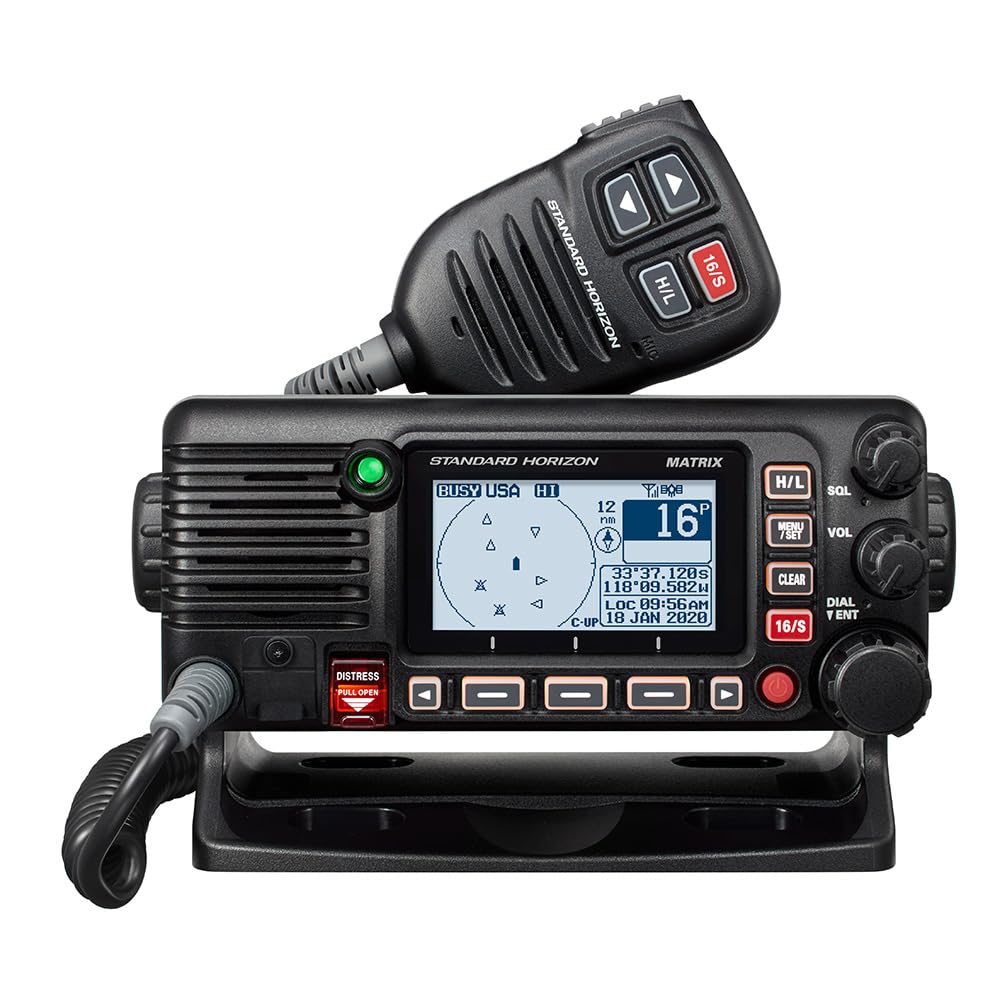
Standard Horizon delivers a fixed-mount VHF radio with a built-in AIS receiver, internal GPS, and full NMEA 2000 connectivity — all at a price that undercuts the Garmin equivalent by a significant margin. The radio displays AIS targets on its own screen and passes the data over NMEA 2000 to your chartplotter. Its 25W VHF output ensures reliable communication.
The unit is waterproof and comes with a three-year warranty, which is generous for its tier. The included mounting bracket, dust cover, and USB cable make the initial install hassle-free. Users have found the AIS target overlay to be responsive and clear, with no noticeable lag when multiple targets appear.
It is critical to note that the AIS functionality here is receive-only. If you need a transceiver, this unit does not transmit your position. However, for boaters who already have a VHF for transmitting and simply want AIS data displayed, this is the most cost-effective path to a fully integrated system.
Why it’s great
- Integrated AIS receiver, GPS, and VHF in one unit.
- NMEA 2000 connectivity for chartplotter integration.
- Excellent value: three-year warranty at a mid-range price.
Good to know
- AIS is receive-only — does not broadcast your vessel’s position.
- No dedicated AIS antenna port; shares VHF antenna.
- Limited to 66 channels.
4. Lowrance Link-9 VHF Marine Radio with AIS-RX

The Lowrance Link-9 is a stylish, high-contrast VHF radio with a large white dot-matrix LCD and a beige finish that matches older Lowrance displays. It includes a built-in AIS receiver and supports both NMEA 2000 and NMEA 0183 protocols, making it compatible with a wide range of network architectures. AIS targets appear directly on the radio’s screen and are passed to any connected chartplotter.
Installation is typical for a fixed mount, but users have noted the manual is sparse on details, especially regarding MMSI entry. The radio’s design is deliberately clean and minimal, and the suncover and flush-mount kit are appreciated touches. The audio quality is clear, and the DSC functionality works as expected once the MMSI is programmed.
Boaters building a full Lowrance ecosystem will appreciate the seamless integration. The dual-protocol support (NMEA 2000 and 0183) is a significant advantage for older vessels that have a mixture of equipment. Keep in mind that the AIS is for receiving only; for transmit capability you would need a separate transceiver.
Why it’s great
- Large, highly readable dot-matrix LCD display.
- Dual NMEA 2000 and NMEA 0183 connectivity.
- Clean design that pairs well with Lowrance displays.
Good to know
- AIS receiver only — does not transmit position.
- Manual lacks detailed setup guidance.
- Beige color may not match all modern dashboards.
5. ICOM M424G 21 Fixed Mount VHF Radio with Internal GPS

The ICOM M424G (Black) is a fixed-mount VHF radio that builds a dedicated AIS path through its compatibility with the MA-500TR AIS transponder, rather than including an internal AIS receiver. It does feature a built-in GPS for DSC emergencies and position display. The radio is IPX7 submersible and includes Icom’s Aqua Quake function to clear water from the speaker grill.
Reception clarity and range are hallmarks of Icom engineering — users consistently report superior sound quality and reliable communication at distances over 60 miles offshore. The dual/tri-watch function actively monitors channel 16 with an audible alert, a feature that missing from some competitors. The optional remote handset is a robust wired solution that outperforms wireless alternatives in noisy pilothouses.
This radio is for the mariner who wants a bombproof VHF first, with the option to add a full AIS transponder later. It is not an all-in-one AIS solution, but rather a professional-grade communication platform that connects to one. If you already own or plan to buy an MA-500TR, this pairing is unbeatable.
Why it’s great
- Professional-grade Icom build quality and reception.
- Direct compatibility with Icom MA-500TR AIS transponder.
- IPX7 submersible and Aqua Quake drain feature.
Good to know
- No built-in AIS receiver — requires external transponder.
- NMEA connections are exposed unless flush-mounted.
- Flush mount kit installation is reportedly fiddly.
6. ICOM IC-M424G 22 Fixed Mount VHF Radio with Internal GPS
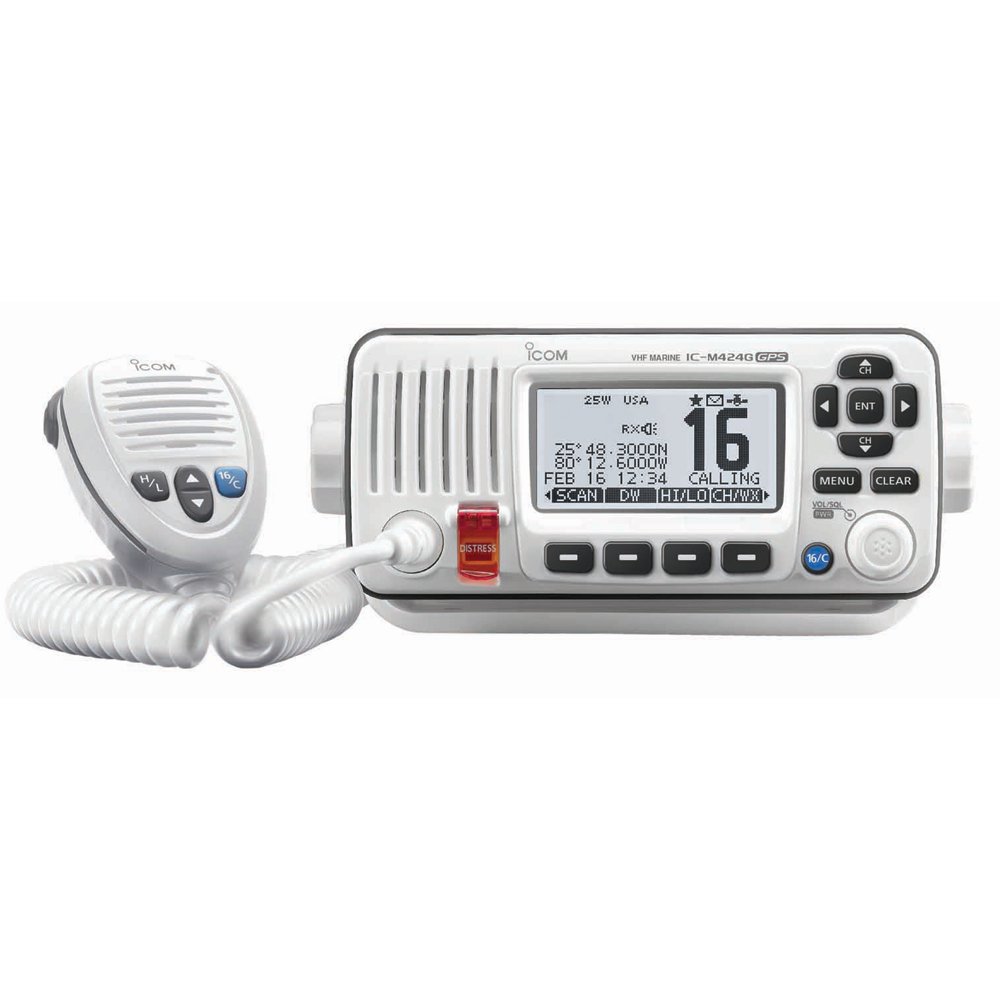
The IC-M424G 22 is essentially the same radio as the black M424G but finished in white. It shares the same core specs: built-in GPS, IPX7 submersible rating, Aqua Quake, and compatibility with the MA-500TR AIS transponder. The white finish is a better match for lighter-colored dashboards and helm stations.
Like its sibling, the M424G 22 offers exceptional VHF reception and audio clarity. The noise-canceling microphone works well in high wind, and the ability to route the speaker audio through the remote mic is a practical feature for noisy environments. The unit supports 22 channels and covers the full marine VHF band.
For boaters who prefer a white instrument panel aesthetic, this is the identical choice with a cosmetic difference. The same caveats apply: no built-in AIS receiver, and the exposed connectors should be protected from weather. It remains a top-tier VHF radio that serves as the foundation for a future AIS transponder upgrade.
Why it’s great
- Same professional Icom performance in a white enclosure.
- Built-in GPS for accurate DSC positioning.
- Excellent audio and noise cancellation.
Good to know
- No internal AIS receiver or transponder.
- Weather exposure risk for connector wires if not flush-mounted.
- Learning curve for programming all features.
7. Garmin dēzl OTR620 Truck Navigator

The Garmin dēzl OTR620 is a dedicated GPS navigator for heavy trucks, not a marine AIS device. It specializes in commercial vehicle routing based on truck size, weight, and cargo type, with alerts for bridge heights, sharp curves, and low-clearance hazards. Its 6-inch touchscreen offers high-resolution mapping with BirdsEye satellite imagery for destination preview.
The device leverages the dēzl community to share truck parking availability, loading dock locations, and preferred routes. It also integrates with the dēzl smartphone app for wind speed weather overlays, PrePass weigh station notifications, and CAT Scale locations. The split-screen view of upcoming turns is highly practical for navigating tight urban deliveries.
If you are a commercial trucker looking for a purpose-built navigation tool, the OTR620 is a fantastic choice. However, it does not transmit or receive AIS data and is not suitable for marine navigation. It is included here for truckers who also operate vessels and want a single-brand ecosystem.
Why it’s great
- Custom truck routing by height, weight, and width.
- Community-shared parking and loading dock data.
- High-res 6-inch display with satellite overlay.
Good to know
- Not a marine AIS device — no vessel tracking.
- Requires smartphone app for some features.
- Limited to road navigation only.
8. Raceceiver Transponder Package TXPKG01

The Raceceiver TXPKG01 is a dedicated race timing transponder used for motocross and off-road racing. It is not a marine AIS system. Each transponder is assigned a unique ID that is read as the vehicle passes over a loop antenna, giving race organizers sub-millisecond crossing time accuracy. The package includes a mount pouch and charger.
The device is small, lightweight, and durable enough to survive being bounced through a dirt track. Users report excellent reliability, with the transponder consistently being picked up by timing systems at major tracks. The 0.0001 second measurement accuracy is far beyond what any marine AIS system requires.
This transponder is included here for completeness as a different category of vehicle identification system. If you need a marine AIS transceiver for your boat, look at the Garmin or Icom options above. If you race dirt bikes or cars, the Raceceiver is the correct tool.
Why it’s great
- Extremely accurate 0.0001 second timing.
- Rugged and small enough for racing use.
- Works with My Race Pass timing systems.
Good to know
- Not for marine AIS use — different category.
- Requires specific loop antenna and decoder.
- No GPS or position broadcasting capability.
9. BTECH UV-50PRO 50W Dual Band Mobile Ham Radio
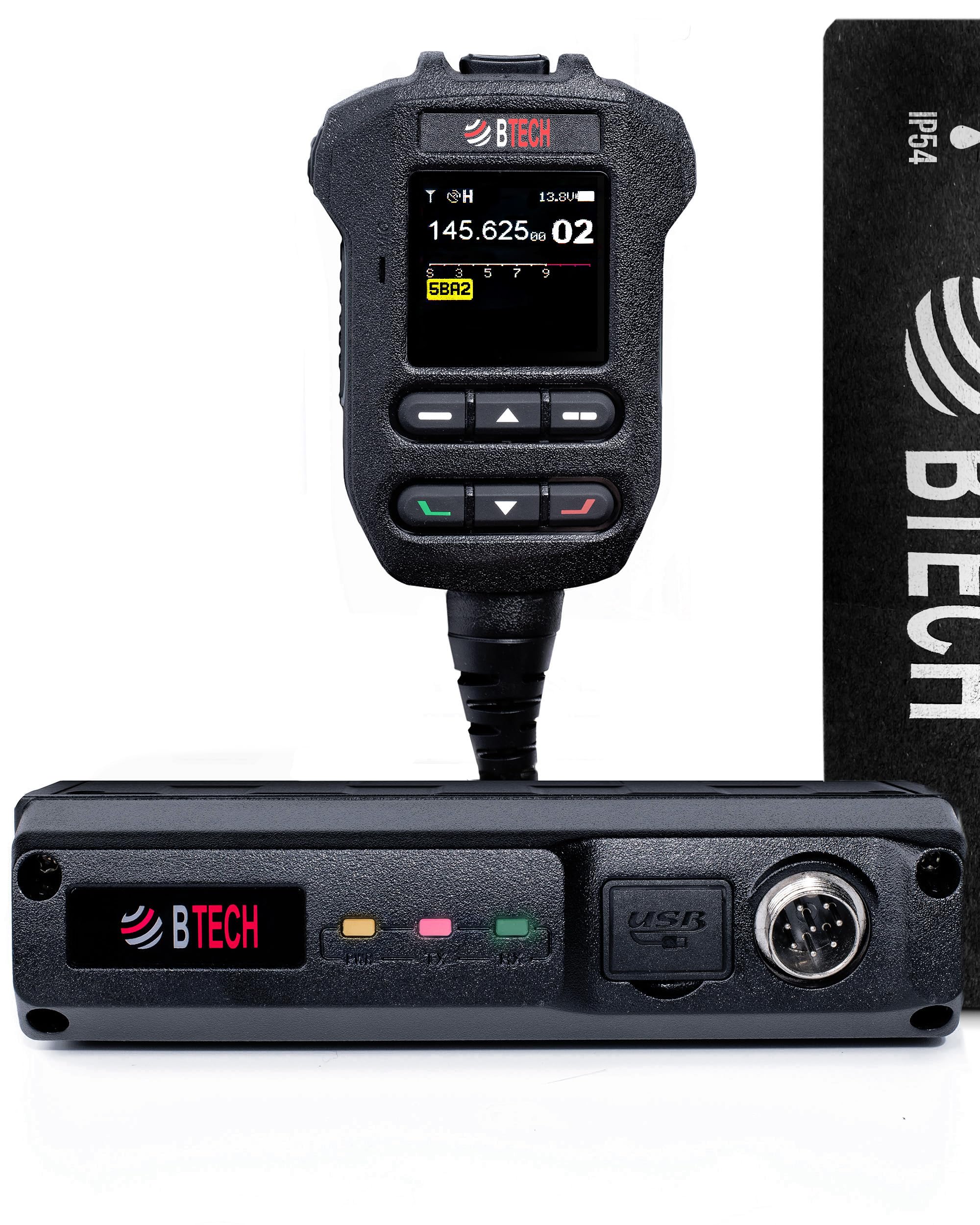
The BTECH UV-50PRO is a 50W dual-band amateur radio transceiver with built-in GPS and APRS (Automatic Packet Reporting System) capability. It is not a marine AIS system. APRS allows the radio to transmit GPS position packets on the amateur bands, but this data is not recognized by marine AIS receivers or the commercial shipping traffic. The radio requires an amateur radio license to operate.
The UV-50PRO features Bluetooth app programming via iOS/Android, AI noise reduction for vehicle and loud environments, and satellite tracking tools. The APRS implementation includes smart beaconing, Mic-E support, and destination settings. Output power measured 54W on VHF and 48W on UHF, exceeding its rated 50W specification.
For licensed hams who want a powerful mobile rig with APRS position reporting, the UV-50PRO is a compelling budget-friendly option. However, it is not a substitute for a marine AIS system and cannot communicate with the maritime AIS network. Boat operators should use proper marine-class gear.
Why it’s great
- High 50W transmit power for extended range.
- Built-in GPS and APRS for position tracking.
- AI noise reduction improves audio clarity.
Good to know
- Requires amateur radio license to transmit.
- APRS is not AIS — incompatible with marine networks.
- Documentation is poor; programming app can be buggy.
FAQ
What is the difference between AIS Class A and Class B?
Can I use a marine AIS system without a VHF radio?
Does my boat need an MMSI number for AIS?
Will AIS work if my GPS signal is lost?
Final Thoughts: The Verdict
For most users, the best marine ais system winner is the Garmin AIS 800 Class B Transceiver because it offers full two-way visibility with native NMEA 2000 integration and reliable German engineering. If you want a portable backup with AIS receiving capability, grab the Icom M94D handheld. And for the budget-conscious cruiser who needs AIS data displayed on an existing chartplotter, nothing beats the value of the Standard Horizon fixed-mount VHF with AIS-RX.