
Our readers keep the lights on and my morning glass full of iced black tea. As an Amazon Associate, I earn from qualifying purchases.
Nothing ruins a day on the water faster than a dead trolling motor or a starter that struggles to turn over. A marine boat battery faces a uniquely hostile environment: constant vibration, deep discharges, salt spray, and extreme temperatures. Choosing the wrong chemistry or capacity means swapping batteries every season or getting stranded miles from the ramp.
I’m Min — the co-founder and writer behind Gadgets Feed. I’ve spent countless hours analyzing technical specifications, customer endurance reports, and cycle-life data across dozens of marine battery models to identify which ones actually deliver on their promises for boaters and anglers.
This guide breaks down the critical specs — reserve capacity, cold cranking amps, cycle life, and chemistry trade-offs — so you can confidently choose the best marine boat batteries for your vessel and budget.
How To Choose The Best Marine Boat Batteries
Selecting the right marine battery starts with understanding your boat’s electrical demands. A starting battery needs high cold cranking amps (CCA) for a brief burst to turn over an engine, while a deep-cycle battery delivers steady power over hours for trolling motors, fish finders, and house loads. Dual-purpose batteries split the difference but rarely excel at either extreme. Your choice between flooded lead-acid, AGM, and lithium LiFePO4 directly impacts weight, lifespan, maintenance, and upfront cost.
Chemistry: AGM vs. Lithium LiFePO4
AGM batteries remain the budget-friendly standard for marine use. They are spill-proof, vibration-resistant, and require no water refills. However, they typically deliver 300 to 500 cycles at 50% depth of discharge and weigh significantly more — a Group 31 AGM often exceeds 60 pounds. Lithium LiFePO4 batteries, while costing more upfront, provide 4,000 to 8,000 cycles, weigh roughly 60% less than AGM equivalents, and maintain stable voltage until nearly fully discharged. The weight savings alone improve fuel efficiency and boat handling for smaller vessels and kayaks.
Capacity and Reserve Capacity
Amp-hours (Ah) tell you how much energy the battery stores, but reserve capacity (RC) measures how long it can hold a steady load — critical for running electronics or a trolling motor when the engine is off. Look for RC ratings of 100 minutes or more for reliable all-day fishing. Lithium batteries also offer superior usable capacity: you can safely discharge LiFePO4 to 20% state of charge, whereas AGM batteries should not go below 50% to avoid permanent damage. This effectively doubles your usable watt-hours for the same rated Ah.
Cold Cranking Amps (CCA) for Starting
If your battery must start an outboard or inboard engine, CCA is non-negotiable. Marine engines typically require 600 to 900 CCA depending on displacement and climate. AGM dual-purpose batteries like the Optima BlueTop deliver strong CCA ratings while offering some deep-cycle capability. Pure deep-cycle lithium batteries often provide lower surge current, but dedicated dual-purpose lithium models with high peak current ratings — like the NOCO NLX27 — now match or exceed AGM starting performance.
Physical Size and Terminal Configurations
Marine battery trays follow standard BCI group sizes: Group 24, Group 27, and Group 31 are the most common. Always measure your existing tray and check terminal orientation — marine terminals (stud or dual SAE/post) provide more secure connections in high-vibration environments than automotive top posts. Ensure your chosen battery includes a leak-proof or IP-rated case for bilge or deck mounting where saltwater exposure is possible.
Quick Comparison
On smaller screens, swipe sideways to see the full table.
| Model | Category | Best For | Key Spec | Amazon |
|---|---|---|---|---|
| Litime 12V 100Ah TM | Lithium | Trolling motor endurance | 4000 cycles @ 100% DOD | $309.99Amazon |
| Dyness 12V 100Ah Mini TM | Lithium | Compact trolling motor setup | 25% smaller than Group 31 | $182.99Amazon |
| HRBEENERGY 12.8V 100Ah | Lithium | Versatile RV/boat/marine | 8000+ cycles, IP67 case | $149.99Amazon |
| NOCO Lithium NLX27 | Lithium | Dual-purpose starting & deep-cycle | 1400A peak / 100Ah | Amazon |
| DUMFUME 12V 150Ah | Lithium | High-capacity solar/RV backup | 150Ah / 1920Wh capacity | $182.55$192.96Amazon |
| Newport 12V50Ah AGM | AGM | Lightweight kayak/canoe trolling | 32 lbs / 50Ah capacity | $129.99Amazon |
| Weize Group 31M AGM | AGM | Dual-purpose starting & house power | 825 CCA / 240 RC | Amazon |
| OPTIMA 34M BLUETOP | AGM | High-vibration starting battery | 800 CCA, SpiralCell design | Amazon |
| OPTIMA D31M BLUETOP | AGM | Heavy-duty starting & deep-cycle | 900 CCA / 155 min RC | Amazon |
In‑Depth Reviews
1. Litime 12V 100Ah Trolling Motor LiFePO4 Battery

The Litime 12V 100Ah TM is purpose-built for trolling motors and it shows in the real-world results. Weighing just 22.16 pounds in a standard Group 31 footprint, this LiFePO4 battery shaves roughly 38 pounds off a comparable AGM setup — a difference you feel instantly in kayak tracking and jon boat planing. The built-in TVS diode protects 12V-36V motors from voltage spikes common in rough water. With 4000 cycles at 100% depth of discharge, it lasts ten years or more under normal fishing use, which works out to a fraction of the cost per cycle of any lead-acid alternative.
In field use, anglers report running a 45lb thrust trolling motor for eight hours and returning with the battery still nearly fully charged. The smart BMS includes low-temperature charge protection that cuts off below 32°F and discharge protection below -4°F, preventing cold-weather damage. It also meets the ABYC E-13 standard for marine electrical systems, adding an extra layer of safety against salt spray and vibration. You can expand the bank to 4P4S configuration for up to 20.48kWh of storage if your power needs grow.
The main consideration is that this battery lacks active cell balancing internally; some users solved this with a multibank lithium charger and manual disconnects. Additionally, units sometimes ship in sleep mode and require a force-charge wake-up — a quick process with a NOCO or similar lithium-compatible charger. For the price, this is the best balance of cycle life, weight savings, and marine-specific features for serious anglers.
Why it’s great
- Ultra-light at 22 lbs transforms boat handling
- 4000+ cycles at 100% DOD outlasts AGM 10x over
- TVS diode protects trolling motor electronics from spikes
- ABYC E-13 certified for marine safety
Good to know
- No internal cell balancing; needs external lithium charger for optimal performance
- May arrive in sleep mode requiring force-charge activation
- Not designed for engine starting despite high cycle life
2. Dyness 12V 100Ah LiFePO4 Battery Mini TM
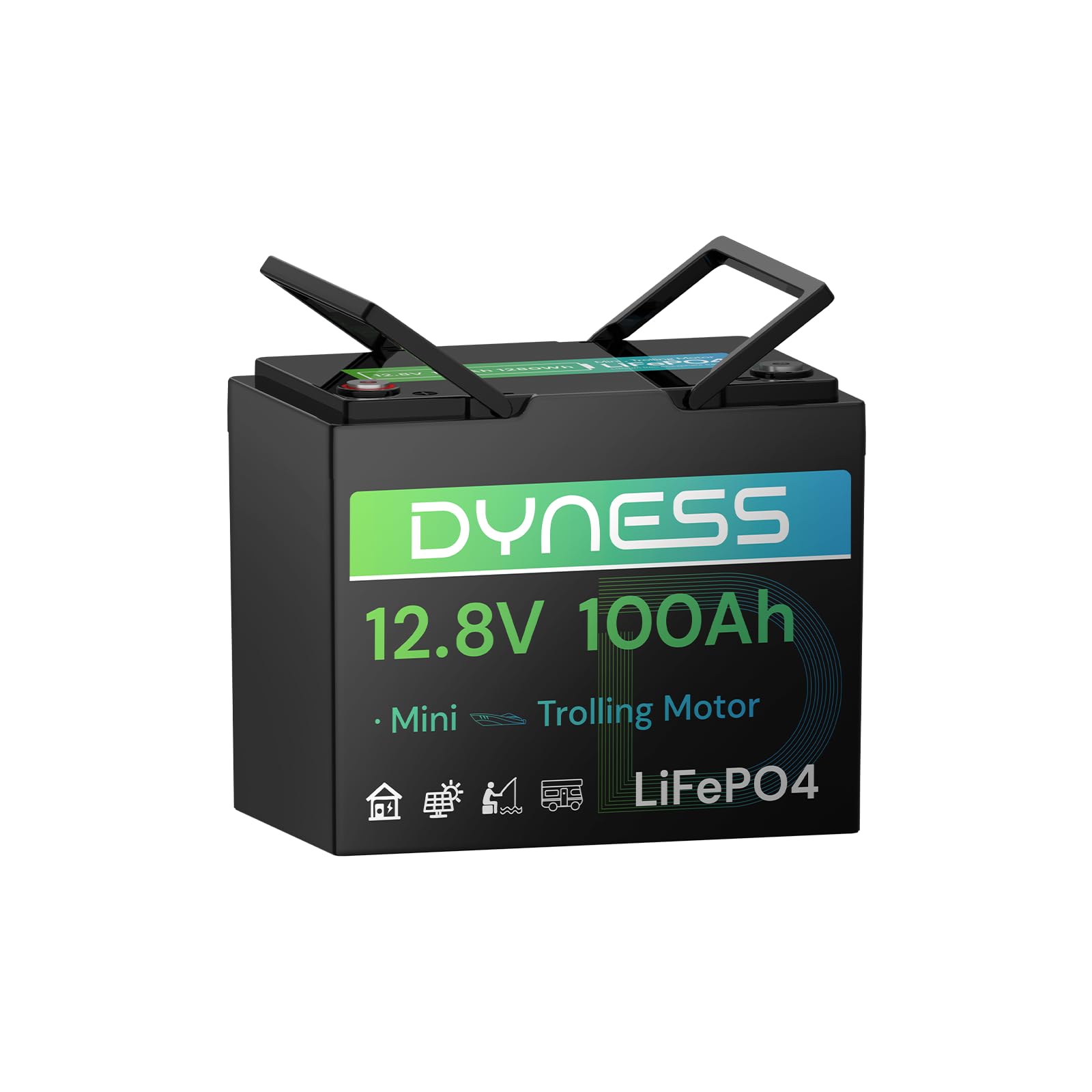
The Dyness Mini TM is engineered specifically for 30-68lb trolling motors and it prioritizes footprint above all else. At 10.2 x 6.6 x 8.2 inches and 20.9 pounds, it is 25% smaller than a standard Group 31 battery, freeing up critical deck space for gear coolers, tackle boxes, or extra rods. The IP65-rated waterproof and dustproof case shrugs off splashes and rain without concern, and the low-temperature charge protection automatically halts charging below 32°F (0°C), resuming only above 41°F — vital for early-season anglers in northern climates.
With premium A+ grade cells, Dyness claims 6000+ deep cycles and a ten-year lifespan — six times longer than standard lead-acid. In practice, kayak fishermen report running a 38lb Minn Kota for an entire day without dropping below 50% charge. The battery supports series and parallel connections up to 4S4P, allowing you to build a 20.48kWh storage system as your needs expand. It comes certified to FCC, CE, RoHS, and UN38.3 standards, so you are getting independently tested cells.
The trade-off is capacity: at 100Ah, this battery is best suited for day trips rather than multi-day off-grid setups. For optimal charging speed, Dyness recommends using a dedicated LiFePO4 charger (sold separately). Some users noted that the battery holds steady voltage until nearly depleted, so you will want a battery monitor with a state-of-charge readout rather than relying on voltage alone to avoid surprise cutoffs.
Why it’s great
- Smallest marine 100Ah form factor on this list — ideal for tight compartments
- IP65 waterproof/dustproof rating handles salt spray and rain
- 6000+ deep cycles with A-grade LiFePO4 cells
- Low-temp charge protection prevents cold-weather damage
Good to know
- 100Ah capacity limits multi-day off-grid usage
- Requires specific LiFePO4 charger for fastest refueling
- Flat voltage curve demands a battery monitor for accurate state-of-charge
3. HRBEENERGY 12.8V 100Ah LiFePO4 Battery

The HRBEENERGY 12.8V 100Ah delivers an exceptional value proposition: an IP67 waterproof case with 8000+ cycles at a price that undercuts many premium lithium brands. At only 19.4 pounds, it saves nearly 30 pounds over an equivalent AGM battery, and the Group 24 form factor drops directly into existing trays without modifications. The built-in 100A smart BMS covers overcharge, overdischarge, overcurrent, short circuit, and low/high-temperature cutoff — so the battery protects itself even in demanding marine environments.
Boaters report impressive real-world runtime: a 30lb Minn Kota trolling motor ran for three hours at moderate thrust and barely drained 30% of capacity. The battery supports parallel expansion up to 16 units for a total of 20480Wh, making it a viable candidate for solar-equipped RVs or larger house banks. The 1280Wh total capacity translates to over 106 hours for a 12W lamp or 2.5 hours for a 500W heater, depending on your draw.
The downsides center on documentation. The manual is sparse, and some users noted that the low-voltage cutoff activates around 9.5V rather than the typical 10V for LiFePO4, with the BMS re-enabling after a few minutes in a cycle that can be confusing. This unit is best paired with a quality LiFePO4 charger that communicates properly with the BMS to avoid unnecessary cutoffs. For the price-per-cycle, however, this is hard to beat.
Why it’s great
- IP67 waterproof case withstands direct splash and hose-down cleaning
- Exceptionally light at 19.4 lbs for a 100Ah marine battery
- 8000+ cycles at moderate DOD delivers decade-long lifespan
- Expandable to 16 batteries in parallel for large power systems
Good to know
- Low-voltage cutoff cycles at ~9.5V can confuse BMS behavior
- Sparse documentation leaves some setup questions unanswered
- Requires compatible LiFePO4 charger for optimal performance
4. NOCO Lithium NLX27 12V 100Ah
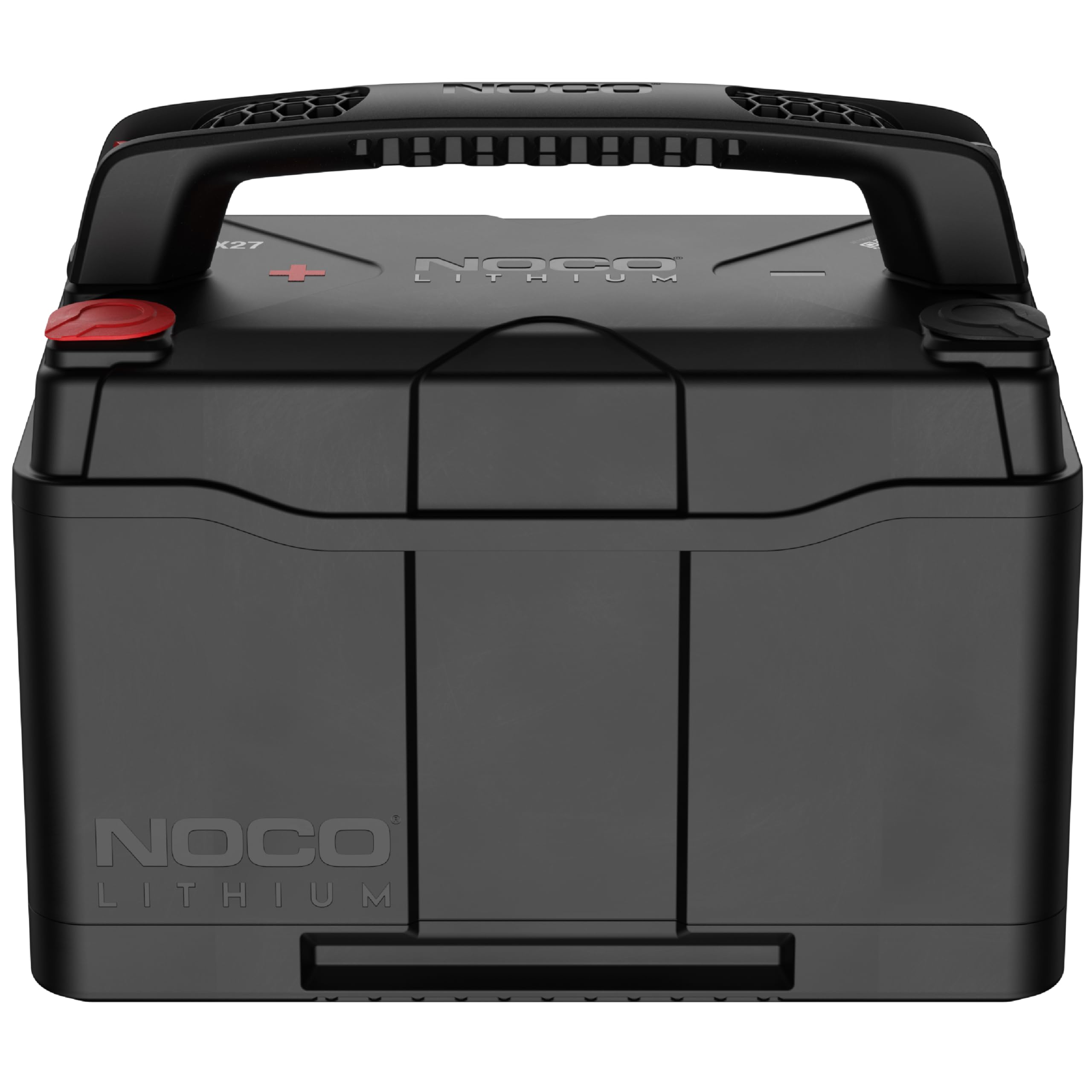
The NOCO NLX27 shatters the traditional lithium limitation by delivering true dual-purpose capability: 1400 peak amps for engine starting alongside 100Ah of deep-cycle capacity. This is a Group 27 drop-in replacement that weighs 33.2 pounds — about half what a comparable lead-acid setup would weigh — and it charges fully in just two hours with a 50A input. The quad-post terminal layout includes threaded, SAE, and button head posts, giving you maximum flexibility for wiring both starting and house circuits.
The dynamic BMS features bidirectional cell balancing and active thermal monitoring with no reset required after protection events — a significant upgrade over cheaper lithium batteries that lock out and require manual intervention. NOCO backs this with a five-year warranty and UL listing, which adds confidence for permanent marine installations. In real-world use, boaters report effortless starts on 3-cylinder Kubota diesels and high-end audio systems that would flatten a standard AGM in minutes.
The catch is the price — this is the most expensive battery on this list, and the premium buys you dual-purpose flexibility that pure deep-cycle lithium batteries cannot match. Some users noted fitment issues in vehicles with fixed wiring harnesses that reduced vertical clearance by a quarter-inch. If you need a single battery to both start your outboard and power your electronics, the NLX27 eliminates the need for a separate house bank, which justifies the investment.
Why it’s great
- True dual-purpose: 1400A starting + 100Ah deep-cycle in one battery
- 2-hour recharge at 50A is twice as fast as lead-acid
- Quad-post terminals fit any wiring configuration
- UL listed with 5-year warranty for peace of mind
Good to know
- Highest upfront cost of any battery reviewed
- Group 27 height may cause fitment issues in tight compartments
- Some users reported dead-on-arrival units requiring replacement
5. DUMFUME 12V 150Ah LiFePO4 Battery
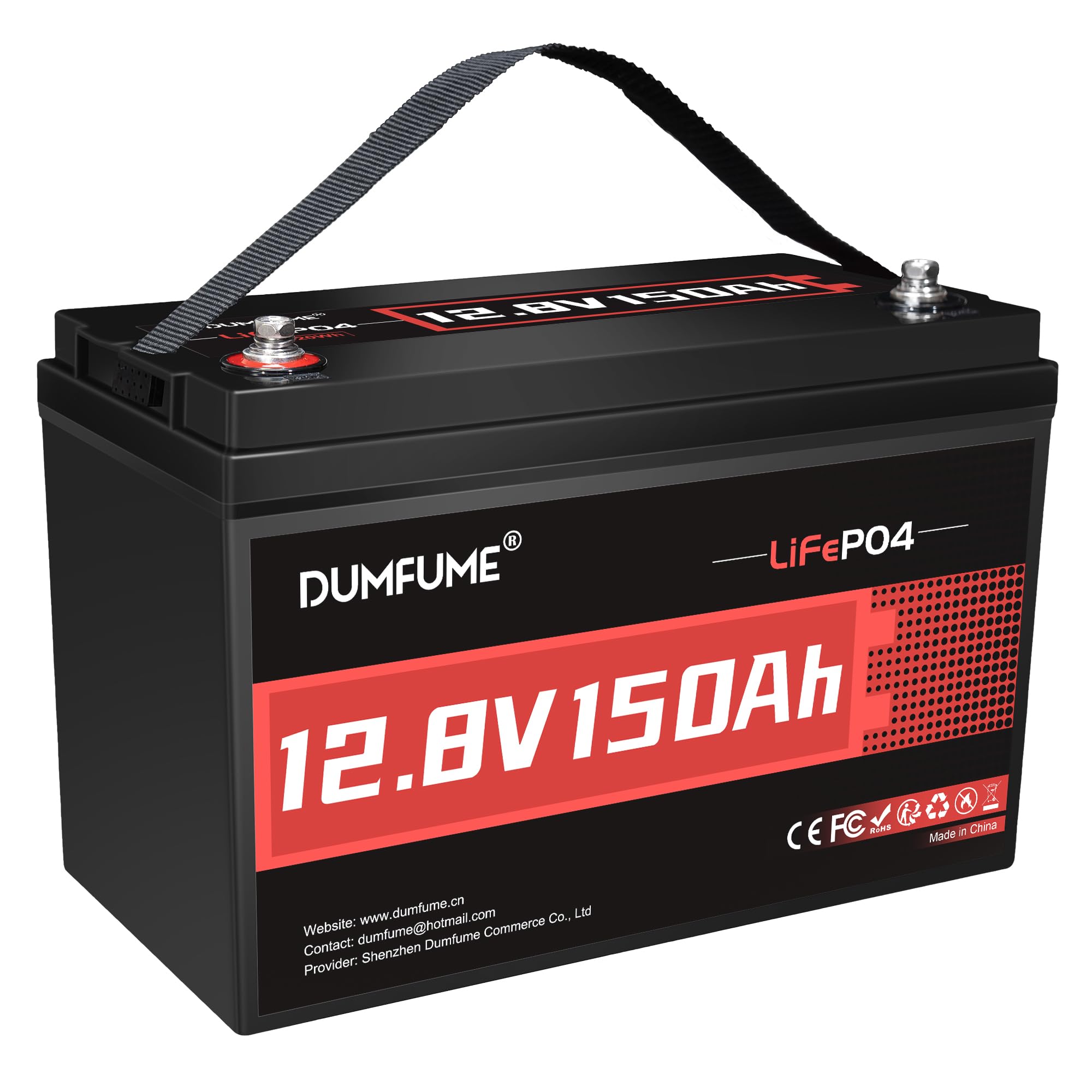
The DUMFUME 12V 150Ah offers the highest raw capacity among the lithium batteries on this list at 1920Wh, yet it weighs only 22.05 pounds — less than many 100Ah AGM batteries. This makes it a strong choice for larger house banks or solar backup systems on boats and RVs where runtime matters more than space. The 100A BMS provides standard protections, and you can expand the system in 4S4P configurations for larger voltage or capacity needs.
Capacity testing from multiple users confirmed that these batteries often exceed their rated 150Ah by roughly 7Ah, which is a welcome surprise for a mid-range price point. In golf cart applications, the 36V and 48V versions handled steep inclines and controller capacitor spikes after a brief initial BMS cutoff that was resolved by connecting the charger. For home solar setups, users reported stable power output during extended off-grid travel with easy series connection.
The most common issue reported is long-term reliability: a small number of users experienced BMS failure after one year, with the battery refusing to hold charge under a 3.5A fridge load. Warranty claims require direct contact with the manufacturer rather than Amazon, so document your purchase carefully. Additionally, some units arrived with low voltage (12.2-12.4V) and needed a parallel jump charge to wake the BMS. The five-year warranty provides coverage, but the claims process is less streamlined than NOCO or Optima.
Why it’s great
- 150Ah capacity in a 22 lb package — best Wh-per-pound ratio here
- Often exceeds rated capacity in independent testing
- Expandable to 4S4P for high-voltage or high-capacity arrays
- 5-year warranty covers extended ownership
Good to know
- Documented BMS failures after 12 months in some units
- Warranty claims must go direct to manufacturer, not Amazon
- Some units arrive in low-voltage sleep mode needing jump start
6. Newport 12V50Ah AGM Marine Battery
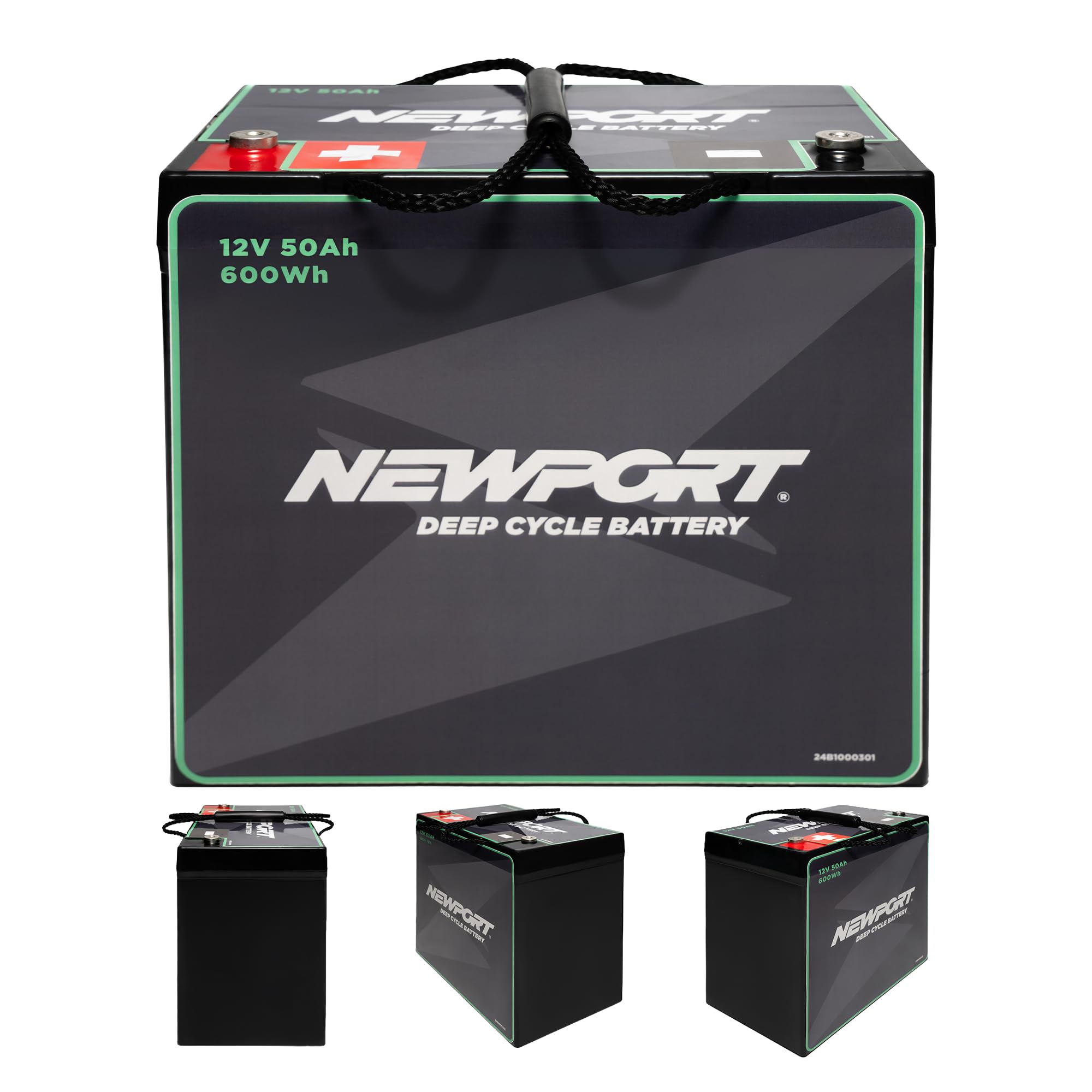
The Newport 12V50Ah is a budget-friendly entry point for kayak and canoe fishermen who need a reliable deep-cycle battery without the lithium price premium. At 32 pounds and 50Ah capacity, it is light enough for one-hand carry into a kayak hatch, and the sealed AGM construction means zero maintenance and no acid leaks. Users report a steady four-plus hours on a 55lb trolling motor at moderate speeds, which covers a full day of fishing for most anglers.
This battery survived a 20 mph tumble from a truck bed onto asphalt with only cosmetic damage — a testament to its robust casing and internal construction. The marine terminals provide secure connections that resist corrosion better than automotive top posts. For sump pump backup or small electronics, the 50Ah capacity works well for intermittent loads, and several owners repurposed it for home emergency use after a season on the water.
The main limitation is runtime: expect roughly seven hours on a 25lb trolling motor at full power, and less on higher-thrust motors. A light bar indicator would be helpful but is absent — you will need an external voltmeter or battery gauge to monitor state of charge. With only a one-year warranty, this is best viewed as an accessible entry-level option for occasional use rather than a daily-driver for serious anglers with large electrical demands.
Why it’s great
- Very lightweight at 32 lbs — easy to carry and install solo
- Survived a 20 mph truck bed tumble with no functional damage
- Sealed AGM construction: no water refills, no acid leaks
- Great price for entry-level marine deep-cycle use
Good to know
- 50Ah limits run time for larger trolling motors or long days
- Only 1-year warranty compared to lithium 5-year offerings
- No built-in charge indicator; requires external meter
7. Weize BCI Group 31M Dual Purpose AGM Battery
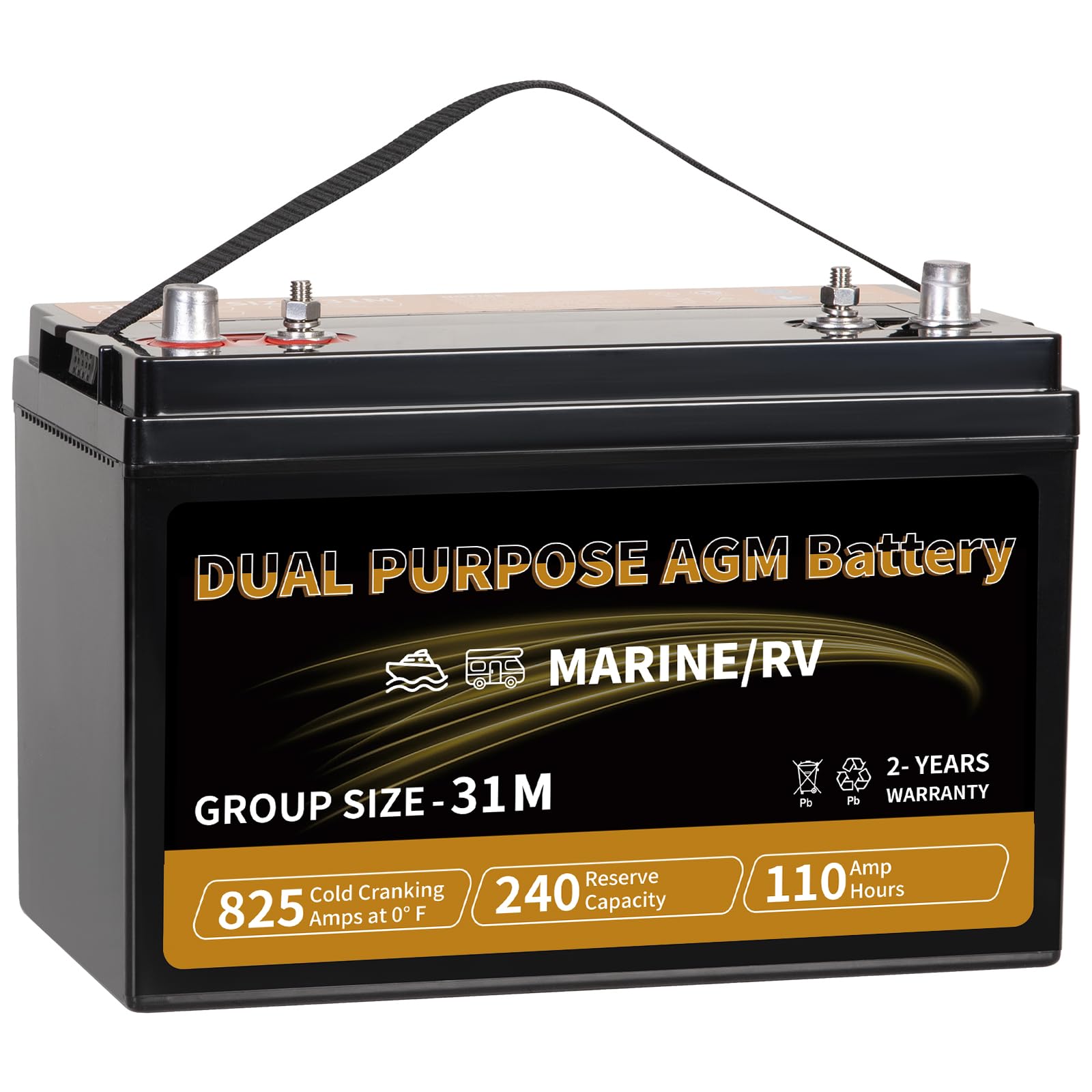
The Weize BCI Group 31M is a dual-purpose AGM battery designed for boaters who need reliable engine starting capability alongside respectable deep-cycle performance. With 825 cold cranking amps and a reserve capacity of 240 minutes, it handles large outboards and V8 inboards with authority while still providing enough sustained power for fish finders, bilge pumps, and cabin lights. The advanced AGM technology delivers twice the cycle life of traditional flooded marine batteries, and the spill-proof design allows versatile mounting positions.
At 67.5 pounds, this is a heavy unit — you need a second person or a lifting strap for installation. The vibration resistance is 20 times higher than flooded batteries, which matters for center consoles and bay boats that regularly pound through chop. Users report spinning 8.1L Caterpillar diesel engines effortlessly, and the quick-charge capability allows a full recharge in significantly less time than standard AGM chemistry.
The primary concern is quality control: some units arrive as duds despite appearing new, failing to hold a charge within a few months. Weize’s two-year warranty covers replacements, but the process can take time. This battery is best suited for larger vessels that already have a separate house bank — relying on this single dual-purpose battery for starting and all house loads may shorten its life compared to a dedicated starting battery setup.
Why it’s great
- 825 CCA handles large marine engines with no hesitation
- 240-minute reserve capacity provides extended house power
- 20x more vibration resistant than flooded batteries
- Quick-charge capable for faster turnaround between trips
Good to know
- Very heavy at 67.5 lbs — requires two people to install safely
- Inconsistent quality control with some dud units reported
- Not suited as sole house battery for high-draw electronics
8. OPTIMA 34M BLUETOP AGM Battery

The OPTIMA 34M BLUETOP is a legend in marine starting applications, and for good reason: its SpiralCell technology wraps 99.99% pure lead into cylindrical cells that deliver 800 CCA in a compact 10 x 6.9 x 7.9 inch package. This design is inherently 15 times more vibration-resistant than standard flooded batteries, making it the go-to choice for outboard-powered boats that endure constant hull vibration. Users consistently report 8-10 year lifespans in real-world boat use, which is remarkable for an AGM battery.
At 38.4 pounds, the 34M is significantly lighter than the Group 31 AGM alternatives while still providing 100 minutes of reserve capacity. The dual SAE and 5/16-inch stainless steel stud terminals offer maximum connection flexibility, and the maintenance-free design means no watering, no terminal corrosion, and no acid leaks. It is a true dual-purpose battery in the sense that it can handle light deep-cycle duty (50Ah C20 rating) alongside its primary starting role.
The drawbacks are typical for premium AGM: a high price per Ah compared to lithium, and the 50Ah capacity limits meaningful deep-cycle use for trolling motors. Some sellers ship old stock — one user received a battery with a two-year-old manufacture date that failed a load test at 98 CCA versus the rated 800 CCA. Always check the date code upon delivery, and consider purchasing from a seller known for fresh inventory. For reliable engine starting with proven longevity, this battery remains a benchmark.
Why it’s great
- Proven 8-10 year lifespan in marine starting applications
- SpiralCell construction delivers extreme vibration resistance
- Compact and light for the CCA output
- Dual terminal system fits any wiring setup
Good to know
- Only 50Ah capacity limits deep-cycle use for trolling motors
- Premium price per Ah compared to lithium alternatives
- Old stock concerns — verify manufacture date upon arrival
9. OPTIMA D31M BLUETOP AGM Battery

The OPTIMA D31M BLUETOP is the larger sibling of the 34M, stepping up to a Group 31 form factor with 900 CCA and a 155-minute reserve capacity. This is the battery you choose when you need maximum starting power for large inboard diesels or twin outboard setups, combined with enough deep-cycle capacity to run downriggers, pumps, and electronics for hours. The SpiralCell technology remains the same — 15 times more vibration resistant than flooded batteries with 99.99% pure lead construction.
Real-world longevity is staggering: users report 9 to 14 years of service in boat applications, with one owner still running a 2010 battery that powers downriggers for four hours and starts a V8 engine without hesitation. The dual SAE and 5/16-inch stainless steel stud terminals handle both ring terminal and post connections, and the maintenance-free sealed design eliminates corrosion and water refills entirely. With 1125 Marine Cranking Amps, this battery starts even cold marine diesels with authority.
The weight — 59.8 pounds — is substantial but still lighter than many flooded Group 31 batteries. The primary risk is shipping damage: Amazon’s packaging is often inadequate for a battery of this weight, with multiple reports of cracked plastic casings and acid leaks from poor packing. Inspect the case carefully upon delivery. At this price point, the D31M is an investment in decades of reliable starting, but lithium alternatives offer more usable deep-cycle capacity for a similar cost.
Why it’s great
- 900 CCA starts large marine diesels with confidence
- 155-minute reserve capacity supports substantial house loads
- 9-14 year lifespan proven in real-world boat use
- SpiralCell construction provides unmatched vibration resistance
Good to know
- Frequent shipping damage reports due to inadequate packaging
- 59.8 lbs requires careful handling and two-person installation
- Cost per usable Ah is higher than LiFePO4 alternatives
FAQ
Can I use a lithium marine battery to start my outboard engine?
What is the difference between Group 24, Group 27, and Group 31 marine batteries?
Why does my marine battery voltage read 12.8V but the battery seems dead?
How do I safely charge a marine AGM battery on my boat?
Can I mix lithium and AGM batteries in the same bank?
Final Thoughts: The Verdict
For most boaters, the best marine boat batteries overall is the Litime 12V 100Ah TM because it delivers the ideal combination of extreme weight savings, 4000+ cycle life, and marine-specific protections like TVS spike suppression and ABYC E-13 certification at a price that undercuts most premium lithium brands. If you need a compact battery for a kayak or small jon boat where every inch of deck space matters, grab the Dyness 12V 100Ah Mini TM for its 25% smaller footprint and IP65 rating. And for a single battery that starts your engine and powers your electronics while halving your weight, nothing beats the NOCO Lithium NLX27 with its true dual-purpose 1400A starting and 100Ah deep-cycle capability.
Product prices and availability are accurate as of the date/time indicated and are subject to change. Any price and availability information displayed on Amazon at the time of purchase will apply to the purchase of this product. As an Amazon Associate I earn from qualifying purchases.
CERTAIN CONTENT THAT APPEARS ON THIS SITE COMES FROM AMAZON. THIS CONTENT IS PROVIDED "AS IS" AND IS SUBJECT TO CHANGE OR REMOVAL AT ANY TIME.
Amazon and the Amazon logo are trademarks of Amazon.com, Inc. or its affiliates.