
The market is flooded with bulky, overpriced home theater receivers that waste space and energy. A mini amplifier solves this by delivering real, clean power in a chassis you can hold in one hand, turning a pair of passive bookshelf speakers into a high-fidelity system without the rack-mount footprint.
I’m Min — the co-founder and writer behind Gadgets Feed. I’ve spent hundreds of hours researching and comparing the latest Class-D amplifier topologies, chipset implementations (TPA3255, MA12070), and component quality (Japanese capacitors, WIMA film caps, and NE5532 op-amps) to separate genuine sonic upgrades from marketing hype.
Whether you are building a desktop system, upgrading a vinyl setup, or filling a small room with sound, this guide to the best mini amplifier will help you match the right chipset and connectivity to your specific speakers and listening habits.
How To Choose The Best Mini Amplifier
The perfect mini amplifier does not exist in a vacuum — it must be matched to your specific speakers, room size, and input sources. A high-power amp with no tone controls will sound thin with low-sensitivity speakers, while a tube pre-amp stage adds warmth but may not handle high-gain sources well. Understanding these trade-offs is the key to buying only once.
Power Rating and Speaker Sensitivity
Amplifier wattage is meaningless without considering your speakers’ sensitivity (dB SPL at 1 watt/1 meter). A 50W amp can drive 90dB+ speakers to deafening levels in a medium room, while the same amp will struggle with 84dB speakers that need four times the power for the same volume. Look for the power rating at your speaker’s impedance (4Ω or 8Ω) — most mini amps deliver more watts into 4Ω loads.
Inputs, Outputs, and Tone Control
The best mini amplifier must have the right ports for your gear. A turntable without a built-in phono preamp requires a phono input (RIAA equalization). Desktop users benefit from a USB DAC input that bypasses a computer’s noisy sound card. Dedicated bass and treble knobs are far more useful than a single EQ preset, as they let you compensate for room acoustics or speaker placement.
Quick Comparison
On smaller screens, swipe sideways to see the full table.
| Model | Category | Best For | Key Spec | Amazon |
|---|---|---|---|---|
| Fosi Audio V3 | Class-D Stereo | Desktop & Small Room HiFi | 300Wx2 @ 4Ω / TPA3255 / 48V | Amazon |
| Fosi Audio MC331 | Integrated Tube DAC | Warm Sound & Versatile Sources | 105Wx2 @ 4Ω / Tube Pre-amp + DAC | Amazon |
| AIYIMA T9 PRO | Tube DAC Hybrid | Budget Tube Sound & VU Meter | 200W / Jan 5725 Tubes / BT 5.2 | Amazon |
| Nobsound NS-13G MAX | Class-D w/ Phono | Turntable Setup (Phono Input) | 300Wx2 @ 4Ω / Phono MM Input / 48V | Amazon |
| AIYIMA A07 MAX | Class-D Stereo/Mono | Maximum Power & Upgrade Path | 300Wx2 @ 4Ω / Switchable Stereo/Mono | Amazon |
| S.M.S.L A100 | Class-D w/ USB DAC | Desktop USB Plug-and-Play | 80Wx2 / MA12070 Chip / Built-in PSU | Amazon |
| RIOWOIS Powered Speakers | Powered Speakers | No-Receiver Desktop System | 40W / Bluetooth 5.3 / 2.75″ Woofer | Amazon |
In‑Depth Reviews
1. Fosi Audio V3 Stereo Amplifier

The Fosi Audio V3 is the current benchmark for the mini amplifier category, pairing the Texas Instruments TPA3255 chip with premium Japanese NCC, ELNA, and German WIMA capacitors. The result is a SINAD rating of up to 88dB and a noise floor of only 140uV, which translates to dead-silent backgrounds and crystal-clear transients even with low-sensitivity speakers like the ELAC B6 (86dB).
A standout feature is the user-swappable op-amp socket. Swapping the stock NE5532 for a Sparkos SS3602 or MUSES02 audibly improves soundstage width and instrument separation. The innovative top/bottom venting and full-body heatsink keep the chassis cool during extended listening sessions, a critical improvement over older Class-D designs that throttled under load.
Connectivity is minimal — a single pair of RCA inputs and pre-out with volume control. There is no Bluetooth, USB, or phono stage. The V3 is a pure power amp designed for users who already have a DAC or preamp. At 300Wx2 into 4Ω with the included 48V/5A supply, it drives most bookshelf and tower speakers with effortless headroom.
Why it’s great
- Outstanding SINAD and noise floor for the price
- Swappable op-amps for sound signature customization
- Powerful 48V supply included; drives 2-8Ω loads
Good to know
- No Bluetooth, USB, or phono input
- RCA-only input limits flexibility
- Requires external DAC for digital sources
2. Fosi Audio MC331 Tube Integrated Amplifier
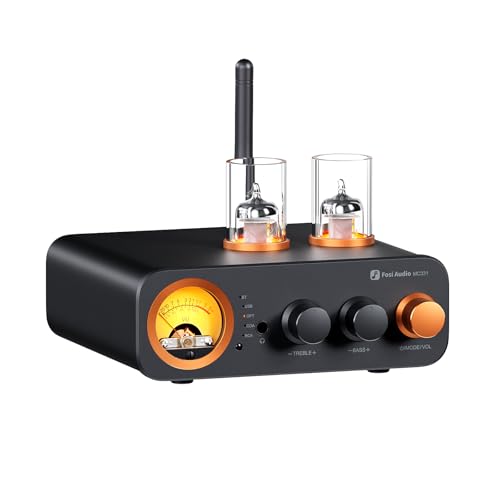
The MC331 is a true all-in-one solution, combining a DAC, amplifier, preamplifier, and even a 3.5mm headphone output into a compact chassis topped with glowing 5725W vacuum tubes and a vintage VU meter. It supports Bluetooth, USB, coaxial, optical, and RCA inputs, making it compatible with everything from a PC to a CD player or turntable with a built-in phono preamp.
The tube stage acts as a pre-amp, imparting a noticeable warmth and softening of digital harshness, especially noticeable when streaming Bluetooth audio or using the built-in TI DAC from a computer. The bass and treble knobs offer ±6dB of adjustment, giving you room correction capability without extra gear. The all-metal build and satisfying control knobs feel substantial.
It delivers 105Wx2 into 4Ω, enough to fill a 900-square-foot room with BOSE 201s. The headphone output automatically mutes the speakers, a thoughtful touch for late-night listening. However, the included vacuum tubes may fail within days — many users report needing to replace them immediately with premium tubes like Riverstone or GE JAN. The remote also has a slight latency.
Why it’s great
- Integrated DAC, Bluetooth, and headphone amp in one box
- Tube pre-amp adds musical warmth to digital sources
- VU meter and bass/treble controls for real-time tuning
Good to know
- Stock vacuum tubes are unreliable and may fail quickly
- Remote control has noticeable latency
- Requires banana plugs for tight speaker terminals
3. AIYIMA T9 PRO Bluetooth Amplifier

The AIYIMA T9 PRO is a compelling entry point into tube-hybrid sound, using Jan 5725 vacuum tubes to filter out the digital edge from Bluetooth 5.2, USB, coaxial, and optical sources. The circuit design from Qualcomm, Texas Instruments, and Cirrus Logic chipsets ensures a clean signal path, while the bass and treble knobs let you dial in a sound profile that matches your room and taste.
The VU meter is a visual delight, though it is less sensitive at low volumes. The amplifier runs warm to the touch under load, and the build quality is solid for the price point. Users report excellent imaging and a full, warm sound that brings vocals forward, especially in a small to medium-sized room. It pairs well with JBL, Bose, and Dayton speakers.
One drawback is the lack of a headphone jack, and the Bluetooth input has a relay click when switching sources. For maximum performance, many users pair the T9 PRO with an upgraded power supply and premium tubes like Riverstone, which adds substantial cost but unlocks noticeably better soundstage depth. As a standalone unit, it offers tremendous value for a tube-integrated amplifier.
Why it’s great
- Affordable entry to tube-hybrid sound with multiple digital inputs
- Bass and treble adjustment for room correction
- Attractive VU meter and compact footprint
Good to know
- Bluetooth relay click when switching sources
- No headphone output for private listening
- VU meter is insensitive at lower volume levels
4. Nobsound NS-13G MAX Stereo Amplifier

The NS-13G MAX from Douk Audio targets the vinyl listener directly, offering a built-in MM phono input that eliminates the need for a separate preamp. The TPA3255 chip, paired with NE5532P preamp chips, Japanese Rubycon capacitors, and WIMA film capacitors, delivers 300Wx2 into 4Ω with a stated 0.005% THD and 107dB SNR — numbers that were unthinkable at this price a few years ago.
The physical design is compact at 5.1x4x1.5 inches, machined from aluminum with dual cooling vents for thermal management. The bass and treble controls offer ±6dB of adjustment, which is especially useful for taming a boomy room or adding presence to a dull recording. The 3.5mm AUX passthrough is volume-synced, allowing you to add a subwoofer or extend to a multi-room setup.
No Bluetooth means you need to connect a streamer or use a dongle for wireless playback. Some units exhibit a constant hum that resists grounding fixes — this appears to be a unit-to-unit quality control issue. The amplifier runs warm even at idle, so adequate ventilation is necessary. When it works, it sounds impressively full and dynamic.
Why it’s great
- Built-in MM phono stage for turntables
- Dedicated bass and treble knobs for easy tone shaping
- Compact CNC-milled aluminum chassis with good thermal design
Good to know
- No Bluetooth connectivity for wireless streaming
- Some units may have an audible hum issue
- Runs warm even at idle; needs ventilation
5. AIYIMA A07 MAX Stereo Amplifier

The A07 MAX is a purpose-built Class-D workhorse using the TPA3255 and NE5532 op-amp combo, with upgraded Nichicon 63V capacitors and a significantly improved heatsink over its predecessor. Its unique party trick is a switchable stereo/mono bridge mode — flip a bottom switch to turn the 2-channel 300Wx2 amplifier into a single 600W mono block, ideal for pairing with a second A07 MAX for a high-power bi-amped or dual-mono system.
In stereo mode, the sound signature is punchy with clean highs and solid bass, though the damping factor drops in mono mode. The logarithmic volume knob offers smooth adjustment, but there are no physical detents, making it tricky to match channel levels in mono mode. There is no hiss or noise when adjusting volume, a sign of good circuit layout. The unit runs at approximately 100°F under moderate load.
Input is limited to a single 3.5mm AUX and RCA, with no Bluetooth, optical, or USB. The included 36V/6A power supply is sufficient for a bedroom system, but upgrading to a 48V/10A supply unlocks the full 315Wx2 output. The A07 MAX is ideal for users who want maximum power headroom and a clear upgrade path without paying for features they won’t use.
Why it’s great
- Switchable stereo/mono bridge for flexible system building
- Upgraded Nichicon capacitors and robust heatsink
- Very low noise floor and logarithmic volume control
Good to know
- No Bluetooth, optical, or USB inputs
- Monoblock mode reduces damping factor
- Volume knob has no detents for channel matching
6. S.M.S.L A100 Mini Class D Amplifier
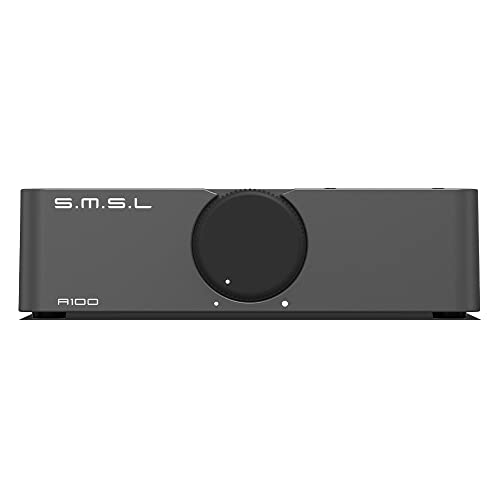
The S.M.S.L A100 uses Infineon’s MA12070 Class-D chip, a different topology from the TPA3255 found in most budget amplifiers. This chip excels at efficiency and low idle power consumption, drawing just 5W during normal playback and 2W at idle. It is packed with a high-quality internal switching power supply, eliminating the need for a bulky external brick.
Connectivity includes USB audio (plug-and-play on Windows), Bluetooth 5.0, and a 3.5mm line input. The USB input is a standout for desktop users — it bypasses the computer’s internal DAC and eliminates ground loop hum that often plagues 3.5mm connections. The built-in subwoofer pre-out (2 sets) allows for an easy 2.1 or 2.2 channel configuration. The gold-plated terminals are a nice touch for corrosion resistance.
There is a known issue with the USB audio mute: setting software volume to zero or triggering mute in the OS can cause a hard mute that requires pressing the mute button twice to restore. Some units also experience severe distortion and clipping at volume levels past 50%, which could damage speakers if not caught early. The blue power LED is always on and fairly bright.
Why it’s great
- Built-in switching power supply for a clean desktop setup
- USB audio input eliminates ground loop hum
- Subwoofer pre-outs for easy 2.1 system expansion
Good to know
- USB mute bug can cause unexpected audio dropouts
- Distortion possible past 50% volume
- Bright blue LED always on; cannot be dimmed
7. RIOWOIS Powered Bluetooth Bookshelf Speakers

While strictly a pair of powered bookshelf speakers rather than a standalone amplifier, the RIOWOIS DS6701NP deserves consideration for users who want a complete system in a single box. The 40W Class-D amplifier is built into the main speaker and drives the 2.75-inch woofers and tweeters without requiring any external receiver or amplifier. It is a true plug-and-play solution for a desktop or small bookshelf.
Connectivity is extensive for the price: Bluetooth 5.3 for wireless streaming, optical and TV-ARC inputs for TV connection (control volume with your TV remote), and AUX for a turntable or computer. The remote control allows switching between three sound effect modes, including a clear vocal EQ that makes dialogue and lyrics stand out. The reinforced MDF cabinet with wood grain finish minimizes cabinet resonance.
These speakers cannot be used with an external amplifier — they are powered speakers. The optical input requires PCM/stereo output from your source; Dolby or DTS signals will cause cracking or silence. At maximum volume, there is a clear limitation in loudness, and the 3-foot power cables are short. For a simple, low-cost desktop system that requires zero setup, this is an excellent entry point.
Why it’s great
- Complete all-in-one system; no amplifier or receiver needed
- Bluetooth 5.3 and TV-ARC for versatile source connection
- Clear vocal reproduction with three EQ presets
Good to know
- Not compatible with external amplifiers or receivers
- Limited maximum loudness and short power cables
- Optical input requires PCM/non-surround signal only
FAQ
Can I use a mini amplifier with a turntable that lacks a built-in preamp?
What does the VU meter on my mini amplifier actually measure?
Why does my mini amplifier get hot even at low volume?
Final Thoughts: The Verdict
For most users, the best mini amplifier winner is the Fosi Audio V3 because it offers the best balance of raw power, low noise, and upgradeability (swappable op-amps) in a compact form factor. If you want a complete all-in-one solution with tube warmth and a DAC, grab the Fosi Audio MC331. And for a dedicated turntable setup with phono input and tone controls, nothing beats the Nobsound NS-13G MAX.