
Our readers keep the lights on and my morning glass full of iced black tea. As an Amazon Associate, I earn from qualifying purchases.
Specs are compiled from manufacturer listings and verified buyer reviews and can change over time — please confirm the key details on the product page before buying.
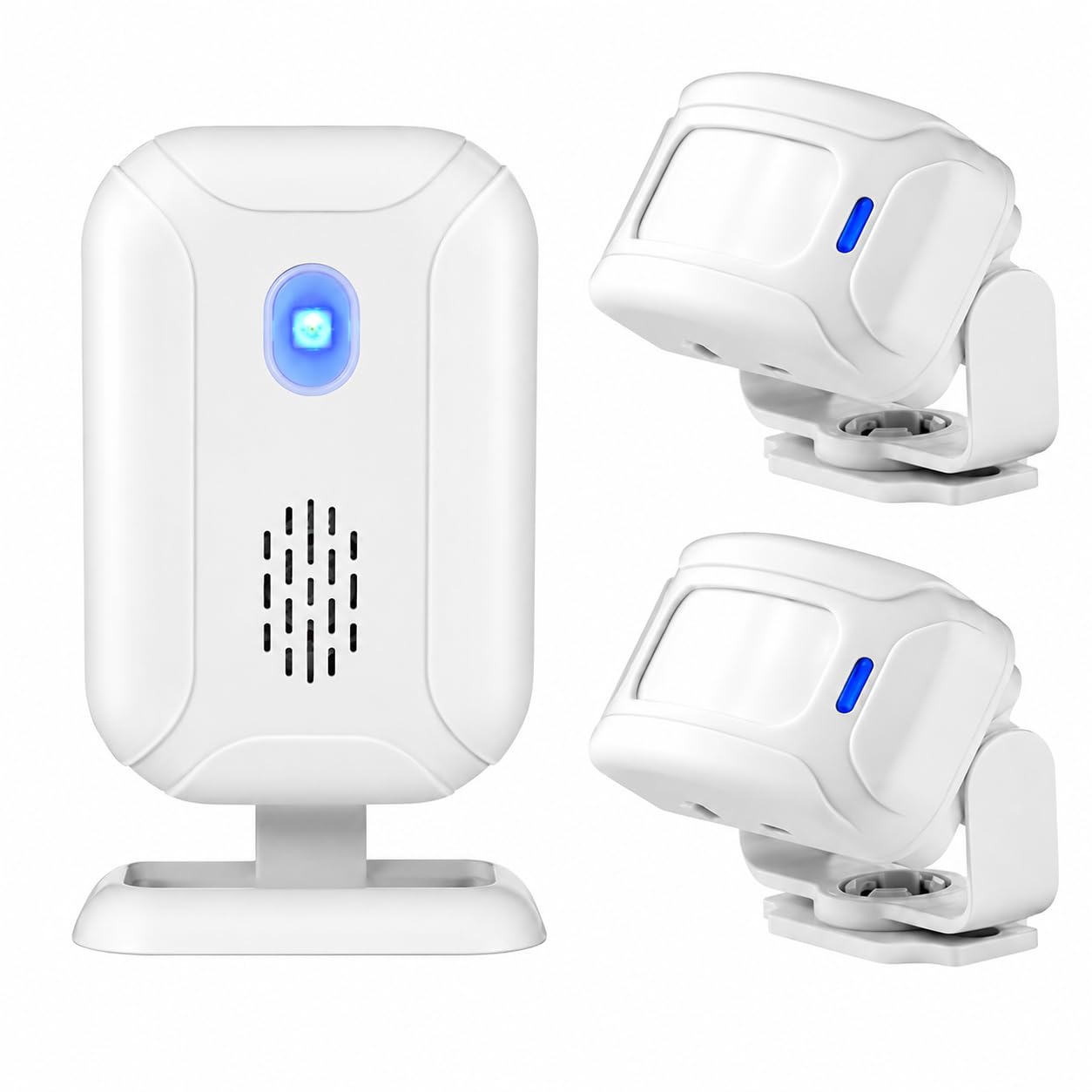
A motion alarm sensor exists to alert you the moment someone or something enters a protected zone. Whether it’s a package thief at your front door, a parent with dementia wandering at night, or a deer feasting on your garden, the right unit turns a surprise into an early warning.. This guide ranks the best options for indoor monitoring, outdoor animal deterrents, and long-range property alerts based on published specs and owner consensus.
I’m Min — the founder and writer behind Gadgets Feed. This guide is built by comparing the manufacturers’ published specifications and the patterns across verified customer reviews, so you get each pick’s real strengths and trade-offs instead of marketing spin.
From 110-decibel chimes to solar-powered sirens that reach 500 feet, we’ve found the best motion alarm sensor for every entryway, driveway, and garden edge..
Our Picks at a Glance


How To Choose The Best Motion Alarm Sensor
Picking a motion alarm sensor starts with where you will put it. An indoor unit for a loved one’s bedroom serves a totally different purpose than a solar-powered siren for a farm. Here is what separates a keeper from a return.
Indoor Chime vs. Outdoor Deterrent
If you are monitoring an entrance, a mailbox, or an elderly relative’s room, you want a plug-in receiver with selectable chimes and volume levels. If you are protecting a garden or yard from animals, you need a weatherproof, solar-powered unit with a loud siren. Mixing these up is the most common mistake — an indoor chime will not survive the rain, and a 130dB siren is overkill for a hallway.
Range: Detection vs. Transmission
Every spec sheet lists two distances. The detection range is how far the sensor can see movement (often 16–26 feet). The transmission range is how far the signal travels from sensor to receiver (this can be 500 feet or more). For a large property, the transmission range is the number that decides if the receiver in your house will actually hear the sensor at the gate.
Volume, Expansion, and Power
Look for adjustable volume levels in decibels (dB) so you can tune loudness to your space. If you have multiple entry points, check whether the system expands to extra sensors. On power, decide between simple AAA batteries for indoor units or solar panels for outdoor ones. Solar models need sunlight to charge, so placement matters.
Quick Comparison
| Model | Best For | Max Chime/Sound Volume | Wireless Range | Power Source | Amazon |
|---|---|---|---|---|---|
| AMHEY Wireless Chime★ Best Overall | Indoor door & room alerts | 110dB | 500 feet | 2 AAA batteries | Amazon |
| METAK Wireless ChimeTop Performer | Long-range indoor alerts | 110dB | 500 feet | USB or 3 AAA batteries | Amazon |
| Waytronic Wireless ChimeMost Versatile | Multi-zone indoor detection | 113dB | 918 feet | 2 detectors included | Amazon |
| BESTOONE Motion Alarm | Whole-home multi-sensor | 3 volume levels | 300 feet | 4 detectors (AAA) | Amazon |
| COTINSE Solar Alarm | Solar-powered yard defense | 130dB | 26 feet | Solar panel | Amazon |
| SABRE Burglar Alarm | DIY home intrusion | 120dB | 750 feet | Not specified | Amazon |
| ChunHee Solar Alarm | Versatile animal deterrent | 130dB | 8 meters | Solar panel | Amazon |
| HTZSAFE Driveway Alarm | Long-range property perimeter | 5 volume levels | 1/2 mile | Solar panel | Amazon |
| Qualirey 6-Pack Alarm | Multi-point farm coverage | 129dB | 8 meters | Solar panel | Amazon |
In‑Depth Reviews
1. AMHEY Wireless Motion Sensor Door Chime
Our pick — 4.5★ from 950+ verified ratings; the strongest balance of quality and price.
The plug-in chime that turns a 500-foot signal into a room-filling alert.
This is the pick we keep coming back to for indoor monitoring because it nails the basics. The sensor detects movement within a 16–26 foot range at a 110° angle, then transmits that signal up to 500 feet to the plug-in receiver. That means you can mount the sensor at a front door, garage, or back gate and still hear the chime clearly from deep inside the house. It’s a system built for keeping tabs on elderly relatives who wander or customers entering a retail space.
What wins people over is the flexibility of its sounds. — there are 32 unique ringtones covering everything from standard doorbells to alarm tones, plus 5 adjustable volume levels from 0 to 110dB, including a silent mode. The LED light flash provides a visual cue for the hearing impaired, and the system expands to up to 20 sensors and unlimited receivers. It runs on just 2 AAA batteries which are included.
Pricing it against the METAK below, both hit that 500-foot swing, but this one asks for only 2 AAA batteries while the METAK needs 3. The trade-off is the volume dial: at its lowest setting some owners still find it too loud for a quiet home, and the instructions have been described as difficult to follow. For a caregiver or small business owner who wants a dependable, easily expandable alert network, this is the one to beat.
What Owners Rave About
- Functionality earns the most praise — buyers report it works flawlessly for package theft alerts and monitoring dementia patients.
- Easy setup with great battery life, with one owner noting it still worked well after a year.
- The 500-foot range lets you place the receiver far from the sensor.
The Honest Caveats
- Even the quietest volume setting is too loud for some.
- The instruction manual is poorly translated and skips battery installation steps.
- The sensor has no on/off switch — you must remove the battery to silence it.
Ideal for: caregivers who need reliable wandering alerts and businesses that want a cheap entry chime.
Think twice if: you need a whisper-quiet chime, since this one starts loud and gets louder.
2. METAK Motion Sensor Door Chime
A 360° adjustable sensor that works almost too well, even 60 feet away.
The defining feature here is the hardware flexibility. The infrared detector covers a 110° angle up to 26 feet, but unlike most rivals, the sensor sits on a 360° adjustable mount so you can point it exactly where you need. It also offers dual power — pop in 3 AAA batteries for portability or plug in via USB for continuous operation. That USB option is a genuine advantage for high-traffic spots where you don’t want to swap batteries.
At the receiver end, you get the same 32 chimes and 5 volume levels up to 110dB as the AMHEY, but the wireless transmission reaches the same 500 feet. The system is expandable to connect up to 20 motion sensors to a single receiver, making it a strong candidate for offices or multi-room homes. Owners mention it picks up pets reliably, with one owner moving the receiver about 60 feet from the sensor with zero issues.
The biggest differentiator versus the AMHEY is that 360° mount — it lets you fine-tune the detection zone to avoid false triggers. The catch is it needs 3 AAA batteries versus the AMHEY’s 2, making it slightly heavier at 0.21 kg. If you value precise aiming and a backup USB power source over the lowest battery count, this is the better buy.
Edge over the AMHEY: That 360° swivel mount is the reason to pick this one — it cuts down on false alarms from wind or passing cars by letting you aim the sensor away from them.
Reach for it if: you want a sensor that can be aimed precisely and powered by USB for non-stop operation.
3. Waytronic Wireless Motion Sensor Alarm Chime
The twin-sensor kit that stretches a 918-foot signal across driveways and offices.
If you need to monitor two separate entry points right from the start, this kit is the reason to skip single-sensor systems. It ships with 1 receiver and 2 PIR detectors, so you can cover both a front door and a mailbox or a driveway and a back gate without buying extra hardware. The transmission range is the longest here at up to 280 meters (918 feet), and detection reaches roughly 2–8 meters (6.6–26 feet).
What makes it feel more premium is the sound library — 36 ringtones and 4 volume levels from 113dB down to 25dB. That 25dB floor is the quietest option on this list, which is a genuine win if you want a gentle alert that won’t wake the house. The receiver also features a night light with 4 LED colors (white, red, blue, green) so you can assign a different color to each sensor and instantly know which entryway triggered it.
Compared to the BESTOONE, this one trades raw sensor count (2 vs 4) for a longer range and that useful colored-light system. The main limit is that it is not waterproof at all — the manual is explicit about keeping it away from rain, so this is strictly an indoor or covered-porch tool. It also uses 1 Lithium Polymer battery (included), and the music-style ringtones have drawn some mixed comments from owners expecting actual melodies.
The standout feature: The color-coded LED alerts are a small touch that makes a big difference when you have two sensors — you know exactly which door rang without looking at the label.
Best for: anyone with two entry points who wants the longest indoor transmission range and quiet alert options.
Not for: outdoor use — this needs to stay under cover or in a dry area.
4. BESTOONE Motion Sensor Alarm

A four-sensor kit that blankets a whole home with 300 feet of coverage.
This is the coverage king for multi-room homes. The box includes 4 motion detectors and 2 plug-in alarms, so you can put a sensor on a front door, a window frame, a hallway, and a driveway entrance all at once without buying extras. Each detector senses infrared movement out to about 20 feet, and the signal travels up to 300 feet to the receiver — enough reach for a larger house where the receiver sits centrally.
The receiver offers 38 ringtones and three volume levels (medium, high, low), plus a silent mode where only the LED light flashes. That silent mode is a standout for parents or caregivers who want a subtle visual cue without startling anyone. Each of the 2 included alarms lights up to show which sensor was triggered, which helps when you have detectors in different rooms.
Measured against the Waytronic, this kit covers more square footage with 4 detectors but gives up range (300 vs 918 feet). The 4 detectors each need AAA batteries which are not included, so budget for that upfront. A recurring note in reviews is that you cannot easily tell which of the 2 alarms is sounding unless you label them yourself.
Why It Wins for Whole-Home
- The 4-sensor, 2-receiver bundle is the fastest way to secure multiple entry points.
- Silent mode with LED-only alerts is ideal for not startling kids or pets.
- Customers note the sensors have a wide view and are sensitive to movement.
Consider Before Buying
- Requires 4 AAA batteries, none of which are included.
- Not waterproof — keep the detectors out of the rain.
- Differentiating which alarm is ringing takes some labeling effort.
Grab it if: you want to cover a whole house or small office with one purchase and don’t need extreme wireless range.
skip it if: you need weatherproof outdoor sensors, since this kit is strictly indoor.
5. COTINSE Solar Outdoor Motion Sensor Alarm
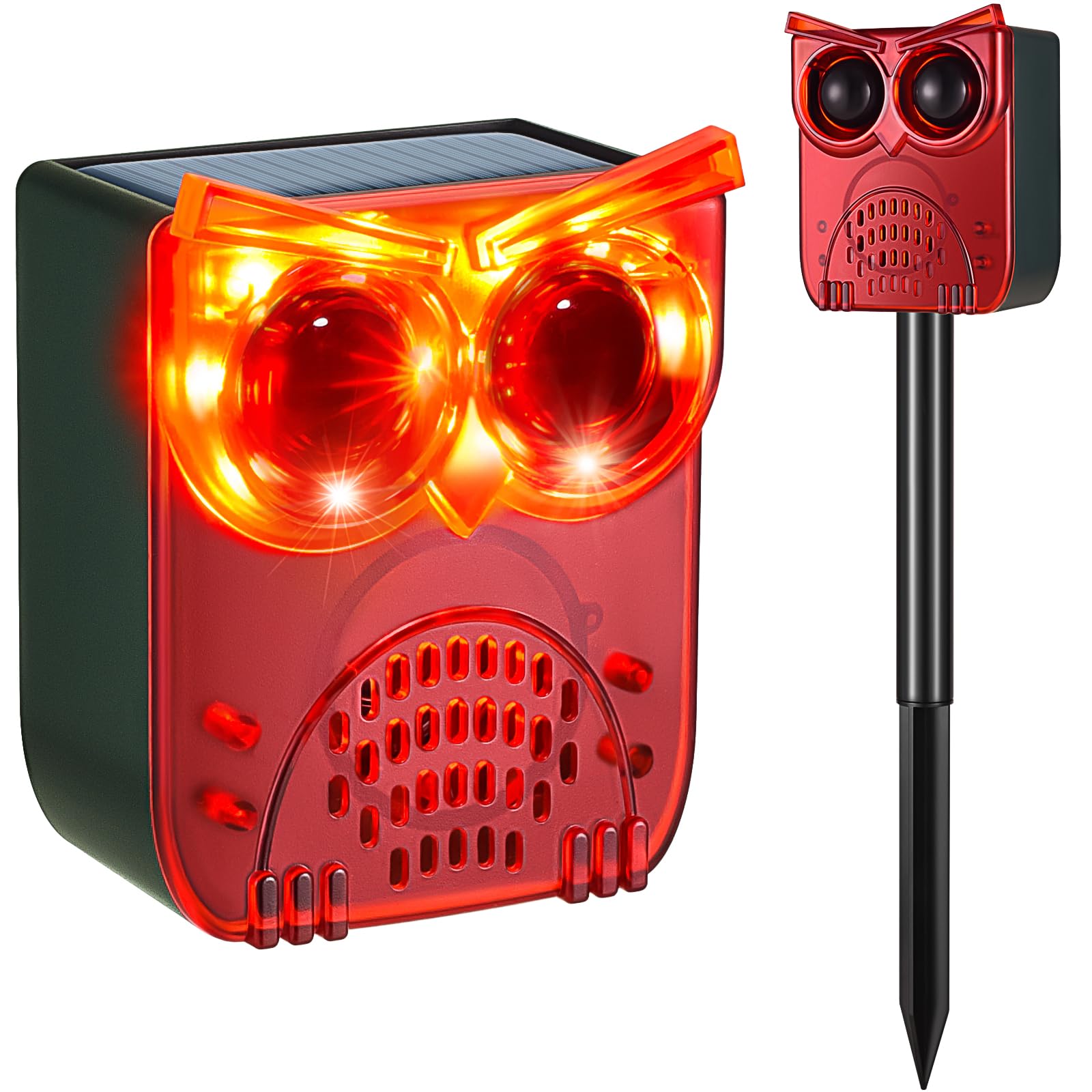
A solar-powered 130dB siren with 13 looping sounds that stop animals from getting used to the noise.
This is the most refined outdoor deterrent here, and the reason is the looping-sound design. It packs 13 built-in sounds — dog barking, gunshot, eagle cry, police siren — that play in a continuous loop. That loop is the smart part: animals get habituated to a single repeated noise, but the variety keeps them guessing, so the deterrent effect lasts longer than a one-trick siren.
It runs entirely on solar power, with a full charge in 8 hours and up to 300 days of standby time. The infrared sensor picks up body heat movement within 5–8 meters (16–26 feet) at a 110° horizontal angle and 60° vertical angle. The IP55 weatherproof casing handles rain, snow, and temperatures from -10°C to 50°C, and there are 4 work modes including a 24-hour light-only mode for quiet residential areas and a night-only mode to save power.
Compared to the ChunHee below, this one holds a higher average rating from over 1,000+ owners and adds that 13-sound looping library plus a ground stake, wall mount, and pole strap in the box. The main downside owners flag is that when a sound like barking triggers, it continues for a long time — which is great for scaring foxes but potentially annoying for your own neighborhood.
The Smart Deterrent Edge
- 13 looping sounds prevent animal habituation, a step beyond single-sound sirens.
- 300-day standby on a full solar charge means near-zero maintenance.
- Reviewers point out it scared away an owl the same evening it was set up.
Know the Trade-Offs
- The looping bark can go on for too long and annoy neighbors.
- Battery is not included, so the first charge needs direct sun.
- Detection range is 26 feet, which is shorter than some rivals.
Reach for this if: you want a set-and-forget solar deterrent that won’t lose its scare factor after a week.
Look elsewhere if: you live in tight quarters where a long barking loop could cause friction.
6. SABRE Wireless Motion Sensor Burglar Alarm

A simple 120dB intrusion siren that can be heard up to 1,500 feet away.
This is the straightforward intruder alarm for anyone who wants protection without a phone app or Wi-Fi setup. The SABRE blasts a 120dB siren that is audible up to 1,500 feet (457 meters) away, and detects movement across a 120-degree wide angle. It is a no-wiring-needed DIY unit: mount the sensor, set the receiver, and you’re armed.
It offers 3 adjustable settings: a chime mode for alerting you when kids or guests come and go, plus a home and away mode that lets you move around without accidentally setting it off. Shoppers say it is sensitive enough to detect raccoons and loud enough to wake them from 100 feet away. It has held up for years of outdoor use for some, though the manual recommends a DIY weatherproof housing.
This is rated 4.0 stars across 500+ owners, which is solid. The biggest single caution is that setup can be fiddly — some buyers report buttons and codes not responding as expected, and the volume is not adjustable. If you want a dead-simple, budget-friendly intrusion siren rather than a chime, this fits. If you need selectable tones and volume control, the AMHEY at the top is a better fit.
Where it shines: That 120dB siren with a 1,500-foot audible range is a genuine burglar deterrent that costs less than a monthly cloud-subscription camera.
Best for: renters or first-timers who want cheap, loud protection without wiring or a subscription.
Not for: anyone who needs adjustable volume or a reassuring chime rather than a harsh siren.
7. ChunHee Solar Outdoor Motion Sensor Alarm
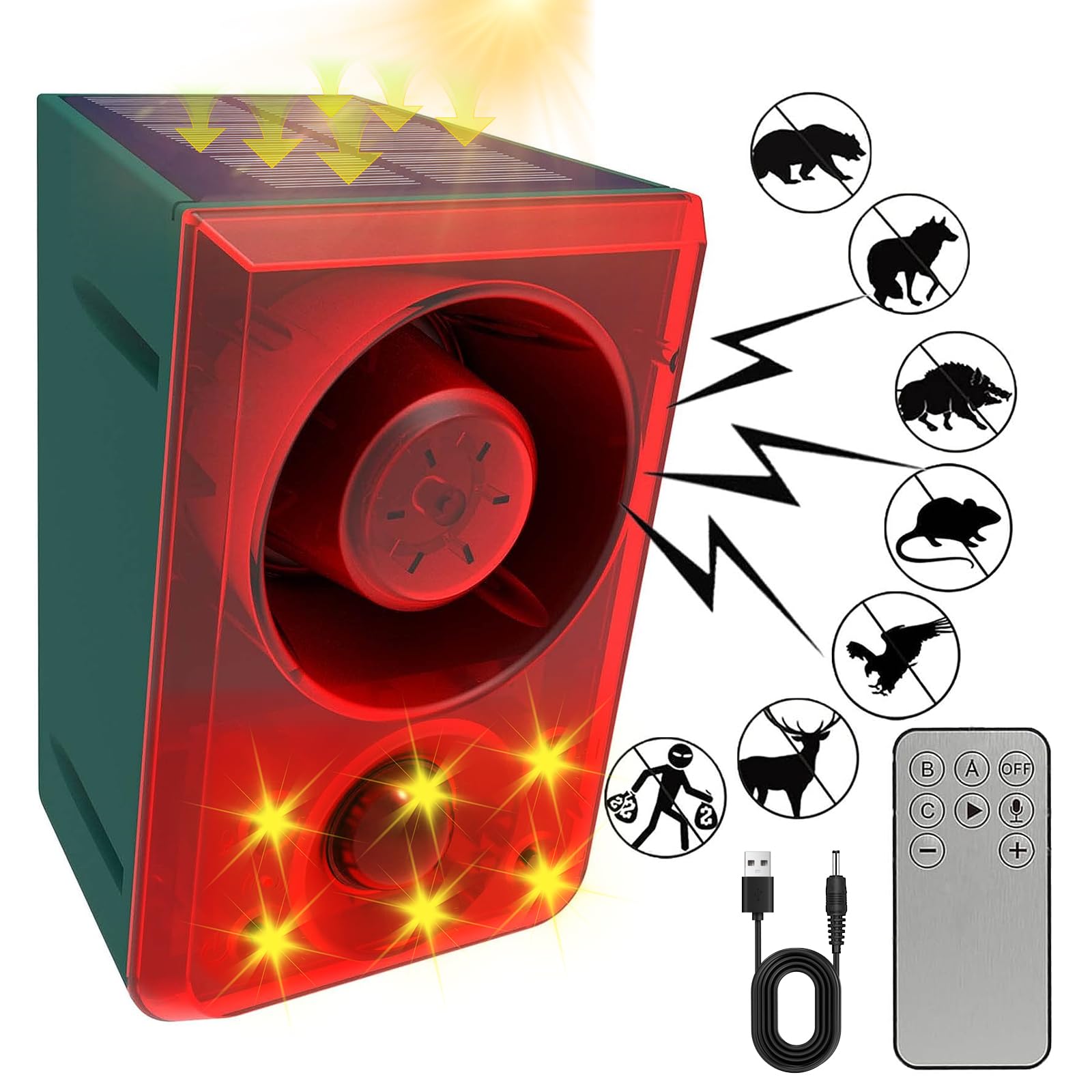
A solar siren with a custom recording option that scares deer, squirrels, and even the neighbors.
You can make this outdoor alarm sound like anything you want. Beyond the default barking dog and gunshot sounds, you can record your own 20-second custom alarm through the built-in mic — so a command, a whistle, or any noise that works for your specific pest problem. When the 110° sensor (a wide-angle detector) spots movement within 5–8 meters, it triggers a 130dB siren (louder than a rock concert) and a strobe light, so intruders or animals get a clear, loud warning.
It is powered by a high-capacity solar panel with an ABS housing rated IP65 waterproof, so it shrugs off storms and snow. There are 3 operating modes: 24-hour with flash and alarm, night-only with flash and alarm, and a timer mode. The box includes a remote control, which lets you change settings without climbing a ladder to reach the unit.
Owners have used it to stop deer from eating their plants and to keep squirrels out of garden beds entirely. The recurring caveat is that the solar charging is hit-or-miss — some units lose charge in low light, and the included instructions are thin. The detection is also sensitive enough that wind can trigger it, so placement away from swaying branches matters.
The hook: A 130dB siren you can program with your own voice or sound gives you a deterrent no other unit here can match.
Choose this if: you want a loud, weatherproof animal deterrent with a custom recording feature and remote control.
pass on it if: your yard is mostly shaded, since reliable solar charging is the make-or-break factor here.
8. HTZSAFE Solar Driveway Alarm

A birdhouse-styled solar sensor that guards up to a half-mile of driveway.
This is the serious property-monitoring option, built for long driveways and large perimeters. The included solar sensors detect moving people or vehicles from 25 to 70 feet in front of them, with 3 adjustable sensitivity settings (Low=25ft, Medium=50ft, High=70ft). The wireless signal then travels up to a half-mile to the plug-in receiver, which is a massive reach compared to the 500-foot indoor chimes.
The receiver runs on a built-in rechargeable battery so it keeps working even during a power outage, and it offers 35 optional melodies with 5 adjustable volume levels. You can assign a different melody to each sensor — so a “Driveway” alert sounds distinct from a “Dog Barks” alert for the backyard. The sensors are solar-powered with a birdhouse design that blends into a yard, making them far more discreet than a plastic siren box.
Owners who have run it for two years on a 300+ foot driveway report it still works perfectly and detects deer, dogs, and even mountain lions. The recurring positive is the setup experience — people love that it works from the start with a plug-and-play receiver. The durability story is mixed, though, with a small number of owners reporting a sensor failing after a few weeks; slanting solar panels help shed snow and rain better than flat ones.
Why It Leads on Range
- The 1/2-mile wireless reach is the longest in this guide, ideal for big properties.
- Adjustable 70-foot detection range with 3 sensitivity levels cuts false alarms.
- The birdhouse design is discreet and paintable to match your yard.
What to Watch
- An occasional sensor has failed within weeks, though support response varies.
- The preset melodies are not customizable recordings.
- It sits at a higher price point than the indoor chimes.
Reach for this if: you have a long driveway or large property and need a discreet, solar-powered alert you can hear a half-mile away.
Look elsewhere if: you need custom recording or can’t tolerate the small risk of an early sensor failure.
9. Qualirey 6 Pack Solar Motion Sensor Alarm

A six-pack of solar sirens that surround a garden or farm with 129dB of protection.
For a farm, orchard, or large garden, one siren is never enough — which is exactly why this six-pack exists. You get 6 solar motion sensor alarms, each with a 125° sensing angle that detects movement within 5–8 meters, then triggers a 129dB siren and a strobe light visible from 1000 meters away. Placed around a perimeter, they create a wall of sound and flashing light that pushes animals out rather than just scaring them at one spot.
Each unit offers 4 modes: 24-hour with flash and alarm, 24-hour with flash only, night-only with flash and alarm, and night-only flash. The alarms are IP65 waterproof with a stainless steel bracket and rugged ABS housing, and each lasts up to 30 days on a single charge before needing more sun or a DC charge. Owners have used them to keep bears and deer away from apple trees, and report the bright flashing LEDs work as a strong visual deterrent even before the sound kicks in.
The standout quality is the build — owners describe them as well-made and reliable, with solar charging that works even in low light. Compared to buying six individual units from other brands, this pack delivers better value and consistent quality. The limitations are the same as any solar siren: sensitivity to wind and branches can cause false triggers, and the 8-meter detection range is shorter than the HTZSAFE’s 70-foot reach, so spacing them closer together matters.
The value story: Six loud, weatherproof sirens in one box is the fastest way to protect a whole property line — owners mention it keeps bears and deer out of gardens entirely.
Choose this if: you need to cover a large outdoor area and want the simplicity of one box containing everything.
Think twice if: you only need to guard a single entry point — this much coverage would be overkill.
Understanding the Specs
Detection Angle & Range
The detection angle (often 110° to 125°) is the width of the invisible “cone” the sensor watches. A wider angle covers more of a room or yard entrance without needing multiple sensors. The detection range is how far that cone extends — typically 16 to 26 feet indoors and up to 70 feet for premium outdoor units. Match these to the size of the doorway, hallway, or driveway you are protecting.
Wireless Transmission Range
This is the distance the signal travels from the sensor to the receiver. Indoor chimes often hit 300 to 500 feet, while a premium driveway alarm can reach a half-mile. Do not confuse this with detection range — a sensor can spot you at 26 feet but still send that alert 500 feet to a receiver in your house. For large properties, this is the number that matters most.
Decibels (dB) & Volume Control
Volume is measured in decibels, with 110dB to 130dB being the common range for alarms. A 110dB chime is loud enough to hear across a house, while a 130dB siren is designed to scare animals and intruders. Adjustable volume levels (often 3 to 5 steps) let you tune loudness, and some units include a silent mode with only an LED flash for discreet monitoring.
Power Source & Weatherproofing
Indoor units run on AAA batteries, while outdoor models rely on solar panels with rechargeable batteries. The weatherproofing rating (like IP55 or IP65) tells you how well it resists rain and dust. A lower rating like IP55 handles light rain, while IP65 handles heavy storms and snow. If a unit has no IP rating, treat it as indoor-only.
FAQ
What is the difference between detection range and wireless transmission range?
Will a motion alarm sensor work through walls or glass?
Can I use an indoor motion chime outside?
What does a PIR sensor mean and how does it detect motion?
How do I stop false alarms from wind or passing cars?
Can I add more sensors to an existing system later?
How long do the batteries last in a motion sensor alarm?
Is a 130dB siren too loud for a residential neighborhood?
What is the difference between a chime mode and an alarm mode?
Can a motion sensor alarm be used to monitor a wandering elderly parent?
Final Thoughts: The Verdict
For the majority of shoppers, the motion alarm sensor winner is the AMHEY Wireless Chime because it pairs a 500-foot transmission range (so you hear alerts from across a large home) with 32 chimes and 5 volume levels at an approachable price, backed by the strongest overall satisfaction in indoor monitoring. If you want a solar-powered outdoor deterrent that won’t lose its scare factor, grab the COTINSE Solar Alarm with its 13 looping sounds and IP55 build (meaning it resists dust and water jets). And for a long driveway or large property, the HTZSAFE Driveway Alarm is the one to reach for with its remarkable half-mile wireless reach, so you get alerts even from the far end of your land.
How We Picked
We do not accept paid placement. Every pick is matched to a real buyer and a real use-case; we do not hands-on test units.
Sources & Methodology
Specifications: manufacturer listings and product documentation. Review insights: verified customer reviews, as of August 2026. Pricing: not shown on this page (it changes often); check the current price via the retailer link.
As an Amazon Associate, Gadgets Feed earns from qualifying purchases. This does not affect which products we feature.