
A mountaineering backpack isn’t just a sack for your gear; it’s a critical piece of survival equipment that must transfer the load of a rope, ice tools, crampons, and a multi-day food supply efficiently to your hips while keeping its center of gravity stable on exposed terrain. The wrong choice here — a frame that flexes, a hip belt that shifts, or fabric that punctures on granite — can turn a summit attempt into a dangerous, exhausting ordeal.
I’m Min — the co-founder and writer behind Gadgets Feed. To build this guide, I systematically analyzed the load-bearing frame architectures, fabric denier ratings, and torso adjustment ranges of over twenty models, cross-referencing real-world user feedback on durability and fit for long approaches and technical ascents.
After that deep dive, I’ve separated the packs that can genuinely handle alpine abuse from those that are merely hiking packs with a higher price tag. Here is everything you need to know before picking your next mountaineering backpack.
How To Choose The Best Mountaineering Backpack
Choosing the right alpine pack involves balancing capacity against the specific demands of your objective — a 16-liter summit pack for a speed ascent of a couloir is a completely different animal from a 65-liter expedition pack for a multi-day route on a glaciated peak. Focus on these four factors before you buy.
Load-Bearing Frame and Suspension
A mountaineering pack needs a stiff frame to transfer weight efficiently to the hip belt, especially when you’re carrying a coiled rope, a rack of hardware, and a heavy down parka. Look for a lightweight aluminum perimeter frame or a shaped HDPE framesheet. Avoid floppy, frameless designs for loads over 25 pounds; they will sag and pull you backward on steep sections.
Fabric Durability and Waterproofing
Alpine environments are abrasive. The pack must resist punctures from sharp rock and crampon points. A minimum of 210-denier nylon is acceptable for day packs, but expedition bags should use 330-denier or 420-denier ripstop. For waterproofing, a roll-top closure with taped seams is far more reliable than a rain cover, which can be ripped off by wind or snag on a tree branch.
Attachment Points and Climbing-Specific Features
Without dedicated ice tool loops and a pick protector, you cannot safely carry your axes. Look for reinforced daisy chains on the front panel for lashing a rope or helmet, and compression straps that can cinch down a load for scrambling. A removable lid that converts into a summit pack is a huge bonus for leaving the heavy basecamp bag behind on summit day.
Fit and Torso Adjustment
A pack that doesn’t fit your torso length cannot transfer load to your hips, period. Most mountaineering packs offer at least 2–3 inches of torso adjustment via a ladder system on the shoulder straps. Never guess your size — measure your iliac crest to your C7 vertebra before you order, and choose a pack that can be dialed in precisely.
Quick Comparison
On smaller screens, swipe sideways to see the full table.
| Model | Category | Best For | Key Spec | Amazon |
|---|---|---|---|---|
| Deuter Futura Air Trek 60+10 | Premium | Multi-day alpine treks with heavy loads | 60+10L / 2150g | Amazon |
| Osprey Kestrel 48L | Premium | Technical day routes and overnight trips | 48L / fixed hipbelt / AirScape | Amazon |
| Thule Landmark 70L | Premium | Extended alpine travel with theft protection | 70L + 20L daypack / 1.84kg | Amazon |
| Thule Landmark 60L | Premium | Backpacking travel with integrated daypack | 60L + 20L daypack / LoopLocks | Amazon |
| North Face Terra 65 | Mid-Range | Entry-level multi-day backpacking | 65L / 4.5 lbs / U-zip access | Amazon |
| Osprey Rook 65L | Mid-Range | Reliable all-around backpacking with rain cover | 65L / AirSpeed / 3.7 lbs | Amazon |
| Granite Gear Blaze 60L | Mid-Range | Lightweight load-hauling for hut-to-hut treks | 60L / 5.5 lbs / removable frame | Amazon |
| Deuter Vertrail 16L | Mid-Range | Fast and light alpine day trips | 16L / waterproof roll-top / 1.1 lbs | Amazon |
| Rockagator Kanarra 90L | Budget | River crossings and basecamp hauling | 90L / 500D PVC / RF-welded seams | Amazon |
In‑Depth Reviews
1. Deuter Futura Air Trek 60+10

The Deuter Futura Air Trek 60+10 is the premium benchmark for a reason: its Air Comfort back system provides a ventilated, tensioned mesh that keeps a 45-pound load off your spine while the lightweight aluminum frame transfers that weight squarely onto the padded, ergonomic hip belt. The 60+10 expandable main compartment swallows a full expedition rack and a week of freeze-dried meals, and the 2150-gram total weight is exceptionally low for this much structure.
Deuter engineered this pack for long approaches on mixed alpine terrain — the lid is removable and can be used as a small summit pack, and the attachment points include dedicated ice tool loops, a pick protector, and trekking pole holders. The fabric is a robust 210-denier ripstop nylon with a PU coating that sheds rain, though a roll-top closure would have improved waterproofing in heavy wet snow.
For the serious mountaineer moving between technical routes and basecamp over multiple days, this pack delivers superior carrying comfort and organization. The harness is tailored to a male torso, so women should check the fit closely or consider Deuter’s unisex sizing. It’s an investment, but one that will handle alpine abuse for years.
Why it’s great
- Outstanding load transfer on technical terrain
- Excellent back ventilation on long ascents
- Comprehensive climbing attachments included
Good to know
- Premium price reflects the build quality
- Shoulder strap padding could be thicker for very heavy loads
2. Osprey Kestrel 48L

The Osprey Kestrel 48L sits in a sweet spot for alpine use: large enough for a bivy, stove, and two days of food, yet compact enough to stay stable while scrambling on a ridge. Its injection-molded AirScape backpanel provides a custom torso fit with a ladder adjustment system, and the fixed hip belt with ergonomic pads keeps the load locked in place during dynamic movement.
Osprey includes a high-visibility integrated rain cover, a stashable trekking pole attachment, and daisy chains on the front panel for lashing a foam pad or helmet. The side compression straps cinch the pack down tightly when the load is small, eliminating sway. The fabric is a thick 210-denier nylon with a 420-denier base, which resists abrasion well on rocky scrambles.
The 48-liter volume is the main limitation if you need to carry a full rope, a harness, and a helmet simultaneously. It’s ideal for short alpine routes with a light rack, but for longer unsupported expeditions you’ll want the 58-liter version or a larger expedition pack. The build quality is excellent, and the Osprey guarantee adds peace of mind.
Why it’s great
- Excellent torso adjustability for a custom fit
- Integrated rain cover stows away neatly
- Durable 420-denier base handles sharp rock
Good to know
- 48L may be too small for full technical rope carries
- Fixed hip belt cannot be swapped for different sizes
3. Thule Landmark 70L
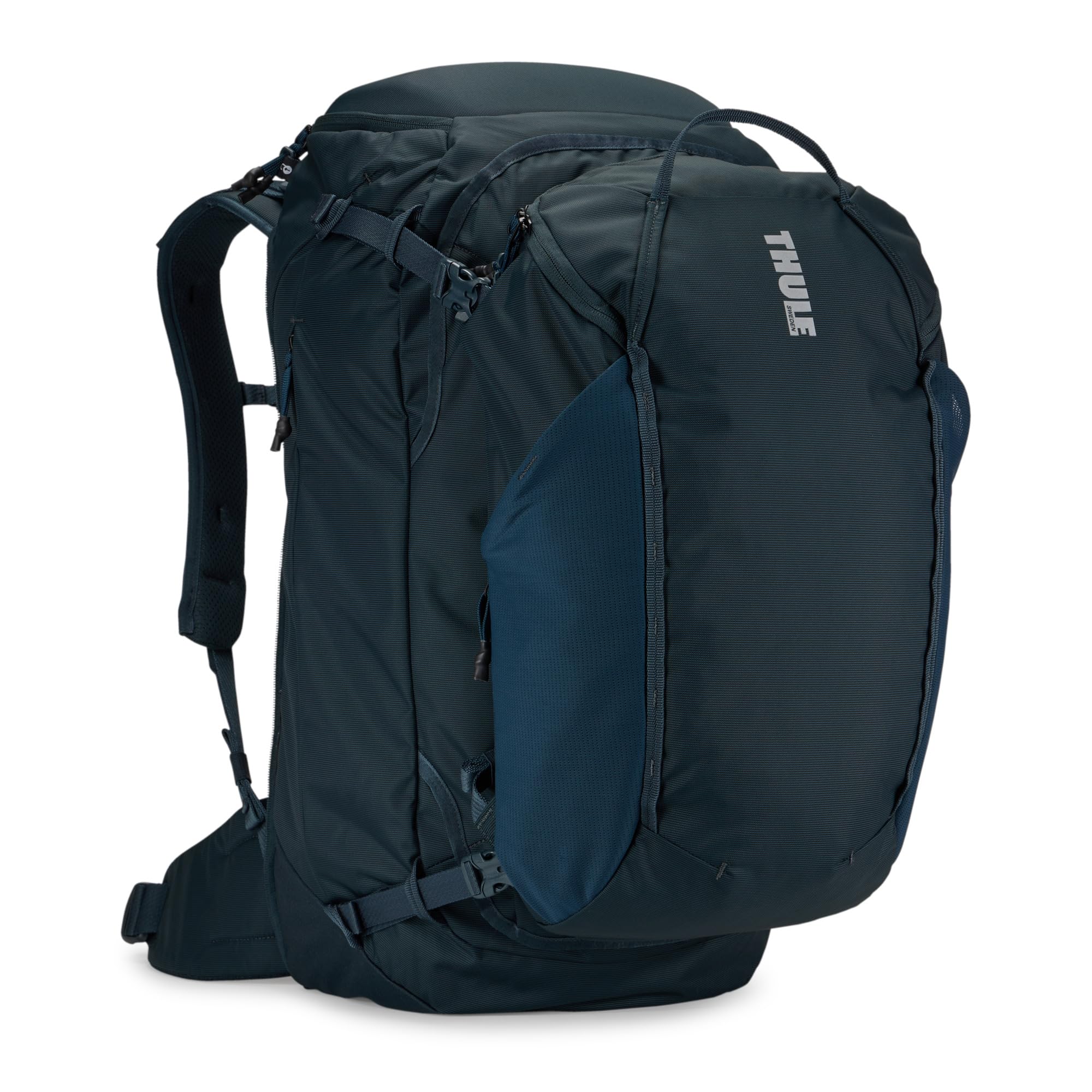
The Thule Landmark 70L is built for the mountaineer who also travels extensively — it splits into a 50-liter main pack and a removable 20-liter daypack that can function as a carry-on. The main compartment uses a cinch-top closure with a flap that covers a zippered entry, offering better rain protection than a standard zipper, and the entire bag is made from a robust 420-denier nylon that shrugs off rough handling at airports or on talus slopes.
Security features include the hidden CashStash pocket under the SafeZone panel and innovative LoopLocks that secure zipper pulls to the bag, which is useful in crowded train stations. The suspension is surprisingly comfortable for a travel-oriented pack, with an adjustable torso length and padded hip belt that handles 35 pounds well. The removable daypack includes a padded laptop sleeve and its own CashStash pocket.
On the trail, the lack of ice tool loops or a pick protector limits its use for technical climbing. The compression system works fine for cinching down the load, but you cannot lash a rope effectively without additional webbing. For alpine trekking where the objective doesn’t require technical ice climbing, this pack is a comfortable, theft-resistant companion.
Why it’s great
- Integrated 20L daypack is perfect for summit pushes
- Durable 420-denier fabric for travel and trail abuse
- Excellent theft-deterrent features for transport
Good to know
- No dedicated ice tool or axe attachments
- Not fully waterproof in heavy rain without cover
4. Thule Landmark 60L
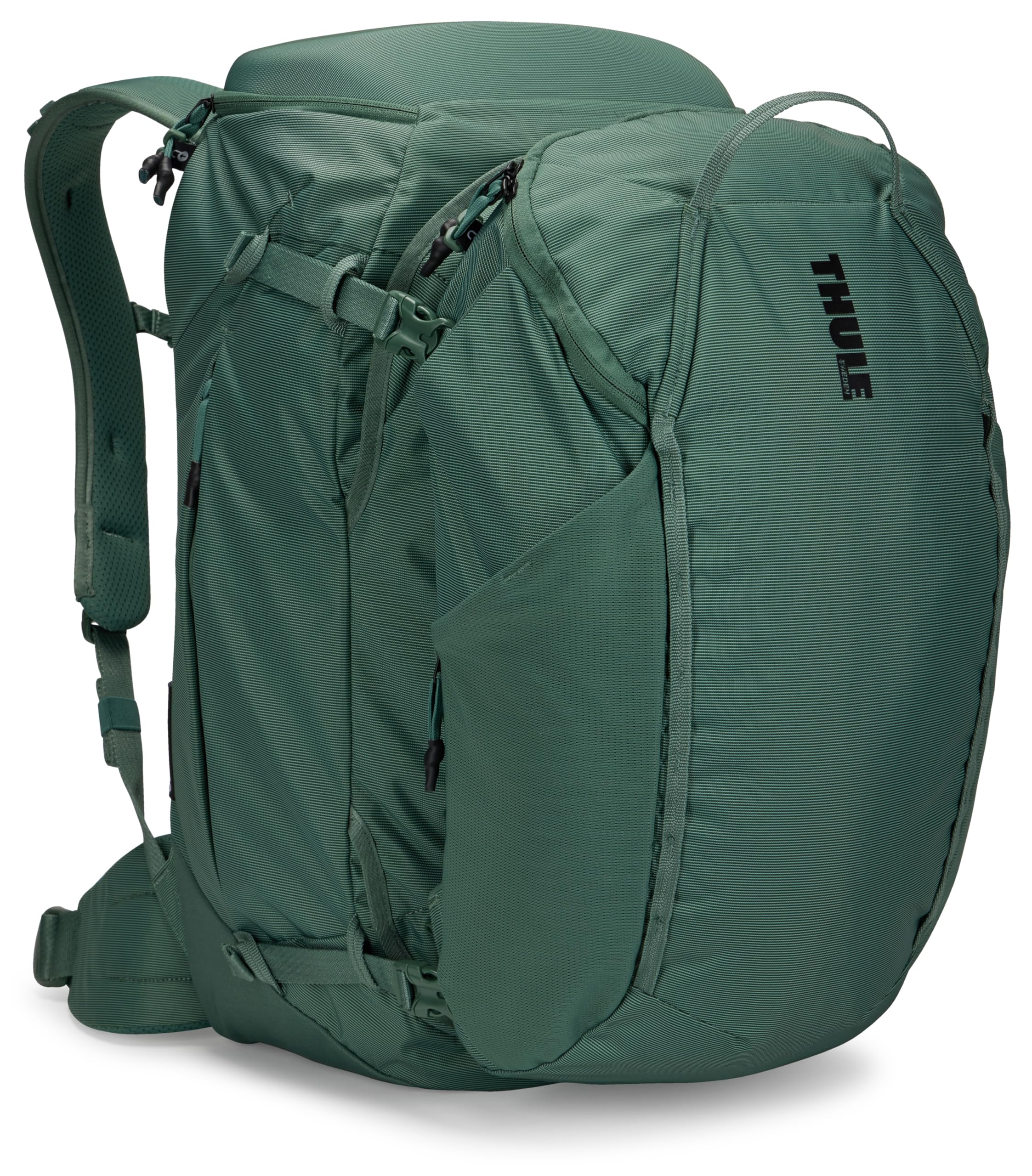
The Thule Landmark 60L offers essentially the same core design as the 70L version but in a smaller footprint that more easily fits in overhead bins on larger aircraft. The 60-liter main bag separates from the 20-liter daypack, giving you two distinct carry options — a large checked bag and a personal item — which is a huge advantage for international mountaineering trips with multiple flights.
The suspension uses a padded hip belt with an ergonomic curve, and the torso length is adjustable via a Velcro ladder system. The fabric is a sturdy 420-denier nylon that has survived months of trail and transit use according to owner reports. The hidden CashStash compartment inside the main pack’s back panel is large enough for a passport and wallet, adding real security value in unfamiliar cities.
Like the 70L, this pack lacks climbing-specific attachments, so it’s best suited for alpine trekking rather than technical ascents. The zippers are lockable but not fully waterproof, so gear inside will get damp in sustained rain without a dry bag. For the traveler who needs a single bag that can go from a Guayaquil bus station to a Patagonian trailhead, this is a compelling choice.
Why it’s great
- Detachable daypack doubles as a summit bag
- Concealed security pocket for valuables
- Durable construction tested on multi-month trips
Good to know
- Not designed for technical ice tool carrying
- No waterproof zippers, rain cover recommended
5. The North Face Terra 65

The North Face Terra 65 is a solid mid-range entry for backpackers moving into alpine terrain without breaking the budget. The pack features a full-length two-way U-zip that gives you access to the main compartment from the side, top, and bottom — a convenience item that allows you to dig out a puffy jacket without unloading everything from the top-loading cinch closure.
The suspension includes a removable frame sheet, load lifter straps, and an adjustable thoracic carriage, which together create a stable platform for loads up to 40 pounds. The hip belt is padded and contoured, and the shoulder straps have a moderate amount of cushioning. Attachment points for trekking poles and ice axes are included, but the axe loops are a bit flimsy compared to alpine-specific designs.
The fabric is a 210-denier nylon with a 420-denier base, which is adequate for well-groomed trails but may show wear quickly on abrasive granite. The back panel uses foam lumps rather than a suspended mesh, so ventilation is average. For the price, this pack offers exceptional storage and convenience features, but serious climbers may want a more rugged harness for technical loads.
Why it’s great
- Full U-zip access for easy gear retrieval
- Adjustable torso length for a custom fit
- Ice axe and trekking pole loops included
Good to know
- Fabric may abrade faster on sharp rock
- Back panel lacks ventilation for hot days
6. Osprey Rook 65L

The Osprey Rook 65L is a strong contender in the mid-range segment, offering Osprey’s respected AirSpeed vented backpanel at a price that significantly undercuts the premium Kestrel series. The tensioned mesh back keeps a gap between your back and the pack, which dramatically reduces sweat buildup on warm-weather approaches — a genuine advantage when you’re switching from hike to climb under a heavy sun.
The pack includes an integrated rain cover that stows in its own pocket, and the LightWire frame transfers loads efficiently to the hip belt for a comfortable carry up to 40 pounds. The front panel features compression straps and a daisy chain for lashing a rope or a closed-cell foam pad. The hydration sleeve fits a 3-liter bladder, and the hip belt pockets are large enough for a smartphone and snacks.
The main drawback is the lack of a large front mesh pocket — a common feature on many Osprey packs — which reduces external storage options for wet layers. The fabric is a 210-denier nylon, which is adequate for trail use but not as durable as the 420-denier material on the Kestrel. Still, for the price, this pack combines proven comfort and reliable performance on multi-day alpine treks.
Why it’s great
- Ventilated AirSpeed backpanel reduces sweating
- Integrated rain cover saves weight and hassle
- LightWire frame transfers load efficiently
Good to know
- No large front mesh pocket for wet gear
- Fabric is less durable than premium Osprey lines
7. Granite Gear Blaze 60L

The Granite Gear Blaze 60L is a lightweight framed pack that carries a surprising amount of weight for its low base weight. At around 5.5 pounds, it’s heavier than an ultralight frameless pack but far more capable of handling a 45-pound load thanks to its removable HDPE framesheet and the contour-molded foam hip belt. The adjustable torso system uses a ladder of Velcro panels that allows a range of 16 to 22 inches.
The pack features large, deep hip belt pockets that accommodate a modern phablet-sized smartphone, and the front mesh pocket is generous enough for a wet shell or a small towel. The top lid is removable and converts into a small summit pack with its own shoulder straps — a genuinely useful feature for leaving the main bag at basecamp and heading up the final pitch.
The fabric is a 100-denier robic nylon on the main body with a 210-denier base, which is light but more prone to punctures than heavier options. The straps and buckles have held up well over several seasons of hard use, but users note the pack lacks a bottom sleeping pad strap, which can be an inconvenience. For those who prioritize low weight and solid load carry for hut-to-hut and trail-based alpine trips, this is a fine choice.
Why it’s great
- Converts to a useful summit pack with the lid
- Hip belt pockets fit large modern phones
- Adjustable torso range fits many body types
Good to know
- Fabric is not as abrasion-resistant as heavier options
- No bottom straps for a sleeping pad or tent
8. Deuter Vertrail 16L
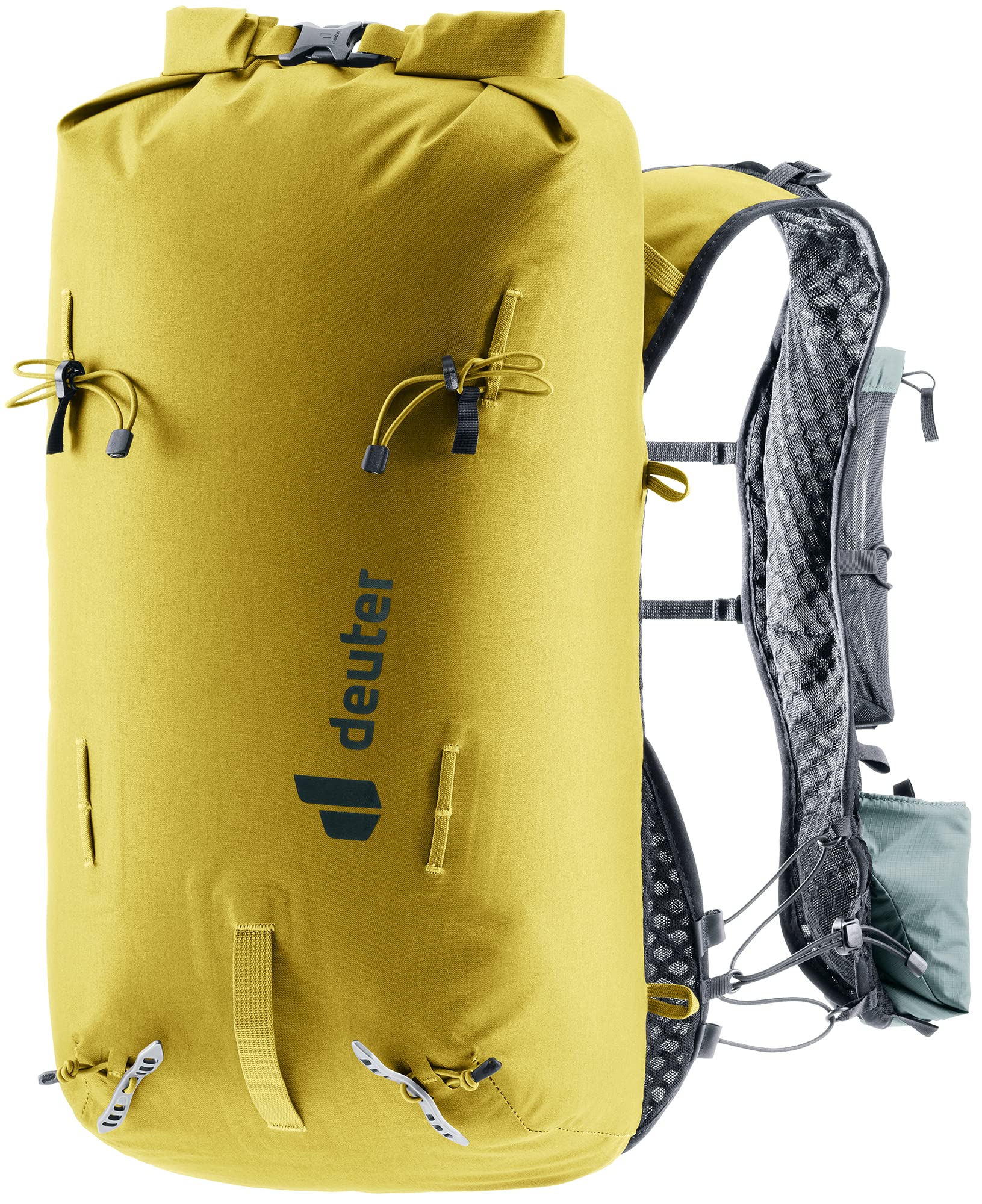
The Deuter Vertrail 16L is not a general-purpose expedition pack; it’s a specialty tool for the fast-and-light alpine climber who moves quickly through technical terrain with minimal gear. The roll-top closure with taped and welded seams makes it fully waterproof — no rain cover needed — and the vest-style shoulder harness wraps around the torso for a tight, stable fit that doesn’t shift during a 5.8 pitch.
Deuter included thoughtful climbing features: ice tool loops, a trekking pole holster, and small zippered mesh pockets on the shoulder straps for a GPS unit or smartphone. The back panel is a thin foam pad that offers minimal load support, but the pack is designed for loads under 15 pounds — typically a down jacket, a first aid kit, food, and water for a day route. The weight is barely noticeable when empty.
The capacity is strictly for day trips or fast solo ascents; you cannot fit a bivy, stove, or overnight gear. The snug fit works best for lean builds, and tall users may find the pack rides too high. It’s a perfect second pack for the climber who already owns a larger expedition bag and needs a nimble summit-day companion that won’t let moisture in during a wet couloir descent.
Why it’s great
- 100% waterproof welded-seam construction
- Vest-style harness is very stable on technical moves
- Shoulder strap pockets for quick-access essentials
Good to know
- Only 16L — no room for overnight or bivy gear
- Snug fit may not accommodate broad shoulders
9. Rockagator Kanarra 90L
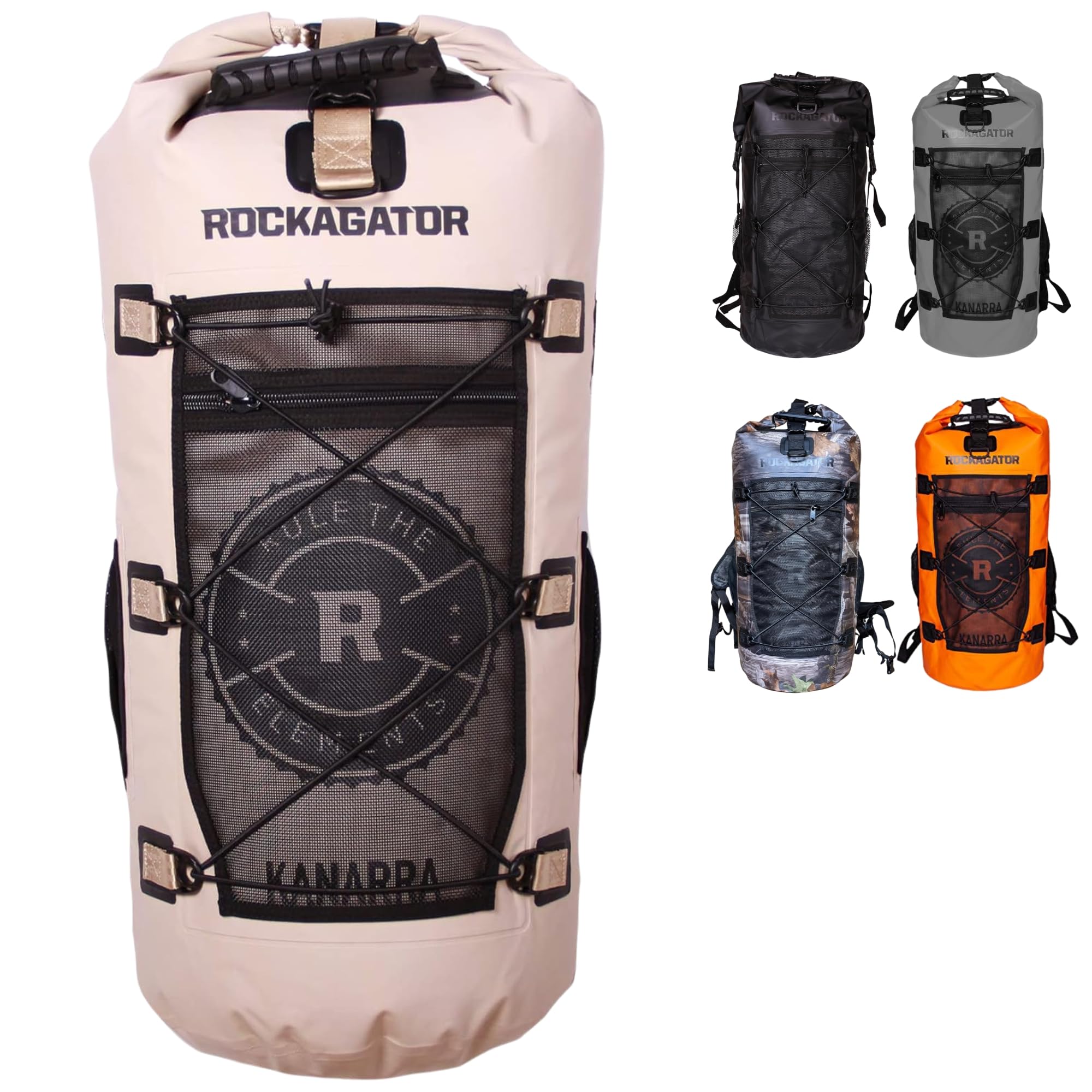
The Rockagator Kanarra 90L is a budget-oriented dry bag backpack designed primarily for wet environments like river crossings, canoe portages, and basecamp hauling in damp climates. Its 500-denier PVC fabric with RF-welded seams makes it completely waterproof when the roll-top closure is properly sealed — no amount of rain will get inside. The 90-liter capacity is enormous and can swallow a full expedition kit, including a bear canister.
The padded waist straps have multiple adjustment points to shift the load to your hips, and the sternum strap adds lateral stability. The pack includes shock cord netting on the back panel for lashing a jacket or a foam pad, plus Hypalon tether points on both sides for attaching additional gear. The rubber carry handle is durable and convenient for loading into a canoe or pickup truck.
The biggest limitation is the lack of a frame — the pack has no support structure, so loads over 30 pounds will sag and become uncomfortable on extended walks. The unpadded shoulder straps dig in when the bag is filled to capacity, making it unsuitable as a primary pack for long alpine approaches. It’s a purpose-built bag for short carries and wet-basecamp use, not a comfortable trekking pack for steep terrain.
Why it’s great
- Completely waterproof with welded seams
- Massive 90L capacity for expedition gear
- Hypalon attachment points for external lashing
Good to know
- No frame — uncomfortable under heavy loads over 30 lbs
- Unpadded straps dig into shoulders on long hikes
FAQ
How much volume do I need for a multi-day mountaineering trip?
Should I buy a pack with a fixed or adjustable torso length?
Can I use a regular hiking backpack for mountaineering?
Are waterproof packs worth the extra weight and cost?
Final Thoughts: The Verdict
For most users, the mountaineering backpack winner is the Deuter Futura Air Trek 60+10 because it combines excellent load transfer, practical alpine features, and a ventilated back system that keeps you comfortable on long approaches. If you want a more compact technical pack for short alpine routes, grab the Osprey Kestrel 48L. And for budget-conscious trekkers who need a reliable multi-day bag with solid features, nothing beats the The North Face Terra 65.