
Dragging a dead remote from room to room in search of fresh alkalines is a losing game that wastes cash and frustrates the entire household. A quality NiMH charger eliminates that cycle entirely, turning a single pit stop into years of ready-to-go power for game controllers, wireless mice, flashlights, and kids’ toys.
I’m Min — the co-founder and writer behind Gadgets Feed. I’ve spent countless hours cross-referencing charge-rate curves, individual-bay detection logic, and real-world self-discharge data to build this guide around measurable performance rather than marketing fluff.
This guide cuts through the noise to deliver a clear, data-backed ranking of the best nimh battery charger for every use case and budget.
How To Choose The Best NiMH Battery Charger
Not all chargers treat your cells the same way. A cheap unit with a single charge rail can overcharge one battery while undercharging its neighbor, reducing cycle life. Understanding a few core specs will help you buy a charger that protects your investment in rechargeable cells.
Individual Bay Charging vs. Series Charging
Individual bay charging means each slot operates independently, monitoring voltage and stopping when that specific cell is full. Series chargers treat multiple batteries as one block, which leads to imbalances and premature wear. For any household with mixed battery ages or brands, individual bays are non-negotiable.
Charge Rate and -ΔV Detection
A charge rate around 500–1000 mA is gentle on standard NiMH cells, while 2000 mA slots enable rapid refills for high-capacity batteries. The most critical safety feature is -ΔV (negative delta V) detection: the charger monitors a small voltage dip that signals full charge and stops immediately, preventing the heat buildup that cooks cells.
Compatibility and Cell Preservation
All NiMH chargers work with AA and AAA sizes, but some also detect faulty or non-rechargeable cells and refuse to charge them. A low self-discharge preservation mode (trickle charge) after full charge keeps cells topped off without degrading them, extending usable life past 500 cycles.
Quick Comparison
On smaller screens, swipe sideways to see the full table.
| Model | Category | Best For | Key Spec | Amazon |
|---|---|---|---|---|
| Panasonic BQ-CC65 | Premium | Advanced users & diagnostics | LCD shows voltage & mAh | Amazon |
| Panasonic BQ-CC63 | Premium | Reliable high-capacity charging | 8 individual bays, 5‑hour charge | Amazon |
| EBL 16‑Bay LCD | Mid-Range | High‑volume charging | 16 slots, LCD status per cell | Amazon |
| KOSHARE 8‑Slot | Mid-Range | Magnetic storage & charging | 8·2800mAh AA included | Amazon |
| Eneloop Panasonic CC17 | Mid-Range | Compact starter kit | 4 bays, 2100 cycle cells | Amazon |
| Amazon Basics 8‑Bay | Budget | Value bundle with USB‑C | USB‑C input, 8 AAA + 8 AA | Amazon |
| EBL Combo 8‑Slot | Budget | Entry‑level all‑in‑one | 2 USB outputs, 16 cells total | Amazon |
In‑Depth Reviews
1. Panasonic BQ-CC65AKBBA Super Advanced eneloop pro Quick Charger

The Panasonic BQ-CC65 is the most sophisticated NiMH charger on this list. Its LCD panel cycles through real-time voltage, charge/discharge time, and mAh discharge levels for each of its 4 individual slots, giving you lab-grade insight into your cells’ health. A dedicated USB port outputs 5V/1A so your charger doubles as a phone top‑up station.
Charge times are genuinely fast: a pair of eneloop pro AA cells reach full capacity in roughly 2 hours, while a full set of four takes about 4 hours. The -ΔV detection is precise enough to prevent the overheating that silently destroys lesser batteries, and the refresh function can resuscitate older NiMH cells that have developed voltage depression from repeated partial charges.
Build quality matches the price — the chassis feels dense, the sliding contacts are smooth, and the blue‑backlit LCD is easy to read even in dim light. The only real trade‑off is the 4‑slot limit; if you need to charge 8 cells at once, you will want a second unit or the 8‑bay CC63.
Why it’s great
- LCD shows voltage, charge time, and mAh discharge per slot
- Refresh mode restores underperforming or older NiMH cells
- Built‑in USB port charges phones at 5V/1A
Good to know
- Only 4 charging bays — not for bulk households
- Premium price point
2. Panasonic BQ-CC63SBA Advanced eneloop 8‑Position Quick Charger
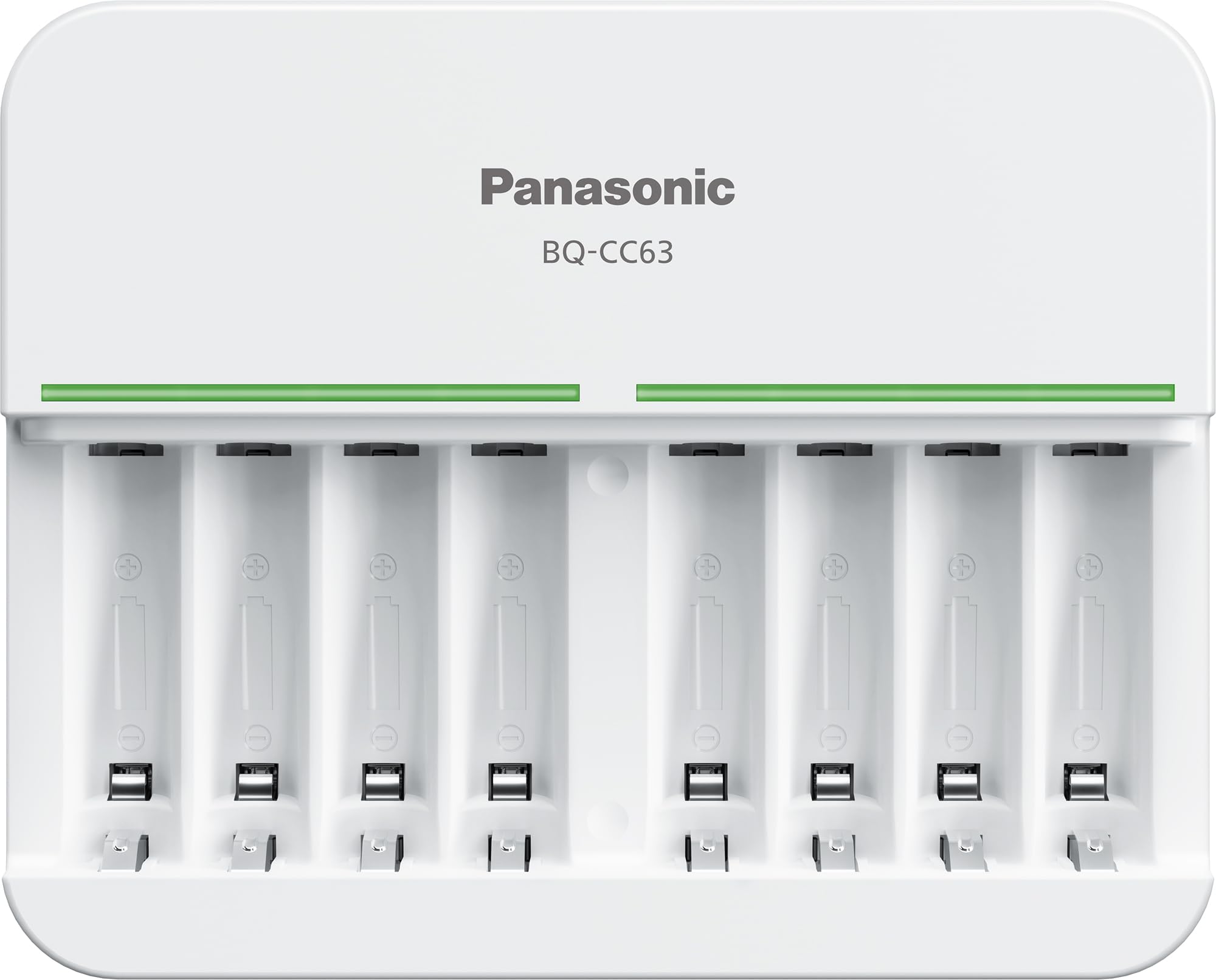
The BQ-CC63 delivers everything most households need without the complexity of a data readout. Eight independent slots let you charge any mix of AA and AAA eneloop cells simultaneously, and each bay uses individual -ΔV detection to stop at the exact moment each cell is full — no cooking, no guessing. The 5‑hour full charge time for a set of 8 AA cells is entirely practical for overnight top‑ups.
An included 6‑foot AC power cord means you can reach awkward outlets on a bookshelf or desk, and the 8 individual green LED indicators (one per slot) give clear status at a glance: green means charging, off means full. There is no intermediate brightness or color change, which some users find less informative than the CC65’s LCD, but for daily charging it is perfectly functional.
The absence of batteries in the box keeps the price competitive for those who already own eneloop cells or want to pair it with higher‑capacity eneloop pro packs. This charger is UL, CE, and FCC certified, so safety is not an afterthought at this price tier.
Why it’s great
- 8 independent bays treat each cell individually
- Complete 8‑cell charge in about 5 hours
- Comes with a long 6‑foot AC power cord
Good to know
- No LCD — LED only shows on/off
- Batteries sold separately
3. EBL AA Battery Charger, 16 Bay with LCD Display

When you need to cycle 16 cells at once — for photography gear, multi‑player game nights, or a fleet of wireless microphones — the EBL 16‑bay LCD charger is the only unit here with that capacity. Each of the 16 slots charges independently with a 2000 mA output current, enabling a single AA to reach full charge in about 1 hour and a full 16‑cell batch within 3 hours.
The gentle green LCD is a standout: every slot shows a 5‑bar charge level (20% increments) so you know exactly where each cell stands without squinting at tiny LEDs. The charger also detects and flags bad or non‑rechargeable batteries, refusing to charge them and preventing a potential hazard. The built‑in MCU control system manages overcharge, overcurrent, and reverse‑polarity protection.
One minor ergonomic friction: retrieving AAA batteries from the deep slots can require a small tool like a screwdriver because the contacts are snug. Despite that, the build is solid, the AC cable is integrated (no wall wart required), and the 100‑240V input makes it travel‑friendly worldwide.
Why it’s great
- 16 independent slots — highest capacity on this list
- 5‑bar LCD per slot gives clear charge progress
- 1‑hour fast charge for a single AA
Good to know
- AAA batteries can be tricky to remove from the slots
- No USB output
4. KOSHARE Rechargeable Ni‑MH AA with Charger, 8‑Slot 2800mAh
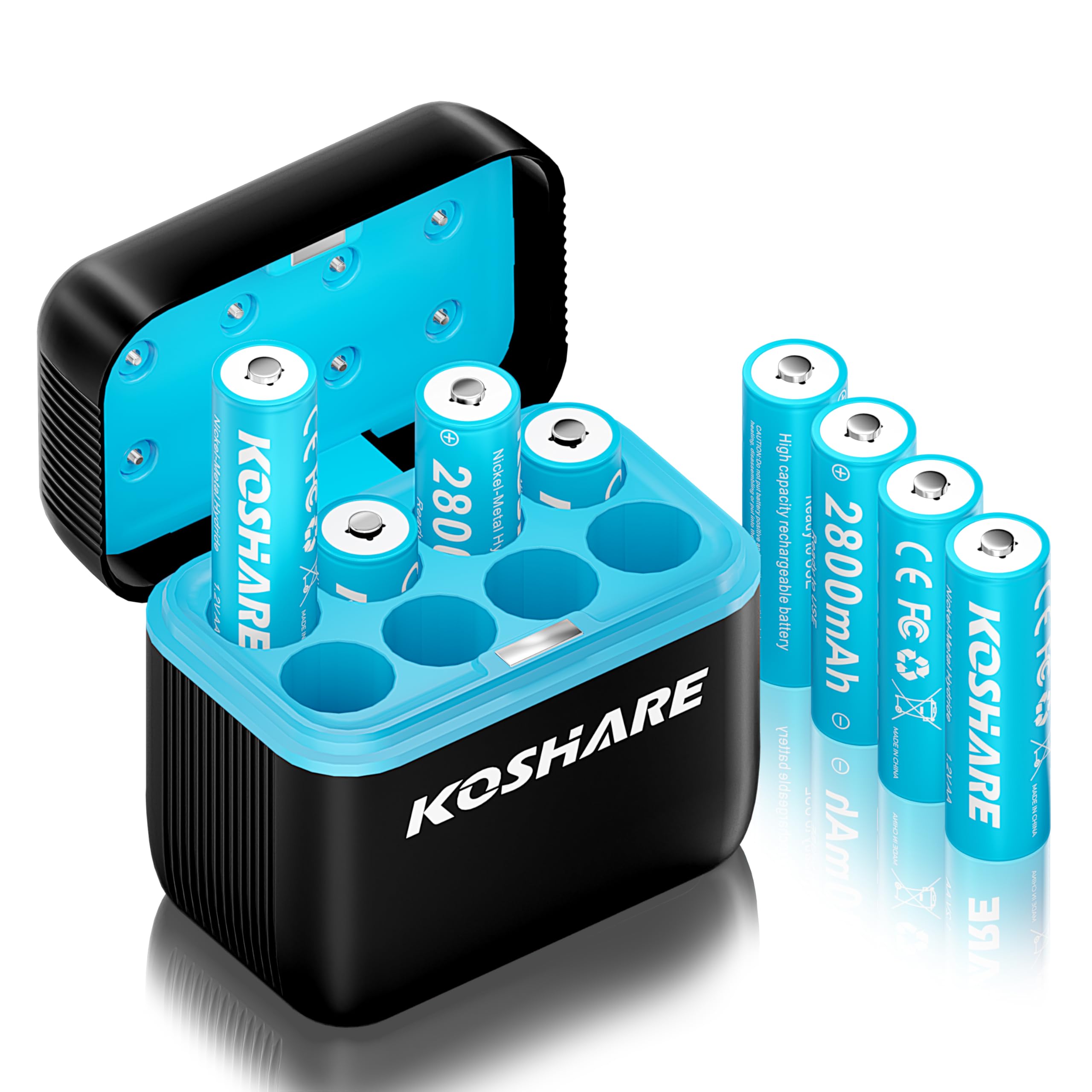
KOSHARE takes a different approach: the 8‑slot charger doubles as a storage case thanks to a magnetic tray design that holds the batteries in place when not charging. It comes with 8 AA 2800 mAh cells pre‑charged, so you are ready to go right out of the box. The smart LED indicators use a steady red light for charging and solid green for full, plus a flashing red warning for battery errors or abnormal temperature.
Each slot charges independently, so you can charge 1, 3, or all 8 cells without worrying about pairing. The charger recommends a 5V/3A adapter (not included) for optimal performance, and a Type‑C charging cable is in the box. The 2800 mAh cells are noticeably higher capacity than the 2000 mAh standard, giving your high‑drain devices longer runtimes between refills.
The build is lightweight but adequate, and the integrated storage solution reduces desk clutter. The main limitation is that these specific cells should only be charged in the KOSHARE charger — mixing with other chargers could affect performance or safety.
Why it’s great
- Magnetic tray doubles as charger and storage case
- 8 included 2800 mAh AA cells with 800‑cycle rating
- Type‑C input cable in the box
Good to know
- Batteries should only be charged in KOSHARE charger
- 5V/3A power adapter not included
5. Eneloop Panasonic K-KJ17MCA4BA Advanced Individual Cell Charger

The CC17 is the entry point into the eneloop ecosystem and remains one of the most reliable 4‑bay chargers for everyday use. Each slot individually charges AA or AAA NiMH cells with independent LED indicators hidden under the white casing — they are visible when lit but invisible when off, giving the charger a clean unibody look. The included 4 AA cells are rated for 2100 cycles (minimum 2000 mAh), so this kit pays for itself many times over if you are replacing alkaline batteries in TV remotes, clocks, and game controllers.
A critical detail: the charger ships with a small plastic strip blocking the internal circuit to prevent parasitic drain during storage. Removal is simple but can confuse first‑time users who think the unit is broken. Once that strip is out, the charger works with any NiMH brand (Sony, Duracell, Energizer) and auto‑shuts off when cells are full. The 100‑240V input means it works worldwide with a simple plug adapter.
The charge rate is moderate — not as fast as the CC65 or the EBL 16‑bay, but that gentleness actually prolongs cell life in the long run. AAA batteries sit lightly in the bays and do not require excessive force to insert.
Why it’s great
- 4 independent bays with individual LED indicators
- Included AA cells rated for 2100 charge cycles
- World‑voltage input (100‑240V) for travel
Good to know
- Plastic shipping strip inside must be removed before use
- Moderate charge speed — not a fast charger
6. Amazon Basics Rechargeable NiMH 8‑Bay Charger with USB‑C
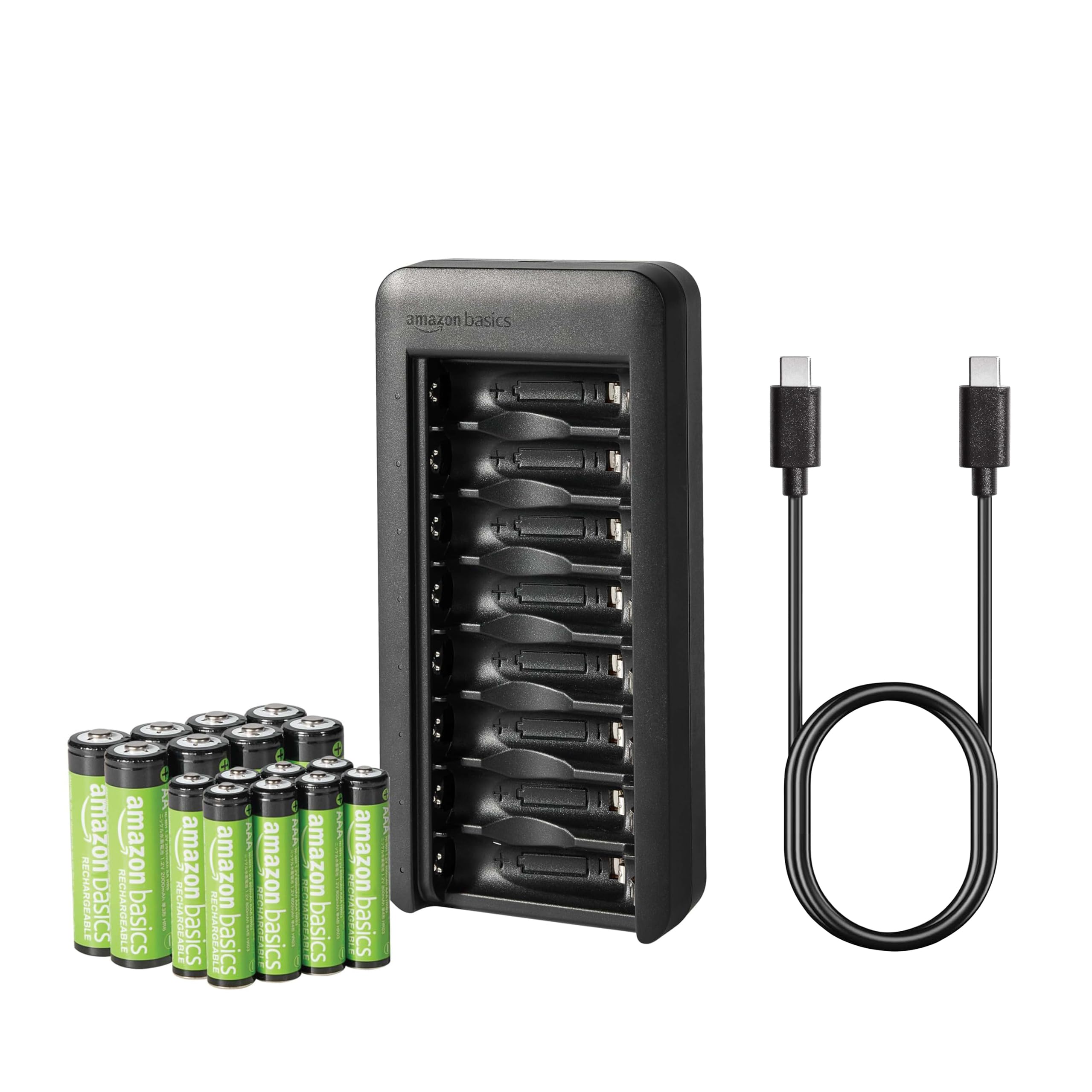
The Amazon Basics 8‑bay charger is the most wallet‑friendly bundle that still provides independent‑bay charging for 8 cells. It includes 8 AA 2000 mAh and 8 AAA 800 mAh batteries — enough to power multiple households for months of normal use. The charger uses USB‑C input (cable included, no power adapter) and the batteries maintain 80% capacity for up to 12 months of storage, making them true low self‑discharge cells.
LED behavior covers four states: slow blinking for charging, solid white for full, fast blinking for error (bad or alkaline battery detected), and a quick power‑on sequence when plugged in. The charger supports mixed AA/AAA charging in any combination, and the LEDs do not need pairing — each slot works completely independently. A full 8‑cell charge takes about 10 hours, which is on the slower side, but perfectly fine for an overnight cycle.
Some users report that charging more than 2 AA cells can cause check‑lights to flash unexpectedly, which may indicate a sensitivity to cells with slightly different internal resistance. The build quality is decent for the price, but the charger lacks the robust feel of Panasonic or EBL units.
Why it’s great
- Excellent value: 8 AA + 8 AAA cells included
- USB‑C input — use any modern phone charger
- Each bay charges independently
Good to know
- 10‑hour charge time for a full 8‑cell set
- Occasional false error detection with mixed cells
7. EBL AA 2300mAh & AAA 1100mAh Charger with 2 USB Ports
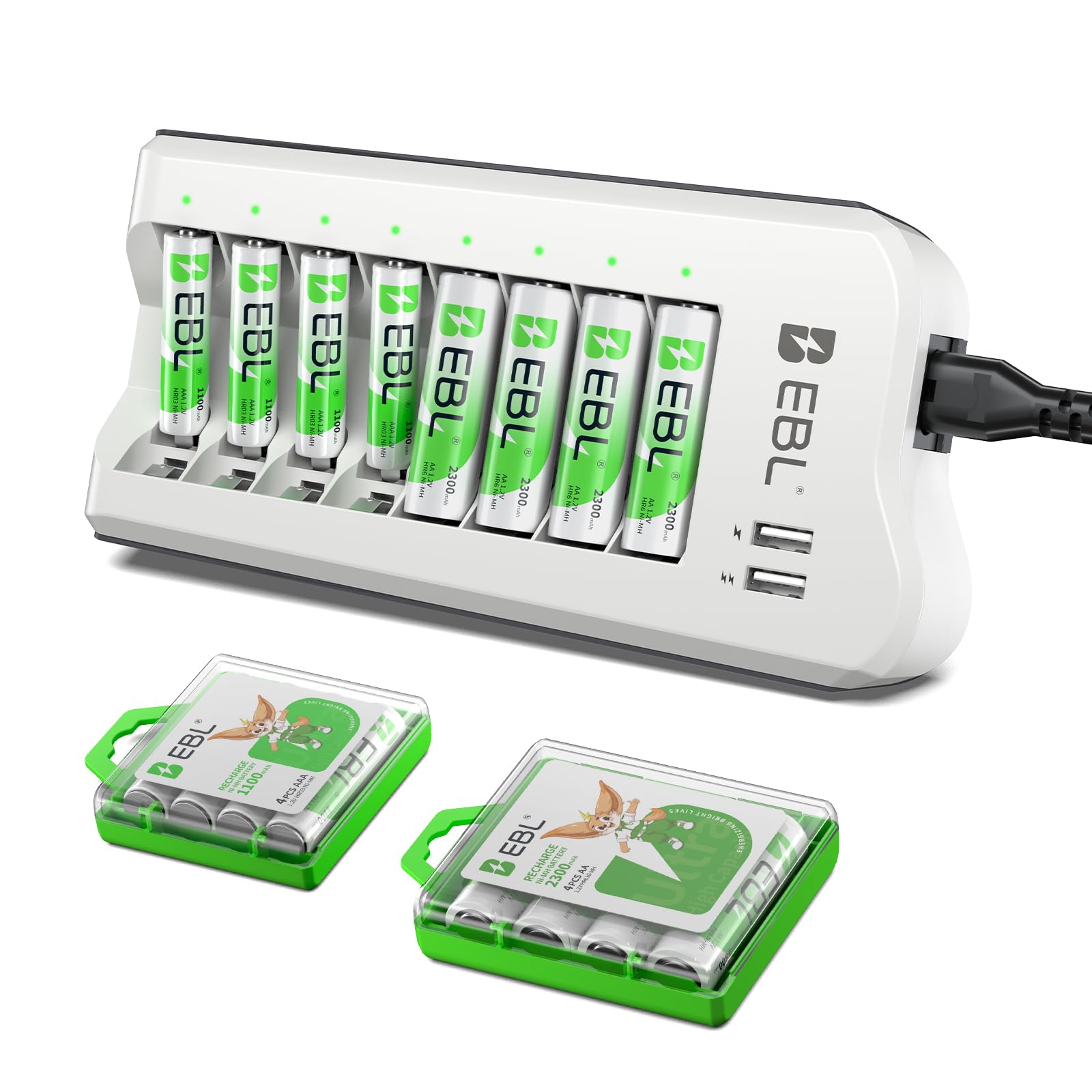
The EBL combo charger is the most complete entry‑level package: it charges 1–8 AA or AAA NiMH cells while also providing two USB‑A output ports (total 2.1A) so you can charge your phone or tablet from the same unit. The included batteries — 8 AA 2300 mAh and 8 AAA 1100 mAh — use ProCyco technology rated for up to 500 deep cycles, and the low self‑discharge seal holds 80% capacity after 3 years of storage.
Charging is simple: insert any mix of cells (no pairing required), plug in via the built‑in AC cable, and the red/green LEDs indicate charge status. The USB ports work simultaneously with battery charging, reducing the need for separate USB wall adapters. The batteries come in two storage cases, which helps organize your collection and makes travel easy.
There are a couple of trade‑offs at this price point. The charger uses a high‑frequency switching circuit that some users report emits a faint 16 kHz whine — not audible to most people but noticeable in a quiet room. The AAA batteries sometimes arrive with a surface charge that needs a few full cycles to reach their rated capacity, so initial performance may improve after 4–5 charge/discharge runs.
Why it’s great
- Two USB‑A outputs charge phones while charging batteries
- 16 batteries included (8 AA + 8 AAA) in storage cases
- No pairing required — charge any mix of cells
Good to know
- Some units produce a faint high‑frequency whine
- AAA batteries may need a few cycles to reach full capacity
FAQ
Can I leave NiMH batteries on the charger after they are full?
Why do my new NiMH batteries seem to run out quickly at first?
What does the refresh or discharge function do on the CC65 charger?
Final Thoughts: The Verdict
For most users, the best nimh battery charger winner is the Panasonic BQ‑CC63 because it gives you 8 true individual bays, reliable -ΔV cutoff, and a fast 5‑hour charge time at a price that beats the premium LCD models. If you want real‑time diagnostics and a refresh function to restore older cells, grab the Panasonic BQ‑CC65. And for high‑volume households needing to charge 16 cells at once, nothing beats the EBL 16‑Bay LCD charger.