
Our readers keep the lights on and my morning glass full of iced black tea. As an Amazon Associate, I earn from qualifying purchases.
Specs are compiled from manufacturer listings and verified buyer reviews and can change over time — please confirm the key details on the product page before buying.
When you cannot breathe well — from a lung condition, a high-altitude hike, or a rough night with sleep apnea — knowing your blood oxygen level matters most. An O₂ sat monitor (a device that clips onto your finger and measures the oxygen in your blood) gives you that number. The confusing part: some models last through a weekend, others run for weeks on one set of batteries, and a few are accurate enough for a clinic. This guide cuts through the medical-marketing noise so you pick the monitor that matches how you actually plan to use it.
I’m Min — the founder and writer behind Gadgets Feed. This guide is built by comparing the manufacturers’ published specifications and the patterns across verified customer reviews, so you get each pick’s real strengths and trade-offs instead of marketing spin.
To pick the right o2 sat monitor, you need to match it to your real use: battery endurance for all-night tracking, accuracy specs for trustworthy spot-checks, and data storage if you want to show readings to your doctor.
Quick Picks
- Nonin TruO2 OTC Pulse Oximeter 3250 — Best Overall
- Medline Soft-Touch Bluetooth Fingertip Pulse Oximeter — Battery King
- EMAY Sleep Oxygen Monitor (EMO-80) — Sleep Tracker
- HOLFENRY Handheld Pulse Oximeter (JKS50F) — Multi-User Hub
How To Choose The Best O2 Sat Monitor
Buying a pulse oximeter is simpler than it looks if you focus on three things: how long it lasts on a charge, whether it stores data for later review, and how accurate the manufacturer says it is. Nail those three, and the rest is mostly screen size and color.
Battery Endurance Dictates Your Use Case
A monitor that runs for 40 hours is a fundamentally different tool from one that runs for 8. The longer battery life lets you wear it all night and check the data in the morning, while a shorter battery means you must charge it between uses. If you plan to track oxygen during sleep, look for a device that advertises at least 40 hours of continuous operation.
Accuracy Range Is the Real Spec
Every oximeter reports a measurement range, for example 35-100% or 70-100% SpO₂. A wider range is not necessarily better — what matters is the range where the device is actually accurate. Some monitors are precise down to 1% between 70-100%, which is the clinically relevant zone. Models that measure below 70% are typically intended for sports and aviation, not medical diagnosis.
Storage and Sync: Record First, Review Later
Some fingertip oximeters show you a number and then forget it. Others, like the EMAY, store up to 40 hours of data internally so you can sync it later to a phone app. If you want a report to share with your doctor, choose a device with built-in memory and a free companion app. A simple spot-check model works fine if you only need a quick reading once in a while.
Quick Comparison
| Model | Best For | Battery Life | SpO₂ Range | Storage / App | Amazon |
|---|---|---|---|---|---|
| EMAY Sleep Oxygen Monitor (EMO-80) | Overnight tracking with later review | 40 Hours | 35-100% | 40 hrs built-in memory + app | $59.00Amazon |
| Medline Soft-Touch Bluetooth (HCSM70T) | Long-life home monitoring with Bluetooth | 300 Hours | 70-100% | Bluetooth + Medline Health App | $73.28$79.99Amazon |
| HOLFENRY Handheld Pulse Oximeter (JKS50F) | Multi-user home with trend recording | 8 Hours | 70-100% (1% accuracy) | 300 sets/ID for 10 users + app | $89.10$99.00Limited time dealAmazon |
| Nonin TruO2 OTC 3250 | Medical-grade accuracy across skin tones | 2200 min (~37 hrs) | — | Automatic on/off, Apple Health | $269.99$299.00Amazon |
In‑Depth Reviews
1. Nonin TruO2 OTC Pulse Oximeter 3250

The only monitor here with FDA clearance that treats dark skin and cold fingers the same as light skin and warm ones.
Nonin literally invented the fingertip pulse oximeter, and the TruO2 3250 brings that hospital-proven PureSAT technology into your home. You do not need a prescription to buy it, but the FDA has cleared it for over-the-counter use, which is a serious stamp of trust that most consumer oximeters lack. The device is rated accurate across skin tones and in low-circulation situations like cold hands — a real-world problem that cheaper monitors often ignore.
The design is deliberately simple: you slide your finger in, it turns on automatically, and the bright LED display shows you your SpO₂ and pulse rate. There is also a CorrectCheck feature that warns you if your finger is not positioned right, so you do not get a false reading. Unlike the Medline below, this one does not connect to an app, but it does sync with Apple Health for passive logging. A battery life of 2200 minutes (roughly 37 hours) makes it an easy grab-and-go device for daily spot checks.
Buyers report that the Nonin consistently produces readings that match their clinical devices at the doctor’s office, which is the highest praise a home oximeter can get.
Why It Leads the Pack
- FDA-cleared for OTC home use — the only unit on this list with that certification
- PureSAT technology delivers accurate readings across all skin tones and low perfusion
- CorrectCheck tells you if your finger is poorly positioned, preventing bad data
The Trade-Offs
- No internal memory or smartphone app for storing and reviewing historical data
- Battery life of 2200 minutes is solid but far shorter than the 300-hour Medline
Reach for this if: accuracy matters most and you want a device trusted by hospitals, with no guesswork about whether your skin tone or cold fingers will affect the reading.
Look elsewhere if: you need overnight trend recording or an app to store weeks of data — this is a spot-check champ, not a sleep tracker.
2. Medline Soft-Touch Bluetooth Fingertip Pulse Oximeter

A 300-hour battery that makes every other oximeter here look like a rechargeable toy — you will change the batteries long before the device dies.
Medline built this oximeter around an absurdly generous battery life: 300 hours from a pair of AAA cells. That is a 37.5x gap compared to the 8-hour runtime of the HOLFENRY model below. For practical purposes, you can use this device daily for months without worrying about power. It comes with a soft finger pad for comfort and a bright OLED display that rotates through 7 different viewing angles, so you never have to twist your wrist to see the numbers.
The Bluetooth connection to the free Medline Health app lets you document, track, and share your SpO₂ and pulse rate readings directly from your phone. Unlike the EMAY unit that records first and syncs later, the Medline can stream data live. The measurement range is 70-100% SpO₂, which covers the clinically relevant zone, and the unit is described by the manufacturer as accurate as healthcare-grade units without requiring a prescription.
Owners mention that the Bluetooth pairing is straightforward and the app graphs are clear enough to show a doctor without extra explanation.
Standout Strengths
- 300-hour battery life — by far the longest endurance in this comparison
- OLED display with 7 viewing angles makes reading easy from any position
- Bluetooth app sync for live data tracking and sharing with your physician
Honest Limits
- No internal memory for offline recording — data only lives in the app while connected
- SpO₂ range of 70-100% is narrower than the 35-100% range of the EMAY
Your pick if: battery anxiety bothers you and you want a Bluetooth oximeter that will run for months on two AAA batteries without ever needing a recharge.
Not for you if: you need offline data storage — this unit does not record unless the app is actively paired.
3. EMAY Sleep Oxygen Monitor (EMO-80)

Record your oxygen and pulse all night without your phone nearby, then sync the data in the morning with one tap.
The EMAY Sleep Oxygen Monitor takes a different approach from the Medline: instead of streaming data live, it records continuously onto its own 40-hour internal memory. You put it on your finger before bed, go to sleep, take it off in the morning, and sync the whole night’s data to the free iOS/Android app at your convenience. This “record first, sync later” design is ideal if you do not want to sleep with your phone next to you.
The measuring range stretches from 35-100% SpO₂ and 30-250 bpm for pulse rate, which is broader than the Medline’s 70-100% zone. The device uses 2 included AAA batteries and weighs almost nothing at 0.01 kilograms. The large digital LCD display rotates so you can read it without twisting your neck, which is a small but thoughtful touch. The manufacturer explicitly states the device is intended for sports and aviation use, not for medical diagnosis, so treat it as a trend-monitoring tool rather than a clinical instrument.
One reviewer noted that the app’s summary report made it easy to show their doctor a week’s worth of overnight oxygen patterns without needing to keep a handwritten log.
Key Advantages
- 40 hours of built-in data memory lets you record all night without any app connection
- Broad measurement range from 35-100% SpO₂ and 30-250 bpm
- Rotating display means no neck craning to read the numbers
Important Caveats
- Not FDA-cleared for medical use, only for sports and aviation tracking
- 40-hour battery life is solid but drastically shorter than the Medline’s 300-hour runtime
Designed for: anyone who wants to track oxygen continuously overnight and review the data later on a phone app without keeping the phone in the bedroom.
skip it if: you need a clinically cleared device or prefer live Bluetooth streaming — the Medline or Nonin serve those use cases better.
4. HOLFENRY Handheld Pulse Oximeter (JKS50F)
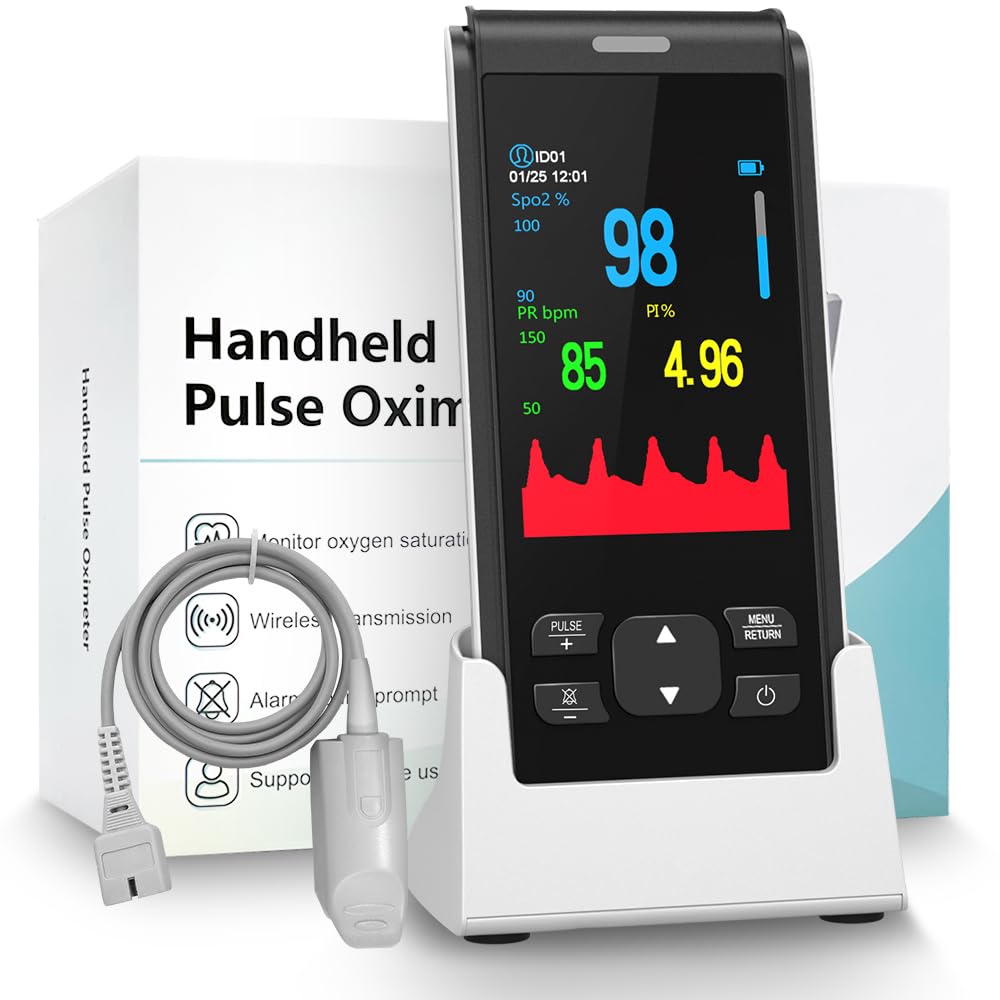
A desktop-style oximeter that stores separate histories for up to 10 family members in one compact charging cradle.
The HOLFENRY earns its spot because it is the only pick here that stores separate histories for up to 10 people — a household of four can each have their own 300-set record without mixing up readings. Unlike the other finger-clip monitors, this one sits in a charging cradle and connects to an adult finger probe via a cable, so it feels more like a clinical unit you would see in a nurse’s station.
Accuracy is rated at 1% for SpO₂ (blood oxygen saturation) between 70-100% and 1 bpm (beats per minute) for pulse rate — the tightest spec here for the range that matters most in a clinic. You get two measurement modes: Spot-check for a quick read and Trend Record for continuous overnight monitoring. The battery lasts 8 hours on a full charge, which is the shortest of the group by a wide margin, but the unit works continuously while plugged into the charging base, so battery life is a non-issue for home use. If your pulse drops below 50 bpm or your oxygen falls below 90%, the device beeps and the values flash as a visual alert. Customers note the cable between the cradle and probe can feel restrictive if you move around in bed, so this monitor suits someone who sleeps still or wants a bedside station, not a hiker who needs a pocket-sized device.
Reviewers point out that the charging cradle works well, but the magnetic connector on the device itself is not removable, so if it ever fails, the whole unit needs to be replaced.
What You Get
- 10 user profiles with 300 data records per user — ideal for families or small clinics
- 1% accuracy on SpO₂ between 70-100% and 1 bpm on heart rate
- Audible and visual alarms for low oxygen or low pulse rate
The Catch
- 8-hour battery life is the shortest here, a 37.5x gap compared to the Medline’s 300 hours
- The magnetic charging connector is non-removable and has no replacement parts available
Ideal when: multiple people in your household need tracked oxygen data and you want each person’s history stored separately in one device.
Look elsewhere if: you need long battery life or a simple clip-and-go form factor — the Medline or Nonin serve single users better.
Understanding the Specs
SpO₂ Measurement Range vs Accuracy
SpO₂ stands for peripheral capillary oxygen saturation — essentially the percentage of oxygen in your blood. A spec like “35-100%” tells you what the device can measure, but the real action happens in the “accurate to 1%” claim between 70-100%. That narrow band is where your body normally lives (95-100%) and where a problem shows up (below 90%). Wider ranges that go below 70% are rarely useful for home monitoring because readings that low usually mean you need a hospital, not a home device.
Battery Life and Recording Mode
A pulse oximeter’s battery life directly determines whether it is a spot-check tool or a sleep tracker. A 300-hour battery means months of occasional use, while a 40-hour battery means you can wear it overnight for several nights before needing a change. Pay attention to whether the device records data internally or only while connected to an app. Internal memory lets you sleep without your phone in the room; live Bluetooth streaming gives you real-time graphs but requires the app to stay open.
FAQ
What does SpO₂ mean on a pulse oximeter?
Is an O2 sat monitor the same as a pulse oximeter?
How long can I wear a fingertip oximeter continuously?
Do I need an FDA-cleared pulse oximeter for home use?
Will a pulse oximeter work on dark skin or cold fingers?
How do I share my oxygen data with my doctor?
What is the difference between spot-check and trend-record modes?
Can a pulse oximeter track sleep apnea?
Why does my oximeter read differently on each finger?
How often should I replace the batteries in my pulse oximeter?
Final Thoughts: The Verdict
Across the board, the o2 sat monitor winner is the Nonin TruO2 3250 because it is the only device on this list with FDA clearance, verified accuracy across skin tones, and medical-grade reliability without needing a prescription. If you want long battery life with Bluetooth tracking, grab the Medline Soft-Touch. And for overnight trend recording that does not require your phone to stay in the room, the EMAY Sleep Oxygen Monitor is the best dedicated sleep tracker.
How We Picked
We do not accept paid placement. Every pick is matched to a real buyer and a real use-case; we do not hands-on test units.
Sources & Methodology
Specifications: manufacturer listings and product documentation. Review insights: verified customer reviews, as of July 2026. Pricing: not shown on this page (it changes often); check the current price via the retailer link.
As an Amazon Associate, Gadgets Feed earns from qualifying purchases. This does not affect which products we feature.
Product prices and availability are accurate as of the date/time indicated and are subject to change. Any price and availability information displayed on Amazon at the time of purchase will apply to the purchase of this product. As an Amazon Associate I earn from qualifying purchases.
CERTAIN CONTENT THAT APPEARS ON THIS SITE COMES FROM AMAZON. THIS CONTENT IS PROVIDED "AS IS" AND IS SUBJECT TO CHANGE OR REMOVAL AT ANY TIME.
Amazon and the Amazon logo are trademarks of Amazon.com, Inc. or its affiliates.