
Our readers keep the lights on and my morning glass full of iced black tea. As an Amazon Associate, I earn from qualifying purchases.
Specs are compiled from manufacturer listings and verified buyer reviews and can change over time — please confirm the key details on the product page before buying.
You can cut the cable bill and still watch the big game or local news in crisp detail. A solid outdoor antenna pulls free, over-the-air channels straight from broadcast towers, and the right one for your home depends on range, direction, and how comfortable you are on a ladder. This guide separates real long-range performers from inflated marketing claims, so you can cut the cord with confidence.
I’m Min — the founder and writer behind Gadgets Feed. This guide is built by comparing the manufacturers’ published specifications and the patterns across verified customer reviews, so you get each pick’s real strengths and trade-offs instead of marketing spin.
From motorized rotors to attic-friendly designs, we break down what actually matters when you choose the best outdoor tv antenna for your specific location and signal needs.
Our Picks at a Glance

How To Choose The Best Outdoor TV Antenna
Choosing the right antenna starts with your location. A 150-mile-rated antenna won’t help if you are 10 miles from the towers and pointing it the wrong way. The real job is matching the antenna’s design to the direction of your local broadcast towers, your distance from them, and what’s in between — trees, hills, and buildings all eat into your signal.
Understand Directional vs. Multi-Directional
A directional antenna (like a Yagi design) pulls in signals from one direction with high gain, which is perfect if all your local towers sit in a cluster. A multi-directional antenna pulls from the front and back, which helps when towers are scattered around you but often with less raw power. Your choice here determines whether you aim once and forget, or spend time fine-tuning the angle.
Quick Comparison
| Model | Best For | Advertised Range | Amplified | Mounting | Amazon |
|---|---|---|---|---|---|
| Televes Ellipse Mix★ Best Overall | Fringe & difficult areas | 75 miles | Yes (Smart Preamp) | Roof/Attic | Amazon |
| McDuory DA-210Best Value | Budget-friendly value | 120 miles | Yes | Attic/Outdoor | Amazon |
| CEKAY MotorizedMost Versatile | Multiple tower directions | 150 miles | Yes | Pole Mount | Amazon |
| McDuory Yagi | Simple, strong local pickup | 150 miles | No | Attic/Roof | Amazon |
| CEKAY Yagi | Budget all-metal durability | 70 miles | No | Pole Mount | Amazon |
| GE Pro Yagi | Trusted brand reliability | 80 miles | No | Roof/Attic | Amazon |
| PIBIDI UHD-8903 | Long-range compact design | 200 miles | No | Roof/Attic | Amazon |
| Five Star Antenna | Multi-TV installation | 200 miles | No | Roof/Pole | Amazon |
| ClearStream 4MAX | Complete whole-home kit | 70+ miles | Yes (Jolt Switch) | Indoor/Outdoor | Amazon |
In‑Depth Reviews
1. Televes Ellipse Mix 148883
Our pick — over 4.5★ from 400+ verified ratings; the strongest balance of quality and price.
Its adaptive preamp turns weak fringe signals into a full, stable channel list.
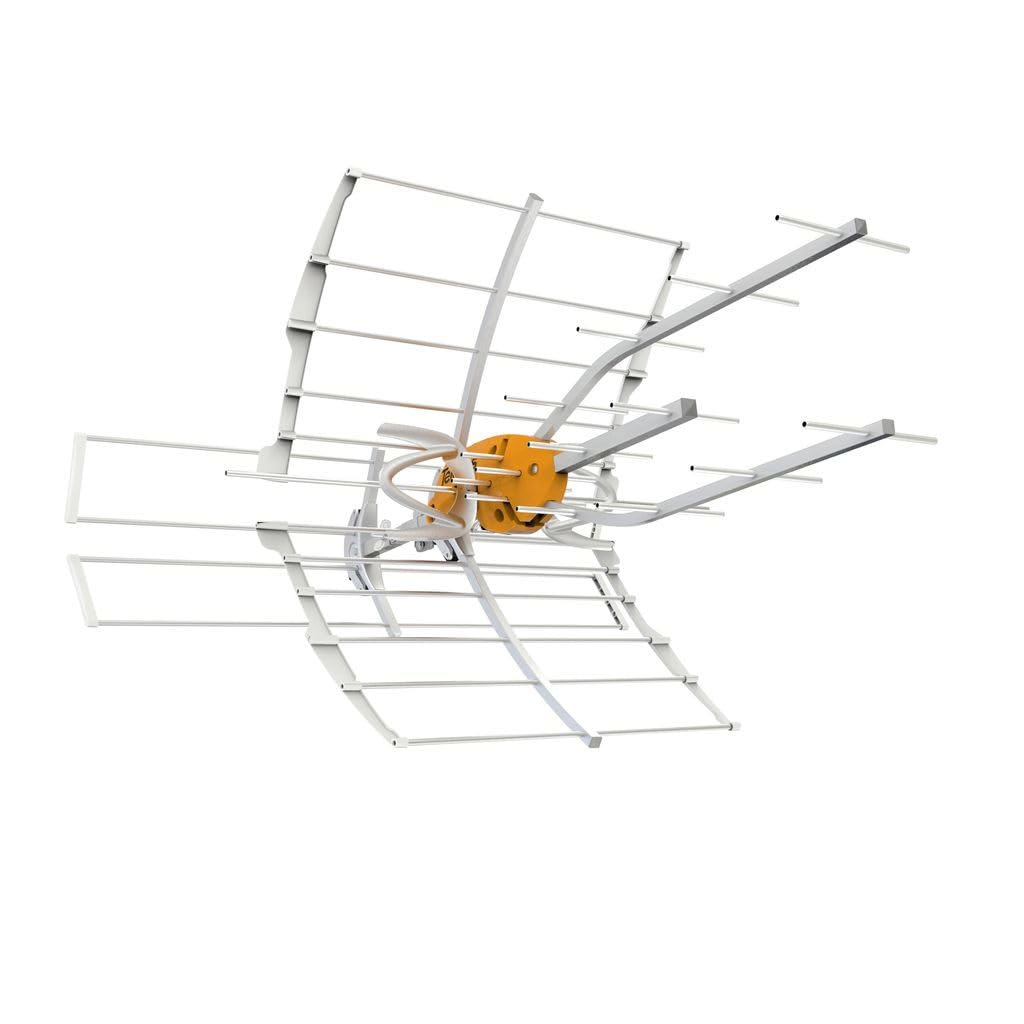
This is the antenna for homes where other antennas give up. Its built-in TForce preamplifier automatically adjusts gain separately for VHF and UHF bands (36.5 dBi High VHF, 40 dBi UHF), which stops weak stations from dropping out while preventing overload when a strong signal hits. In plain terms, it locks in a stable picture even when conditions fluctuate, without you touching a dial.
Buyers report staggering results compared to its 75-mile rating: in Central FL, 40 miles from towers, it pulled in 113 channels (up from 85), and a broadcast engineer verified the 75-mile rating in real-world testing.. It’s also a breeze to put together — tool-free assembly in under 60 seconds — and it mounts on masts from 0.78″ to 2.4″. The trade-off is the premium price, but for rural and fringe areas, this is the difference between cutting the cord and crawling back to cable.
The design is a directional triple-boom layout with curved reflectors that focuses reception toward towers, filtering out FM, LTE, 4G, and 5G interference. It’s built for the long haul with corrosion-resistant aluminum and stainless steel hardware, and it’s NextGen TV ready for ATSC 3.0 broadcasts. If your local towers are scattered, the extreme directionality (a 40° beamwidth) means precise aiming matters — a tiny adjustment can change your lineup.
Why It Leads
- Adaptive preamp prevents both weak reception and overload
- Tool-free assembly in under 60 seconds
- Corrosion-resistant aluminum for years of outdoor use
The Trade-Off
- Premium price tag that budget buyers will feel
- Highly directional, so aiming demands patience
Reach for this if: you live in a fringe zone or rural area where other antennas fail, and you want a set-and-forget solution that self-adjusts.
Think twice if: your budget is tight and your local towers are within 20 miles — a simpler antenna will do the job for less.
2. Digital Amplified Outdoor HDTV Antenna (McDuory)
This budget-friendly amplified antenna replaces a cable bill with reliable local channels.
Don’t let the humble price fool you. This amplified antenna delivers the most-discussed “functionality” among its owners, and the stories back it up. In Chicago, 30 miles from towers with a clear line of sight, owners mention getting 68 clear channels versus 40 with their old antenna, fixing stubborn CBS and PBS drops. In a Tampa attic 35 miles out, it pulled in 7-8 regular channels plus roughly 70 extra ones.
You get clear 720p, 1080p, and 1080i pictures across VHF (170-230MHz) and UHF (470-860MHz) bands, with a claimed 120-mile range. The kit includes a 40-foot RG6 coax cable, and most parts arrive pre-assembled, so you can install it without tools or a mounting pole. But it is directional, so you must aim it precisely and mount it high; one owner in a single-story attic only received UHF signals and missed VHF for sports.
Realistic expectations are key here. While the 120-mile claim is optimistic — one owner explicitly doubts it — the value is undeniable for suburban and semi-rural homes. The reception wins consistent praise, and the price makes it a low-risk first step into cutting the cord.
Smart Spend: The performance-per-dollar is the best in this lineup, making it the ideal entry point for cord-cutters testing the waters.
Honest Limit: The 120-mile rating overstates reality, and durability gets mixed feedback, so treat it as a capable local-channel antenna, not a fringe-zone miracle.
3. CEKAY 150-Mile Motorized Outdoor TV Antenna
Its motorized rotor lets you spin toward the strongest signal from your couch, ending roof climbs.
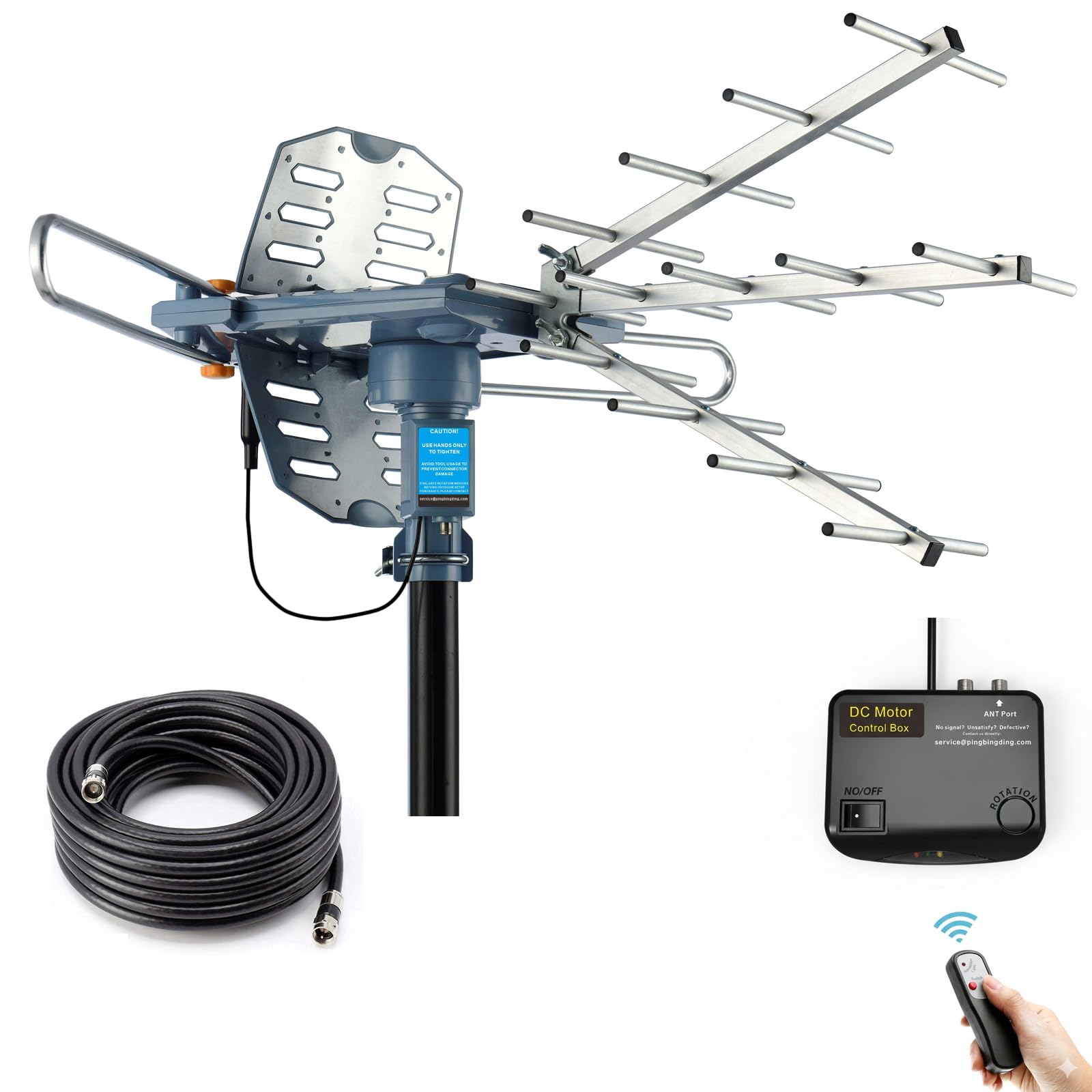
If your local towers sit in different directions, this is the antenna that saves your knees. The motorized 360° rotation is controlled by a wireless remote, letting you sweep for the best signal without ever touching the roof. In rural areas this shines — one owner pulled 79 channels versus a neighbor’s 52 after tuning, and another confirmed it grabs all FCC-expected stations plus some out-of-range ones from a fixed NNE position.
It claims a 150-mile range across VHF (170–230 MHz) and UHF (470–860 MHz) with support for 720p, 1080i, 1080p, and 4K. The built-in high-gain, low-noise amplifier reduces interference, and the included 40-ft RG6 cable gives flexible placement. Assembly takes about 5 minutes, and the design avoids the coax-wrapping problem of older models. Customers note stable performance in storms with no cable tangling.
The honest trade-offs are the plastic build (not rugged, though it holds up) and the tuning process — expect to do several rescans, with one owner spending about an hour on five scans. The rotor is praised, but the build quality and remote control get mixed mentions, so treat it as a capable suburban tool rather than a heavy-duty pro unit.
The Rotor Payoff
- Wireless remote adjusts direction without roof access
- 5-minute tool-free assembly
- Smooth rotation with no random spinning
What to Expect
- Plastic construction feels less rugged than metal rivals
- Tuning can take several rescans to dial in
Perfect for: rural and suburban homes with towers in multiple directions, where a fixed antenna would force a compromise.
Look elsewhere if: you want a heavy-duty all-metal build for extreme weather, or you’re happy with one fixed direction.
4. McDuory Yagi Outdoor TV Antenna

This compact passive Yagi outperforms amplified indoor antennas at a fraction of the size.
Sometimes simpler is better. This passive Yagi antenna (no amplifier) delivers a claimed 150-mile total range, with up to 70+ miles from the broadcast towers, across both UHF and VHF signals. In a real-world attic test 30 miles from towers, it pulled in Fox, NBC, ABC, and CBS with full signal and HD clarity — a result that left an indoor amplified antenna’s 1-2 channels in the dust.
It’s remarkably compact, which owners appreciate, and assembly takes about an hour from start to finish with no tools required. The 1080i HDTV support with full 720p, 1080p, and 4K compatibility means future-proofing is covered. A 40′ coax cable is included, and the lightweight design makes it easy to mount on a fascia or in an attic.
The honest catches are durability and range reality. Owners note it works well within 50 miles of towers but is realistically limited to local channels around 20 miles out in some setups. The long rods can sit loose in their sockets — one owner fixed this with pop rivets — and hardware may rust over time. Treat it as a solid local-channel performer, not a fringe-zone hero.
Straightforward Strength: The quality-to-size ratio wins people over — it’s small, it’s cheap, and it grabs local channels cleanly.
Keep in Mind: Durability is the recurring caveat, so if you face harsh coastal weather, a metal build like the CEKAY Yagi below is the safer bet.
5. CEKAY Outdoor Yagi TV Antenna

This all-metal budget pick delivered 100% signal quality even in a basement test.
Here’s proof you don’t need an amplifier for great results. This all-metal Yagi antenna handles extreme weather — heat, rain, wind, and snow — and still delivers. In a basement test, one owner measured 90-100% signal quality even pointing backward, and moving it to the attic pushed every metric to 100% with over 30 extra channels from towers 20+ miles away.
The high-gain design covers 170~860MHz for UHF and VHF with full 720p, 1080i, 1080p, 4K, and even 8K support. It’s also NextGen TV (ATSC 3.0) compatible, future-proofing your setup for the next broadcast standard. The kit includes a 40FT RG6 coax cable and a J-mount, and most assembly is pre-done — no tools required for the minor remaining steps. A 1-year warranty backs it up.
The trade-off is realism about the 70-mile rating: reviewers point out solid performance up to about 30 miles from the tower. Some owners note the arms fit very tightly into rubber holders (a hammer helped) and that it feels thin for an outdoor pole mount, with one suggesting glue on the pole connections. But for attic installs and modest distances, the performance-per-dollar is exceptional.
Built Tough
- All-metal construction withstands harsh weather
- 8K and ATSC 3.0 ready for the future
- Includes 40FT coax and J-mount
Honest Limits
- Arms fit very tightly and need force to assemble
- Thin build means attic installs suit it better than exposed poles
Grab it for: a budget-friendly attic install where you want all-metal durability and future-proof ATSC 3.0 support.
skip it if: you’re mounting high on an exposed pole in a windy zone, where a sturdier frame holds up better.
6. GE Outdoor HD Digital TV Antenna

The reliable brand name that proves a compact Yagi can still pull 34 stations from a mountain peak.
GE’s reputation for reliability shows here. This compact Yagi-style antenna delivers clear 1080p HD reception and is 4K Ultra HD-ready, covering HDTV, VHF, and UHF channels up to 80 miles from the broadcast source. From a rural mountain peak over 40 miles out, one owner grabbed 34 free stations. Under a concrete tile roof at 35 miles, another reported no pixelation even during storms.
The rugged construction stands up to tough outdoor conditions, and the included weather-resistant mounting bracket, mast clamp, and J-mount give you flexible placement on a wall, roof, or standard mast. It’s also NextGen TV (ATSC 3.0) compatible. GE backs it with a limited-lifetime replacement pledge and free U.S.-based technical support — a safety net few competitors offer.
The honest feedback is that instructions are confusing (a common thread across owners), and the build feels decent but not premium, with durability debated. Range is realistically strong to about 40 miles, with one owner over 65 miles from Cleveland losing some channels depending on direction. The compact size is a plus, but the signal finder demands patience and a careful check between magnetic and true bearings.
Why It’s Trusted: The limited-lifetime pledge and U.S.-based support make this the low-risk choice for first-time cord-cutters.
The Learning Curve: Set aside time to decipher the manual and fine-tune the aim; the payoff is a clear picture that beats cable.
7. PIBIDI Outdoor TV Antenna

The box is small, but the reach is huge — a 120-mile windy valley test ended with a strong picture.
Buyers are surprised at how small the box is compared to the picture quality. That compact design still delivers serious reach: in a windy Ohio valley 120 miles from transmitters, one owner swapped out a motorized 150-mile antenna and pulled in 28 channels with a strong picture even in bad weather. To hit its 200-mile rating, though, you will likely need a signal booster.
Longer elements are designed to lock in a stable signal across VHF (170~230MHz) and UHF (470~790MHz), supporting 1080p and 4K broadcasts. It resists weather, includes lightning protection and a grounded design, and ships with a 40ft RG6 coaxial cable plus a detailed setup guide. A 1-year warranty covers you if anything fails.
Real-world results are impressive: one owner testing many antennas found this the best for size and price, getting 64-86 channels depending on aim. The recurring theme is that it has no built-in rotator, so frequent roof adjustments get tiring, and the 200-mile claim realistically needs a booster in very fringe areas. But the build quality and channel count win consistent praise.
Why It Impresses
- Compact size with extended elements for strong gain
- Lighning protected with grounded design
- Superior build quality praised by owners
The Catch
- No rotator means manual aiming for different directions
- 200-mile range may need an optional booster in fringe zones
Best suited for: buyers in rural areas who want a compact, well-built antenna and don’t mind occasional manual re-aiming.
Consider another if: you want a motorized rotor or need a truly plug-and-play 200-mile range without extra boosters.
8. Five Star Outdoor HDTV Antenna

The whole-home antenna that fed a 175-foot run to a cottage and lost only one low-power station.
If you’re feeding multiple TVs, this kit is built for it. The package includes an antenna, mounting bracket, J-pole, and a TV splitter, making it a true multi-room solution. In a tough test, one owner ran a 175-foot cable to a cottage and lost only a single low-power station, while grabbing 60 channels versus 26 from an indoor amp. From Houston, over 45 miles out with buildings in the way, another pulled in 128 OTA channels.
The extended length and larger receiving elements target more stable signal reception for both VHF and UHF, with 1080p and 4K support up to a claimed 200 miles. It’s ATSC 3.0 ready for the NextGen TV transition. Assembly is straightforward — one owner mounted it on a flagpole and was done quickly, though the instructions miss a key detail about aligning VHF vibrator screws the same way to avoid breaking plastic.
Be realistic about the range and wind. Shoppers say the 200-mile rating is optimistic — on flat terrain, expect 75-90 miles — and the lightweight build sways in the wind, causing occasional channel dropouts. Reception varies by location, but for suburban and rural homes within 50 miles, the channel count and clarity are tough to match at this price.
Whole-Home Ready
- Includes splitter for up to 4 TVs
- Extended elements boost VHF and UHF reception
- ATSC 3.0 ready for future broadcasts
Watch For
- Lightweight build sways in strong wind
- Advertised 200-mile range is optimistic on flat ground
Pick this for: multi-TV households wanting one antenna to feed every room, with a splitter included from the start.
pass on it if: you’re in a very windy area, where the sway could cause dropouts, or you need true 200-mile fringe performance.
9. Antennas Direct ClearStream 4MAX Complete
This premium whole-home system took one owner from three weak Spanish channels to 151 crisp ones.
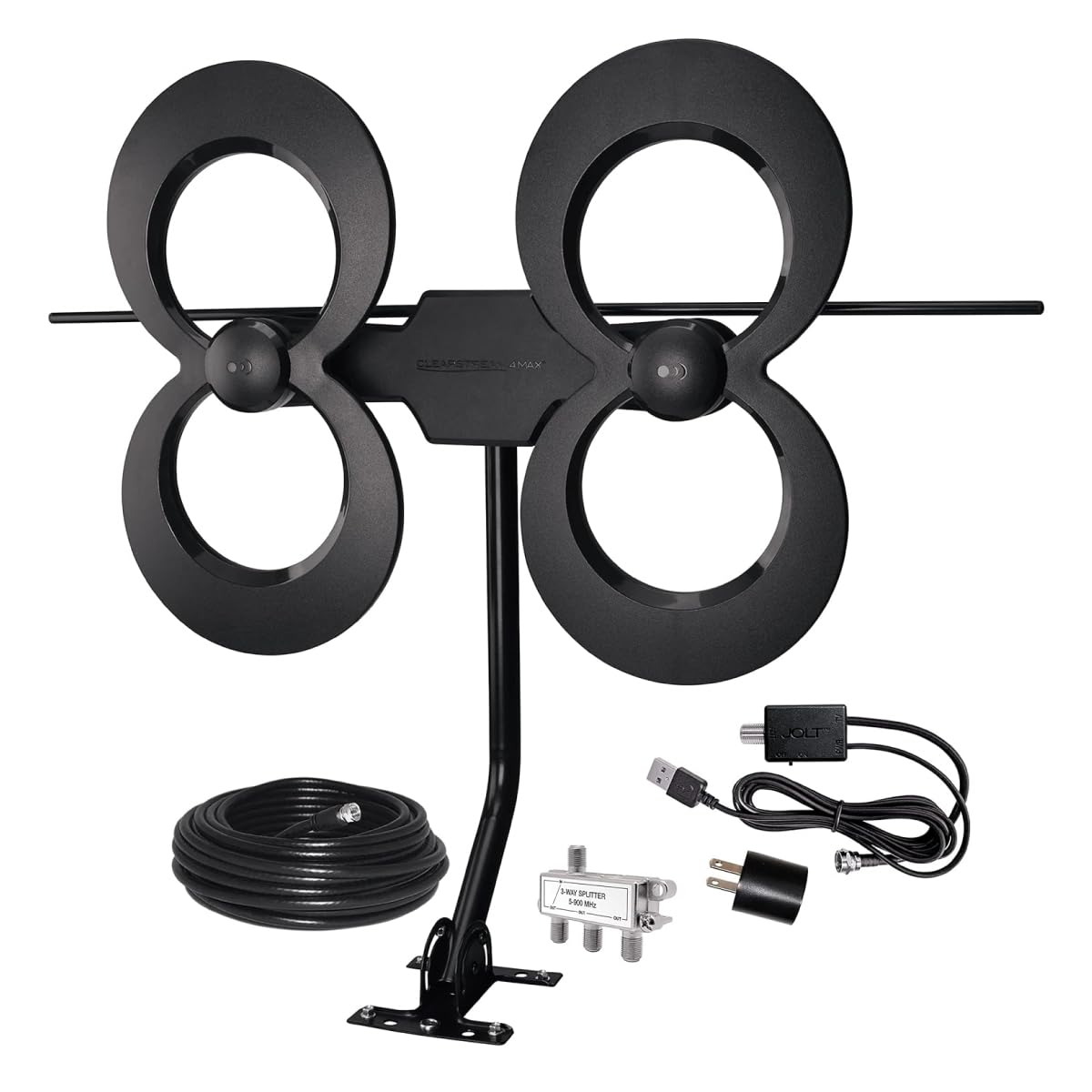
This is the complete package for anyone serious about cutting the cord. The ClearStream 4MAX includes the antenna, cable, 20″ mast, amplifier, and a 3-way splitter — everything you need to distribute free TV to up to three TVs. The multi-directional UHF and Hi-VHF elements pull signals from the front and back, which is a lifesaver when local towers aren’t clustered in one direction.
The numbers speak for themselves. In rural Arizona, an owner went from 3 Spanish and 2 English channels that locked up every few seconds to 151 channels. Aimed at Orlando from an attic, another picked up a huge lineup with a clear picture even in bad weather. Houston stations came in from 40-50 miles away with ease. It’s compatible with NextGen TV, 4K, 8K UHD, and Full HD 1080p, with no internet required.
The premium price is the main sticking point — some owners feel it’s worth every penny, others question the value. There’s also a specific quirk: the included splitter caused signal loss every 10 seconds for one owner until it was removed, after which the signal was strong and steady. Mounting is flexible for indoor, attic, or outdoor use, and the 2.7-pound weight makes installation manageable.
The Whole Package: When you want one box that covers antenna, amp, mast, and splitter, this is the most complete solution here.
The Fine Print: Test the antenna without the splitter first if you see dropouts — a simple bypass fixed it for one owner.
Understanding the Specs
Advertised Range vs. Reality
The “150-mile” or “200-mile” number on the box is largely a marketing figure for ideal, unobstructed conditions. In the real world, trees, hills, buildings, and even weather cut that down dramatically. A more honest expectation is that you’ll get solid reception within 30-50 miles of the towers, with fringe areas needing a really strong antenna like the Televes or a signal booster.
Amplified vs. Passive
An amplified antenna has a built-in preamplifier to boost weak signals, which helps in rural or fringe areas. But amplification isn’t always better — if you’re close to the towers, too much gain can cause overload, actually degrading the picture. Passive antennas rely purely on their physical design for gain, which is often cleaner for suburban homes. The smart preamp on the Televes adjusts automatically to avoid this problem.
Directional vs. Multi-Directional
Directional antennas (like Yagi designs) focus on one direction with high gain, ideal when all towers are in a cluster. Multi-directional antennas pull from the front and back, which suits scattered towers but with less raw power. The CEKAY motorized option solves this by physically rotating a directional antenna to face different towers on demand. Your choice depends entirely on your local tower layout.
NextGen TV (ATSC 3.0)
ATSC 3.0 is the new broadcast standard offering better picture, sound, and signal reliability over the air. Antennas marked “ATSC 3.0 ready” can receive these signals where available, though you’ll need a compatible tuner in your TV. Buying a future-proof antenna now means you won’t need to upgrade when your local stations make the switch. Most modern picks like the Televes, GE, and CEKAY Yagi already support it.
FAQ
How far can an outdoor TV antenna realistically pick up channels?
Do I need an amplified antenna or a passive one?
What is the difference between VHF and UHF signals?
Can I install an outdoor antenna in my attic instead?
What does ATSC 3.0 (NextGen TV) mean for my antenna?
Why is my antenna only picking up some channels?
How many TVs can one outdoor antenna support?
Is a motorized antenna worth the extra cost?
How long do outdoor TV antennas last?
Do I need to rescan my TV after installing an antenna?
Final Thoughts: The Verdict
For the majority of shoppers, the best outdoor tv antenna winner is the Televes Ellipse Mix because its adaptive preamp and 75-mile accuracy solve the two biggest antenna frustrations: weak fringe signals and overload. If you want a budget-friendly first step, grab the Digital Amplified Outdoor HDTV Antenna and watch your cable bill disappear. And for scattered towers that demand flexibility, the CEKAY Motorized Antenna is the one to reach for.
How We Picked
We do not accept paid placement. Every pick is matched to a real buyer and a real use-case; we do not hands-on test units.
Sources & Methodology
Specifications: manufacturer listings and product documentation. Review insights: verified customer reviews, as of August 2026. Pricing: not shown on this page (it changes often); check the current price via the retailer link.
As an Amazon Associate, Gadgets Feed earns from qualifying purchases. This does not affect which products we feature.