
Our readers keep the lights on and my morning glass full of iced black tea. As an Amazon Associate, I earn from qualifying purchases.
Specs are compiled from manufacturer listings and verified buyer reviews and can change over time — please confirm the key details on the product page before buying.
Ditching cable starts with one honest question: can an antenna actually pull in the channels you watch without pixelation or dropouts? The right antenna depends on your distance to broadcast towers and local terrain, not the brand. This guide compares seven antennas by real-world range, channel counts, and installation ease to match your location and budget.
I’m Min — the founder and writer behind Gadgets Feed. This guide is built by comparing the manufacturers’ published specifications and the patterns across verified customer reviews, so you get each pick’s real strengths and trade-offs instead of marketing spin.
If you are tired of monthly bills for channels you rarely watch, finding the right over-the-air tv antenna is the smartest first step toward free, crisp local television in full HD.
Our Picks at a Glance

How To Choose The Best Over-The-Air TV Antenna
The biggest mistake is choosing an antenna by the mile rating on the box. That rating is a theoretical maximum, not a guarantee for your neighborhood. Actual reception depends on tower distance, terrain, and building materials.
Directional vs. Omni-Directional
A directional antenna (often a Yagi design with a long boom) must point at the broadcast towers, but it delivers far more gain and better rejection of interference from behind. An omni-directional antenna grabs signals from every direction at once — perfect if your local towers are scattered around the compass, but it typically trades away raw distance for that convenience. If your towers are clustered in one direction, a directional model usually wins on channel count and stability.
The Amplifier Question
Built-in pre-amplifiers boost weak signals, but they can cause problems. Near strong towers, an amplifier’s gain can overload the tuner and knock out channels. Treat amplification as a tool for fringe reception, not a mandatory feature—several top models work best with it off.
VHF and UHF Explained Simply
TV stations broadcast on two different bands. UHF carries most modern channels and travels well at shorter range, while VHF (especially low VHF) covers longer distances but is more prone to interference. Antennas that explicitly handle both bands, with separate elements for each, are the ones that consistently earn praise for pulling in the full lineup including local affiliates.
Quick Comparison
| Model | Best For | Max Range | Channel Count | Amplified | Amazon |
|---|---|---|---|---|---|
| Televes DAT BOSS Mix LR★ Best Overall | Fringe & rural reception | 80 miles | 29 | Yes (TForce) | Amazon |
| GE Indoor AntennaBest Value | Suburban apartments | 50 miles | 100 | Yes (PureAmp) | Amazon |
| McDuory Yagi Outdoor | Budget roof installs | 150 miles | 2 | No | Amazon |
| PIBIDI Outdoor | Windy, open areas | 200 miles | — | No (booster ready) | Amazon |
| 1byone Omni-Directional | Multi-directional towers | 100 miles | 2 | Yes | Amazon |
| Antennas Direct Element | Clustered tower areas | 60+ miles | 2 | No | Amazon |
| Five Star Outdoor | Multi-TV households | 200 miles | 100 | No | Amazon |
In‑Depth Reviews
1. Televes DAT BOSS Mix LR 149884
Our pick — over 4.5★ from 450+ verified ratings; the strongest balance of quality and price.
The long-range specialist built for the toughest, most remote reception zones.
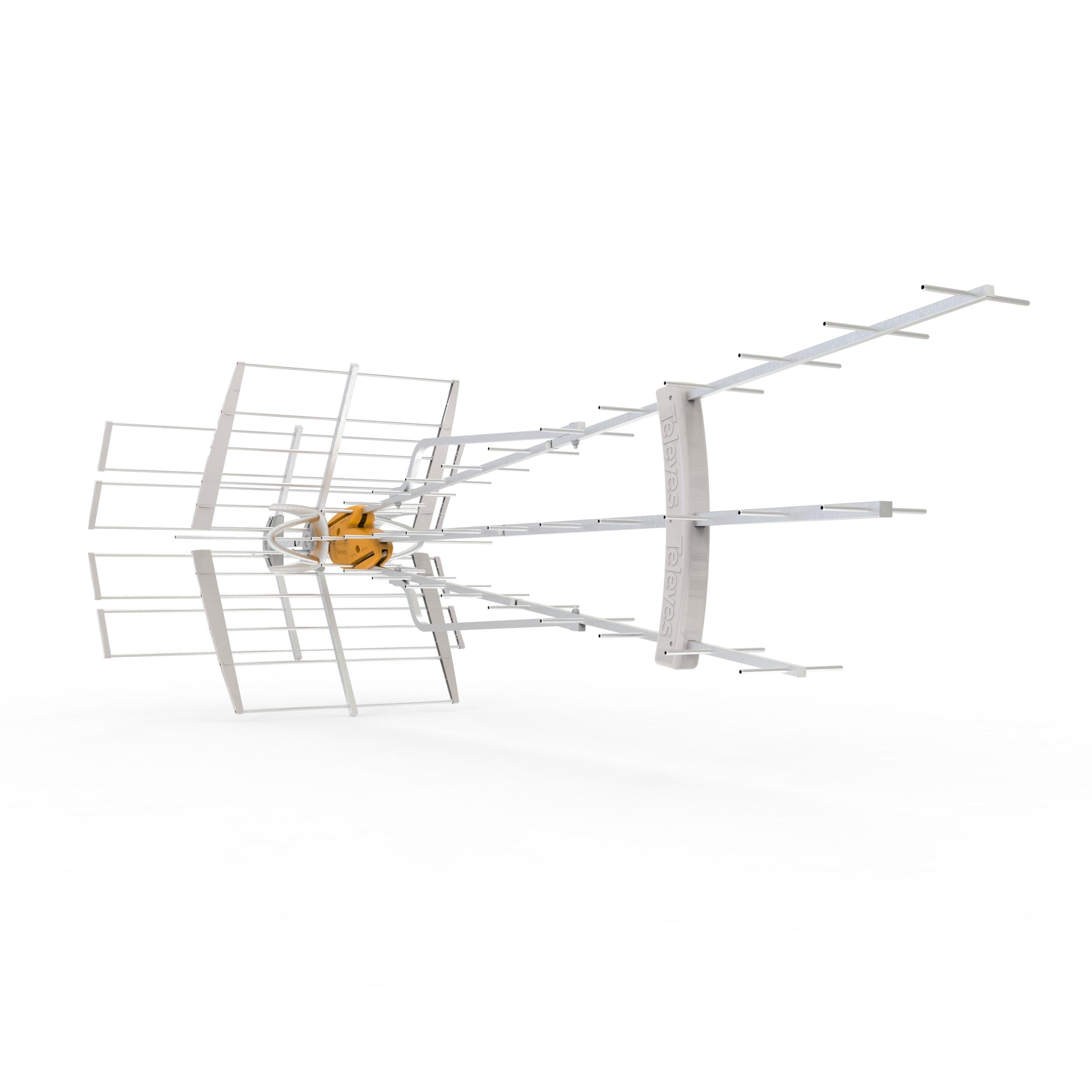
When towers are far and terrain is hostile, this antenna keeps your picture stable. The Televes DAT BOSS Mix LR uses a stacked triple-boom design with a built-in TForce preamplifier (a signal booster that automatically adjusts gain separately for each band — 38 dBi for High VHF and 46 dBi for UHF), so you get a steady picture even when signal strength fluctuates. Buyers report “between 50 and 80 miles great reception,” which aligns with its 80-mile rated maximum range.
What separates this from every other option here is the intelligent filtering. Integrated FM, LTE, 4G, and 5G filtering blocks the cellular and radio interference that quietly ruins channel counts on lesser antennas. The front-to-back ratio of 25 dB on UHF means it rejects signals from behind, focusing only on your towers and slashing multipath ghosting. It is also ATSC 3.0 (NextGen TV) ready, so it handles current HDTV and UltraHD 4K broadcasts.
The trade-off is the assembly, which owners call a genuine project. The reception field is narrow, so direction and tilt need patient tuning, and the included hardware (mast clamps, wrench, weather boot) expects a 0.78″ to 2.4″ mast. Mounted 60 feet up, owners mention locking in 26 to 114 channels depending on location. This is professional-grade gear for people who want to install once and forget it.
Built for the Fringes
- Automatic per-band amplification prevents overload and weak-signal dropouts
- Fully weather-resistant aluminum, stainless steel, and ABS build
- Dual operation mode keeps passing signal even if power fails
- Engineered and patented in Europe with 60+ years of antenna expertise
The Assembly Reality
- Assembly is involved and direction tuning takes patience
- Narrow reception field demands precise aiming at your towers
- Premium investment aimed at serious cord-cutters only
Your best shot at distant towers: This is the pick for rural homes where every channel is a struggle and reliability matters more than price.
Who should look elsewhere: If you live within 20 miles of towers and want plug-and-play simplicity, a smaller indoor model will save you effort and money.
2. GE TV Antenna for Smart TV Indoor
A simple indoor flat antenna that turns a suburban window into a free TV lineup.
For apartment dwellers and suburban buyers who just want the local news, sports, and sitcoms without a monthly bill, this GE is the easiest path. It carries a 50-mile range and receives VHF and UHF signals in uncompressed 1080p, plus it is 4K ready. The standout spec is its channel capacity — rated for 100 channels, which is 50 times the spec sheet of some outdoor Yagi models here. One owner living 37 miles south of Chicago reports pulling in about 30 crisp local channels.
What wins people over is the PureAmp Technology, which boosts signal strength while reducing dropouts. The adjustable stand flips between horizontal and vertical so you can angle it against a wall or lay it flat on a shelf. Buyers who pair it with a cheap LTE filter find the reception gets dramatically better, cutting the 5G network interference that can eat into channel counts in populated areas.
The honest caveat is consistency. Some customers note well over 100 channels while others land just a handful, and a few feel the newer build quality slipped versus older GE models. The stand, in particular, drew mixed feedback after a design change. This is a value pick that rewards a little placement experimentation — move it a foot and rescan before giving up.
easy entry to OTA: Setup takes minutes, the price is entry-level, and the picture quality earns steady praise for the money. It is the ideal first antenna for testing whether free TV works in your neighborhood before you commit to a roof install.
Placement-sensitive: Expect to hunt for the best window and add a filter in signal-congested areas; owners who do report crisp results.
Reach for this if: You rent, move often, or want a zero-tool test of your local broadcast strength.
Look elsewhere if: You live way out in the countryside — an amplified indoor panel cannot match a directional outdoor yagi for raw distance.
3. McDuory Outdoor Yagi Antenna

The no-frills Yagi that delivers 3x the range of the GE for a budget-tier price.
This passive Yagi antenna proves you do not need to spend heavily for solid outdoor reception. It claims a 150-mile total range, or up to 70+ miles from broadcast towers, which is triple the GE indoor’s 50-mile rating. It supports 720p, 1080i, 1080p, and 4K across the VHF 170~230MHz and UHF 470~860MHz bands. It arrives mostly pre-assembled, needing only a few elements combined with no tools.
The performance reviews are striking: owners switching from failed antennas to this one report rock-solid high-VHF and UHF reception, with one attic install pulling 101 channels versus 65 before, and no pixelation. Buyers consistently call it the best bang for the buck, especially for those within 50 miles of towers. The included 40-foot coax cable means you can usually reach your mounting spot without buying extras.
The durability is where the honest warnings sit. The light materials mean the long elements can fit loosely, and some owners fixed them with pop rivets. Hardware may rust over time, and the range realistically caps around 20 to 25 miles for reliable local channels despite the big number on the box. For the price, it is a fantastic starter outdoor antenna if you seal the connections properly.
Huge reach for little money: The channel count and signal quality far outstrip its entry-level price, making it a favorite first outdoor install.
Build demands care: Treat the elements gently, grease electrical joins, and seal the coax cover to get long service — durability is the recurring caveat in owner feedback.
Best if: You want to test an attic or roof mount without a big commitment and you live within 25-50 miles of towers.
Think twice if: You expect true 150-mile fringe reception or need hardware that survives years of coastal salt air untouched.
4. PIBIDI Outdoor TV Antenna

The lightweight long-range specialist that reaches stations 80 miles out without a struggle.
If you live in a rural area where towers are scattered and distant, this PIBIDI is engineered for exactly that scenario. Its extended-length design uses longer and larger receiving elements than typical antennas to lock onto both VHF (170~230MHz) and UHF (470~790MHz) signals. It receives 1080p and 4K broadcasts, and buyers in truly remote spots report pulling in channels about 80 miles away with clear picture quality.
What surprises owners most is how light it is. One buyer called it “lightweight and clear picture,” noting how easy it is to carry up to the roof for mounting. The kit includes a 40-foot RG6 coaxial cable and a detailed guide, so a first-time installer has everything needed. When it replaces older, larger antennas, owners consistently report superior performance — one swapped out a 12-to-15-year-old model and immediately got all stations 40 to 100 miles away with sharp clarity.
The catch is that the advertised 200-mile reach is optimistic. Buyers frankly note it “will not get the range advertised,” and several found an optional signal booster necessary to hit their best channel counts. One owner got 28 channels with an old Radio Shack booster versus just 3 without it. This is a strong mid-range performer that rewards pairing with an amplifier if you are truly on the fringe.
What Owners Rave About
- Outstanding clear picture quality from stations up to 80 miles away
- Remarkably lightweight and easy to handle during roof mounting
- Comprehensive kit with 40ft RG6 cable saves extra purchases
- Beats three prior antennas on channel count in direct comparisons
The Realistic Limits
- 200-mile rating needs an optional booster to approach its potential
- No built-in rotator — roof adjustments are manual
- Reception varies widely and depends heavily on local tower placement
For rural cord-cutters: Pick this if you need genuine long-distance reach and want a light, manageable install kit.
skip it if: You expect the box’s 200-mile claim from the start — plan for a booster and realistic expectations about your terrain.
5. 1byone Omni-Directional Outdoor Antenna

The low-maintenance panel that grabs signals from every direction at once.
If broadcast towers sit in different directions and you are tired of climbing on the roof to rotate a Yagi, this antenna ends that chore. The 1byone is omni-directional, pulling UHF and VHF signals from 360 degrees with no aiming required, and its exclusive Smart Pass amplifier (a signal booster) boosts reliability on windy or rainy days. It is among the most popular antennas ever sold, with a massive owner base, and works for home, RV, attic, or marine use.
The built-in pre-amplifier and 4G/LTE filter are the real workhorses here. The amp boosts the signal right at the antenna to compensate for long cable runs, while the filter removes interference from 4G mobile phone signals that can kill channel counts. Reviewers point out stunning results when placement is right — one apartment install jumped to 118 clear channels after extending the cable to a dining room window, and another reached 130+ channels.
Placement is the recurring theme, and it is finicky. The included 32ft RG6U cable can be too short for ideal spots, and moving the antenna even slightly can gain or lose channels. Some shoppers say it works best as an attic antenna rather than outdoors — one found it not waterproof after two years of horizontal outdoor exposure in Reno, suffering water ingress into the preamp. Within 15 miles of towers, the amplifier is often unnecessary and can even be a hindrance.
No aiming required: The 360-degree design is genuinely liberating for scattered towers — no rotator, no endless adjustment, just scan and watch.
Waterproofing is a question: Treat it as an attic-first antenna; owners who mounted it fully exposed outdoors saw the preamp degrade over time.
Reach for this if: You have towers in multiple directions and want one antenna that handles them all without manual aiming.
Look elsewhere if: You need maximum raw distance — a directional Yagi will out-reach this panel in open, single-direction terrain.
6. Antennas Direct Element

The focused, precisely-engineered antenna for areas where towers cluster in one direction.
This Antennas Direct Element is a step ahead of conventional Yagi designs thanks to its uni-directional focus. It pulls UHF and VHF signals from 60+ miles away, and its unique design provides focused, precise reception when towers are clustered in one general direction. It is NEXTGEN TV, 4K, 8K UHD, and Full HD 1080p compatible, with no internet connection required. Installers consistently praise its solid build for withstanding wind and hail.
Buyers report it pulls in stations from broadcast towers 40 miles away with a simple mast install, and one rural buyer in a hilly area at 25 miles got crisp channels without any amplifier — noting the amp actually halved his channel count when engaged. The all-weather mounting hardware handles a standard mast or an attic placement, and the 2.6-pound weight makes it manageable for a solo installer.
The honest limitation is its directional nature. One buyer at 32 miles on high ground with mature trees found the signal weak and unwatchable in wind, despite trying heights from 6 to 25 feet. This antenna rewards clear line-of-sight to towers; heavy obstacles in the path will defeat even a quality unit. Picture quality also drew mixed feedback in some setups, so position it carefully.
Focused power: The uni-directional design delivers strong, stable signal for clustered tower areas, often without an amplifier.
Line-of-sight matters: Trees and hills between you and the towers will cut performance — this is not an omni-directional workaround.
Best for: Suburban and rural homes where towers sit in one clear direction and you want a durable, precise install.
Not for: Dense, tree-obstructed valleys where scattered towers demand omni-directional coverage.
7. Five Star Outdoor HDTV Antenna

The multi-directional powerhouse that feeds four TVs from one roof-mounted unit.
For households with several televisions, this Five Star antenna is the practical answer. It is designed to support 4 TVs and includes the J-pole mount, mounting bracket, and TV splitter right in the box — everything needed to distribute free 1080p and 4K reception across your home. It receives VHF and UHF signals with an extended-length design using longer, larger receiving elements for more stable signal strength.
The multi-directional pickup handles towers from various directions, and its extra length targets stable, strong reception. Owners rave about the results: one installation at 45+ miles pulled 128 OTA channels, and a buyer in the woods who “always” had reception problems suddenly got channels they never could before. The included 40ft coax cable and simple assembly instructions make it accessible for DIY installers.
Like others with big range claims, the 200-mile rating is marketing optimism — owners mention it does not actually reach 200 miles, though three stations about 40 miles away came in well. The lightweight build moves in the wind, occasionally knocking out channels until it settles. Follow the assembly guidance about screw alignment carefully to avoid breaking the plastic VHF section.
Built for the Whole House
- Supports 4 TVs with included splitter for whole-home distribution
- J-pole and mounting bracket included — no extra hardware shopping
- Customers note up to 128 channels from 45+ miles away
- Multi-directional pickup grabs towers from various directions
Reality Checks
- 200-mile claim is optimistic; realistic reliable range is closer to 40-45 miles
- Light build sways in wind, causing occasional channel dropouts
- Assembly instructions on VHF alignment could be clearer
Pick this if: You need to feed multiple TVs in one house and want a complete kit with splitter and mount included.
pass on it if: You live in a high-wind area or expect genuine 200-mile fringe reception without compromises.
Understanding the Specs
Mile Range vs. Reality
The number on the box is a theoretical maximum in ideal conditions with clear line-of-sight. Real reception depends on your distance to towers, terrain, and building materials. Treat any range over 60 miles as a marketing figure — most owners see reliable channels only within 20 to 50 miles regardless of the claim. Match the antenna’s realistic reach to your actual distance to towers, not the biggest number you can find.
Amplified vs. Passive
A built-in amplifier boosts weak signals, which helps in fringe areas with long cable runs. But too much gain near strong towers can overload the tuner and knock out channels entirely — several top-reviewed owners here found their best results with the amp off. Amplification is a tool for distant reception, not a universal upgrade. If you live within 20 miles of towers, a passive antenna often performs just as well or better.
VHF and UHF Bands
Broadcast TV uses two frequency bands. UHF (roughly 470-860MHz) carries most modern channels and works well at moderate range. VHF (170-230MHz for high VHF) travels farther but is more vulnerable to interference from buildings and weather. Antennas that explicitly handle both bands with dedicated elements — like the Televes and McDuory — consistently pull in fuller channel lineups than UHF-only panels.
LTE and 5G Filtering
Cellular towers broadcast on frequencies adjacent to TV bands, and their signals can bleed into your antenna and cause dropouts or lost channels. Built-in filters (like the Televes TForce or 1byone’s 4G/LTE filter) block this interference at the source. On antennas without built-in filtering, owners often buy an inline LTE filter for under to dramatically improve results — a cheap fix that solves a very real problem in populated areas.
FAQ
Will an over-the-air antenna work in my apartment building?
How many channels can I realistically expect to get?
Do I need an amplifier or signal booster?
Can one antenna feed multiple televisions?
What is the difference between directional and omni-directional antennas?
What does ATSC 3.0 or NextGen TV mean for my antenna?
Why do I get channels with an outdoor antenna but not an indoor one?
How do I aim a directional antenna at the broadcast towers?
Final Thoughts: The Verdict
Across the board, the over-the-air tv antenna winner is the Televes DAT BOSS Mix LR because its intelligent per-band amplification and filtering deliver reliable channels where lesser antennas fail. If you want a budget-friendly entry point, the McDuory Yagi gives you impressive range for a fraction of the cost. And for households with scattered towers needing no aiming, the 1byone Omni-Directional is the one to reach for.
How We Picked
We do not accept paid placement. Every pick is matched to a real buyer and a real use-case; we do not hands-on test units.
Sources & Methodology
Specifications: manufacturer listings and product documentation. Review insights: verified customer reviews, as of August 2026. Pricing: not shown on this page (it changes often); check the current price via the retailer link.
As an Amazon Associate, Gadgets Feed earns from qualifying purchases. This does not affect which products we feature.