
Our readers keep the lights on and my morning glass full of iced black tea. As an Amazon Associate, I earn from qualifying purchases.
Specs are compiled from manufacturer listings and verified buyer reviews and can change over time — please confirm the key details on the product page before buying.
A portable basketball hoop should make driveway pickup games fun, not a test of your patience when it wobbles or rusts. The real challenge is finding one that stays upright during a kid’s excited layup, survives a rainy season, and actually rolls where you need it. This guide breaks down the exact specs and real-owner feedback so you know which hoop earns its spot on the concrete.
I’m Min — the founder and writer behind Gadgets Feed. This guide is built by comparing the manufacturers’ published specifications and the patterns across verified customer reviews, so you get each pick’s real strengths and trade-offs instead of marketing spin.
Whether you are outfitting a family driveway or a backyard practice court, this deep look at the best portable basketball hoop available right now will help you match the right backboard size, height range, and base stability to your players and your space.
Quick Picks
- TONBUX Basketball Hoop Outdoor 44/48/54 Inch PC Backboard — Best Overall
- Lifetime 54-Inch Adjustable Basketball Hoop — Competition Pick
- Lifetime 90690 Portable Basketball System, 44″ Polycarbonate Backboard — Smart Entry
- Asbest Adjustable Basketball Hoop Outdoor 10FT with 44/48 Inch Backboard — Easy Adjust
- IGL Kids Basketball Hoop Outdoor | 4-8.5ft Adjustable Height | 33″ Shatterproof Backboard — Young Player Fit
- DUMOS 10FT Adjustable Height Portable Basketball Hoop Outdoor for Adult, 44 Inch Shatterproof Backboard — Budget Entry
How To Choose The Best Portable Basketball Hoop
Before you click “buy,” there are a handful of specs and build choices that make the difference between a hoop that lasts for years and one that frustrates you by the second week. Here is what to look for.
Backboard Size and Material
The backboard is where the ball meets the hoop. A larger board, like a 54-inch model, gives you more surface for bank shots and rebounding practice, while a 44-inch board is a solid all-around size for most driveways. Polycarbonate backboards are the standard for portable hoops — they resist shattering and UV damage better than acrylic, though the rebound feel is slightly less crisp than a glass board you would find on a fixed court.
Height Adjustment Range
If multiple ages or skill levels will use the hoop, you need a system that adjusts without tools and stays locked at the chosen height. Look for a minimum height around 7.5 feet if adults and teens are the main players, or as low as 5.25 feet if young children will use it. Crank and stepless mechanisms are easier for a single person to operate than telescoping poles that require you to line up holes with a pin.
Base Stability and Weight
A portable hoop is only as stable as its base. When filled with water or sand, the base acts as the anchor. Heavier bases — those holding 100 pounds or more — resist tipping during aggressive play or in windy conditions. Sand adds more weight per gallon than water and won’t freeze in winter, making it the preferred fill for year-round outdoor use.
Frame and Rim Durability
Look for a powder-coated steel frame to resist rust and corrosion. The rim should have a spring or shock-absorbing mechanism so that dunks and hard rebounds don’t bend the rim out of shape over time. A standard 18-inch rim matches regulation size, which is important if the hoop doubles as a training tool.
Quick Comparison
On smaller screens, swipe sideways to see the full table.
| Model | Best For | Backboard | Height Range | Base Fill Capacity | Amazon |
|---|---|---|---|---|---|
| TONBUX 44/48/54 Inch | Family versatility | 44-inch PC | 5.25–10 ft | 150 lbs (water) / 225 lbs (sand) | $189.99$229.99Amazon |
| Lifetime 54-Inch | Competitive play | 54-inch PC | 7.5–10 ft | Heavy duty (sand/water) | $499.99$579.00Amazon |
| Lifetime 44-Inch | Entry-level value | 44-inch PC | 7.5–10 ft | Heavy duty (sand/water) | $199.99$229.00Amazon |
| Asbest 44/48 Inch | Easy crank adjustment | 44/48-inch PC | 5.25–10 ft | Enlarged (sand/water) | $189.99Amazon |
| IGL Kids 33-Inch | Young children | 33-inch PC | 4–8.5 ft | 55 lbs main base + 30 lbs anchor (water) / 71.6 lbs main base + 40 lbs anchor (sand) | $139.99$169.99PrimeAmazon |
| DUMOS 44-Inch | Budget family fun | 44-inch PC | 6.1–10 ft | Fillable (water/sand) | $89.89$99.99Limited time dealAmazon |
In‑Depth Reviews
1. TONBUX Basketball Hoop Outdoor 44/48/54 Inch PC Backboard
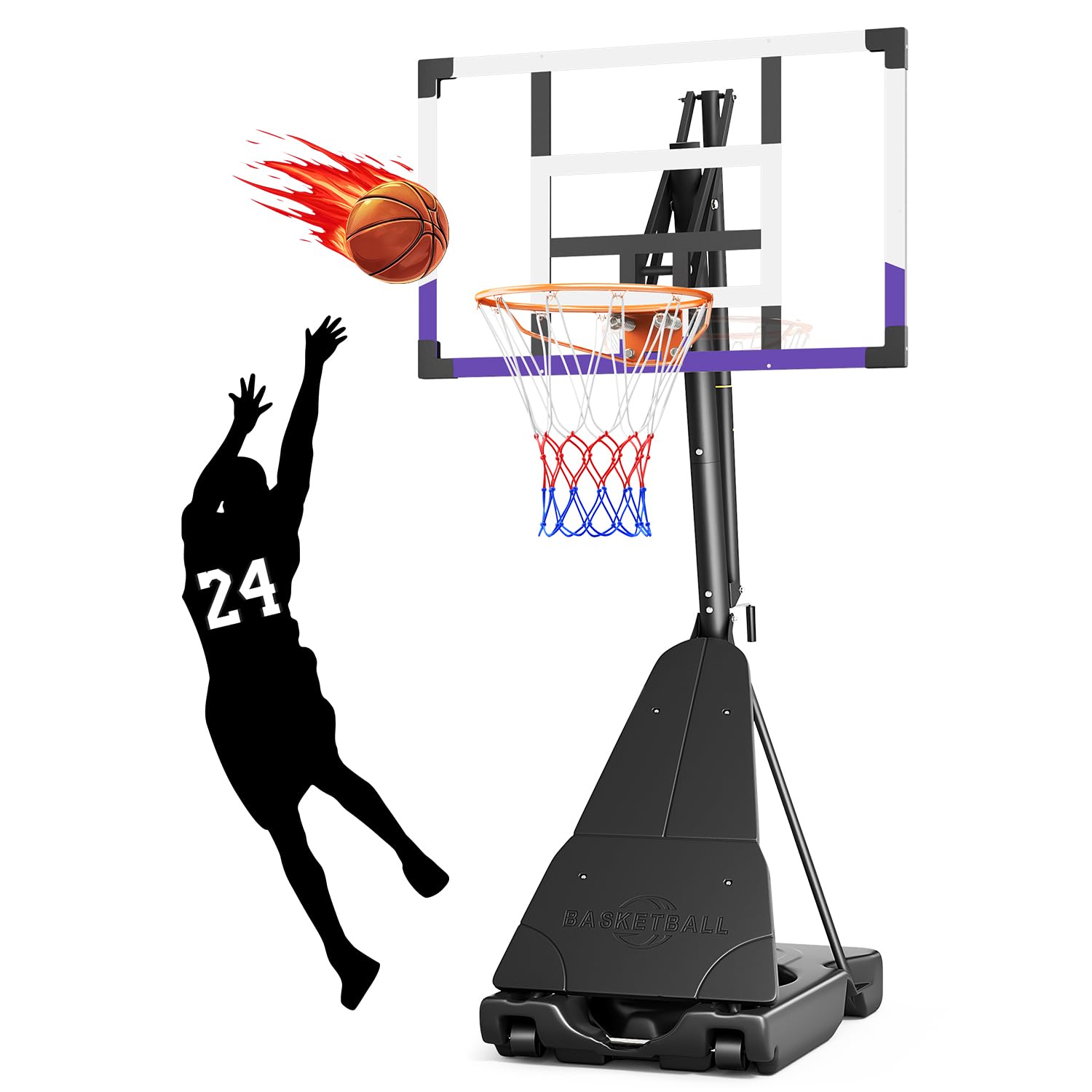
The family hoop that goes from a kindergartner’s first shot to a teen’s practice in one crank.
You get a remarkably wide height range with this one — the crank system lets you adjust from 5.25 feet to a full 10 feet, so it fits a 6-year-old learning to aim and a high-school player working on free throws on the same day. The 44-inch polycarbonate backboard gives you a shatterproof surface that also provides a decent rebound for practice drills. The 18-inch rim features dual spring shock absorbers (small springs that soften the impact and prevent bending), which means aggressive play won’t warp the rim over time.
Where this hoop really pulls ahead is the base stability. You get an oversized base that measures 44 inches long and 28 inches wide; when filled with sand it supports up to 225 pounds — far more than most portable hoops in this tier. Buyers report that even on windy days and with kids hanging on the rim, “it hasn’t budged.” One owner also noted it took about 25 minutes to put together and that the build feels sturdy right away. For a hoop that spans every age in the house, the TONBUX is the most versatile choice here.
Unlike the IGL kids model that maxes out at 8.5 feet, the TONBUX goes to a regulation 10 feet, so it grows with the player rather than being outgrown. The trade-off is the 78-pound shipping weight — you will want a second person to help with assembly, but the payoff is a hoop that stays planted during intense play.
Why it wins: Covers the widest height range of any pick here (5.25–10 ft), the sand-filled base holds 225 lbs for rock-solid stability, and the dual-spring rim handles hard rebounds without bending.
A real limitation: Assembly is heavy at 78 pounds, so you will need a helper to lift the backboard and pole into place.
Ideal for: Families with kids across different ages who want one hoop that works for everyone from a toddler to a teenager without having to buy a second one later.
Look elsewhere if: You only have space for a very small court — the oversized base requires a 44 x 28 inch footprint.
2. Lifetime 54-Inch Adjustable Basketball Hoop

The 54-inch backboard that turns a driveway into a real practice court.
If you want the largest backboard on wheels, this is it. The 54-inch steel-framed polycarbonate surface gives you a bigger target for bank shots and a more realistic rebound area than any 44-inch model delivers — a meaningful edge if you are practicing game-speed moves. The Slam It Pro Rim uses spring flex action (a spring-loaded rim that bends down on a dunk and snaps back), which means you can hang on the rim without worrying about bending it, and it handles fast rebounds that mimic a gym experience.
The Power Lift mechanism raises and lowers from 7.5 to 10 feet. It is not quite as easy as the stepless crank on the Asbest, but it is simple enough that one person can do it without tools. The base fills with sand or water and comes with wheels so you can roll the whole rig out of the way when you want the driveway back. Owners mention that the 4-inch steel pole and alloy steel frame resist rust well, and the unit has held up through “8 months of use with three families” in rain, snow, and wind. One owner did mention the assembly is “painful” — expect about 2.5 hours and a second set of hands for the heavy parts; the 107-pound weight is the most of any pick here.
Compared to the Lifetime 44-inch model, this one steps up to a breakaway rim and a much larger backboard, which makes it a better pick for older kids and adults who want to do more than shoot free throws. The catch is that the height adjustment does not go below 7.5 feet, so younger children (under about 8 years old) may struggle to reach the rim even at the lowest setting.
Standout spec: The only model in this lineup with a regulation-style 54-inch backboard and a pro-style breakaway rim for dunk practice.
Honest trade-off: Minimum height of 7.5 feet excludes younger kids, so it is best for families with players starting around middle-school age.
Best fit: Teenage players, competitive adults, and any household that values a larger rebound surface for serious skill development.
Not great for: Families with toddlers or kindergarten-age children — the 7.5-foot minimum is too high for them to enjoy without an adult lifting them.
3. Lifetime 90690 Portable Basketball System, 44″ Polycarbonate Backboard

A no-surprises 44-inch hoop that delivers reliable driveway play without overspending.
This is the baseline that other portable hoops are measured against. The 44-inch Fusion polycarbonate backboard (a type of polycarbonate with a UV-protective coating) resists fading from direct sun and holds up to light-to-moderate play without warping. The telescoping pole adjusts in 6-inch increments from 7.5 to 10 feet, and you do not need any tools to change the height — just a pin and a bit of muscle. The solid 5/8-inch steel rim is reinforced with 1/2-inch braces, so it holds up to daily use even though it lacks the spring-loaded rim of the more expensive Lifetime 54-inch model.
The heavy-duty base fills with sand or water and the whole system rolls on wheels, making it easy to reposition when you need the driveway for something else. Customers note that assembly takes about 30 minutes to an hour, and one owner noted that even after being outdoors for years the hoop “holds up nicely.” The pole is powder-coated, which helps resist rust — a key advantage over budget options like the DUMOS where one reviewer noted rust appeared on exposed metal fast. One heads-up from the reviews: the rim may arrive slightly tilted from the factory, so check it with a level during assembly and adjust the bracket before tightening everything down.
The main difference between this and the larger Lifetime 54-inch is the backboard size and rim type — this one is better for casual family play and players who don’t plan to dunk, while the 54-inch model is for more aggressive practice. The lower price point makes this an ideal starter hoop for a home that wants a brand-name system without investing in premium features.
Solid points: Decades-long brand reputation, tool-free height adjustment in 6-inch steps, and a UV-protected backboard that does not yellow in the sun.
Weak spot: The rim is fixed, so hanging or dunking will eventually bend it — keep play to normal shots and layups.
Who it suits: First-time hoop buyers, families with casual shooters, and anyone who wants a reliable Lifetime product without the premium price tag.
Who should pass: Players who plan to dunk regularly or need a lower minimum height for very young children (7.5 ft is the floor).
4. Asbest Adjustable Basketball Hoop Outdoor 10FT with 44/48 Inch Backboard
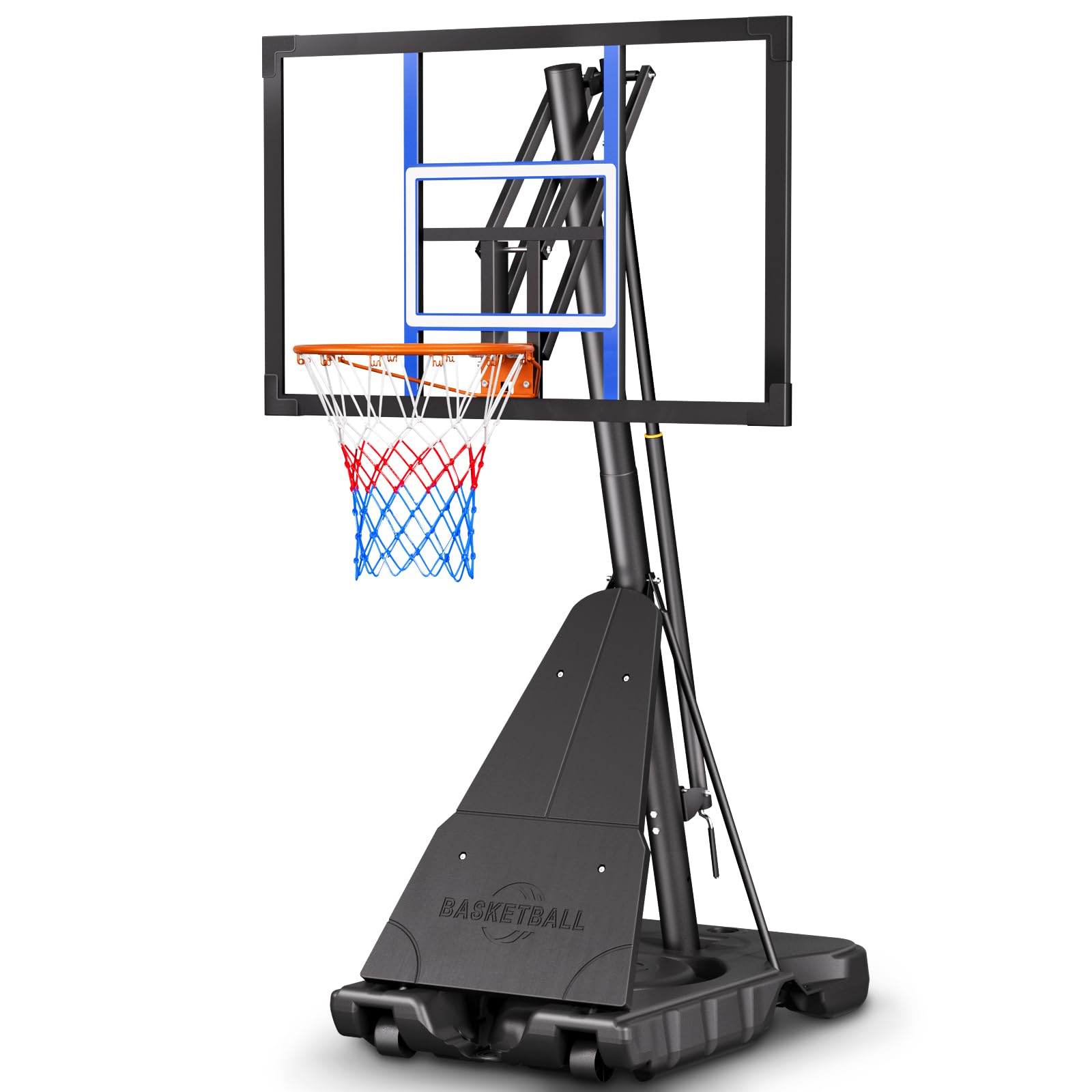
A hand-crank system so smooth a kid can change the height without an adult.
The defining feature here is the stepless hand-crank adjustment — you spin the crank and the backboard glides to any height between 5.25 and 10 feet, stopping exactly where you want it. There are no holes to line up and no pins to pull, which means a 7-year-old can lower it for herself and then raise it again for her older brother in about 15 seconds. The backboard comes in 44 or 48-inch options, and the 18-inch standard rim has dual shock-absorption springs, so hard dunks bounce the rim back into shape rather than bending it permanently.
The base is enlarged with four reinforced support rods that attach to the main pole, which helps prevent the whole unit from tipping sideways during aggressive drives. When filled with water or sand, the base stays planted. Buyers mention that assembly takes about 90 minutes with two people, and one owner noted the “water base provides stability” and that the backboard “returns ball to players without chasing.” The rust-proof powder-coated steel frame holds up to outdoor weather, and the solid PE net (polyethylene, a durable plastic that resists UV fraying) does not weaken in direct sun like standard nylon nets do.
One reviewer did call out that the height adjustment mechanism “feels sketchy at the extremes” — meaning it is rock-solid at mid-range heights (7–9 feet) but may feel a bit less secure at the very top or very bottom. If you plan to leave it at one height most of the time, this is a non-issue. The 77-pound weight is similar to the TONBUX, so plan for a two-person assembly.
What stands out: The simplest, fastest height change of any hoop here — a true stepless crank with no tools, no pins, no ladders.
One cautious note: The mechanism feels less sturdy at absolute maximum extension (10 ft), so for consistent heavy play at full height, the TONBUX or Lifetime 54-inch may feel more solid.
Best for: Multi-child homes where different ages need different rim heights without parents having to intervene every time.
Skip if: You want the absolute most stable feel at max height — the crank mechanism trades a bit of brute force for convenience.
5. IGL Kids Basketball Hoop Outdoor | 4-8.5ft Adjustable Height | 33″ Shatterproof Backboard
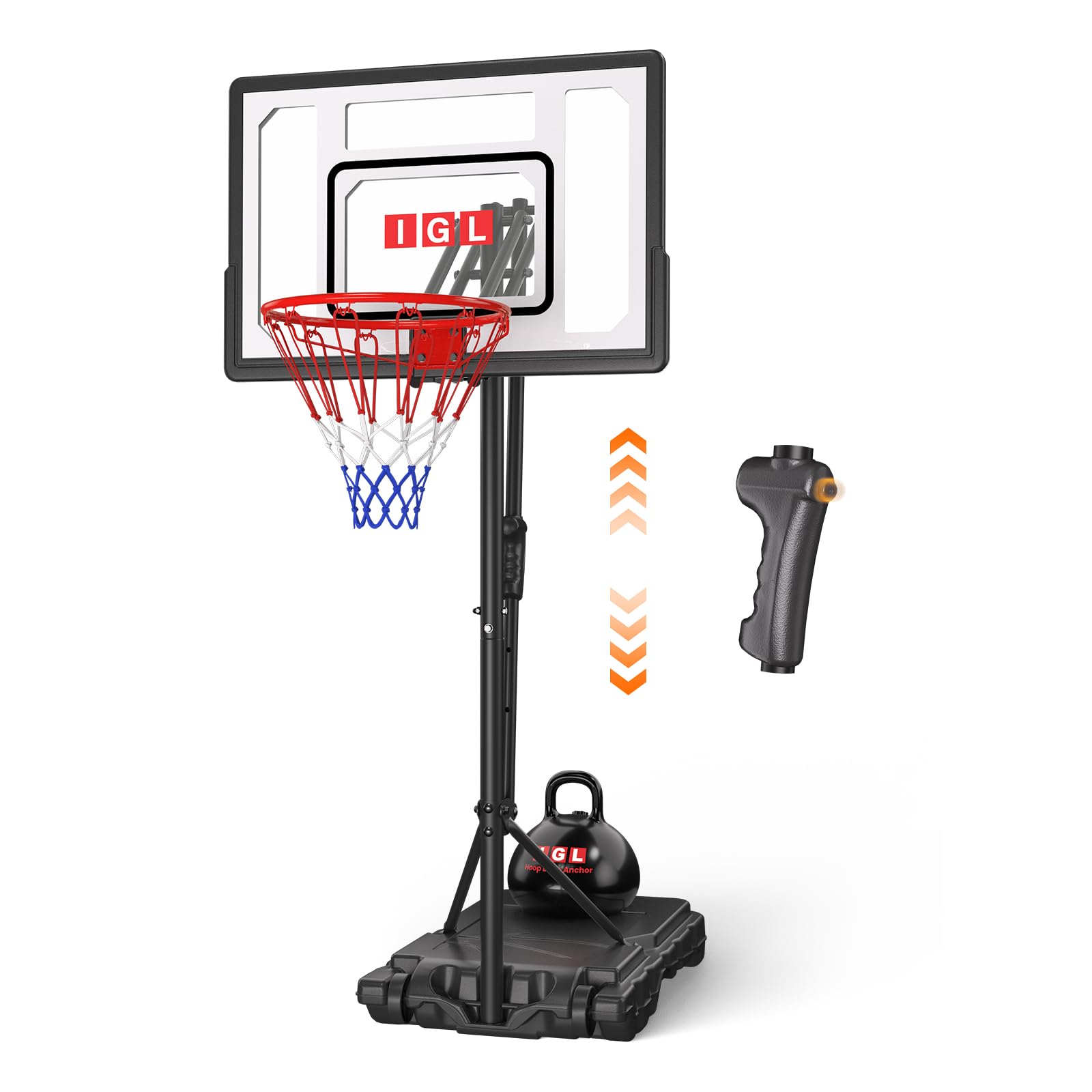
The only hoop here that goes down to 4 feet — made for real backyard use by young kids.
If you are buying for a child aged 3 to 10, this is the pick that matches their height and strength. The 33-inch polycarbonate backboard is smaller than the adult-size 44-inch models, but that is a feature, not a flaw — it keeps the ball in play instead of bouncing off into the garden, and the smaller surface is easier for little arms to reach. The height range from 4 to 8.5 feet means a toddler can actually make a basket, and as your child grows, the hoop rises with them into the early teen years.
What sets this apart from smaller Walmart-style toy hoops is the dual-ballast stability system. The main base fills with 55 pounds of water or 71.6 pounds of sand, and you can add an extra anchor base that holds another 30 pounds of water or 40 pounds of sand. That combined 85 to 111.6 pounds of weight prevents tipping even when a kid hangs on the rim, which is a genuine safety concern with cheaper lightweight hoops. The RECC steel frame (a corrosion-resistant steel alloy) and shatter-resistant backboard are built to stay outdoors, and one buyer mentioned that the goal “has been set up in my back yard for almost a year and it still looks like I just put it up.”
The trade-off for this kid-specific design is the limited ceiling. The IGL tops out at 8.5 feet, while the TONBUX and Lifetime regulation hoops go to 10 feet, so a teenager will outgrow it. Still, for the age group it targets — kids through early middle school — it is the most thoughtfully built option here.
Key strength: Starts at 4 feet — the lowest minimum height in this guide — so a preschooler can actually practice aiming without an adult lifting the ball.
Built-in limit: Caps at 8.5 feet, so plan to graduate to a full-size hoop once your child starts hitting growth spurts and wants to shoot three-pointers.
Who this is for: Parents of children aged 3 to 10 who want a stable, weather-resistant hoop that a kid can use independently without the base tipping.
Not the one for: Teenagers or adults — at 8.5 feet max, they will not be able to practice regulation free throws or dunks.
6. DUMOS 10FT Adjustable Height Portable Basketball Hoop Outdoor for Adult, 44 Inch Shatterproof Backboard
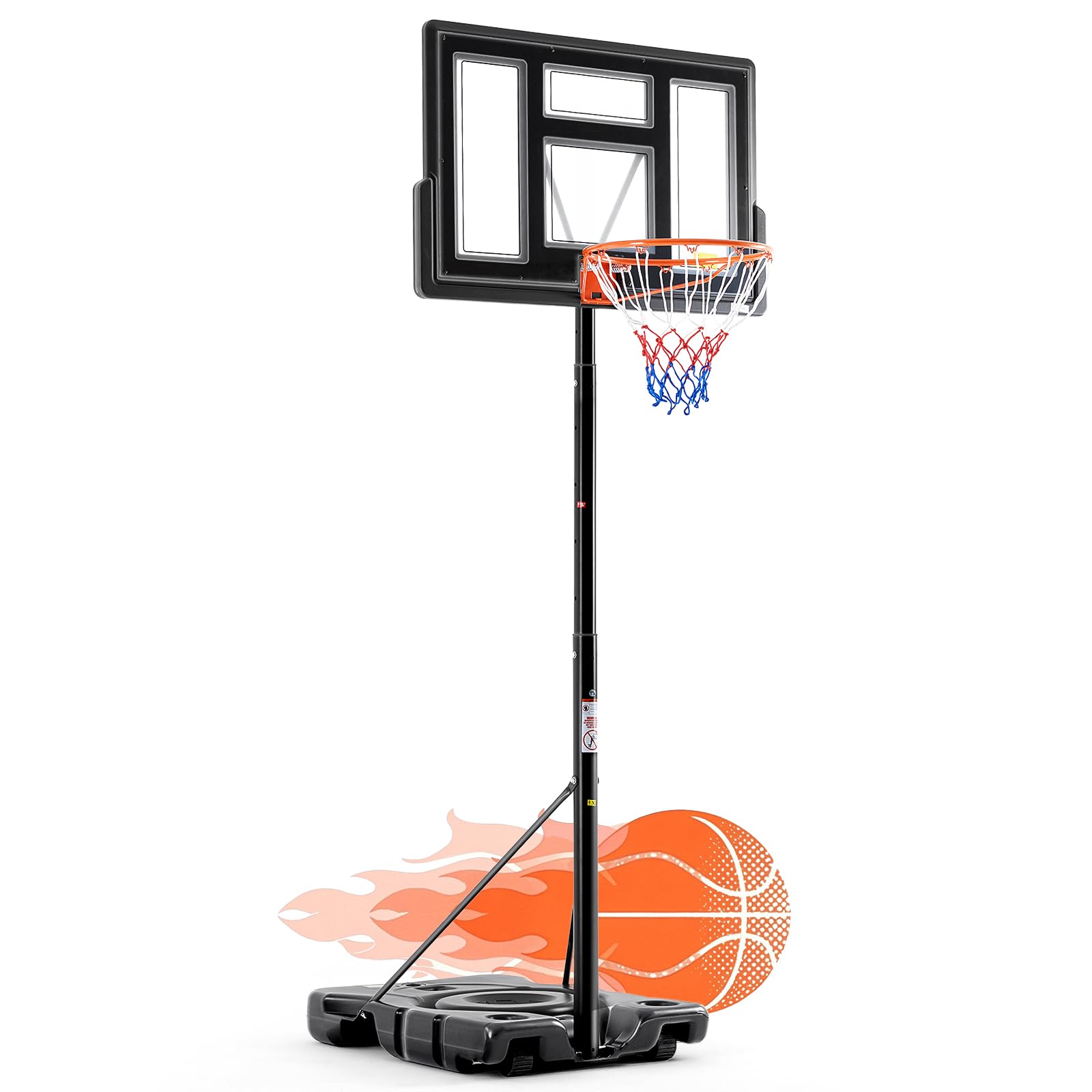
The most affordable way to get a full 10-foot hoop into your driveway — with some honest trade-offs.
At its price point, this DUMOS model delivers the essentials: a 44-inch shatterproof backboard, a shock-absorbent rim that softens impact, and a height range from 6.1 to 10 feet, versus the 7.5 to 10-foot range on many Lifetime models. That means a 6-year-old can actually use it at its lowest setting, and an adult can raise it to regulation height for real practice. The base fills with water or sand and comes with wheels, so you can roll it between the driveway and garage.
Assembly is straightforward — reviewers point out they put it together by themselves in under an hour. The metal frame and adjustable hoop work well for casual family games. However, there is a durability concern that shows up repeatedly in the reviews: “rust on metal in 2 weeks” was a note from one buyer, particularly in coastal or humid environments where salt air accelerates corrosion. The metal components are not powder-coated to the same standard as the Lifetime or TONBUX models, so you will want to apply a rust inhibitor if you are near the ocean.
Compared to the IGL kids hoop that lasted a full year with no visible wear, the DUMOS is a better choice if budget is your primary concern and you plan to keep it in a garage or covered area when not in use. For all-out outdoor exposure in a rainy or salty climate, spending a bit more on the TONBUX or a Lifetime model will save you from replacing rusted parts in the first season.
High points: Lowest price for a full-size 10-foot hoop, the 6.1-foot minimum height fits young kids, and assembly is genuinely easy.
Genuine weakness: The metal frame is susceptible to rust — several buyers noted visible corrosion within two weeks, especially near the coast.
Who should buy: Shoppers on a tight budget who need a functional 10-foot hoop right now and can store it under cover or in a garage.
Who should skip: Anyone living in a coastal area or where the hoop will sit exposed to rain and humidity year-round — you will be better served by the rust-resistant steel frames on the TONBUX or Lifetime models.
Understanding the Specs
Backboard Material: Polycarbonate vs. Acrylic
Nearly every portable hoop uses a polycarbonate backboard (a tough, shatter-resistant plastic that handles impact without cracking). Polycarbonate is lighter than glass but more durable than acrylic, which tends to yellow and become brittle after a season of direct sun. If you see “PC backboard” in a spec, that is polycarbonate — it is your best bet for longevity. The trade-off is that polycarbonate rebounds the ball with a slightly duller sound and feel than glass, but for a portable hoop it is the right choice.
Base Fill: Sand vs. Water
You fill the base yourself, and the choice matters. Sand is heavier per gallon (about 13 pounds per gallon vs. 8.3 pounds for water), so sand-filled bases resist tipping better and do not crack if they freeze in winter. Water is easier to dump and refill if you need to move the hoop frequently. Most bases hold between 50 and 150 pounds when filled — aim for the heavier side if your hoop will see aggressive play or strong wind. A base that uses an anchor system (like the IGL’s dual-ballast setup) adds even more tipping resistance.
FAQ
How much does a portable basketball hoop weigh when empty?
Can I leave a portable basketball hoop outside in winter?
What size backboard should I get for a 10-year-old?
How do I move a portable basketball hoop after filling the base?
Is a portable hoop as stable as an in-ground hoop?
What does “shatterproof” backboard mean exactly?
How long does a portable basketball hoop typically last?
Will a portable hoop fit on a standard driveway?
Final Thoughts: The Verdict
Across the board, the best portable basketball hoop winner is the TONBUX 44/48/54 Inch because it combines a 5.25 to 10-foot height range with a 225-pound sand-filled base and a dual-spring rim, covering everyone from a young child to a competitive teen without needing a second hoop. If you want the largest backboard for serious practice, grab the Lifetime 54-Inch with its breakaway rim and stadium-sized rebound surface. And for young children aged 3 to 10, the standout is the IGL Kids Hoop with its 4-foot minimum height and dual-ballast safety system.
How We Picked
We do not accept paid placement, and we did not hands-on test every unit. Instead, we match each pick to a real buyer and use-case by comparing the manufacturers’ published specifications against the patterns in verified customer reviews — so you get each pick’s real strengths and trade-offs instead of marketing copy.
Sources & Methodology
Specifications: manufacturer listings and product documentation. Review insights: verified customer reviews, as of July 2026. Pricing: not shown on this page (it changes often); check the current price via the retailer link.
As an Amazon Associate, Gadgets Feed earns from qualifying purchases. This does not affect which products we feature.
Product prices and availability are accurate as of the date/time indicated and are subject to change. Any price and availability information displayed on Amazon at the time of purchase will apply to the purchase of this product. As an Amazon Associate I earn from qualifying purchases.
CERTAIN CONTENT THAT APPEARS ON THIS SITE COMES FROM AMAZON. THIS CONTENT IS PROVIDED "AS IS" AND IS SUBJECT TO CHANGE OR REMOVAL AT ANY TIME.
Amazon and the Amazon logo are trademarks of Amazon.com, Inc. or its affiliates.