
The quietest portable generators on the market now achieve noise levels between 50 and 59 decibels, comparable to a normal conversation or rainfall, while still delivering the wattage needed to run an RV air conditioner, a refrigerator, and essential electronics. Choosing the right model means balancing decibel ratings, run time, fuel type, and weight against the specific power demands of your setup.
I’m Min — the co-founder and writer behind Gadgets Feed. My research for this guide involved cross-referencing dozens of decibel test results, run-time claims, and verified owner experiences to separate genuine whisper-quiet performance from marketing hype.
The best picks aren’t always the most expensive ones. After hours of comparing inverter technology, fuel efficiency, and real-world noise reports, I’ve built this complete guide to the best quietest portable generators that actually deliver on their promises of low decibels and reliable power.
How To Choose The Best Quietest Portable Generators
Finding a generator that is genuinely quiet requires understanding the relationship between inverter technology, engine displacement, and the enclosure design. Open-frame conventional generators often exceed 70 dBA, making them unsuitable for campgrounds or residential neighborhoods at night. Inverter generators enclose the engine and alternator in a sound-dampening housing, throttle down automatically under light load, and produce cleaner electricity. The most critical spec to verify is the decibel rating at a specific distance (typically 23 feet or 7 meters at half load). A difference of 3 dBA represents a doubling or halving of perceived sound energy.
Wattage vs. Noise Tradeoff
A larger engine must spin a heavier rotor, which naturally generates more mechanical noise. Premium models like the Honda EU3000iS achieve 3000 starting watts while staying at 50-57 dBA using a large displacement engine (418cc) running at slower RPMs. Smaller, lighter inverter generators such as the Champion 2500-watt model (53 dBA at 23 feet) trade peak wattage for extreme portability. Calculate your essential loads: a 13,500 BTU RV air conditioner requires roughly 2,800-3,300 starting watts, while a refrigerator plus lights and a modem needs only 1,200-1,800 watts. Matching your power requirements to the quietest available model in that wattage band will yield the best results.
Fuel Type and Runtime
Gasoline remains the most common and energy-dense fuel, but dual-fuel models (gasoline and propane) allow you to use cleaner-burning propane at the cost of roughly 10% reduced peak wattage. Propane generally produces less exhaust odor and can be stored indefinitely, making it a strong choice for emergency backup where quiet operation is paired with long-term fuel storage. Run time under half-load is the most honest comparison metric: a 1.3-gallon tank might deliver 4-5 hours, while a 3.4-gallon tank can exceed 18 hours in economy mode. The Eco or Economy mode on inverter generators drops the engine to idle when fewer appliances are drawing power, dramatically reducing noise and fuel consumption during low-demand periods.
Portability and Starting Method
Weight ranges from 39 pounds (Champion 2500) to 144 pounds (Honda EU3000iS). For RV owners or campers, models between 45 and 65 pounds with integrated telescoping handles and wheels (like the Westinghouse units or the WEN 4800-watt) offer a reasonable balance of power and maneuverability. Remote electric start—available on premium models from Westinghouse and Cummins Onan—is a game-changer for overnight use or bad-weather scenarios: you can start or stop the unit without stepping outside. Recoil pull-start is standard on budget-tier and mid-range models, and most start within one to two pulls when properly maintained.
Quick Comparison
On smaller screens, swipe sideways to see the full table.
| Model | Category | Best For | Key Spec | Amazon |
|---|---|---|---|---|
| Westinghouse 5000W iGen5000c | Premium Inverter | Home backup + RV | 52 dBA at 23 ft | Amazon |
| Cummins Onan P4500I | Premium Inverter | RV and job sites | Remote start included | Amazon |
| Honda EU3000iS | Premium Inverter | Ultra quiet camping | 50-57 dBA at 23 ft | Amazon |
| Westinghouse 4000W iGen4023 | Dual Fuel Inverter | Gasoline + propane | 52 dBA, remote fob | Amazon |
| Anker SOLIX C2000 Gen 2 | Solar Power Station | Zero-emission backup | Silent operation | Amazon |
| WEN 4800W 56477i | Mid-Range Inverter | High power / home | Wheels + handle | Amazon |
| Pulsar PGD40ISCO | Mid-Range Inverter | Lightweight 4000W | 59 dBA, 47.3 lbs | Amazon |
| Champion 2500W | Ultralight Inverter | Ultra portable | 53 dBA, 39.7 lbs | Amazon |
| WEN 3600W 56360i | Mid-Range Inverter | RV and camping | 46 lbs, fuel shutoff | Amazon |
| PowerSmart 3800W | Budget Inverter | Value quiet power | 59 dBA, 52 lbs | Amazon |
| Aceup Energy 4000W | Budget Inverter | Entry-level quiet | 50 lbs, gauge | Amazon |
In‑Depth Reviews
1. Westinghouse 5000W iGen5000c
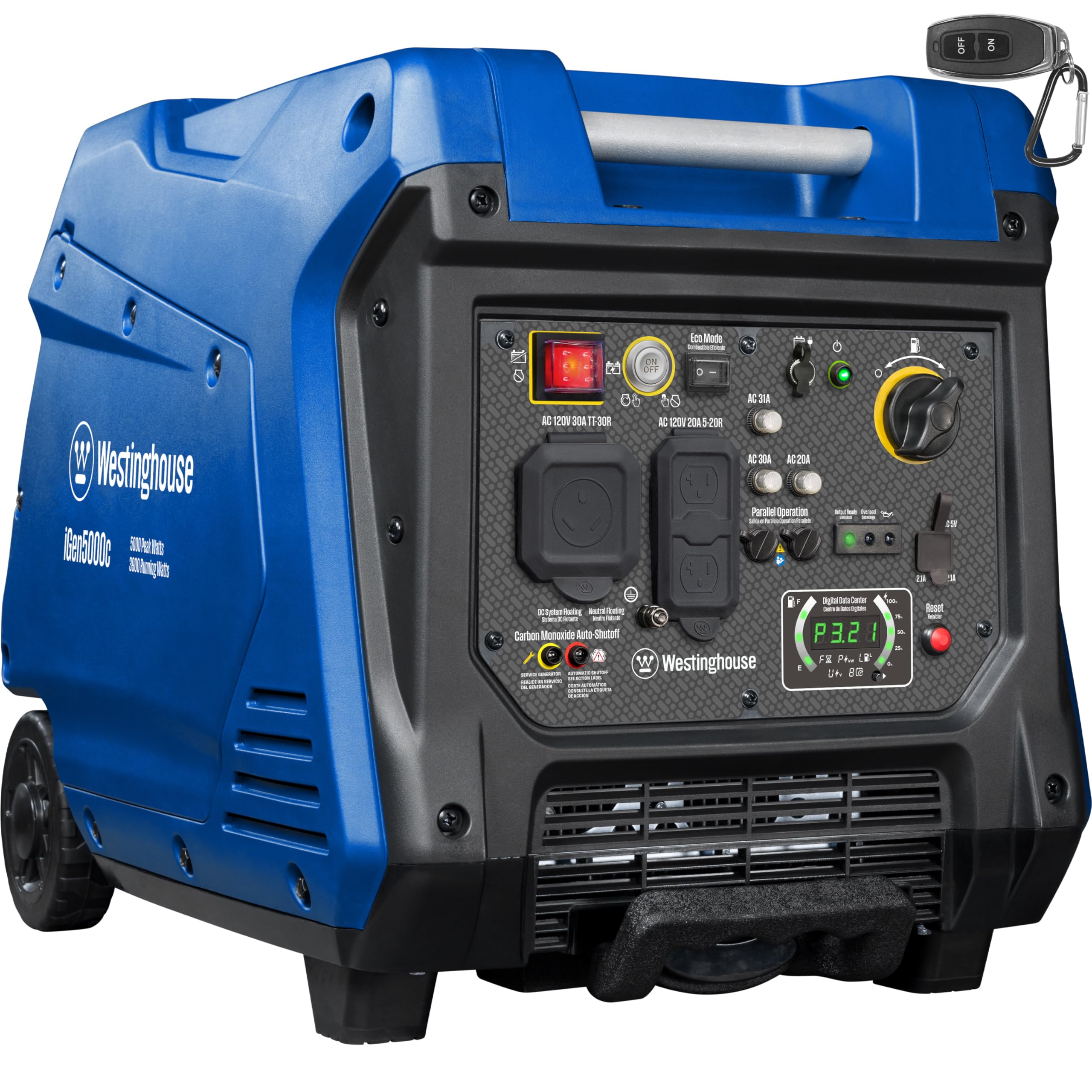
The Westinghouse iGen5000c delivers 5000 peak watts and 3900 rated watts with a noise rating of just 52 dBA from 23 feet—making it one of the quietest generators at this power level. Its 224cc engine is paired with an inverter producing less than 3% total harmonic distortion, safe for laptops, TVs, and other sensitive electronics. The push-button electric start with a remote key fob allows you to fire up the generator from inside your home or RV, which is a major convenience during bad weather or overnight stops.
The 3.4-gallon fuel tank delivers up to 18 hours of run time in economy mode, covering an overnight camping trip or an extended power outage on roughly one tank. The telescoping handle and integrated wheels make moving this 105-pound unit manageable despite the weight. Two standard 120V outlets plus a TT-30R RV outlet and dual USB ports cover most household and RV needs.
Owners consistently praise its quiet operation and reliable remote start, though the battery charger and initial oil/funnel are included in the box. The 3-year limited warranty and nationwide customer service network add confidence. For anyone needing a powerful yet quiet solution for home backup or RV use, this is the benchmark model.
Why it’s great
- Class-leading 52 dBA noise level from 23 feet
- Remote key fob and electric start included
- 18-hour run time on eco mode with 3.4-gallon tank
- Parallel capable for doubling output
Good to know
- 105 pounds; wheels and handle help but it’s still heavy
- Only two standard 120V outlets
- Battery must be kept charged via included charger
2. Cummins Onan P4500I
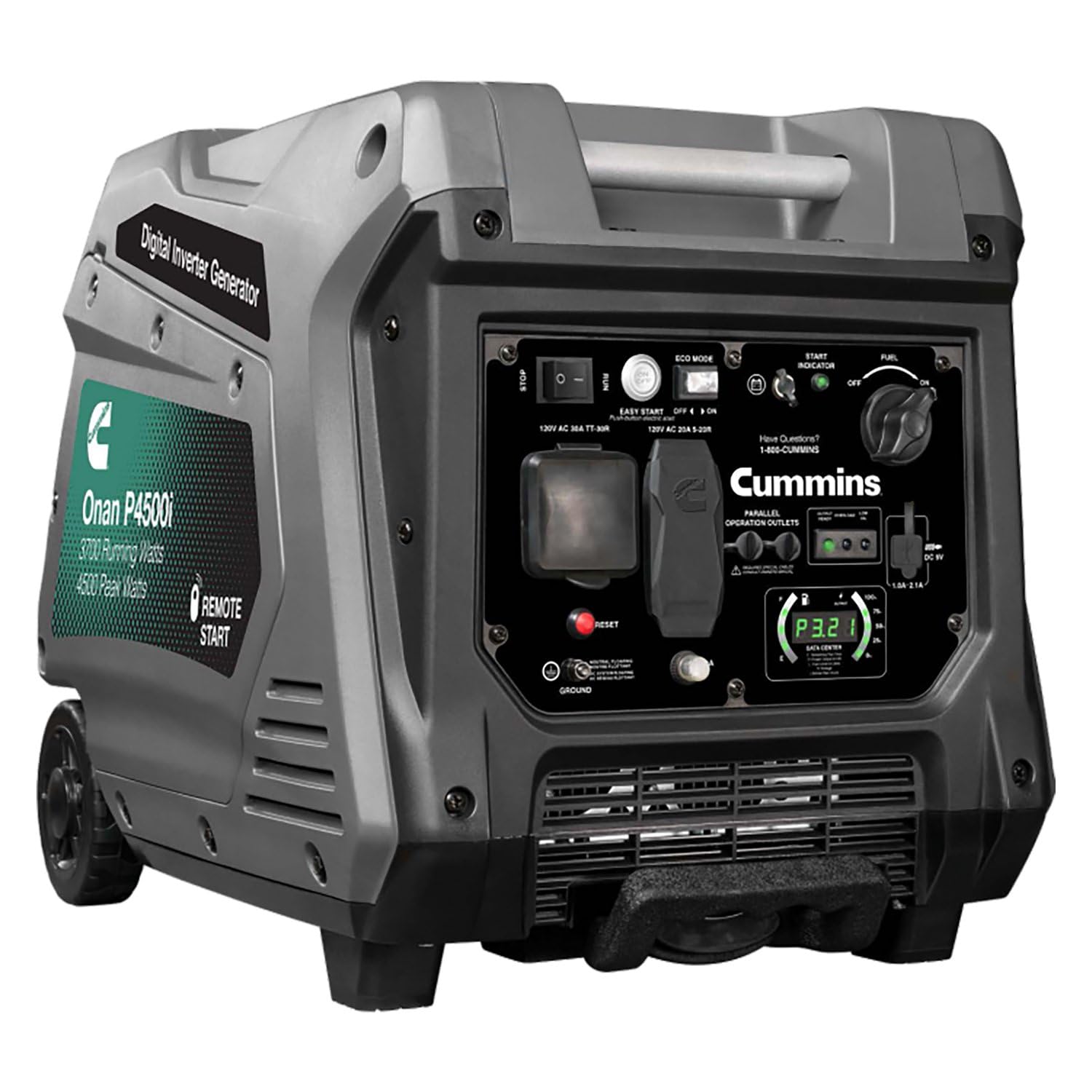
The Cummins Onan P4500I pairs a rugged 224cc OHV four-stroke engine with inverter technology to deliver 4500 peak watts at a whisper-quiet level that owners consistently rate as nearly inaudible from a neighboring campsite. The push-button electric start with a backup recoil pull cord provides fail-safe ignition, and the remote start lets you turn it on and off from inside your RV—a huge plus for cold mornings or rainy nights. The engine runs at a lower RPM under load, contributing to its quiet reputation and fuel efficiency.
Parallel capability allows two P4500I units to combine for up to 50 amps, useful for larger RVs or job-site power demands. The digital display shows remaining run time, voltage, and power output, while the gasoline fuel tank provides sufficient runtime for overnight camping. Dual 5V USB ports and a TT-30R RV outlet are standard, making hookup straightforward.
Owners highlight the quiet operation, reliable first-pull starts even in sub-zero temperatures, and the well-designed luggage-style handle that makes the 98-pound unit surprisingly easy to roll over gravel. The oil change access is a bit tight due to body panel alignment, but the build quality and consistency over hundreds of hours of use are widely praised. For those who want proven engineering and a strong resale value, this is a top contender.
Why it’s great
- Exceptionally quiet; owners report neighbors cannot hear it
- Remote start and parallel capable
- Starts reliably in -15°F conditions
- Luggage-style handle works well on rough terrain
Good to know
- 98 pounds; oil drain plug access is tight
- Price is firmly in premium territory
- Propane conversion requires an aftermarket kit
3. Honda EU3000iS
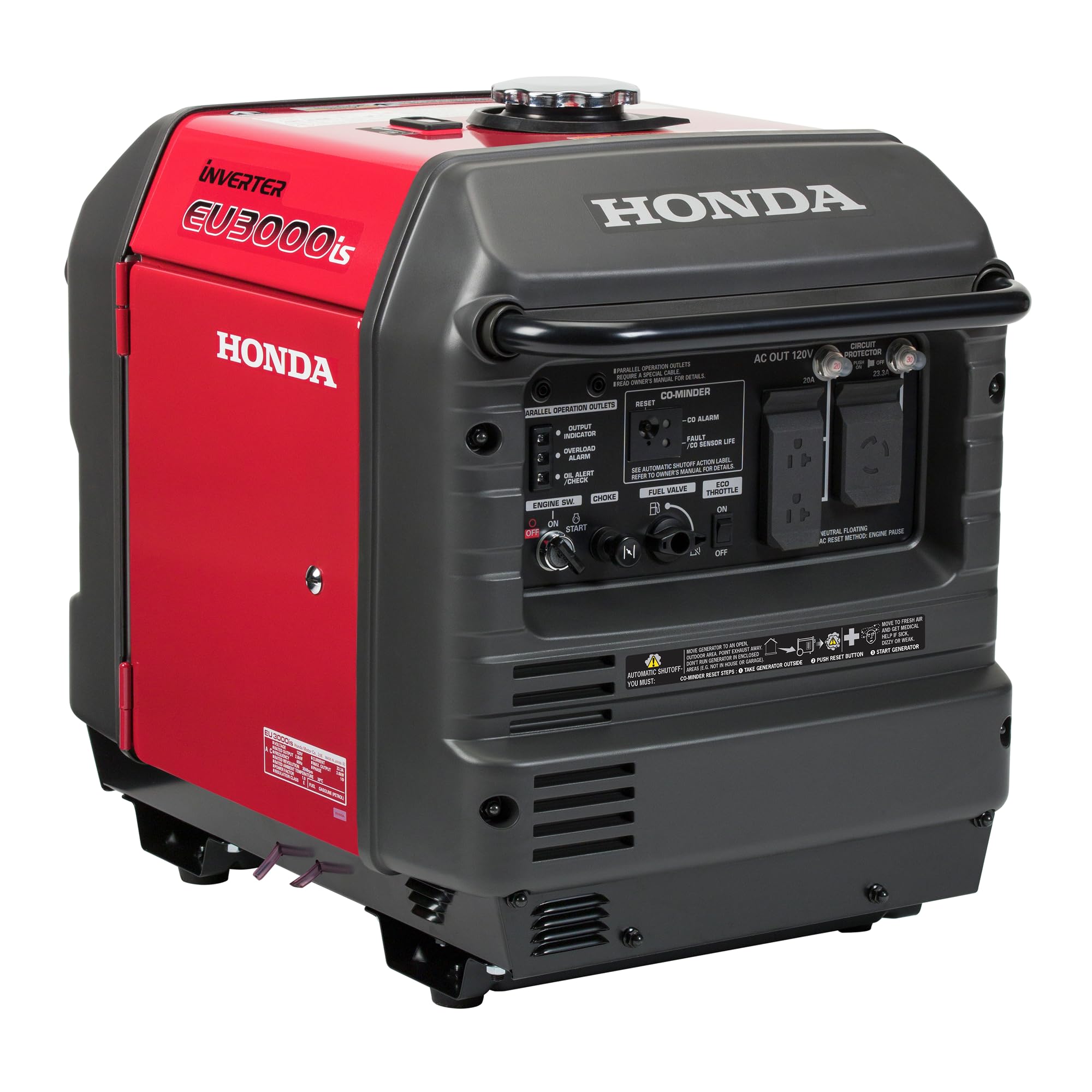
The Honda EU3000iS is the gold standard for quiet generator operation, rated at just 50 to 57 dBA depending on load. Its 418cc engine runs at a slower, more relaxed speed than smaller generators, producing a deep hum rather than a high-pitched buzz. The Eco Throttle system automatically adjusts engine RPM to match the load, delivering up to 19.6 hours of run time on the 3.4-gallon fuel tank at a 25% load. This is the longest run time in its class and a key reason campers and homeowners choose it.
Electric start, a CO-MINDER carbon monoxide detection system that auto-shuts down the generator if CO levels become unsafe, and advanced inverter technology with less than 3% THD make it a fully featured, safety-conscious unit. It can power most 13,500 BTU RV air conditioners, refrigerators, and sensitive electronics without concern. The 144-pound weight is the biggest compromise—this is not a one-person carry unit by any means, but the integrated wheels and handle ease movement on flat ground.
Honda offers a 3-year residential warranty, and owners routinely report thousands of hours of trouble-free operation. The build quality, fuel efficiency, and near-silent operation justify the premium price for those who prioritize absolute peace and quiet. It is not available for sale in California; residents should look at the EU3200iAC2 instead.
Why it’s great
- Ultra quiet 50-57 dBA; barely audible from inside an RV
- Up to 19.6-hour run time in Eco Throttle mode
- CO-MINDER safety auto-shutdown sensor
- Industry-leading reliability and resale value
Good to know
- 144 pounds — heavy for its wattage class
- Highest price in this lineup
- Not sold in California; check local laws
4. Westinghouse 4000W iGen4023

The Westinghouse iGen4023 is a dual-fuel inverter generator that runs on gasoline (4000 peak watts / 3300 rated) or propane (3600 peak / 3000 rated), offering flexibility for situations where propane storage is easier or longer shelf life is needed. Its noise rating of 52 dBA from 23 feet ties the larger iGen5000c for one of the quietest readings at this wattage. The remote key fob start, electric start, and recoil backup give three ways to get it running.
The 1.69-gallon gasoline tank provides up to 7 hours of run time at half load in economy mode, while propane extends run time slightly due to the different energy density. The telescoping handle and 62.8-pound weight make it a far more portable option than the 5000-watt model while still delivering enough power for a 30-amp RV hookup, a 13,500 BTU air conditioner, and multiple household essentials. The rotating LED data center shows fuel level, power output, remaining run time, and lifetime hours.
Owners consistently highlight the remote start as a game-changer for overnight use and the quiet operation that doesn’t disturb neighbors. Some users note that the 52 dBA rating is measured at half load, and full load adds a few decibels. The 3-year warranty and included propane hose make it a complete package for those who want fuel choice without sacrificing low noise.
Why it’s great
- Dual fuel: gasoline or propane for flexibility
- Remote start with key fob at a competitive price point
- 52 dBA noise level is genuinely quiet
- Telescoping handle and 62.8 lbs — one-person portable
Good to know
- Propane reduces peak wattage by about 10%
- Battery drain if remote not used — keep charger handy
- Not as quiet as claimed at full load for some users
5. Anker SOLIX C2000 Gen 2
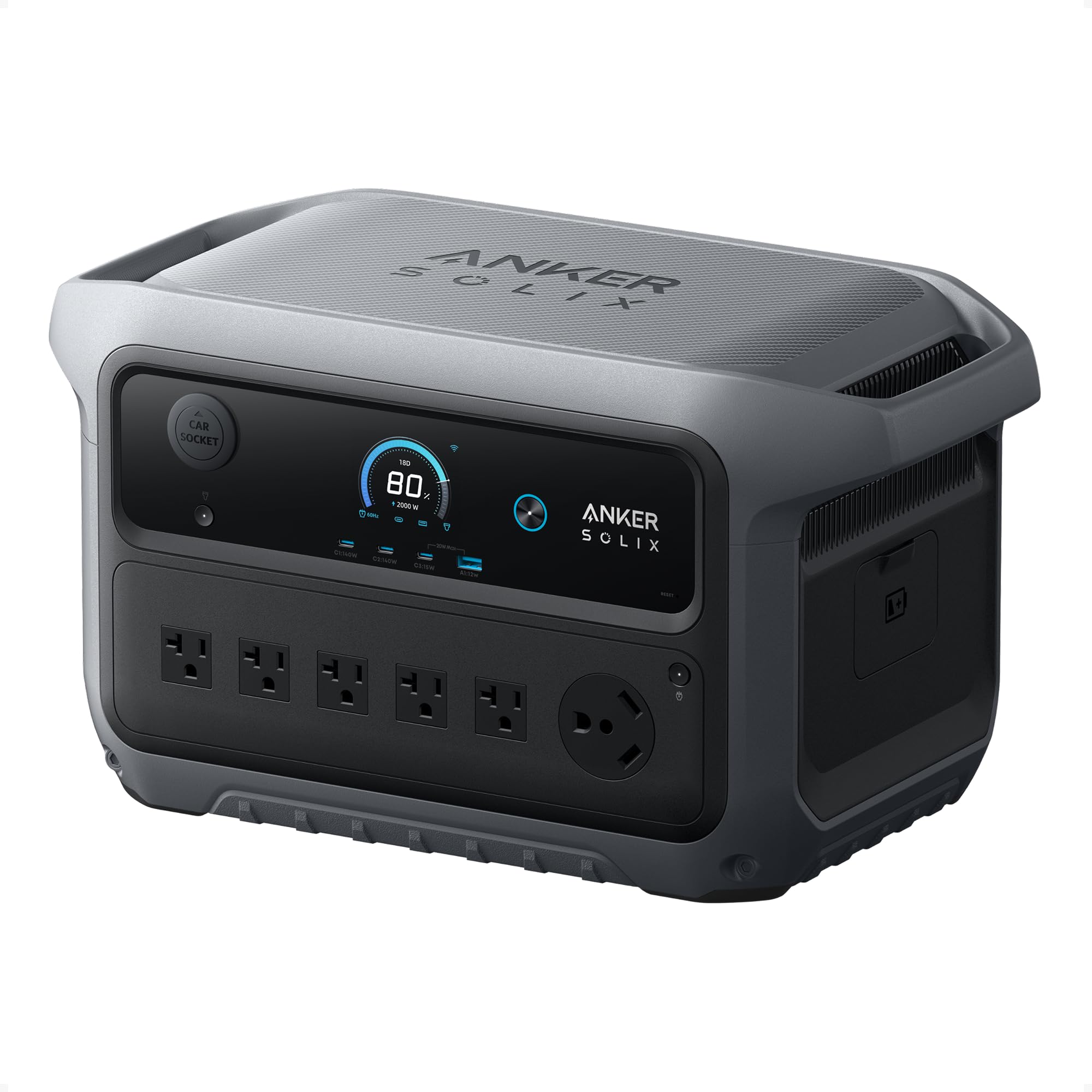
The Anker SOLIX C2000 Gen 2 is not a combustion generator—it is a 2048Wh LiFePO4 battery power station with a 2400W rated inverter (4000W peak). This means it produces zero engine noise, making it the absolute quietest option in this guide. It runs a refrigerator for up to 32 hours on a single charge and can be expanded to 4kWh with an additional battery for 64 hours of fridge runtime. The 58-minute full recharge from AC is class-leading.
The unit weighs 41.7 pounds and measures 18.1 x 9.8 x 10.1 inches, making it smaller and lighter than any gas generator with comparable sustained output. Six recharging methods include AC wall, solar (800W max input for 100% in 58 minutes), car alternator at 800W for a 3-hour charge, and generator. The pure sine wave output is safe for sensitive electronics, and the Bluetooth app allows monitoring and control.
Owners praise the fast charging speed, the ability to run a fridge and freezer simultaneously, and the peace of mind of silent, emission-free operation. The LiFePO4 chemistry is rated for 3000+ cycles. If your power needs are under 2400W sustained and you prioritize absolute silence, zero exhaust, and indoor-safe operation, this is the ideal alternative to a gas generator.
Why it’s great
- Completely silent operation — no noise, no fumes
- 58-minute full recharge via AC or solar
- 2048Wh capacity, expandable to 4096Wh
- Lightweight (41.7 lbs) and compact
Good to know
- 2400W sustained limit — won’t run large air conditioners
- Higher upfront cost per watt than gas generators
- Requires solar panels for off-grid recharging
6. WEN 4800W 56477i

The WEN 56477i pumps out 4800 surge watts and 4000 rated watts from a 224cc engine, making it the highest-rated-wattage model in this list outside of the premium trio. It is designed around WEN’s Watchdog CO Shutdown Sensor, which automatically turns off the generator if dangerous carbon monoxide levels are detected—a crucial safety feature for home backup scenarios. The fuel shutoff mechanism runs the carburetor dry before shutdown, extending engine life.
Unlike lighter inverter models, the 56477i comes with onboard wheels and a telescoping pull handle, making the 72.7-pound unit reasonably easy to roll out of a garage or truck bed. The four three-prong 120V receptacles, one TT-30R RV outlet, one 12V DC receptacle, and two USB ports provide ample connectivity for home and RV use. Owners report running a refrigerator and freezer for medication storage, plus lights and internet, with excellent fuel efficiency and quiet operation that impressed them compared to conventional open-frame generators.
Run time is approximately 8 hours per tank at half load. The three-year warranty is competitive. While not as compact as ultralight models, this generator offers the best power-per-dollar ratio in the mid-range segment, especially for those who need 4000 rated watts for home backup without stepping into the premium price tier.
Why it’s great
- 4000 rated watts for under
- Wheels and telescoping handle included
- CO Shutdown safety sensor standard
- Fuel shutoff extends carburetor life
Good to know
- 72.7 pounds — still heavy for one person without wheels
- Not as quiet as premium models (no official dBA rating)
- Initial oil check and monthly starts recommended
7. Pulsar PGD40ISCO

The Pulsar PGD40ISCO delivers 4000 peak watts and 3200 rated watts at a noise rating of 59 dBA, with a dry weight of only 47.3 pounds. That combination of power and portability is rare—most generators pushing 4000 surge watts weigh 55-65 pounds. The 145cc engine runs on a 1-gallon fuel tank for about 4 hours at half load. Recoil start is standard, and the compact white enclosure fits easily into an SUV trunk or RV storage compartment.
The control panel includes two 120V AC outlets, a 12V DC outlet, and USB ports. Parallel operation is supported if you need to combine two units for higher output. The clean sine wave output (less than 3% THD) is safe for laptops and phones. Owners specifically note that it handles a 13,500 BTU RV air conditioner with a soft start, though the mic may run continuously on hot days.
While reviewers describe the noise as quieter than any open-frame generator, multiple owners note it is noticeably louder than a Honda EU2000i or Predator 3500. The fuel cap can vapor-lock in high heat; cracking it open alleviates the pressure. For buyers who prioritize light weight and 4000W peak capacity over absolute silence, this unit offers a compelling power-to-portability ratio.
Why it’s great
- 47.3 pounds — among the lightest 4000W units available
- 59 dBA is quiet enough for campgrounds
- Clean power under 3% THD for electronics
- Parallel ready for double output
Good to know
- Not the quietest inverter; louder than premium models
- 1-gallon tank needs refilling every 4 hours at half load
- Fuel cap may vapor-lock in extreme heat
8. Champion 2500W Ultralight

The Champion Power Equipment 2500-watt ultralight inverter generator tips the scale at just 39.7 pounds while delivering 2500 starting watts and 1850 running watts at 53 dBA from 23 feet. This is the lightest full-featured inverter generator in the lineup, designed for one-person carry to a campsite, tailgate, or job site. The 79cc engine with electronic ignition starts reliably, and the 1.1-gallon tank provides up to 11.5 hours of run time in economy mode.
Champion includes the CO Shield carbon monoxide auto-shutoff system, a critical safety feature for outdoor use near shelters or vehicles. The clean electricity (less than 3% THD) powers sensitive electronics without concern. A 120V 15.4A duplex household outlet, a 12V automotive-style outlet, and parallel outlets are included; a parallel kit allows pairing with another 2500-watt Champion unit for double output.
Owner reports are overwhelmingly positive about its portability and quiet operation, noting it easily runs a refrigerator, freezer, lamps, and internet during multi-day power outages. The CO Shield sensor has been flagged by some users as overly sensitive, sometimes shutting down the unit when used outside in windy conditions. The 3-year limited warranty and lifetime technical support add security.
Why it’s great
- Only 39.7 pounds — truly one-person portable
- 53 dBA — genuinely quiet for campground use
- 11.5-hour run time at quarter load
- CO Shield auto-shutoff safety system
Good to know
- 1850 running watts — not enough for large AC units
- CO sensor may trigger shutdowns in windy conditions
- No wheels or handle; must be carried
9. WEN 3600W 56360i

The WEN 56360i delivers 3600 surge watts and 2900 rated watts from a 149cc engine, all wrapped in a 46-pound package. That power-to-weight ratio makes it ideal for RV owners who need to run a 13,500 BTU air conditioner without carrying unnecessary bulk. The inverter produces clean electricity (under 3% THD) safe for phones, tablets, and laptops. The fuel shutoff feature runs the carburetor dry before shutdown, preventing stale fuel from gumming up the system.
The control panel includes two three-prong 120V receptacles, one TT-30R RV receptacle, one 12V DC outlet, and two 5V USB ports. Run time is approximately 4 hours on the tank when running the air conditioner, longer with lighter loads. Owners consistently describe it as quiet enough for campground use, with a gentle purr that doesn’t disturb neighbors, and compact enough to fit under a camper bunk.
The three-year warranty backs this unit. Several owners noted the single control switch (fuel on/off, choke, start/stop) is simple and convenient. The engine has no oil filter, requiring oil changes every 25 hours. If you want enough power for an RV AC at under 50 pounds with clean sine wave output, this is one of the best values in the mid-range segment.
Why it’s great
- 46 pounds with 3600 surge watts — excellent power-to-weight
- Fuel shutoff extends engine life
- TT-30R RV outlet included
- Quiet enough for campground use
Good to know
- 4-hour run time at half load with AC demanding use
- No oil filter; requires regular oil changes every 25 hours
- Throttle may not keep up with large simultaneous loads
10. PowerSmart 3800W
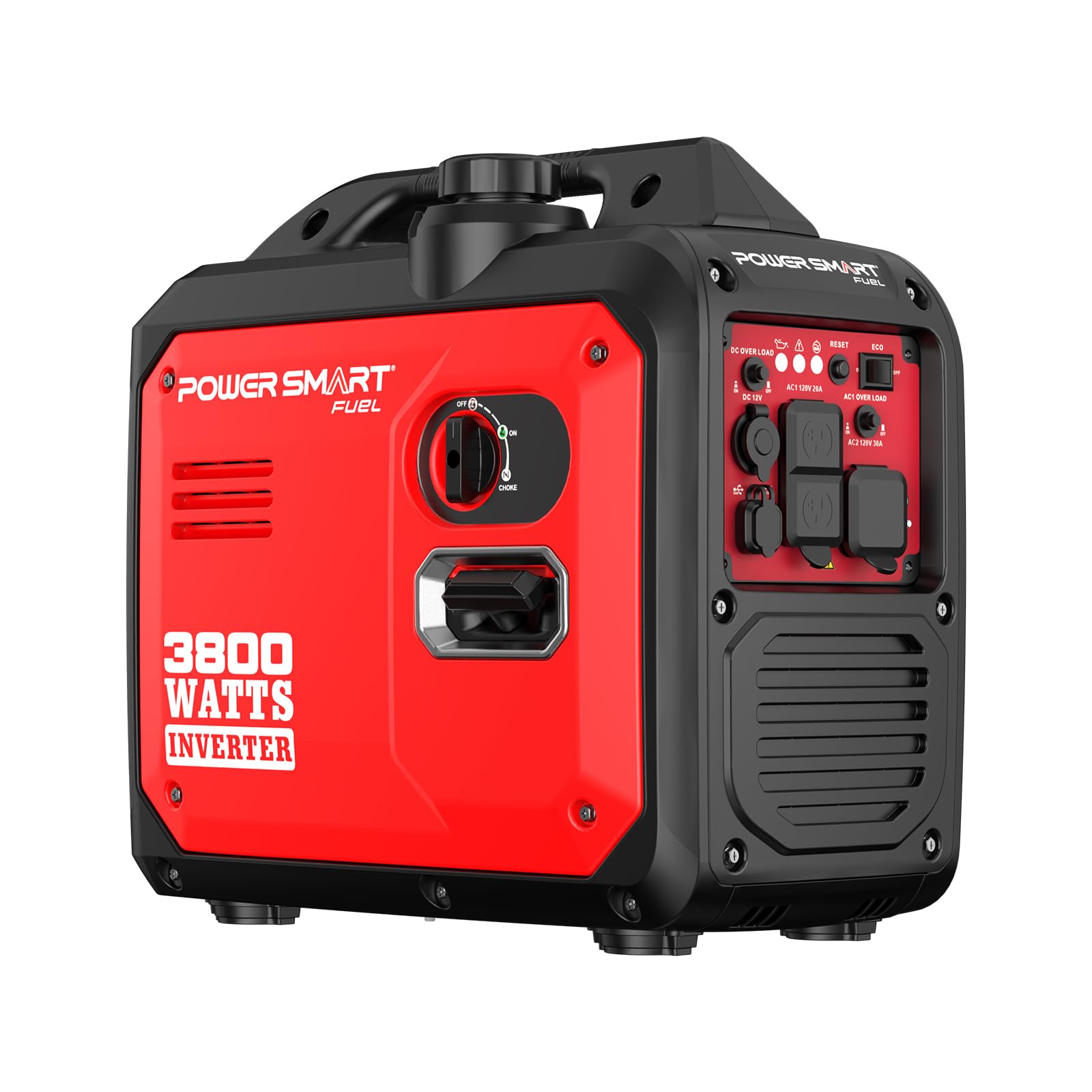
The PowerSmart DB5068 generates 3800 starting watts and 3200 rated watts from a 143cc four-stroke OHV engine, rated at 59 dBA from 23 feet. It is among the most affordable inverter generators in the 3200-rated-watt class, offering a clean sine wave output with less than 3% THD. The 1.19-gallon fuel tank provides up to 4.5 hours of run time at half load, with an economy mode that throttles down automatically to save fuel and reduce noise.
At 52 pounds, it is light enough for one person to load into a truck bed, and the compact form factor stores easily. It comes with two 120V 26.7A AC outlets and a 5V USB port. Parallel operation is supported with an optional kit for doubling output. Owners consistently praise the easy one-pull starting out of the box, the quiet operation that is quieter than comparable Predator models, and the ability to run a refrigerator, fans, and lights continuously during an outage.
The two-year warranty is shorter than some competitors, and the tank capacity is on the smaller side for longer outages. A fuel shutoff is included, which helps with long-term storage. For budget-conscious buyers who need 3200 rated watts in a quiet, reliable inverter package, this unit delivers strong performance at a low entry price.
Why it’s great
- 3200 rated watts for a very attractive price
- 59 dBA – quieter than typical open-frame units
- Easy to start — owners report first-pull starts
- Parallel ready for expanded capacity
Good to know
- 4.5-hour run time at half load — smaller tank
- Two-year warranty is shorter than competitors
- No wheels or handle included
11. Aceup Energy 4000W
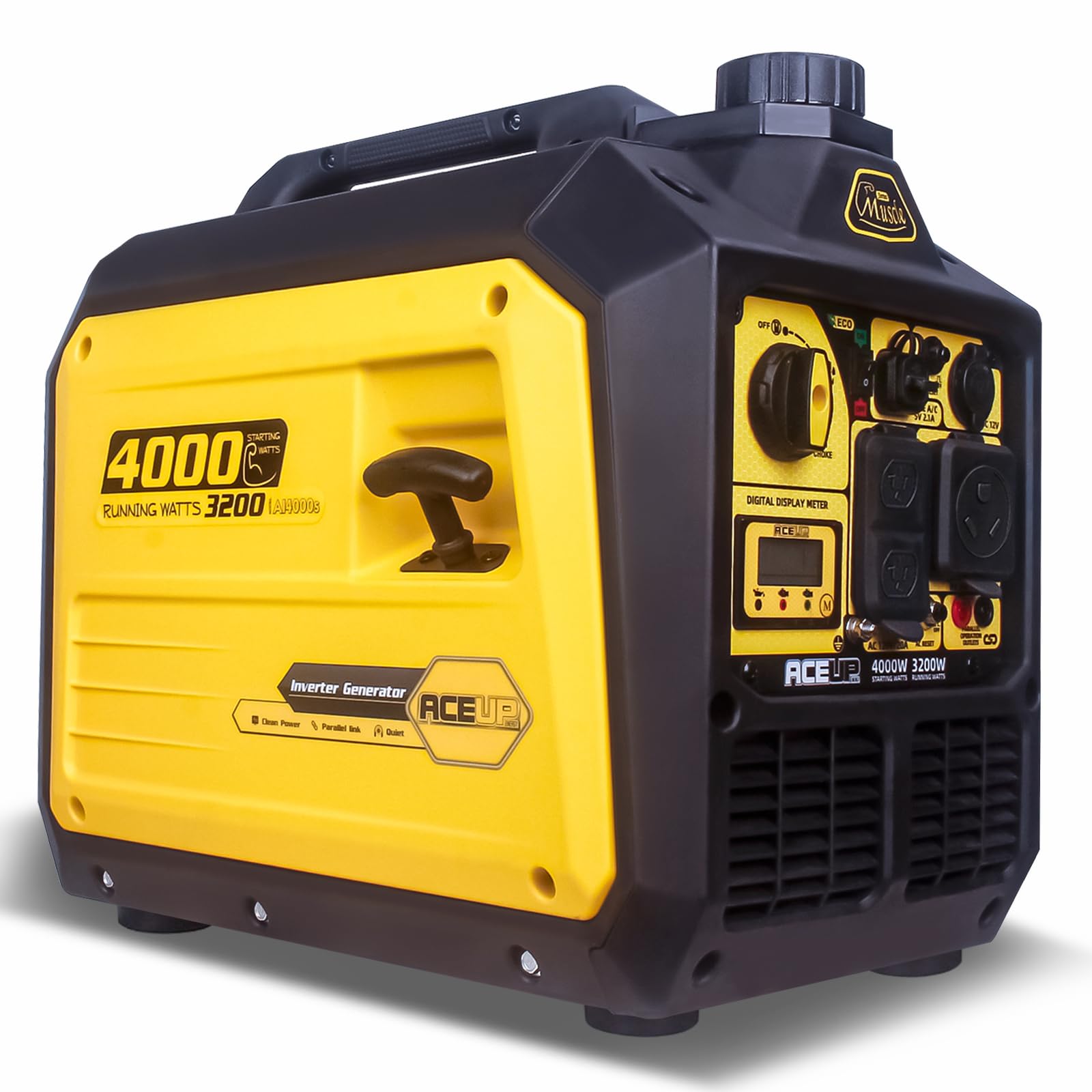
The Aceup Energy 4000W inverter generator offers 4000 peak watts and 3200 rated watts from a 149cc engine, with an intelligent gauge that tracks voltage, run time, fuel level, hertz, and power output. Its fully enclosed design reduces noise to levels that owners describe as conversation-friendly at 23 feet. The 5-in-1 control knob simplifies startup: fuel on/shut-off, engine on/off, and choke are integrated into one switch.
The 1.32-gallon fuel tank provides up to 5 hours of run time at half load. Outlets include one 120V 20A outlet, one RV receptacle, and one 12V DC 8.3A car charger outlet. Parallel capability allows connecting two units for doubled output (parallel kit sold separately). The unit weighs 50 pounds and includes engine oil, an oil funnel, and a spark plug wrench in the box. Owners have reported using it continuously during two-week outages to run a refrigerator, lamps, fans, and internet.
Some users have noted the generator is very loud unless set to Eco mode, which reduces wattage output for significantly quieter operation. A tank-collapsing issue has been reported if the vent is not opened properly. The EPA compliance and 2-year limited warranty with lifetime technical guidance are standard. For an entry-level price, this unit provides a solid introduction to inverter generator ownership.
Why it’s great
- 4000W peak / 3200W rated for a very low price
- 5-in-1 control knob simplifies startup and shutdown
- 50 pounds — easy one-person lift
- Parallel ready for expansion
Good to know
- Loud in standard mode; Eco mode halves wattage for quiet
- 1.32-gallon tank gives only 4-6 hours at moderate load
- Reports of tank collapse if vent is not properly opened
FAQ
How many decibels is too loud for a campground?
Can I run a 13,500 BTU RV air conditioner on a 3000-watt quiet generator?
Is a dual-fuel generator quieter on propane than gasoline?
How often should I change the oil in a quiet inverter generator?
Final Thoughts: The Verdict
For most users, the best quietest portable generators winner is the Westinghouse 5000W iGen5000c because it combines the lowest noise rating (52 dBA) with enough power for home backup and RV living, plus the convenience of remote start. If you want zero noise and zero emissions for electronics and small appliances, grab the Anker SOLIX C2000 Gen 2. And for an ultralight, ultra-quiet option that fits in a car trunk for weekend camping, nothing beats the Champion 2500W Ultralight at under 40 pounds with 53 dBA operation.