
When the grid goes dark during a hurricane, ice storm, or rolling blackout, the difference between chaos and comfort is a reliable power source. A quality backup generator isn’t just about keeping the lights on—it’s about preserving food, running medical equipment, maintaining security systems, and keeping your home’s critical circuits operational. The market ranges from portable dual-fuel workhorses to permanent standby units with automatic transfer switches, each demanding a careful evaluation of wattage, fuel type, and total harmonic distortion.
I’m Min — the co-founder and writer behind Gadgets Feed. I’ve spent countless hours analyzing technical specifications, decibel ratings, surge-to-running watt ratios, and real-world fuel consumption data to separate the units that deliver true whole-home protection from those that fail under sustained load.
This guide evaluates thirteen of the most capable units on the market, comparing inverter technology, transfer switch readiness, and fuel flexibility so you can confidently select the best residential backup generators for your specific outage-preparedness plan.
How To Choose The Best Residential Backup Generators
Selecting a backup generator starts with a simple but non-negotiable step: calculate the starting wattage of your largest appliance (typically a well pump, central AC, or refrigerator compressor) and add it to the running wattage of everything you need simultaneously. A unit that can’t handle locked-rotor surges will trip its breaker the moment the AC kicks on. Beyond wattage, consider fuel logistics—propane and natural gas eliminate the hassle of storing volatile gasoline, while battery-based systems offer silent, emissions-free operation but cap out at lower total capacities.
Fuel Type and Run Time
Gasoline delivers the highest peak wattage per dollar but degrades in storage after a few months without stabilizer. Propane burns cleaner, extends engine life, and won’t gum up the carburetor, but reduces peak output by roughly 10%. Natural gas offers unlimited run time if your home is piped but requires a stationary generator with a dedicated connection. Battery power stations provide instant, quiet backup for sensitive electronics and smaller loads, but recharging during a multi-day outage demands solar panels or a separate generator.
Safety Features: CO Shutdown and Transfer Switches
Every modern backup generator worth considering includes a carbon monoxide (CO) watchdog sensor that automatically kills the engine if exhaust accumulates. This is critical because generator-related CO poisoning causes hundreds of deaths annually. For whole-home integration, a unit with an L14-30R or 14-50R outlet can connect to a manual transfer switch, while permanent standby units like the Generac Guardian series include automatic transfer switches that detect grid failure and restore power within seconds.
Quick Comparison
On smaller screens, swipe sideways to see the full table.
| Model | Category | Best For | Key Spec | Amazon |
|---|---|---|---|---|
| Westinghouse WGen5300c | Portable Gas | Essential Circuit Backup | 6,600W Peak / 5,300W Running | Amazon |
| WEN DF680iX | Dual-Fuel Inverter | EV Charging & RV Use | 6,800W Gas / 6,000W Propane Peak | Amazon |
| BLUETTI AC200L | Battery Power Station | Clean, Silent Backup | 2,048Wh / 2,400W Pure Sine Wave | Amazon |
| Anker SOLIX C2000 Gen 2 | Battery Power Station | Ultra-Compact Home Backup | 2,048Wh / 2,400W (4,000W Peak) | Amazon |
| DuroStar DS13000MX | Dual-Fuel Open Frame | Whole-Home Backup (Budget) | 13,000W Peak / 500cc Engine | Amazon |
| Westinghouse WGen12500c | Dual-Fuel Open Frame | High-Wattage Whole Home | 12,500W Peak / 9,500W Running (Gas) | Amazon |
| DuroMax XP13000HXT | Tri-Fuel Open Frame | Natural Gas Whole-Home Backup | 13,000W Peak / 500cc Tri-Fuel | Amazon |
| EcoFlow DELTA Pro | Battery Power Station | Expandable Home Battery Backup | 3,600Wh / 3,600W (7,200W Dual) | Amazon |
| AIVOLT VS12000411 | Dual-Fuel Inverter | Quiet Operation & 50A RV | 11,250W / 57dB (23 ft Claimed) | Amazon |
| Champion 201407 | Inverter Generator | Quiet Whole Home & Sensitive Electronics | 11,000W Peak / <3% THD | Amazon |
| GROWATT HELIOS 3600 Duo | Battery Power Station | 240V Split-Phase Whole-Home | 7,200W / 7.2kWh Total (Expandable) | Amazon |
| Generac Guardian 10kW | Automatic Standby | Permanent Whole-Home Protection | 10,000W / 100A Transfer Switch | Amazon |
| Generac Guardian 26kW | Automatic Standby | Maximum Whole-Home Coverage | 26,000W / 200A Transfer Switch | Amazon |
In‑Depth Reviews
1. Westinghouse WGen5300c

The Westinghouse WGen5300c strikes a compelling balance between affordability and essential features for homeowners who need reliable backup without committing to a permanent installation. Its 274cc cast-iron sleeved engine delivers 6,600 peak watts and 5,300 running watts—enough to power a refrigerator, several lights, a modem, and a space heater simultaneously. The electric push-button start with a remote key fob eliminates the hassle of recoil starting in cold weather, and the automatic CO shutdown adds a critical safety layer that many budget-oriented units omit.
With a 4.7-gallon fuel tank providing up to 14.5 hours of runtime at 50% load, this generator can carry you through an overnight outage without refueling. The control panel includes one L14-30R twist-lock receptacle for transfer switch connection, a TT-30R for RV use, and a duplex 120V household outlet—all protected by rubber covers. User reports confirm it handles two refrigerators, reptile heaters, a TV, and a modem with room to spare, though the 87 dB noise level at the unit means it’s best placed away from living spaces.
Assembly is minimal: attach the included wheel kit, add oil and fuel, and the unit is ready. The battery requires a periodic trickle charge, especially in sub-freezing temperatures where electric start may struggle, but the recoil backup ensures it still fires up. Westinghouse backs it with a 3-year limited parts and labor warranty, which is above average for this price bracket and signals confidence in their cast-iron engine platform.
Why it’s great
- Remote start key fob works reliably from distance
- Cast iron sleeve extends engine lifespan significantly
- Clean sine wave suitable for sensitive electronics
Good to know
- Battery needs trickle charging in cold climates
- Measured noise around 87 dB at unit—not a quiet neighbor option
- No dual-fuel capability; gasoline only
2. WEN DF680iX

The WEN DF680iX is a rare dual-fuel inverter generator that can serve double duty as home backup and EV charger. Its 224cc engine produces 6,800 surge watts on gasoline (5,100 rated) and 6,000 surge watts on propane (4,500 rated), while the bonded-neutral 240V output enables low-power Level 2 charging for plug-in hybrid and battery electric vehicles. This makes it uniquely valuable for EV owners who need a way to replenish their car’s battery during extended grid outages.
Inverter technology keeps total harmonic distortion (THD) low, making the DF680iX safe for sensitive electronics like televisions, computers, and CPAP machines. The CO Watchdog sensor automatically shuts the unit down if dangerous carbon monoxide levels are detected. The fuel shut-off feature is a smart touch—by draining the carburetor before shutdown, it reduces gumming and extends the life of the fuel system, a common failure point on lesser generators.
At 99.2 pounds, the DF680iX is significantly lighter than open-frame competitors, though the inverter chassis is notably short and can be top-heavy when maneuvering. The included telescoping pull handle and wheel kit make rolling it to a storage spot manageable. Users report excellent propane efficiency, with a 40-pound tank lasting a full weekend under moderate load. The 3-year warranty is standard for the category, but WEN’s customer service received mixed reviews regarding response times.
Why it’s great
- Bonded-neutral 240V output for Level 2 EV charging
- Dual-fuel flexibility with tool-free LPG quick-connect
- Fuel shut-off extends carburetor life and reduces maintenance
Good to know
- 240V mode disables 120V outlets simultaneously
- Some units reported early 240V outlet failure
- Battery lacks integrated trickle-charge connector
3. BLUETTI AC200L

The BLUETTI AC200L is a battery-based power station that brings 2,048 watt-hours of LiFePO4 storage and 2,400 watts of continuous AC output (3,600W Power Lifting mode for surges) to the home backup market. Its key advantage over combustion generators is absolute silence, zero emissions, and instant power transfer with sub-10ms UPS switching—meaning your modem and router never blink during an outage. The AC200L supports expansion via B230 or B300 battery packs up to 8,192Wh total, enabling multi-day coverage for essential loads.
Recharging this station is impressively fast: 0–80% in 45 minutes via 2,400W AC input, or full charge in under two hours from 1,200W solar panels. The 11-port output panel includes two 100W USB-C PD ports, a 30A RV outlet, a 48V/8A DC port, and five standard AC outlets. The accompanying Bluetooth/Wi-Fi app provides real-time monitoring of charge level, input/output rates, and estimated runtime, which is invaluable for load management during prolonged outages.
At 61.4 pounds, the AC200L is manageable for two-person placement but not truly portable for daily moving. The LiFePO4 chemistry delivers over 3,000 cycles to 80% capacity, translating to roughly 10 years of daily use or far longer for occasional backup. One limitation: if the proprietary AC charging cable fails, replacements must be ordered from BLUETTI directly. Still, for homeowners who prioritize quiet operation and clean power for sensitive gear, this battery station is a compelling primary or supplementary option.
Why it’s great
- Sub-10ms UPS switch ensures uninterrupted power to critical devices
- Fast recharge—0-80% in 45 minutes from wall AC
- 3000+ cycle LiFePO4 chemistry with 5-year warranty
Good to know
- 61 lb weight is heavy for one person to lift
- Proprietary AC charging cable is a single-point failure
- Cannot run large 240V appliances like well pumps
4. Anker SOLIX C2000 Gen 2

The Anker SOLIX C2000 Gen 2 redefines the space-to-power ratio for battery backup systems. At just 41.7 pounds and 18.1 x 9.8 x 10.1 inches, it is 25% lighter and 29% smaller than comparable 2kWh units while still delivering 2,400W rated AC output with a 4,000W peak surge. The 2,048Wh LiFePO4 battery can power a dual-door refrigerator for up to 32 hours on a single charge, and the standby power consumption is a microscopic 9W—meaning it won’t drain itself when not in use.
Recharge speed is this unit’s headline feature: a full 0–100% charge takes only 58 minutes via AC input, enabled by Anker’s HyperFlash technology. The C2000 Gen 2 also supports 800W alternator charging, letting road warriors refill the battery in about 3 hours while driving—eight times faster than a standard 12V car socket. The companion app (Bluetooth and Wi-Fi) provides granular load monitoring, estimated runtime, and charge/discharge scheduling for time-of-use optimization.
Output ports include five AC outlets, dual 100W USB-C, and a 30A RV port, though there is no 240V split-phase option. The build quality is excellent with a metal and plastic chassis that feels far more premium than its weight suggests. Users confirm it powers a fridge, freezer, TV, modem, and lighting for over 10 hours during real outages. The primary downside is the lack of an included carrying handle—Anker expects the unit to be placed and left in a designated spot, not carried daily.
Why it’s great
- Industry-leading 58-minute full recharge
- Extremely compact and lightweight for 2kWh capacity
- 9W standby power consumption is best in class
Good to know
- No 240V output for well pumps or large appliances
- No included hard copy manual; digital only
- Expansion battery sold separately
5. DuroStar DS13000MX

The DuroStar DS13000MX brings 13,000 peak watts and a 500cc OHV engine to the dual-fuel category at a price point that undercuts most competitors with similar displacement. It runs on gasoline or propane, with a front-facing fuel selector that allows switching without stopping the engine—a major convenience during extended outages when fuel supply might change. The 50-amp outlet makes it transfer switch ready for whole-home connection, and the all-metal frame and reinforced power panel suggest it can withstand years of use and occasional rough handling.
Push-button electric start coupled with a remote key fob means you can fire the unit up from inside the house during a storm without braving the elements. The CO Alert sensor automatically shuts down the generator if dangerous carbon monoxide levels accumulate, a mandatory safety feature for any unit likely to be used near occupied structures. Users report powering an entire home—two ACs, fridge, stove, microwave, water heater, TVs, and well pump—with minimal strain, though the AC compressor does cause a momentary dip that the engine handles without stalling.
At 220 pounds and measuring nearly 30 inches on each side, this is not a portable unit in the traditional sense. The wheel kit and fold-out handles make it rollable over smooth surfaces, but positioning it on a concrete slab or generator pad is a two-person job. DuroStar includes an oil funnel, spark plug wrench, tool set, and propane regulator in the box. Their 3-year warranty covers residential use, and users praise the support team’s responsiveness for parts replacement.
Why it’s great
- Hot-switch between gasoline and propane while running
- 500cc engine delivers enough surge for dual AC startup
- All-metal construction with reinforced power panel
Good to know
- 220 lb dry weight requires two people to lift onto a pad
- Not an inverter—THD higher than inverter models
- Propane operation reduces peak output; factor 10% derating
6. Westinghouse WGen12500c

The Westinghouse WGen12500c delivers 12,500 peak watts (9,500 running on gasoline, 11,200 peak and 8,500 running on propane) from its 457cc cast-iron sleeved engine, placing it in the upper tier of portable dual-fuel generators. The 6.6-gallon fuel tank provides up to 12 hours of runtime at half load, and the 14-50R 50-amp outlet is transfer switch ready for direct whole-home integration. The included remote key fob with electric start, plus the backup recoil pull, ensures reliable firing even if the battery is low.
This unit earns its reputation from Consumer Reports and Popular Mechanics recommendations, largely due to the consistent voltage regulation and the automatic CO shutdown sensor that meets EPA safety standards. The control panel features two GFCI-protected 120V 20A duplex outlets in addition to the L14-30R and 14-50R receptacles, all with rubber covers to keep debris out during storage. Users confirm it runs a well pump, water heater, and refrigerator simultaneously without voltage sag, though the heat exchanger fan is noticeably loud under full load.
Assembly takes about 5 minutes: attach the wheel kit, add oil and fuel, and start. However, the manual contains a few quirks—the foot nuts are pre-welded rather than included separately, and the included tool kit lacks a labeled spark plug wrench. The 3-year limited parts and labor warranty is a solid commitment, and Westinghouse’s nationwide service network adds peace of mind for those in more remote regions. At 212 pounds, it benefits from a permanent placement on a generator pad rather than frequent relocation.
Why it’s great
- Consumer Reports and Popular Mechanics consistently recommend this model
- Cast iron sleeve engine delivers long service life
- 50A 14-50R outlet simplifies transfer switch connection
Good to know
- Loses efficiency above 2,000 ft altitude without a jet kit
- Manual references a non-existent Eco switch
- Propane derating to 8,500W may not cover larger homes
7. DuroMax XP13000HXT
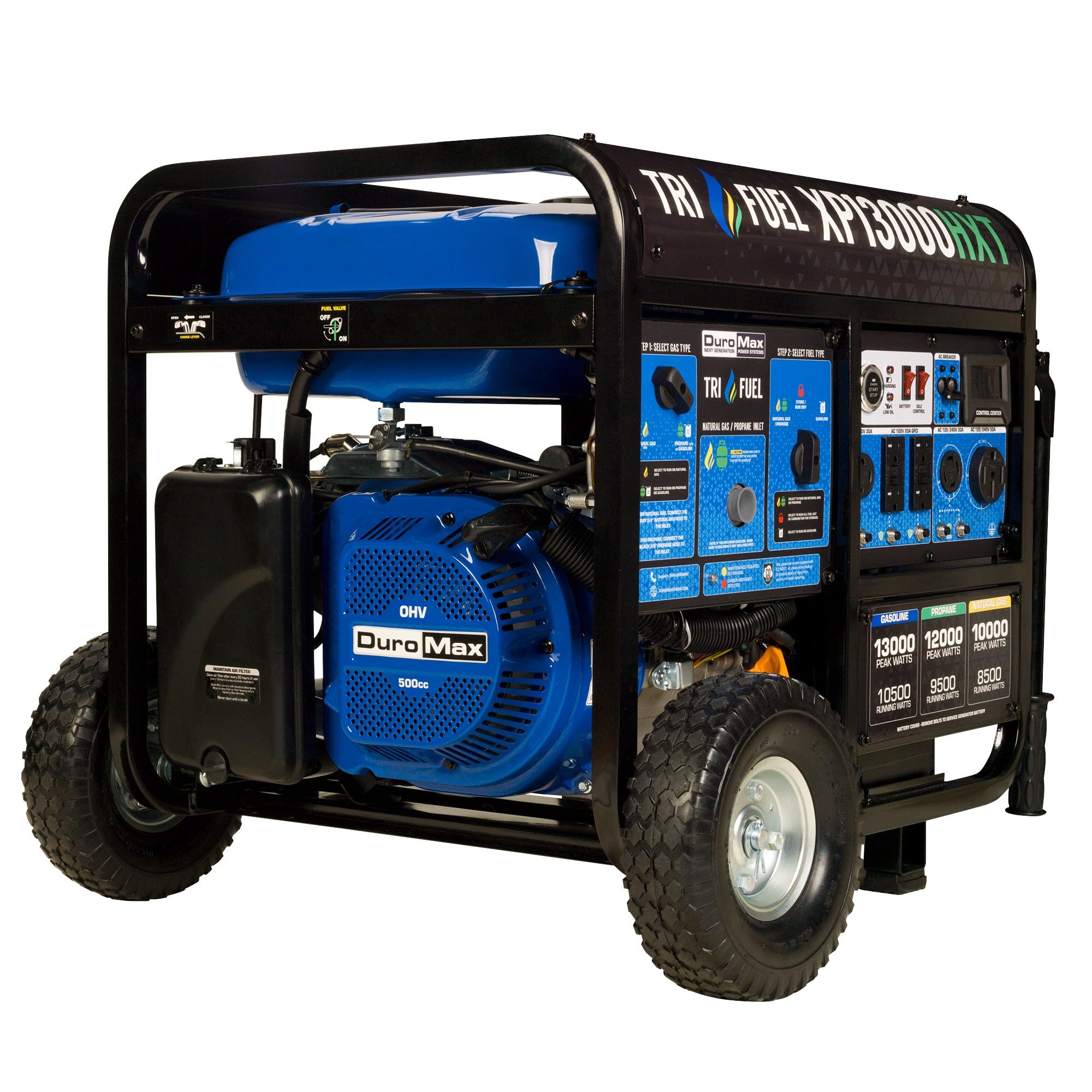
The DuroMax XP13000HXT is one of the few portable generators that runs on three fuels—gasoline, propane, and natural gas—giving you maximum fuel flexibility during prolonged outages. The 500cc OHV engine produces 13,000 peak watts, and the tri-fuel capability means you can switch to a natural gas line from your home’s gas meter for unlimited runtime without refueling. The CO Alert sensor automatically shuts down the unit if carbon monoxide reaches dangerous levels, and the push-button start plus remote key fob let you activate it from inside the house.
The interface is well-designed for a stationary generator: the front-facing fuel selector dial lets you swap between fuel types in seconds, and the digital display shows voltage, frequency, and run hours. The 50-amp twist-lock outlet is transfer switch ready, and DuroMax includes a 15-foot natural gas hose (3/4-inch) and a propane regulator in the box. Users report the unit easily powers an entire home—including a central AC, two fridges, furnace, security lights, and cameras—at just 25-30% load during a winter ice storm, running 6 hours on 2.2 gallons of gasoline.
At 240 pounds, the XP13000HXT is among the heaviest portable units, but the wheel kit and folding handle make it manageable on level ground. DuroMax’s customer support is notably responsive—users report call-back times under 20 minutes and replacement parts shipped in 3-5 days. The tri-fuel design does require a bit more attention to installation: the natural gas connection often needs a certified plumber to run a 3/4-inch line from the house. The 3-year limited warranty covers parts and labor, though the 500cc engine is loud by any measure—typical for this displacement class.
Why it’s great
- Tri-fuel operation eliminates fuel storage concerns with NG
- 500cc engine provides massive surge for large homes
- Excellent customer support responsiveness
Good to know
- 240 lb dry weight requires a permanent, level pad
- No oil included in the box; buy separately
- Natural gas consumption of 225K BTU/hr may require upsizing the meter
8. EcoFlow DELTA Pro
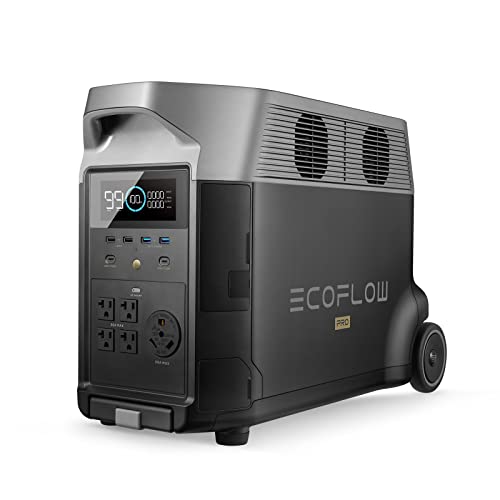
The EcoFlow DELTA Pro is a high-capacity battery power station with 3,600 watt-hours of LFP chemistry storage and 3,600W of continuous AC output (boostable to 4,500W via X-Boost). Its defining feature is modular expandability—you can daisy-chain up to two DELTA Pro units for 7,200W split-phase 240V output, and add extra batteries to reach a total capacity of 25kWh. This makes it the most scalable battery solution for homeowners who want silent, emissions-free backup that can grow with their needs.
Recharge speed is a standout: X-Stream technology delivers a full 0–100% charge in 1.8 hours from a 240V outlet, or 2.7 hours from a standard 120V wall outlet. Solar input of up to 1,600W can refill the unit in 2.8 hours with four 400W panels. The 15-port output array includes five 120V AC outlets, two 100W USB-C PD ports, two USB-A fast charge ports, and a 12V car outlet. The EcoFlow app (Wi-Fi and Bluetooth) provides real-time monitoring and customization of charge/discharge schedules, ideal for time-of-use energy management.
At 99 pounds, the DELTA Pro is heavy but manageable with the integrated handles. The LFP battery is rated for over 3,500 cycles to 80% capacity, translating to roughly 10 years of daily cycling. Users consistently praise its ability to power a refrigerator, freezer, coffee maker, and home oxygen concentrator simultaneously, with pass-through mode automatically switching to battery backup when grid power drops. The main trade-off is upfront cost, but the ability to claim a 30% Residential Clean Energy Tax Credit for qualified solar setups partially offsets the investment.
Why it’s great
- Scalable to 25kWh—grows with your energy needs
- Full recharge in under 2 hours from 240V wall outlet
- 2700W AC output is sufficient for large appliances
Good to know
- 99 lb weight requires deliberate placement
- Expansion batteries and combiner kit are significant additional costs
- Proprietary cable system; ordering replacements requires EcoFlow directly
9. AIVOLT VS12000411
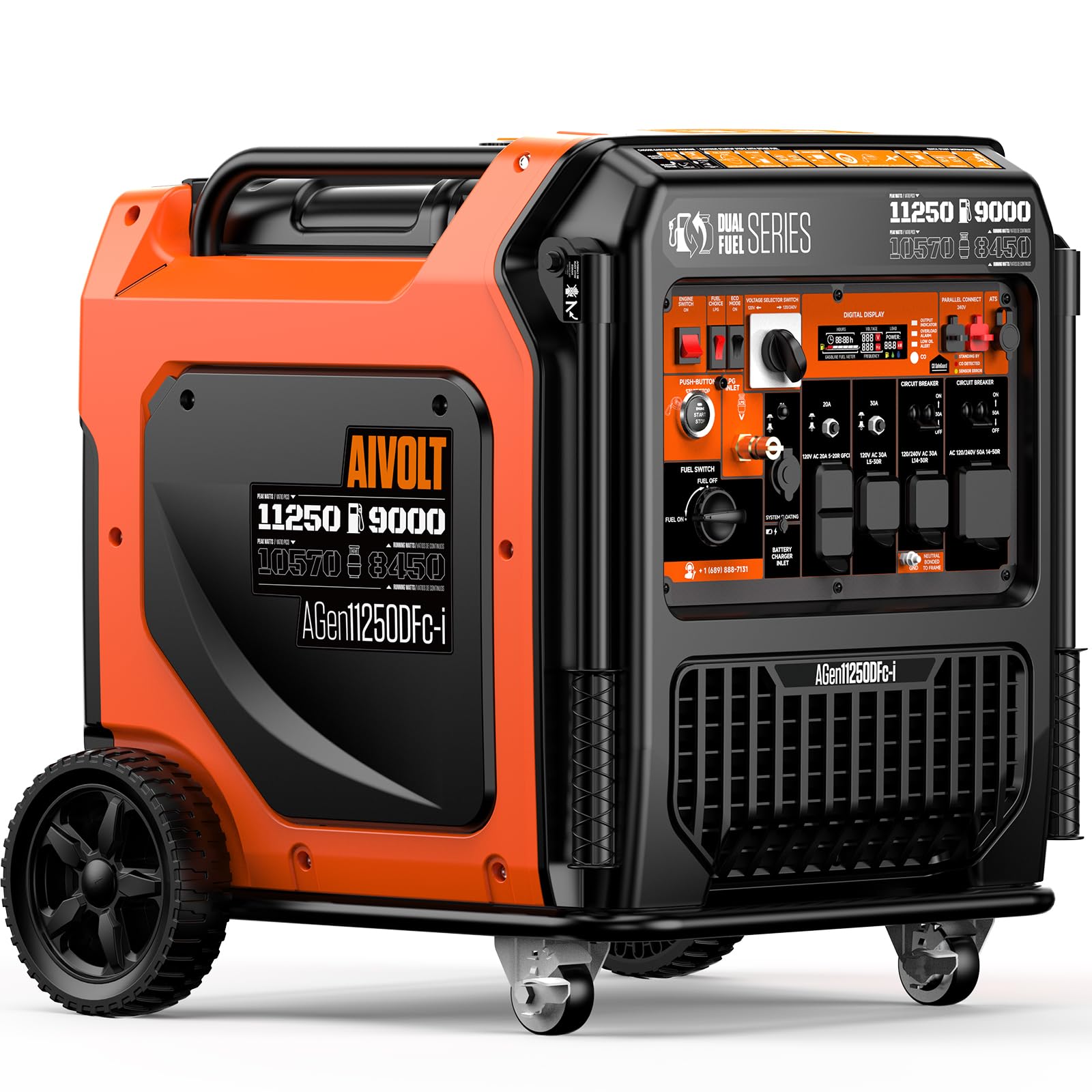
The AIVOLT VS12000411 is a dual-fuel inverter generator that produces 11,250 surge watts on gasoline (9,000 running) and 10,570 surge on propane (8,540 running), while maintaining a noise level the manufacturer claims at 57 dB from 23 feet. Inverter technology keeps THD low, making it safe for sensitive electronics like variable-speed mini-splits, medical equipment, and smart home hubs. The 50-amp 120/240V outlet is RV-ready and transfer switch compatible, and the unit is CARB compliant for sale in all 50 states including California.
Hot-switch capability lets you toggle between gas and propane without shutting down the engine—a critical feature when a propane tank runs dry and you need to pivot to gasoline instantly. The electric start with remote key fob is backed by a manual recoil pull for battery-dead scenarios. The digital display provides fuel level, voltage, frequency, and run hours at a glance, and the parallel-ready design allows a second VS12000411 to double output to over 22kW using a sold-separately kit.
Users running full food trucks confirm the unit handles multiple refrigeration units, warmers, a water heater, and a 24K BTU AC without issue on propane. However, there are quality-control notes: one unit shipped with a defective female receptacle on the inverter, and another reportedly failed after just one hour of runtime. AIVOLT’s support is based in China, which led to delays for some owners. The build quality feels premium with a thick orange steel frame, but the 110 lb weight and large footprint require a permanent placement plan.
Why it’s great
- Quiet inverter operation suitable for noise-sensitive neighborhoods
- CARB compliant—legal in all 50 states including California
- Hot-switch fuel selector without engine shutdown
Good to know
- Noise measured 72-73 dB at 5 ft—not 57 dB under load
- Customer support is China-based with slower response times
- Quality control varies; full testing before 30-day mark is advised
10. Champion 201407

The Champion 201407 is a high-end inverter generator that delivers 11,000 starting watts and 9,000 running watts with total harmonic distortion under 3%, making it one of the cleanest power sources in the portable generator segment. This sub-3% THD is critical for powering variable-speed mini-splits, modern refrigerators with inverter compressors, and home theater systems without triggering error codes or damaging control boards. The 459cc Champion engine includes cold start technology for reliable firing in sub-freezing temperatures, and the wireless remote key fob operates from up to 80 feet away.
Noise output is rated at 64 dBA from 23 feet, which is exceptionally quiet for a unit producing 9kW of continuous power—roughly half the noise of a comparable open-frame generator. The 5.5-gallon fuel tank delivers 10-15 hours of runtime at typical household loads (around 30% of capacity). The control panel features two GFCI 120V 20A household duplex outlets, a 120/240V 30A locking outlet, a 120/240V 37.5A outlet, and a 12V automotive-style port. Champion backs it with a 3-year limited warranty and free lifetime technical support, which users consistently rate highly for phone availability and knowledge.
Assembly includes installing the wheel kit, adding oil, and connecting the battery. Former Honda inverter owners switching to Champion report being pleasantly surprised by the build quality and quietness. The unit is heavy at 200 pounds, but the wheel kit and folding handle make it rollable. The main recurring complaint is the CO Shield sensor: in poorly ventilated semi-enclosed areas, even with reasonable airflow, the sensor may trigger a shutdown too aggressively—some users reported the generator cutting out even when placed outside the vehicle in a food trailer setup.
Why it’s great
- Under 3% THD—safe for all sensitive electronics including mini-splits
- 64 dB(A) noise rating is genuinely quiet for this power class
- Cold start technology fires reliably in freezing temperatures
Good to know
- CO Shield sensor can be overly sensitive in partially enclosed spaces
- Fuel gauge is hard to read in direct sunlight
- No included battery charging pigtail for maintenance
11. GROWATT HELIOS 3600 Duo
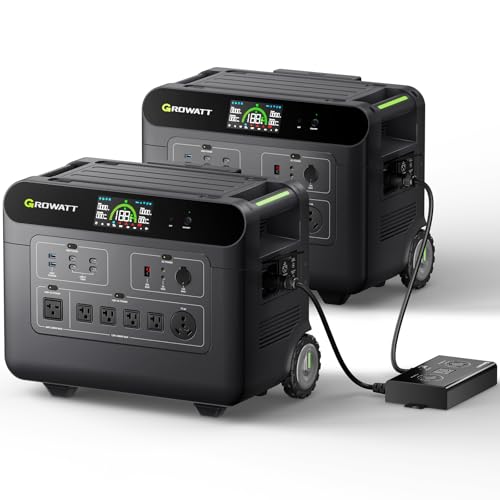
The GROWATT HELIOS 3600 Duo bundle includes two 3,600Wh/3,600W LFP power stations plus a split-phase combiner hub that outputs 240V/7,200W—enough to run a well pump, electric dryer, or large central AC. Each unit individually charges at up to 2,000W from solar panels and can be recharged from wall AC in about 1.5 hours. The total system is expandable to 36kWh with additional expansion batteries, providing up to 7 days of continuous home power for a typical household.
This is the only battery-based system on the list that natively supports 240V split-phase output without requiring a separate autotransformer. The <15ms EPS (Emergency Power Supply) switchover means that when the grid drops, your connected circuits transfer to battery power so quickly that computers and routers stay online. The app provides real-time monitoring and can optimize charging during off-peak utility hours. The LFP cells are rated for 4,000 cycles to 80% capacity—roughly 10 years of daily use—and the cold-start technology allows operation down to -22°F, making it viable for northern climates.
Each HELIOS 3600 unit weighs about 100 pounds, so the dual-unit system totals 200 pounds plus the combiner hub. The integrated wheels and handle make single-unit movement manageable, but the combined setup is best left in a fixed location. Some users report the Bluetooth/Wi-Fi app connectivity can be finicky—occasionally losing connection—but the units work perfectly fine without the app for basic on/off and charging. GROWATT’s US-based customer service has earned praise for swift replacements of shipping-damaged equipment, with one user receiving a full replacement within days.
Why it’s great
- Native 240V split-phase without bulky external transformers
- 4,000-cycle LFP battery rated for 10+ years of daily cycling
- Sub-15ms EPS switch keeps computers online during transfer
Good to know
- 200 lb total system weight for dual-unit configuration
- App connectivity (Bluetooth/Wi-Fi) can be unreliable
- 240V combiner mode disables individual unit EPS pass-through
12. Generac Guardian 10kW

The Generac Guardian 10kW is a permanently installed automatic standby generator that includes a 100-amp 16-circuit transfer switch, providing whole-home protection without manual intervention. When utility power fails, the unit detects the outage within seconds, starts automatically, and transfers your connected circuits to generator power within 30 seconds. It runs on natural gas or liquid propane from your home’s existing gas line, eliminating the need to store and refuel with gasoline—a major convenience for multi-day outages.
True Power Technology delivers clean electricity with less than 5% total harmonic distortion, safe for sensitive electronics. The G-Force 400 series engine is purpose-built for Generac and runs quieter and more efficiently than typical portable engines. The Mobile Link Wi-Fi connectivity allows remote monitoring of generator status, maintenance alerts, and historical runtime data from anywhere via the Generac app. The 10kW rating (41.7 amps at 240V) is sufficient to power a typical 2,000-3,000 square foot home’s essential circuits—lighting, refrigerator, furnace blower, well pump, and a few general-purpose circuits.
Installation requires a certified electrician and plumber, and the total cost often doubles the generator price when factoring in concrete pad, gas line connection, electrical wiring, and permit fees. The unit measures 48 x 25 x 29 inches and weighs 338 pounds, so it must be placed on a level outdoor pad at least 5 feet from windows and doors. Generac includes a 5-year limited warranty, which is among the longest in the standby generator market. One potential pitfall: if purchased through third-party sellers like Amazon, some warranty claims have been complicated by questions about the seller’s authorized status—buying from a local Generac dealer may be safer.
Why it’s great
- True automatic operation—no manual starting or fuel handling
- Runs on natural gas for unlimited runtime during outages
- 5-year warranty is best-in-class for standby generators
Good to know
- Professional installation can double the total investment
- 10kW may not cover larger homes with 4+ ton AC units
- Mobile Link Wi-Fi setup can be finicky; some users never get it working
13. Generac Guardian 26kW
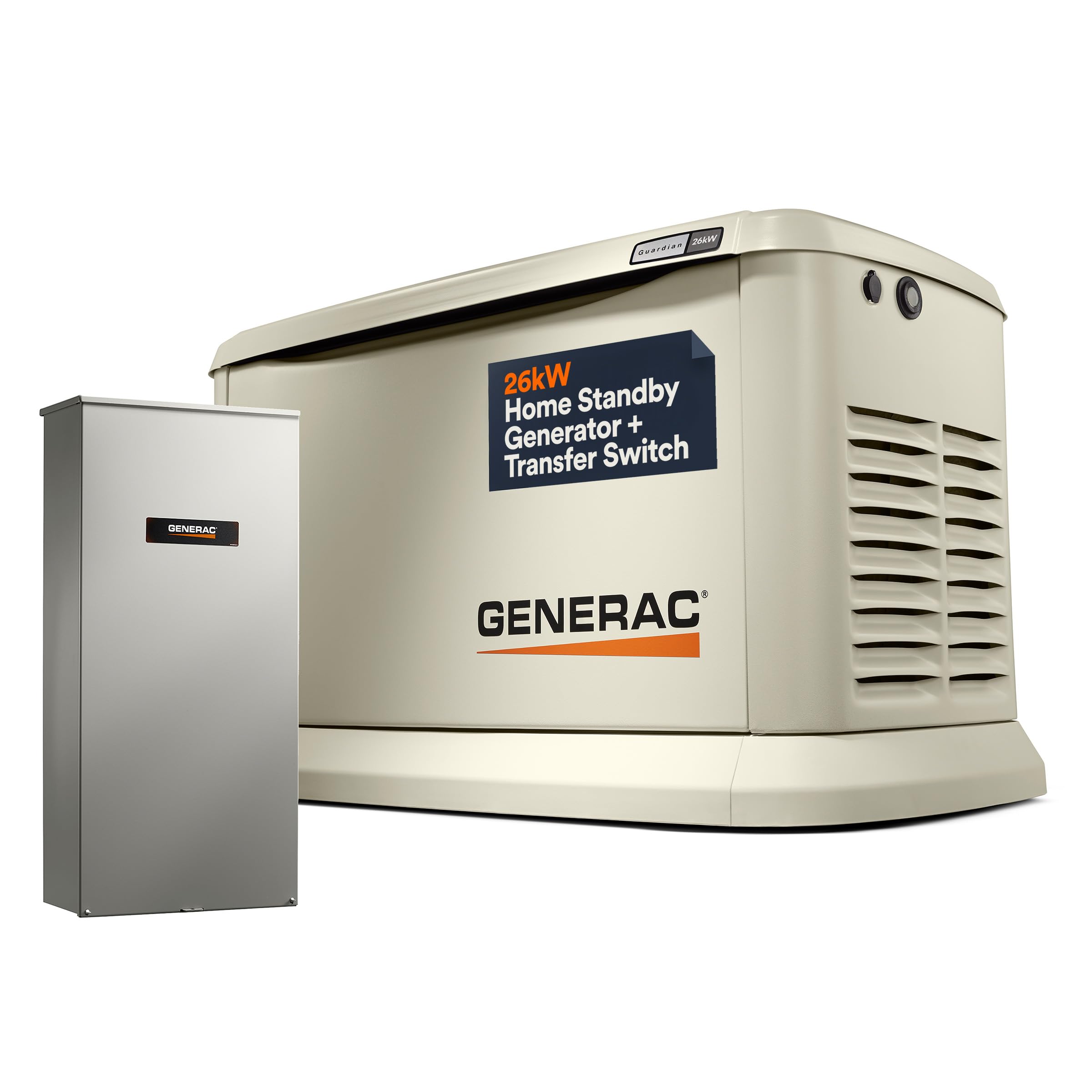
The Generac Guardian 26kW is the most powerful automatic standby generator on this list, with a 999cc G-Force 1000 series engine producing 26,000 watts on natural gas or liquid propane. It includes a 200-amp automatic transfer switch, meaning it can handle the full electrical load of almost any residential home—including multiple central AC units, electric oven, water heater, well pump, and all lighting circuits simultaneously. This is the solution for homeowners who want zero compromise: when the grid goes down, life continues exactly as normal.
True Power Technology keeps harmonic distortion under 5%, which is adequate for most household electronics, though users with highly sensitive audio/video gear may still want to add a dedicated UPS for critical components. The Mobile Link Wi-Fi module provides remote status monitoring, scheduled exercise cycles, and push notifications if the unit encounters a fault. The fully enclosed aluminum housing is designed for permanent outdoor installation and is significantly quieter than open-frame portable units—noise levels are similar to a window air conditioner from 50 feet away.
Professional installation is mandatory and complex: the generator alone weighs 518 pounds, requires a large concrete pad, a dedicated natural gas line (often requiring meter upgrade), and the 200-amp transfer switch needs to be wired into the main panel by a licensed electrician. The total installed cost typically ranges from to depending on local labor rates and gas line runs. Generac’s 5-year limited warranty is reassuring for a major investment, but purchasing through an authorized local dealer is strongly recommended to avoid warranty complications. Users who have installed this unit during outages report running their entire home—including 4-ton ACs and electric ovens—without any sense that the generator is straining.
Why it’s great
- 26,000W capacity handles entire home with all appliances running
- 200A transfer switch eliminates need for load shedding
- 5-year warranty and nationwide service network
Good to know
- Total installed cost can exceed after permits and labor
- 518 lb unit requires a reinforced concrete pad
- Natural gas consumption may require meter upgrade at additional expense
FAQ
How do I size a generator for my home’s well pump and AC?
Can I run a generator in my garage during a storm?
What is the advantage of a tri-fuel generator over dual-fuel?
How does an automatic standby generator differ from a portable unit?
Is a battery power station better than a gas generator for home backup?
Final Thoughts: The Verdict
For most users, the best residential backup generators winner is the Westinghouse WGen5300c because it delivers a practical power range, reliable remote electric start, and critical CO safety technology at a price that doesn’t overcomplicate the decision. If you want dual-fuel flexibility and inverter-clean power for electronics and EV charging, grab the WEN DF680iX. And for permanent, automatic whole-home protection with no manual operation required, nothing beats the Generac Guardian 10kW standby system.