
Our readers keep the lights on and my morning glass full of iced black tea. As an Amazon Associate, I earn from qualifying purchases.
Specs are compiled from manufacturer listings and verified buyer reviews and can change over time — please confirm the key details on the product page before buying.
If a bolt sits behind a brake caliper, under an intake manifold, or flat against a frame rail, a standard impact wrench simply will not reach it. A right angle impact wrench turns the socket 90 degrees, so the head slips into that gap while the handle stays in open air. The pick that suits most people is the Astro Pneumatic Tool 1832 ONYX — the crowd favorite at 4.5+ stars across 600+ ratings — because it packs 415 ft-lb of torque (twisting force) into a body just 3.46 inches long.
I’m Min — the founder and writer behind Gadgets Feed. This guide is built by comparing the manufacturers’ published specifications and the patterns across verified customer reviews, so you get each pick’s real strengths and trade-offs instead of marketing spin.
Below you will find cordless and pneumatic options sorted by what they actually do well, plus the numbers that decide whether one fits your job. Every pick here is a genuine 90-degree tool, so the only real question is which right angle impact wrench matches your garage, your air supply, and the bolts you fight most.
Our Picks at a Glance


How To Choose The Best Right Angle Impact Wrench
The whole point of this tool is fit, not raw power. A 900 ft-lb monster is useless if its head will not clear a sway bar link. So start with the gap you actually work in, then pick the torque to match.
Head depth decides what you can reach
A head profile under three inches slips between a caliper and a knuckle; a fat head gets stuck outside the gap. Some models here list a slim head around 2.2 inches, which is the kind of figure that lets you work on exhaust bolts and engine mounts without dropping the subframe. Check that number before you look at torque at all.
Breakaway torque versus working torque
Breakaway torque is the force needed to crack a rusted nut loose; fastening torque is what you use to tighten. The torque figure printed on the box is usually the best-case one. A tool rated at 415 ft-lb in the tightest body here is a different animal from a 135 ft-lb compact, and each suits a different job.
Cordless battery or shop air
A cordless model runs on a battery pack — listed in volts and amp-hours — and lets you work anywhere without a hose. A pneumatic model is fed by compressed air and typically lists the air pressure it needs, often around 90 PSI, plus an average air consumption figure. If your compressor is small, that consumption number is the one that will disappoint you.
Quick Comparison
| Model | Best For | Torque | Head Type | Power Source | Amazon |
|---|---|---|---|---|---|
| Astro Pneumatic Tool 1832 ONYX 1/2″ Nano Angle★ Best Overall | Tight-gap reach with serious power | 415 ft-lb | Fixed 90-degree, 3.46 in | Pneumatic | Amazon |
| Alloyman 20V Brushless Right Angle WrenchBest Value | Slim cordless access on a budget | 207 ft-lb | Fixed 90-degree, 2.2 in | 20V cordless | Amazon |
| Milwaukee 2565P-20 M12 FUEL 1/2″Heaviest Hitter | Maximum cordless torque | 220 ft-lb | Fixed, 2.8 in head | M12 cordless (bare tool) | Amazon |
| AOBEN 1/2″ Angle Wrench Brushless | Lug nuts and DIY garage work | 135 ft-lb | 90-degree angle head | 20V cordless | Amazon |
| Astro Tool 1833 3/8″ Nano Flex-Head | Flexible reach into odd angles | 400 ft-lb | 180-degree flex, 3.34 in | Pneumatic | Amazon |
| Milwaukee 2564-20 M12 FUEL 3/8″ | All-round cordless engine work | 220 ft-lb | Fixed 90-degree, 3/8 in | M12 cordless (bare tool) | Amazon |
| Chicago Pneumatic CP7737 1/2″ | Air-powered shop torque | 220 ft-lb | Fixed square angle | Pneumatic | Amazon |
| Milwaukee 2668-20 M18 3/8″ | Precision control on smaller fasteners | 60 ft-lb | Fixed square, 3/8 in | M18 cordless (bare tool) | Amazon |
| XIIW 1/2″ Angle Impact Wrench | Big torque from a shop compressor | 910 ft-lb | Floating angle head, 6.3 in handle | Pneumatic | Amazon |
| Alloy Power 20V Brushless Right Angle | Budget cordless kit with two batteries | 207 ft-lb | Fixed 90-degree, 2.2 in | 20V cordless | Amazon |
| Ingersoll Rand W5350 1/2″ | Reactionless control on large hardware | 180 ft-lb | Fixed, 2.2 in angle head | 20V cordless (bare tool) | Amazon |
In‑Depth Reviews
1. Astro Pneumatic Tool 1832 ONYX 1/2″ Nano Angle Impact Wrench – 415ft/lb
Our pick — 4.5+★ from 600+ verified ratings; the strongest balance of quality and price.
The shop-air answer that shrinks a serious impact wrench down to pocket-sized reach.
Picture a 1/2-inch drive, 415 ft-lb pneumatic wrench squeezed into a body that measures 3.46 inches end to end. That is the 1832, and the numbers matter because 3.46 inches is short enough to hook the head behind a caliper without pulling the wheel off the hub. It also undercuts the 17.25-inch Ingersoll Rand W5350 by roughly 4.5x in body length, at least on paper.
On raw torque it out-punches every cordless pick here, and all but the 910 ft-lb XIIW. Against the Alloy Power 20V cordless at 207 ft-lb, the Astro’s 415 ft-lb is roughly double the nut-busting muscle — a 4.4x gap in the listed figures. Owners mention that torque first, because it cracks suspension and bumper bolts that a compact cordless flinches at.
Stay honest about the trade-off: this is a pneumatic tool, so you need an air supply and a hose to run it. Durability feedback is mixed, so keep the air supply clean and don’t over-grease the head. It is also only as good as the compressor behind it.
What wins people over
- 415 ft-lb of breakaway power in a 3.46-inch body — far shorter than the 17-inch Ingersoll Rand W5350
- Chrome vanadium steel construction and round head in a 2 lb package you can pass around
- Fits where an inline wrench simply cannot — behind calipers, tight engine bays, cramped suspension
Where it asks a favour
- Pneumatic only — no hose and compressor means no work
- Long-term durability draws divided feedback from the review pages
- Not a precision tool for small fasteners; it is built for stubborn bolts
Reach for it if: your compressor is up to the job and the bolts you fight live in gaps a normal wrench can’t enter.
Skip past if: you work away from a hose — you will need a cordless model instead.
2. Alloyman 20V Brushless Right Angle Impact Wrench, 1/2″
A slim 2.2-inch head and a pair of batteries make this the cordless starter kit for tight engine bays.
The first thing to weigh is access. That 2.2-inch ultra-slim head is paired with a 15.5-inch reach, which is the profile that lets you slide in along an exhaust pipe or reach a suspension bolt without removing anything big. It is a shorter footprint than the Astro Tool 1833’s 3.34-inch flex body — though the Alloyman trades the flex joint for a fixed 90-degree head.
On the power side it lists 207 ft-lb at 0–2000 RPM and 0–2500 IPM, with a two-speed control that drops to 133 ft-lb in low mode for gentler fastening. The brushless motor (one with no carbon brushes to wear out) is there to run cooler and keep torque steady over repeated jobs. A built-in LED makes dark under-hood work less of a guess.
The honest catch is that the kit is only as good as its cells. It ships with two 2.0Ah batteries, and buyers report mixed feelings on weight and long-term durability. Treat the breakaway torque with a grain of salt on stubborn hardware — 207 ft-lb is a working figure, not a miracle.
The smart buy when: you want cordless freedom plus a spare battery without going to a pro-tier brand.
Think twice when: your bolts are rusted solid — this is a maintenance and assembly tool, not a last-resort breaker.
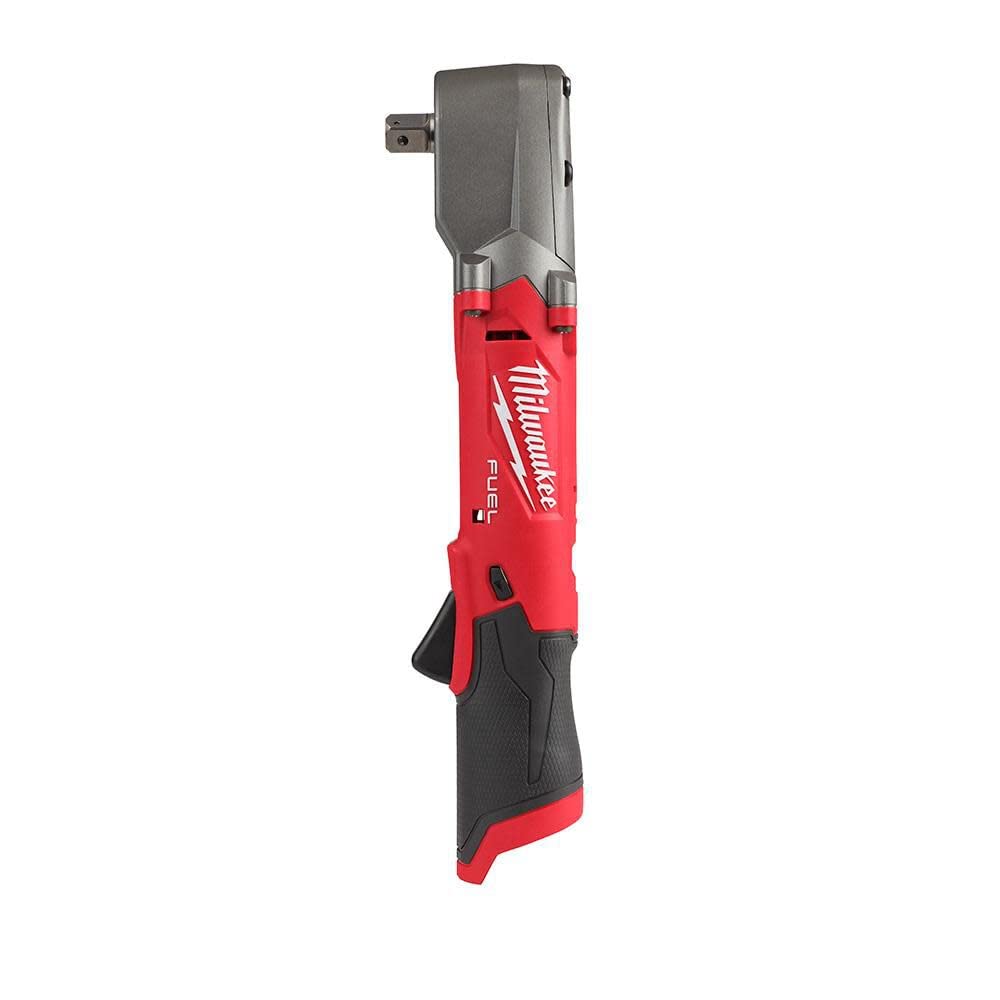
3. Milwaukee 2565P-20 M12 FUEL 1/2″ Right Angle Impact Wrench
Four drive modes, a 2.8-inch head, and 220 ft-lb from a pack small enough to tuck under the hood.
What sets this apart from the other cordless picks is control. The 4-Mode Drive Control includes an auto shut-off that stops at no more than 15 ft-lb, so you don’t crush a delicate fastener, plus a bolt-removal mode that drops the RPMs once the bolt is free. It is the same 220 ft-lb as the 3/8-inch 2564, but with the 1/2-inch drive and a pin detent that holds sockets firm.
That 2.8-inch head profile and a 14.17-inch body are built around hard-to-reach spaces, and the REDLINK PLUS electronics (Milwaukee’s circuitry that watches for overload and overheating) is why the tool stays lively on long jobs. There is an LED for the work area, too.
One thing to note up front: this is a bare tool. You need your own M12 battery and charger, so if you are not already inside that battery platform, factor in the extra kit. It is also the heaviest spec of the M12 angle range at 3.4 lb, which you notice working overhead.
Where it shines: the auto shut-off mode makes this a genuinely careful tool for engine and trim assemblies, not just a bolt-buster.
The fine print: bare tool only — no battery, no charger, and you are buying into a specific battery family.
Made for: the buyer already on the M12 battery line who wants maximum angle-wrench torque with fine control.
Less suited to: anyone starting from nothing and not wanting to buy a battery and charger separately.
4. Astro Tool 1833 3/8″ Nano Flex-Head Angle Impact Wrench – 400ft/lb

The one that bends to your bolt, not the other way around.
A flex head is the feature that earns this pick its slot. The head swivels 180 degrees and the handle 360 degrees, so you can angle the socket into awkward spots — brake caliper bolts being the obvious example. The 3.34-inch body is shorter even than the fixed-head Astro 1832 at 3.46 inches, and its 400 ft-lb breakaway torque sits in the same league as the top pick.
It is a pneumatic tool, driven by a twin hammer mechanism and a dual air intake motor that is meant to add power without adding bulk. The aluminium body keeps it manageable at 3.5 lb. Owners praise its fit into tight spots most, which is exactly what the 180-degree flex head is for.
Here is the fair warning: some buyers find the head larger than expected once it is in their hand, and the flex joint is one more moving part to look after. Power gets mixed reviews — plenty for most jobs, but not the biggest in this list. You still need a compressor behind it.
The flex-head payoff
- 180-degree flex head plus 360-degree swivel handle reaches angles a fixed head can’t
- 400 ft-lb in a 3.34-inch body — the shortest listed here
- Comfortable fit into brake and caliper jobs, per the review consensus
What you live with
- Needs an air supply — pneumatic only, no battery option
- Some owners say the head is bulkier than the photos suggest
- Power is not top of this list; it wins on articulation, not brute force
Choose it for: caliper, suspension, and any job where a bent neck saves you disassembly.
Rule it out if: you need the simplest fixed head and the most torque for the money.
5. AOBEN 1/2″ Angle Wrench Brushless for Auto Repair & Tight Space

A no-hose, two-battery kit that covers lug nuts and garage projects for the weekend wrencher.
At 135 ft-lb this is the modest one on paper, yet buyers talk up its torque more than any other trait. The reason is that 135 ft-lb is plenty to spin lug nuts and most routine fasteners, and the variable speed trigger (0–2250 RPM) gives you room to ease in rather than snap a stud. The 90-degree head does the tight-space work a standard wrench can’t. The kit itself is generous: two 2.0Ah batteries, six deep sockets, and a carry case.
The brushless motor runs cooler and needs less upkeep than a brushed one, and the LED light helps when the workspace is dark. Owners mention surprising power for a 135 ft-lb tool, with one review citing stubborn F250 bolts. Battery life is where opinions split, so a second pack is genuinely useful.
Why it sells: the two-battery, six-socket, carry-case bundle is the complete DIY kit, and the torque punches above 135 ft-lb expectations.
How to read it honestly: this is not a heavy-duty breaker — treat battery life as the limit and keep a spare charged.
The right call for: home mechanics who want a ready-to-go cordless kit with sockets and packs in the box.
Not for: professional heavy hardware where double the torque is the minimum.
6. Alloy Power 20V Brushless Right Angle Wrench, 1/2″ Ratchet
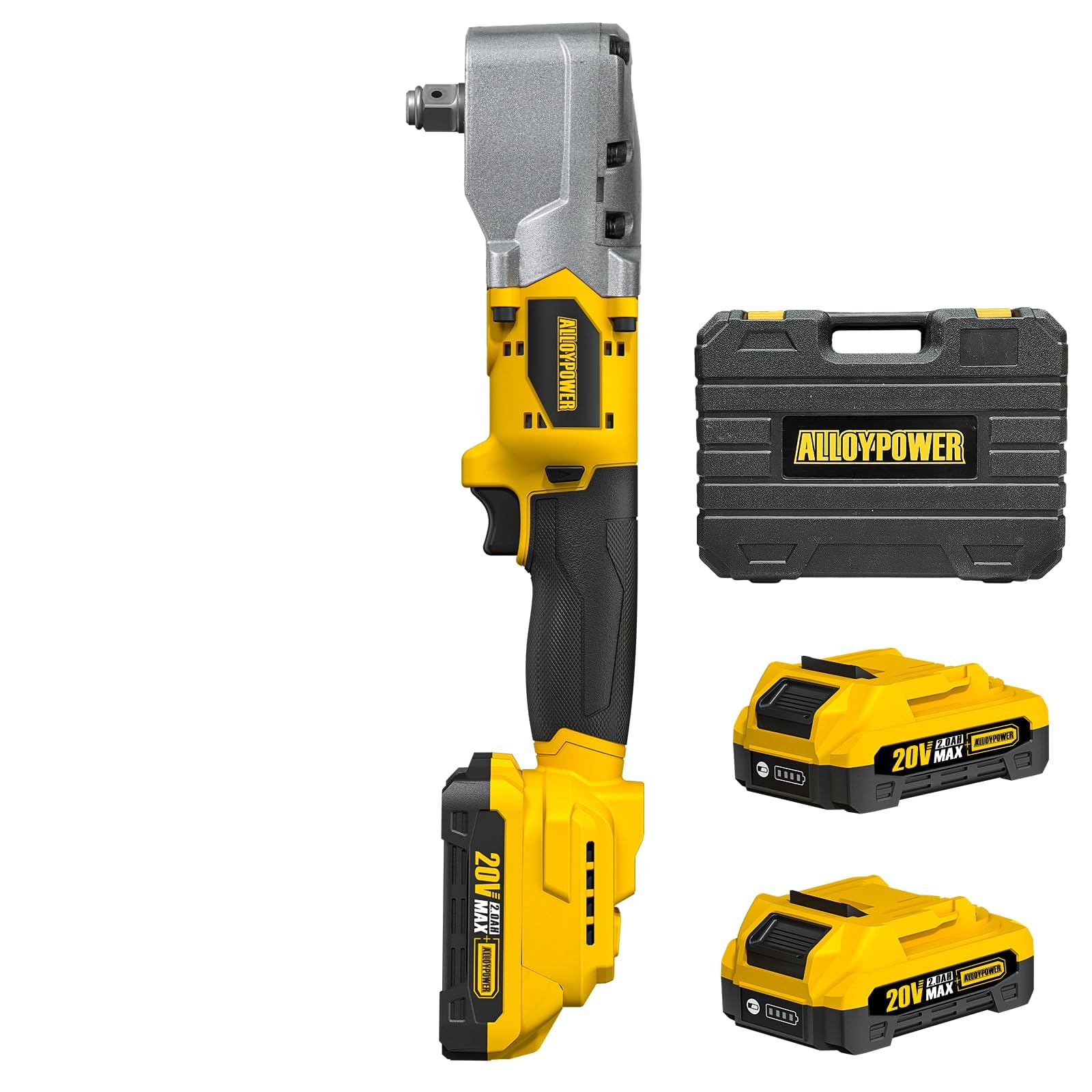
Budget-friendly cordless access for the bolts hiding under a hood.
The 2.2-inch slim head and 15.5-inch reach are identical in spirit to the Alloyman above, and the two make the same 207 ft-lb claim. The difference is the kit story and the confidence behind it. It comes with two 20V 2.0Ah batteries, a charger, and a hard case, and it pairs with the Alloy Power cordless line — a 1-year warranty backs it.
What buyers tend to like is the value: a full cordless angle kit for the tightest outlay here. The two-speed control lets you choose between measured and maximum output. Expect it to work fine for suspension and engine-bay fasteners when the bolts are clean-ish.
The gripe worth knowing: durability reports are split, with some ownership noting a unit that quit after a few projects. Weight also gets mixed feedback. That is the honest limit of a budget brushless — treat it as a light-use tool, not something you abuse daily.
Worth considering if: budget is the head-of-the-list concern and you want maximum included kit for the outlay.
Look elsewhere if: you run a shop and put tools through daily punishment.
7. Milwaukee 2564-20 M12 FUEL 3/8″ Right Angle Impact Wrench

The 3/8-inch all-rounder that engine bay hands reach for first.
At 220 ft-lb this is one of the strongest cordless models in the list, and it weighs just 2.83 lb — light enough to hold one-handed overhead for a while. It runs on Milwaukee’s M12 FUEL lithium-ion packs and is a bare tool, so the battery is on you. The 90-degree 3/8-inch head is the tight-space workhorse here. The M12 line is a huge advantage if you already own packs; if you don’t, the entry cost climbs.
Owners rate performance first, calling it a pro-grade tool that also suits home engine work. It handles weekend under-hood work and pro jobs on the same 220 ft-lb M12 pack.
What you should weigh: it is a bare tool, and some buyers find the power has limits against very stubborn hardware. As with any 3/8-inch drive, the smaller anvil is a ceiling if you are fighting 1/2-inch-class bolts.
The engine-bay case
- 220 ft-lb in a lightweight 2.83 lb body — easy to hold in tight spots
- Hardened alloy steel construction and M12 FUEL battery platform
- Regularly reviewed as strong on both DIY and professional engine work
The catches
- Bare tool only — battery and charger sold separately
- 3/8-inch anvil caps it against 1/2-inch-class stubborn nuts
- Power reported as mixed on the hardest fasteners
The pick for: M12 owners who want one angle wrench for engine and general repair work.
Keep walking if: you need 1/2-inch drive or have no Milwaukee packs yet.
8. Chicago Pneumatic CP7737 1/2″ Angle Impact Wrench

A 9000 RPM air tool with one-hand forward and reverse — control for the disciplined tech.
The numbers behind this one are a working speed of 9000 RPM and 220 ft-lb of maximum torque in reverse, with a direct-drive single-hammer mechanism. The three forward positions and one reverse position let you stage the power rather than slam it on. A single-handed forward–reverse switch keeps your other hand on the socket, which matters when you are upside down under a dash or a frame. The aluminium body keeps the weight to 3 lb.
Air supply is the whole ballgame here. It is a pneumatic wrench, so the pressure and volume from your compressor decide whether it hits its rating. The direct-drive transmission is simpler than a twin hammer, which some mechanics prefer for predictable behaviour.
The honest limit: limited buying feedback so far, so you lean on the spec sheet and the brand’s 1-year warranty. If your air setup is modest, verify it can feed the tool’s pressure needs before committing.
Best in a well-fed shop: the direct-drive, 9000 RPM character rewards a proper compressor and a careful hand.
Worth knowing before you buy: it is air only, and the compressor you already own is half the purchase decision.
Ideal for: air-tool users who want staged power, high RPM, and one-hand direction changes.
Not the fit for: cordless-first buyers or anyone without shop air.
9. Ingersoll Rand W5350 1/2″ Right-Angle Cordless Impact Wrench

A reactionless 180 ft-lb cordless built for MRO work and long shifts away from a socket.
The defining spec here is not torque but the way it handles torque: a finely tuned impact mechanism and motor produce 180 ft-lb of reactionless force, which means the tool doesn’t try to spin your wrist when the bolt lets go. The 2.2-inch angle head is the access story, and a variable-speed trigger goes up to 1,850 RPM. There is a one-hand forward/reverse switch, and a steel-lined aluminium hammer case with a serviceable head — enough to repair rather than replace.
Look at the dimensions before cheerleading: 4.6 lb with the battery fitted and 17.25 inches long. That is the exact trade-off against the Astro 1832 at 3.46 inches — the Ingersoll trades reach for a cordless body, and it’s a 4.5x gap in length by those figures. Some buyers will find it too long for deep under-dash work.
Two things to know. First, it runs on a 20V inline battery design that keeps the centre of gravity low but needs the proprietary pack. Second, this listing is the tool only, with no battery or charger. Add those costs before you commit.
Suits the tech who: needs cordless, reactionless control on larger hardware and values a serviceable head.
Better avoided if: you need the shortest possible reach or are not prepared to buy batteries separately.
10. XIIW 1/2” Angle Impact Wrench, 910 ft-lbs Torque

A pneumatic angle wrench with more punch than almost anything else here.
If raw torque is the whole brief, this is the outlier: 910 ft-lb max with a free speed of 7500 RPM and a twin hammer mechanism. Compare that to the 207 ft-lb of the Alloy Power cordless and you are looking at a 4.4x gap in the listed figures. Nothing else on this page states torque in the same bracket. It is air-powered and needs 90 PSI minimum and an average air consumption of 5 cfm to work well. A 6.3-inch extended handle and rubber housing keep it controllable, and the muffled exhaust keeps noise down.
The forward/reverse knob lets you ease back on torque to avoid over-tightening, and the free-speed trigger gives you fine control on small jobs. The red flag is the weight: 1.84 kg (about 4 lb) in a compact body is heavy for overhead work. Power and strength also draw mixed reports — some find it a beast, others say it underdelivers on stubborn hardware.
The power case
- 910 ft-lb of max torque — 4.4x the 207 ft-lb of the Alloy Power cordless
- 7500 RPM twin hammer for fast loosening on heavy hardware
- Adjustable forward/reverse knob to avoid over-torquing smaller bolts
The reality check
- Pneumatic only — needs 90 PSI and 5 cfm of air to deliver its rating
- Around 4 lb in the hand is heavy overhead
- Mixed feedback on real-world power; the box number is not always what you feel
A star pick when: you have a strong compressor and regularly face 1/2-inch hardware that others can’t shift.
Keep in check with: small fasteners — this is a heavy hitter, not a delicate one.
11. Milwaukee 2668-20 M18 2-Speed 3/8″ Right Angle Impact Wrench Bare

The gentle giant for fasteners that hate too much twist.
At 60 ft-lb this is the lowest rated torque in the list — and that is the point. It is a 2-speed 3/8-inch right-angle wrench for jobs where a 220 ft-lb tool would round a bolt. The M18 platform means big-battery compatibility if you already own it. A 12.2-inch length and 2.6 lb make it one of the shorter M18 options. The 3/8-inch square drive fits common sockets.
The catch is the same as its sibling: it is a bare tool with no battery or charger. Compared to the higher-torque M12 models, power is the trade-off; you are paying for control and holdability. The product listing itself is thin on detail, so it is a straightforward buy on the strength of the brand and platform.
Who it is for: M18 owners who need a low-torque angle wrench for delicate, precise fastening.
Why the lower torque matters: 60 ft-lb is a safety ceiling on small fasteners — it won’t overpower what you are working on.
Buy it when: you are on M18 and need a precise, low-torque angle wrench for trim, small hardware, or assembly.
Not the one if: you need to break loose rusted bolts — 60 ft-lb will not cut it.
Understanding the Specs
Torque (ft-lb)
Torque is twisting force, measured in foot-pounds — think of it as how hard the tool can turn a stuck bolt. Breakaway torque is the force to crack a rusted nut loose; fastening torque is for tightening. A small 135 ft-lb wrench covers lug nuts and light repairs, while 400 ft-lb and above handles heavy suspension and machinery. Match the number to your bolts, not the marketing.
Head profile and reach
The right angle head is 90 degrees to the handle, which is what lets it slide into a gap an inline wrench can’t enter. A slim head under three inches reaches between a caliper and a knuckle; the body length decides how deep you can go. Flex heads add a swivel joint so you can angle the socket into odd spots, at the cost of one more moving part.
Battery voltage and amp-hours
Cordless models are rated in volts (the power of the battery) and amp-hours (capacity — how long it runs). A 20V pack with 2.0Ah holds a usable charge for a few tasks, while two packs back-to-back let you keep working. Higher voltage generally means more available power, but the trade-off is weight in your hand.
Air pressure and consumption
Pneumatic wrenches are fed by compressed air and list the pressure they need (often around 90 PSI) plus an average air consumption figure in cfm. A small compressor may not keep up, and the wrench will feel weaker than its rating. If you own shop air, check both figures before buying.
FAQ
What is the difference between a right angle impact wrench and a standard impact wrench?
Will a 3/8-inch right angle impact wrench loosen lug nuts?
Do I need special air tools to run a pneumatic angle wrench?
How long does a cordless right angle impact wrench run on one battery?
Can a right angle impact wrench over-tighten or strip a bolt?
Is a flex-head right angle wrench better than a fixed head?
What drive size should I pick between 3/8-inch and 1/2-inch?
Do bare tool listings include a battery and charger?
How much torque do I need for brake caliper and suspension bolts?
Can I use a right angle impact wrench for non-automotive jobs?
Final Thoughts: The Verdict
For most people chasing the best right angle impact wrench, the Astro Pneumatic Tool 1832 ONYX is the one to buy — it puts 415 ft-lb into a body just 3.46 inches long, which is the combination that actually wins tight-gap jobs. If you want cordless freedom with two batteries in the box, the Alloyman 20V Brushless is the value answer at 207 ft-lb and a 2.2-inch slim head. And for maximum cordless torque with fine control from an M12 pack you already own, reach for the Milwaukee 2565P-20.
Whichever you pick, buy on the torque and head-depth figures that match your bolts — the crowd has already done the hard part, and the Astro’s standing at 4.5+ stars shows it keeps earning its place in working toolboxes.
How We Picked
We do not accept paid placement. Every pick is matched to a real buyer and a real use-case; we do not hands-on test units.
Sources & Methodology
Specifications: manufacturer listings and product documentation. Review insights: verified customer reviews, as of November 2026. Pricing: not shown on this page (it changes often); check the current price via the retailer link.
As an Amazon Associate, Gadgets Feed earns from qualifying purchases. This does not affect which products we feature.