
Modern smoke alarm detectors have evolved beyond simple ionization sensors and disposable 9V batteries, now offering 10-year sealed lithium power supplies, photoelectric precision sensors that ignore burnt toast, and wireless interconnectivity that sounds every unit when one detects danger. Choosing the right one means navigating sensor types, power sources, and safety certifications that directly impact your family’s safety.
I’m Min — the co-founder and writer behind Gadgets Feed. I’ve spent countless hours analyzing technical specifications, customer feedback, and the latest UL standards across dozens of smoke and CO detector models to separate marketing claims from real-world performance.
After comparing sensor technologies, battery longevity claims, and interconnectivity features across the leading brands, this guide will help you identify the best smoke alarm detector to protect your home without driving you crazy with false alarms.
How To Choose The Best Smoke Alarm Detector
Not all smoke alarms are created equal. The right choice depends on your home’s electrical setup, your tolerance for false alarms, and whether you need carbon monoxide detection. Focus on these four factors to narrow the field.
Sensor Type: Ionization vs. Photoelectric vs. Dual
Ionization sensors respond faster to flaming fires but are notoriously prone to false alarms from cooking. Photoelectric sensors detect smoldering fires earlier and cut nuisance alarms significantly—most modern units, including First Alert’s Precision Detection and Kidde’s Enhanced Sensing, use photoelectric technology. Dual-sensor units combine both but are less common in the mid-range tier.
Power Source: Hardwired vs. Battery vs. Sealed Lithium
Hardwired detectors with battery backup (like the First Alert SMI105-AC) are required in many building codes and allow interconnect without wireless pairing. Battery-only units offer flexibility for older homes. The clear winner for convenience is a 10-year sealed lithium battery—you install it once, test it weekly, and replace the entire unit after a decade with zero battery swaps in between.
Interconnectivity: Wired vs. Wireless
Interconnected alarms mean when one unit detects smoke, every unit sounds—critical for alerting sleepers on a different floor. Hardwired interconnect requires running wires between units, while wireless RF interconnect (as seen in the X-Sense SC06-W) lets you link up to 18 units without rewiring, making it ideal for retrofit installations.
Quick Comparison
On smaller screens, swipe sideways to see the full table.
| Model | Category | Best For | Key Spec | Amazon |
|---|---|---|---|---|
| X-Sense SC06-W 3-Pack | Wireless Interconnected | Whole-home coverage without rewiring | Wireless RF interconnect up to 18 units | Amazon |
| First Alert BRK SMI105-AC 3-Pack | Hardwired + Battery Backup | Code-compliant wired homes | Hardwire interconnect + 10-year battery backup | Amazon |
| Kidde P3010B | Battery-Only Standalone | Simple battery-powered replacement | 10-year sealed lithium photoelectric sensor | Amazon |
| First Alert SMCO100 3-Pack | Battery Combo (Smoke + CO) | Dual protection, multi-pack value | Two-in-one smoke + carbon monoxide detection | Amazon |
| Kidde Smoke & CO Detector 2-Pack | Voice Alert Combo | Clear voice warnings for fire vs. CO | Voice alerts say “Fire!” or “Warning! Carbon Monoxide!” | Amazon |
| First Alert SMICO100 | Battery Combo (Individual) | Affordable single-unit smoke + CO | Precision Detection, 9V battery, 10-year warranty | Amazon |
| First Alert SMI105-AC (Single) | Hardwired Entry-Level | Single hardwired unit with backup | Precision Detection, hardwire + 10-year battery backup | Amazon |
In‑Depth Reviews
1. X-Sense SC06-W 3-Pack
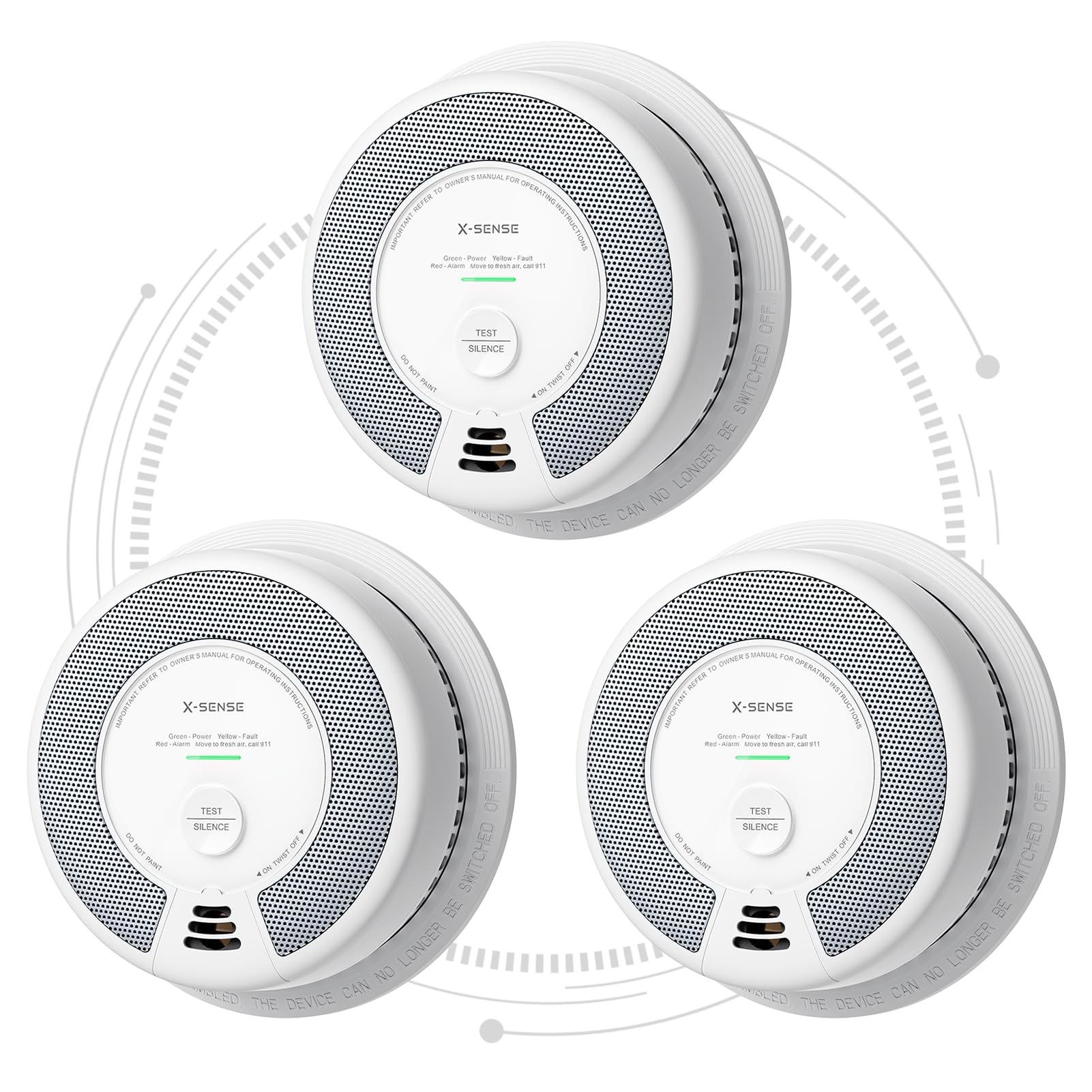
The X-Sense SC06-W delivers the most practical interconnect solution for homes without hardwiring. Its wireless RF interconnect links up to 18 Link+ devices, so when the basement unit detects smoke, every alarm on every floor sounds—no electrician required. Each unit packs a 10-year sealed lithium battery and dual photoelectric + electrochemical sensors for smoke and CO detection, certified to UL 217 and UL 2034 standards.
Installation is genuinely simple: mount the provided bracket, twist the alarm on, and pair units by holding the test button for five seconds. The 85 dB alarm is loud enough to wake heavy sleepers. The heat-resistant PC enclosure ensures durability in garages or utility rooms. Users report flawless interconnect range across three-story homes with no pairing dropouts.
The 3-pack covers most single-family homes, and the 5-year warranty plus lifetime technical support adds confidence. The only catch is the bundled units may require manual pairing out of the box, which takes about a minute per pair. If you want whole-home coverage without rewiring, this is the package to beat.
Why it’s great
- Reliable wireless interconnect up to 18 units, no hardwiring
- 10-year sealed lithium battery eliminates all battery changes
- Combined smoke and carbon monoxide detection in one device
- Loud 85 dB alarm with clear test/silence button
Good to know
- Units may require manual pairing, not pre-paired as advertised
- No adapter bracket included for existing junction boxes
- Higher per-unit cost compared to basic standalone detectors
2. First Alert BRK SMI105-AC 3-Pack

The 3-pack version of First Alert’s hardwired SMI105-AC is the smart choice for homeowners with existing wired interconnect wiring. Each unit connects via an Easy Adapter Plug that pigtails to your junction box—no complex junction box modifications. Precision Detection technology uses a photoelectric sensor tuned to comply with UL 217 9th Edition, significantly reducing nuisance alarms from cooking steam or shower humidity while catching real fires early.
A 10-year battery backup means these alarms keep working during power outages without the dreaded low-battery chirp. The green LED backlight provides subtle nighttime visibility, and the initiating alarm indicator lights up on the unit that first detected smoke, helping you quickly locate the source. Users consistently praise the straightforward replacement: twist off the old unit, unplug the harness, plug in the new one, and twist on.
This 3-pack replaces multiple detectors at once, ensuring all units are in the same 10-year operational window. The only downsides are the missing mounting screws in some packages and the need to rewire pigtails if replacing a different brand. For code-compliant wired homes, this is the gold standard.
Why it’s great
- Hardwire interconnect with 10-year battery backup for power outages
- Precision Detection reduces cooking nuisance alarms dramatically
- Easy Adapter Plug and green LED backlight simplify installation
- Alarm indicator identifies the source unit
Good to know
- Mounting screws may be missing from the package
- Requires pigtail rewiring if replacing non-First Alert units
- No carbon monoxide detection—smoke only
3. Kidde P3010B Smoke Detector

The Kidde P3010B is a straightforward, no-frills smoke detector that focuses on the essentials: a photoelectric sensor, a 10-year sealed lithium battery, and a Test-Hush button that silences false alarms from cooking or steam. It automatically activates when you attach it to the mounting bracket, so there is no pull-tab to forget. The white housing is compact at just 5.22 inches wide and 1.6 inches deep, making it one of the most discreet options on this list.
At a budget-friendly price point, it delivers UL-listed protection without requiring any wiring. The 10-year battery eliminates annual 9V replacements, though some users report the battery falls short of the full decade—Kidde’s warranty covers the alarm for 10 years, not the battery’s actual runtime. The end-of-life chirp alerts you when replacement is due, which is standard across this category.
Where this detector stumbles is the mounting bracket: Kidde changed the design from previous generations, so it may not fit your old base without drilling new holes. A handful of users also experienced random false alarms within months. That said, for a simple battery-powered unit that meets code for most bedrooms and hallways, the P3010B offers reliable detection at a low cost.
Why it’s great
- Photoelectric sensor reduces cooking nuisance alarms
- 10-year sealed lithium battery, no battery swaps
- Auto-activation on bracket mount simplifies installation
- Compact and attractive design
Good to know
- Battery may not last the full 10 years as claimed
- New bracket design requires new mounting holes
- Some reports of random false alarms within months
4. First Alert SMCO100 3-Pack
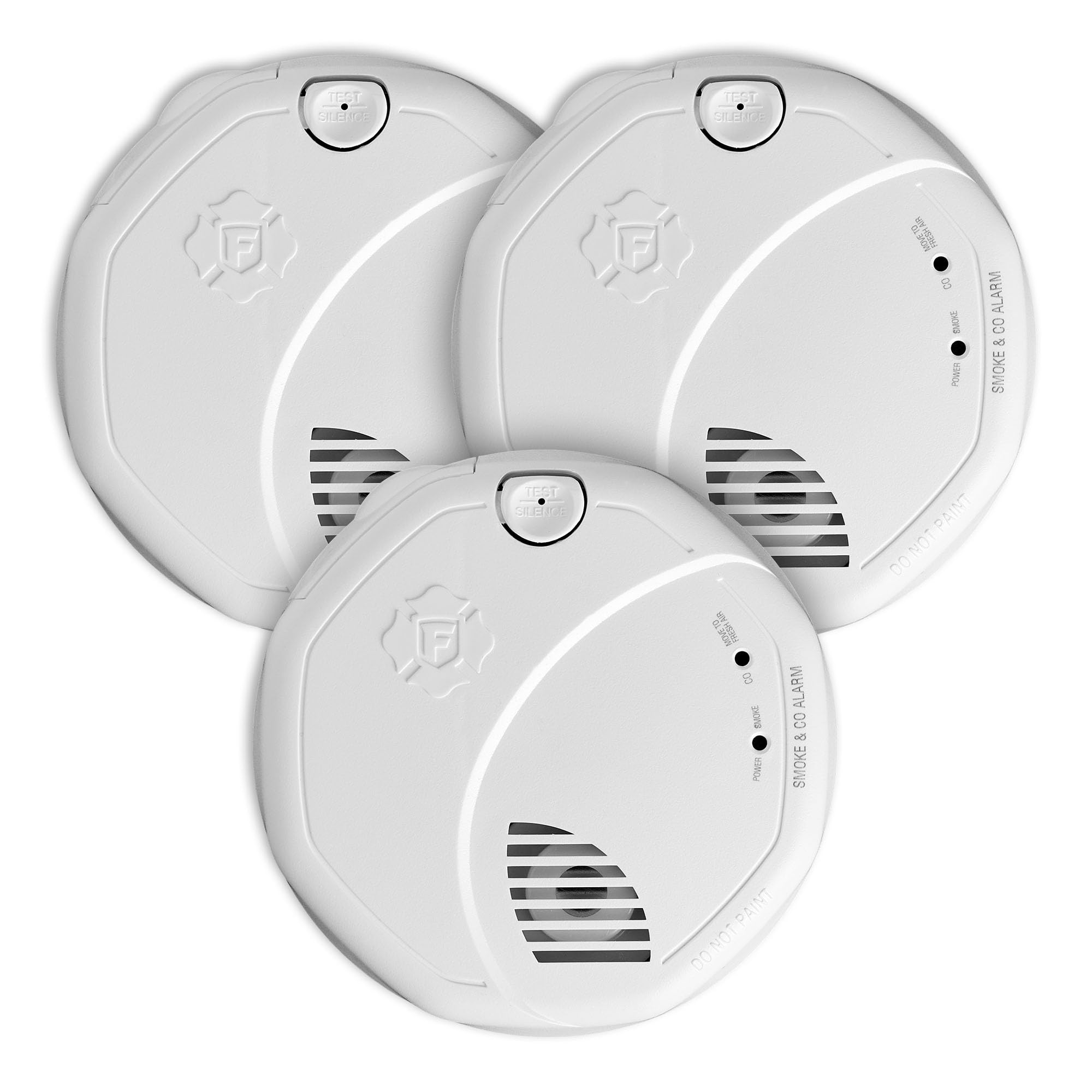
The First Alert SMCO100 3-Pack is the most cost-effective way to equip multiple rooms with both smoke and carbon monoxide detection. Each unit uses Precision Detection photoelectric technology for smoke and an electrochemical sensor for CO, all powered by standard AA batteries (included). The 2-in-1 design saves you from mounting separate detectors, and the end-of-life warning ensures timely replacement.
Installation is truly tool-free: the twist-and-turn lock mechanism secures the unit to the ceiling plate. Users report these units lasting 7-8 years before the end-of-life chirp, with AA battery replacements needed only once or twice per year. The test/silence button lets you quickly verify operation or mute a false alarm from cooking.
The 3-pack is perfect for multi-level homes where you want smoke and CO coverage on each floor. The only catch is these use standard AA batteries rather than a 10-year sealed lithium cell, so you’ll need to remember annual battery swaps. Also, the mounting base differs from older First Alert models, so you may need to patch old screw holes.
Why it’s great
- Two-in-one smoke and carbon monoxide detection
- AA battery operation for simple maintenance
- Precision Detection reduces nuisance alarms
- 3-pack covers multiple rooms economically
Good to know
- Requires annual battery replacement (not sealed lithium)
- No interconnect capability between units
- Twist-and-turn lock mechanism differs from previous bases
5. Kidde Smoke & Carbon Monoxide Detector 2-Pack

The most distinctive feature of this Kidde 2-pack is the voice alert system that verbally announces the type of danger: “Fire!” for smoke or “Warning! Carbon Monoxide!” for CO. This is a genuine safety upgrade—when the alarm sounds at 3 a.m., hearing “Fire!” versus “Carbon Monoxide!” tells you whether to evacuate immediately or open a window. The Enhanced Sensing technology meets UL 217 9th Edition, meaning it’s less likely to false-alarm from cooking.
Each unit runs on a 10-year sealed lithium battery and includes a self-testing function that internally verifies the sensor and electronics are working. LED warning indicators provide visual status, and the voice distinguishes this model from every other battery-powered combo detector on this list. The 2-pack covers a main floor and upstairs or a living area and basement.
The trade-off is premium pricing and a new mounting bracket that won’t fit older Kidde bases—expect to patch two screw holes. Some users also note the voice is slightly softer than the tone alarm, though still audible. For those who want instant hazard identification without looking at a panel, this is the standout choice.
Why it’s great
- Voice alerts distinguish between fire and carbon monoxide
- Enhanced Sensing meets UL 217 9th Edition for fewer false alarms
- 10-year sealed battery with self-testing functionality
- LED warning light indicators for visual status
Good to know
- New bracket design requires new mounting holes
- Voice volume may be lower than the tone alarm
- Premium price compared to basic combo detectors
6. First Alert SMICO100

The First Alert SMICO100 is the entry-level combo detector that delivers Precision Detection smoke sensing and electrochemical CO detection at the lowest possible cost. It runs on a standard 9V battery (included), which users report lasts about a year with normal use. The test/silence button lets you manually verify operation and mute cooking alarms, and the end-of-life warning chirps when it’s time to replace the entire unit after 10 years.
Installation is simple: the mounting base screws into the ceiling or wall, and the detector twists on. Users praise its reliability in RVs and campers where hardwiring isn’t available. It covers the same safety essentials as the more expensive SMCO100 but in a single-unit format with a 9V battery instead of AA batteries—slightly less convenient but equally effective.
The main limitation is the non-rechargeable 9V battery, which needs annual swaps and doesn’t offer the 10-year sealed convenience. Also, the mounting base may not match older First Alert models if you’re replacing an expired unit. For a single-room smoke and CO solution on a tight budget, this works perfectly.
Why it’s great
- Affordable two-in-one smoke and CO protection
- Precision Detection photoelectric sensor reduces false alarms
- Easy twist-on installation and test/silence button
- 10-year warranty and end-of-life warning
Good to know
- 9V battery requires yearly replacement
- Mounting base may not fit older First Alert models
- No interconnect capability
7. First Alert SMI105-AC (Single)

If you only need to replace a single hardwired smoke detector and want the best value, the First Alert SMI105-AC single unit delivers Precision Detection and 10-year battery backup without buying a multi-pack. It hardwire interconnects with compatible First Alert units, so adding one to an existing system triggers all alarms when it detects smoke. The Easy Adapter Plug simplifies the swap from old to new.
The photoelectric sensor meets UL 217 9th Edition, reducing false alarms from cooking—a major upgrade over older ionization detectors. The 10-year sealed battery backup ensures protection during power outages, and the green LED backlight offers a subtle nightlight effect. Users consistently report a quick 10-minute replacement process: twist off, unplug, plug in the new adapter, twist on, and pull the battery tab.
The only drawbacks are the lack of included mounting screws (some packages omit them) and the smoke-only functionality—no carbon monoxide detection. For a simple smoke-only replacement in a wired home, this is the most efficient option.
Why it’s great
- Hardwire interconnect with Precision Detection sensor
- 10-year battery backup for uninterrupted protection
- Easy Adapter Plug for fast replacement
- Green LED backlight and alarm indicator
Good to know
- Smoke only—no carbon monoxide detection
- Missing mounting screws in some packages
- Requires pigtail rewiring if replacing non-First Alert units
FAQ
How often should I replace my smoke alarm detector?
Do I need a smoke alarm with carbon monoxide detection?
Why does my smoke alarm keep false alarming while cooking?
Can I mix different brands of interconnected smoke alarms?
Final Thoughts: The Verdict
For most users, the best smoke alarm detector winner is the X-Sense SC06-W 3-Pack because its wireless RF interconnect delivers whole-home protection without rewiring, combined with a 10-year sealed battery and dual smoke/CO detection. If you have a hardwired home and want code-compliant interconnect, grab the First Alert BRK SMI105-AC 3-Pack. And for the most budget-conscious option that still offers combo smoke and CO protection, nothing beats the First Alert SMICO100.