
Our readers keep the lights on and my morning glass full of iced black tea. As an Amazon Associate, I earn from qualifying purchases.
Specs are compiled from manufacturer listings and verified buyer reviews and can change over time — please confirm the key details on the product page before buying.
That sinking feeling when a vehicle that sat for two weeks won’t crank is exactly what a solar battery charger eliminates. Instead of dragging out extension cords or a bulky plug-in maintainer, you lay a panel on the dash or mount it on a roof, and the sun quietly tops the battery off every single day.
I’m Min — the founder and writer behind Gadgets Feed. This guide is built by comparing the manufacturers’ published specifications and the patterns across verified customer reviews, so you get each pick’s real strengths and trade-offs instead of marketing spin.
The list ahead follows a flexible rule: any panel that accepts a 12V battery is in play, so a 10W maintainer and a 50W kit sit side by side for the same job. Here is how to pick the right solar battery charger for your car, boat, or RV.
Our Picks at a Glance


How To Choose The Best Solar Battery Charger
Match the panel to the job. A tiny 10W panel is perfect for a motorcycle that sits all winter, but a truck with a security system and parasitic drain might need 20W to 30W just to break even.
Wattage: The Real Workhorse Metric
Wattage tells you how fast the panel can push energy back into the battery. A 10W panel might add about 0.1V per day in good sun, while a 30W panel can recover a drained battery in a week. Bigger is better for vehicles with alarms or electronics that draw power while parked.
MPPT vs. PWM Controllers
MPPT (Maximum Power Point Tracking) pulls up to 30% more energy in shade or low light, while PWM (Pulse Width Modulation) is the simpler, cheaper option for basic maintenance.. MPPT panels are worth the premium if you park in shade or cloudy regions.
Quick Comparison
| Model | Best For | Power Output | Controller Type | Weight | Amazon |
|---|---|---|---|---|---|
| SUNER POWER 30W★ Best Overall | Most versatile all-rounder | 30 watts | MPPT | 1.81 kg | Amazon |
| Renogy 10WBudget Champion | Entry-level maintainer | 10 watts | — | 14.23 oz | Amazon |
| OYMSAE 10WVisual Simplicity | Simple cars & bikes | 10 watts | — | 13.44 oz | Amazon |
| FlexSolar 20W | Flexible curved surfaces | 20 watts | Smart controller | 1.7 pounds | Amazon |
| SUNAPEX 20W | Low-light performance | 20 watts | MPPT-style smart | 1.06 kg | Amazon |
| ECO-WORTHY 25W | Hardware-style kit | 25 watts | PWM 4A | 2.34 kg | Amazon |
| SOLPERK 30W | Submersible controller | 30 watts | MPPT | 2.04 kg | Amazon |
| Sun Energise 25W | Full-featured MPPT | 25 watts | MPPT | 2.53 kg | Amazon |
| SOLPERK 50W | Heavy duty & off-grid | 50 watts | PWM 10A | — | Amazon |
In‑Depth Reviews
1. SUNER POWER 30W
Our pick — over 4.5★ from 300+ verified ratings; the strongest balance of quality and price.
The smartest 30-watt panel that talks to your battery type before charging.
This is the panel that keeps a 660CCA battery topped up to 13.8V in a single week, per owner reports — impressive for any charger, let alone a portable one. The built-in Ultra-Smart MPPT controller tracks the sun’s optimal power point at up to 99% efficiency., so you extract more usable energy than a basic controller would.
You can safely charge almost any 12-volt battery type—flooded, AGM, or lithium—because this panel lets you switch between three modes: 12V, 12V AGM, and 12V Lithium. The included plug-and-play SAE harness (a standard two-pin connector) comes with alligator clips, a bare-end cable, and a cigarette lighter adapter, so you can hook it to a boat, truck, or dump trailer without any wiring expertise.
It’s not just about raw power — the visual charge level indicators show 25%, 50%, 75%, and 100%, so you know exactly where the battery sits without a multimeter. A word of caution: one owner noted the panel gets very hot in direct sunlight and melted dashboard coating, so mount it with the included suction cups on glass rather than directly on a dash.
Why It’s The Top Pick
- 30W output is triple the entry-level panels, so it recovers drained batteries rather than just maintaining them
- Three selectable modes for flooded, AGM, and lithium batteries
- Waterproof, spark-proof, and overload-protected for low-maintenance outdoor use
Worth A Second Look
- Runs hot in direct sun — avoid placing on dashboards
- Heavier at 1.81 kg than flexible panels, so mounting is best on flat glass
Reach for this if: you want one panel that maintains a boat, a car, and an RV without swapping gear.
Look elsewhere if: you only need a tiny top-up for a motorcycle — 30W is more than you need.
2. Renogy 10W
The featherweight that keeps a parked car alive without extension cords.
At just 14.23 ounces, this is the panel you toss on a windshield and forget about until spring. Buyers report it fixed a dead battery on a display-model riding lawn tractor, delivering reliable starts even after months in storage — which beats buying a new battery entirely.
Renogy’s monocrystalline cells (a high-efficiency silicon type) and multi-layered lamination keep it weather-resistant and dustproof, so it lives happily on a dash or windshield through all seasons. The quick SAE connection means you can switch between ring terminals, alligator clips, or a cigarette lighter plug in seconds.
The honest reality is that 10W is a maintainer, not a full charger — owners mention roughly +0.1V per day from about 12V, which holds the line but won’t rescue a deeply drained battery. Some found the included cables short and unfused, so a little custom wiring may be in your future if you want a neat install.
Verdict: The cheapest reliable way to keep a rarely-driven car, camper, or tractor battery from dying.
Best for: anyone who parks a vehicle for weeks and just wants the battery alive for a fair price.
Not for: reviving a fully drained battery — 10W simply isn’t enough current.
3. OYMSAE 10W
Color-coded charging lights make this the most beginner-friendly panel here.
The three indicator lights tell you everything: blue for sun detected, red for actively charging, and green for a full battery. That’s a huge relief for anyone who’s ever wondered if their trickle charger was actually working — you just glance at the dash.
Customers note it survived two full northeast winters and kept a motorcycle battery charged year-round, which speaks to its ETFE (a tough, weatherproof film) build and the epoxy board bottom plate that adds rigidity. The 98-inch extension cord included in the box is generous, giving you real flexibility on where to mount the panel versus where the battery lives.
The trade-off is that a 10W panel needs days of full sun to do meaningful work — one owner found it slow, and another never saw the green light at all. A few also found the cigarette lighter jack incompatible with their vehicle’s outlet, so connecting directly to the battery is the more reliable path.
What wins people over: the traffic-light simplicity of knowing exactly what’s happening — most owners call installation a two-minute job.
The recurring gripe: the cigarette adapter can be a dud, so plan to use the alligator clips instead.
Pick this for: a motorcycle or occasional-use car where a glance at the LEDs beats reading a manual.
Think twice if: your vehicle sits in deep shade — low light starves a 10W panel.
4. FlexSolar 20W

A coin-thin panel that bends around sunroofs and boat decks.
At only 0.11 inches thick, this flexible panel conforms to curved surfaces that rigid panels can’t touch — think windshields, sunroofs, or a boat deck. It mounts with included suction cups and carabiners, so there’s zero drilling and no bulky hardware.
Buyers consistently say this panel saved them from buying a new battery, and the monocrystalline core delivers 20%-25% photoelectric conversion efficiency (the industry term for how much sunlight becomes electricity), outpacing cheaper polycrystalline panels. The four connection methods — cigarette plug, alligator clips, OBDII, and ring terminals — cover nearly every vehicle setup you’ll encounter.
The smart controller halts at full capacity and resumes on voltage drop, preventing the reverse-current drain that plagues simpler panels. The honest notes: it’s stiffer than truly flexible panels, and the included cables feel cheap — several owners replaced them with rugged aftermarket ones, though the panel itself earned consistent praise.
Standout strength: the OBDII adapter is rare at this price and lets you plug into most modern cars without touching the battery.
The catch: check dimensions before buying — it’s larger than most and won’t fit a compact dash.
Choose this if: you need a panel that hugs a curved surface and reaches into a modern car’s OBDII port.
skip it if: you want a rigid, glass-fronted panel for permanent outdoor mounting.
5. SUNAPEX 20W
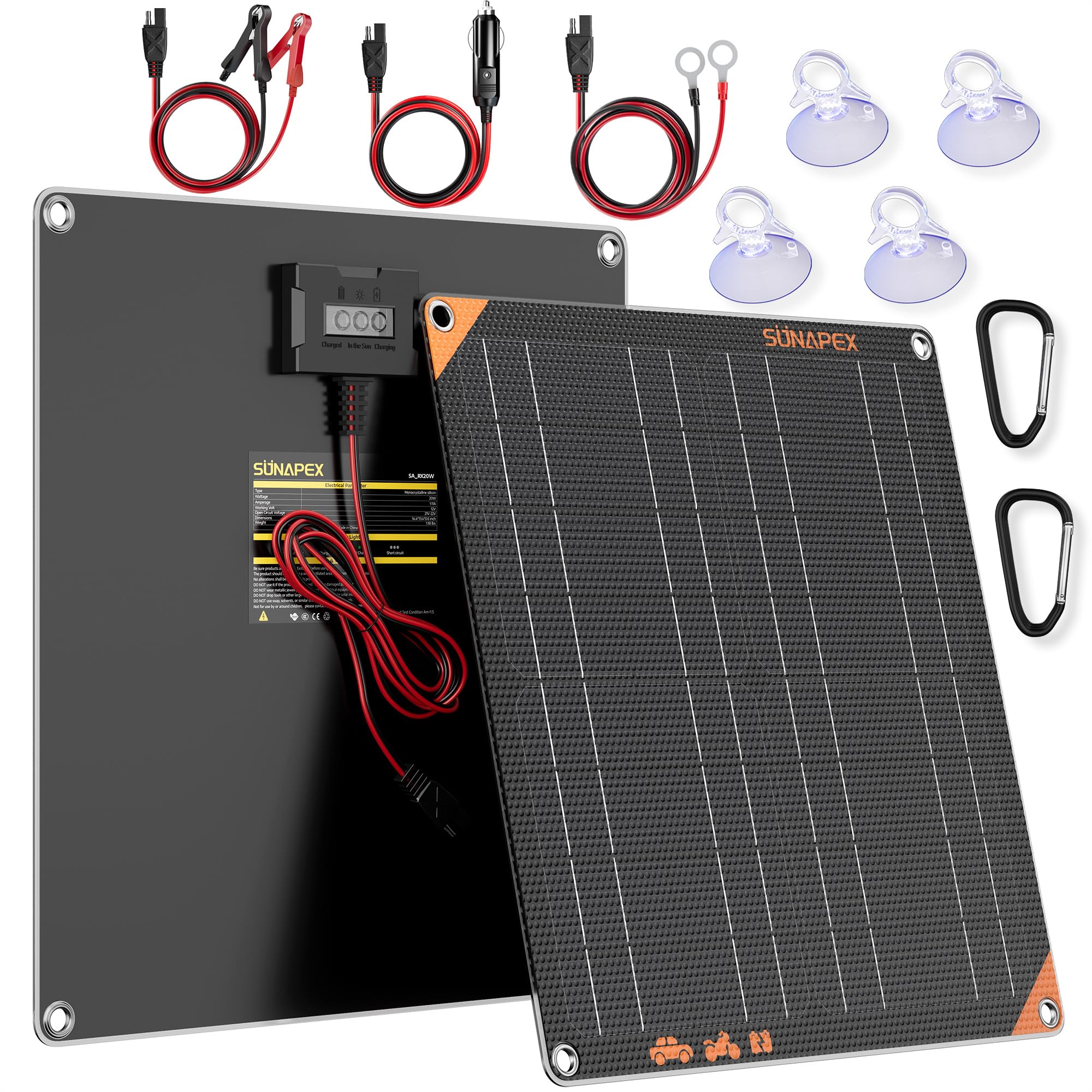
The 20-watt panel that keeps charging even when clouds roll in.
Unlike most panels that choke in overcast conditions, this one’s monocrystalline cells maintain stable output in low light and cloudy weather — a boon for RV owners parked in shaded lots. The fully sealed IP67 waterproof rating (meaning it’s dust-tight and survives immersion in water) lets it handle rain, snow, and extreme temperatures without complaint.
Owners use it for everything from keeping a truck battery charged with a 1A trickle to powering solar Meshtastic nodes (off-grid radio devices). The built-in smart controller prevents overcharging, over-voltage, and deep discharge, and the three LEDs show sun detection, active charging, and a full battery.
The flexible ETFE design with suction cups and carabiners mounts to a windshield in seconds, and the 1-year workmanship warranty plus lifetime technical support backs it up. A fair warning: it won’t charge a battery that’s dropped below a certain voltage threshold — it’s built to maintain healthy batteries, not resurrect dead ones.
Clear Strengths
- IP67 waterproof handles full rain and snow exposure
- 30% high-efficiency monocrystalline cells outperform standard panels
- Works in low light where others give up
Honest Limits
- Won’t wake a battery below a certain voltage
- Runs hot in direct sun — the flexible surface absorbs heat
Reach for it if: your vehicle parks under trees or in cloudy regions — this is the low-light specialist.
Look past it if: you’re trying to revive a fully drained battery; it needs a healthier starting point.
6. ECO-WORTHY 25W
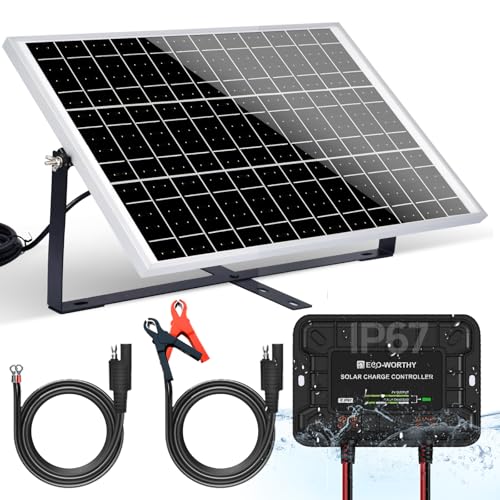
A 25-watt rigid panel that charged a battery from 12.2 to 13.4 volts on an overcast day.
That overcast-day performance is a standout in real owner testing — most panels lose most of their output without direct sun, but this one kept climbing. The low-iron tempered glass and corrosion-resistant aluminum frame are 100% waterproof and rustproof, handling wind loads up to 2400 Pa and snow loads up to 5400 Pa..
The kit is genuinely complete: a 25W panel, a waterproof 4A PWM controller, alligator clips, O-rings, a mounting bracket, and screws. Reviewers point out it works straight from the start, hooking up to a boat or trailer winch battery and having it charged by end of day.
The PWM controller is the weak link — it’s tuned for 12V and will be overloaded by anything above about 18V, so don’t try to attach a larger panel to it later. Owners who wanted a bigger controller simply swapped it out, keeping the excellent panel itself.
The thing everyone notes: it’s a complete kit — panel, controller, and hardware — with genuinely good build quality for the money.
The honest caveat: the included PWM controller is basic, so plan for a future upgrade if you scale up.
Best for: a boat, trailer, or gate that needs a complete, ready-to-mount solar solution from the start.
Not ideal if: you want MPPT efficiency — this leans on a simple PWM controller.
7. SOLPERK 30W
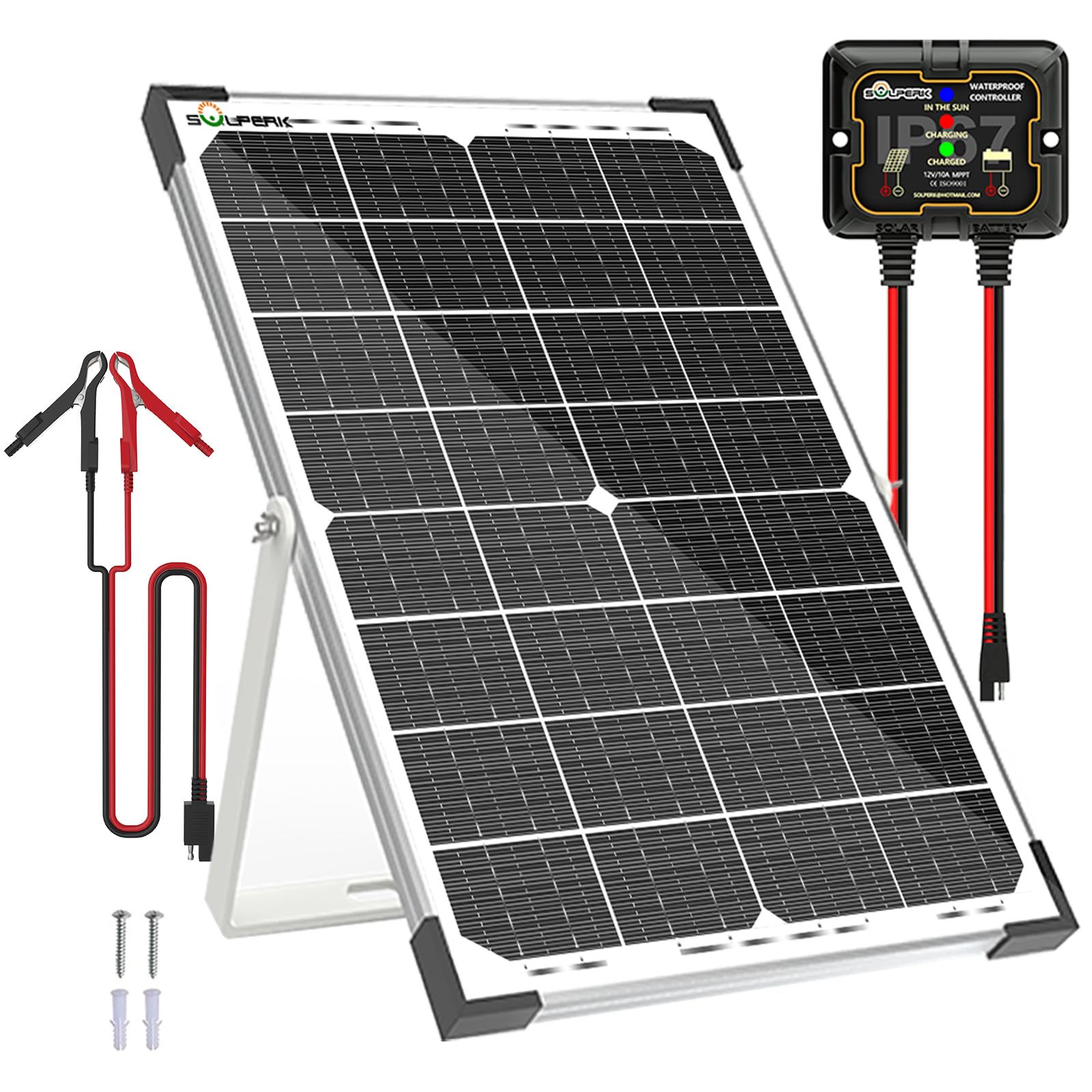
The MPPT controller so waterproof it can be fully submerged.
Most solar controllers die if they get wet; this one is designed to be completely submerged in water, making it the pick for boats, marine trailers, and exposed roof mounts. The submersible MPPT controller extracts over 30% more energy than a standard PWM unit in the same sunlight., so your battery gets more from the same sunlight.
The 360° adjustable bracket is a genuine convenience — you can angle the panel on a ground, wall, or roof mount to chase the sun through the seasons. Shoppers say it charged a trolling motor battery from 60% to 100% in 3-4 days of full sun, and kept a car battery charged through long idle periods without overcharging.
The A+ monocrystalline silicon cells convert sunlight at a high efficiency rating., and the low-iron tempered glass plus aluminum frame shrug off sandstorms, hail, and blizzards. The one recurring complaint is the mounting hardware feels a bit cheap, but the panel and controller themselves earned solid marks.
Standout feature: a fully submersible controller — no other pick here matches that marine-grade toughness.
Good to know: mounting hardware is basic, so budget for better brackets if it’ll face high winds.
Choose this for: wet environments where a standard controller would short out.
pass on it if: you want a plug-and-play dash panel — this is built more for fixed outdoor mounting.
8. Sun Energise 25W

A 25-watt panel that held a 7-year-old RV battery at 12.6V for three years in storage.
That longevity story from owners is the kind of real-world proof that matters — an aging battery kept alive through three storage seasons without dropping. The built-in MPPT controller hits 99% tracking efficiency and 98% peak conversion, boosting energy use by 20%-30% over standard controllers..
The 3-stage charging algorithm (Bulk, Absorption, Float) mirrors premium plug-in maintainers, charging hard then easing to a safe float voltage.: it charges hard, then eases off, then holds a safe float voltage so the battery isn’t boiled or overcharged. Buyers report a Ford Transit RV stayed out of deep-sleep mode through eight winter days at 12.6V.
It’s built with A+ mono cells, tempered glass, and a corrosion-resistant ABS frame rated for 2400 Pa wind and 5400 Pa snow load.. The honest notes: it’s a slow maintainer, not a rescue charger, and the panel face needs a daily wipe with non-abrasive cleaner to keep output strong.
What Shines
- MPPT controller with 99% tracking efficiency boost every ray
- 3-stage charging protects battery health long-term
- Multi-battery compatibility from gel to LiFePO4
What To Know
- Slow charge means it’s a maintainer, not a battery reviver
- Panel face needs regular cleaning for peak output
Reach for it if: you need a weatherproof MPPT maintainer for a vehicle parked long-term.
Look elsewhere if: your battery is already deeply drained — this one plays a waiting game.
9. SOLPERK 50W

A 50-watt panel that charges a pontoon boat’s batteries faster than hauling them home.
This is the heavy hitter for people who actually draw on their batteries, not just maintain them. Owners mention charging two pontoon boat batteries quickly so they spend more time on the water and less time hauling batteries home — the exact promise a big panel delivers.
The 60-degree adjustable bracket lets you set the angle at 0°, 15°, 30°, 45°, or 60°, so you can tune for winter sun angles or summer overhead rays. The IP65 waterproof controller (protected against dust and low-pressure water jets) carries a 10A rating, and the high-efficiency monocrystalline cells convert 21%-30% of sunlight into power.
It powers more than batteries — buyers use it for gate openers, camera banks, and off-grid lighting, with one noting it eliminated the need for a DC charger on a generator battery. The honest caveats: some units arrive shattered in shipping, and the controller can fail within months, though the panel itself gets consistent praise for low-light performance.
Where it dominates: raw wattage — 50W is double the mid-range panels, so it actually charges rather than just maintains.
The risk: shipping damage and a controller that isn’t the kit’s strong point — check the panel immediately on arrival.
Pick this if: you draw real current (winches, trolling motors, gate systems) and need genuine charging speed.
it’s not for you if: you only need a dash-mounted maintainer — this is a fixed-install panel.
Understanding the Specs
MPPT vs. PWM Controllers
MPPT (Maximum Power Point Tracking) is the smarter controller — it constantly adjusts to pull the maximum possible power from the panel, even in shade or low light, typically yielding 20-30% more energy than a basic controller. PWM (Pulse Width Modulation) is the simpler, cheaper option that connects the panel directly to the battery and throttles the charge — fine for maintaining a healthy battery but less efficient overall.
Wattage and Charging Speed
Wattage is the panel’s power ceiling. A 10W panel adds roughly 0.1V per day in good sun, which maintains a battery but won’t revive it. A 20W to 30W panel can recover a drained battery within a week, and 50W kits genuinely charge batteries for active use like trolling motors or winches. Match the wattage to whether you’re maintaining or actually drawing power.
FAQ
Will a solar battery charger work through a windshield?
What wattage do I need for a car battery?
Can I use a solar charger on a lithium LiFePO4 battery?
How long does a solar trickle charger take to charge a dead battery?
Do these panels overcharge the battery?
Why is my solar charger only showing a blue light and not charging?
Can these panels be left outside in rain and snow?
Will a solar charger drain my battery at night?
What’s the difference between a trickle charger and a maintainer?
Final Thoughts: The Verdict
Across the board, the solar battery charger winner is the SUNER POWER 30W because its MPPT controller, three battery modes, and 30W of output cover cars, boats, and lithium batteries in one kit. If you want a flexible panel that hugs curved surfaces, grab the FlexSolar 20W. And for heavy off-grid use where you need real charging speed rather than maintenance, the SOLPERK 50W is the one to reach for.
How We Picked
We do not accept paid placement. Every pick is matched to a real buyer and a real use-case; we do not hands-on test units.
Sources & Methodology
Specifications: manufacturer listings and product documentation. Review insights: verified customer reviews, as of August 2026. Pricing: not shown on this page (it changes often); check the current price via the retailer link.
As an Amazon Associate, Gadgets Feed earns from qualifying purchases. This does not affect which products we feature.