
The most common mistake buyers make when shopping for a home theater amplifier is chasing the highest wattage number on the box. Power output under real-world conditions — with all channels driven — is often half the advertised peak rating, and many receivers sacrifice clean amplification for feature lists that most users will never configure. A surround receiver’s job is to decode object-based audio, drive your speakers accurately, and switch video sources without glitching — anything less wastes the investment you’ve made in your display and speaker system.
I’m Min — the co-founder and writer behind Gadgets Feed. I’ve spent hundreds of hours comparing room correction algorithms, HDMI 2.1 chipset compatibility, and real-world power delivery across every major brand to separate genuinely capable receivers from spec-sheet gimmicks.
Whether you are building a dedicated media room or upgrading a living room setup, the right best surround receiver balances clean amplification with robust support for Dolby Atmos, DTS:X, and modern gaming features like VRR and ALLM without requiring a firmware flowchart to operate.
How To Choose The Best Surround Receiver
Picking the right AV receiver is about matching channel count, power delivery, and room correction to your actual speaker layout and room size, not buying the most expensive model on the shelf. Below are the four decision layers that separate a great match from an expensive mistake.
Channel Count and Speaker Configuration
Decide on your speaker layout before you choose a receiver. A 5.1.2 system (five ear-level channels, one subwoofer, two overhead or Dolby Atmos enabled speakers) requires a 7-channel receiver. Moving to 5.1.4 or 7.1.2 needs a 9-channel unit, and a full 7.1.4 configuration demands 11 processing channels. Many receivers advertise 7.2 channel support but cannot drive a 5.1.2 setup and a powered Zone 2 simultaneously — check the manual for assignable amplifier channels.
HDMI 2.1 Bandwidth and Gaming Features
HDMI 2.1 ports come in two bandwidth flavors: 40Gbps and 48Gbps. The full 48Gbps is required for uncompressed 4K/120Hz with 12-bit color, while 40Gbps still supports 4K/120Hz with minor chroma subsampling. Both tiers support Variable Refresh Rate (VRR), Auto Low Latency Mode (ALLM), and Quick Frame Transport (QFT). If you own a PlayStation 5, Xbox Series X, or a high-end graphics card, prioritize a receiver that has at least two 40Gbps or full 48Gbps inputs — early HDMI 2.1 chipsets suffered from handshake issues.
Room Correction Quality
Room correction is the single biggest factor in real-world sound quality, yet most buyers ignore it. Audyssey MultEQ XT32 (found on mid-range Denon units) delivers solid correction for most rooms. Yamaha’s YPAO R.S.C. with multipoint measurement is fast and reliable with Yamaha speakers. Onkyo’s inclusion of Dirac Live on the TX-RZ50 sets a new standard — full-bandwidth correction that drastically reduces subwoofer nulls and improves imaging without the clinical sound of older correction systems. Sony’s 360 Spatial Sound Mapping on the ES series creates a convincing phantom height effect even with a minimal 5.1.2 configuration.
Build Quality and Thermal Management
Class A/B amplifiers run hot, especially when driving low-impedance speakers in a closed cabinet. Look for receivers with a ventilation design that pulls heat upward rather than relying solely on side vents. Units like the Onkyo TX-RZ50 and Yamaha Aventage line include a rigid chassis with a fifth foot for stability, thicker internal circuit boards, and larger heat sinks. If you plan to place the receiver inside a cabinet, measure the depth — many flagship models exceed 16 inches deep and will not fit standard AV furniture without the back panel cut out.
Quick Comparison
On smaller screens, swipe sideways to see the full table.
| Model | Category | Best For | Key Spec | Amazon |
|---|---|---|---|---|
| Onkyo TX-RZ50 | Premium | Dirac Live room correction | Dirac Live, THX Select, 120W/ch | Amazon |
| Sony STRAZ5000ES | Premium | 11.2 channel flagship | 11.2 ch, 360 Spatial Sound, 130W | Amazon |
| Sony STRAZ1000ES | Premium | Sony ecosystem integration | 7.2 ch, 360 Spatial Sound, 100W | Amazon |
| Denon AVR-S970H | Premium | HEOS multi-room streaming | 7.2 ch, 90W, HEOS, 8K/60Hz | Amazon |
| Yamaha RX-A2A | Premium | Aventage build quality | 7.2 ch, YPAO R.S.C., Surround:AI | Amazon |
| Onkyo TX-NR6100 | Mid-Range | THX certified gaming | 7.2 ch, THX Select, 210W peak | Amazon |
| Denon AVR-S770H | Mid-Range | Ease of use and reliability | 7.2 ch, 75W, Audyssey, eARC | Amazon |
| Yamaha RX-V6A | Mid-Range | MusicCast multi-room | 7.2 ch, 8K/60, YPAO, eARC | Amazon |
| JBL MA710 | Mid-Range | Phono input and shallow chassis | 7.2 ch, 110W, 8K, Chromecast | Amazon |
| Pioneer VSX-935 | Mid-Range | Dolby Atmos Height Virtualization | 7.2 ch, 8K, Zone 2, RF remote | Amazon |
| JBL MA510 | Budget | Entry-level 5.2 channel | 5.2 ch, 75W, 8K, AirPlay 2 | Amazon |
In‑Depth Reviews
1. Onkyo TX-RZ50 9.2-Channel AV Receiver

The Onkyo TX-RZ50 is the most compelling mid-premium receiver on the market because it bundles Dirac Live out of the box — a room correction system that typically costs hundreds extra as a license from other manufacturers. Dirac Live’s full-bandwidth correction addresses subwoofer nulls and frequency response irregularities that Audyssey and YPAO struggle with, producing a noticeably cleaner soundstage, especially in rooms with problematic reflections.
With 9.2 channels of processing and pre-outs for 7.2.4 speaker layouts, the TX-RZ50 supports 5.1.4 or 7.1.2 configurations without needing an external amplifier. The THX Select certification guarantees reliable 120-watt-per-channel output into 8 ohms with low distortion, and the HDMI 2.1 inputs handle 4K/120Hz and 8K/60Hz for both PlayStation 5 and Xbox Series X without the handshake dropouts that plagued earlier Onkyo HDMI implementations.
The main downsides are the learning curve for Dirac Live — it requires a PC or Mac for the best results — and the fact that the dual subwoofer outputs are not independently calibrated. A few users have reported WiFi module failures, though the replacement units are stable. For anyone serious about sound quality in a challenging room, the TX-RZ50 is the best value in this list.
Why it’s great
- Dirac Live included at no extra cost
- THX Select certified 120W/ch continuous
- 11.2 channel processing with full pre-outs
- Quiet cooling fan design
Good to know
- No printed manual included
- Dual sub outs are not independent
- HDMI switching takes ~12 seconds
2. Sony STRAZ5000ES 11.2 CH 8K A/V Receiver

The Sony STRAZ5000ES sits at the top of the consumer food chain with 11.2 discrete amplifier channels capable of driving a full 7.1.4 Dolby Atmos layout without external amplification. Sony’s 360 Spatial Sound Mapping uses the D.C.A.C. IX calibration mic to analyze the room and create phantom height speakers, producing a sound bubble that rivals dedicated ceiling speakers in a 5.1.2 configuration — a genuine technical achievement.
With 130 watts per channel into 8 ohms (two channels driven, 1kHz, 0.9% THD), the AZ5000ES delivers clean headroom for demanding speakers. The HDMI 2.1 implementation includes all 7 inputs and 2 outputs supporting 8K/60Hz and 4K/120Hz with VRR and ALLM, though HDR10+ support is absent. The build quality is exceptional — a 34.7-pound chassis with a rigid internal frame that minimizes vibration.
It runs hot under sustained load, and Sony recommends active cooling (like the AC Infinity Aircom T10) for enclosed cabinets. The price is steep, but for buyers building a dedicated theater room who want Sony’s unique spatial audio processing and don’t need HDR10+, it is the most complete package available.
Why it’s great
- 360 Spatial Sound Mapping creates convincing phantom height channels
- 11.2 channel built-in amplification
- Backlit remote included
- Works with Sonos certified
Good to know
- Runs very hot without active cooling
- No HDR10+ or QMS support
- Requires careful manual calibration for optimal imaging
3. Sony STRAZ1000ES 7.2 CH 8K A/V Receiver

The Sony STRAZ1000ES brings Sony’s flagship 360 Spatial Sound Mapping and D.C.A.C. IX room correction to a 7.2-channel chassis at a significantly lower entry point than the AZ5000ES. It delivers 100 watts per channel into 8 ohms and supports Dolby Atmos and DTS:X decoding, but unlike the flagship, it requires an external amplifier for a 5.1.4 or 7.1.4 layout due to its 7-channel amplifier section.
The HDMI 2.1 ports handle 8K/60Hz and 4K/120Hz with VRR and ALLM across 6 inputs and 2 outputs, making it an excellent hub for a gaming-focused 5.1.2 system. The auto-calibration mic is easy to set up, and the on-screen graphical interface is one of the most user-friendly in this class — you can complete the full setup without reading a manual.
As with the AZ5000ES, HDR10+ is missing, and the receiver runs warm enough that ventilation matters. The lack of support for HDR10+ is a non-issue for most users since Dolby Vision covers the vast majority of streaming and disc content, but it is worth noting for anyone with an HDR10+-only display.
Why it’s great
- 360 Spatial Sound Mapping for immersive phantom height effects
- User-friendly on-screen setup and calibration
- 6 HDMI 2.1 inputs with VRR/ALLM
- Clean 100W/ch amplification
Good to know
- Runs hot without active cooling
- HDR10+ not supported
- 7.2 channels limit Atmos to 5.1.2 without external amp
4. Denon AVR-S970H 8K Ultra HD 7.2 Channel Receiver

The Denon AVR-S970H offers a compelling mix of power, streaming integration, and gaming readiness for the mid-premium tier. Its 90 watts per channel drives most bookshelf and tower speakers with authority, and the HEOS multi-room platform integrates with Spotify, TIDAL, and Amazon Music HD without requiring an external streamer. The phono input is a welcome addition for vinyl enthusiasts.
HDMI 2.1 support includes three 8K/60Hz inputs and 4K/120Hz passthrough with VRR, ALLM, and QFT for lag-free gaming. The Audyssey MultEQ room correction provides reliable calibration for medium-sized rooms, though it lacks the XT32 version found on higher-end Denon models. The eARC connection worked flawlessly with Roku and Fire Stick sources in testing, passing Dolby Atmos from streaming apps without hiccups.
Powered Zone 2 reduces the main system to 5.2 channels, which is standard for this class. The on-screen setup assistant is the most intuitive in the industry, making this an excellent choice for first-time surround receiver buyers who want premium streaming and gaming support.
Why it’s great
- HEOS multi-room with TIDAL and Spotify Connect
- Phono input for turntable
- Excellent on-screen setup assistant
- Runs cooler than competing models
Good to know
- Audyssey MultEQ, not XT32
- Powered Zone 2 reduces main channels to 5.2
- Remote lacks dedicated TV power button
5. Yamaha RX-A2A AVENTAGE 7.2-Channel AV Receiver

The Yamaha RX-A2A is the entry point to the Aventage line, which Yamaha positions as their highest build-quality tier. The chassis includes a fifth foot for vibration damping, thicker circuit boards, and a larger heat sink than the RX-V series. YPAO R.S.C. with multipoint measurement provides fast and accurate room correction for most domestic spaces.
Surround:AI analyzes audio content in real-time and adjusts parameters to emphasize dialogue, effects, or ambiance depending on the scene, which produces a noticeably more engaging movie experience without manual tweaking. Three HDMI 2.1 inputs support 8K/60B and 4K/120AB with ALLM and VRR, though the bandwidth is capped at 40Gbps rather than the full 48Gbps found on some competitors.
The MusicCast multi-room system is robust, supporting Spotify Connect, AirPlay 2, and Amazon Music HD. The phono input covers vinyl playback. Some users report sporadic HDMI handshake issues with certain TV brands, and the lack of analog video inputs is a limitation for anyone with legacy gear. On sale, the RX-A2A offers Aventage build quality at a price that undercuts flagship models.
Why it’s great
- Aventage build with fifth foot stabilization
- Surround:AI dynamic audio optimization
- Phono input and comprehensive multi-room
- Fast, reliable YPAO calibration
Good to know
- HDMI 2.1 at 40Gbps bandwidth
- No analog video inputs
- Occasional HDMI handshake issues with some TVs
6. Onkyo TX-NR6100 7.2 Channel THX Certified Receiver
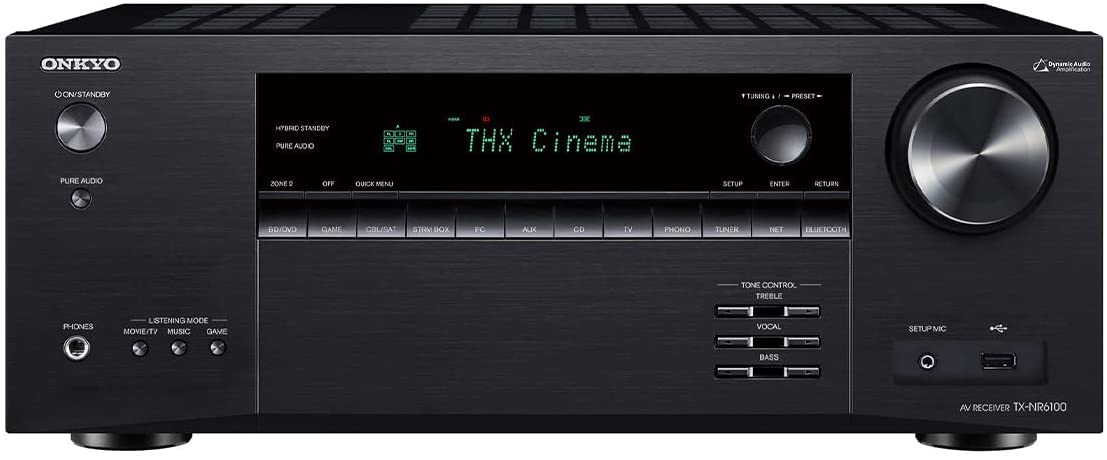
The Onkyo TX-NR6100 brings THX Select certification and robust gaming features to the mid-range bracket. With three HDMI 2.1 inputs running at 40Gbps, it supports 4K/120Hz on both PlayStation 5 and Xbox Series X without the VRR flickering issues that affected earlier Onkyo HDMI boards. The 210-watt-per-channel peak rating translates to genuinely dynamic sound with Klipsch Reference speakers.
The receiver supports 5.2.2 Dolby Atmos and DTS:X playback, and the THX Select certification ensures accurate frequency response and consistent power delivery across all channels in medium-sized rooms. The Klipsch Optimize Mode automatically applies the correct crossover settings for Klipsch Reference and Reference Premiere speakers, simplifying setup for owners of that brand.
Bi-amping the front speakers consumes the surround back channels, reducing the system to 5.1. The remote lacks backlighting, which is a common complaint. Some users have reported HDMI 2.1 processor issues after extended use, though this appears limited to early production batches. For THX-certified gaming performance at a mid-range price, the TX-NR6100 is hard to beat.
Why it’s great
- THX Select certification for consistent power
- Klipsch Optimize Mode for automatic crossover settings
- 8 HDMI inputs with HDMI 2.1 support
- Runs cooler than previous Onkyo generations
Good to know
- Bi-amping reduces to 5.1 system
- Remote is not backlit
- HDMI 2.1 processor reliability varies by production batch
7. Denon AVR-S770H 7.2 Ch Home Theater Receiver

The Denon AVR-S770H is the sweet spot for users who want reliable performance without overpaying for features they will never use. Its 75 watts per channel drives 8-ohm speakers cleanly for most medium-sized rooms, and the Audyssey MultEQ room correction provides a significant improvement over no calibration at all, taming bass peaks and adjusting speaker distances with minimal effort.
HDMI 2.1 support includes 4K/120Hz passthrough with VRR, ALLM, and QFT, making it a capable gaming hub for a 5.1.2 Atmos setup. The Dolby Height Virtualization and DTS Virtual:X upmixers create convincing overhead effects without ceiling speakers — useful for renters or anyone unwilling to cut into their ceiling. The HEOS platform integrates Pandora, Spotify, and TIDAL seamlessly.
Some users have reported random volume drops and occasional HDMI handshake failures that require a power cycle, though these issues seem to affect a minority of units. The on-screen setup is among the best in its class, guiding even first-time users through speaker configuration and input assignment without confusion.
Why it’s great
- Excellent on-screen setup assistant for beginners
- Dolby Height Virtualization for Atmos without ceiling speakers
- HEOS multi-room streaming platform
- HDMI 2.1 with VRR, ALLM, and QFT for gaming
Good to know
- Occasional volume drop or HDMI handshake issues reported
- Remote has a learning curve
- Basic Audyssey MultEQ, not XT32
8. Yamaha RX-V6A 7.2-Channel AV Receiver

The Yamaha RX-V6A sits in the middle of Yamaha’s lineup and delivers a strong feature set for its tier. It supports 7.2 channels with Dolby Atmos and DTS:X, three HDMI 2.1 inputs with 8K/60B and 4K/120AB passthrough, and MusicCast multi-room streaming. The YPAO room correction is fast and delivers a balanced frequency response without the clinical sound of some competitors.
The eARC support is solid, though some users report that the receiver does not auto-power on with certain TV models — you have to turn it on manually before the sound routes through eARC. The component video inputs are gone, so all sources must connect via HDMI. The 200-watt total power rating translates to 75-80 watts per channel under real-world conditions with all channels driven.
The RX-V6A is a good option for users already invested in Yamaha’s MusicCast ecosystem with wireless speakers in other rooms. The setup involves a firmware update out of the box, and the learning curve for the full feature set is steeper than Denon’s equivalent. For multi-room audio fans, however, the MusicCast integration is worth the extra effort.
Why it’s great
- MusicCast multi-room with Spotify, TIDAL, and AirPlay 2
- Three HDMI 2.1 inputs with 8K/60 support
- YPAO calibration is fast and reliable
- Clear dialogue and dynamic sound for movies
Good to know
- eARC does not auto-power on with some TVs
- Setup requires firmware update
- Learning curve for full feature set
9. JBL MA710 7.2 Channel 8K AV Receiver

The JBL MA710 stands out for its shallow chassis depth of just 13.7 inches, making it one of the few mid-range receivers that fits comfortably inside standard AV cabinets without requiring a cutout. It delivers 110 watts into 7 channels with Dolby Atmos and DTS:X decoding, supporting 5.1.2 or 7.1 channel configurations. The moving magnet phono input is a rare inclusion at this price level.
Six HDMI 2.1 inputs with 8K/60Hz and eARC provide plenty of connectivity for modern sources, and the built-in Chromecast and Apple AirPlay 2 support cover most streaming needs. The sound is clean and neutral, with enough power to drive 4-ohm speakers like the Polk ES60 without strain. The on-screen setup menu works through HDMI ARC for easy configuration.
The non-backlit remote is a disappointment in an otherwise well-designed package, and the auto shut-off defaults to 20 minutes of inactivity, requiring a manual change in the setup menu. JBL’s firmware update support has been slow — the MA710 was still on year-old firmware at the time of testing. For users who need a shallow receiver with a phono input, the MA710 is the only mainstream option.
Why it’s great
- Shallow 13.7-inch chassis fits most AV cabinets
- Phono input for turntable connectivity
- 110W/ch with 4-ohm load capability
- Chromecast and AirPlay 2 built-in
Good to know
- Remote lacks backlighting
- Firmware updates are infrequent
- Auto shut-off requires manual adjustment
10. Pioneer VSX-935 7.2 Channel Receiver
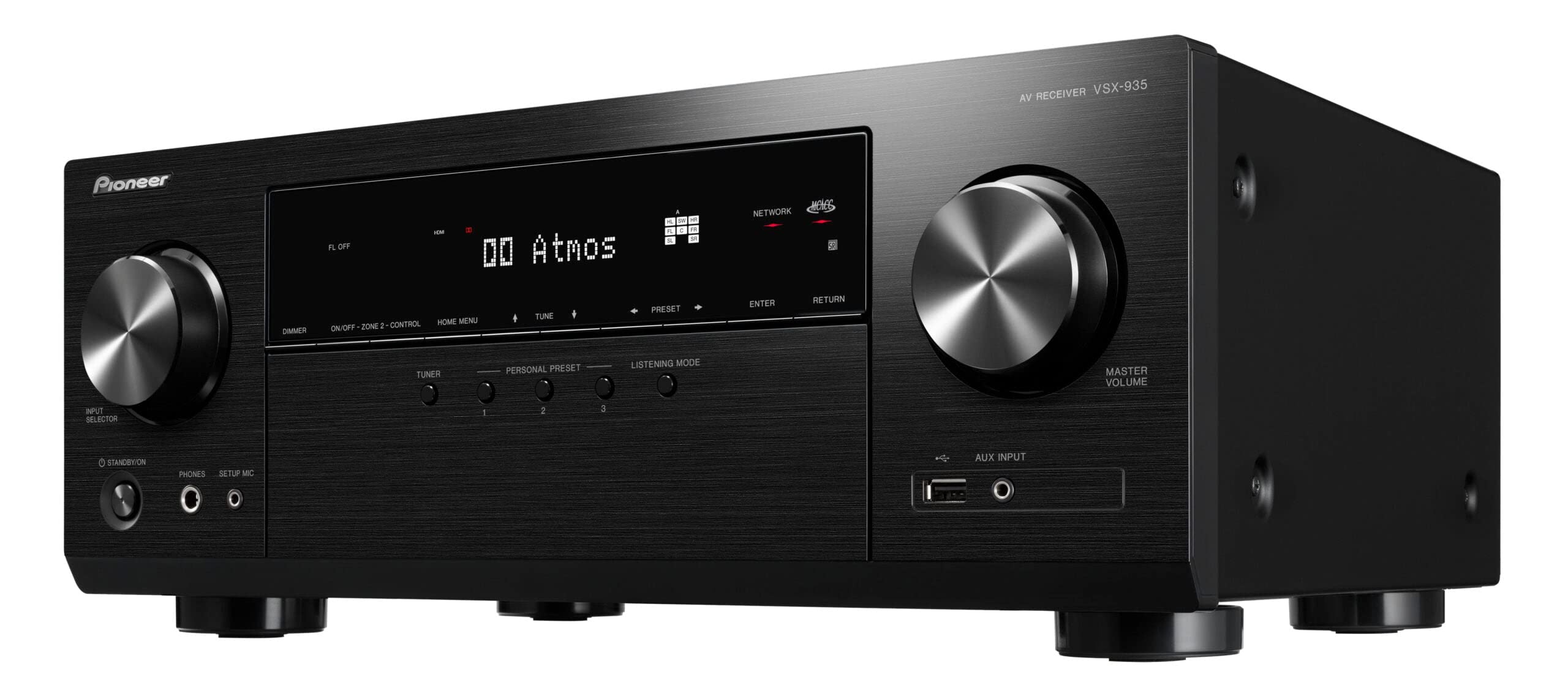
The Pioneer VSX-935 is a solid mid-range option that focuses on virtualized surround technology rather than raw channel count. Dolby Atmos Height Virtualization creates the illusion of overhead sound without ceiling speakers, and it works effectively with standard 5.1 or 7.1 speaker layouts. The RF remote is a practical inclusion — it works without line-of-sight, which is useful if the receiver is hidden in a cabinet.
The HDMI 2.1 inputs support 8K/60Hz and 4K/120Hz with enhanced gaming features, making it a capable hub for the latest consoles. Dual zone output allows independent audio distribution to a second room, and the display is clear with a dimmer function to reduce distraction during movie watching. The unit ships with 2021 firmware, so a wired network update is recommended before setup.
The Bluetooth implementation is frustrating — it is buried in menus and lacks a dedicated remote button, which makes switching between Bluetooth and HDMI sources cumbersome. Some early units arrived DOA, but vendor replacements seem to have resolved the quality control issue. For users who value virtualized Atmos and a long-range remote, the VSX-935 is a competent performer.
Why it’s great
- Effective Dolby Atmos Height Virtualization without ceiling speakers
- RF remote works through cabinets
- Dual zone output for multi-room audio
- HDMI 2.1 with 8K/60Hz support
Good to know
- Bluetooth menu is buried with no dedicated button
- Requires firmware update out of the box
- Some units have quality control issues
11. JBL MA510 5.2 Channel 8K AV Receiver

The JBL MA510 is a 5.2-channel receiver designed for users building a compact 5.1 system without the need for Atmos height channels. It delivers 75 watts into each of its five channels, which is sufficient for modest bookshelf speakers in small to medium rooms. The 8K HDMI 2.1 inputs with eARC ensure compatibility with the latest TVs and gaming consoles.
Streaming support includes Bluetooth, Apple AirPlay 2, and Google Chromecast built-in, covering the major ecosystems without requiring an external streamer. The shallow chassis design — just 13.7 inches deep — mirrors the MA710 and fits easily in most cabinets. Setup through the on-screen menu via HDMI ARC is straightforward after firmware updates are applied.
The MA510 cannot downmix DTS-HD Master Audio to 2.1 channels, which is a limitation for users with stereo-only setups who still want lossless audio from Blu-ray discs. The non-backlit remote is frustrating in a dark theater room. For the price, it is a clean entry point into 4K surround sound with modern HDMI features, but serious home theater builders should budget for at least the MA710.
Why it’s great
- Compact depth fits standard media cabinets
- Chromecast and AirPlay 2 for wireless streaming
- 8K HDMI 2.1 with eARC for future-proofing
- Clean, neutral sound for the price
Good to know
- No DTS-HD Master Audio downmix for 2.1
- Remote lacks backlighting
- 5.2 channels limit Atmos and expandability
FAQ
What is the difference between Dolby Atmos and DTS:X?
Do I need a separate amplifier for a 7.1.4 setup?
Why does my receiver run so hot?
Can I use a surround receiver with powered bookshelf speakers?
Final Thoughts: The Verdict
For most users, the best surround receiver winner is the Onkyo TX-RZ50 because it bundles premium Dirac Live room correction, THX Select certification, and 9.2 channels of processing at a price that undercuts competitors with similar specifications. If you want Sony’s unique 360 Spatial Sound Mapping for phantom height effects without cutting ceiling holes, grab the Sony STRAZ5000ES. And for a budget-friendly entry into 4K surround sound with modern HDMI features, nothing beats the JBL MA510.