
Driving on under-inflated tires isn’t just a fuel-economy hit — it’s a safety compromise that reduces grip, increases stopping distance, and accelerates tread wear. The only way to know your true tire pressure is with a gauge you trust, and the market today offers everything from simple analog sticks to precision digital inflators with locking chucks.
I’m Min — the co-founder and writer behind Gadgets Feed. I’ve spent countless hours cross-referencing ANSI calibration standards, comparing PSI accuracy tolerances, and analyzing customer reports of real-world drift and durability across dozens of tire gauge models to bring you this guide.
After calibrating against known references and reading hundreds of verified user reports, I’ve narrowed the field to the models that deliver repeatable, category-specific accuracy. Whether you need a digital readout for your daily driver or a rugged analog gauge for off-road use, this guide to the best tire air gauge covers the tools that actually earn a spot in your glovebox or garage.
How To Choose The Best Tire Air Gauge
Choosing a tire air gauge is about matching your vehicle type and work style to the right set of features. Not every gauge fits every tire — a 0-30 PSI scale is perfect for ATVs but useless for a truck running 45 PSI. Focus on accuracy rating, display type, hose design, and the presence of a bleed valve.
Accuracy Standards: ANSI Grade 2A vs ±1%
Look for gauges calibrated to ANSI B40.7 Grade 2A, which guarantees ±1 PSI accuracy across the entire scale. Higher-end digital models claim ±0.5% or ±0.5 PSI — these are worth the extra investment if you run high-pressure tires or race rubber. Analog gauges usually quote ±1.5% of full scale, meaning a 100 PSI gauge is accurate to ±1.5 PSI at mid-range.
Digital vs Analog: Battery Reliability
Digital gauges offer 0.1 PSI resolution and backlit displays, but they depend on batteries that can die mid-job. Analog gauges never need power and read instantly, but their internal springs can drift with age or impact damage. Pro mechanics often keep both — a digital inflator for the shop and a pocket analog gauge for road trips.
Chuck Design and Hose Length
A 360-degree swivel chuck with a locking clip-on head makes one-handed inflation possible. On dual-rear-wheel trucks, a longer flexible hose (14 inches or more) is critical for reaching inner valve stems without scraping your knuckles. Standard 1/4-inch NPT threads ensure the gauge connects to your compressor without adapters.
Quick Comparison
On smaller screens, swipe sideways to see the full table.
| Model | Category | Best For | Key Spec | Amazon |
|---|---|---|---|---|
| ETENWOLF T600 | Digital | Everyday precision | ±0.5% / 0-250 PSI | Amazon |
| Milton 507KIT | Digital Inflator | Home shop / trucks | ±1 PSI / 0-250 PSI pistol grip | Amazon |
| EXELAIR EX516DIG | Digital | Dual-wheel / fleet use | 5-100 PSI / backlit display | Amazon |
| GERCHWAY 100 PSI | Analog Inflator | No-battery reliability | ±2 PSI / 0-100 PSI glow dial | Amazon |
| AstroAI (B07D3PVBJ4) | Digital Inflator | Auto-on convenience | ±1% / 3-250 PSI / lock-on chuck | Amazon |
| AstroAI T1 | Digital Inflator | Budget value / compact | Grade 2A / 3-250 PSI / 0.65 lb | Amazon |
| JACO Elite E30 | Analog Low-PSI | ATV / off-road / RO tank | ±1.5% / 0-30 PSI / lock-on dial | Amazon |
In‑Depth Reviews
1. ETENWOLF T600 Digital Tire Pressure Gauge 0-250 PSI
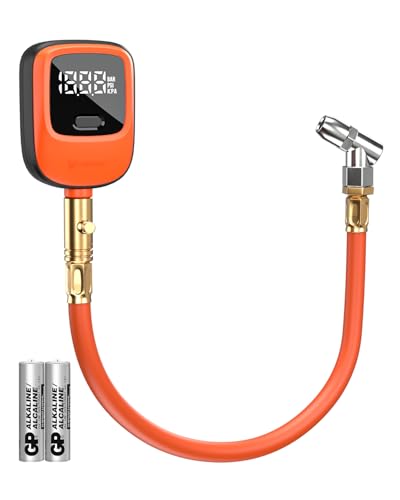
The ETENWOLF T600 is manually calibrated to ANSI B40.7 Grade 2A standards with a ±0.5% accuracy rating — noticeably tighter than the ±1 PSI baseline. In real-world use, customers report readings matching within 0.5 PSI of known-accurate analog gauges and OEM TPMS sensors across both car tires (39 PSI) and bike tires via a Presta adapter. The 0–250 PSI range covers everything from a bicycle to a heavy-duty truck, and the 360° rotating nozzle with flexible rubber hose makes awkward valve angles a non-issue.
A single button handles power, zero-reset, and unit switching (PSI, BAR, KPA). The display locks the reading until you press the button again — no need to squint at a moving needle. The integrated bleed valve lets you deflate while the gauge is still attached, so you can dial in exact pressure without removing and re-attaching. Powered by two replaceable AA batteries, the T600 avoids the sealed-battery obsolescence of cheaper digital gauges.
Build quality is solid with a metal-and-rubber body that survived consistent use in 45°F weather with no drift. The swivel points are intentionally tight to prevent air leaks, and the included batteries are a nice touch. It sits comfortably in hand for both car and motorcycle use, and the 2-year warranty adds peace of mind.
Why it’s great
- High ±0.5% accuracy validated by multiple real-world comparisons
- Bleed valve and locking chuck for single-tool inflation
- Replaceable AA batteries, no proprietary cells
Good to know
- Plastic body components may not survive heavy drops on concrete
- Swivel is tight initially — requires a break-in period
2. Milton 507KIT Digital Tire Inflator

The Milton 507KIT is a 3-in-1 digital inflator, deflator, and pressure gauge built around a pistol-grip alloy steel body that makes one-handed operation genuinely easy. It delivers ±1 PSI accuracy across 0–250 PSI with 0.1 PSI resolution, meeting the ANSI/ASME B40.1 standard. The backlit LCD display auto-illuminates when pressure is detected, so working under a hood or in dim garage lighting is straightforward.
The 14-inch rubber hose with a locking brass clip-on chuck reaches inner dual-wheel valve stems without contortion. A fully integrated deflate button on the grip lets you fine-tune pressure without removing the chuck. Customers note the gauge auto-powers on when connected to a tire, and auto-shuts off after 15 seconds — saving AAA battery life in daily shop use. One user with severe arthritis reported the clip-on end eliminated the struggle of pressing a pencil gauge into the valve.
Build quality feels premium: the brass locking coupler is heavy-duty, and the hose is flexible at low temperatures. The main caution is that the NPT fitting shipped with the unit may be extremely tight on some hoses — a quick coupler swap solves it. The trigger and bleeder allow precise pressure adjustment, and the battery level indicator on the display prevents surprises mid-job.
Why it’s great
- Ergonomic pistol grip with integrated bleed trigger for one-tool tuning
- Brass lock-on chuck and 14-inch hose for dual-wheel access
- Auto backlit display with battery level indicator
Good to know
- Pre-applied sealant on NPT threads can crack couplers if over-tightened
- Gauge head is fixed (no swivel) — best for right-hand use
3. EXELAIR EX516DIG by Milton Dual Head Tire Gauge

The EXELAIR EX516DIG is a digital gauge built with a full metal body and a non-slip comfort grip, designed for frequent use in fleet or shop environments. It measures 5–100 PSI (plus kPa and BAR) — a narrower, more focused range than the 250 PSI monsters, which means better mid-range resolution for passenger cars and light trucks running 30–50 PSI. The backlit LED display and a built-in LED flashlight at the base let you read pressure and see the valve stem in poor light.
The 360-degree dual-head swivel chuck works on straight-foot and angled valve stems, including hard-to-rear dually valves. The display locks the reading until you press reset, and auto-shutoff saves the two included AAA batteries. Customers report the gauge is accurate enough to match across multiple units consistently, and one owner noted the metal body survived being run over by a truck tire without losing calibration — a testament to its durability.
Downsides include a slightly slower response time — it needs a few seconds engaged on the valve to stabilize the reading. The plastic button is cosmetic, pressing an internal PCB switch underneath, but the overall build is robust. The extended reach (13.38 inches total length) makes it a top choice for trucks with recessed valve stems.
Why it’s great
- All-metal construction rated for industrial/commercial abuse
- Built-in LED flashlight for low-light tire checks
- Dual-angle swivel chuck reaches dually and recessed valves
Good to know
- Not instant-read — needs 2-3 seconds for a stable reading
- Plastic button actuates a PCB switch (not robust for extreme abuse)
4. GERCHWAY Tire Inflator with Pressure Gauge — 100 PSI
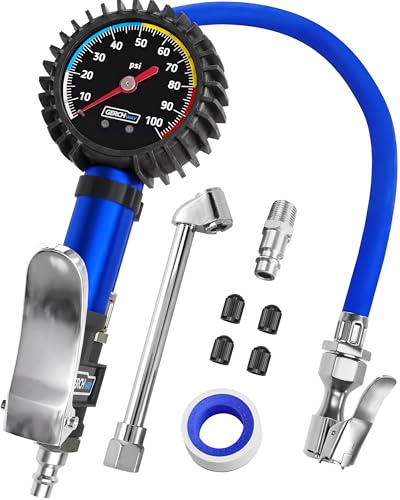
The GERCHWAY 100 PSI analog inflator is built for the user who refuses to trust electronics with their tire pressure. With a 0–100 PSI scale, it operates in the most accurate zone for passenger tires (35–50 PSI falls in the middle third of the dial, where analog gauges are most precise). It claims ±2 PSI (2% FS) accuracy, which is adequate for daily driving but less precise than a digital Grade 2A gauge.
The large rubber case surrounding the gauge protects against drops, and the glow-in-the-dark dial is legible in dim corners of a garage without needing a flashlight. The 360-degree swivel air chuck with a longer flexible hose provides good clearance around dual-wheel setups and awkward valve angles, and the 1/4-inch NPT quick-connect fitting hooks directly to most air compressors. A deflate button is embedded in the dial face for releasing excess pressure without removing the chuck.
Customers appreciate the included spare parts (Teflon tape, valve caps, extra O-rings) and the fact that it never needs batteries. The kit includes both a standard length and a shorter nozzle for motorcycle tires. The main criticism: the clip-on chuck doesn’t always hold a seal hands-free — you may need to hold it onto the stem, especially on older valves with worn threads.
Why it’s great
- Zero battery dependency — works every time, any temperature
- Glow dial readable in low light without flashlight
- Long swivel hose with spare parts included
Good to know
- Chuck may not seal hands-free on all valve stems
- ±2 PSI accuracy is less precise than digital alternatives
5. AstroAI Digital Tire Pressure Gauge with Inflator (B07D3PVBJ4)
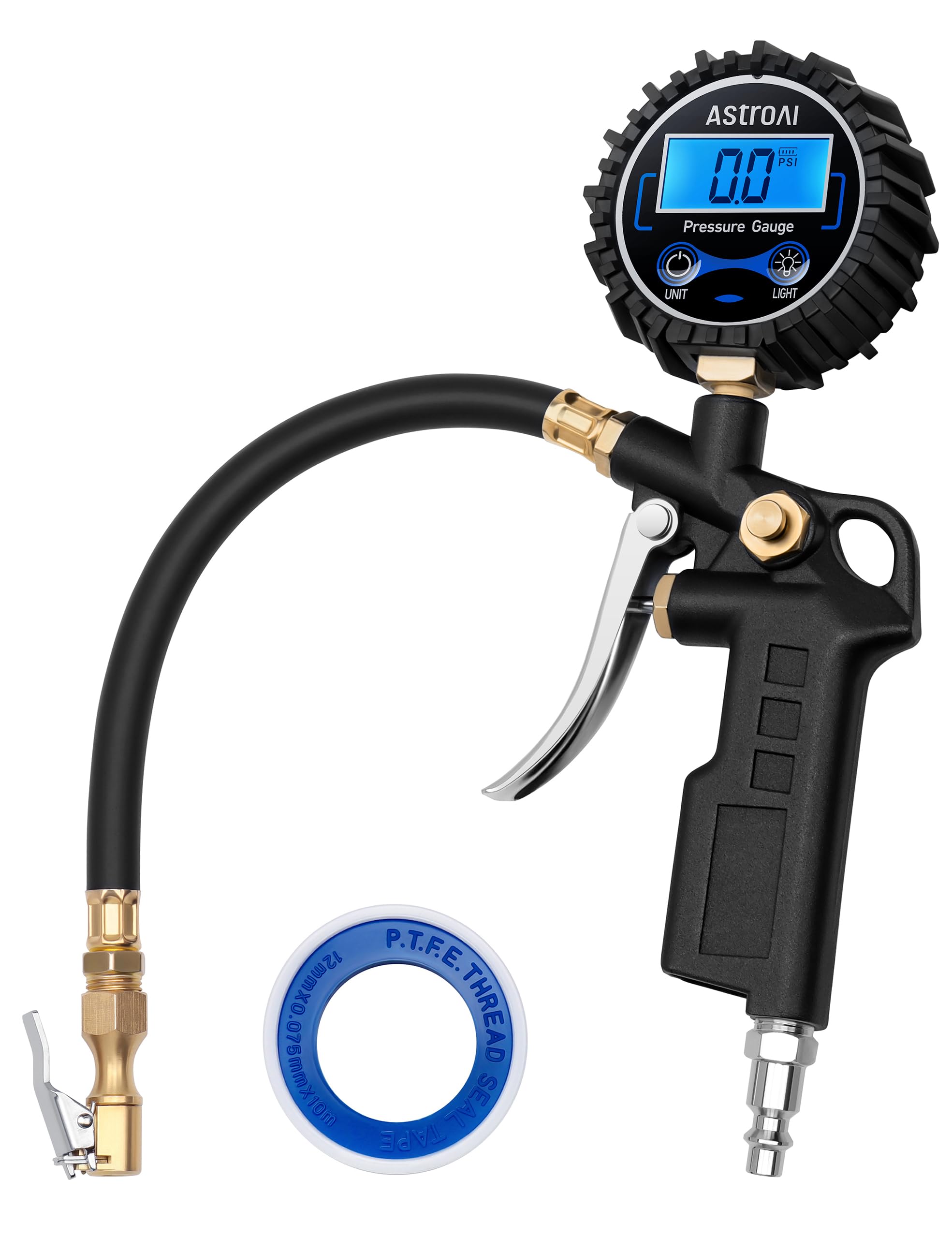
The AstroAI 250PSI-M is a well-rounded digital inflator gauge calibrated to within ±1% of exact pressure across a 3–250 PSI range. It’s compatible with both 1/4-inch and 1/2-inch NPT air compressor outputs, which gives it rare flexibility for those with older or non-standard fittings. The all-in-one unit combines a straight locking chuck, a gauge, a hose, and a bleed valve, letting you check, inflate, and deflate without swapping tools.
One standout feature is the auto-on sensor: pressurize the gauge against a valve stem and it powers up instantly, then shuts off after 20 seconds of inactivity to preserve battery life. The 0.1 PSI display resolution gives you precise readings, and the heavy-duty stainless steel and brass components hold up to regular shop work. Customer reviews consistently mention quick, repeatable readings that match within 0.5 PSI of other known-accurate gauges.
The ABS-and-aluminum body is lightweight (10.56 ounces) but feels durable. The main trade-off is the straight-locking chuck — it works fine for standard Schrader valves but doesn’t swivel, so you may need to angle the gauge body awkwardly on recessed stems. The 3-year warranty from AstroAI is stronger than most competitors at this tier.
Why it’s great
- Dual NPT compatibility (1/4″ and 1/2″) for flexible compressor connection
- Auto-on sensor and auto-shutoff save battery
- ±1% accuracy with 0.1 PSI resolution
Good to know
- Straight chuck doesn’t swivel — limited on recessed valve stems
- Display not backlit, harder to read in dim conditions
6. AstroAI T1 Digital Tire Pressure Gauge with Inflator
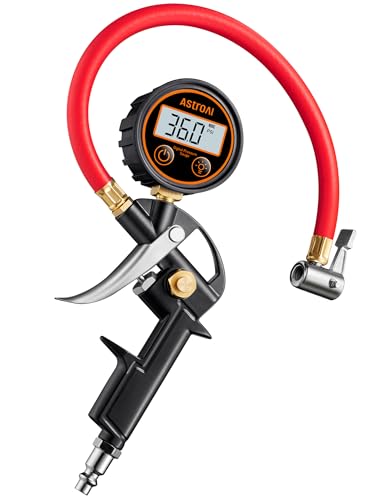
The AstroAI T1 is an entry-level digital inflator that punches above its price tier with ANSI B40.7 Grade 2A certification (±1 PSI). At just 0.65 pounds and measuring 9.65 x 4.61 x 1.77 inches, it’s one of the most portable all-in-one gauges on this list. It covers 3–250 PSI with four selectable units (PSI, BAR, KPA, KG/CM²), making it suitable for bicycles, motorcycles, cars, and commercial trucks.
The gauge maintains ±0.1 PSI accuracy across -14°F to 122°F, so it won’t drift in winter roadside checks. The anti-air-leakage connector and built-in deflate valve let you release pressure without unscrewing the chuck. Customers praise the easy-to-read digital display and the elimination of guesswork — no more running back and forth to the compressor. The brass construction adds corrosion resistance for humid or wet environments.
While the T1 feels solid for its weight, the ABS and brass construction isn’t as rugged as all-metal options like the EXELAIR. The display lacks a backlight, which is a minor inconvenience in low-light roadside scenarios. The compact size makes it ideal for glovebox storage, and the price point makes it a no-regret purchase for occasional users who still want Grade 2A accuracy.
Why it’s great
- ANSI Grade 2A certified at a very competitive price
- Ultra-compact (0.65 lbs) and portable
- Wide temperature tolerance (-14°F to 122°F)
Good to know
- No backlight on the display
- ABS body less durable than all-metal alternatives
7. JACO Elite Low Pressure Tire Gauge — 30 PSI

The JACO Elite E30 is a niche specialist: a 0–30 PSI analog gauge designed for low-pressure tires on ATVs, UTVs, dirt bikes, tractors, and off-road vehicles. Most digital gauges lose accuracy at the bottom of their 0–250 PSI range, but the E30’s 0–30 scale means a 15 PSI off-road tire is reading at mid-dial, where analog gauges hit peak precision. It’s calibrated to ±1.5% of full scale (roughly ±0.45 PSI at 30 PSI).
The build uses a solid brass stem with a shock-resistant rubberized guard that protects the delicate internal spring mechanism from drops and vibration. The 360-degree swivel air chuck with an extended tip ensures a perfect seal from any angle, while the built-in deflator valve lets you air down quickly for trail use. The large 2-inch dial glows in the dark and features a lock-on needle — reading stays on the dial until you press the reset button.
Customers confirm accuracy within 0.5 PSI of a reference gauge and love the one-hand operation. The main limitation is obvious: it maxes out at 30 PSI, so it’s useless for passenger car tires that typically run 32–42 PSI. The reset button mechanism is delicate — dropping the gauge can damage the internal linkage, so handle with care. JACO backs it with a 100% lifetime warranty.
Why it’s great
- Exceptional accuracy in the 0-30 PSI low-pressure zone
- Lock-on needle with glow dial for night off-road use
- 360 swivel chuck with integrated deflator for trail air-downs
Good to know
- 30 PSI max — not suitable for standard passenger car tires
- Internal mechanism can be damaged if dropped on hard surface
FAQ
Can I use a 0-30 PSI gauge on my passenger car tires?
Why does my digital tire gauge read differently from the gas station pump?
How do I calibrate or zero an analog tire pressure gauge?
Final Thoughts: The Verdict
For most users, the best tire air gauge winner is the ETENWOLF T600 because it combines ±0.5% accuracy, a bleed valve, a swivel chuck, and replaceable AA batteries in a package that works on everything from a bicycle to a pickup. If you prefer a feature-rich inflator with a pistol grip and lock-on chuck for home shop use, grab the Milton 507KIT. And for zero-battery reliability on off-road rigs with 15 PSI tires, nothing beats the JACO Elite E30.