
Our readers keep the lights on and my morning glass full of iced black tea. As an Amazon Associate, I earn from qualifying purchases.
Specs are compiled from manufacturer listings and verified buyer reviews and can change over time — please confirm the key details on the product page before buying.
You want a toy that an 8-year-old will play with more than once, and that is a high bar. At this age, kids have outgrown baby toys but still need supervision with complex gadgets. the balance is a toy they can build, experiment with, or solve independently—the picks below hold attention for hours, not minutes.
I’m Min — the founder and writer behind Gadgets Feed. This guide is built by comparing the manufacturers’ published specifications and the patterns across verified customer reviews, so you get each pick’s real strengths and trade-offs instead of marketing spin.
If you are hunting for toys for 8 year olds that mix real learning with genuine replay value, these nine picks are the ones worth your attention.
Our Picks at a Glance



How To Choose The Best Toys For 8 Year Olds
An 8-year-old is at a unique stage where their fine motor skills, reading ability, and attention span are finally developed enough for complex builds. Winning toys at this age let kids work independently, feel real accomplishment, and offer depth for repeat play. Here is what separates a one-day wonder from a long-term favorite.
Look for open-ended replay value
A toy that can only be assembled one way gets boring by day three. The strongest picks here either offer multiple build configurations or a huge number of distinct projects — often over 100 — so the toy stays fresh for months. Check whether a kit can be combined with other sets from the same brand, which effectively doubles its lifespan.
Match the challenge to the child
There is a big difference between an 8-year-old who loves puzzles and one who gets frustrated easily. A logic game with 60 progressive difficulty cards can be perfect for a patient thinker but frustrating for a kid who wants instant results. Think about how your child handles a difficult task before choosing between a fast-reward building kit and a slow-burn logic challenge.
Check what’s actually in the box
Many science kits advertise a huge number of experiments but quietly require you to supply common household items like baking soda or vinegar. That is fine — but it changes the experience. Also check whether batteries are included, since several electronics kits need them separately. Knowing what you must add before the first use prevents disappointment on gift-giving day.
Quick Comparison
| Model | Best For | Projects | Age Range | Weight | Amazon |
|---|---|---|---|---|---|
| Snap Circuits Jr. SC-100★ Best Overall | First electronics builds | 100+ | 8+ | 640 g | Amazon |
| ThinkFun Gravity MazeLogic Builder | Logic and spatial reasoning | 60 challenges | 8+ | 1.1 pounds | Amazon |
| Doctor Jupiter Girls’ Science KitKitchen Lab | Hands-on chemistry fun | 135+ | 8-12 | 650 g | Amazon |
| Snap Circuits Flight Deck | Physics and flying gadgets | 5 projects | 8+ | 0.29 kg | Amazon |
| Shashibo DODECA Cube | Fidget-friendly shape shifting | 100+ shapes | 8+ | — | Amazon |
| National Geographic Junior Chemistry Set | Young scientists aged 4+ | 50 experiments | 4+ | 0.72 kg | Amazon |
| LEGO Creator Fierce Shark | 3-in-1 creature builds | 3 models | 8+ | 1.1 pounds | Amazon |
| National Geographic Earth Science Kit | Volcanoes, crystals, and digs | 100+ | 8-12 | 2.6 pounds | Amazon |
| NEXBOX 8-Wheel Stunt Car | Active outdoor play | — | 6-12 | 0.79 kg | Amazon |
In-Depth Reviews
1. Snap Circuits Jr. SC-100 Electronics Exploration Kit
Our pick — over 4.5★ from 29,000+ verified ratings; the strongest balance of quality and price.
The crowd favorite that turns an 8-year-old into a circuit-building engineer with zero soldering.
This is the pick that parents and educators keep coming back to, and the reason is simple: it delivers over 100 electric-powered projects from a single box of 28 color-coded pieces. Your child can snap together a flying saucer and watch it take off, or build a working alarm — all without a single tool or drop of solder. The numbered pieces click onto a plastic grid, so even a first-time builder gets instant success.
Buyers rave most about the build quality, making it the most-discussed feature by far. Kids as young as 4 enjoy taking it apart and rebuilding it, and several buyers report the set lasting years — one nostalgic buyer owned the same kit 12 years ago and credits it with sparking an engineering passion. The full-color manual guides a child from easy to genuinely challenging projects, and you only need common household items for the extras.
It is also a brilliant gift because it grows with the kid: the pieces are interchangeable with other Snap Circuits sets, so a child who outgrows these 100 projects can combine sets for even more builds. The one honest trade-off is that a few owners found some components fragile, with pieces not always snapping as securely as they would like.
Why It Wins Kids Over
- Over 100 projects from 28 snap-together parts
- No tools or soldering required — instant start
- Pieces work with other Snap Circuits sets
- Color-coded, numbered parts make instructions easy
The Honest Trade-Off
- Some pieces feel fragile and may not snap securely
- Batteries not included
Reach for this if: you want a screen-free toy that teaches real electrical engineering basics and holds a child’s attention for years.
Look elsewhere if: your child needs instant gratification — building a circuit takes patience and following steps.
2. ThinkFun Gravity Maze
The marble-run logic game that quietly stumps adults while keeping kids off screens.
Gravity Maze is a thinking toy disguised as a marble run. You get 9 towers, 3 marbles, a game grid, and a target piece, then work through 60 challenge cards that climb from beginner to expert. Each card asks you to build a path that drops the marble into the target — and some of the later challenges will humble grown-ups. The satisfying “clink” of a marble landing correctly is its own reward.
The gameplay is the thing people praise most about this one, with hours of entertainment reported across the board. It builds spatial reasoning, planning, and problem-solving skills through hands-on trial and error, with instant feedback every time a marble falls the wrong way. It is also a strong collaborative toy: the review pages sum it up — kids and parents end up huddled over the grid together, and the “one more level” syndrome is real.
One honest note: 8 years old may be right at the edge. If your child gets frustrated by puzzles, the challenge cards might feel too hard — some owners suggest 10 is the balance for true puzzle-solving. But even as free play, building marble runs with the towers is engaging on its own.
Screen-free brain workout: 60 progressive puzzles that build patience, spatial reasoning, and problem-solving — with answers printed on the card backs when adults get stuck.
One caveat: it is genuinely hard for some 8-year-olds, and a few families reported beating all 60 challenges within a week before moving on.
3. Doctor Jupiter Girls’ Ultimate Science Experiments Kit
A 135-experiment chemistry set that turns the kitchen into a weekend science lab.
Doctor Jupiter packs over 135 experiments into one box, covering volcano science, water science, color science, and crystal growing. The included measuring cylinder, conical flask, test tube stand, and other lab tools make a child feel like a real scientist. Each project is designed to take just 5-10 minutes, which is perfect for the 8-12 attention span.
The gift appeal is the standout — it is the most-praised aspect, and parents report it becoming a favorite birthday present. Kids as young as 7 have worked through projects daily for nearly a week with minimal help, and the manual explains the “why” behind each reaction, not just the steps. The kit complies with ASTM F963-17, the U.S. federal toy safety standard, so it’s safe for supervised kitchen experiments.
Be ready to supply a few basics from home — one family noted only a balloon was missing. The value-for-money verdict is split: plenty of parents call it worth every penny, while a few find it on the pricey side for what’s inside. The many small pieces also need a storage plan.
Weekend project engine: 135+ experiments with 5-10 minute setup times keep curious kids busy daily — the instruction manual even explains the science behind each reaction.
Plan for extras: a few household items like balloons are needed, and the many small components demand a storage bin.
4. Snap Circuits Flight Deck

The add-on that launches paper airplanes, flying saucers, and levitating balls.
Where the SC-100 is a broad introduction to electronics, Flight Deck is a focused physics playground. It offers five unique projects: launching paper airplanes and flying saucers, levitating balls over a fan to demonstrate air pressure, and creating artistic patterns on a spinning wheel. The easy-to-follow directions let kids work independently and build confidence as they discover how electricity and aerodynamics connect.
The gift factor is what people mention most about this kit — it has become a reliable birthday and holiday pick. Kids as young as 7 have loved it, and one 10-year-old is reportedly obsessed, repeatedly rebuilding the configurations from the guidebook. The replay value comes from the many build combinations, and the manufacturer sells affordable individual replacement parts if anything wears out.
The trade-off is honesty about the paper airplane launcher: even some adults found that specific feature tricky to get right, while the other components were easy and functional. Durability also gets mixed feedback, with a few owners reporting the motor failing on first use — though this is not the consensus experience.
What Makes It Fun
- Five distinct physics projects including levitation
- Independent building with easy instructions
- High replay value from many configurations
Watch For
- Paper airplane launcher is finicky even for adults
- Occasional motor failure reported on first use
- Batteries not included
Who it fits: a child already curious about Snap Circuits who wants flying, spinning, air-pressure fun.
Who might pass: a family that wants a standalone toy — this shines brightest as an add-on to the main Snap Circuits kit.
5. Shashibo DODECA Magnetic Puzzle Cube
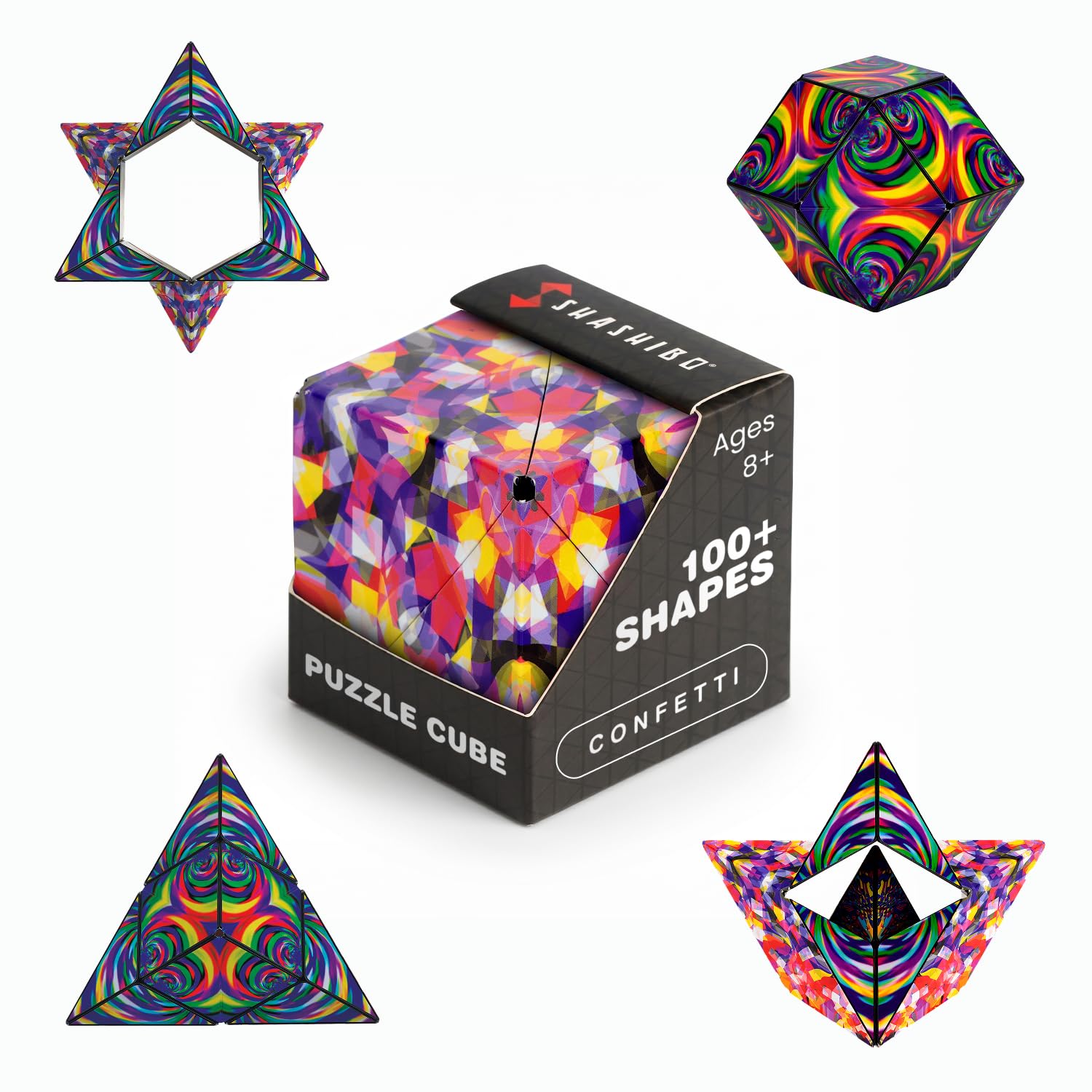
The magnetic cube with over 100 shapes that quiets restless hands anywhere.
Shashibo is less a “toy” and more a pocket-sized obsession. This 2.36-inch cube folds and flips through over 100 possible shapes, powered by 36 ultra-strong magnets designed for connectivity. Enjoyment is the most-praised aspect—kids as young as 7 and adults get hooked on flipping it into geometric art.
It is marketed as a classroom must-have and a digital-detox distraction, and that checks out: it is silent, screen-free, and small enough to disappear into a backpack. Young children, teens, and even adults with arthritis have found it engaging, and the Collect & Connect system lets you snap multiple cubes together for bigger, more complex structures.
The biggest honest concern is durability — a significant share of owners mention the stickers peeling off or the cube coming apart with heavy use. There is also real friction on value: plenty of buyers call it overpriced for what is essentially a magnet puzzle, even while admitting kids love it.
Quiet screen-free relief: over 100 shapes from a palm-sized cube makes it an ideal fidget toy for car rides, classrooms, and waiting rooms.
Know the risk: stickers can peel with heavy daily use, and the price-to-size ratio feels steep to some families.
6. National Geographic Junior Chemistry Set

A 50-experiment chemistry lab that even a toddler can enjoy with supervision.
National Geographic’s Junior Chemistry Set is pitched at ages 4 and up, making it the most accessible science kit on this list. It includes 50 hands-on experiments built around common household items like baking soda and vinegar, plus over 20 durable, child-safe lab tools including test tubes, a funnel, and safety goggles. The fully illustrated, step-by-step instructions let young scientists follow along on their own.
Enjoyment is the dominant theme in owner feedback — kids love making colored solutions and playdough, and the set is easy to set up and clean up. Blue Marble, the parent company, has won the Toy Association’s Toy of the Year Award, and this set is an Amazon exclusive. For an 8-year-old just getting into science, the simple experiments build confidence fast.
The catch is that it skews young: a 5-year-old needed lots of hand-holding, and some projects were beyond him. That same simplicity might make it feel too easy for a mature 8-year-old. A few owners also note it doesn’t come with every ingredient needed, and the dye can stain hands — wear play clothes.
Gentle science introduction: 50 easy experiments with clear pictures build confidence in the youngest scientists, using pantry staples.
Age reality check: best for ages 4-7; a sharp 8-year-old may want a kit with more challenge and fewer household-ingredient runs.
7. LEGO Creator Fierce Shark with a Treasure Chest
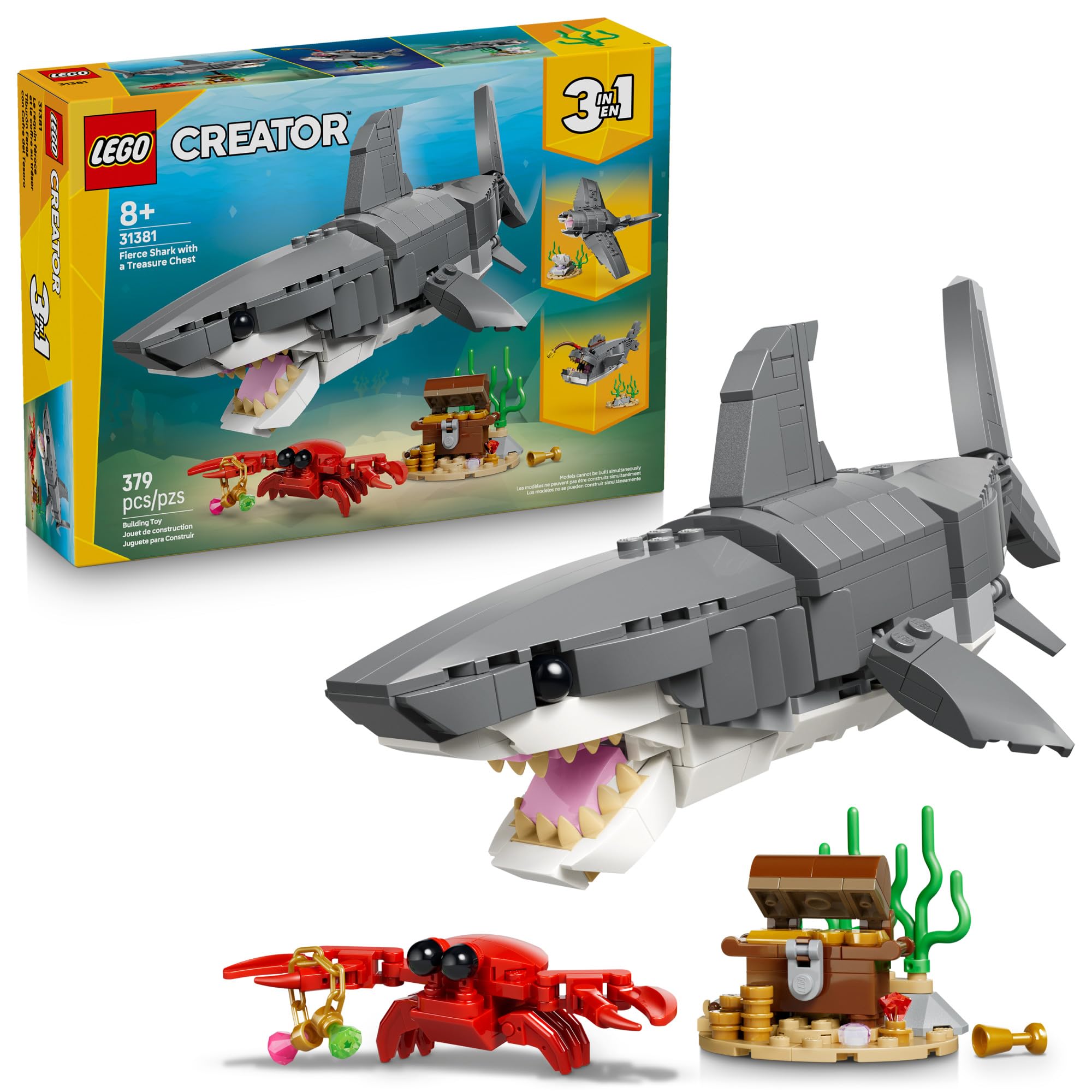
One box of bricks that builds a shark, an anglerfish, or a manta ray.
LEGO’s 3-in-1 Fierce Shark delivers triple the value of a standard set. From 379 pieces, an 8-year-old can build a posable shark with a treasure chest, an anglerfish, or a manta ray — though not all at once. Each model has moveable parts: the shark’s mouth, body, side fins, and tail fin all articulate, and the manta ray’s tail fin poses too. The finished builds sit on an included stand, doubling as shelf decor.
Quality is what owners praise most about this set, with playability close behind. Kids are genuinely thrilled by it — one 9-year-old birthday recipient loved putting it together, and the LEGO Builder app provides easy-to-follow instructions where kids can zoom and rotate models in 3D while building. LEGO bricks have met strict industry standards for consistency and compatibility since 1958, ensuring every piece clicks together reliably.
This is the safest gift on the list for a kid who already loves building. The set measures over 10 inches long as the shark, making it substantial. The only real limit is its single-subject theme — a child who isn’t into sea creatures may prefer a different 3-in-1.
What Builders Get
- Three complete models from one 379-piece set
- Posable fins, mouth, and tail on every build
- Display stand included for shelf decor
- LEGO Builder app with 3D zoomable instructions
What To Know
- Only one model can be built at a time
- Sea-life theme may not suit every interest
Go with this one for: a reliable, high-quality build that a LEGO-loving 8-year-old can finish in about an hour and proudly display.
skip it if: the ocean theme won’t land — in which case the same 3-in-1 format exists in other subjects.
8. National Geographic Earth Science Kit

A 100-plus activity earth science kit with volcanoes, crystals, and dueling water tornadoes.
National Geographic’s Earth Science Kit is the heavyweight of this list at 2.6 pounds, packed with more than 15 core experiment activities that expand to 100+ total. Kids can build an erupting volcano, grow a crystal, run dueling water tornadoes, and dig through two geologic dig kits. It is designed to be shared — enough material to conduct experiments with family, friends, or classmates.
The quality is the most-praised aspect, followed closely by its gift-giving appeal. Parents have kept kids entertained for hours with the volcano experiment alone, and it is a noted favorite for homeschooling families. The detailed, full-color Learning Guide teaches the science at work in each experiment, building a lasting appreciation for earth sciences rather than just a fun afternoon.
Two honest caveats: the value-for-money verdict is split, with some calling it overpriced for what is inside, and the instructions receive genuinely mixed feedback — several owners found them lacking. The experiments use household supplies in places, so check the guide before starting.
Big, shareable science: 100+ activities from volcanoes to crystal growing, with a full-color Learning Guide that explains the science behind the fun.
Two honest snags: some owners find it slightly overpriced and the instructions occasionally thin — a parent may need to fill in the gaps.
9. NEXBOX 8-Wheel Hand Controlled RC Stunt Car

The 8-wheel stunt car that does flips, spins, and 360-degree rotations with a wave of the hand.
For the kid who needs to move, this RC car is pure adrenaline. The 8-wheel design enables double-sided driving, acrobatic flips, incredible climbing, and 360-degree rotations, all controlled either by a classic remote or a gesture-sensing watch. Flashing lights, dynamic music, and realistic exhaust effects add to the drama. It comes with two rechargeable lithium-ion batteries, so the play session lasts longer.
Playability is what owners praise most — kids from 5 to 12 are hooked, building obstacle courses and taking the car to parks. One 5-year-old’s first RC car reportedly went across grass and a sand playground just fine, and siblings end up playing together in the cul-de-sac. It is also weather-resistant, so a bit of outdoor adventure won’t ruin it. The gesture watch is a standout feature that ordinary RC cars simply don’t offer.
The recurring realism check: durability is genuinely mixed, with a few owners finding it easy to damage under hard play. Battery life and value-for-money also get split reviews. It is the most expensive pick here, so weigh the thrill against the build quality.
The Thrill Factor
- 8 wheels enable flips, climbs, and 360-degree spins
- Gesture-sensing watch or classic remote control
- Two rechargeable batteries included
- Weather-resistant for outdoor play
Before You Buy
- Durability is mixed — hard play can damage it
- Battery life gets split reviews
- Premium price for a stunt toy
Pick this for: an energetic 8-year-old who prefers action over puzzles and will get a kick out of gesture controls.
Think twice if: your child is rough on toys — the stunt mechanics can be damaged with hard landings.
Understanding the Specs
Project & Challenge Count
This is the single most useful number on a STEM toy box. A kit advertising 100+ projects means months of replay value, while a 5-project set like the Flight Deck is more of a focused add-on. For logic toys, the challenge count matters similarly — 60 progressive cards in Gravity Maze means a slow burn from beginner to expert, rather than a one-afternoon puzzle. A higher project or challenge count means longer-lasting relevance.
Age Range & Independence
An age label like “8+” tells you the minimum skill level, but it doesn’t tell you how much parent help is needed. The National Geographic Junior Chemistry Set is rated 4+, which means an 8-year-old may find it too easy — it skews young. Meanwhile, Gravity Maze is rated 8+ but some families report it challenging even adults. Read the age range as a starting point, then match it to your child’s patience and reading ability.
FAQ
Which toy has the longest replay value for an 8-year-old?
Are batteries included with these toys?
Which STEM kit needs the fewest extra household supplies?
Is the ThinkFun Gravity Maze too hard for an 8-year-old?
Which of these toys works best for siblings to share?
How long does the NEXBOX stunt car battery last?
Which toy is best for a child who already loves LEGO?
Are these toys safe for younger siblings to be around?
Which pick holds up best to daily heavy use?
Final Thoughts: The Verdict
For most families, the toys for 8 year olds winner is the Snap Circuits Jr. SC-100 because it blends over 100 projects, real electrical engineering basics, and the strongest durability reputation on this list. If your child loves logic and spatial puzzles, grab the ThinkFun Gravity Maze. And for a guaranteed smile on gift day, the LEGO Creator Fierce Shark is the one to reach for.
How We Picked
We do not accept paid placement. Every pick is matched to a real buyer and a real use-case; we do not hands-on test units.
Sources & Methodology
Specifications: manufacturer listings and product documentation. Review insights: verified customer reviews, as of August 2026. Pricing: not shown on this page (it changes often); check the current price via the retailer link.
As an Amazon Associate, Gadgets Feed earns from qualifying purchases. This does not affect which products we feature.