
That old white cube you’ve been plugging your phone into every night might be the reason your battery barely makes it to lunch. A Type-A charger is the unsung workhorse of everyday charging, but not all 5-volt bricks are built the same. The difference between a sluggish trickle and a meaningful top-up comes down to the amp rating and the internal chipset negotiating the power draw.
I’m Min — the co-founder and writer behind Gadgets Feed. I’ve spent countless hours comparing charge curves, connector durability, and safety certifications across dozens of USB-A adapters to isolate the units that actually deliver their rated output without overheating.
Whether you’re stocking up for multiple rooms or need a reliable backup for travel, finding the right best type-a charger means matching your devices to a block that won’t sag under load or degrade after a few weeks of use.
How To Choose The Best Type-A Charger
Picking a USB-A charger sounds simple, but the market is flooded with generic bricks that advertise high numbers they can’t sustain. The key variables are output current per port, compatibility with fast-charging protocols, physical build, and safety protections. Below are the three factors that separate a durable daily driver from a disposable cube.
Output Current Per Port
The most important spec printed on any Type-A charger is the amperage. A standard 5V/1A block works fine for a pair of wireless earbuds or an older phone overnight, but modern handsets with larger batteries need 2.1A or 2.4A per port to charge at a reasonable speed. When a charger claims “2.4A total” across two ports, check whether each port can deliver that alone or if the amperage splits — a 2.4A shared dual-port block will only give 1.2A per device when both are plugged in.
Fast Charging Protocol Support
Not all Type-A chargers support Qualcomm Quick Charge or any other fast-charging handshake. If your Android phone supports QC 3.0, pairing it with a QC-certified wall adapter can cut charging time roughly in half compared to a standard 5V/2.4A block. For iPhones, any USB-A port will max out at 12W (5V/2.4A), so a QC-compliant charger offers no speed advantage there — but it will benefit compatible Samsung, Google, and Motorola devices dramatically.
Build Quality and Safety Features
A cheap charger can run hot, develop a loose connection, or fail entirely within months. Look for bricks that advertise over-current, over-voltage, and short-circuit protection, and prefer units made from flame-retardant polycarbonate or ABS + PC materials. A compact footprint is convenient, but ensure the prongs sit flush and the casing doesn’t feel hollow. Brands that include a warranty or responsive customer service are a strong signal of confidence in their manufacturing.
Quick Comparison
On smaller screens, swipe sideways to see the full table.
| Model | Category | Best For | Key Spec | Amazon |
|---|---|---|---|---|
| Anker PowerPort Mini 2-Pack | Premium | Travel & daily reliability | 2.1A per port, foldable plug | Amazon |
| Anker 20W USB-C 2-Pack | Premium | iPhone + USB-C fast charging | 20W PD, 2-pack with cables | Amazon |
| Aiminu 40W 4-Port 2-Pack | Premium | Multi-device households | 40W total, 4 ports | Amazon |
| Yosou 20W USB-C 2-Pack | Mid-Range | Budget dual-port fast charging | 20W PD + QC 3.0 | Amazon |
| Pofesun QC 3.0 2-Pack | Mid-Range | Android QC 3.0 devices | 30W total, 1x QC 3.0 port | Amazon |
| Amazon Basics 12W 2-Pack | Budget | Simple, reliable 2.4A charging | 12W, 2.4A single port | Amazon |
| iGENJUN 6-Pack Dual USB | Budget | Filling every room cheaply | 2.4A total, 6-pack | Amazon |
In‑Depth Reviews
1. Anker PowerPort Mini 2-Pack

Anker has built a reputation around consistent output, and the PowerPort Mini is the textbook example of a no-compromise Type-A charger. Each of the two ports delivers a full 2.1 amps simultaneously, which means an iPad and an iPhone can both charge at their maximum USB-A rate without one starving the other. The cube is smaller than a golf ball — roughly 3 cm on each edge — and the foldable prongs make it vanish into a pocket or the corner of a toiletry bag.
Anker’s PowerIQ technology negotiates the optimal current for whatever device is connected, so a pair of Bluetooth earbuds won’t get blasted with unnecessary amperage. Over years of use, the plastic casing stays cool and the connection remains tight. The white finish resists scuffing, and the dual-port layout leaves the adjacent wall socket unobstructed, a detail many bulkier bricks overlook.
The unit does not support Qualcomm Quick Charge — it’s a straight 5V/2.1A per port — so Android users with QC-compatible phones won’t see turbo speeds. But for anyone charging iPhones, standard Android phones, tablets, or accessories, this is the most reliable USB-A cube you can buy, backed by Anker’s 18-month warranty and a customer service team that actually responds.
Why it’s great
- Full 2.1A per port even with both occupied
- Foldable prongs for true pocket-friendly travel
- Anker PowerIQ delivers tailored current to each device
Good to know
- Does not support QC or any fast-charge protocol
- USB-A only — no USB-C PD port built in
2. Anker 20W Fast USB-C 2-Pack

This 2-pack bundles two compact 20W chargers with two 5-foot USB-C to USB-C cables, making it a near-perfect ready-to-go solution for households switching to USB-C. The USB-C port delivers Power Delivery at 20W, which pushes an iPhone 16 from zero to around 58% in 30 minutes. The secondary USB-A port runs at 12W, so you can keep an older device or a pair of AirPods charging alongside the primary device without slowing the PD handshake.
Anker’s MultiProtect safety system handles overvoltage, temperature spikes, and short circuits. The black matte finish hides scratches well, and the bricks are small enough to toss into a work bag without adding bulk. The included cables are braided and terminated with snug connectors that don’t wobble — a detail that matters when you’re plugging and unplugging daily.
Neither the USB-C nor the USB-A port supports Qualcomm Quick Charge, so Samsung or Pixel users who rely on QC will only get standard 5V charging from the Type-A port. Also, the USB-C cable is not a full 100W-rated cable, so it won’t fast-charge a laptop. For phone and tablet charging, however, this package is hard to beat for the price.
Why it’s great
- Comes with 2 high-quality braided USB-C cables
- 20W PD delivers genuine fast charging for modern iPhones
- Compact dual-port design with solid safety protections
Good to know
- No QC 3.0 support for Android fast charging
- Included cables not rated for laptop-level charging
3. Aiminu 40W 4-Port 2-Pack
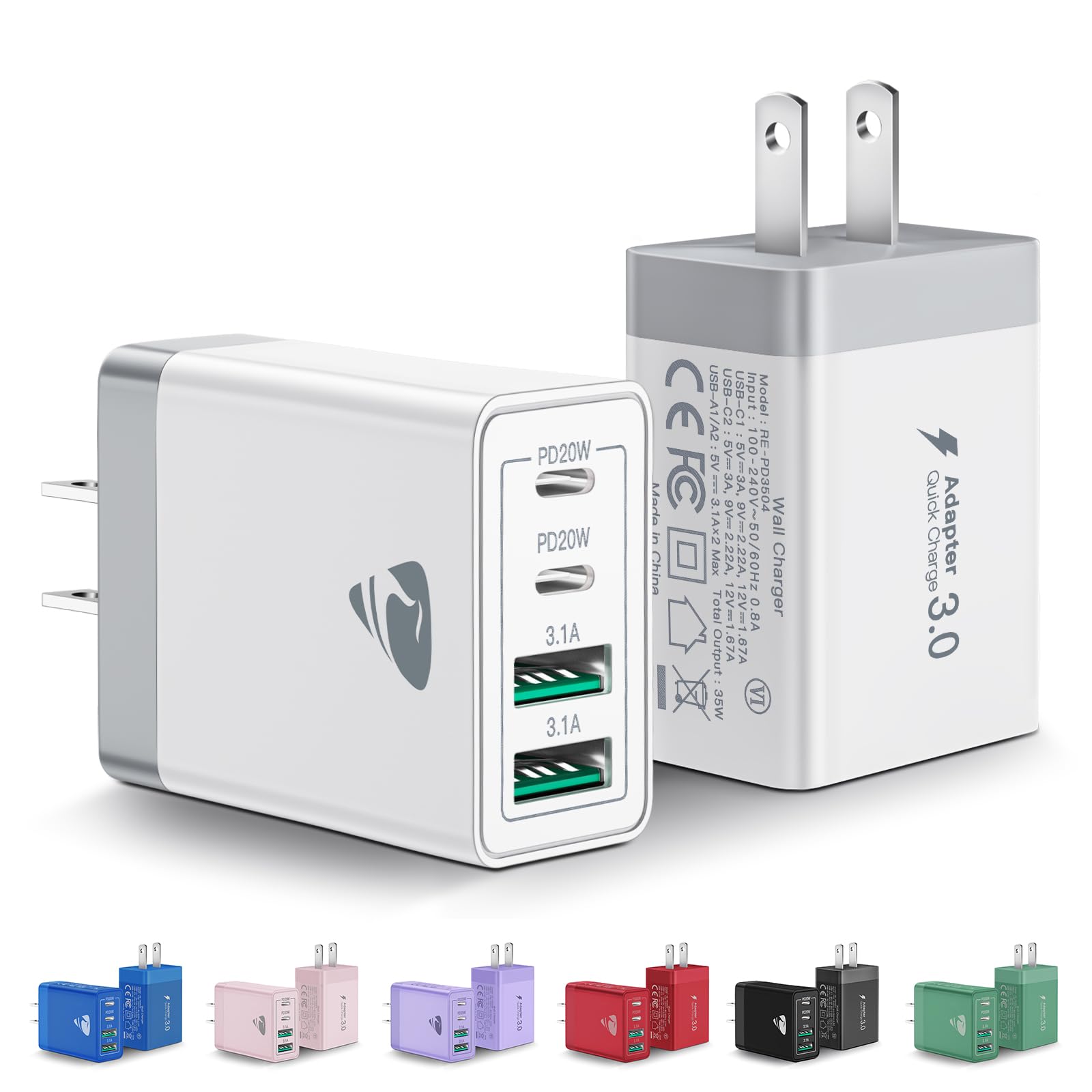
The Aiminu 2-pack tackles the mess of multiple bricks by packing four ports — two USB-A and two USB-C — into each cube. With a total output of 40 watts per charger, the power is distributed intelligently. When you plug a single device into a USB-C port, it can pull up to 20W for fast PD charging. Add a second device, and the bus splits the wattage, so you won’t get 20W on both USB-C ports simultaneously — expect roughly 10W each when two are active.
The build uses ABS + PC fireproof material, and the internal chipset guards against over-current and over-heating. In practice, a family can charge two iPhones and a pair of Android phones overnight from one outlet location. The white finish is clean, and the cube footprint is compact enough for a nightstand or hotel desk without hogging space.
The second USB-A port on each charger is capped at 5V/2.4A without QC support, so fast-charging Android devices should be plugged into a USB-C port. Additionally, the prongs are fixed — they do not fold — so the cube is slightly less travel-friendly than the Anker PowerPort Mini. For a stationary charging station, though, the port count alone justifies the spot.
Why it’s great
- Four ports per charger reduce outlet clutter
- 20W PD on USB-C for fast iPhone/Samsung charging
- Fireproof ABS + PC casing for safety
Good to know
- USB-C ports share power — 20W only with one device
- Fixed prongs do not fold for travel
4. Yosou 20W USB-C 2-Pack
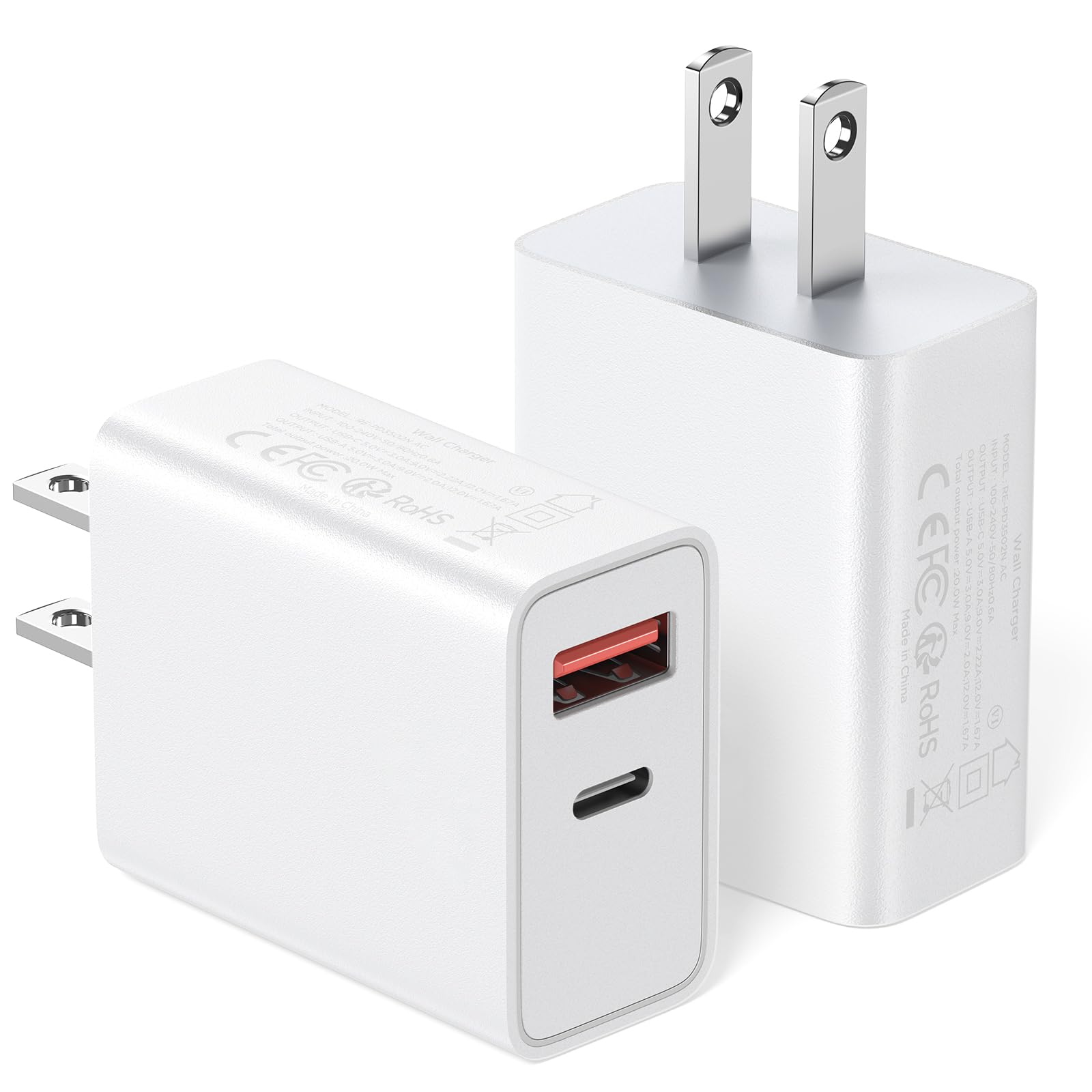
What sets the Yosou 2-pack apart from other budget dual-port chargers is its crosswise plug orientation — the prongs sit on the long edge, so the brick sits sideways against the wall instead of jutting out vertically. This leaves the outlet directly below completely free, a small but meaningful advantage for crowded power strips or tight behind-furniture spaces. Each charger combines a USB-C port delivering 20W PD and a USB-A port delivering up to 18W QC 3.0.
For Android users, the QC 3.0 port is a genuine advantage. A Samsung Galaxy S23 plugged into the USB-A port will negotiate the faster voltage steps and charge significantly quicker than on a standard 5V/2.4A port. The USB-C side handles iPhones and iPad Minis at their maximum PD rate. The 3.1-amp total capacity means both ports can run at or near their peak simultaneously without tripping protection.
The casing is smooth white plastic, and the footprint is smaller than a credit card. That said, the brand is newer and less proven than Anker, so long-term reliability is less documented. Users report consistent performance over the first month of use, but the 18-month warranty provides a useful safety net. The 2-pack does not include cables, so factor that into your total cost.
Why it’s great
- Crosswise plug leaves adjacent outlets accessible
- Supports both PD 20W and QC 3.0 protocols
- Compact design for tight spaces
Good to know
- No charging cables included in the package
- Newer brand with less long-term reliability data
5. Pofesun QC 3.0 2-Pack

The Pofesun 2-pack is built around Qualcomm’s Quick Charge 3.0 standard, which dynamically adjusts voltage in 200-mV increments to keep the battery at its optimal charging rate for longer. This means a compatible device like the Motorola Edge or a Samsung Galaxy A series can reach 50% in around 30 minutes. One port on each dual-port brick is dedicated to QC 3.0, while the second port delivers a steady 5V/2.4A for non-QC devices.
The bricks are compact — roughly 1.8 by 1.6 by 1 inch — and the black matte plastic resists fingerprints. The 100-240V input range makes them useful for international travel with a simple plug adapter. In the box you get two chargers, one of which can stay by the bedside while the other lives in a work bag. Several customer reports note that the build quality is solid enough that the casing doesn’t creak when you pull it from the wall.
It’s important to note that the QC 3.0 port does not support Power Delivery, so iPhones and iPads will charge at standard 5V/2.4A speeds — about 12W max. Additionally, some users found that the red QC 3.0 port was not recognized as a fast charger by Google Pixel devices, which rely on USB PD rather than Qualcomm’s standard. For Samsung, LG, and Motorola QC users, however, this is a reliable, affordable fast-charging solution.
Why it’s great
- Genuine QC 3.0 support for compatible Android phones
- Compact size with universal voltage for travel
- Two-pack provides good value for multiple rooms
Good to know
- No USB PD support — iPhones charge at standard speed
- Pixel devices may not recognize the QC port as fast
6. Amazon Basics 12W 2-Pack

The Amazon Basics 12W charger does one thing and does it reliably: it delivers 5V at 2.4 amps through a single USB-A port. There are no extra ports, no fast-charging protocols, no foldable prongs — just a simple white cube that fits in any standard outlet. The 2-pack format means you can keep one in the kitchen and one in the bedroom without having to move a single brick around the house.
The internal safety switch provides automatic shutoff in case of a short circuit or overheating, and the lightweight polycarbonate housing doesn’t get uncomfortably warm even after charging a tablet for several hours. It’s compatible with virtually any USB-A cable and any device that charges over USB — from an iPhone 15 to a JBL speaker to a Kindle. The 2.4-amp output ensures that even larger devices like an iPad Air draw meaningful current rather than trickle-charging.
The obvious limitation is the single port — you can only charge one device at a time per brick. There’s also no support for Quick Charge or Power Delivery, so if your phone supports fast charging, this adapter won’t tap into that capability. And at 12W, it’s slower than the 20W PD chargers now common with new phones. But for a straightforward, worry-free backup charger at a great price for two, it’s hard to argue with the value.
Why it’s great
- Reliable 2.4A output from a trusted brand
- 2-pack covers two locations right away
- Safety shutoff prevents overheating
Good to know
- Single USB-A port only — no dual-device charging
- No QC or PD fast-charge support
7. iGENJUN 6-Pack Dual USB
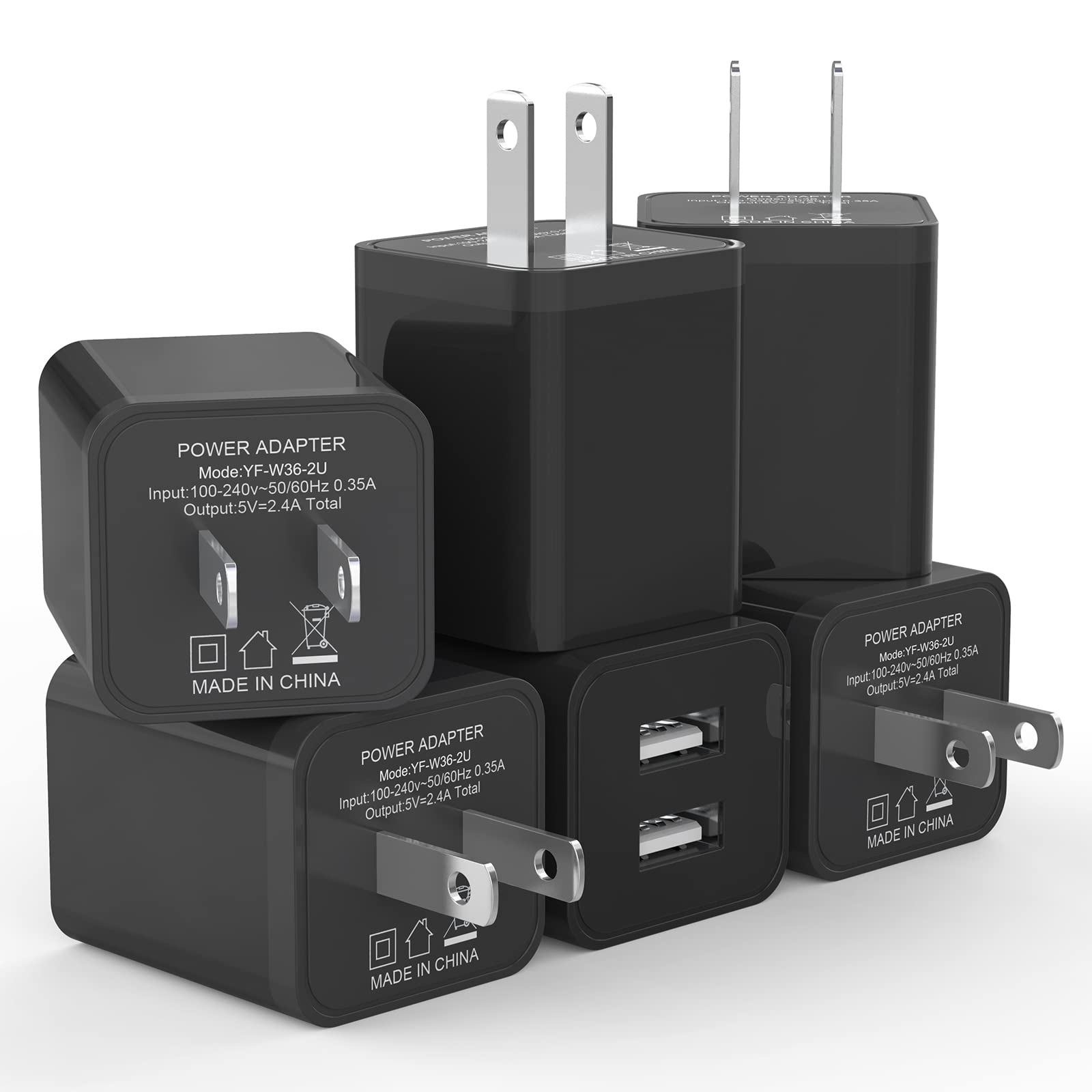
The iGENJUN 6-pack is the ultimate quantity-first solution for households or small offices that need a charger in every room. Each dual-port brick delivers a total of 5V/2.4A shared across two USB-A ports. That means plugging one device per brick gives you a full 2.4A, but charging two devices simultaneously splits the current to roughly 1.2A each — fine for overnight charging but not ideal if you need a fast top-up before heading out.
The bricks are color-coded within the 6-pack, which is a clever touch for families where each member claims a personal charger. The polycarbonate enclosure is lightweight and includes built-in protection against over-current, over-voltage, and short circuits. In use, the bricks run cool and the ports grip cables firmly without being so tight that they’re hard to remove. The compact cube shape doesn’t obstruct adjacent outlets on a power strip.
The biggest trade-off is that each port is limited to 1.2A when both are in use, which is slower than dedicated single-port or intelligent multi-port chargers. There’s also no fast-charging protocol support — this is strictly standard 5V charging. If you need fast charging for a QC-compatible Android or PD for an iPhone, look elsewhere. But if you simply want to scatter six reliable chargers around your home without overthinking specs, this pack delivers exactly that.
Why it’s great
- 6 chargers cover every room and travel bag
- Color-coded bricks prevent mix-ups in a family
- Compact cube design saves outlet space
Good to know
- 2.4A shared across both ports — 1.2A per device
- No QC, PD, or other fast-charging support
FAQ
Can a Type-A charger fast-charge my iPhone?
What does Quick Charge 3.0 actually do for my Android phone?
Is it safe to leave a Type-A charger plugged in overnight?
Why does my device charge slower on a dual-port charger when both ports are used?
Final Thoughts: The Verdict
For most users, the best type-a charger winner is the Anker PowerPort Mini 2-Pack because it delivers a full 2.1A per port in a compact, foldable-plug design that travels effortlessly and charges reliably every time. If you want dual-protocol fast charging for both iPhones and Android phones, grab the Yosou 20W USB-C 2-Pack. And for a multi-device household needing four ports per location, nothing beats the Aiminu 40W 4-Port 2-Pack.