
Our readers keep the lights on and my morning glass full of iced black tea. As an Amazon Associate, I earn from qualifying purchases.
Specs are compiled from manufacturer listings and verified buyer reviews and can change over time — please confirm the key details on the product page before buying.
The real question when you shop for a UHF TV antenna isn’t “how far can it claim to reach”—it’s whether you’ll actually get your local channels without pixelation, and whether the setup will survive a storm. The best picks here earn their spot by pairing strong reception with honest build quality you can trust.
I’m Min — the founder and writer behind Gadgets Feed. This guide is built by comparing the manufacturers’ published specifications and the patterns across verified customer reviews, so you get each pick’s real strengths and trade-offs instead of marketing spin.
Focus on reception range, channel counts, and installation ease to find the right uhf tv antenna for your home.
Our Picks at a Glance


How To Choose The Best UHF TV Antenna
Your UHF antenna choice hinges on your location, the obstacles between you and the broadcast towers, and how much mounting effort you’ll invest. Most buyers overestimate the range they need and underestimate how critical placement is.
Start with your distance to the towers
Use a site like RabbitEars to see which towers are near you and in what direction. If you’re within a major metro area, a smaller Yagi will do. If you’re in a rural or fringe area, you’ll want a longer boom with more elements and possibly an amplifier.
Understand range is a ceiling, not a promise
Every manufacturer lists a maximum range. Real-world performance is almost always less, because hills, trees, and buildings block signals. Look for an antenna with headroom—if your towers are at 40 miles, a 70-mile rated antenna is a safer bet than one rated at 45.
Decide between amplified and passive
An amplifier (a small box that boosts the signal) helps in weak-signal areas, especially with long cable runs. But if you’re close to towers, an amp can overload and actually hurt reception. Many Yagis come in both versions, or let you run them passively.
Quick Comparison
| Model | Best For | Max Range | Band Support | Amplified | Amazon |
|---|---|---|---|---|---|
| Winegard RVW-395★ Best Overall | RVs & campers | 55 miles | VHF/UHF | Yes | Amazon |
| PBD Outdoor YagiBest Value | Budget long-range | 120 miles | VHF/UHF | Yes | Amazon |
| McDuory UHD-3968Attic-Friendly Pick | Attic installs | 70+ miles | VHF/UHF | No | Amazon |
| CEKAY Outdoor Yagi | All-metal durability | 70 miles | VHF/UHF | No | Amazon |
| GE Pro Outdoor Yagi | Trusted brand | 80 miles | VHF/UHF | No | Amazon |
| PIBIDI Outdoor | Compact performance | 200 miles | VHF/UHF | No | Amazon |
| Five Star Outdoor | Multi-TV setups | 200 miles | VHF/UHF | No | Amazon |
| Televes V Zenit | UHF-only UHF markets | 60 miles | UHF | No | Amazon |
| Televes DAT BOSS | Fringe rural areas | 80 miles | High-VHF/UHF | Yes | Amazon |
In-Depth Reviews
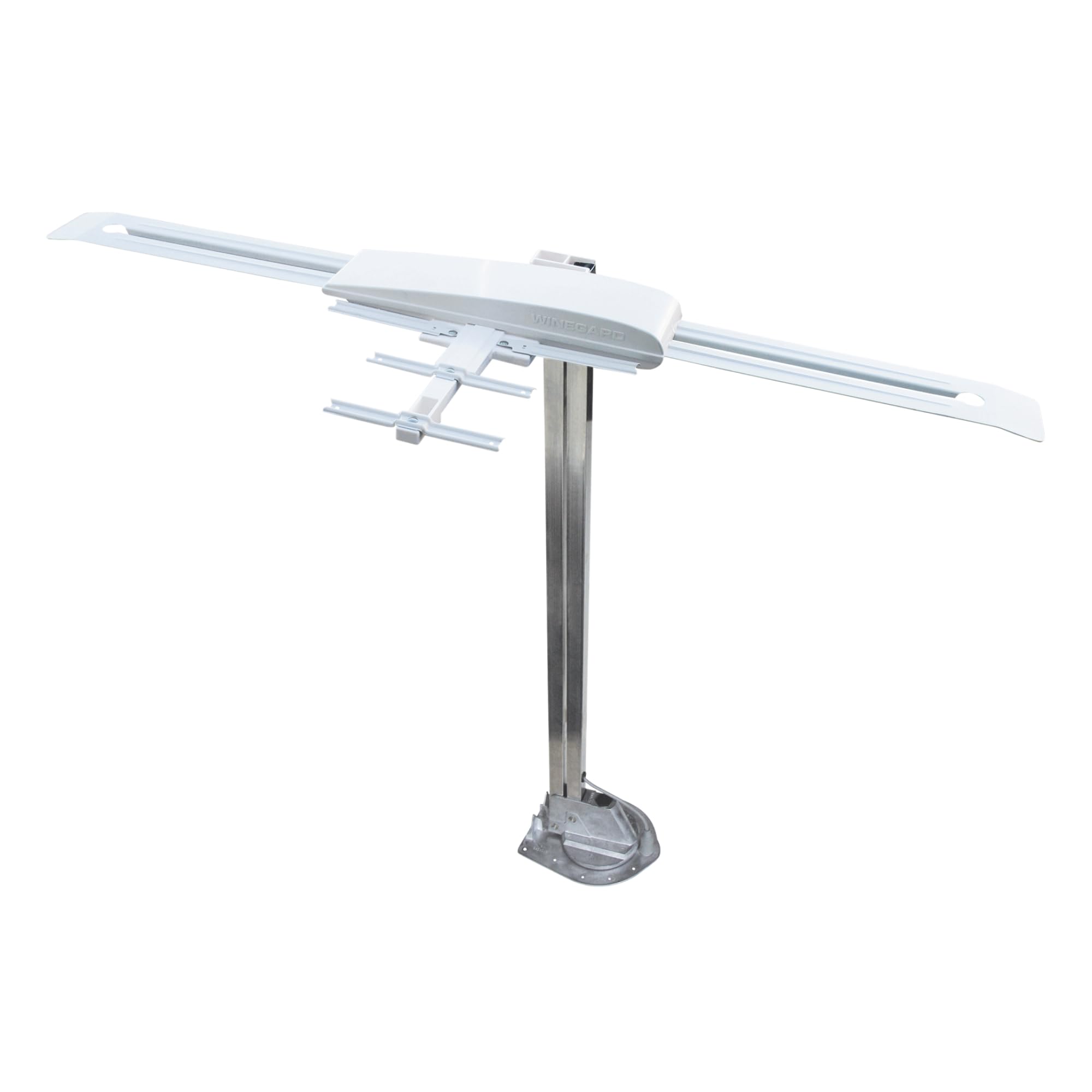
1. Winegard RVW-395 Sensar IV
Our pick — over 4.5★ from 950+ verified ratings; the strongest balance of quality and price.
The crank-up batwing that turns a campsite into a clear-channel living room.
Built for RVs and campers, this Winegard is a straight swap for the OEM batwing on most older motorhomes, and owners say the swap takes minutes. The built-in amplifier is what wins people over—signal counts jump dramatically, with travelers reporting going from just a few stations to solid reception on distant channels.
It’s a serious performer on the road: rated for 55 miles and designed to raise up to 48 inches, so you get height when you park. Buyers report finding 18 stations in a Class C motorhome on a 32″ HD TV, and another owner says it’s the only antenna that stayed reliable at 35 miles out in rural country. The built-in Wingman reflector boosts UHF performance, and it’s NextGen TV and 4K Ultra-HD compatible, so it’s future-proofed for modern broadcasts.
Construction is solid with a powder-coated finish, but a few owners note the plastic gears on the crank can strip if you’re rough with them, so treat the rotation gently. It’s priced at a premium, but for RV owners who want a dependable upgrade rather than a cheap roadside fix, it’s the crowd favorite—4.7 stars across 900+ owners.
Why it travels well
- Amplifier boosts weak signals dramatically in rural areas
- Direct replacement for older Winegard OEM antennas
- 4K Ultra-HD and NextGen TV compatible
What to handle with care
- Plastic crank gears can strip if forced
- Premium price tag for an RV accessory
The road-trip call: if you live or travel in an RV and want reliable, amplified reception without a complicated install, this is the one.
Watch out for: the plastic gears—crank slowly and you’ll be fine.
2. PBD Amplified Outdoor Yagi
The budget Yagi that punches far above its price in tough, tree-heavy terrain.
At this price, the PBD is the value king, and the amplification is what everyone raves about. The built-in amp includes Automatic Gain Control and an LTE filter, which means it strengthens usable signals while ignoring nearby 4G/5G interference—a common killer of over-the-air reception.
You get a 120-mile range, and real-world results back it up: a buyer 48 miles from the CBS tower, surrounded by tall pines, reported CBS coming in perfectly with 76% signal strength and a better picture than cable. Another owner in a rural mountain area found it handled the terrain well, withstanding 70mph gusts when mounted. The 40ft RG6 cable is included, saving you a separate purchase.
It’s not perfect—some owners note the range claim is optimistic depending on your landscape, and a few had defective amplifiers that were quickly replaced by responsive customer support. That reliability hiccup is the trade-off at this price, but the support team consistently makes it right. A hidden gem for rural and budget buyers.
Why it impresses
- Powerful amp with LTE/4G/5G filtering
- 120-mile range claim with real-world proof in pines
- Included 40ft RG6 cable and no-tools setup
The honest catch
- Range varies with terrain; not a true 120-mile guarantee
- Occasional amp failures, though support replaces them
The budget call: if you’re in a rural or semi-rural area and want serious amplification without spending big, reach for this one.
Who it’s not for: anyone expecting a literal 120-mile reach in mountainous terrain—set expectations lower.
3. McDuory UHD-3968 Yagi
The passive Yagi that quietly solves high-VHF problems its rivals can’t touch.
This McDuory is a passive antenna, meaning no amplifier—just raw Yagi design doing the work. That’s actually a strength in stronger signal areas, where an amp only adds noise. Owners praise its ability to lock in high-VHF channels like 8 and 19 that flat antennas completely miss, while keeping UHF rock-solid in all weather.
Assembly is genuinely simple, taking most buyers roughly an hour, and it’s small enough to fit discretely in an attic. One owner swapped out a picture-frame antenna that showed 65 pixelated channels and now pulls in 101 clear channels from the attic with an HDHomeRun. Another mounted it at 25′ outside and finds it works well within 20 miles of the towers, with no need for a higher-gain antenna.
The main durability concern: the long rods fit loosely in plastic sockets, and a few owners fixed that with pop rivets. Some hardware may rust over time, so attic installation sidesteps weathering entirely. It’s a solid, inexpensive choice that proves you don’t need an amp to get great reception.
Where it shines
- Passive design works cleanly in moderate signal zones
- Excellent at capturing high-VHF channels others miss
- Compact size suits attic installs
Know before you buy
- Rods fit loosely in plastic sockets—some owners use rivets
- Hardware can rust if mounted outdoors long-term
The attic verdict: if you’re close to towers and want a simple, no-amp install in your attic, this is your pick.
skip it if: you’re in a fringe area 40+ miles out and need a powered boost.
4. CEKAY Outdoor Yagi

The all-metal workhorse that shrugs off weather and pulls in 90-plus channels.
Built from all-metal construction, this CEKAY is designed to handle heat, rain, wind, and snow without degrading—a meaningful upgrade over antennas with plastic elements. It’s rated for 70 miles and supports full 4K and even 8K broadcast signals, with NextGen TV (ATSC 3.0) compatibility built in for the future.
Performance stories are strong: one owner picked up 51 local channels from an attic install under a cement tile roof, and another calls it a “Yagi Uda for the win” after getting 100% signal on all channels from 20+ miles away. The included 40ft RG6 cable and J-mount save you setup costs, and assembly needs no tools, though owners note the arms fit tightly into rubber holders and may need a firm push or a light tap.
The one honest trade-off is longevity—while many find it durable, a few expressed concerns about long-term wear. And it’s a passive antenna, so if you’re deep in a fringe area, you may want to pair it with a preamp. For most buyers within 30-40 miles of towers, this is a reliable, low-maintenance performer.
Its strong suits
- All-metal build resists harsh weather
- 8K-ready with NextGen TV compatibility
- No-tools assembly with j-mount included
Fair warnings
- Tight element fit requires extra force to assemble
- Passive design may need a preamp in weak-signal zones
The weather-proof call: if you want a sturdy, weather-resistant Yagi for an outdoor roof mount, this one delivers.
Consider the add-on: if your towers are 40+ miles away, budget for an amplifier.
5. GE Pro Outdoor Yagi

The recognizable, brand-name Yagi that just works—with support to back it.
GE claims to be America’s #1 antenna brand, and this Yagi shows why: it’s rated for 80 miles, supports 4K Ultra HD, and comes with a mounting kit including a J-mount, mast clamp, and weather-resistant bracket. The brand’s limited-lifetime replacement pledge and free U.S.-based tech support add confidence you won’t get from generic imports.
Real-world reception is excellent, even in tough spots. One owner on a rural mountain peak 40+ miles out pulls in 34 free channels, and another runs it from an attic under a concrete tile roof at a 35-mile distance with no pixelation and a picture better than cable. It’s compact—smaller than you’d expect—which makes it easier to mount on a fascia or mast, yet still pulls distant stations.
The honest knock is the instructions: several owners found them confusing, especially around dipole alignment and mounting orientation. A few also note the build feels a bit flimsy compared to all-metal rivals. It’s a passive antenna, so distant-signal hunters may add a preamp, and the included J-mount works best for standard masts. For the trusted-brand crowd, this is a solid, dependable mid-range pick.
Why it earns trust
- Brand backed by lifetime replacement pledge
- Compact design mounts easily on roof or fascia
- Clear reception even under concrete tile roofs
The minor gripes
- Instructions are confusing, especially on alignment
- Build feels lighter than all-metal competitors
The brand-name call: if you want a reliable, well-supported antenna without the premium Televes price, this GE is your match.
Who it’s not for: anyone who wants a heavy, industrial-grade build—look at the CEKAY instead.
6. PIBIDI Outdoor Antenna

The compact Yagi that shocked owners with its size—and then with its reach.
First-time buyers are consistently surprised by how small the box is, but that compact footprint doesn’t hurt performance. This PIBIDI is rated for 200 miles—a claim to take with a grain of salt—but real-world results in rural areas are impressive. One owner in a windy Ohio valley, 120 miles from transmitters, pulls in 28 channels with an optional booster, while another replaced a 12-15 year old oversized antenna and now gets stations 40-100 miles away with a sharp, clear picture.
It’s passive, meaning no built-in amp, but it’s designed to pair with a booster if you need one. The included installation kit has a 40ft RG6 cable and a detailed guide, so setup is friendly. Owners consistently mention the build quality feeling excellent for the price, with easy assembly and a durable, lightning-protected design.
The trade-off: without a preamp, weak signals drop off fast—owners mention just 3 channels without a booster versus 28 with one. And one owner found the compact size means it needs careful aiming, requiring up to 50 roof adjustments to lock everything in. It’s a great value, but budget for a booster if you’re far from towers.
What stands out
- Compact size that’s easy to handle and mount
- Strong rural performance with a booster
- Detailed guide and 40ft RG6 included
Reality check
- Passive design needs a booster for distant signals
- Compact form requires careful aiming
The compact call: if you want a small, quality Yagi for a modest distance and don’t mind adding a booster, this fits the bill.
pass on it if: you want a fully amplified antenna that works from the start at long range.
7. Five Star Outdoor HDTV Antenna

The multi-TV antenna that turns a single mount into a whole-house cord-cutting hub.
If you need to feed multiple TVs, this Five Star model is built for it—the package includes a TV splitter so you can distribute the signal to up to 4 sets right from the start. It’s rated for 200 miles and supports 4K and NextGen TV (ATSC 3.0), with an extended boom designed for stable, strong reception.
Channel counts are a highlight: one owner in rural Texas, 45+ miles from Houston towers, picked up 128 over-the-air channels, while another 50 miles out in a rural area got 77 channels just by placing it on a porch facing south. Even with a 2,500-ft mountain in the path, one buyer pulled in 60 channels at 45 miles thanks to the 11dB VHF gain. The 40-ft coax is included, and assembly is simple with no tools.
Two honest caveats: it’s lightweight, which makes it easy to install but means it can move in strong wind and occasionally drop a channel. And the mount is a bit flimsy—several owners replaced it with a DirectTV mount for stability. The 200-mile rating is also optimistic; most report effective range closer to 75-90 miles, which is still plenty for most buyers.
Its highlights
- Includes splitter for up to 4 TVs
- Strong channel counts even past mountains
- Lightweight and easy to assemble
The catch
- Moves in strong wind—channels can drop out
- Included mount is flimsy; consider a sturdier one
The whole-house call: if you want one antenna feeding every TV in the house, this splitter-included pick is your match.
Think about: reinforcing the mount if you live in a windy, exposed spot.
8. Televes V Zenit UHF
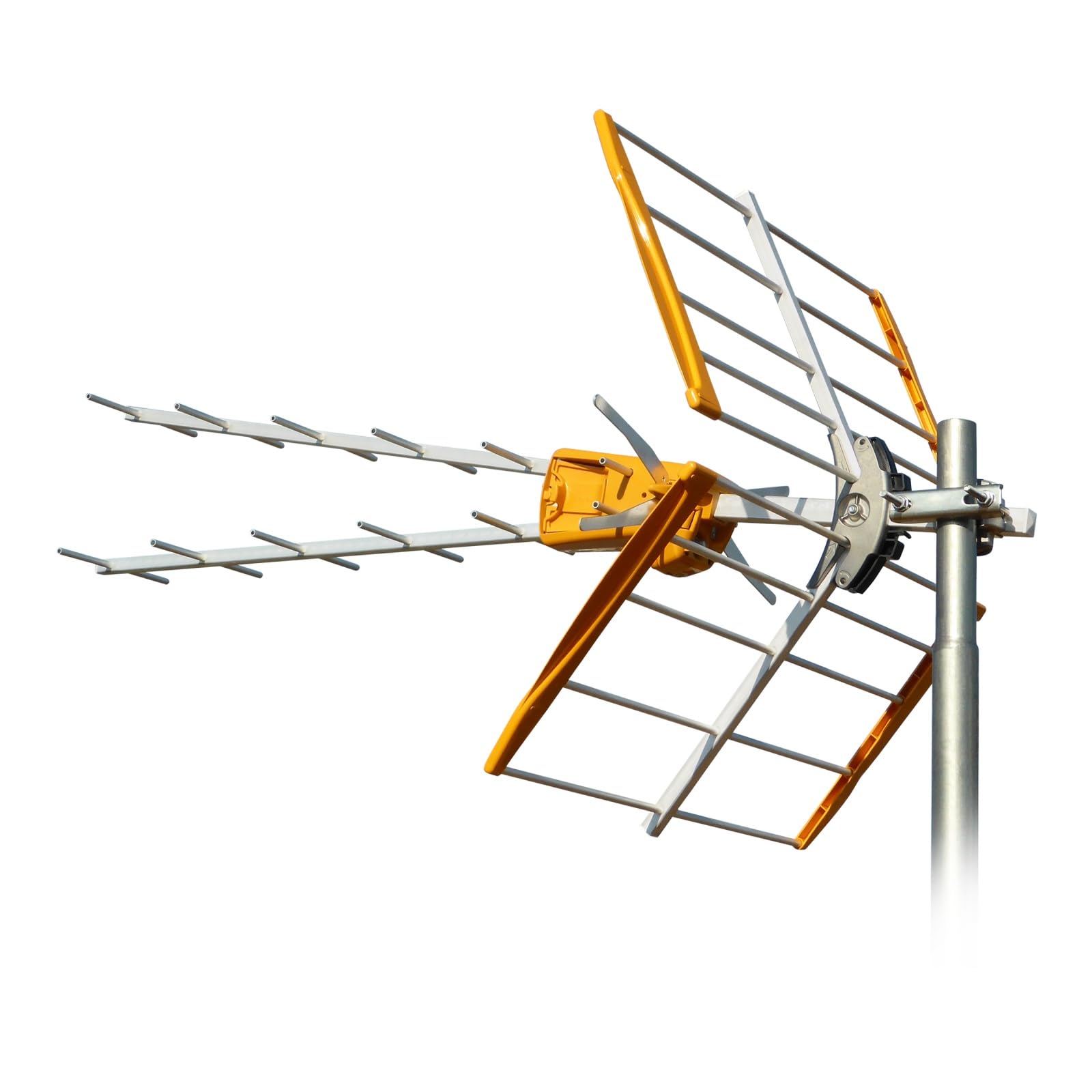
The engineered V-structure Yagi for UHF-only markets where precision matters.
This Televes is a specialist tool: a UHF-only antenna with a compact V-structure Yagi design that stacks two antennas in phase for maximum directional gain. It’s built for suburban, rural, and near-fringe UHF markets up to 60 miles away, and if your local channels broadcast mostly on UHF, this pulls them in with remarkable clarity.
The engineering is the story here. Televes is a European brand with 60+ years of expertise, using corrosion-resistant aluminum, Zamak mounting hardware, and durable ABS plastics. Owners note it “works really well, pulls in stations from all over” and praise the picture quality. One buyer in East Florida boosted reception for ~50-mile stations, getting roughly 45 channels plus 9 NextGen signals.
It’s a passive antenna, so it’s ideal for moderate and strong signal locations, but Televes designed it to pair with their TForce mast preamplifiers for weaker zones. The main complaint is practical: the RG11 coax connection is a poor fit and needs new holes drilled, plus some amp repositioning. It’s priced at a premium for a passive antenna, but for UHF-centric markets, this compact, professional-grade option is worth it.
Its engineering edge
- Compact V-Yagi with high directional gain
- Corrosion-resistant metals and premium plastics
- Professional-grade reception in UHF markets
Notes before buying
- RG11 coax connection needs modification
- Passive only—needs a preamp for weak zones
The UHF specialist call: if your area broadcasts almost entirely on UHF and you want premium engineering, this Televes is the pick.
Who it’s not for: buyers needing VHF support or a fully amplified antenna from the start.
9. Televes DAT BOSS Mix LR
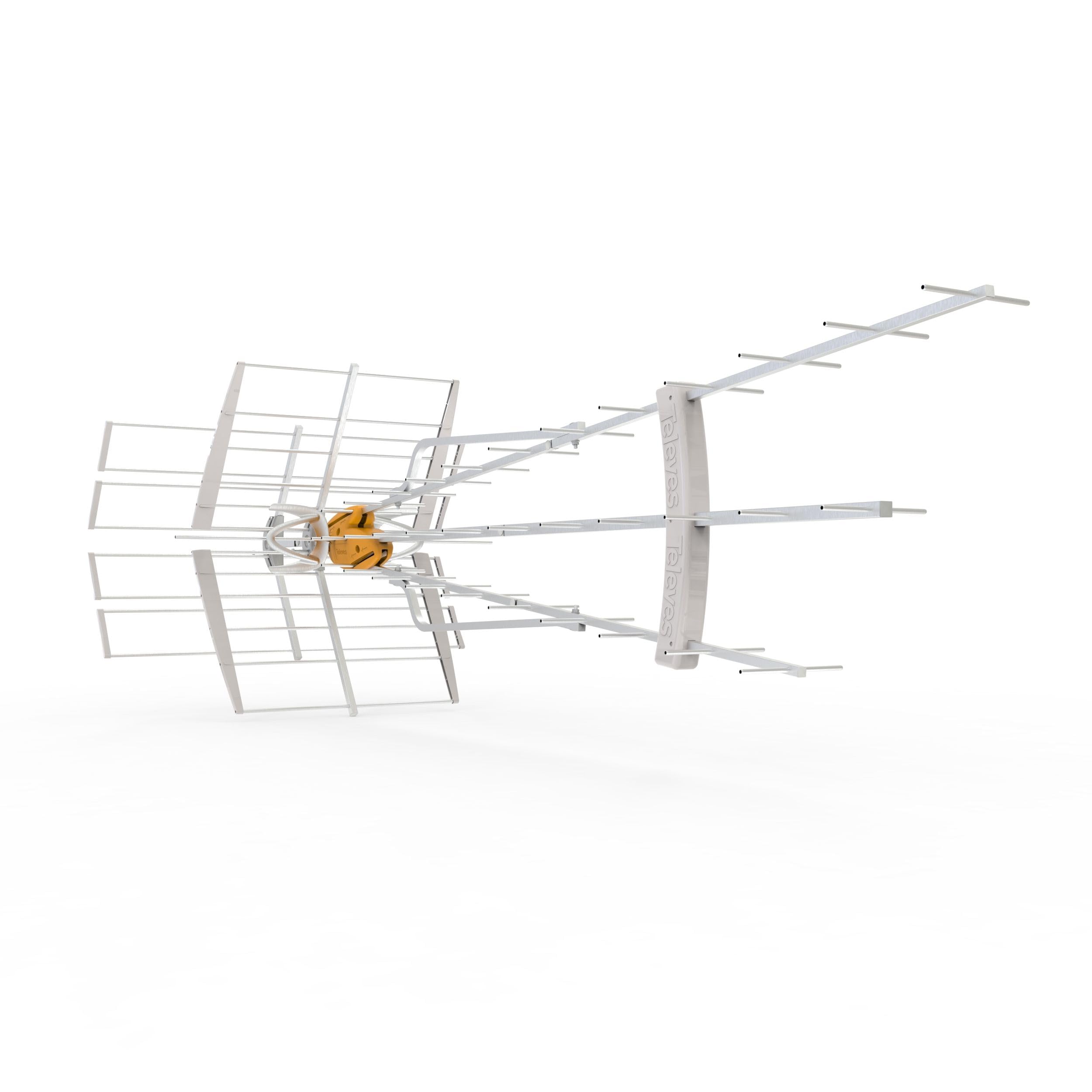
The fringe-area titan that rescues channels five cheaper antennas couldn’t.
This is the heavy artillery for rural and fringe reception. The Televes DAT BOSS Mix LR is a directional stacked triple-boom design with a built-in TForce amplifier, rated up to 100 miles for High VHF and UHF. It’s the most expensive pick here, but for buyers in truly challenging locations, it’s often the only antenna that works.
The smart tech is the BOSS-Tech system: it automatically adjusts amplification independently by band (38 dBi High VHF, 46 dBi UHF) to prevent both weak reception and overload. Plus, it has built-in FM and LTE/4G/5G filtering, which eliminates the cellular interference that plagues so many rural setups. Customers note dramatic results—one in rural Maine with a mountain range blocking signals tried five prior antennas and finally gets a strong signal on all channels now.
Performance is proven at distance: buyers pull in 80-114 channels with a 60-mile split from Dallas towers, and another in a fringe area gets clear HD from 60+ miles away. The dual-mode operation means it works passively even if the power fails, and the UL-listed 12V power inserter is included. Assembly is tricky—it’s a narrow-beam design that demands careful aiming—and at this price it’s an investment, but for the hardest reception cases, it’s worth every dollar.
Why it dominates
- Built-in TForce amp with smart band-by-band gain control
- FM and LTE/4G/5G filtering for clean rural signal
- Proven to beat five prior antennas in fringe areas
The honest cost
- Premium ~ price tag
- Narrow beam demands precise aiming during install
The fringe-area verdict: if you’re 50-100 miles from towers and nothing else has worked, this Televes is your last stop.
Think twice if: you’re within 30 miles of towers—you’d be overpaying for power you don’t need.
Understanding the Specs
Maximum Range
This is the manufacturer’s best-case claim, measured in clear conditions with nothing blocking the path between you and the tower. Real-world range is almost always lower because hills, trees, and buildings absorb signal. Use it as a ceiling—if your towers are within half the rated range, you’re in a good position.
UHF vs VHF Bands
UHF (channels 14-36) and VHF (channels 2-13) are the two broadcast bands, with most modern digital channels on UHF. A UHF-only antenna works in cities where all channels are UHF, but a UHF/VHF combo Yagi is the safer bet for rural areas where local stations may still broadcast on High VHF.
Amplified vs Passive
An amplifier boosts the signal to compensate for long cable runs and weak reception. It’s essential in fringe areas but can overload and cause pixelation if you’re close to towers. Passive antennas rely purely on design and are cleaner in strong-signal zones. Some amplified models can run passively if you don’t power them.
ATSC 3.0 (NextGen TV)
This is the next broadcast standard offering 4K picture, better audio, and stronger signals. An ATSC 3.0-ready antenna means it can pick up these broadcasts when they arrive in your area, though you’ll need a compatible TV or tuner to decode them. Most new Yagis are already built for it.
FAQ
Will a UHF antenna work with my existing TV coax cable?
What’s the real difference between UHF and VHF channels for my area?
Is it better to mount the antenna in my attic or on my roof?
How many channels can I realistically expect to get?
Do I need an amplifier for my outdoor antenna?
Does the 200-mile range claim on some antennas actually hold up?
What does the LTE/4G/5G filter on new antennas do?
Can I use one antenna to feed multiple TVs in my house?
Is it worth paying more for a Televes antenna?
Final Thoughts: The Verdict
For most buyers, the uhf tv antenna winner is the Winegard RVW-395 because it’s a proven RV upgrade with a built-in amplifier that dramatically improves channel counts. If you want serious budget amplification for a home, grab the PBD Outdoor Yagi. And for the hardest rural fringe cases where nothing else works, the Televes DAT BOSS is the one to reach for.
How We Picked
We do not accept paid placement. Every pick is matched to a real buyer and a real use-case; we do not hands-on test units.
Sources & Methodology
Specifications: manufacturer listings and product documentation. Review insights: verified customer reviews, as of August 2026. Pricing: not shown on this page (it changes often); check the current price via the retailer link.
As an Amazon Associate, Gadgets Feed earns from qualifying purchases. This does not affect which products we feature.