
Our readers keep the lights on and my morning glass full of iced black tea. As an Amazon Associate, I earn from qualifying purchases.
Specs are compiled from manufacturer listings and verified buyer reviews and can change over time — please confirm the key details on the product page before buying.
The lighter your pack, the more miles you actually enjoy — every ounce you shed keeps your legs fresh and your back happy. The whole point of ultralight backpacking is cutting the clutter so the trail, not your gear, is what you remember. This guide gets straight to the seven pieces of ultralight backpacking gear that shave pounds without leaving you cold or hungry at camp.
I’m Min — the founder and writer behind Gadgets Feed. This guide is built by comparing the manufacturers’ published specifications and the patterns across verified customer reviews, so you get each pick’s real strengths and trade-offs instead of marketing spin.
Whether you are shaving weight on your first three-day trip or replacing a hand-me-down tent, these picks stack up on warmth-to-weight, packed size, and real-world durability — all backed by what actual buyers report from the trail.
Quick Picks
- Therm-a-Rest NeoAir Xlite NXT Ultralight Camping and Backpacking Sleeping Pad — Premium Pick
- Naturehike Mongar 2 Person Backpacking Tent — Best Value Shelter
- Jetboil MicroMo Lightweight Precision Camping and Backpacking Stove Cooking System — Precision Cooking
- Snow Peak Titanium Multi Compact Cookset — Heirloom Cookset
- Jetboil MightyMo Ultralight and Compact Camping and Backpacking Stove — Minimalist Burner
- TREKOLOGY Sleeping Pad for Camping – Ultra-Lightweight, 4″ Thick Camping Mat — Budget All-Season Pad
- OneTigris Featherlite Ultralight Sleeping Quilt — Budget Quilt
How To Choose The Best Ultralight Backpacking Gear
The first mistake most new ultralight hikers make is looking at a single number — the weight — and ignoring how that gear actually performs when the temperature drops or the rain starts. The real cost of a bad choice is a cold, wet, or hungry night on the trail. Focus on four trade-offs before you buy.
Warmth-to-Weight Ratio (It Matters More Than Total Weight)
A sleeping pad that weighs 13 ounces is a win — but only if its R-value (a standardized measure of how well the pad blocks heat loss to the cold ground) keeps you warm at the temperatures you actually camp in. A three-season quilt rated to 40°F is useless if you head out in shoulder-season lows of 30°F. Match the insulation spec to your trips, not just to the scale.
Packed Size vs. Ease of Use on the Trail
Ultralight gear often trades convenience for packed size. A stove that boils water in three minutes is fast, but a small burner may be harder to simmer on. A tent that packs down to the size of a football is great — but if it takes 15 minutes to set up in the rain, you lose the time you saved on weight. Think about how often you will be unpacking and repacking each day.
Durability vs. Weight — The Honest Trade-Off
Thin 20D nylon (a measure of fabric thickness where lower numbers mean lighter, more delicate material) saves ounces but tears more easily against rocks or roots. A titanium pot is ultralight but burns food faster if you do not watch it. Read buyer reviews for real-world stories about how these materials hold up after a few dozen nights, not just the manufacturer’s claims.
The Hidden Weight: Packing Strategy
Every piece of gear needs a home in your pack: a sleep system that fits inside your tent’s vestibule, a cookset that nests together, and a pad that inflates fast without a pump you have to carry separately. The best ultralight gear works together as a system — not as a collection of the lightest individual items.
Quick Comparison
On smaller screens, swipe sideways to see the full table.
| Model | Best For | Weight | Key Insulation / Temp | Packed Size | Amazon |
|---|---|---|---|---|---|
| Therm-a-Rest NeoAir Xlite NXT | Premium ultralight sleep system | 13 oz (370 g) | 4.5 R-Value | 1-liter bottle | $192.84$209.95Amazon |
| Naturehike Mongar 2 Tent | Affordable light two-person shelter | 4.73 lbs | 4000mm waterproof fly | 19.7″ x 5.9″ | from $79.18Amazon |
| Jetboil MicroMo Cooking System | Precise simmer in an integrated system | 12 oz (0.75 lbs) | 0.8L FluxRing cup | 9 x 6 x 5 in | $135.99Amazon |
| Snow Peak Titanium Multi Compact Cookset | Ultralight two-person cookware set | 0.73 Pounds | 4-piece set (pots + frying pans) | Stacks into one unit | $92.98Amazon |
| Jetboil MightyMo Stove | Minimalist stove for fast boils | 0.21 Pounds | 2900W max output | 4.1 x 4.1 x 3.75 in | $63.94Amazon |
| TREKOLOGY Sleeping Pad | Budget four-season sleeping pad | 2 lbs (900 g) | 7.2 R-Value | Water-bottle sized | $60.99Amazon |
| OneTigris Featherlite Quilt | Budget ultralight quilt for mild nights | 35 oz (1000 g) | 40°F rating | Gallon-jug sized | $67.98Amazon |
In‑Depth Reviews
1. Therm-a-Rest NeoAir Xlite NXT Ultralight Camping and Backpacking Sleeping Pad

You sleep warm on just 13 ounces — the lightest full-feature insulated pad at this warmth level.
You get a warm, stable night’s sleep at just 13 ounces (370 g) — the NeoAir Xlite NXT rolls up as small as a conventional 1-liter bottle, which is the kind of packed size that frees up room for extra food or a luxury layer. Its 3-inch (7.6 cm) thick profile and baffled internal structure give you support without the bottoming-out feeling thinner pads cause. The reflective ThermaCapture technology traps radiant heat, and the Triangular Core Matrix minimizes convective heat loss to deliver a 4.5 R-Value (a standardized measure of how well it blocks heat loss to the cold ground). Owners mention this NXT version is near-silent — a huge improvement over the crinkly earlier models — and comfortable for side-sleepers up to about 5’9″. The WingLock valve makes inflation and deflation fast, and the included pump sack, stuff sack, and patch kit add no real weight to your pack.
The honest trade-off: at 20 inches wide, this regular-size pad is narrow for broad-shouldered sleepers who shift a lot. If you sleep cold and need more width, the TREKOLOGY below gives you 4 inches of thickness and a 7.2 R-Value for less money — but it weighs a lot more.
what separates it
- 13 oz weight that beats nearly every insulated pad at its warmth level
- Near-silent fabric (no crinkling) — a real upgrade from older NeoAir models
- Packs to 1-liter bottle size, freeing pack volume
What to watch for
- 20-inch width is narrow for wide-shouldered side sleepers
- Thin fabric demands a groundsheet or careful campsite selection
- Warranty service reported as slow by one buyer with a seam leak
The weight weenies’ dream: Grab the Xlite NXT if your top priority is the lightest, most packable warm pad that still delivers real comfort — and you are willing to pay a premium for ounces saved.
skip it if: You need a wider sleeping surface or you camp mostly on rocky ground where delicate fabrics worry you.
2. Naturehike Mongar 2 Person Backpacking Tent

A freestanding two-person dome that punches well above its price point — 4000mm waterproof fabric at 4.73 lbs.
This tent gives you a legitimate 82.7 x 53.2 x 41.3 inch interior (over 30 square feet of floor area) for just 4.73 pounds total, including the free groundsheet. The 20D nylon fly and floor both carry a 4000mm waterproof rating (a measure of how much water pressure the fabric can hold back before leaking — 4000mm is serious rain protection). The 7001 aluminum alloy poles make the dome freestanding, so you can pitch it on tent platforms or bare ground and move it if the site is imperfect. Reviewers consistently note that setup takes about 5 minutes solo, and the tent handles wind and rain well when properly staked. The two doors and two large vestibules give each person a gear storage zone and keep wet packs out of the sleeping area.
The honest trade-off: at 4.73 pounds this is heavier than dedicated ultralight two-person shelters that can dip under 3 pounds, but those cost two to three times as much and use thinner fabrics. One reviewer noted that stakes snapped on hard soil, so you might want to replace them with stronger groundhogs for rocky campsites.
Why it stands out
- Full double-wall freestanding design with two doors and vestibules
- 4000mm waterproof rating on both fly and floor — real storm protection
- Includes groundsheet, packs into a 19.7″ carry sack
What to know
- 4.73 lbs is not ultralight for two-person tents — be honest about your base weight
- Stock stakes may bend or snap in hard-packed soil
- Pole structure has many setup steps despite being freestanding
Perfect for: Couples or friends sharing a shelter who want genuine two-person space and real rain protection without spending +.
Not for: Solo ultralight hikers aiming for a base weight under 10 pounds — you can save nearly 2 pounds with a single-wall trekking-pole tent.
3. Jetboil MicroMo Lightweight Precision Camping and Backpacking Stove Cooking System

The system that actually lets you simmer, not just boil — rare in integrated stoves.
Unlike most integrated camping stoves that are basically boil-only, the MicroMo gives you real adjustable heat control through Jetboil’s engineered valve — you can simmer soup or cook eggs without scorching them. The whole system weighs 12 ounces and packs into a compact 9 x 6 x 5 inch shape. The 0.8-liter FluxRing cooking cup has a drink-through lid with a pour spout and strainer, so you can eat straight from the pot and strain pasta. Customers note it boils water in about 2.5 minutes and that the push-button igniter works reliably down to 20°F. The modular design secures the pot to the burner, which prevents the kind of spills that happen with pot-on-stove setups.
The honest trade-off: the 0.8-liter capacity is small — it works for one hungry person or two light meals, but not for cooking for a whole group. Reviewers also note the lid fit was loose on one unit (fixable by molding) and that the system is not designed for gourmet cooking beyond basic meals. At 12 ounces, it is heavier than the standalone MightyMo stove below, but the integrated cup and simmer control make the extra weight worthwhile if you want real cooking flexibility.
Its biggest strengths
- Genuine simmer control — rare for an integrated canister stove
- Boils water in ~2.5 minutes, saving fuel weight over longer boils
- Pot locks onto burner for safe one-handed pouring
Its real limits
- 0.8L capacity limits you to small meals or one-person cooking
- Heavier than a standalone burner system at 12 oz
- Not designed for large pots or group meals
Get it if: You want a complete, simple to use cooking system that does more than boil water — rehydrating dinners, simmering sauces, and making hot drinks all in one unit.
Give it a miss if: You only boil water for dehydrated meals — the lighter and cheaper MightyMo stove below does that faster.
4. Snow Peak Titanium Multi Compact Cookset

Japanese titanium cookware that weighs less than a water bottle and fits inside itself — 0.73 pounds for two pots and two pans.
This 4-piece set from Snow Peak weighs just 0.73 pounds and nests into a single stack — two pots and two frying pans with foldable handles that save space in your pack. Made from high-quality titanium, it is durable enough for direct campfire use; one buyer mentioned putting the pots directly in the campfire with zero damage. The pot lids double as plates or small saucepans, which cuts out extra crockery. The set is designed for two people, so it is a practical choice for a backpacking duo who want a real cooked meal without carrying a full kitchen kit. The folding handles lock securely open and fold flat when storing.
The honest catch: the set runs smaller than many first-time buyers expect — one reviewer called it “too small for family,” and another noted the size runs small. The 0.73-pound weight is a massive 3.5x heavier than the Jetboil MightyMo stove you saw above (0.21 pounds), but you are getting two pots and two pans versus a single burner. Also, there is no lid for the frying pan when using both pots simultaneously — you would need to buy a separate lid.
Why it earns its place
- Titanium construction is lightweight and survives direct campfire use
- Nesting design packs two pots and two pans into one compact stack
- Foldable pot handles lock stable and store flat
What to be aware of
- Smaller than expected — cook for two, not a family of four
- No frying pan lid included for simultaneous use
- Titanium can scorch food easily; watch your heat
Ideal for: Two-person backpacking teams who want to cook real meals (not just boil water) and are willing to invest in a set that will last for decades.
pass on it if: You are cooking solo or you only rehydrate meals — a single titanium mug and a lighter stove saves more weight.
5. Jetboil MightyMo Ultralight and Compact Camping and Backpacking Stove

A featherweight burner that boils water fast (2900W) and simmers without burning — all at 0.21 pounds.
Weighing just 0.21 pounds, the MightyMo is one of the lightest stoves you can buy while still offering real heat control. Jetboil’s four-turn regulator gives you incremental adjustments from full boil to low simmer — a rare feature in a stove this small. It cranks out 2900 watts of maximum energy output, which translates to bringing a pot of water to a rolling boil in roughly three minutes while using half the fuel of traditional stove systems, according to the maker. Buyers confirm it boils water quickly and is wind-resistant enough for most conditions, though one owner reported the flame is easily extinguished in a direct breeze. The push-button igniter works reliably down to 20°F (-6°C), so you can start cooking without fumbling for a lighter in cold weather.
The real trade-off: you need a separate pot, unlike the integrated MicroMo system above, but at 0.21 pounds you save a third of a pound. One customer observed the regulator broke on the first trip — something to watch for — but also said the stove was still usable. The open platform design fits Jetboil’s FluxRing pots and skillet, but those are sold separately.
Its main strengths
- Extremely light at 0.21 pounds — barely noticeable in your pack
- Simmer-capable regulator for real cooking, not just boiling
- Push-button ignition works in cold weather down to 20°F
Its known limits
- Wind protection is minimal; use a windscreen or sheltered spot
- One user highlighted a regulator failure on first trip
- Requires separate pot — no integrated cup like the MicroMo
Reach for this if: You want the lightest possible stove with actual simmer control, and you already have a pot or plan to use a titanium mug.
Look elsewhere if: You need a wind-proof system or you prefer an integrated cup for one-handed eating — the MicroMo above gives you that.
6. TREKOLOGY Sleeping Pad for Camping – Ultra-Lightweight, 4″ Thick Camping Mat
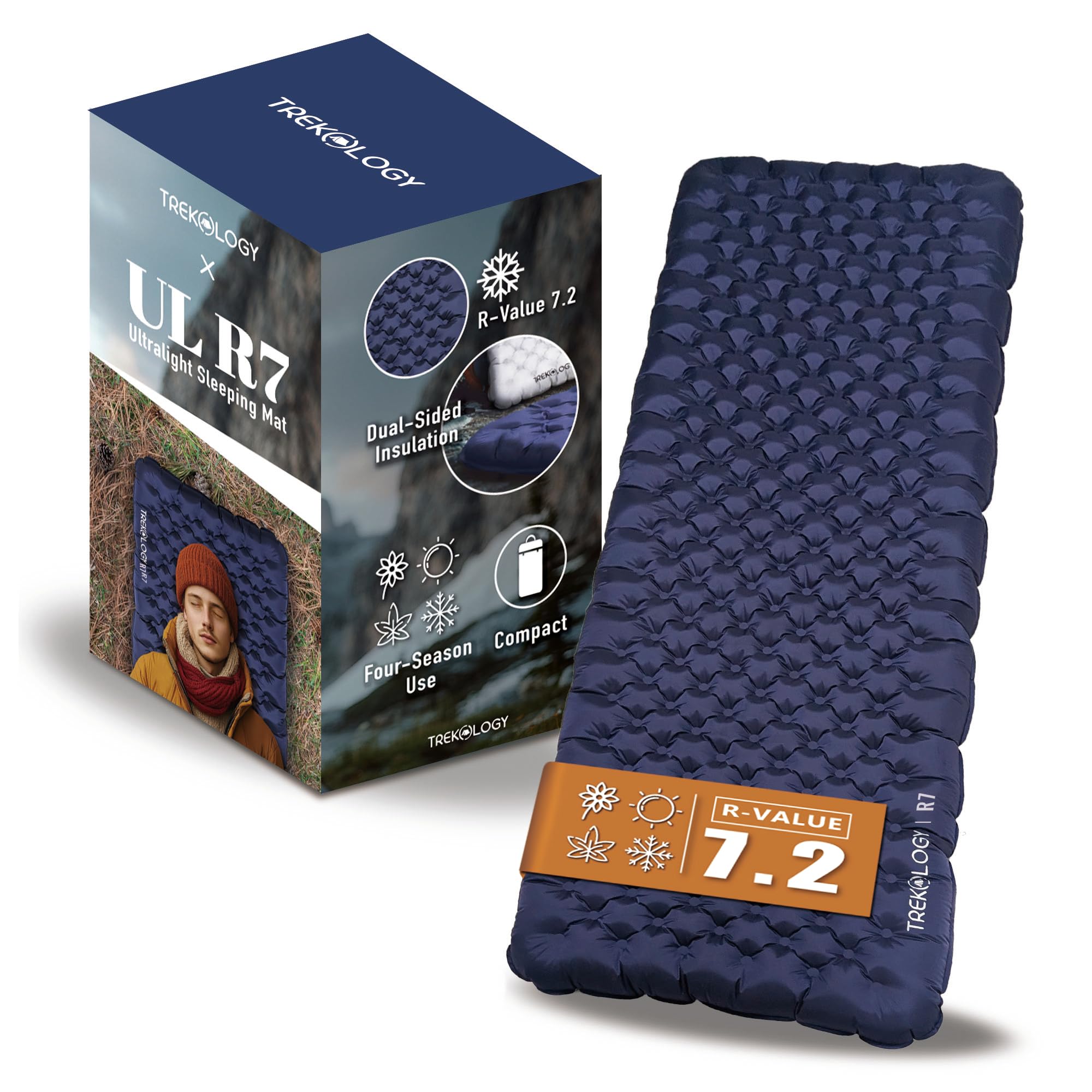
Thick, warm, and surprisingly affordable for a four-season pad — 7.2 R-Value at 2 pounds.
You get a 4-inch thick sleeping pad with an SGS-certified 7.2 R-Value — that is serious cold-weather insulation for a price that undercuts premium competitors by a wide margin. The pad measures 70.8 x 24 x 4 inches, which is long and wide enough for most sleepers up to about 6 feet tall. Reviewers point out using it in temperatures as low as 20°F and waking up warm, with one camper noting they slept warm and comfortable in 22°F with synthetic thermals. The 40D ripstop nylon with TPU coating is tear-resistant and water-resistant, and the anti-leak valve keeps air from seeping out overnight. Despite the insulating power, it packs down to the size of a water bottle for easy carrying.
The honest catch: at 2 pounds (900 grams), this is heavy compared to the Therm-a-Rest Xlite NXT above (13 oz). It is 11% heavier, in fact — a real weight penalty if you are counting every ounce. Also, the surface is slippery; one reviewer recommends putting a shelf liner underneath to keep it from sliding around inside your tent. The stated 7.2 R-Value is impressive, but some buyers doubt the exact number while still confirming the pad keeps them warm near freezing.
Why it is a good pick
- 4-inch thickness for real side-sleeping comfort
- 7.2 R-Value is among the highest at this price point
- 40D nylon shell is more durable than thin ultralight pads
What holds it back
- 2 pounds is heavy for ultralight packing
- Slippery surface needs a shelf liner or groundsheet to stay in place
- No built-in pump; you blow it up by mouth or carry a separate pump sack
Best for: Budget-conscious campers who camp in cold weather and prioritize warmth and thickness over shaving every ounce.
Not for: Weight-focused thru-hikers who need a sub-pound sleeping pad — the Therm-a-Rest Xlite NXT saves nearly a pound for a higher price.
7. OneTigris Featherlite Ultralight Sleeping Quilt
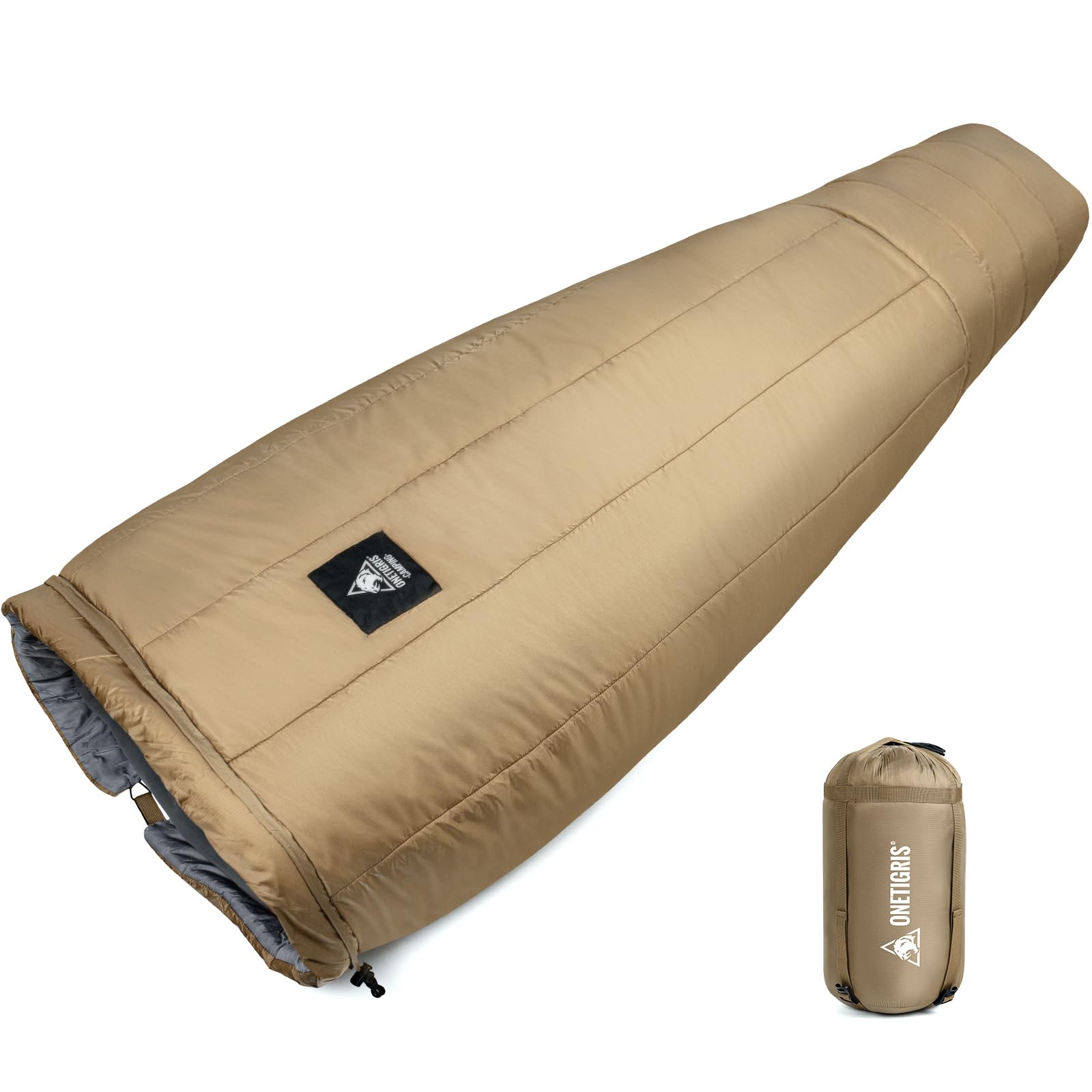
A warm, affordable synthetic quilt that frees you from the sleeping bag coffin — 35 oz and a 40°F rating for three-season use.
Weighing 35 oz (1000 grams), this quilt spreads out 6.5 feet by 2.8 feet — enough room for a 6’1″ sleeper to move around without feeling confined. The 40°F rating covers three-season conditions from spring through autumn. It uses a 20D Ripstop Nylon outer shell with 380T Polyester Pongee lining and SEE Polyester filling, which makes it soft, breathable, and wind-proof. The convertible footbox cinches closed to trap heat or opens to vent on warmer nights. One shopper added the quilt kept them warm on a 40°F night in Upstate New York, and another said it was comfortable down into the 30s with occasional draft adjustments. The hollowed back design works with a sleeping pad to balance down distribution and heat retention, while the hook-and-loop closure keeps the quilt wrapped around you.
The honest catch: the synthetic fill does not compress as small as down — it packs to about the size of a gallon jug, which is bigger than a premium down quilt. One reviewer noted the footbox tore after a few uses (they stitched it shut) and that the stuff sack is just okay. For sub-freezing temperatures, you would need extra layers or a warmer bag inside this quilt.
Its best features
- Synthetic fill is machine washable and dries faster than down
- Spacious 6.5 ft x 2.8 ft size fits taller sleepers
- Convertible footbox for heat retention or venting
Its real drawbacks
- Not as compressible as down — packs to gallon-jug size
- Footbox is a weak point; one buyer’s tore after a few uses
- Best suited for 40°F+ nights unless layered with a bag
Great for: Warm-weather backpackers and hammock campers who want a packable, washable quilt that does not break the bank.
it’s not for you if: You need a sub-freezing sleep system or you want the maximum compressibility of down for a long thru-hike.
Understanding the Specs
R-Value and Why It Dictates Your Comfort
R-value is a standardized measure of how well a sleeping pad resists heat loss to the cold ground. A pad with a 4.5 R-Value is generally warm enough for three-season use down to about 20°F, while a 7.2 R-Value pad handles proper winter camping. The catch is that higher R-values usually mean more insulation weight — you trade ounces for warmth. If you only camp in summer, a 2.0 R-Value pad works fine and saves a lot of weight.
Waterproof Ratings on Tents (mm)
The number in mm (like 4000mm) measures how much water pressure the fabric can hold before leaking — think of it like a column of water sitting on the fabric. A 1200mm rating keeps out light rain; 3000mm handles moderate downpours; 4000mm is serious storm protection. Tents with 4000mm floors can sit in standing water without soaking through. Ultralight tents sometimes drop to 1500mm on the fly to save weight, which is fine for drizzle but not for sustained heavy rain.
Boil Time and Fuel Efficiency on Stoves
Stove specs like “boils water in three minutes” or “2900W max output” tell you how fast you get hot food, but fuel efficiency is what saves weight over a week-long trip. A stove that boils faster uses less fuel per meal, which means carrying a smaller canister. Simmer control adds weight and complexity but lets you cook real meals rather than just rehydrating. If you only boil water for dehydrated dinners, a fast, simple burner is all you need.
Denier (D) on Fabrics
Denier is a unit of fabric thickness — 20D nylon is lighter and packs smaller than 40D nylon, but it tears more easily against rocks or roots. Ultralight tents and quilts often use 20D or 10D fabrics to save ounces, but you need to be careful about campsite selection and using a groundsheet. 40D fabric is more durable and better for rough use, but heavier. Decide based on whether you are on established trails or bushwhacking.
FAQ
What is the lightest way to sleep warm?
Can I use a quilt in cold weather?
What does 4000mm waterproof mean on a tent?
How much weight should a two-person tent be?
Is a titanium cookset worth the extra cost?
How do I choose between a standalone stove and an integrated cooking system?
What is the difference between down and synthetic quilt fill?
How do I know if a sleeping pad is wide enough for me?
Can I put a titanium pot directly in a campfire?
Final Thoughts: The Verdict
For most hikers, the ultralight backpacking gear winner is the Therm-a-Rest NeoAir Xlite NXT because it delivers the best warmth-to-weight ratio with a 4.5 R-Value at just 13 ounces — the kind of spec that makes your entire pack feel lighter. If you want a real two-person shelter for a fraction of the premium brands, grab the Naturehike Mongar 2 Tent. And for the lightest stove that still lets you simmer rather than just boil, the Jetboil MightyMo is your best bet.
How We Picked
We do not accept paid placement, and we did not hands-on test every unit. Instead, we match each pick to a real buyer and use-case by comparing the manufacturers’ published specifications against the patterns in verified customer reviews — so you get each pick’s real strengths and trade-offs instead of marketing copy.
Sources & Methodology
Specifications: manufacturer listings and product documentation. Review insights: verified customer reviews, as of July 2026. Pricing: not shown on this page (it changes often); check the current price via the retailer link.
As an Amazon Associate, Gadgets Feed earns from qualifying purchases. This does not affect which products we feature.
Product prices and availability are accurate as of the date/time indicated and are subject to change. Any price and availability information displayed on Amazon at the time of purchase will apply to the purchase of this product. As an Amazon Associate I earn from qualifying purchases.
CERTAIN CONTENT THAT APPEARS ON THIS SITE COMES FROM AMAZON. THIS CONTENT IS PROVIDED "AS IS" AND IS SUBJECT TO CHANGE OR REMOVAL AT ANY TIME.
Amazon and the Amazon logo are trademarks of Amazon.com, Inc. or its affiliates.