
A garage floor littered with handlebars and pedals is a daily nuisance every cyclist knows. A vertical bike rack transforms that chaos by lifting your bike off the ground and tucking it against the wall, reclaiming square footage you didn’t even remember losing. Whether you are parking a lightweight road bike or a 60-pound e-MTB, the right vertical solution keeps your machine stable, accessible, and out of the way.
I’m Min — the co-founder and writer behind Gadgets Feed. I’ve spent hundreds of hours analyzing mounting mechanisms, weight capacities, tire-width limits, and real-world durability feedback across the most popular vertical racks on the market to build this guide.
This guide cuts through the clutter to help you pick the best vertical bike rack for your garage or apartment, whether you prioritize no-lift loading, fender compatibility, or a freestanding footprint.
How To Choose The Best Vertical Bike Rack
Choosing a vertical bike rack is fundamentally about matching the rack’s physical constraints to your bike’s geometry and your available wall or floor area. Overlooking tire-width max or fender clearance is the most common mistake that leads to returns.
Wall Mount vs. Freestanding
Wall-mounted vertical racks are the most space-efficient because they push the bike’s weight into the studs, leaving the floor completely clear. Freestanding gravity racks, on the other hand, require no drilling and can be moved, but they demand a solid footprint on the ground — typically 2 to 3 feet deep — and may feel top-heavy with heavier e-bikes. If you rent your home or lack accessible wall studs, a freestanding vertical stand is the practical choice.
Weight Capacity and Tire-Width Limits
E-bikes often exceed 50 pounds, so a rack rated for 66 to 80 pounds is non-negotiable for electric models. Tire-width compatibility is equally critical: most standard racks cap out at 2.4 to 2.6 inches, while fat-tire-specific models accept up to 4.25 inches. Measure your tire’s actual width with a caliper — don’t guess based on the tire’s printed sidewall number, which is often narrower than the true inflated width.
Loading Mechanism: Swivel, No-Lift, or Lift
No-lift designs let you balance the bike on the rear wheel and roll it into a cradle, which eliminates back strain during daily use. Swivel arms (typically 120 to 124 degrees) add the ability to pivot the stored bike sideways, which is invaluable if you need to park multiple bikes on the same wall section or want to access a car parked next to the rack. Standard lift-and-hook racks are the most affordable but require you to deadlift the full bike weight to chest height.
Quick Comparison
On smaller screens, swipe sideways to see the full table.
| Model | Category | Best For | Key Spec | Amazon |
|---|---|---|---|---|
| monTEK Swivel Wall Mount | Wall Mount | No-lift loading + swivel | 77 lbs, 3.54 in tire width | Amazon |
| Delta Cycle Vertical Rack | Freestanding | Two-bike gravity storage | 75 lbs per tray, 4.25 in tires | Amazon |
| Steadyrack Fender Rack | Wall Mount | Bikes with fenders | 2.4 in max tire, 20-29 in wheels | Amazon |
| StoreYourBoard Swivel Rack | Wall Mount | Multi-bike wall layouts | 50 lbs, 2.6 in tire, 124° swivel | Amazon |
| CyclingDeal Freestanding Rack | Freestanding | Four-bike floor storage | 33 lbs per bike, tilt cradles | Amazon |
| RTR BIKES Brutus Up Pro | Freestanding | Mobile e-bike storage | 66 lbs, rolling wheelbase | Amazon |
| WEIZE Hitch Rack | Hitch Mount | Vehicle transport of e-bikes | 160 lbs total, 5.5 in fat tires | Amazon |
In‑Depth Reviews
1. monTEK Swivel Bike Wall Mount

The monTEK wall mount solves the biggest pain point of vertical storage: hoisting a heavy bike overhead. The no-lift design lets you balance the rear wheel on the ground and roll the front wheel into the cradle, so you never have to deadlift the full frame weight. The steel build carries a rated limit of 77 pounds, which comfortably covers almost any traditional mountain bike or hybrid, and the 120-degree swivel lets you pivot the stored bike sideways to reclaim walking space in a narrow garage.
A four-level adjustable arm accommodates wheel diameters from 16 to 29 inches and tires up to 3.54 inches wide — that’s wide enough for plus-size tires on modern trail bikes. The kit includes hardware for both wood stud and concrete walls, and the rack folds flat against the wall when empty. Real-world buyers confirm that the cradle works with 29 x 2.5-inch MTB tires, even with fenders, as long as the arm is shortened by one hole to create the necessary clearance.
One note: the bottom tire catch is made of a dense polymer rather than all steel, which some users felt was less premium than the rest of the rack. The swivel range is also limited compared to some high-end competitors, although 120 degrees proved sufficient for staggered mounting in real garage layouts. For the combination of capacity, ease of use, and swivel flexibility, this rack delivers the best overall value for most cyclists.
Why it’s great
- No-lift loading eliminates back strain during daily use
- 77-pound capacity covers road, MTB, and many e-bikes
- Swivel design frees up wall space adjacent to the rack
Good to know
- Bottom tire catch uses plastic, not full steel
- Not compatible with bikes equipped with full fenders
2. Delta Cycle Vertical Rack
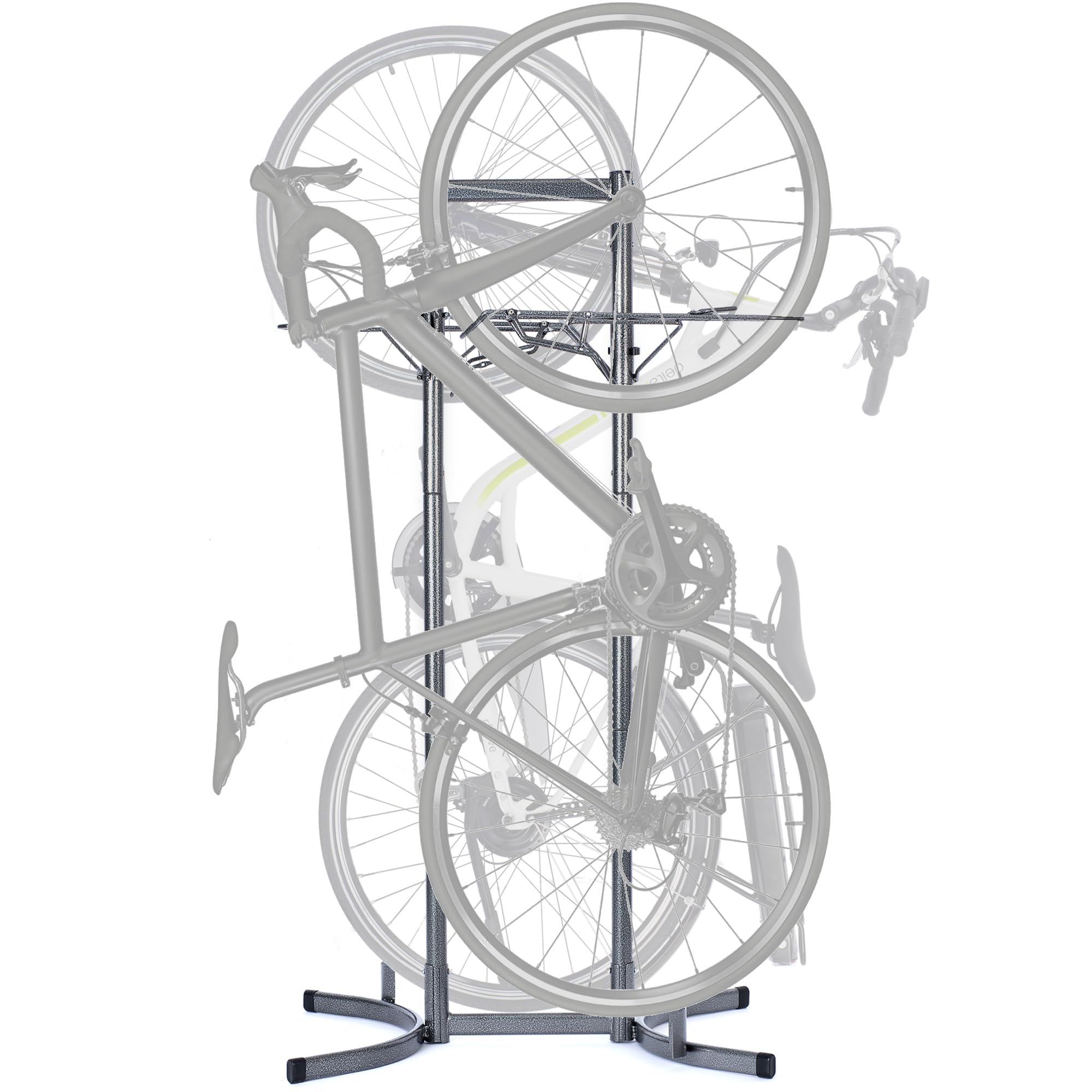
The Delta Cycle Vertical Rack is a freestanding two-bike gravity stand that securely holds bikes upright by their wheels, requiring zero wall drilling. Each wheel tray supports up to 75 pounds, and the spring-loaded design accommodates tires up to 4.25 inches wide — fat enough for burly e-bike tires and plus-size MTB rubber. The footprint measures 32 by 24 inches, which is compact enough for a corner of a one-car garage or a spacious apartment entryway.
The rack is fully adjustable for wheel diameters from 20 to 29 inches, and the two tiers are spaced so that the lower bike sits clear of the upper bike’s frame. Assembly requires only a screwdriver and takes about ten minutes. A hammertone gray powder coat gives it a clean, bike-shop aesthetic that doesn’t look out of place in a living space.
The main trade-off is that the upper tray requires you to lift the bike fairly high — about chest level for most adults — so riders with mobility concerns should plan to load the lower position first. The adjustable arms slide freely when unweighted, which some users found annoying when maneuvering bikes on and off. The rack also requires at least 6.5 feet of ceiling height to accommodate the vertical footprint. It is, however, lightweight at about 25 pounds, so repositioning it is straightforward.
Why it’s great
- No drilling required — ideal for renters or temporary setups
- Holds up to 4.25-inch wide fat tires with ease
- Stable base design prevents tipping with heavy e-bikes
Good to know
- Upper loading position requires a significant lift height
- Adjustable arms can slide out when not loaded
3. Steadyrack Fender Rack

The Steadyrack is the go-to vertical wall mount for cyclists who refuse to remove their fenders for storage. Unlike most wall racks that pinch or crush fender struts, this design uses a wide, open cradle that cradles the tire without contacting the stays, provided there is at least 0.75 inches of clearance between the tire and the fender brace. The rack pivots on its mount, letting the bike swing flush against the wall — a mechanism that has been refined through years of real-world use.
Construction blends carbon steel with UV-treated polymer, so the rack resists corrosion even in unconditioned garages. Tire width tops out at 2.4 inches, which covers standard road tires, commuter slicks, and narrower gravel rubber, but will not accommodate plus-size or fat tires. Wheel diameter range spans 20 to 29 inches, and a single unit holds most adult bikes up to about 55 pounds — enough for lightweight e-bikes, as confirmed by owners using it with 40-pound electric city bikes.
Owners consistently report that installation takes about ten minutes per unit into wood studs, and the included hardware kit covers standard 16-inch stud spacing. The Steadyrack has a premium feel that justifies its higher per-unit cost, and the customer service reputation is excellent. The main catch is the tire-width limit — if your bike uses tires wider than 2.4 inches, this rack will not fit.
Why it’s great
- Specifically designed to work with fenders and mudguards
- Pivot mechanism minimizes wall protrusion to about 3 feet
- High-quality materials and excellent customer support
Good to know
- Maximum tire width is just 2.4 inches — no fat tires
- Premium price point compared to basic hook-style racks
4. StoreYourBoard Swivel Rack
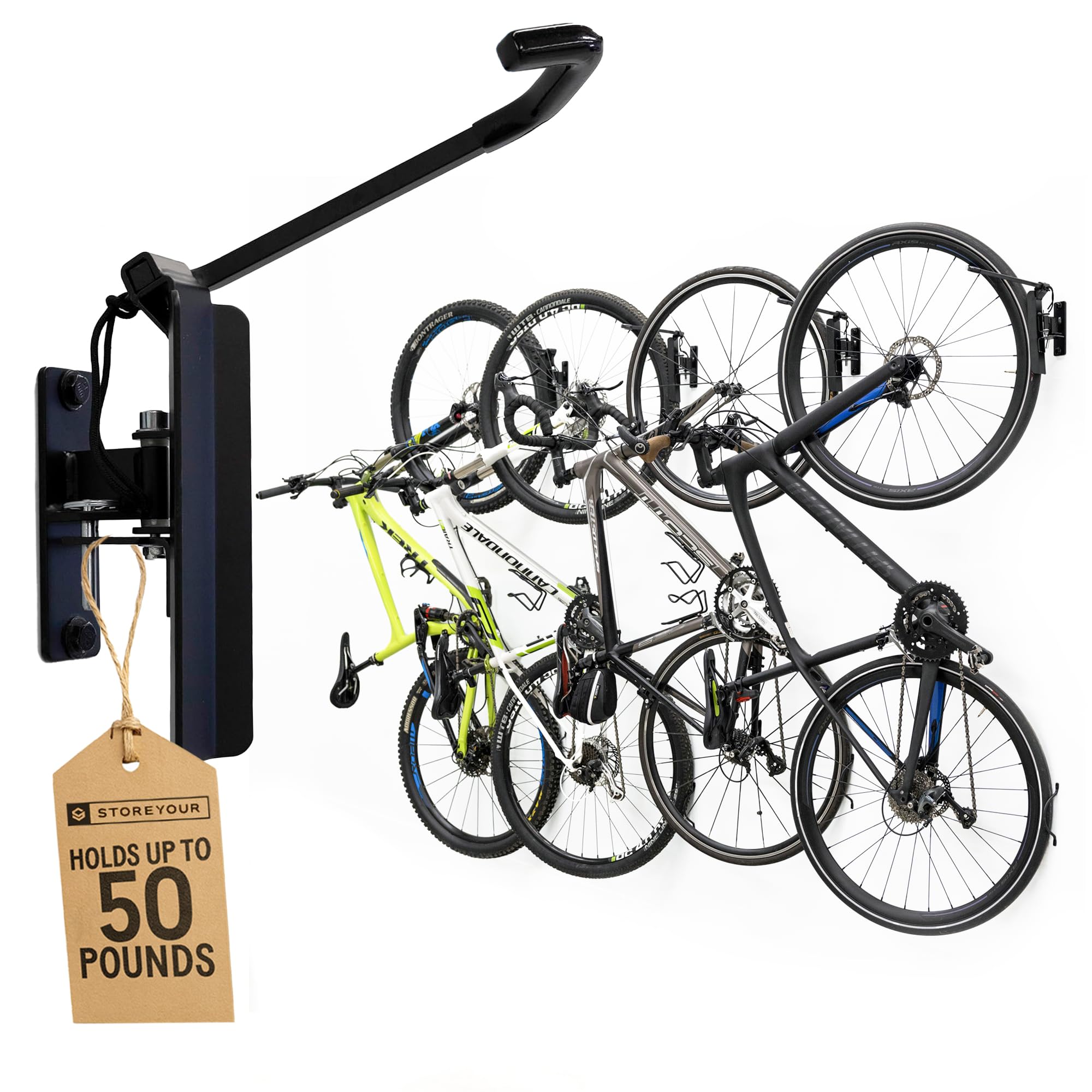
The StoreYourBoard rack delivers a 4-pack of individually swiveling wall mounts at a per-unit cost that undercuts most single-rack competitors. Each unit is built from precision-welded alloy steel with a powder-coated finish and a claimed load capacity of 50 pounds — enough for most standard road, gravel, and hardtail mountain bikes. The swivel range extends to 124 degrees, and each rack includes a lock-pin stopper that prevents unwanted rotation during loading.
Tire width is limited to 2.6 inches, so it fits 95 percent of non-fat-tire recreational bikes. The cradle has a rubber-coated hook to protect the wheel’s finish, and an integrated rear tire catch keeps the bike stable once hung. All hardware for stud mounting is included, and the company backs the rack with a lifetime warranty. Buyers consistently note that the swivel makes a huge difference in multi-bike garages, allowing you to stagger the bikes and access the wall behind them.
The main downside is that 50 pounds is a firm ceiling — an e-bike that weighs 55 pounds or more is over the limit. You also have to lift the bike to chest height to engage the hook, which is tiring for daily use with heavier bikes. The 4-pack price is a genuine bargain for a family with multiple standard bikes, but individual buyers who only need one or two mounts might find the Steadyrack or monTEK more compelling for their specific features.
Why it’s great
- 4-pack provides multi-bike storage at an excellent per-unit cost
- 124-degree swivel with lock-pin stopper for controlled rotation
- Lifetime warranty and US-based customer support
Good to know
- 50-pound limit cannot handle most e-bikes
- Requires lifting the full bike weight to mount height
5. CyclingDeal Freestanding Rack

The CyclingDeal freestanding rack is designed for households with multiple bikes — it stores up to four bicycles on a single floor footprint without any wall attachment. Each bike hangs from adjustable tilting cradles that pivot to match sloping top tubes and aggressive frame geometries, so you can store women’s step-through frames and full-suspension mountain bikes on the same rack side by side. The per-bike weight limit is 33 pounds (132 pounds total), which is fine for kids’ bikes, road bikes, and lightweight hardtails.
The base is a broad steel plate that spans roughly 29 inches wide and sits low to the ground, providing lateral stability. The vertical tube offers machined holes for height adjustment, and the two hooks on each arm can be repositioned independently. Assembly is straightforward with basic tools, and the powder-coated finish withstands garage humidity without rust. Many owners confirm that the rack remains stable even on uneven tile or rough concrete floors.
The 33-pound per-bike limit is the main restricting factor — a single modern e-bike or heavy downhill rig will exceed it. The rack also feels top-heavy if heavier bikes are placed on the upper hooks, so the intended use is for standard-weight bikes placed with heavier bikes lower. Some users note a slight wobble when fully loaded, though no reports of tipping. This is a smart option for families who need to store multiple non-electric bikes in a compact floor area.
Why it’s great
- Holds four bikes in a freestanding floor footprint
- Tilting cradles accommodate unusual frame shapes and step-throughs
- No wall mounting required — great for apartments and rentals
Good to know
- Per-bike weight limit of 33 pounds excludes most e-bikes
- Can feel slightly top-heavy with heavier bikes on the upper hooks
6. RTR BIKES Brutus Up Pro
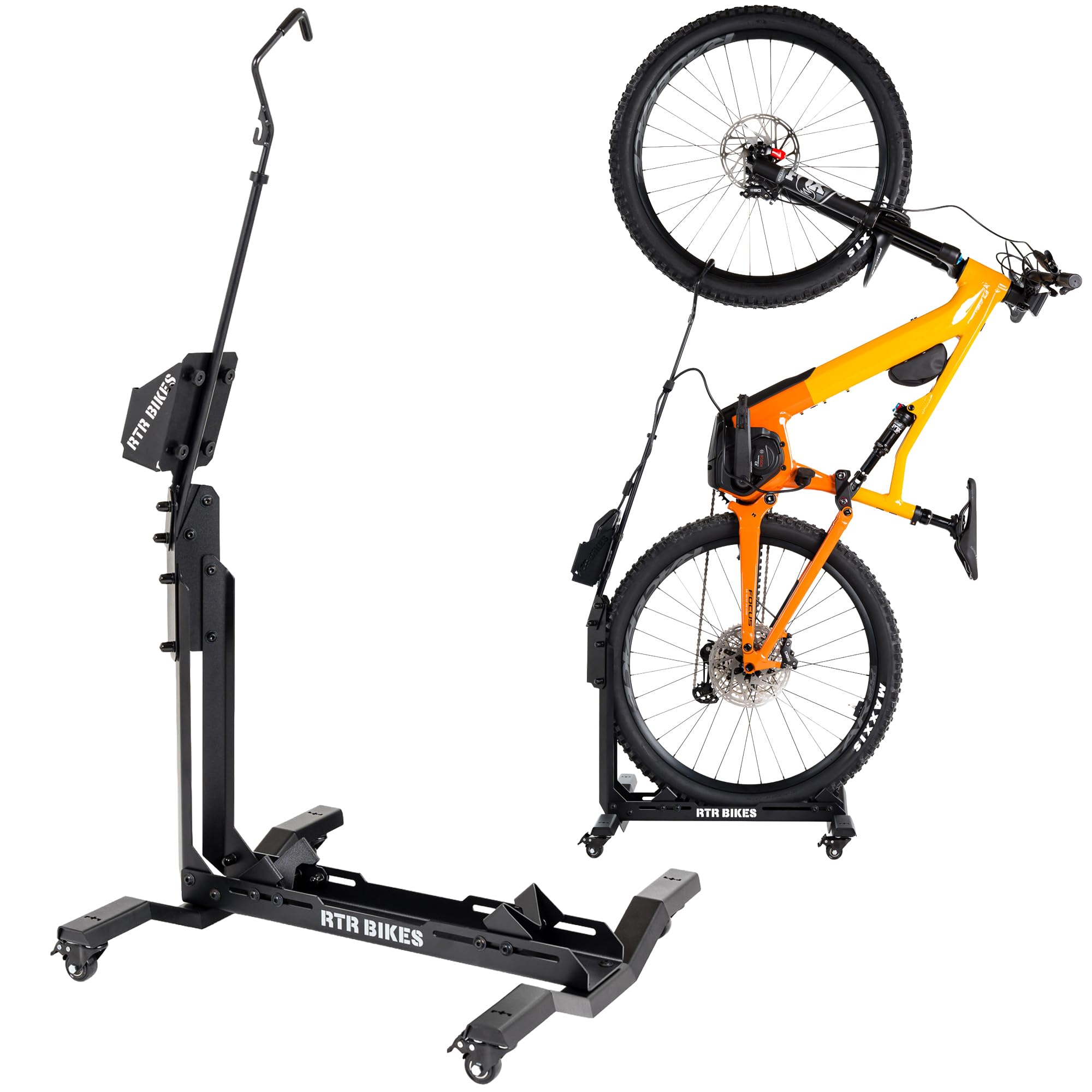
The Brutus Up Pro is a mobile vertical bike stand that rolls on heavy-duty caster wheels with locking brakes, making it ideal for shared or multi-purpose spaces where you need to relocate the storage arrangement frequently. The stand is built from high-grade European steel with a textured powder coat, and it holds the bike by the tire — never touching the rim or the frame — which is a genuine advantage for carbon rims and delicate paintwork. The rated capacity is 66 pounds, which covers most commuter e-bikes and mid-drive mountain bikes.
An integrated charger mount tray clips onto the upright, turning the stand into a tidy charging station for e-bike batteries. Tire width compatibility extends to 3.5 inches, and wheel diameter spans 24 to 29 inches. The base is 27 by 23 inches, which is compact enough to tuck into a corner or roll against a workbench. Owners of 50-to-80-pound e-bikes report that the stand holds them securely upright, and the locking wheels prevent any roll-away risk when parking on a sloped driveway.
The main drawbacks are the high price point and assembly complexity — some buyers noted missing instructions and a fiddly build process. The caster wheels are on the smaller side, which can hang up on garage floor debris or uneven joints. The design also leans slightly forward, which a few users felt could be more rear-biased for stability with heavier bikes. Still, if you need a rolling, no-drill solution for a heavier e-bike, this is the most capable stand in its class.
Why it’s great
- Rolling casters with brakes allow repositioning without lifting
- Dedicated charger mount keeps the e-bike ready to ride
- 66-pound capacity and 3.5-inch tire clearance for modern e-bikes
Good to know
- Premium cost that may exceed some budgets
- Small caster wheels can struggle on rough garage floors
7. WEIZE 2-Bike Hitch Rack
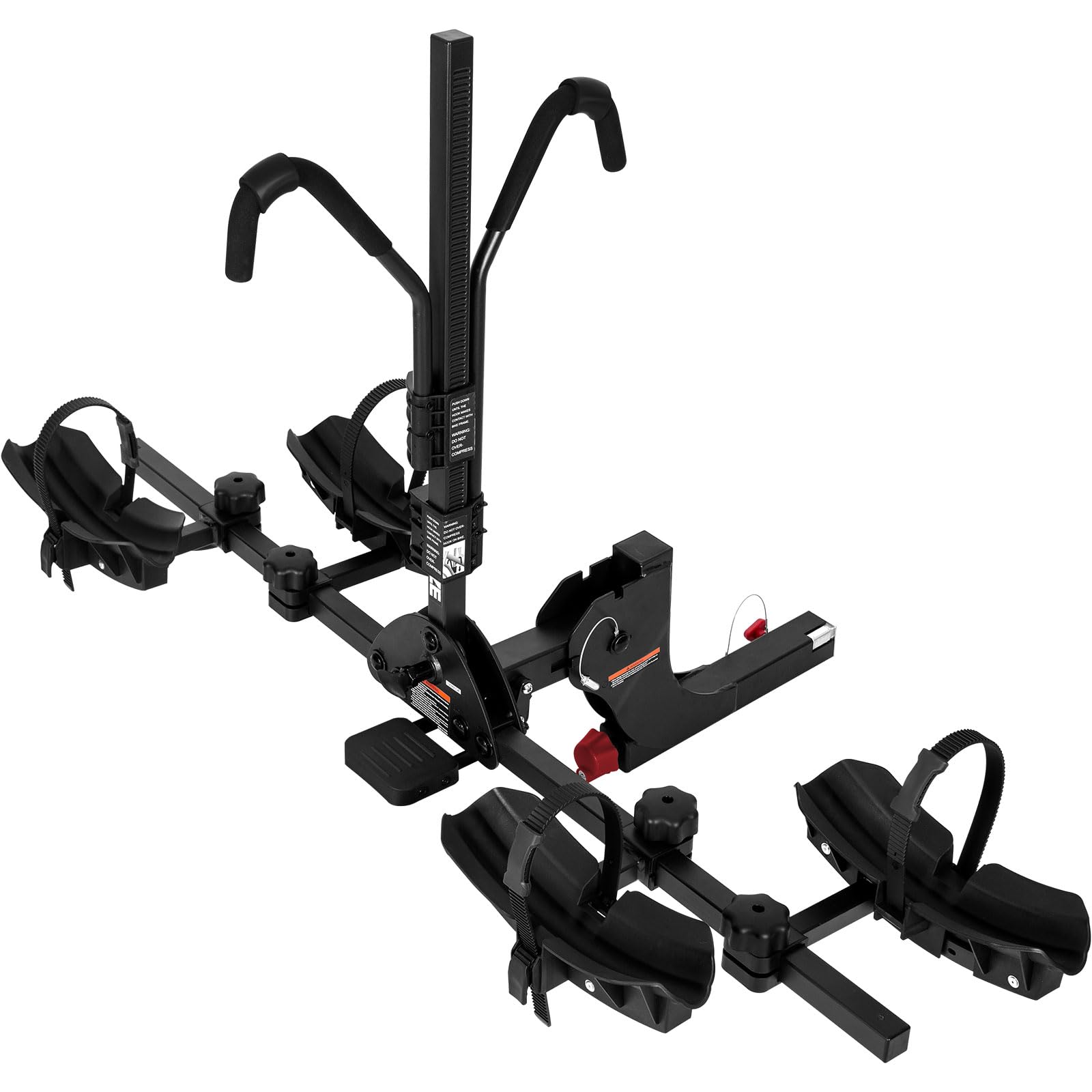
The WEIZE hitch rack extends the vertical storage concept to vehicle transport, offering a class-leading total capacity of 160 pounds — that is 80 pounds per bike — and accepting fat tires up to 5.5 inches wide. The anti-wobble locking mechanism tightens the rack into the 2-inch hitch receiver using a keyed bolt, eliminating the dangerous sway that plagues cheaper racks at highway speeds. Soft locking frame clamps and gear straps secure the bike without scratching the paint, and a safety tether provides redundancy.
The smart tilting function lets you drop the rack down to access the rear hatch even when bikes are loaded, though it is not compatible with swing-out tailgates. The platform folds up into a compact unit when not in use, and it can be adjusted to carry either one or two bikes. Wheel size covers 17 to 29 inches, and the wheelbase range is 18.5 to 49.5 inches. Real-world owners consistently praise the solid build, noting that the rack feels as stable as racks costing twice as much.
Assembly requires a moderate amount of time — around 30 minutes — and the included instructions are functional rather than polished. The rack is heavy at just under 50 pounds, so installation onto the hitch is a two-person job for most users. For low step-through frames, a separate top cross-bar adapter is required. If your primary need is to transport two e-bikes or fat-tire bikes behind your vehicle, the WEIZE offers a combination of capacity and wobble-free stability that is rare at this level.
Why it’s great
- 160-pound total capacity carries two heavy e-bikes with ease
- Anti-wobble locking system prevents dangerous sway
- Accepts tires up to 5.5 inches for fat-tire bikes
Good to know
- Heavy rack at 50 pounds — requires two people for installation
- Step-through frames need a separate top bar adapter
FAQ
Can I use a vertical wall mount for a carbon fiber frame?
What is the difference between a 120-degree swivel and a fixed vertical mount?
How much space does a vertical bike rack actually save?
Will any vertical rack work with a step-through or women’s frame?
Final Thoughts: The Verdict
For most users, the best vertical bike rack winner is the monTEK Swivel Wall Mount because it combines a no-lift loading mechanism with a 77-pound weight capacity and a useful 120-degree swivel, all at a price that undercuts premium competitors. If you need a freestanding solution that requires no drilling, grab the Delta Cycle Vertical Rack — it handles fat tires up to 4.25 inches and supports up to 75 pounds per tray. And for transporting two heavy e-bikes behind your vehicle, nothing beats the WEIZE Hitch Rack with its 160-pound total capacity and anti-wobble locking system.