
Our readers keep the lights on and my morning glass full of iced black tea. As an Amazon Associate, I earn from qualifying purchases.
Specs are compiled from manufacturer listings and verified buyer reviews and can change over time — please confirm the key details on the product page before buying.
Your recording routine decides which voice recorder you should buy. A student capturing a 90-minute lecture needs long battery life, while a journalist in a noisy café needs directional microphones, and an executive wants AI-generated meeting notes (automatic text summaries of your audio). The right device matches your daily habit, not the longest spec sheet.
I’m Min — the founder and writer behind Gadgets Feed. This guide is built by comparing the manufacturers’ published specifications and the patterns across verified customer reviews, so you get each pick’s real strengths and trade-offs instead of marketing spin.
We’ll break down the top models by battery life, storage, and recording quality so you can find the voice recorder that matches your workflow perfectly.
Our Picks at a Glance


How To Choose The Best Voice Recorder
Focus on three things: how long you need it to run, how clear the audio must be, and how you plan to get the files off the device. Getting these right makes the difference between a tool you use daily and one that gathers dust.
Battery Life Is Your Safety Net
For a full day of classes or back-to-back meetings, you need a recorder that lasts past hour three. Look for models that promise at least 20-30 hours on a single charge or set of batteries—enough for a week of typical use without recharging.
Storage Determines How Long You Can Record
A recorder with 4GB of internal memory is fine for short meetings, but a 64GB model can hold thousands of hours of audio. If you record at high quality (MP3 128kbps or WAV), you burn through storage faster. Match the capacity to your recording habits so you are not deleting old files to make room.
Simple vs. Smart Recording
Traditional recorders capture audio and leave the transcription to you. Newer AI-powered models automatically transcribe, summarize, and organize your notes in an app. If you hate typing up notes, the AI route saves you hours each week, but it requires a smartphone connection and often a subscription for advanced features.
Quick Comparison
| Model | Best For | Battery Life | Storage | Headphone Jack | Amazon |
|---|---|---|---|---|---|
| Sony ICD-PX370★ Best Overall | Reliable everyday recording | 57 hours | 4 GB | 2.5 mm | Amazon |
| Tonfarb 64GBStorage King | Massive storage on a budget | 32 hours | 64 GB | 3.5 mm | Amazon |
| EVISTR 64GBCrowd Favorite | Lectures & meetings | 100 hours | 64 GB | 3.5 mm | Amazon |
| EVIDA 64GB | Ultra-portable pocket duty | 15 hours | 64 GB | — | Amazon |
| Olympus VN-541PC | Simple one-touch operation | 60 hours | 4 GB | 2.5 mm | Amazon |
| Olympus WS-882 | High-res music & audio | 68 hours | 32 GB | 3.5 mm | Amazon |
| Sony ICD-PX470 | Crisp interviews & calls | 55 hours | 4 GB | Stereo Jack | Amazon |
| Comulytic Note Pro | AI transcription & summaries | 45 hours | 64 GB | None | Amazon |
| Pocket AI Recorder | Leaders & frequent meetings | 4 days | 64 GB | — | Amazon |
In‑Depth Reviews
1. Sony ICD-PX370 Mono Digital Voice Recorder
Our pick — 4.5★ from 6,500+ verified ratings; the strongest balance of quality and price.
The dependable default that nails the basics—long battery, simple controls, and a no-fuss built-in USB plug.
The Sony ICD-PX370 earns the top spot because it simply does everything well without demanding you learn a complex menu. Its defining feature is the 57-hour battery life (at MP3 128Kbps), which means you can record a full week of lectures or meetings before swapping in new AAAs. The built-in, direct USB connection folds out of the device for instant file transfer to your PC—no cables to lose, no adapters to hunt for.
This is a 4GB mono recorder, so it records in one audio channel rather than stereo, which is fine for speech and interviews. Owners consistently praise the clear sound that captures every word and its pocket-friendly size. The thing everyone raves about is build quality, with hundreds of buyers singling it out as a solid, reliable performer that feels like it will last.
The trade-off is the 2.5mm headphone jack, which is smaller than the standard 3.5mm found on most headphones, so you will likely need an adapter. Also, it runs on two AAA batteries, and while the battery life is advertised at 57 hours, buyers report that rechargeable batteries last around 10 hours in real-world use—so keep spares handy for marathon sessions.
What Owners Love
- Excellent audio clarity for voice and interviews
- 57-hour battery life on a single set of batteries
- Built-in USB plug means no lost cables
- Simple one-touch record button for quick capture
The Honest Trade-offs
- 2.5mm headphone jack requires an adapter for standard headphones
- Rechargeable batteries last about 10 hours, not the full 57
- Mono recording, not stereo
- 4GB storage fills up faster than 64GB rivals
The pick for: Students, journalists, and professionals who want a dependable, straightforward recorder that just works day after day.
Think twice if: You need to record in stereo or want massive storage for thousands of hours of audio—this one is built for quality of life, not capacity.
2. Tonfarb 64GB Digital Voice Recorder
A budget-friendly powerhouse with 64GB of built-in storage and a feature set that punches far above its price.
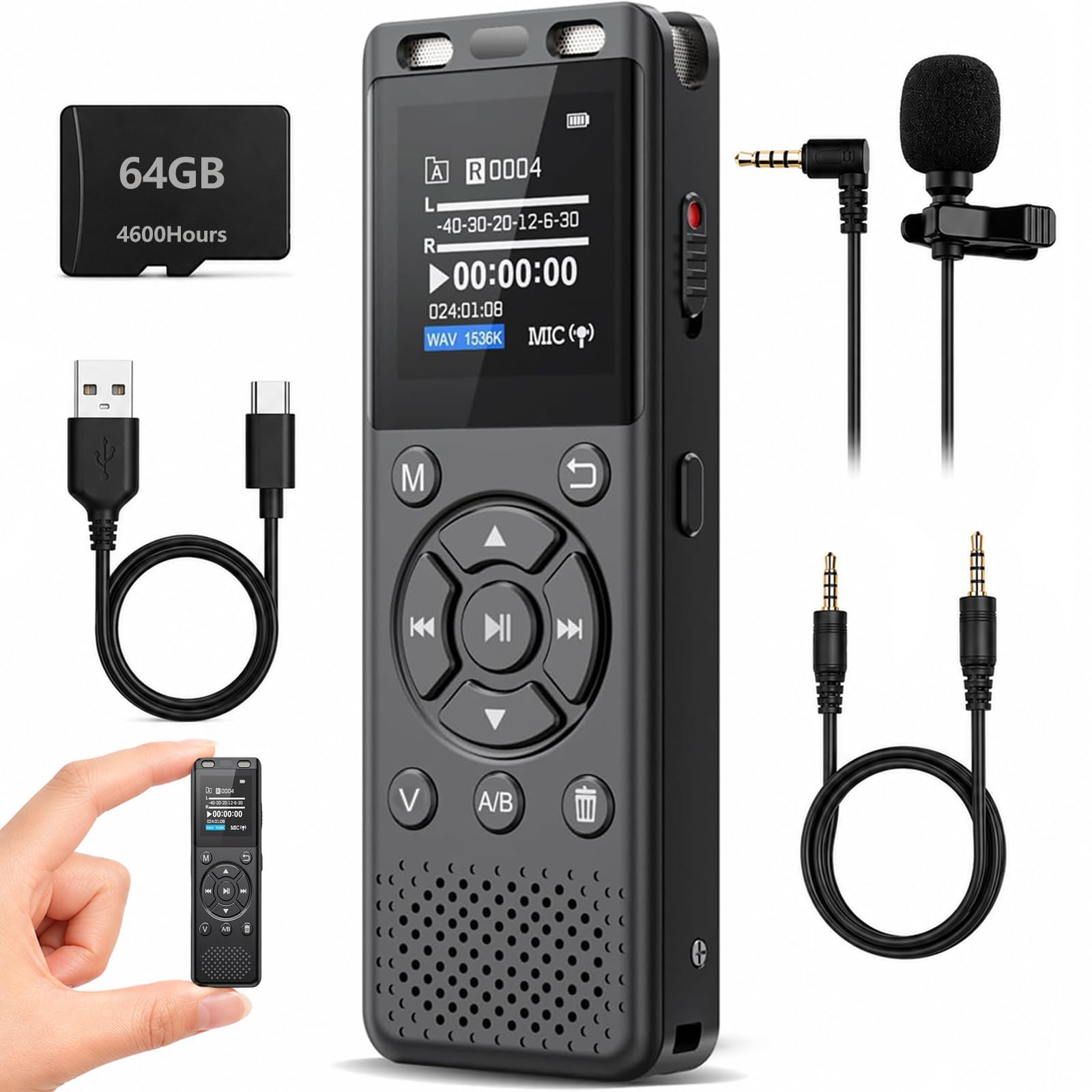
The Tonfarb 64GB is for anyone who never wants to think about running out of space. With a built-in 64GB TF card, it stores up to 4,600 hours of recordings—a massive 97.1x more recording time than the Sony’s 4GB internal memory. Its 600mAh battery supports up to 48 hours of continuous use (at MP3 32kbps), though the listed average battery life is 32 hours, enough for multiple days of classes or fieldwork.
It records in WAV format at up to 1536kbps PCM quality, and the voice-activated mode automatically starts recording when sound reaches your set level, saving both storage space and battery. The large 1.44-inch screen makes navigating menus easy, and password protection keeps your personal memos secure. Unlike the Sony, it uses a standard 3.5mm headphone jack—40% larger than the Sony’s 2.5mm—so your regular headphones work without an adapter.
The main complaint centers on the line-in recording: owners mention that line-in records only one side despite multiple tests, and the headphone sound is poor. Voice recording via the external mic works well, and it plays MP3/WAV files perfectly. If your primary need is capturing voice in lectures or meetings, this is a fantastic value; if you planned to use the line-in port to record from another device, be prepared for disappointment.
Why It Stands Out
- 64GB storage holds thousands of hours of audio
- Voice-activated recording saves battery and space
- Standard 3.5mm headphone jack
- Password protection for sensitive files
Where It Stumbles
- Line-in recording has a reported defect with one-sided audio
- Playback volume is low through the built-in speaker
- Mono sound despite stereo microphone listing
- No belt clip included
Best for: Students on a budget who want huge capacity and don’t need to record from external audio sources.
Look elsewhere if: You need reliable line-in recording (plugging in an external microphone or audio source) or clear playback through built-in speakers—this recorder excels only at capturing voice directly.
3. EVISTR 64GB Digital Voice Recorder
The lecture-hall workhorse with a 100-hour battery and a 360-degree noise-reduction mic that catches distant voices.
The EVISTR L357 is the most popular recorder on this list, and for good reason—it delivers the features students and professionals need at a price that makes sense. Its 100-hour battery life is nearly double the Sony’s 57 hours, making it the longest-lasting option here for straight recording. The 500mAh battery fully charges in 3 hours via the included Type-C cable, and it records up to 4,660 hours of audio (at 32Kbps) on its 64GB storage.
What wins people over is the sound quality—the dynamic noise-reduction microphone collects sound in 360 degrees, and the adjustable 7 levels of recording gain let you capture voices from across the room. The voice-activated recording feature is a standout: it only records when someone is talking, cutting out silent gaps and saving playback time. It also supports WAV/MP3 formats, A-B repeat for language learning, and variable-speed playback for reviewing dense material.
The recurring gripe is the file management system—when deleting files, the display shows only the first 6 of the 14-digit filename, which can lead to accidentally deleting the wrong recording. The screen and buttons are small, and the manual is frustratingly unclear, though the basic record and save functions are genuinely simple for anyone to use. For the price, customers note it easily beats dedicated camera microphones for festival interviews and conference recordings.
The Highlights
- 100-hour battery life—the longest in this lineup
- Voice-activated recording saves storage and time
- 360-degree noise-reduction mic captures distant speakers
- Type-C charging for fast, modern setup
Watch Out For
- File deletion screen shows only part of the filename
- Small screen and buttons are hard to navigate
- Manual is confusing and lacks detail
- High gain levels (4+) can introduce white noise
Perfect for: Students recording lectures and anyone who wants a long-lasting, voice-activated recorder that won’t miss a word.
skip it if: You are not comfortable with small buttons and a finicky menu—this one rewards patience with its feature set.
4. EVIDA 64GB Digital Voice Recorder
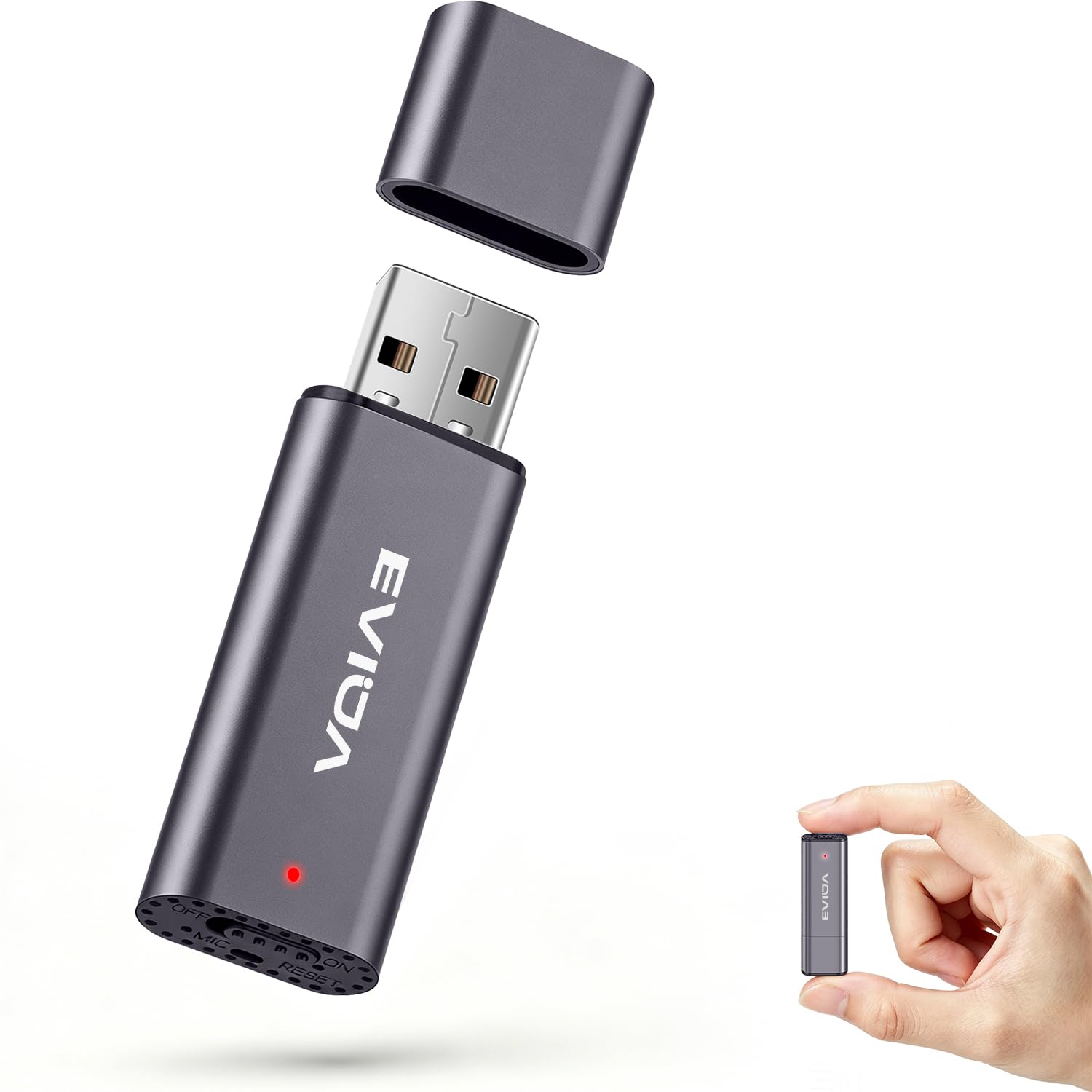
A featherlight 14.7g recorder that slips into a shirt pocket and still stores 750 hours of audio.
The EVIDA is the lightest device here at just 14.7g—so small you will forget it is in your pocket until you need it. Despite the tiny frame, it packs 64GB of built-in memory, allowing you to store up to 750 hours of recording files before worrying about space. Its defining safety feature is the low-battery smart auto-save, which automatically saves your recording before the battery runs out so you never lose an important conversation.
Owners describe the sound quality as crisp and clear, easily picking up soft voices in Zoom meetings and quiet conversations around a conference table. One buyer calls it “lightweight and has good sound quality that you would expect from the pricier brands,” putting it on par with more expensive options for everyday voice work. The ease of concealment and portability make it a favorite for recording phone calls and in-person discussions discreetly.
The trade-off is the 15-hour battery life, which is the shortest among the standard recorders here—fine for a day or two of use but not for a week-long trip without a charge. The navigation also takes time to learn, and reliability is a mixed bag, with some units reported to stop working. For the price and size, though, it is a strong contender if portability is your top priority.
The real appeal: This is a “low-maintenance” pocket recorder with great pickup for its size, perfect for quick meetings and notes.
The honest limit: The 15-hour battery means regular charging, and the small size makes the controls fiddly until you get used to them.
Reach for this if: You need to record Zoom calls or discreetly capture phone conversations and want something nearly weightless.
Reconsider if: You are recording all-day events—the battery won’t stretch past a single long session.
5. OM SYSTEM Olympus VN-541PC

The simplest recorder on the list—one button starts recording, and four scene presets handle the settings for you.
The VN-541PC is for anyone who wants to press a button and record without wading through menus. Its one-touch recording ensures you never miss a moment, even if the device is off. It has four recording scenes that automatically adjust the settings based on your situation—choose the one for meetings, lectures, dictation, or interviews and the recorder tune itself. The noise-cancellation function cleans up playback so voices come through clearly.
It is a compact, 4GB mono recorder with a 60-hour battery life and records in WMA format. Owners consistently call it the simplest recorder they have found, praising the logical controls that avoid the confusing menus of budget Chinese brands. It records a conference room well, and transferring files is easy via the micro-USB cable or direct headphone transcription. It is built to last—one owner is on their third unit, with the first two failing only from water exposure, not daily use.
The catch is that pausing creates a new file each time, which can clutter your file list if you pause frequently. There is no record button lock, so it can trigger unintentionally in a pocket or bag. It also uses a 2.5mm headphone jack, so your standard headphones will need an adapter. For a dependable, no-nonsense recorder, this is the one that just works.
Why It’s Simple to Love
- One-touch recording starts instantly
- Four scene presets auto-adjust settings
- 60-hour battery life is endurance-class
- Noise cancellation for clear playback
Minor Frustrations
- Pausing creates a new file every time
- No record button lock for pocket carry
- 2.5mm headphone jack needs an adapter
Ideal for: Teachers, seniors, or meeting attendees who want a recorder with simple controls—no complex menus to navigate, just press record and go.
Not for: Power users who need adjustable gain levels, stereo recording, or long-form continuous recording without file breaks.
6. OM SYSTEM Olympus WS-882

The hi-fi choice that records in Linear PCM for studio-quality audio, plus a 68-hour battery and USB direct.
The WS-882 is the step-up option for anyone who treats recording quality seriously. It records in Linear PCM format—a higher-fidelity audio standard that captures more detail than compressed MP3—alongside standard MP3, making it ideal for music, podcasts, and any situation where audio clarity is non-negotiable. It offers 32GB of internal memory with up to 1,040 hours of maximum recording time, and the USB direct connection lets you plug it into a laptop like a flash drive.
Owners say it “picks up the lowest of sounds,” making it a favorite for paranormal investigations and quiet recordings. It is a stereo recorder, so it captures room ambience and multiple speakers with more depth than mono rivals. The 68-hour battery life means it can run for days of field recording without a charge. File indexing and the ability to erase selected files keep your recordings organized, and external mic support turns it into a podcasting-quality tool.
The honest downside is that large micro SD cards slow the boot time significantly—a 32GB card takes about 20 seconds to start up, while using only the 4GB internal memory boots in 4 seconds. It has no backlight on the tiny mirror-like screen, so navigating in dark environments is tricky. It lacks USB recharging, so you will need to carry spare AAA batteries for extended trips.
The standout feature: Linear PCM recording captures audio detail that MP3 recorders simply miss—hear subtle sounds, room tone, and quiet whispers.
The trade-off: Dated interface with a small, unlit screen and slow boot times with large SD cards makes it less beginner-friendly than the Sony options.
Pick this for: Podcasters, musicians, and field recorders who demand high-fidelity audio and plan to use an external mic.
Pass on it if: You want a quick, modern interface with bright screen—this one is functional but feels old-school.
7. Sony ICD-PX470 Stereo Digital Voice Recorder

Sony’s stereo upgrade with an adjustable microphone range that zeroes in on voices across a room.
The ICD-PX470 takes everything reliable about the PX370 and adds stereo recording plus a smarter microphone. Its adjustable microphone range lets you customize how far the recorder “listens,” so you can focus on a single voice in a noisy room or capture the whole conversation around a table. The auto voice recording mode reduces background noise automatically, which is a godsend for interviews in cafés or busy offices.
It delivers 55 hours of battery life and features a built-in, direct USB connection for fast transfers to a PC. The micro SD card slot expands storage beyond the internal 4GB, supporting cards up to 32GB—a flexibility the PX370 lacks. Owners find it “perfect for recording interviews,” with multiple recording modes for phone calls, meetings, and across-room capture. One music professional even found two usable settings that produce less distortion than pricier Zoom recorders, calling it “surprisingly good little recorder even for voices that usually blow mics out.”
The recurring complaint is battery drain: reviewers point out the battery drains quickly during use and even in standby, advising you to remove the batteries when the recorder sits idle. The built-in speakers are weak, and there is no USB recharging option, so plan for battery replacements. The built-in mic is sensitive, which is great for capture but means you may want a belt clip—an accessory Sony doesn’t include.
Why It Shines
- Stereo recording captures more depth than mono
- Adjustable mic range focuses on specific voices
- Micro SD slot allows storage expansion to 32GB
- Multiple scene modes for interviews, meetings, and calls
The Drawbacks
- Battery drains even in standby—remove batteries when idle
- Weak built-in speaker for playback
- No USB recharging despite direct USB connection
Grab it if: You conduct interviews or record meetings in varied environments and want adjustable pickup patterns to match the room.
Think about it if: You leave your recorder unused for days—the standby battery drain will frustrate you.
8. Comulytic Note Pro AI Voice Recorder
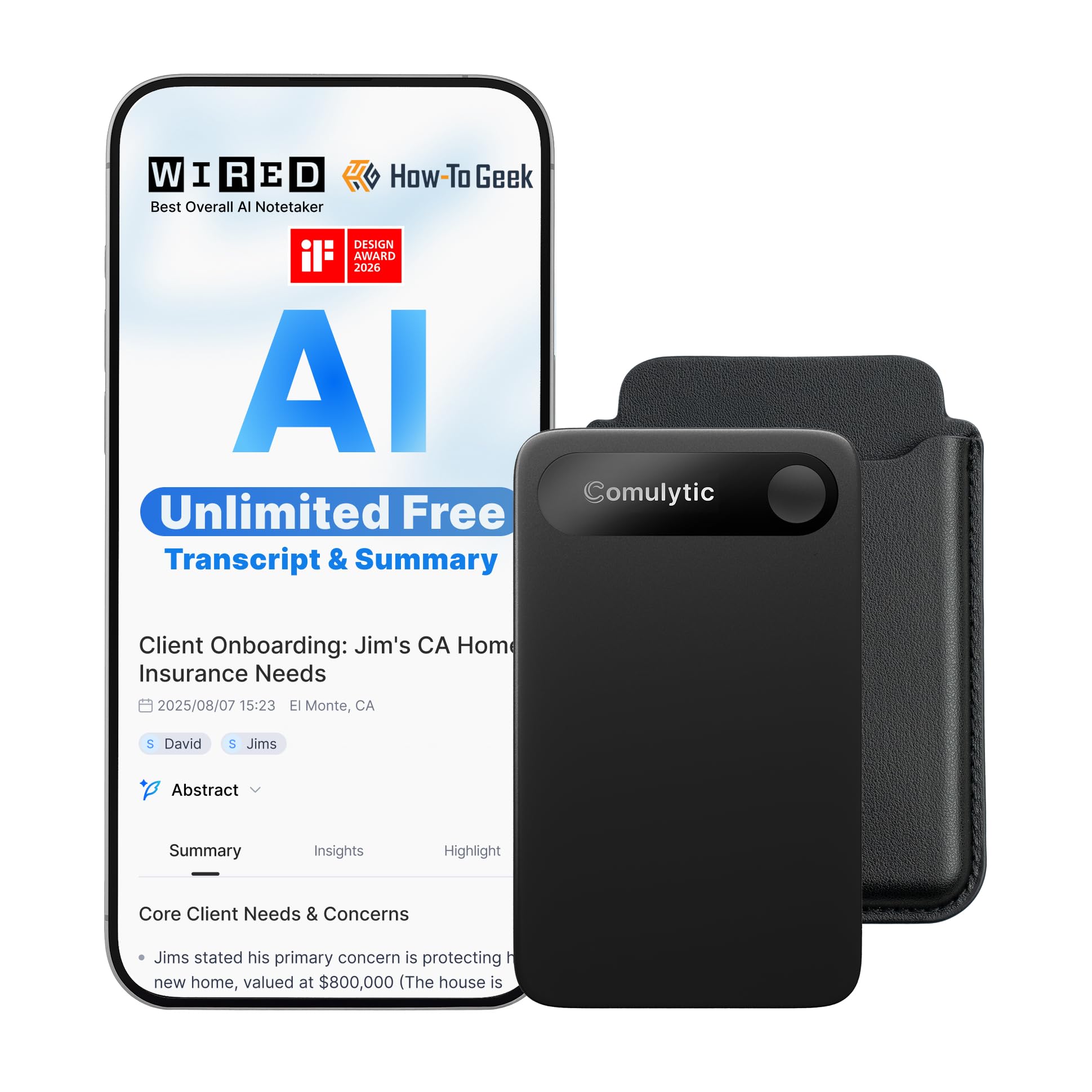
A magnetic, 3mm-thin AI recorder that transcribes meetings and interviews in 113 languages while you talk.
The Comulytic Note Pro is a different beast—not just a recorder but an AI note-taking system. At just 3mm thin and 27.6g, it is the slimmest device here, and three magnetic accessories let you snap it to your phone, laptop, or notebook. One tap starts recording, and the AI automatically detects whether you are in a call, meeting, or interview without manual mode switching. Its 64GB of built-in storage holds thousands of hours, and the Wi-Fi sync pushes recordings to the cloud at up to 10x Bluetooth speed in real time.
The headline feature is free, unlimited transcription with basic AI summaries on the lifetime Starter Plan. The app delivers fast transcription, action items, and to-do lists, with It transcribes with 98% accuracy across 113 languages.. A triple-mic array with AI noise reduction captures words clearly within 5 meters, even in a crowded room. It offers a 45-hour battery for continuous recording, 107 days of standby, and a full charge in 90 minutes—built for back-to-back workdays. Files are AES-encrypted and CCPA-compliant for privacy.
The catch: there is no headphone jack, so you cannot listen back directly on the device without connecting to your phone. The free plan covers basics, but advanced features like deep dive analysis and the “Ask Comulytic Assistant” require the optional Premium Plan. One owner notes the summary option sometimes feels like an ad for the paid tier and there is no bulk export. For professionals who live in meetings, the time saved on transcription is the real value.
The AI Advantage
- Free unlimited transcription and basic summaries forever
- Triple-mic array captures clear audio in noisy rooms
- 45-hour recording battery with 90-minute full charge
- Ultra-slim magnetic design attaches anywhere
Consider First
- No headphone jack for direct playback
- Advanced features locked behind a monthly subscription
- Requires smartphone app for transcription and file access
Made for: Executives, consultants, real estate agents, and journalists who want meetings to summarize themselves without manual notes.
Skip if: You are fine typing your own notes and just want a simple recorder—the AI features are the entire point here.
9. Pocket AI Voice Recorder
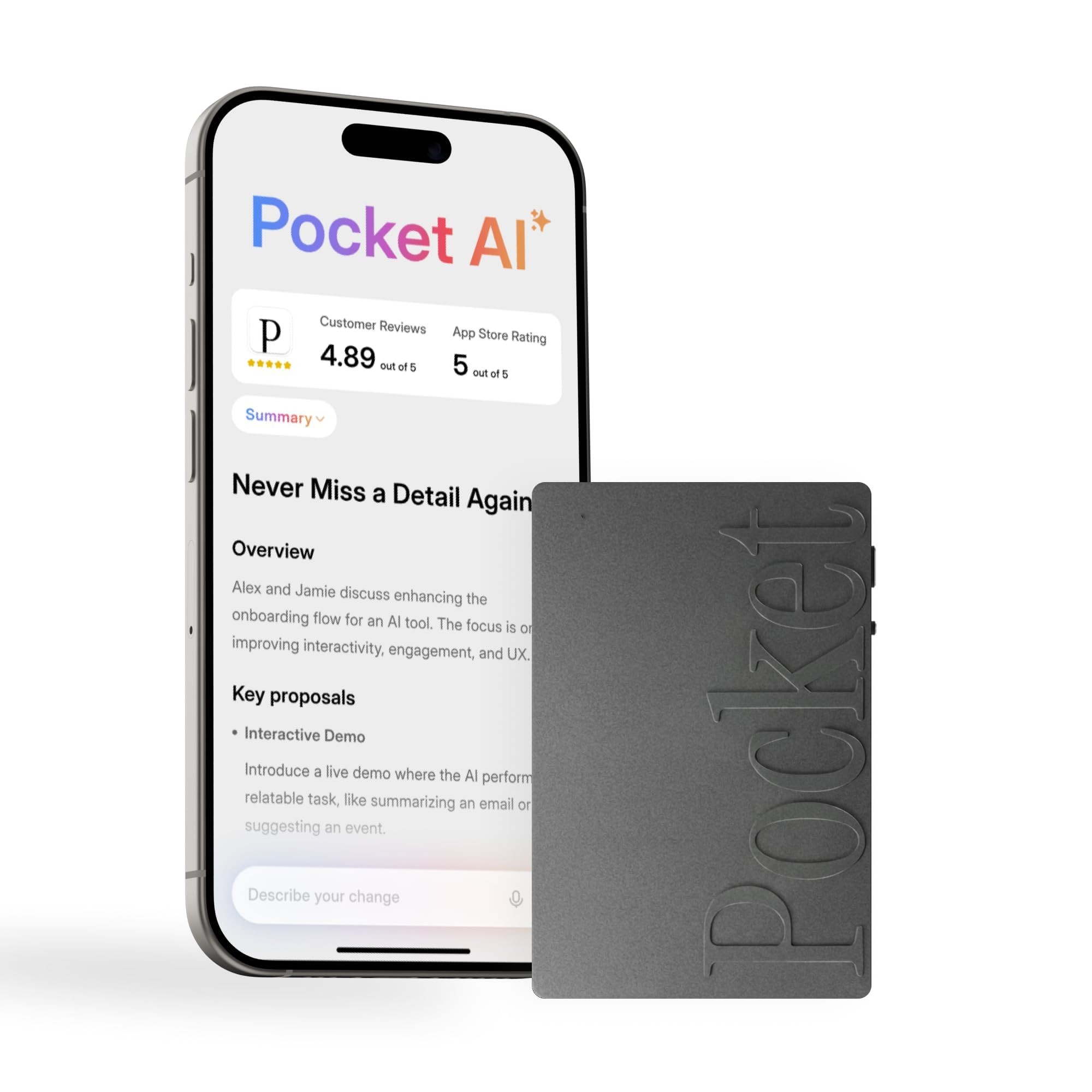
A credit-card-sized AI assistant with a 4-day battery that clips to your iPhone via MagSafe for hands-free capture.
The Pocket AI Recorder is the premium option for leaders who want a true “personal assistant” in their pocket. Its defining feature is the 4-day battery life on a single charge, which means you can travel for a long weekend without packing a charger. It is MagSafe compatible, so it snaps onto the back of an iPhone or other MagSafe devices for convenient, hands-free recording—perfect for capturing meetings and calls without holding anything.
One-tap recording captures meetings, phone calls, and in-person conversations instantly. The AI automatically turns recordings into clear summaries, key action items, and structured conversation maps, so you can review what matters without re-listening to audio. The “Ask Pocket” feature lets you query across your meetings to extract key insights and generate next steps, all grounded in your actual recordings. The app separates conversations by speaker and exports notes to Word or PDF.
The catch is that advanced features come through an optional subscription, though core features work from the start. Shoppers say the battery lasts 8+ days with heavy use, a pleasant surprise beyond the advertised 4 days. It handles accents and transcribes 100+ languages, making it a strong choice for bilingual professionals. It records discreetly through a chest or pants pocket, capturing conversations without the other party noticing.
Why Leaders Love It
- 4-day battery on a single charge
- MagSafe attachment for hands-free recording
- AI summaries, action items, and conversation maps
- Transcribes 100+ languages with accent handling
Before You Buy
- Premium features require an optional subscription
- Bluetooth connection needed for app features
- Higher price point than traditional recorders
The verdict: The ultimate upgrade for iPhone users who want recording, transcription, and meeting summaries in one pocket-sized device.
Not for: Budget buyers who only need to capture audio—the AI features justify the premium only if you actually use them.
Understanding the Specs
Battery Life (Hours)
This number tells you how long the recorder can run continuously on a full charge or set of batteries. A 57-hour battery like the Sony’s means you can record through a full day of meetings without recharging, while a 15-hour battery like the EVIDA’s requires more frequent top-ups. For all-day events or travel, aim for 30+ hours so you never stress about a dead device mid-recording.
Storage Capacity (GB)
Storage determines how many hours of audio you can keep before transferring files. A 4GB recorder holds a few full-length recordings, while a 64GB model like the Tonfarb stores up to 4,600 hours—enough for years of lectures. If you record in higher quality formats like WAV or MP3 at 128kbps, you use space faster, so match capacity to how often you offload files.
FAQ
What is the difference between mono and stereo recording?
How many hours of recording can a 64GB voice recorder store?
Will my standard headphones work with these recorders?
What is voice-activated recording and why does it matter?
How does an AI voice recorder differ from a traditional one?
How long does the battery last on these recorders?
Is a voice recorder better than recording with my smartphone?
Can I use these recorders to record phone calls?
What recording format should I choose: MP3, WAV, or WMA?
How do I transfer recordings to my computer?
Final Thoughts: The Verdict
For the majority of shoppers, the voice recorder winner is the Sony ICD-PX370 because it blends a 57-hour battery, dependable build quality, and a built-in USB connection into one simple package—real-world owners consistently single out its quality above everything else. If you want top-tier battery endurance and voice-activated convenience, grab the EVISTR 64GB with its 100-hour runtime. And for leaders who want meetings to summarize themselves, the Pocket AI Recorder with its 4-day battery and MagSafe attachment is the one to reach for.
How We Picked
We do not accept paid placement. Every pick is matched to a real buyer and a real use-case; we do not hands-on test units.
Sources & Methodology
Specifications: manufacturer listings and product documentation. Review insights: verified customer reviews, as of August 2026. Pricing: not shown on this page (it changes often); check the current price via the retailer link.
As an Amazon Associate, Gadgets Feed earns from qualifying purchases. This does not affect which products we feature.