
The core challenge of any two-way radio is simple: can the person on the other end hear you clearly when it matters? Static, dropped calls, and confusing menus turn a useful tool into a frustrating brick. A good walkie talkie delivers crisp audio over a meaningful distance, with controls you can operate blindfolded.
I’m Min — the co-founder and writer behind Gadgets Feed. Having spent countless hours comparing output power, battery chemistry, and waterproofing certifications, this guide cuts through the noise to find the radios that actually perform.
From backcountry ridges to the warehouse floor, here is a detailed analysis of the current market to help you find the best walkie talkie for your specific needs.
How To Choose The Best Walkie Talkie
Selecting a walkie talkie isn’t just about the highest wattage number on the box. You must balance frequency band, power source, environmental sealing, and intended scenario. Overlooking any one factor can leave you with a radio that fails when you need it most.
Licensing: FRS vs. GMRS
FRS (Family Radio Service) radios operate on a license-free basis and cap output at 2 watts. They are the perfect entry point for family hikes and short-range site work. GMRS (General Mobile Radio Service) opens higher power limits (up to 50 watts on some channels) and repeater access, but requires a paid FCC license per user. If you need range beyond a mile or two in wooded terrain, GMRS is the correct path. Mixing them creates compatibility issues — both bands share frequencies, but power and feature sets differ.
Battery Architecture: Built-in vs. Removable
Radios with built-in lithium-polymer batteries offer a sleeker profile and simple USB-C charging. The trade-off: when the battery inevitably degrades after two years, the entire radio becomes e-waste. Removable lithium-ion packs allow hot-swapping fresh spares on multi-day trips, extending the unit’s useful life significantly. Match your battery choice to your trip duration: a four-day backcountry expedition demands removable cells, while a day at the ski hill is fine with an integrated pack.
Environmental Sealing: IP Ratings Explained
An IP54 rating means the radio is protected against limited dust ingress and splashing water from any direction. That’s adequate for rain and construction dust. IP67 takes it further — the unit can be submerged in one meter of water for 30 minutes. A floating radio adds an extra safety net for kayaking or boating. MIL-STD-810H testing covers drop survival, temperature extremes, and vibration, but does not automatically include waterproofing. Check both certifications on any rugged-claim radio.
Quick Comparison
On smaller screens, swipe sideways to see the full table.
| Model | Category | Best For | Key Spec | Amazon |
|---|---|---|---|---|
| Rocky Talkie Mountain Radio | Premium | Backcountry / Climbing | 4-Day Battery / 2W FRS | Amazon |
| Retevis RB48 | Mid-Range | Rugged Outdoor / Marine | IP67 / Floats / 2000mAh | Amazon |
| BAOFENG GM-15 Pro | Mid-Range | GMRS Enthusiasts | 250 Channels / Repeater | Amazon |
| Retevis RT68 | Value | Work Site / Everyday | 1200mAh / License-Free FRS | Amazon |
| BAOFENG MP31 | Value | Entry-Level GMRS | IP54 / NOAA / USB-C | Amazon |
| DURLK ZX-808 | Budget | Family Recreation | 1800mAh Built-in / FRS | Amazon |
| Jueion Q81 Kid Pack | Budget | Kids / Short-Range Play | 4-Pack / 12 Channels / Toy | Amazon |
In‑Depth Reviews
1. Rocky Talkie Mountain Radio
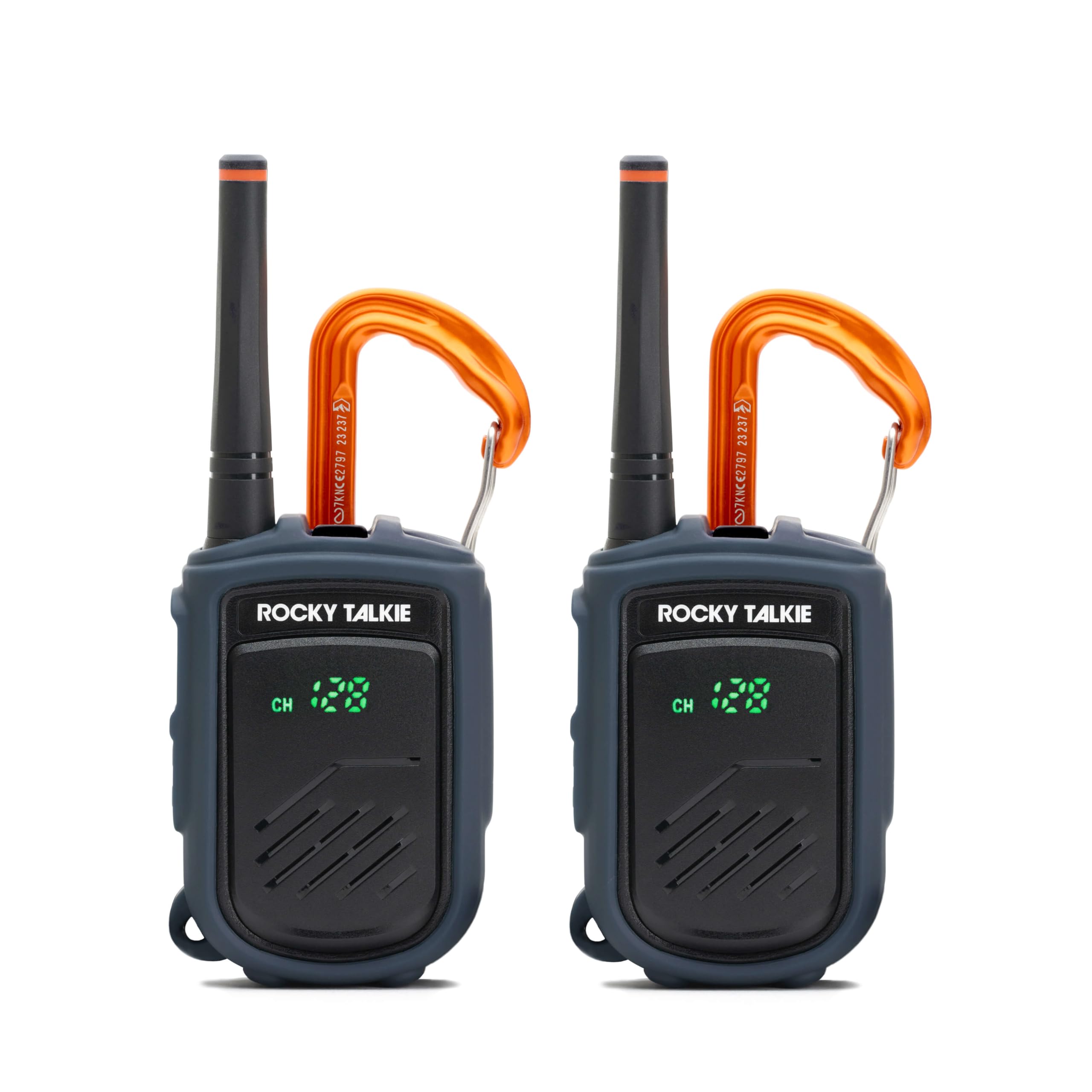
Built specifically for alpine and backcountry use, the Rocky Talkie Mountain Radio rethinks the form factor from the ground up. It dispenses with fragile belt clips in favor of a climbing-rated carabiner and a metal-reinforced leash, making it nearly impossible to lose on a ridge. The 1550 mAh replaceable lithium-ion battery delivers a verified 4 days of mixed use, even in sub-freezing temperatures — a spec that holds up under real multi-day trips.
The audio quality is remarkably clear for a 2-watt FRS radio, with a shatterproof LCD screen and a thick rubber armor that absorbs drops. Users confirm 25+ mile line-of-sight range over open water, though typical wooded terrain yields a more conservative 1-2 miles. The interface is intentionally simple: five buttons and zero menu diving, which is exactly what you need with gloves on. This is the radio to buy if reliability and durability are your top priorities.
On the downside, the 2-watt power cap means city and dense-forest range drops quickly — expect under 0.5 miles on low power in urban environments. It also lacks the NOAA weather scan found on many cheaper sets. For the price, you are paying for the bulletproof build and exceptional battery management, not for channel count or whistles. It ships as a 2-pack with two carabiners and USB-C cables.
Why it’s great
- Replaceable battery with 4-day real-world life in cold conditions
- Shatterproof screen and rubber armor survive serious abuse
- Climbing carabiner and leash eliminate the broken-clip failure
Good to know
- No built-in NOAA weather channels
- 2-watt power cap limits urban penetration
- Premium price positions it as a specialist tool
2. Retevis RB48
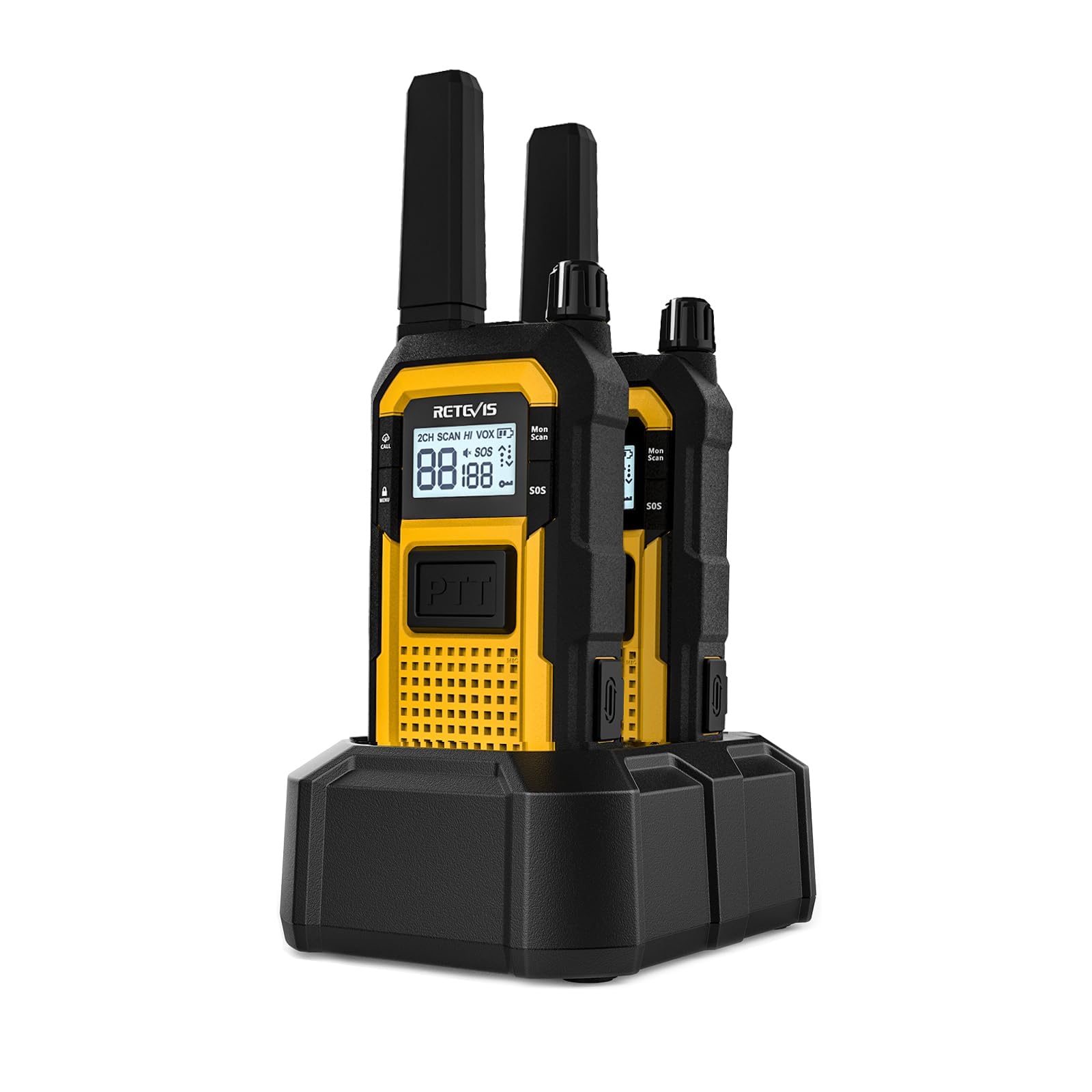
The Retevis RB48 brings military-spec durability to the license-free FRS band without the complexity of GMRS licensing. It is MIL-STD-810H certified for drops, dust, and temperature extremes, and has an IP67 rating that means it can be submerged in 1 meter of water for 30 minutes. Critically, the RB48 floats — a feature verified by users who accidentally dropped it into the ocean during kayak launches.
A 2000 mAh Li-ion battery powers the unit for up to 20 hours of typical use. The included USB-C charging dock lets you drop both radios in at once, avoiding the fiddly port-plugging dance. The bright yellow casing is high-visibility on a worksite or trail, and the silicone button covers allow gloved operation. Audio clarity is the best in its class, with users reporting clean transmissions at 2700 feet through trees. Dual PTT buttons and programmable roger beep complete the pro-level feature set.
Some users note that the display scratches easily — a soft rag for cleaning is recommended. The range is realistically around one mile in hilly wooded terrain, though the radio advertises up to 300,000 square feet of building coverage. Changing channels requires holding the menu button, which can be slow when you need to switch fast. For the price, you get an extremely tough radio that is ready to go out of the box with no FCC license required.
Why it’s great
- IP67 waterproof and floats on water — ideal for boating
- 2000 mAh battery delivers a full day of heavy use
- MIL-STD-810H drop rating survives 2-meter falls
Good to know
- Display is prone to scratching from rough handling
- Range drops significantly in urban environments
- Channel switching is menu-based, not a dedicated knob
3. BAOFENG GM-15 Pro

The BAOFENG GM-15 Pro is the right choice for the GMRS licensee who wants repeater access and programmable memory without paying professional-tier prices. It packs 250 memory channels, 22 GMRS frequencies plus 8 repeater channels, and another 24 customizable repeater slots. The unit ships with a USB-C charger, a 1500 mAh battery, and two antennas per radio — including an upgraded longer whip for better range.
Output power is rated at 8 watts, though some third-party testing suggests a true 5-watt maximum on the high channels. Even at 5 watts, users report hitting a 12-mile repeater when paired with an Abbree AR-771 aftermarket antenna. The radio includes NOAA weather scanning with 11 channels, an SOS alarm, flashlight, and VOX hands-free operation. Pre-programmed frequencies out of the box allow plug-and-play GMRS communication immediately.
The menu system is functional but dense — the printed manual is mediocre, and full CHIRP programming support is not available for the locked GMRS-only firmware. You program repeaters manually via the keypad, which is doable but requires reading the instructions carefully. Audio clarity is good for the price bracket, though not as crisp as the premium units. The green 2-pack color scheme is tasteful and visible in the field. Bring an FCC license — the GMRS requirement is non-negotiable.
Why it’s great
- 250 memory channels with GMRS repeater support
- NOAA weather scan and SOS alarm for emergency use
- Excellent value for a programmable GMRS radio
Good to know
- True output power is closer to 5W than the advertised 8W
- Menu-based programming is complex for beginners
- Requires an FCC GMRS license for legal operation
4. Retevis RT68

The Retevis RT68 is the workhorse of the license-free FRS world. It comes ready to use out of the box with no configuration needed — perfect for warehouse teams, construction sites, and family gatherings where simplicity trumps features. The radio is compact at 1.37 x 1.96 x 4.56 inches, fitting comfortably in a work vest pocket. The 1200 mAh Li-ion battery provides up to 24 hours of mixed use, and the USB charging base ensures orderly charging for both units simultaneously.
The RT68 passes a one-meter free-fall test without damage, making it genuinely suited for everyday worksite abuse. Audio output is rated at 40 decibels — loud enough for noisy environments, though not as clear as higher-end units. Users report excellent clarity across all channels 1 through 5 with compatible FRS radios, and the range is sufficient for a typical two-story building or a half-mile outdoor path. The included belt clips and lanyards are standard but functional.
The main limitation is cross-brand compatibility: channels above 5 may not transmit or receive with other GMRS or FRS brands unless privacy tones are perfectly matched. The RT68 is best used as a matched set within its own ecosystem. For a dedicated team or family using only these units, it offers outstanding reliability at a budget-friendly price. The rugged enclosure and long battery life make it a strong contender for anyone who just needs radios that work without fuss.
Why it’s great
- License-free FRS operation, no FCC paperwork required
- Passes one-meter drop test for worksite durability
- USB charging base with LED status indicators
Good to know
- Limited cross-brand compatibility on higher channels
- Sound quality is adequate but not premium-grade
- No NOAA weather channels or LED flashlight
5. BAOFENG MP31

The BAOFENG MP31 is arguably the best entry point into GMRS for families and small groups who want repeater capability without spending on premium hardware. It covers 22 GMRS channels plus 8+8 repeater channels, all accessible through a simple three-button-and-knob interface that eliminates the menu-diving that scares off new users. Voice announcements speak the channel number, a feature that visually impaired users specifically praise.
The IP54 rating protects against rain splashes and dust, making it suitable for camping and hiking in moderate weather. Each radio comes with a 1500 mAh removable battery and a 2-in-1 Type-C charging cable that charges both units from a single USB port. NOAA weather scanning and receiving functions are included, providing real-time severe weather alerts for hurricanes, tornadoes, and tsunamis. Battery life averages 6 hours of continuous use, with 2 days of standby monitoring.
Range is realistically up to 3 miles in open line-of-sight conditions, though urban environments will cut that significantly. The detachable antenna is a nice upgrade path — you can swap in a higher-gain whip for better performance. The included earpieces are basic but functional. The main catch is the GMRS license requirement: each user in the group needs a separate FCC license if using these for business. For casual family use on a shared license, the MP31 is an unbeatable value proposition.
Why it’s great
- Simple three-button interface with voice channel announcements
- 2-in-1 USB-C charging and removable 1500mAh battery
- NOAA weather scanning and GMRS repeater support
Good to know
- 6-hour battery life is shorter than many competitors
- IP54 is splash-proof but not submersible
- Requires GMRS license for legal operation
6. DURLK ZX-808
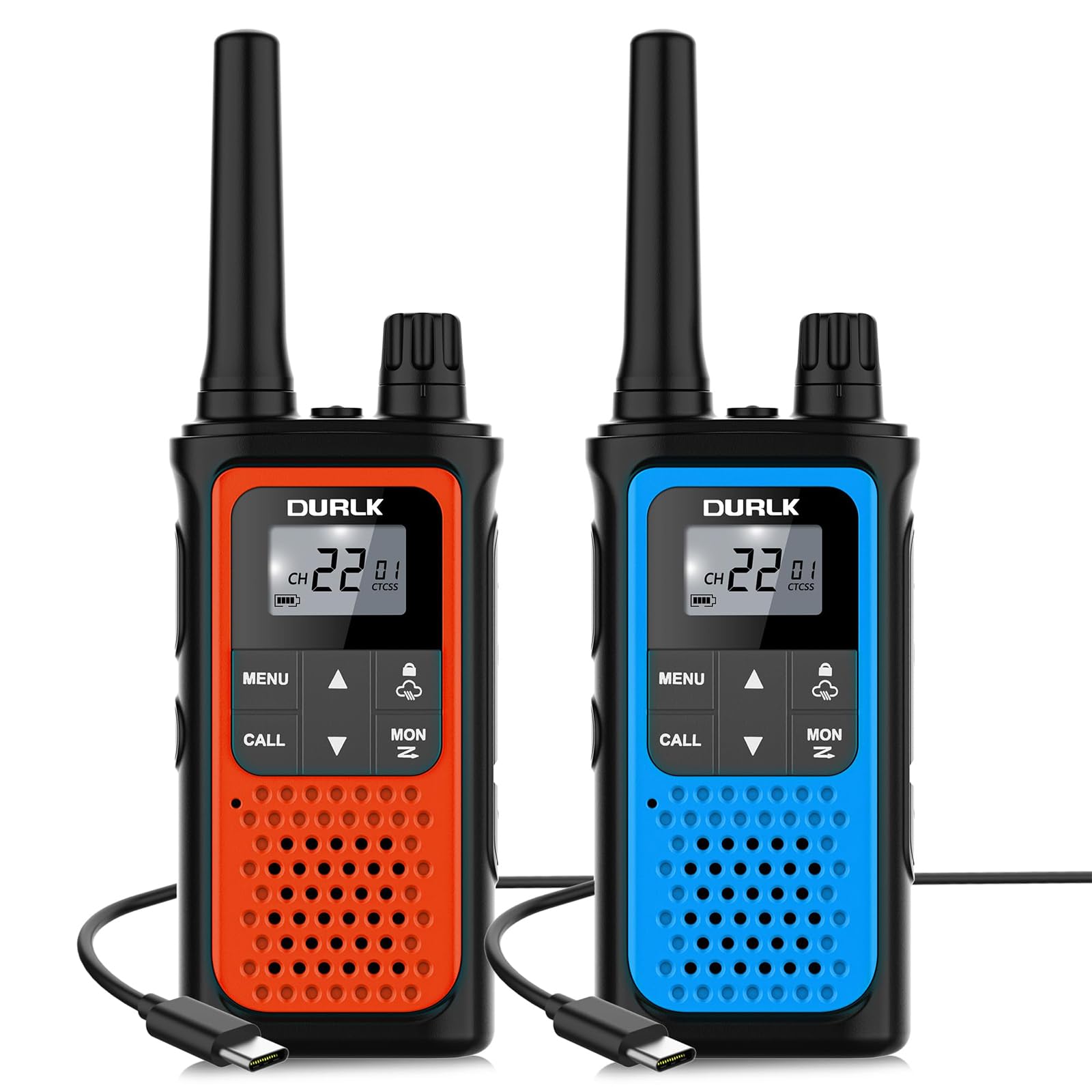
The DURLK ZX-808 offers a compelling package for casual outdoor use: a built-in 1800 mAh lithium battery, 22 FRS channels with 121 privacy codes, and a 2-in-1 USB-C charging cable. The radio features an HD LCD screen with backlight, rotary switches for volume and channel, and a built-in LED flashlight. It is designed specifically for recreation — skiing, hiking, cycling, camping — and it shows in the thoughtful orange and blue color scheme.
Audio quality benefits from upgraded speakers that deliver 150% more volume than older budget models, according to DURLK’s specs. Users confirm clear sound at half a mile through trees and uphill terrain, with a battery that lasts 3-4 days of intermittent use. NOAA weather scanning with 10 channels provides real-time severe weather alerts. The included USB-C adapter charges both radios from a single wall plug, and the 4-hour charge time is fast for the capacity.
The main trade-off is the built-in battery — when it degrades, the entire unit must be replaced. Some users report battery drain when the radio is idle, though shutting it off completely solves the issue. The claimed 3-mile range is optimistic; real-world performance is closer to 1 mile in open conditions and 0.5 miles in wooded areas. For the price, however, it is hard to fault a radio that delivers clear audio, NOAA alerts, and a flashlight in a lightweight 107-gram package.
Why it’s great
- Built-in 1800mAh battery with USB-C charging
- NOAA weather scan and LED flashlight for safety
- Very lightweight at 107 grams per unit
Good to know
- Non-replaceable battery limits long-term lifespan
- Real-world range is under 1 mile in typical terrain
- Some idle battery drain requires powering off completely
7. Jueion Q81 Kid Pack (4-Pack)

The Jueion Q81 is purpose-built for children ages 3-12, and it nails the use case. The 4-pack includes green, orange, blue, and red units with removable colored shells, allowing kids to personalize their radio. The interface is reduced to a single one-touch call button and a three-position volume switch — no privacy codes, no channel scanning, no menus. The radios are deliberately incompatible with adult FRS/GMRS units, preventing interference from external transmissions.
The 1800 mAh rechargeable battery delivers roughly 128 hours of battery life over a month of school-week use, according to verified buyers. The radios are lightweight at approximately 50 grams each and survived multiple drops onto concrete without damage. Audio is clear enough for across-the-yard communication, though range is limited to about 100-200 feet through walls. The built-in flashlight is a hit with younger kids.
These are not tools for serious communication. The 12 channels operate in the 400-470 MHz toy band, which lacks the power and frequency stability of certified FRS or GMRS gear. The range is genuinely short — expect about 50-100 feet indoors. But that is a feature, not a bug: it keeps the kids contained within the yard. For the price of a 4-pack, the Q81 is the safest, most durable option for introducing young children to two-way radio communication.
Why it’s great
- Extremely durable and lightweight for young children
- Very long battery life with USB-C charging
- Removable colored shells for personalization
Good to know
- Limited range — 100-200 feet max, not for hiking use
- Toy-band frequencies are incompatible with adult radios
- No privacy codes or advanced features
FAQ
Do I need a license to use a walkie talkie?
What is the real-world range of a typical walkie talkie?
Can FRS and GMRS radios talk to each other?
Final Thoughts: The Verdict
For most users, the walkie talkie winner is the Rocky Talkie Mountain Radio because it combines a 4-day replaceable battery, shatterproof build, and simple FRS operation into a package that actually survives backcountry abuse. If you want GMRS repeater capability and programmable channels, grab the BAOFENG GM-15 Pro. And for a license-free rugged unit that floats and takes a beating, nothing beats the Retevis RB48.