
A flagship GPU pulling over 450 watts creates an immense thermal challenge. Air coolers, no matter how massive, struggle to keep the Ada Lovelace core below its throttle threshold during extended 4K ray-traced sessions or multi-hour rendering jobs. A liquid-cooled solution directly addresses the heat density problem, moving the thermal load to a dedicated radiator where sustained dissipation is dramatically more effective.
I’m Min — the co-founder and writer behind Gadgets Feed. I’ve spent years analyzing GPU thermal architectures, power delivery designs, and real-world benchmark data to understand what separates a 60°C card from one that creeps toward 80°C under sustained load. (And Homer 🐱 supervised the entire sorting process from his perch on the server rack’s warmest spot).
This guide breaks down the top liquid-cooled RTX 4090 options by comparing cooling loop designs, boost clock behavior, VRM thermal coverage, and chassis compatibility — everything you need to confidently choose the right best water-cooled 4090 for your next high-end build.
How To Choose The Best Water-Cooled 4090
Selecting a liquid-cooled RTX 4090 involves more than just picking the card with the highest boost clock. The cooling loop’s coverage, radiator size, and pump quality directly determine whether your GPU stays at 55°C or creeps toward 70°C under sustained load. Here are the critical factors to evaluate.
Radiator Size and Case Compatibility
Most AIO liquid-cooled 4090s use either a 240mm or 360mm radiator. A 360mm radiator offers roughly 50% more surface area, which translates to lower fan speeds for the same thermal load — crucial for noise-sensitive builds. However, a 360mm radiator requires a case that supports top or front mounting, typically full-tower or large mid-tower chassis. Measure your case’s radiator clearance before committing, and confirm that your RAM height and motherboard VRM heatsinks won’t interfere with the tubing routing.
Cold Plate Coverage: VRM and Memory Matter
A liquid-cooled GPU’s cold plate must contact not only the GPU die but also the voltage regulator modules (VRMs) and GDDR6X memory modules. The RTX 4090’s memory runs hot — GDDR6X can exceed 90°C under sustained load if not properly cooled. Premium designs like those from ASUS and MSI use full-coverage cold plates with phase-change thermal pads that bridge the gap between components, ensuring consistent temperatures across the entire board.
Pump Quality and Noise Profile
Not all pumps are created equal. Some AIO GPU coolers use pumps that emit a noticeable whine at higher RPMs, especially when the GPU is under heavy load. Look for designs that decouple the pump speed from the GPU fan curve, allowing you to set a fixed pump speed that balances acoustic comfort with adequate flow. Magnetic levitation or ceramic bearing pumps tend to run quieter and last longer than traditional sleeve-bearing designs.
Quick Comparison
On smaller screens, swipe sideways to see the full table.
| Model | Category | Best For | Key Spec | Amazon |
|---|---|---|---|---|
| MSI RTX 4090 SUPRIM Liquid X 24G | AIO Liquid | Silent sustained performance | 240mm radiator, 2625 MHz boost | Amazon |
| ASUS ROG Strix RTX 4090 White OC | Air Cooled | Aesthetic white build | 3.5-slot vapor chamber cooler | Amazon |
| PNY RTX 4090 VERTO Triple Fan | Air Cooled | Compact fit in mid-towers | 13.26″ length, 2520 MHz boost | Amazon |
| GIGABYTE RTX 4090 Gaming OC | Air Cooled | Included anti-sag bracket | 2535 MHz boost clock | Amazon |
| VIPERA RTX 4090 Founders Edition | Air Cooled | NVIDIA reference design | 2520 MHz boost, dual axial fans | Amazon |
| MSI RTX 5080 SUPRIM Liquid SOC | AIO Liquid | Mid-range liquid-cooled option | 16GB GDDR7, 2760 MHz boost | Amazon |
| ASUS ROG Astral LC RTX 5090 | AIO Liquid | Next-gen Blackwell flagship | 360mm AIO, 32GB GDDR7 | Amazon |
In‑Depth Reviews
1. MSI GeForce RTX 4090 SUPRIM Liquid X 24G

The MSI SUPRIM Liquid X delivers the most compelling argument for a factory AIO-cooled 4090. Its 240mm radiator and pump assembly keep the GPU die below 60°C during extended Blender rendering sessions, a feat few air coolers can replicate. The full-coverage cold plate contacts both the VRM and memory modules, reducing GDDR6X temperatures by up to 15°C compared to reference air-cooled designs. At 2625 MHz boost out of the box, it dynamically overclocks without thermal throttling.
Noise performance is where this card separates itself. The radiator fans spin at lower RPMs than any triple-fan air cooler while moving the same thermal load, creating a near-silent experience under 50% load. Users report consistent sub-40°C idle temperatures and mid-50°C peaks during Cyberpunk 2077 at 4K with path tracing enabled. The tubing is braided and flexible enough to route cleanly through most large mid-tower cases, though a 360mm radiator option would have been welcome for those prioritizing ultra-low fan speeds.
Long-term reliability is supported by MSI’s implementation of a ceramic bearing pump designed for 50,000-hour operation. The single 16-pin power connector simplifies cable management compared to multi-connector air-cooled alternatives. For anyone building a high-end workstation or silent gaming rig, this is the most thermally efficient factory-cooled 4090 on the market.
Why it’s great
- Sustains sub-60°C core temps under continuous full load
- Quieter than any air-cooled 4090 at equivalent thermal output
- Full-coverage cold plate cools VRMs and memory effectively
Good to know
- 240mm radiator limits peak dissipation compared to 360mm designs
- Case must support side or front radiator mounting
- Some users report power connector seating issues if not fully inserted
2. ASUS ROG Strix GeForce RTX 4090 White OC Edition

While not a liquid-cooled card, the ROG Strix White OC is the benchmark for air-cooled 4090 performance against which all AIO solutions are compared. Its 3.5-slot vapor chamber cooler with Axial-tech fans moves 23% more airflow than the previous generation, keeping core temperatures below 65°C during gaming workloads. The white PCB and shroud make it the go-to choice for all-white themed builds that cannot accommodate radiator mounting.
The card includes ASUS’s patented milled heatspreader that draws heat from the VRM and memory regions with exceptional efficiency. During AI model training sessions, users report that the card stays quiet and cool, never exceeding 60°C even when drawing north of 400 watts. The single 16-pin power connector is a welcome simplification over the four 8-pin adapters required by some competing models.
The premium is significant — the white variant commands a substantial upcharge for the color alone. Builders must confirm they have enough chassis depth to accommodate the 14-inch length and 3.5-slot width. For those committed to an air-cooled approach, this is the best-performing white 4090 available, but it cannot match the sustained thermal headroom of a proper liquid-cooled solution.
Why it’s great
- Outstanding air cooling keeps temps below 65°C under load
- White aesthetic is unique and visually stunning
- Single 16-pin connector simplifies cable routing
Good to know
- Massive 3.5-slot size limits case compatibility
- White color adds a significant price premium
- Not a liquid-cooled design; thermal headroom is lower than AIO options
3. PNY GeForce RTX 4090 VERTO Triple Fan

The PNY VERTO is the most physically compact RTX 4090 in this lineup, fitting into cases where longer cards simply cannot go. At 13.26 inches, it slides into mid-tower chassis that reject the 14-inch Strix or the radiator-equipped SUPRIM Liquid X. Despite its compact size, it retains a 2520 MHz boost clock and 16384 CUDA cores, delivering identical compute performance to larger cards in a smaller thermal envelope.
Its triple-fan cooler runs quietly enough for most users, with Time Spy scores around 29,950 when paired with a 7800X3D and fast DDR5. The all-black design with a subdued PNY logo avoids flashy RGB, making it ideal for professional workstations where aesthetics need to remain neutral. Linux users report seamless compatibility with CUDA 12 and ROCm workloads, making it a favorite for ML and rendering pipelines.
The primary trade-off is that the compact cooler limits thermal headroom during sustained overclocking — expect temperatures around 65-70°C under prolonged 450-watt loads, which is still excellent for an air-cooled design. The 16-pin to four 8-pin adapter is cumbersome and may require a right-angle adapter for clean routing in narrower cases. For builders prioritizing chassis compatibility over peak overclocking, this is the most practical 4090 available.
Why it’s great
- Shortest PCB fits mid-tower cases easily
- Quiet operation with effective cooling
- Neutral design suits professional builds
Good to know
- Four 8-pin adapter complicates cable management
- Thermal headroom for overclocking is limited vs larger designs
- PNY logo cannot be disabled via software
4. GIGABYTE GeForce RTX 4090 Gaming OC 24G
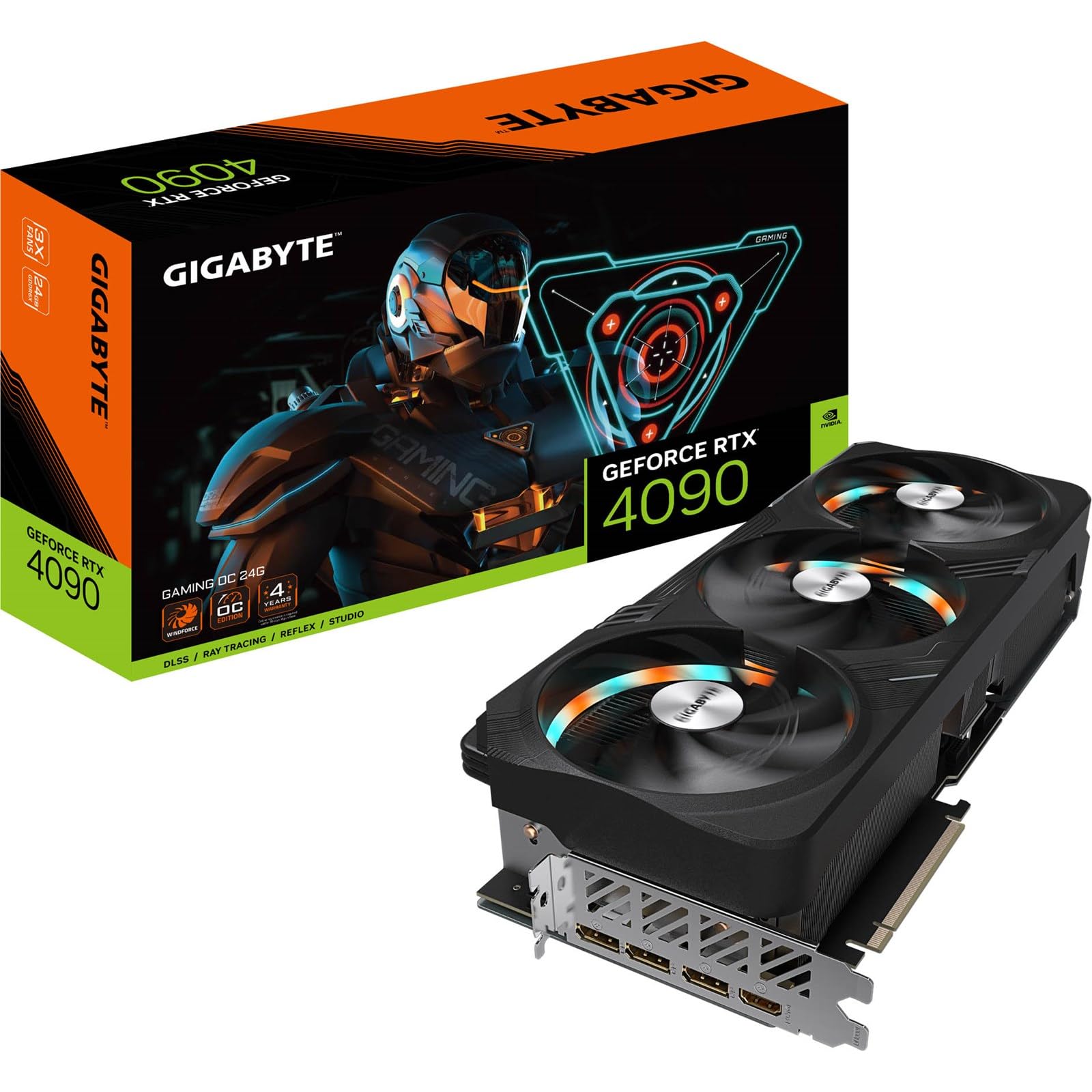
GIGABYTE’s Gaming OC model offers one of the highest factory boost clocks at 2535 MHz, paired with a robust triple-fan WINDFORCE cooler. The card includes an anti-sag bracket in the box — a thoughtful inclusion given the 4090’s weight and torque. The RGB Fusion lighting system provides customizable illumination across the shroud, though some users report a subtle strobe effect that cannot be avoided unless the lights are dimmed or turned off completely.
Thermal performance is strong for an air cooler, with users reporting stable temperatures in the mid-60s during gaming and keeping under 70°C during rendering. The metal backplate adds structural rigidity and includes a vented section to improve airflow through the fin array. For AI workloads, users have successfully run Qwen 3.6 and other large language models using CUDA optimizations with consistent VRAM temperatures below 90°C.
The critical caveat is physical size — the card is 340mm long and requires an additional 30-35mm of clearance within the chassis for the support bracket. Several users report it will not fit in mid-tower cases like the bequiet 500DX without modifications. The underside curvature also prevents the use of standard GPU support sticks. Measure your case’s internal depth carefully before purchasing.
Why it’s great
- High factory boost clock at 2535 MHz
- Includes anti-sag bracket in the box
- Strong air cooling for sustained workloads
Good to know
- 340mm length plus bracket clearance limits case options
- RGB strobe effect at low brightness is distracting
- Not a liquid-cooled design
5. VIPERA NVIDIA GeForce RTX 4090 Founders Edition

The Founders Edition from NVIDIA represents the baseline reference design for the RTX 4090. Its dual-axial flow-through cooler moves air across both sides of the PCB, achieving decent thermal performance in a relatively compact 11.97-inch package. The 2520 MHz boost clock and 24GB of GDDR6X deliver the same raw compute power as any AIB card, making it a straightforward choice for users who prefer NVIDIA’s own design language.
The card runs quieter than the first-generation Founders Edition coolers, with most users reporting acceptable noise levels during gaming and near-silent operation during less demanding tasks. For AI and rendering workloads in Blender, users report excellent performance with CUDA and OptiX acceleration, significantly reducing render times compared to previous generation cards. The included accessory kit and power cable make installation straightforward.
The Founders Edition’s cooling solution is inferior to AIO liquid-cooled alternatives under sustained load — expect temperatures around 70°C during extended Blender renders, compared to 55-60°C on the SUPRIM Liquid X. The card is also priced at a premium relative to its thermal performance tier. For users who do not need the absolute lowest temperatures or quietest operation, the Founders Edition is a capable if unexceptional choice.
Why it’s great
- Compact 11.97″ length fits most cases
- NVIDIA reference design with official support
- Solid performance for AI and rendering workloads
Good to know
- Runs hotter and louder than AIO liquid-cooled options
- Premium price for reference thermal performance
- No RGB or aesthetic customization
6. MSI Gaming RTX 5080 16G SUPRIM Liquid SOC

While this is technically an RTX 5080 rather than a 4090, the SUPRIM Liquid SOC deserves mention as the most accessible liquid-cooled option within this thermal performance tier. It uses a 360mm radiator and MSI’s full-coverage cold plate to deliver exceptional cooling to the NVIDIA Blackwell GPU. With a 2760 MHz boost clock and 16GB of GDDR7 on a 256-bit bus, it handles 4K gaming at 120+ FPS and creative workloads with ease.
The liquid cooling keeps the GPU die at remarkably low temperatures — users report 41-43°C under load on a Samsung G9 49-inch ultrawide at maximum settings. The sound profile is near-silent, with the radiator fans rarely needing to spin above 800 RPM even during sustained gaming sessions. The premium build quality and brushed metal finish match high-end system aesthetics, and the card’s power draw per frame is lower than the 4090’s, making it more efficient for the same visual output.
The key limitation is VRAM — 16GB is sufficient for current 4K gaming and most creative work, but future titles and larger AI models will push against that ceiling sooner than the 24GB on a 4090. The card also requires a 360mm radiator mounting position, ruling out smaller cases. For builders who want liquid-cooling advantages without the full flagship investment, this is the smartest compromise available.
Why it’s great
- Outstanding 41-43°C core temps under gaming load
- Near-silent operation with 360mm radiator
- Excellent performance-per-watt efficiency
Good to know
- 16GB VRAM may limit future high-resolution textures
- Requires 360mm radiator support in case
- Not an RTX 4090 — raw compute is lower
7. ASUS ROG Astral LC GeForce RTX 5090 32GB OC Edition

The ROG Astral LC represents ASUS’s flagship approach to AIO-cooled GPUs for the Blackwell generation. Its 360mm radiator and magnetic daisy-chainable fans are designed to balance thermal performance with installation convenience. The full-coverage cold plate uses a phase-change thermal pad over the GPU die, improving heat transfer efficiency compared to traditional thermal paste. With 32GB of GDDR7 memory and a 2610 MHz boost clock, this card targets the highest possible 4K and 8K gaming fidelity.
Users report that the card handles everything thrown at it while barely cracking 60°C, even during extended video generation and rendering sessions. The 360mm radiator allows for very low fan speeds, contributing to a quiet overall system. ASUS includes dual HDMI 2.1b and three DisplayPort 2.1b outputs, future-proofing multi-monitor setups at high refresh rates. The packaging is robust, with double-boxed shipping for protection during transit.
The proprietary magnetic fan connector on the radiator is a significant limitation — it prevents users from reversing the fan direction to intake if needed, and custom fan swaps require separate PWM connectors. Long-term reliability concerns have been raised by some users who have had mixed experiences with ASUS support. At this price tier, buyers must accept that they are paying a premium for the latest generation’s peak performance, with the understanding that the card’s proprietary fan system reduces flexibility.
Why it’s great
- Massive 32GB GDDR7 for future-proofing
- Sub-60°C core temps under sustained load
- Dual HDMI 2.1b for multi-monitor setups
Good to know
- Proprietary magnetic fans reduce customizability
- Premium price reflects early-adopter tax
- ASUS support reputation is mixed
FAQ
Does an AIO-cooled 4090 require maintenance like a custom water loop?
Will a water-cooled 4090 fit in my mid-tower case?
Final Thoughts: The Verdict
For most users, the best water-cooled 4090 winner is the MSI SUPRIM Liquid X 24G because it delivers the ideal balance of sustained thermal performance below 60°C, near-silent operation, and straightforward installation without requiring a massive case. If you want maximum VRAM and next-gen Blackwell features, grab the ASUS ROG Astral LC RTX 5090. And for compact chassis compatibility with excellent liquid cooling, nothing beats the MSI RTX 5080 SUPRIM Liquid SOC.