
Our readers keep the lights on and my morning glass full of iced black tea. As an Amazon Associate, I earn from qualifying purchases.
Specs are compiled from manufacturer listings and verified buyer reviews and can change over time — please confirm the key details on the product page before buying.
If you are tired of the plastic-pitcher treadmill and store-bought bottles, the real question is not just “does this filter reduce chlorine?” It’s whether the system fits your tap, your fridge, and your patience for replacing cartridges. This guide sorts the countertop pitchers from the install-free reverse osmosis units so you can match a system to your water and your space.
I’m Min — the founder and writer behind Gadgets Feed. This guide is built by comparing the manufacturers’ published specifications and the patterns across verified customer reviews, so you get each pick’s real strengths and trade-offs instead of marketing spin.
You’ll walk away knowing the difference between a simple filtration pitcher and a true reverse osmosis system, and which type fits your home. These are the water filter choices that balance filtration power with a daily-use reality.
Our Picks at a Glance

How To Choose The Best Water Filter
Start with what’s coming out of your tap. If you mainly want to soften the taste of chlorine and catch basic sediment, a simple carbon pitcher works. If you want to tackle heavier contaminants like lead or fluoride, you likely need an under-sink or reverse osmosis system. Match the stage of filtration to your water quality concern.
Understand the Filtration Method
Basic pitchers use activated carbon to catch chlorine and improve taste. Under-sink models add more stages, like sediment filters or KDF media, for heavier metals. Reverse osmosis (RO) systems push water through a special membrane, which is the most thorough method. Know that RO systems often remove beneficial minerals too, which is why some add a remineralization stage.
Check Filter Lifespan and Replacement Cost
Every filter has a rated life, usually in gallons or months. A filter that lasts 12 months and handles 8,000 gallons means fewer replacements and lower hassle. Compare the rated life with your daily water use. A slow, long-life filter can be more cost-effective than a quick one you must replace every couple of months.
Consider Installation and Space
Pitchers and countertop units need no plumbing—just space on a shelf or counter. Under-sink models connect to your cold water line and take up cabinet space. If you rent or want zero tools, an install-free countertop unit is the clear path. If you own your place and want a hidden solution, an under-sink system is worth the effort.
Quick Comparison
| Model | Best For | Capacity | Filter Life | Flow Rate | Amazon |
|---|---|---|---|---|---|
| Brita 10 Cup Pitcher★ Best Overall | Compact Fridge Use | 10 cups | 2 months | Quick Fill | Amazon |
| Brita 27 Cup DispenserFamily Dispenser | Big Families | 27 cups | 2 months | Spigot | Amazon |
| OEMIRY CountertopFaucet Direct | Faucet Direct Connect | 8,000 gal | 12 months | 1.6 GPM | Amazon |
| SimPure V7 Under Sink | Cabinet Installation | 20,000 gal | 12 months | 1.6 GPM | Amazon |
| Waterdrop TST-UF | Ultrafiltration Value | 8,000 gal | 24 months | 1.59 GPM | Amazon |
| DREO RO Countertop | Smart Features | 5 L tank | 265 gal | Auto-Fill | Amazon |
| APEC ROES-50X | Traditional RO Power | 50 GPD | 2 years | 50 GPD | Amazon |
| AquaTru Glass Carafe | Countertop RO Purity | 4 lb carafe | 6 months | 0.5 GPM | Amazon |
| Waterdrop M6CG | Hot & Cold Water | 185 oz tank | 12 months | Instant Dispense | Amazon |
In-Depth Reviews
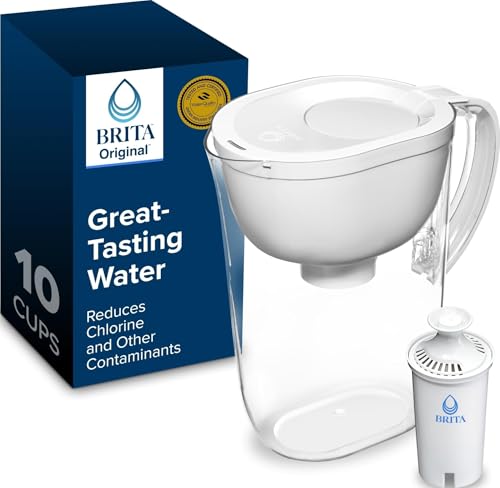
1. Brita Large 10 Cup Water Filter Pitcher
Our pick — over 4.5★ from 59,500+ verified ratings; the strongest balance of quality and price.
The fridge-shelf champion that fixes the classic leaky-pitcher design and pours crisp water fast.
This is the jug that wins most households over for a reason: it holds 10 cups of water, which is enough to fill three 24-ounce reusable bottles. Buyers report it “filters really quickly,” and the redesigned inset cap finally stops the spills that old pitcher lids were famous for. It fits on a refrigerator shelf without hogging space—its 5.59-inch width and 2.29-pound weight make it easy to lift one-handed and tuck away.
Switching from bottled water to this pitcher is a quieter kind of win. It reduces chlorine (taste and odor), Mercury, Copper, Zinc, and Cadmium, and Brita says it can replace 1,800 single-use plastic bottles a year. The trade-off is upkeep: the Standard filter needs replacing after 40 gallons or about every 2 months (the Longlast version stretches to 120 gallons or roughly 6 months). It’s built for 1-2 people who want good taste without a big footprint, though some owners mention the plastic handle can crack with rough handling, so treat the lid tabs gently.
What wins people over is the taste upgrade per dollar—the water comes out clean, and the value for money is what keeps it in carts. It’s a simple, freestanding pitcher that does one job well: making tap water taste good enough that you stop buying bottles.
Why It Fits Daily Life
- 10-cup capacity covers a full day for one or two people
- Replaces 1,800 single-use plastic bottles a year
- Space-efficient shelf fit with an easy-fill locking lid
The Real Catch
- Standard filter needs replacing about every 2 months
- Plastic body can crack if handled roughly
Reach for this if: you want a cheap, proven taste fix that fits a fridge shelf and serves 1-2 people.
Look elsewhere if: you need heavy-metal removal beyond chlorine and copper, or you want a system that doesn’t demand a filter swap every couple of months.
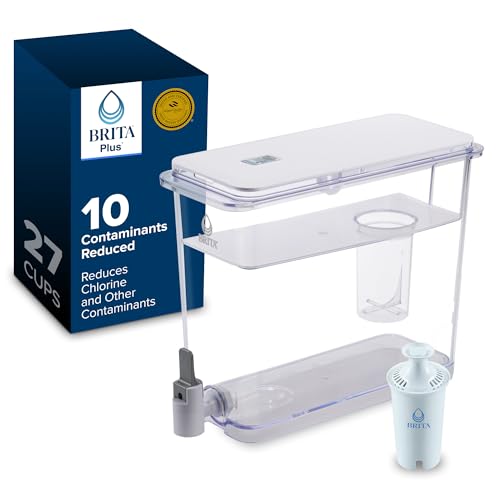
2. Brita X-Large 27 Cup Water Pitcher Dispenser
A fridge-door workhorse that replaces a 5-gallon water cooler with a drip-free tap.
This is the Brita for households that keep running out of water by Tuesday. It holds 27 cups—2.7 times what the 10-cup pitcher above handles—so a full family can drink for days. Instead of pouring a heavy jug, you draw water through a convenient spigot, which makes it a practical swap for anyone still hauling 5-gallon cooler bottles. It fits in the fridge “doesn’t take too much space” while keeping a slim profile on the counter.
This dispenser’s filtration goes beyond basic pitchers with NSF-certified reduction of chlorine, mercury, cadmium, copper, and zinc. The BritaPlus filter is WQA NSF/ANSI certified to reduce chlorine (taste and odor), mercury, cadmium, copper, zinc, and more, while helping retain beneficial minerals. The one filter replaces up to 300 single-use 16.9 oz plastic bottles. Customers note the taste is crisp and refreshing, and it saves them money on bottled water for the whole family. The recurring note is the spigot—it stays drip-free, and the sturdy handle makes it easy to carry even when full.
What wins people over is the water quality at this size; 110 owners single out the quality, and the easy spout and filter install get strong mentions too. The honest caveat is leakage: a few reviewers point out losing a couple cups of water sitting on the counter, though many report zero issues. It’s the right pick for 2-plus-person households that want pitcher convenience without pitcher refills.
A fridge-friendly giant: holds 27 cups for days of family drinking, with a spill-free spout that bests any pour-over jug.
Keep in mind: a minority of units leak a bit; test yours over the sink on first fill and the filter still needs a swap every 40 gallons or about 2 months.
3. OEMIRY Countertop Water Filter, Stainless Steel
A twist-on stainless steel filter that serves filtered tap on demand without emptying a tank.
This one skips the pitcher entirely. It twists directly onto a standard faucet, and a switch lets you flip between tap and filtered water instantly. The body is 304 food-grade stainless steel with a fingerprint-resistant brushed finish, so it’s built to sit on a counter for years. Since it connects to the faucet, you get unlimited filtered water on demand—no waiting for a tank to refill, no lifting a heavy jug.
The multi-stage filtration Its multi-stage filtration reduces up to 99% of chlorine, heavy metals, fluoride, hydrogen sulfide, and bad tastes and odors.. It produces zero waste water and needs no electricity, which makes it a clean fit for kitchens, bathrooms, offices, apartments, or RVs. The rated life is big: 8,000 gallons or 12 months of use on municipal water—a 6.0x gap versus the 2-month Brita pitcher filter above. A buyer using it for two years said the flow stayed strong and the replacement was easy with the included wrench.
What wins people over is the filter quality and how good the water tastes; the appearance gets praise too because it doesn’t look like a plastic gadget on the counter. The honest catch: it does not reduce TDS, since it keeps beneficial minerals like calcium and magnesium—that’s a feature if you want mineral-rich water, not ultra-pure. Also, it only fits standard faucets (not pull-out, handheld, or sensor types), so check your thread before ordering.
Unlimited filtered flow: at up to 1.6 GPM it fills an 8 oz cup in 2-3 seconds, on a system that lasts 8,000 gallons or 12 months.
Not for everyone: only standard faucets work, and if your goal is stripping TDS for pure water, this mineral-retaining filter isn’t that.
4. SimPure V7 Under Sink Water Filter System

An all-metal under-sink filter that installs in minutes and runs a year on one cartridge.
If you want hidden filtration that doesn’t eat counter space, this inline system connects right to your cold water line under the sink. The pitch is install speed—the company says 3 minutes, and shoppers say 5-10 minutes with an adjustable wrench. It uses 5-stage filtration with Double-Sediment Membranes, KDF-55, and Double-Activated Carbon Blocks, catching impurities down to 0.5 microns while keeping beneficial minerals. The housing is 304 food-grade stainless steel, so it won’t crack or degrade like plastic under-sink units.
The value math is strong: one V7 cartridge lasts up to 12 months or 20,000 gallons, which is 2.5x the gallon life of the OEMIRY faucet filter above. The flow rate hits 1.6 gallons per minute, filling an 8 oz glass in about 3 seconds. Owners call the taste “improved 100%” and note it removes chlorine and sediment while staying odor-free. The compact 3.6″ x 12″ profile tucks into crowded cabinets without blocking your garbage disposal or other essentials.
What wins people over is the installation—226 owners call it out as the highlight—plus the solid, heavy steel build. The trade-off: it doesn’t lower TDS (total dissolved solids), so if you’re chasing ultra-pure water, this isn’t it. It’s the best middle path for renters or owners who want serious filtration without drilling or calling a plumber.
The Good
- Tool-free 3-minute install connects to 3/8″ & 1/2″ cold water lines
- 20,000-gallon cartridge lasts up to 12 months
- All-metal 304 stainless housing with a slim profile
The Trade-Off
- Does not lower TDS; retains minerals instead
- Chlorine taste can return before the full 12 months for some water
Pick it if: you want a whole-season filter that hides under the sink, installs without tools, and serves one tap.
skip it if: your source water is heavy on dissolved solids you want removed—this keeps minerals in.
5. Waterdrop TST-UF 0.01μm Ultra-Filtration Under Sink Water Filter

A 0.01-micron membrane that outlasts standard under-sink filters by a full year.
This is the under-sink system for buyers who hate replacing cartridges. The three-stage setup uses a precision ultrafiltration membrane that catches impurities larger than 0.01 microns—that’s the kind of rating that goes after very fine particles. Each filter stage has its own clock: the PP filter runs 6-8 months, the UF filter a year, and the CT filter 12-24 months. The system itself is rated for 8,000 gallons, and it connects to standard 1/2″ or 3/8″ female NPT threads with the included converters.
The flow is nearly instant at up to 1.59 GPM, filling an 8-ounce cup in about 2.3 seconds. Owners call the water “delicious” and note it works well even on well water, with one reporting great taste after 8 months on the original filter. The housing is lead-free 304 stainless steel with a thick sealing ring to keep leaks away. For coffee lovers, the pitch is that it makes home-brewed java taste better than the shop down the street—it lifts the flavor of anything you brew with it.
You get easy installation (132 owners highlight it) and cheap replacement filters, so upkeep stays low. The honest catch: it does not reduce TDS (total dissolved solids, the leftover minerals and salts), and it is not for well water or hot water lines. It is also bulkier at 12.99″ x 4.92″ x 14.49″, so measure your cabinet first. This suits a family that wants serious filtration with the least maintenance.
low-maintenance filtration: with a 12-24 month CT filter stage and an 8,000-gallon rating, this is the lowest-maintenance under-sink pick here.
Watch your cabinet: at nearly 15 inches tall it needs real under-sink clearance, and mineral retention means TDS stays put.
6. DREO Reverse Osmosis Water Filter Countertop
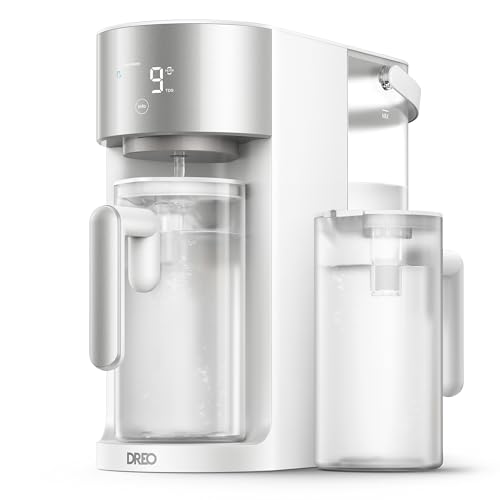
A plug-in water purifier with a live TDS readout and dual self-filling pitchers.
This is the countertop RO system for anyone who wants bottled-quality water without plumbing. You fill the 5L tank, plug it in, and it does the rest—no installation, no drilling. The smart dual-pitcher setup keeps one pitcher ready while the other auto-refills, so you are not stuck waiting for a cycle to finish. A real-time TDS display shows you the raw and pure water readings, and the filter-life indicator tells you when it’s time for a swap.
The filtration uses a 7-in-1 RO membrane that The 7-in-1 RO membrane targets 1000+ impurities, up to 99.99%, including PFOA, PFOS, chlorine, fluoride, and more.. Owners watching the TDS meter saw tap water in the 300+ range drop to under 15 after filtration—a night-and-day number for anyone skeptical it works. The 3:1 pure-to-drain ratio means less waste water than typical RO units. The filter lasts 265 gallons (1000L) and swaps in seconds with a twist-to-install design.
What wins people over is the effectiveness—186 owners call it out as the main reason to buy—plus the taste and the sleek look that blends into a kitchen. The honest limitation: the sensor dispenses only into the provided pitchers, not directly into a glass, and owners must empty the waste water after each use (about 60% of what you fill). It’s ideal for 3 to 4 people and apartment renters who can’t drill into anything.
The Wins
- Install-free: fill the 5L tank, plug in, done
- Live TDS readout confirms purification in real time
- 3:1 pure-to-drain ratio cuts water waste
The Friction
- Only auto-fills the included pitchers, not your own glass
- Waste water must be emptied after each cycle
Choose this for: renters or small households who want verifiable RO purity with zero tools and a modern footprint.
Think twice if: you want to pour straight from the machine into a cup, or you dislike managing a waste tank.
7. APEC Water ROES-50X 5-Stage Under Sink RO System
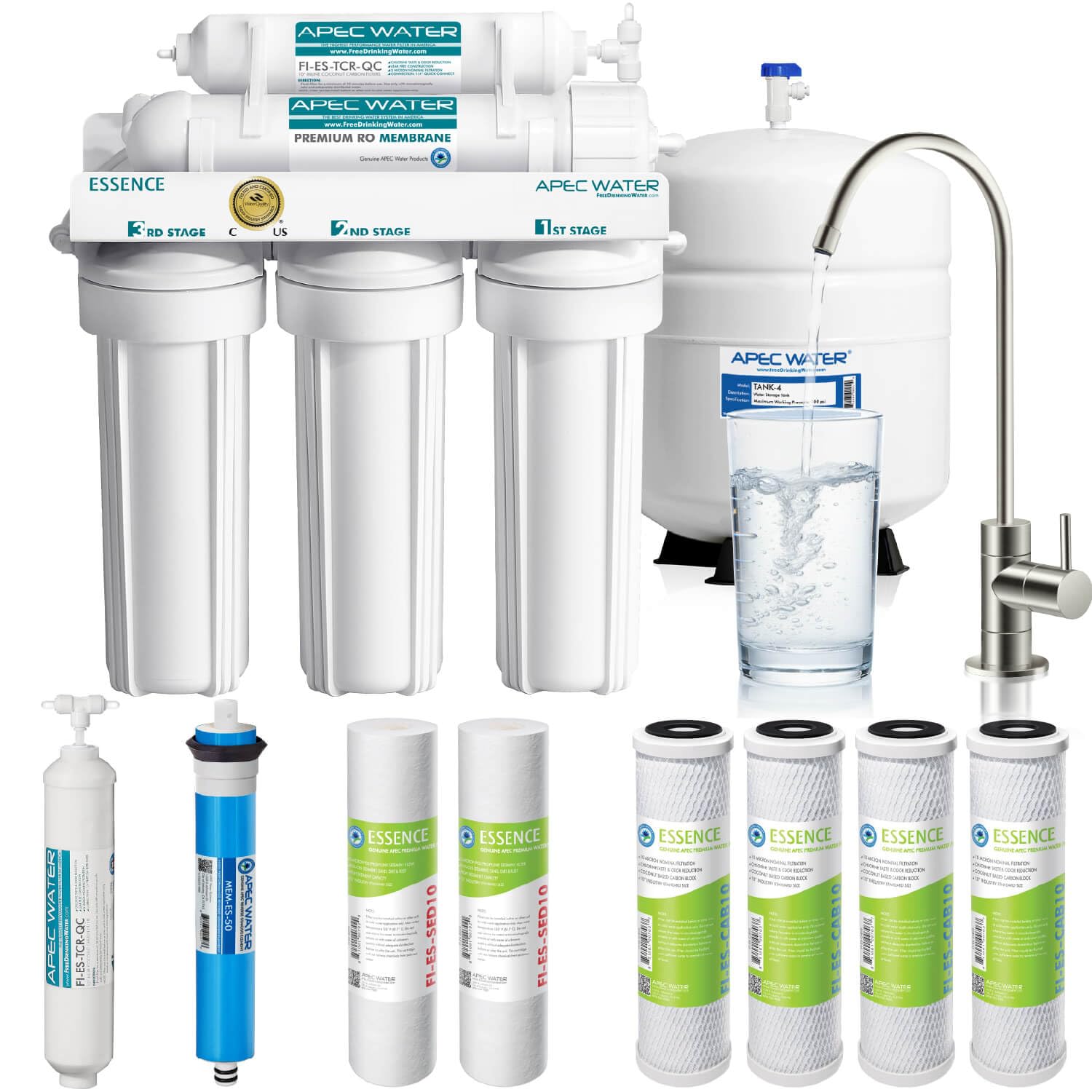
The classic 5-stage under-sink RO that cuts TDS dramatically and The 50-gallon-per-day output typically offsets bottled-water costs within three months..
This is the no-compromise reverse osmosis system for owners who want the most thorough purification available. The 5-stage filtration The 5-stage system removes arsenic, chlorine, lead, fluoride, heavy metals, and 1000+ impurities, including PFAs and microplastics., pushing water through an RO membrane rated for 50 gallons per day. Owners watched their TDS drop from the 400s to around 40—a 90% reduction—with one reporting 95% reduction after 18 months on the original filters.
It’s DIY-friendly, with quick-connect fittings and color-coded tubing so you can install it yourself. The kit includes the FILTER-MAX-ES50 filter set, a brushed nickel faucet, a water tank, and an installation kit. The tank holds enough for steady pressure, filling in about 2-3 hours. Owners note it Buyers report it pays for itself within months compared to monthly bottled-water expenses., and the instructions are clear enough that a first-timer can wire it up in under an hour.
What wins people over is the water quality and the quiet, reliable delivery—91 owners highlight the quality, and the clear instructions get strong mentions. The catch: the tank is big, it takes cabinet space, and you’ll need a 1/2″ drill bit for the faucet hole. A few owners mention factory line leaks, so test over towels on first setup. It gives you ultra-pure water that feels like a real kitchen upgrade.
Serious purification: TDS falls roughly 90% from tap, and the 50-gallon-per-day output keeps a family flowing.
Plan the install: it’s a larger footprint with a separate tank and faucet, so a crowded sink cabinet needs some prep.
8. AquaTru Glass Carafe Countertop RO System
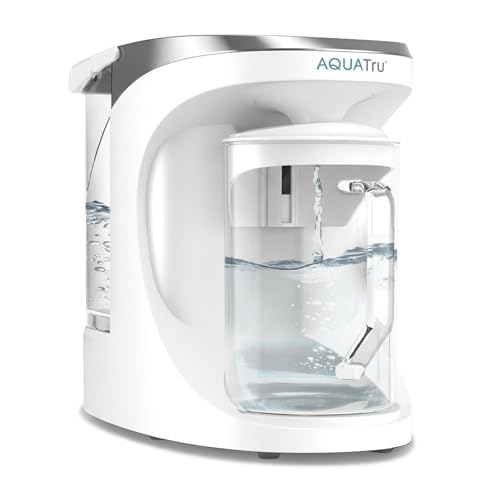
A glass-carafe RO purifier that removes 84 contaminants without a single tool.
This countertop unit goes beyond basic carbon by pushing water through a true 4-stage reverse osmosis filter, removing microplastics, fluoride, chromium-6, arsenic, PFOA+PFOS, and more. NSF certification by IAPMO independently verifies these claims.. Setup takes about 5 minutes and needs no plumbing—you fill the tank with tap water, and it dispenses purified water into the borosilicate glass carafe with a lid. No tools, no drilling, no permanent change to your kitchen.
The filtration is long-term: the Pre/Carbon Filter lasts 6 months or 300 gallons, the RO Filter lasts 1 year or 600 gallons, and the VOC Carbon Filter lasts 1 year or 300 gallons. Customers note a night-and-day taste difference, especially on hard water, and note the unit doesn’t take much counter space despite its 14″ x 7.5″ x 13″ frame. One owner measured zero TDS in the output, a sign of how thorough the RO membrane is.
What wins people over is the taste and water quality, with reliability being the honest concern. The catch: it’s slow—about 8 minutes per carafe—and the input tank is small, so you’ll refill it often. An occasional unit has a filter fail early, and the 14.7-pound weight means it’s not something you move around daily. It’s the pick for renters who want RO-level purity without touching their plumbing.
RO purity, zero plumbing: It removes 84 contaminants including PFOA/PFOS and microplastics, with NSF certification by IAPMO..
Patience required: at roughly 8 minutes per pitcher with a small intake tank, this rewards slower, deliberate use over rapid refills.
9. Waterdrop M6CG Hot & Cold Reverse Osmosis System

The instant hot-and-cold dispenser that turns a glass of water into a French-press-ready machine.
This is the most feature-packed countertop pick: it delivers hot water at 203°F and cold at 59°F instantly, so you can brew a French press, make tea, or pour a chilled glass without a kettle or a fridge. The 8-stage filtration system uses a 0.0001μm RO membrane and goes after TDS, PFOA, PFOS, Nitrate, Fluoride, Arsenic, and Lead. It’s install-free—fill the 185oz tank (135oz tap, 50oz waste), plug it in, and it dispenses pure water from a 40oz detachable glass pitcher.
Beyond purity, it adds minerals back in: K⁺, Ca²⁺, Na⁺, Mg²⁺, Sr²⁺, and Zn²⁺, so water has a balanced taste rather than the flat profile of pure RO. The 3:1 pure-to-drain ratio keeps waste water low, and the waste tank can be recycled for watering plants. A smart touch panel lets you set five water volumes, from a 4oz espresso to a 16oz soup bowl, and the NFC label on the unit opens a smart guide when you tap your phone.
What wins people over is the quality and the convenience of instant hot and cold—145 owners highlight the quality, and setup is about 23 minutes for most. The honest trade-offs: it’s bulky (16.6″ x 9.3″ x 14.5″) and heavy, the waste tank is small, and owners note cold water takes a moment while hot is instant. The filtration speed is slower than a straight tap, so it’s a deliberate pour, not a filling-a-pot system. It’s the splurge for someone who wants a water station, not just a filter.
Why It’s Worth It
- Instant hot (203°F) and cold (59°F) water on demand
- Mineral-infusion stage adds back calcium and magnesium for taste
- 3:1 pure-to-drain ratio with a recyclable waste tank
The Honest Limits
- Bulky footprint and heavy 11.8 kg weight
- Dispensing is slower than tap, and the waste tank is small
Get this for: the kitchen counter where coffee, tea, pets, and family all want different temperatures from one pure source.
Pass if: you lack counter space, or you need to fill large pots quickly—this is a dispensary, not a high-volume tap.
Understanding the Specs
Filtration Precision (Micron Rating)
The micron rating tells you the smallest particle a filter catches. A 0.5-micron system like the SimPure V7 grabs fine sediment and heavy metal particles. The Waterdrop TST-UF goes further at 0.01 microns, and the M6CG’s RO membrane hits 0.0001μm—that level approaches ultra-pure water. The smaller the number, the more thorough the filtration, and the closer you get to water that’s essentially stripped of everything but H2O.
Filter Lifespan and Total Capacity
Lifespan is measured in months or gallons, and it drives your long-term cost. The Brita pitcher needs a filter swap every 2 months (40 gallons), while the OEMIRY faucet filter runs 12 months or 8,000 gallons. The SimPure V7 extends that to 20,000 gallons on one cartridge. Longer life means fewer purchases and less hassle, but check the replacement filter price—a cheap system can cost more over time if the cartridges are pricey.
TDS and Mineral Retention
TDS (total dissolved solids) measures what’s left in the water after filtration. Reverse osmosis systems like the DREO and APEC drive TDS down dramatically, often from the 300s to under 15, so you get stripped-down purity. But they also strip beneficial minerals. Some systems, like the OEMIRY and SimPure V7, deliberately retain calcium and magnesium—so TDS stays higher, but the water tastes “fuller.” Decide if you want stripped-down purity or mineral-rich flavor, because these two goals pull in opposite directions.
Flow Rate and Convenience
Flow rate in GPM (gallons per minute) tells you how fast water comes out. A 1.6 GPM filter like the OEMIRY fills an 8 oz cup in 2-3 seconds—essentially instant. Countertop RO units like the AquaTru run at 0.5 GPM, which means a pitcher takes about 8 minutes. If you fill large containers daily, prioritize flow. If you’re okay waiting for a glass at a time, the slower RO systems deliver far higher purity.
FAQ
What is the difference between a water filter pitcher and a reverse osmosis system?
How do I know if a filter will fit my faucet or under-sink connection?
How often do I really need to replace the filter?
What does TDS mean and should I care?
Is a countertop RO system as good as an under-sink one?
Will a water filter remove fluoride and heavy metals?
What is the difference between a 0.5-micron and a 0.01-micron filter?
Do these filters work on well water?
Which is better for a small apartment or rental?
How do I know the filter is actually working?
Final Thoughts: The Verdict
For the majority of shoppers, the water filter winner is the Brita 10 Cup Pitcher because it delivers the best taste-per-dollar with a proven, compact design that fits a fridge shelf. If you want to stop buying replacement filters every couple of months, the SimPure V7 runs a full year on one 20,000-gallon cartridge. And for the ultimate install-free upgrade with verified RO purity, the DREO countertop RO gives you live TDS readouts and auto-fill pitchers that replace bottled water entirely.
How We Picked
We do not accept paid placement. Every pick is matched to a real buyer and a real use-case; we do not hands-on test units.
Sources & Methodology
Specifications: manufacturer listings and product documentation. Review insights: verified customer reviews, as of August 2026. Pricing: not shown on this page (it changes often); check the current price via the retailer link.
As an Amazon Associate, Gadgets Feed earns from qualifying purchases. This does not affect which products we feature.