
Nothing disrupts a guided tour, church service, or factory walkthrough like a wireless audio guide system that drops signal halfway through a sentence. You need a system that transmits the speaker’s voice directly to every listener’s ear without interference, static, or the constant fear of wandering out of range. This category is about one-way voice clarity over distance, not two-way conversation.
I’m Min — the co-founder and writer behind Gadgets Feed. I’ve spent countless hours analyzing the transmission distances, battery endurance figures, channel counts, and frequency bands that separate reliable tour audio systems from frustrating noise machines.
This guide cuts through the technical noise to help you select the best wireless tour audio guide system for your specific group size, venue type, and operational needs.
How To Choose The Best Wireless Tour Audio Guide System
Choosing a wireless tour audio guide system starts with understanding your venue’s physical layout and your group’s size. You are selecting a one-way audio bridge, not a two-way radio. The three pillars are frequency band for interference immunity, range for spatial coverage, and battery endurance for uninterrupted sessions.
Frequency Band and Channel Flexibility
UHF bands between 902 and 928 MHz offer cleaner propagation through walls and better resistance to interference from Wi-Fi, Bluetooth, and broadcast FM signals than lower 72 MHz or FM bands. Systems with 99 channels and multiple IDs allow several tour groups to operate in the same building without bleeding into each other’s audio.
Range and Real-World Signal Reliability
Advertised line-of-sight ranges of 150 to 200 meters apply outdoors with no obstructions. In a concrete building with floors and walls, expect 30 to 50 meters of reliable coverage. Look for systems that explicitly state their range in open areas and indoors, and prioritize those with PLL (Phase-Locked Loop) technology for stable frequency lock.
Battery Life and Charging Logistics
Receiver battery life matters more than transmitter life because you have multiple units to manage. Receivers should last at least 15 hours for a full multi-day event without recharging. A charging case or multi-port charger that handles all units simultaneously dramatically reduces operational friction between tours.
Physical Design and Hygiene
Single-ear ear-hook receivers keep one ear open for ambient awareness, which is crucial for safety in factory tours or for interpreters needing to hear both the speaker and their own voice. Removable or replaceable batteries allow continued use as cells degrade, and open-style ear sponges are easier to sanitize between users.
Quick Comparison
On smaller screens, swipe sideways to see the full table.
| Model | Category | Best For | Key Spec | Amazon |
|---|---|---|---|---|
| ANLEON MTG-200 | Premium | Large-scale interpretation | 200m range, 30h battery | Amazon |
| Retekess T130U (4th Gen) | Premium | Long tours, large groups | 16 USB charger, 10h/40h | Amazon |
| Retekess T130 (1T 15R) | Premium | Churches, large groups | 15 receivers, auto-pair | Amazon |
| Retekess TT116 | Premium | Noisy factories, outdoor tours | 656ft range, noise reduction | Amazon |
| EXMAX EX-100 (1T 10R) | Mid-Range | Multi-group simultaneous use | 40 IDs, 25h receiver life | Amazon |
| EXMAX ATG-100T (1T 6R) | Mid-Range | Small tours, classrooms | 99 channels, charging case | Amazon |
| EXMAX EX-100 (1T 8R) | Mid-Range | Small group translation | 72 MHz UHF, 25h battery | Amazon |
| AGJ 1T 5R | Value | Budget-conscious tours | 150m range, 1000 mAh | Amazon |
| Retekess TR503 1T 10R | Value | Entry-level church or tours | FM band, AAA receivers | Amazon |
In‑Depth Reviews
1. ANLEON MTG-200 (30 Receivers)
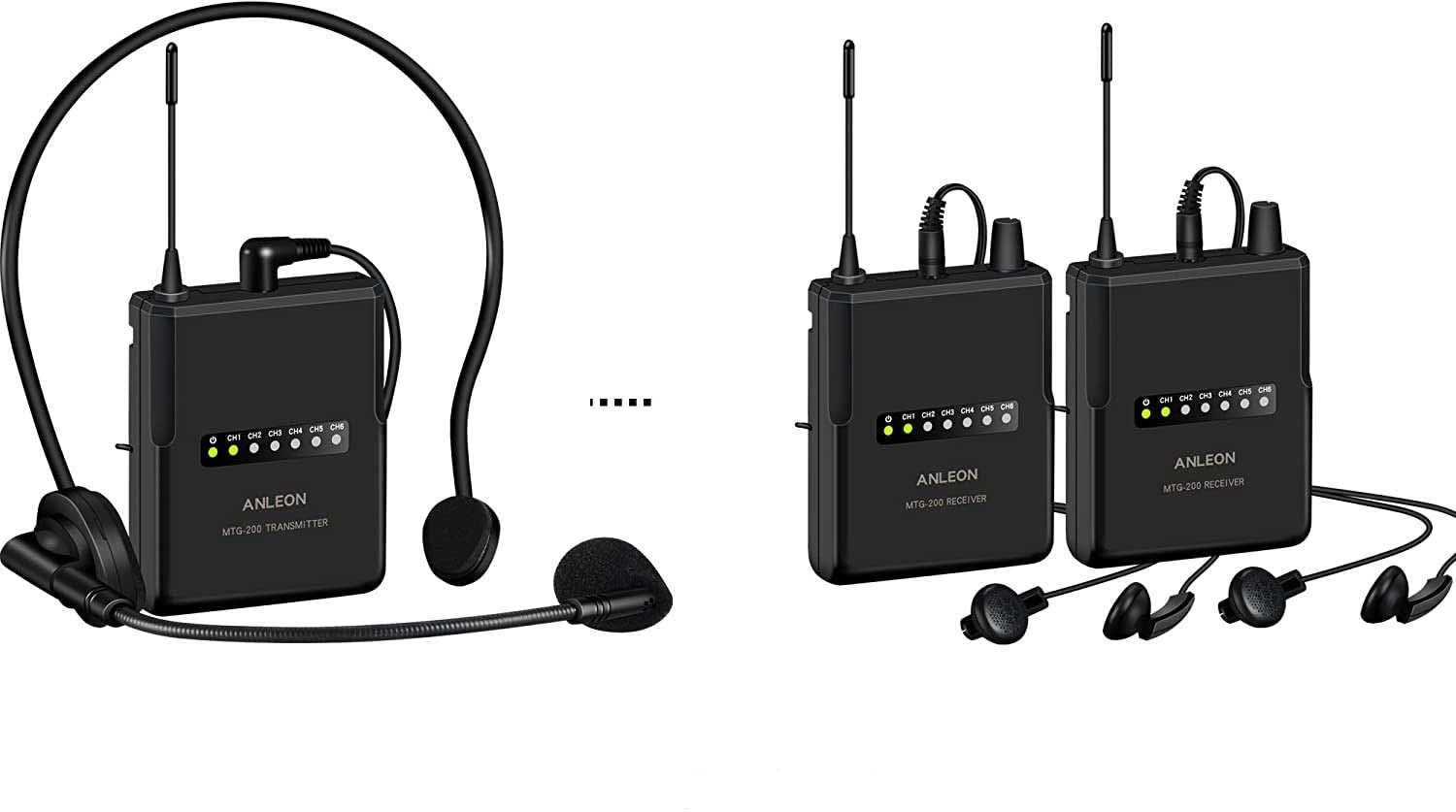
The ANLEON MTG-200 operates in the 902-927 MHz ISM band, which requires no user licensing and provides exceptional immunity to interference from consumer electronics. With six carrier frequencies to choose from, you can easily avoid overlapping signals in dense urban environments or venues with multiple audio systems running concurrently.
Battery endurance is a standout here at 30 hours of continuous operation on a single charge, enough for multi-day conferences without nightly recharging. The expandable design means you can add receivers indefinitely, scaling from the included 30 units to hundreds without changing infrastructure.
Audio quality is crisp and clear with 100 dB sensitivity, though the system requires a human interpreter — it does not perform automatic translation. The ABS enclosure keeps weight manageable at 1 kg for the full set, and the 200-meter outdoor range provides ample coverage for large tour spaces.
Why it’s great
- License-free ISM band avoids interference and fees.
- 30-hour battery life outlasts any multi-day event.
- Expandable to unlimited receivers without hardware changes.
Good to know
- Requires a human interpreter; no auto-translation.
- Indoor range reduces to approximately 50 meters in concrete buildings.
2. Retekess T130U (4th Gen) (1T 10R)
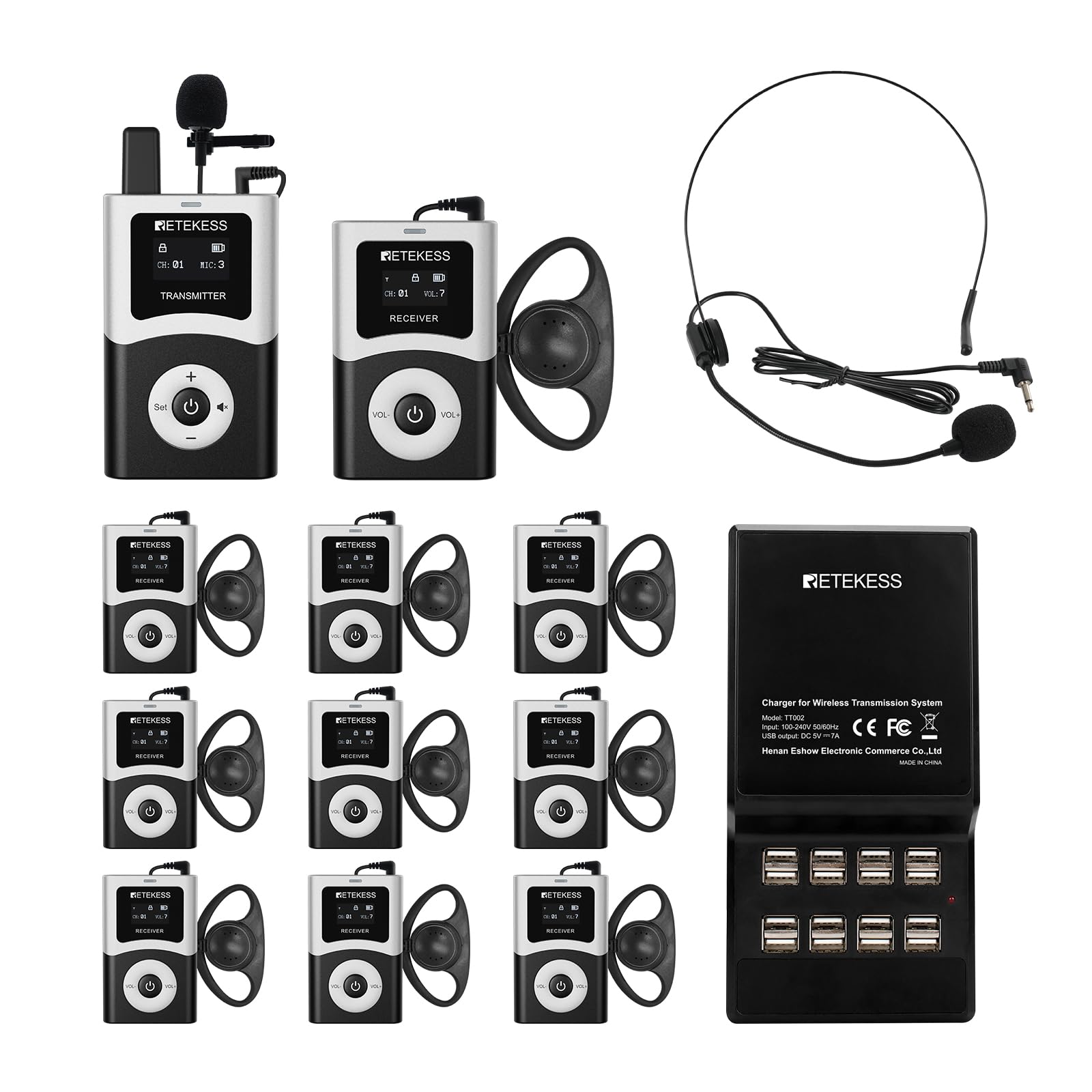
The fourth-generation Retekess T130U pushes receiver endurance to 40 hours, the highest in this comparison, while the transmitter manages a respectable 10 hours. This asymmetry makes practical sense — receivers stay with participants all day, while the guide can recharge a single transmitter quickly between tours.
Weight is remarkably low at 71 grams for the transmitter and 38 grams per receiver, making the system barely noticeable during extended wear. The 16-port USB charger included in the package solves the logistical headache of juicing up a full fleet overnight with a single power strip.
The U-band connectivity with high-fidelity audio codec and noise reduction delivers whisper-level clarity even in moderately noisy environments. The transmitter supports wireless input from smartphones, giving guides flexibility to mix their live voice with pre-recorded audio through a single device.
Why it’s great
- 40-hour receiver battery eliminates mid-tour charging concerns.
- Ultra-lightweight design at 38g per receiver reduces neck fatigue.
- 16-port charger simplifies fleet management.
Good to know
- No carrying case included for cables and units.
- Two nearby transmitters can cause some interference.
3. Retekess T130 (1 Transmitter 15 Receivers)

The Retekess T130 ships with 15 receivers right in the box, making it the highest-count bundled system in this lineup for groups that need to equip a full tour or church translation team immediately. Auto pairing synchronizes all receivers to the transmitter’s channel within five seconds, eliminating manual frequency matching before each event.
PLL technology keeps the signal locked and stable across the 99 available channels, so you can avoid crosstalk even when multiple groups operate in the same venue. The 50-meter range is conservative but reliable indoors, and the ability to connect the transmitter to external media via AUX cable opens up integration with church soundboards or presentation audio.
Battery life is solid with 16 included lithium-ion batteries, though individual endurance figures are not as extreme as the T130U. The system’s one-way transmission design means only the guide speaks, which is ideal for interpretation scenarios where the interpreter’s voice must reach listeners without feedback.
Why it’s great
- Fifteen receivers included — enough for medium tours out of the box.
- Auto pairing in 5 seconds simplifies daily setup.
- 99 channels prevent interference between multiple groups.
Good to know
- 50-meter range is shorter than some competitors.
- Requires a good microphone for best audio clarity.
4. Retekess TT116 (1 Transmitter 10 Receivers)

The Retekess TT116 pushes the working distance to 656 feet (200 meters) line-of-sight, the longest range in this list. This makes it ideal for outdoor plant tours, large manufacturing facilities, or campus-style venues where the guide and listeners may be separated by significant distances.
Noise reduction filters out background machinery hum, crowd chatter, and wind noise before transmission, so listeners hear only the guide’s voice. The removable BL-5C battery is a thoughtful design choice — these batteries are widely available, replaceable without tools, and compliant with airline carry-on restrictions for traveling teams.
Non-in-ear earphones rest outside the ear canal, reducing fatigue during all-day wear and simplifying hygiene between users. The receiver units also feature a dedicated space for branding stickers, which is a unique bonus for factory tours wanting to display corporate logos on the equipment.
Why it’s great
- 200-meter range covers large outdoor and industrial spaces.
- Noise reduction cleans up audio in loud environments.
- Removable batteries simplify travel and replacement.
Good to know
- Charging time of 10 hours is relatively long.
- Some units may experience static in specific RF environments.
5. EXMAX EX-100 (1 Transmitter 10 Receivers)

The EXMAX EX-100 provides 40 channel IDs, allowing up to 10 groups to operate simultaneously in the same venue without audio bleed. This is critical for trade shows, conferences, or museums where multiple guided tours run concurrently in overlapping physical spaces.
Each unit weighs just 46 to 56 grams, and the built-in 900 mAh lithium batteries deliver up to 25 hours of continuous receiver operation — enough for multi-day events. The single-sided ear-hook design keeps one ear free for ambient sound, which interpreters and safety-conscious tour leaders appreciate.
The system includes lavalier and clip-on microphones for hands-free guide operation, and the 3.5mm input jack supports external audio sources. Long-term users report strong reliability over years of weekly use, though the 50-100 meter range means it is better suited for indoor environments than sprawling outdoor venues.
Why it’s great
- 40 channel IDs support up to 10 simultaneous groups.
- 25-hour receiver battery handles multi-day events.
- Proven reliability over years of weekly church use.
Good to know
- 72 MHz band may face interference in dense urban RF environments.
- Some units ship without a detailed instruction manual.
6. EXMAX ATG-100T (1 Transmitter 6 Receivers)

The EXMAX ATG-100T operates on 195-230 MHz UHF frequencies with 99 channels and 99 IDs, giving you granular control over frequency selection in crowded RF environments. The transmitter has a 1200 mAh battery with 20-hour endurance, while receivers pack 900 mAh cells for 25 hours of operation.
The included 32-slot charging case is a standout feature at this tier, allowing the entire fleet plus spares to charge simultaneously from a single power outlet. The system supports both MIC and AUX input via 3.5mm jack, so guides can mix their voice with audio from a phone, MP3 player, or laptop.
Clear voice transmission with a signal-to-noise ratio of at least 90 dB ensures speech remains intelligible even in less-than-ideal acoustic conditions. The ear-hook receivers use breathable sponge pads and keep one ear open, though the microphone and earphone wires double as antennae and must be fully uncoiled for best range.
Why it’s great
- 99 channels with 99 IDs for interference-free multi-group use.
- 32-slot charging case powers the whole fleet from one plug.
- 20-hour transmitter and 25-hour receiver battery life.
Good to know
- Wires must be fully uncoiled to function as antennae.
- Ear hooks accommodate right ear only without modification.
7. EXMAX EX-100 (1 Transmitter 8 Receivers)

This smaller package of the EX-100 ecosystem offers 8 receivers with the same 40 channel IDs and 72 MHz UHF core as its larger sibling, making it a more budget-friendly entry point for small tour groups, church translation teams, or classroom assistive listening setups.
The transmitter weighs 56 grams and the receiver 46 grams, among the lightest in this tier. Both units run for over 25 hours on their built-in 900 mAh lithium batteries, and the transmitter accepts both MIC and AUX input, supporting connection to smartphones, laptops, or PA systems via the 3.5mm jack.
PLL technology locks onto the selected frequency to minimize drift and hiss, and the single-sided ear-hook design keeps listeners aware of their surroundings. Users report clear audio within 50 to 100 meters line-of-sight, though the lower 72 MHz frequency band is more susceptible to interference from electrical equipment than the 900 MHz bands.
Why it’s great
- Ultra-light 46g receivers reduce listener fatigue.
- Over 25 hours of continuous operation per charge.
- PLL technology provides stable frequency locking.
Good to know
- 72 MHz band may pick up interference from motors and electronics.
- No manual included in the box — setup instructions are minimal.
8. AGJ 813T (1 Transmitter 5 Receivers)

The AGJ 813T provides a balanced entry point with 150-180 meters of line-of-sight range on the UHF 902-928 MHz band, avoiding the interference issues that plague lower-frequency systems. Each device packs a 1000 mAh rechargeable lithium battery, with the transmitter lasting 8 hours and receivers stretching to 15 hours.
Twenty-six channels are available for group separation, and the lock switch prevents accidental channel changes during tours — a small but critical detail when handling a fleet. The system includes both a headset microphone and a straight plug-in microphone, giving guides two form factor options depending on their preference.
The plastic build is functional rather than premium, but users consistently report stable connections without signal cutting and intuitive operation. This is a no-frills system that prioritizes range and battery life over refinement, making it a sensible choice for museums, school field trips, or factory tours on a tighter budget.
Why it’s great
- UHF 902-928 MHz band avoids heavy FM interference.
- 150 meter range covers most indoor and outdoor tour routes.
- Lock switch prevents accidental frequency changes.
Good to know
- Plastic build feels less robust than metal-frame alternatives.
- No 3.5mm cable included for external mixer connection.
9. Retekess TR503 (1 Transmitter 10 Receivers)

The Retekess TR503 uses standard FM broadcast frequencies rather than dedicated UHF bands, which means it is susceptible to interference from local radio stations but also means receivers can be powered by ubiquitous AAA batteries instead of proprietary rechargeables. The transmitter has a 450 mAh battery delivering approximately 8 hours of operation per charge.
Setup is straightforward — manually tune transmitter and receivers to the same frequency, and the system works. The PR13 receivers support five station presets, a 24-hour digital clock, and a lock switch to prevent accidental tuning. The 30-meter open-air range is the shortest in this lineup, making it best suited for small church sanctuaries, classroom settings, or intimate tour groups.
The system includes a headset microphone and earphone for the guide, with 15 levels of transmit volume adjustment. Some users report that switching from stereo to mono mode and scanning for open frequencies resolves the initial hiss that can occur in areas with heavy FM broadcast traffic. This is a functional entry-level system for users who understand its FM-based limitations.
Why it’s great
- Receivers run on common AAA batteries — no proprietary cells to replace.
- Five station presets and digital clock on each receiver.
- Very affordable entry point for small groups.
Good to know
- 30-meter range is limited compared to UHF systems.
- FM band picks up local radio stations in some locations.
- Transmitter battery is only 450 mAh — 8 hours maximum.
FAQ
What is the difference between a wireless tour guide system and a two-way radio?
Can I use a wireless tour guide system for automatic language translation?
How many meters of range do I actually need for a church or factory?
Final Thoughts: The Verdict
For most users, the wireless tour audio guide system winner is the ANLEON MTG-200 because it combines a license-free 915 MHz band with 30-hour battery life and unlimited receiver expansion. If you want the longest individual receiver battery life and a 16-port charger, grab the Retekess T130U. And for large groups needing 15 receivers right out of the box, nothing beats the Retekess T130.