
Our readers keep the lights on and my morning glass full of iced black tea. As an Amazon Associate, I earn from qualifying purchases.
Specs are compiled from manufacturer listings and verified buyer reviews and can change over time — please confirm the key details on the product page before buying.
Getting brake lights, turn signals, and accessories to work on a trailer or project car should not mean chasing shorts or guessing which wire is which. A good wiring harness turns that messy job into a straightforward afternoon project by giving you color-coded wires, labeled circuits, and enough length to route everything cleanly.
I’m Min — the founder and writer behind Gadgets Feed. This guide is built by comparing the manufacturers’ published specifications and the patterns across verified customer reviews, so you get each pick’s real strengths and trade-offs instead of marketing spin.
The right choice depends on pin count (the number of connections for a trailer plug), wire length, and the ease of installation — all covered below for the best wiring harness options available today.
Quick Picks
- Oyviny 4 Pin 5 Wire Trailer Wiring Harness 22FT — Best Value
- CheeMuii 7 Way Trailer Wiring Harness Kit 8 FT — Best for RVs
- Universal Extra Long Wires 21 Circuit Wiring Harness Hotrod Kit (VOWAGH) — Project Car Pick
- Universal Wiring Harness Kit – 21 Circuit (Auto Parts Prodigy) — Restoration Favorite
How To Choose The Best Wiring Harness
Picking the right harness means matching the connector type and circuit count to your specific vehicle or trailer. Here are the two factors that matter most.
Pin Count: 4-Pin vs 7-Pin
A 4-pin flat connector handles the basics: brake lights, turn signals, tail lights, and ground. It is the standard for small utility trailers, boat trailers, and light-duty hauling. A 7-pin round connector adds reverse lights, electric brakes (brakes that use electricity to stop a trailer), and auxiliary power (extra power for accessories like interior lights) — essential for larger RVs, campers, and caravans that need more than just lighting.
Circuit Count for Full Rewires
If you are rewiring an entire vehicle, the harness needs enough circuits (individual electrical paths) for every component: headlights, horns, dome lights, power windows, fuel pump, and more. A 21-circuit harness covers a complete classic car or hot rod build, while fewer circuits are fine for simpler projects or trailers.
Quick Comparison
| Model | Best For | Pin / Circuit Count | Length | Weight | Amazon |
|---|---|---|---|---|---|
| Oyviny 4 Pin 5 Wire | Small trailers & utility rewire | 4 Pin | 22 Feet | 0.43 kg | $22.99Amazon |
| CheeMuii 7 Way Kit | RV, camping & 7-pin trailers | 7 Pin | 8 Feet | 1.23 kg | $24.99$30.00Amazon |
| Universal 21 Circuit Harness (VOWAGH) | GM-based hot rods & project cars | 21 Circuits | Extra Long | — | $69.99$75.99Amazon |
| Universal 21 Circuit Harness (Auto Parts Prodigy) | Classic cars & full restorations | 21 Circuits | Extra Long | — | $118.99$129.99Amazon |
In‑Depth Reviews
1. Oyviny 4 Pin 5 Wire Trailer Wiring Harness 22FT

The 22-foot harness that makes re-wiring a small trailer a single-afternoon job.
This Oyviny harness uses a wishbone design — one 4-pin male plug splits into two brown wires that run to the left and right tail lights simultaneously, so you do not need to splice extra wires yourself. The 22-foot length gives you plenty of slack to route through a trailer frame without stress, and the 0.43 kg overall weight makes it surprisingly light to handle compared to heavier 7-pin kits like the CheeMuii.
The wires are pure copper for good conductivity, wrapped in thickened PVC coating (the wire diameter is 0.03 inches) and protected by a black nylon net tube against rubbing. Buyers report the cabling is “high-quality, durable” and that “all lights worked perfectly” right after installation. A minor note from reviewers: the kit does not include #18 butt splices for terminating the wires at the lamps, so you will need to pick those up separately.
At under half a kilogram, this is at 0.43 kg versus the CheeMuii 7-pin kit at 1.23 kg — a real advantage if you are crawling under a trailer to feed wires through tight channels. For a straightforward utility trailer, boat trailer, or small rebuild, this is the most practical option.
Why It Works
- Y-harness design eliminates splicing for left/right taillights
- 22-foot length allows flexible routing on longer trailers
- Pure copper wires with nylon tube protection resist corrosion
The Small Catch
- No included butt splices for lamp wire termination
- 4-pin connector limits use to trailers without electric brakes or reverse lights
Reach for this if: you are rewiring a small to medium trailer and want a simple, color-coded, almost-no-splicing solution that just works.
Look elsewhere if: your trailer needs a 7-pin connector for electric brakes or you need a heavier-duty junction box setup.
2. CheeMuii 7 Way Trailer Wiring Harness Kit 8 FT

The complete 7-pin package with a junction box that keeps all your connections organized.
This CheeMuii kit is built for the bigger stuff — RVs, campers, caravans, and food trucks that need the full set of trailer functions: taillights, brake lights, reverse lights, turn signals, and auxiliary power. The 7-pin plug uses a premium double-prong design (replacing the weaker single-prong connectors you sometimes find), and the 8-foot cord gives you a solid reach from the vehicle to the junction box.
The junction box itself is the highlight — it has 7 color-coded terminals and wires clearly labeled for their function (one reviewer noted the terminal functions are printed right on the box, which made matching wires to their trailer “work perfect”). The box is water-resistant and the 1.23 kg weight reflects the beefy construction you get compared to lighter 4-pin kits like the Oyviny. One buyer pointed out the box does not include a rubber seal or o-ring between the lid and the box, so if it is mounted where rain hits directly, they suggest silicone or terminal grease as a precaution.
Owners mention the installation was “fairly easy” and that the wires are copper, with one reviewer calling it “the best way” to wire a trailer. If you own a travel trailer or a heavy-duty tow rig, this is the straightforward upgrade.
What Stands Out
- Junction box with color-coded, labeled terminals removes wiring guesswork
- Double-prong 7-pin plug designed for durability over single-prong alternatives
- Weather-resistant construction suits outdoor trailer use
What to Watch
- No rubber seal on junction box lid may let in moisture over time
- At 1.23 kg, it is noticeably heavier than a basic 4-pin harness
Go for this if: you need a 7-pin connector for an RV or camper and want an organized junction box instead of a messy tangle of splices.
skip it if: you only need a simple 4-pin setup for a smaller trailer — the Oyviny above is lighter and longer for that purpose.
3. Universal Extra Long Wires 21 Circuit Wiring Harness Hotrod Kit (VOWAGH)
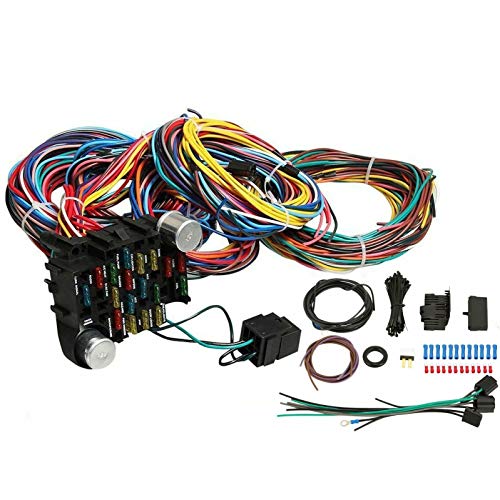
A 21-circuit harness built for LS swaps and GM-based hot rods that need serious wiring density.
This kit from VOWAGH packs 21 circuits and 17 fuses into a setup specifically designed for GM column connectors — it includes wiper/radio acc, cruise/backup, heater/air, power windows, power seats, headlights, horn, fuel pump, and more right from the start. The wires use a 5-millimeter diameter and are described as “thicker gauge” than stock, with extra length that gives you slack to route them wherever your project needs.
Here is the honest trade-off: customers note the harness is not 100% plug-and-play. One reviewer called it the “best investment for project car” after getting headlights, blinkers, and brake lights all working, but noted the supplied flashers are weak and a few wires may need supplementing. Another buyer had labeling issues and wished for a complete wiring diagram. If you have basic automotive electrical knowledge and can trace a circuit, this offers tremendous value for the price — one experienced builder said it is “highly recommended for LS swaps into 80s cars.”
The harness works with GM installations and comes with detailed instructions, though the manufacturer recommends reading them carefully because the font annotations on the fuse box are the main guide. For someone rebuilding a classic Chevy, a hot rod, or a rat rod with a GM platform, this is the dense, circuit-rich kit to start with.
Strong Points
- 21 circuits cover almost every electrical need for a full car build
- Extra-long wires give flexibility for custom routing in project cars
- Includes GM column connectors and labeled fuse box for easier installation
Know Before You Buy
- Some units may have faint or missing wire labels — check immediately
- Not for first-timers; requires automotive wiring knowledge to troubleshoot
Best for: an intermediate-to-advanced builder doing a GM-based project car, LS swap, or classic Chevy who wants a dense circuit list without paying premium-brand prices.
Not for: a wiring novice — the included instructions and labeling are not simple to use, and you will need to know how to verify circuits.
4. Universal Wiring Harness Kit – 21 Circuit (Auto Parts Prodigy)

A classic-car wiring solution praised for beating Painless brand kits at a fraction of the cost.
This 21-circuit harness uses GXL 125 high-temperature cross-linked polyethylene wire — a jacket rated to resist grease, oil, gas, and acid, which matters when you route wires through a hot, dirty engine bay. All circuits are GM color-coded for easier identification, and the included circuits cover everything from headlights and brake lights to dome lights, power windows, hazard lights, electric fuel pump, and even the A/C.
Reviewers point out consistently strong experiences: one owner called it “great value for rewiring a 1953 Chrysler New Yorker,” saying it was an easy install for an experienced user and that the wire length was ample. Another reviewer put it on a 1955 Chevy Belair and noted the harness allowed a dimmer switch relocation. The main critiques are that the fuse panel connections feel a bit cheap and may need gentle massaging to fit securely, and that two wires (the black HVAC wires) may come unlabeled. The instructions include separate pages for GM, Ford, and Mopar — a helpful touch that the VOWAGH kit above lacks.
One reviewer summed it up simply: “Better than Painless brand at 3-4x cost.” If you are restoring a classic and want a solid, well-labeled harness that has real community validation, this is the one to grab.
Why Restorers Pick It
- GXL 125 wire jacket resists heat, oil, gas, and acid for engine-bay durability
- Separate instruction pages for GM, Ford, and Mopar installations
- Buyers consistently praise the value versus premium-brand alternatives
Minor Quirks
- Fuse panel connections may require slight adjustment for a snug fit
- A couple of wires (black HVAC wires) may lack labels from the start
Reach for this if: you are restoring a classic car — especially a GM, Ford, or Mopar — and want a proven harness with durable jacketing and clear instructions.
Consider the alternative if: you are doing a GM-specific hot rod and want the VOWAGH kit’s GM column connectors and slightly different circuit mix.
Understanding the Specs
Wire Gauge and Material
The gauge (thickness) of the wire determines how much electrical current it can carry safely. Thicker wires (lower AWG numbers) handle higher loads like headlights and electric brakes. Pure copper wire offers the best conductivity and resists corrosion better than copper-clad aluminum. Many harnesses use a PVC or cross-linked polyethylene jacket to protect against heat, oil, and moisture.
Circuit Count vs Pin Count
A circuit is one complete electrical path — for example, a circuit for the left turn signal or a circuit for the brake lights. A harness with 21 circuits can power nearly every component in a classic car. Pin count refers specifically to the trailer connector: 4-pin covers basic lights, 7-pin adds reverse lights, electric brakes, and accessory power. Choose based on what your tow vehicle and trailer require.
FAQ
Can I use a 4-pin harness on a trailer that originally had a 7-pin connector?
How long does a trailer wiring harness last?
Will a 21-circuit harness fit my 1950s classic car?
What is the difference between GXL wire and standard PVC wire?
Do I need electrical experience to install a wiring harness?
Can I use a 4-pin harness on a 7-pin connector?
What wires are included in a 4-pin flat harness?
How do I protect my wiring harness from moisture?
Final Thoughts: The Verdict
For most buyers, the wiring harness winner is the Oyviny 4 Pin 5 Wire because it combines a 22-foot length, pure copper wires, and a wishbone design that eliminates splicing for the most common trailer rewiring job. If you need a full 7-pin setup for an RV, grab the CheeMuii 7 Way Kit for its organized junction box. And for a classic car restoration or hot rod build, the Auto Parts Prodigy 21 Circuit Harness offers the best balance of GXL wire quality and real-world community praise.
How We Picked
We do not accept paid placement. Every pick is matched to a real buyer and a real use-case; we do not hands-on test units.
Sources & Methodology
Specifications: manufacturer listings and product documentation. Review insights: verified customer reviews, as of July 2026. Pricing: not shown on this page (it changes often); check the current price via the retailer link.
As an Amazon Associate, Gadgets Feed earns from qualifying purchases. This does not affect which products we feature.
Product prices and availability are accurate as of the date/time indicated and are subject to change. Any price and availability information displayed on Amazon at the time of purchase will apply to the purchase of this product. As an Amazon Associate I earn from qualifying purchases.
CERTAIN CONTENT THAT APPEARS ON THIS SITE COMES FROM AMAZON. THIS CONTENT IS PROVIDED "AS IS" AND IS SUBJECT TO CHANGE OR REMOVAL AT ANY TIME.
Amazon and the Amazon logo are trademarks of Amazon.com, Inc. or its affiliates.