
Disposable AAA batteries drain your wallet and fill landfills with toxic waste, yet most rechargeable alternatives deliver inconsistent voltage or die after a few dozen charges. The right cells, however, eliminate both problems — providing reliable 1.2V power across hundreds of devices while paying for themselves within a handful of recharge cycles.
I’m Min — the co-founder and writer behind Gadgets Feed. I’ve logged hundreds of hours analyzing internal resistance data, capacity test results, and cycle-life benchmarks across dozens of NiMH and lithium-ion AAA cells to separate the performers from the duds.
Whether you are powering gaming controllers, smart home sensors, or high-drain camera flashes, finding the best aaa rechargeable batteries means balancing capacity retention, charge cycle count, and self-discharge rate against your specific device demands.
How To Choose The Best AAA Rechargeable Batteries
Not all rechargeable AAA batteries deliver the same voltage curve, cycle count, or capacity retention. Three factors separate the cells that power your devices reliably for years from those that frustrate you within months.
Capacity vs. Cycle Life Trade-Off
Higher mAh ratings (1100mAh versus 800mAh) sound better, but cells pushed to higher capacities often degrade faster. Premium NiMH cells like Eneloop typically deliver lower rated capacity (800mAh minimum) but exceed 2100 charge cycles, while budget high-capacity cells may fade after 500 cycles. Match capacity to your drain rate: high-drain devices benefit from higher capacity, but low-drain sensors and remotes favor cycle longevity.
Low Self-Discharge (LSD) Chemistry
Standard NiMH cells lose 1% of charge per day, dropping to zero in three months. LSD NiMH cells retain 70–80% capacity after 1–3 years of storage, making them ideal for emergency devices, TV remotes, and smoke alarms where batteries sit unused for months. Look for explicit “low self-discharge” or “pre-charged” labeling.
Voltage and Device Compatibility
NiMH rechargeable cells deliver a nominal 1.2V versus 1.5V from alkaline disposables. Most modern devices tolerate the difference, but some older or voltage-sensitive gadgets (certain clocks, metered medical devices) may report “low battery” prematurely. Lithium-ion rechargeable AAA cells with built-in voltage regulators maintain a steady 1.5V output, solving this issue at a higher cost and lower mAh capacity.
Quick Comparison
On smaller screens, swipe sideways to see the full table.
| Model | Category | Best For | Key Spec | Amazon |
|---|---|---|---|---|
| Eneloop Panasonic BK-4MCCA8BA | Premium NiMH | High-drain & daily cycling | 2100 cycles, 70% charge after 10 years | Amazon |
| Eneloop Panasonic BK-4MCCA6BA | Premium NiMH | Long-term storage reliability | 2100 cycles, 6-pack value | Amazon |
| paleblue USB Rechargeable AAA | Lithium-Ion | 1.5V constant output & fast USB charging | 1-hour charge time, 1.5V consistent voltage | Amazon |
| EBL 8-Pack with USB-C Charger | NiMH Kit | Complete starter bundle | 1200 cycles, 2-hour USB-C charging | Amazon |
| Granicell Rechargeable AAA 8-Pack | NiMH Kit | Versatile multi-bay charging | 1100mAh, independent charging slots | Amazon |
| NICEBATT 1100mAh 24-Pack | High-Capacity NiMH | Bulk replacement for high-drain devices | 1100mAh, 1200+ cycles | Amazon |
| Amazon Basics 12-Pack 850mAh | Budget NiMH | Cost-conscious bulk for light-duty devices | 850mAh, 80% capacity after 24 months | Amazon |
In‑Depth Reviews
1. Eneloop Panasonic BK-4MCCA8BA AAA 2100 Cycle Ni-MH Pre-Charged Rechargeable Batteries, 8-Battery Pack

The Eneloop BK-4MCCA8BA 8-pack represents the gold standard in NiMH AAA cells, rated for an exceptional 2100 recharge cycles while delivering 800mAh minimum capacity. Independent testing confirms these cells routinely exceed their rated capacity by 30% or more, with a remarkably consistent internal resistance of 184mΩ across the entire pack — critical for high-drain applications like camera flashes and motorized toys where voltage sag ruins performance.
Panasonic’s LSD chemistry retains 70% charge after 10 years of storage, making these cells equally suited for emergency flashlights and seldom-used remotes. The batteries arrive pre-charged via solar power at the factory. Users report consistent performance after hundreds of cycles in daily-use devices, with zero leak incidents common in cheaper cells.
The main limitation is the 1.2V nominal output — some voltage-sensitive devices may trigger low-battery warnings prematurely. Additionally, Eneloop cells require a compatible smart charger for optimal longevity; a cheap trickle charger will shorten their lifespan. For users who demand maximum cycle life and charge retention, this pack sets the benchmark.
Why it’s great
- 2100 recharge cycles dramatically outlast budget competitors.
- Retains 70% capacity after 10 years in storage — best-in-class LSD performance.
- Consistent internal resistance across all cells ensures reliable high-drain performance.
Good to know
- 1.2V output may show as “low battery” in some 1.5V-dependent devices.
- Requires a quality smart charger for maximum cycle life.
2. Eneloop Panasonic BK-4MCCA6BA AAA 2100 Cycle Ni-MH Pre-Charged Rechargeable Batteries, 6-Battery Pack

The six-cell version of the legendary Eneloop AAA delivers the identical 2100-cycle longevity and LSD chemistry as its 8-pack sibling, with a typical capacity of 850mAh (800mAh minimum). These cells perform flawlessly in TV remotes, thermostat controllers, and wireless mice where months of idle time would drain standard NiMH cells. Users consistently report these are the only rechargeable batteries that can sit in a smoke alarm for a year and still deliver full voltage when tested.
Made in Japan and packaged in the US, the BK-4MCCA6BA cells operate reliably down to -4°F, making them suitable for outdoor sensor applications and winter flashlights. The pre-charged factory state means zero waiting time — install and use immediately. Long-term owners note that after 500+ cycles, these cells still deliver over 90% of their original capacity, far outperforming the degradation curve of budget alternatives.
The 6-pack format costs more per cell than the 8-pack, so the larger bundle offers better value if you need more than six cells. As with all NiMH chemistry, pairing with a high-quality charger yields the best results. These cells represent the safest long-term investment for anyone standardizing on one rechargeable AAA platform.
Why it’s great
- Industry-leading 2100-cycle durability with minimal capacity fade.
- Holds charge for 10 years in storage — unbeatable for emergency gear.
- Works in extreme cold down to -4°F.
Good to know
- 6-pack costs more per cell than the 8-pack bundle.
- Smart charger recommended but not included.
3. paleblue USB Rechargeable AAA Lithium Batteries, 1 Hour Charge Time, 4 Pack

The paleblue AAA lithium-ion cells break from NiMH convention by delivering a rock-solid 1.5V output throughout the discharge cycle, matching alkaline voltage exactly. This eliminates the premature “low battery” warnings that plague NiMH cells in voltage-sensitive devices like wireless mice, keyboard trackpads, and certain medical monitors. The internal voltage regulator ensures consistent performance until the cell cuts off — no gradual dimming or sluggish motor response.
Charging speed is the standout feature: a full 4-pack tops up in under one hour via the included 4-in-1 USB-A to USB-C cable, which is dramatically faster than typical NiMH chargers requiring 4–8 hours. The lithium-ion chemistry also eliminates the risk of corrosive alkaline leaks that destroy device contacts. At 8 grams per cell, these are lighter than NiMH alternatives, reducing weight in portable gear.
The trade-off is lower capacity (600mAh) versus high-capacity NiMH cells, and a sudden voltage cutoff with no low-battery warning — devices will simply stop working rather than showing a gradual decline. This makes paleblue unsuitable for critical timing devices or clocks. The 4-pack format also costs significantly more per cell than NiMH alternatives, though the built-in USB charging eliminates the need for a separate charger dock.
Why it’s great
- True 1.5V output works perfectly in voltage-sensitive devices.
- Full charge in under 1 hour — 12x faster than typical NiMH.
- No leakage risk; safe for valuable electronics.
Good to know
- 600mAh capacity is lower than high-capacity NiHM cells.
- Sudden voltage cutoff provides no low-battery warning.
4. EBL 8-Pack 1100mAh AAA Rechargeable Batteries & Charger, NiMH, 1200 Cycles
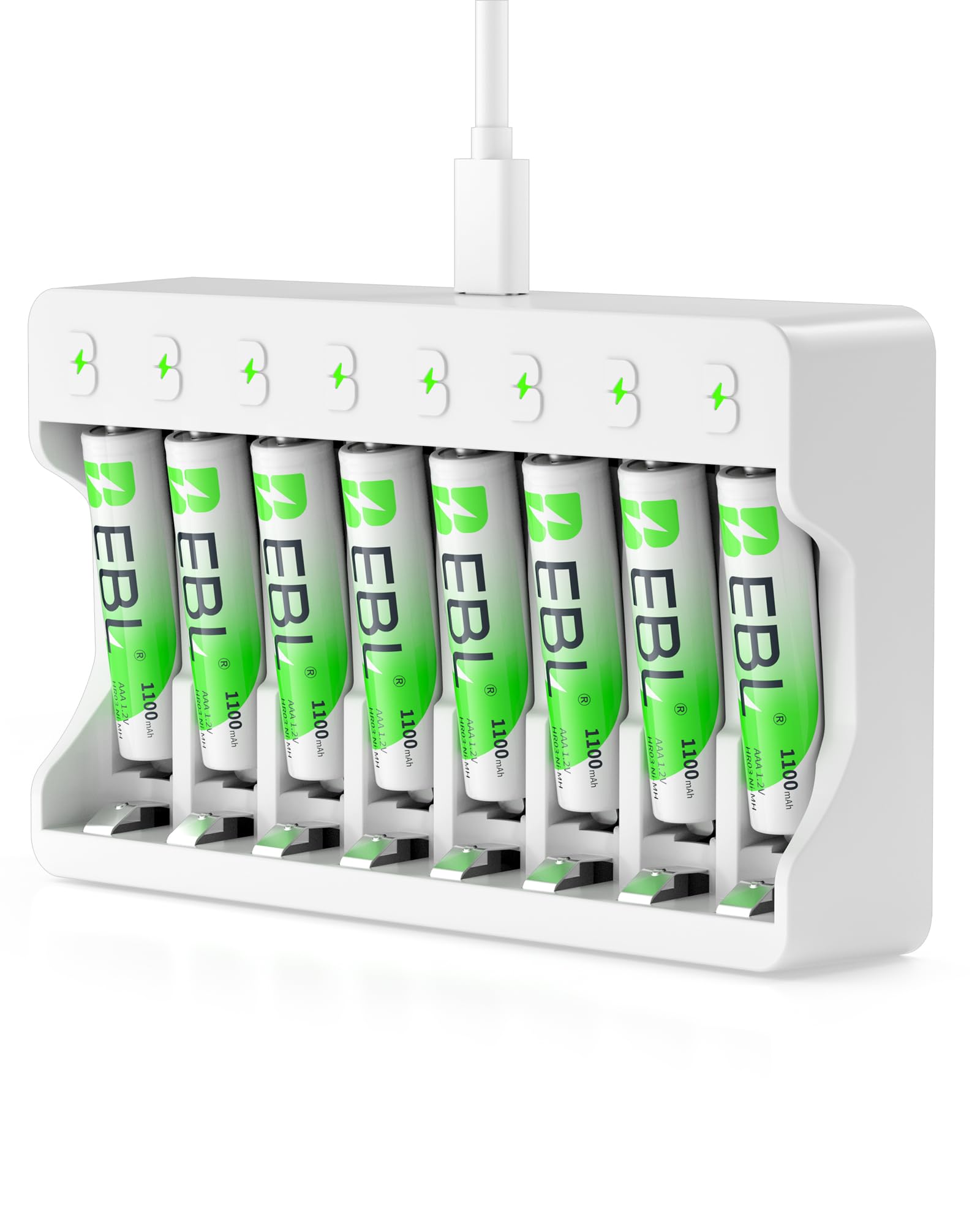
The EBL kit bundles 8 AAA cells rated at 1100mAh with a USB-C fast charger capable of juicing all 8 batteries independently in approximately 2 hours. The UL and CE certified charger uses independent charging slots, meaning you can charge any mix of AA and AAA NiMH/NiCD cells without worrying about one weak cell ruining the entire batch. The USB-C input is a welcome modern convenience — charge from a laptop, power bank, or wall adapter without a proprietary cable.
EBL’s ProCyco technology claims 1200 recharge cycles per cell, and the LSD formulation retains 80% capacity after 3 years of storage — competitive with premium brands at a significantly lower price point. Customer reports confirm these cells handle high-drain devices like camera flashes and game controllers well, though internal resistance measurements tend to be slightly higher than Eneloop cells, which may cause voltage sag under extreme load.
The main downside is that the bundled charger, while functional and safe, lacks advanced features like discharge mode or individual cell conditioning found in premium charger units. For users new to rechargeable batteries, this all-in-one package eliminates the guesswork and provides everything needed to swap out disposables immediately. The 8-pack format with charger offers strong value for households switching multiple devices at once.
Why it’s great
- USB-C charger fast-charges 8 cells independently in 2 hours.
- 1200-cycle lifespan with 80% charge retention after 3 years.
- Complete kit — batteries, charger, and cable included.
Good to know
- Higher internal resistance than premium Eneloop cells.
- Charger lacks advanced conditioning and discharge features.
5. Granicell Rechargeable AAA Batteries with Charger, 8 Pack 1100mAh Low Self Discharge Triple A Batteries with 8 Bay AA AAA Smart Battery Charger
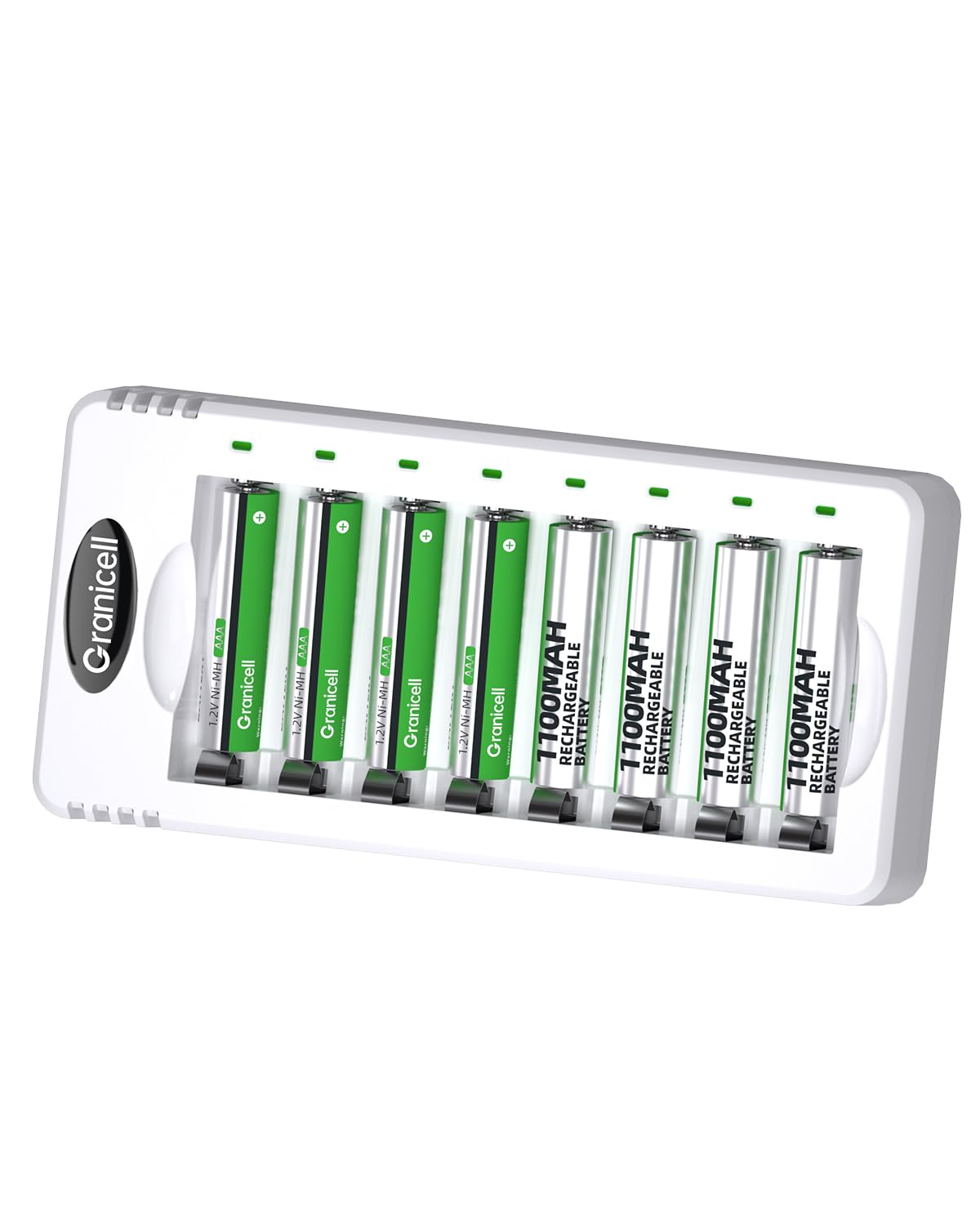
The Granicell kit pairs eight 1100mAh AAA cells with an 8-bay smart charger that charges any combination of AA and AAA NiMH/NiCD batteries simultaneously. Each slot operates independently with its own LED indicator — red for charging, green for full — so you can charge one cell at a time or a full set without pairing requirements. The charger uses USB Type-C input, enabling power from standard phone adapters, power banks, or car USB ports.
Customer feedback confirms the cells hold their charge well across extended storage periods and deliver reliable power in high-drain toys, digital cameras, and gaming controllers. The 1100mAh rating provides noticeably longer runtime per charge than standard 800mAh cells in continuous-use devices. The smart charging circuit automatically stops when each battery reaches full capacity, preventing overcharging that can damage cells over time.
A minor complaint involves the LED indicators — they are quite bright, which may be distracting in a dark room. Some users also report that the charger struggles with older NiCD batteries, failing to recognize or charge them. For households using mixed battery chemistries, sticking with NiMH cells exclusively ensures trouble-free operation. The independent slot design and universal USB charging make this a strong contender for families with diverse device needs.
Why it’s great
- Independent 8-bay charger charges any mix of AA/AAA cell counts.
- USB Type-C input for flexible power source compatibility.
- 1100mAh high capacity provides extended runtime.
Good to know
- Bright LEDs may be distracting in darkened rooms.
- Charger may not reliably charge older NiCD batteries.
6. NICEBATT Rechargeable AAA Batteries 1100mAh, Premium NiMH Triple A Battery Low Self Discharge -24 Count
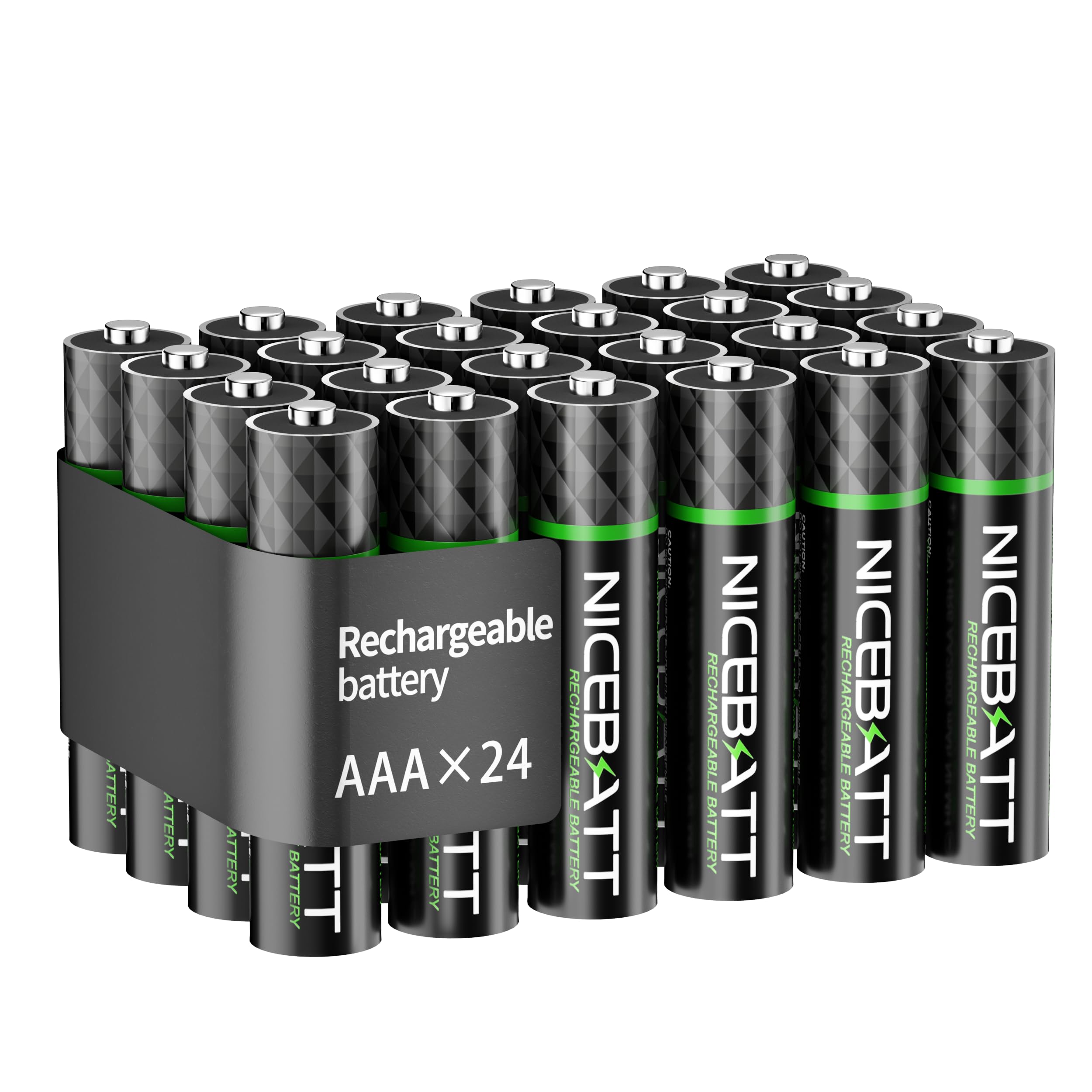
The NICEBATT 24-pack delivers the highest capacity per cell in this guide at 1100mAh, combined with a 1200+ cycle rating and LSD chemistry that retains 80% charge after 2 years of storage. This is the clear choice for households with multiple high-drain devices — think kids’ motorized toys, gaming controllers, portable fans, and digital cameras that burn through batteries quickly. The per-cell cost is among the lowest in its capacity class, making it economical for heavy users.
NiMH chemistry from NICEBATT is designed for high-current discharge applications, meaning voltage holds up better under load compared to standard low-drain cells. The batteries operate across a wide temperature range of -4°F to 140°F, covering outdoor winter use and summer porch devices. Customer reports confirm these cells last noticeably longer per charge than lower-capacity alternatives in continuous-use scenarios.
The trade-off for the higher 1100mAh capacity is that cycle life (1200+ cycles) is lower than Eneloop’s 2100 cycles, meaning these cells will need replacement sooner under heavy daily use. Additionally, the 24-pack requires a separate charger — none is included — and the sheer volume of cells demands organization to track which are charged and depleted. For users who prioritize raw runtime per charge over ultimate longevity, this pack delivers excellent value.
Why it’s great
- 1100mAh capacity delivers longer runtime per charge than standard cells.
- 24-pack offers lowest per-cell cost for high-volume users.
- Wide operating temperature range for outdoor applications.
Good to know
- 1200-cycle rating is lower than premium 2100-cycle cells.
- No charger included — requires separate purchase.
7. Amazon Basics 12-Pack Rechargeable AAA NiMH High-Capacity Batteries, 850 mAh

The Amazon Basics 12-pack offers the lowest entry price for a full set of rechargeable AAA cells, delivering 850mAh capacity with 500 recharge cycles and LSD retention of 80% after 24 months. Independent testing reveals an interesting surprise: many cells in the pack actually exceed their rated capacity, with one test batch averaging 1079mAh — 27% over the advertised 850mAh. This makes them more capable than the spec sheet suggests for general household use.
These cells are pre-charged and ship in frustration-free packaging. Performance is solid for low-to-moderate drain devices: TV remotes, clock radios, wireless keyboards, and children’s toys. The LSD chemistry means you can rotate spares without worrying about self-discharge during storage. The 12-pack quantity provides ample coverage for typical homes, reducing the frequency of reaching for disposables.
The main caveat is consistency — testing shows significant cell-to-cell variation, with some cells performing as premium-tier while others fall into mid-range or weak categories. For applications requiring matched pairs (such as high-end camera flashes), you will need to test and sort cells, which is inconvenient. The 500-cycle rating is also noticeably lower than mid-range and premium competitors. For budget-conscious shoppers replacing disposables in non-critical devices, however, this pack delivers unbeatable value.
Why it’s great
- Lowest cost per cell in this guide — excellent value for light-duty use.
- Often exceeds rated 850mAh capacity in independent testing.
- LSD retention of 80% after 24 months for worry-free storage.
Good to know
- Significant cell-to-cell consistency variation requires sorting for critical use.
- 500-cycle limit is low compared to 1200–2100 cycle competitors.
FAQ
Can I use 1.2V NiMH rechargeable AAA batteries in devices that require 1.5V alkaline batteries?
How many times can I recharge AAA NiMH batteries before they need replacing?
Why do some rechargeable AAA batteries have higher mAh ratings but cost less than lower mAh cells?
What charger should I use for NiMH AAA rechargeable batteries?
Final Thoughts: The Verdict
For most users, the best aaa rechargeable batteries winner is the Eneloop Panasonic BK-4MCCA8BA 8-pack because it delivers an unmatched combination of 2100-cycle longevity, industry-leading low self-discharge, and consistent cell-to-cell performance. If you need true 1.5V output for voltage-sensitive devices, grab the Paleblue USB rechargeable lithium cells. And for budget-conscious bulk replacement in light-duty household devices, nothing beats the per-cell value of the Amazon Basics 12-pack.