
Painting a 28mm space marine or a tiny D&D goblin is a labor of love, but the magic truly starts with the print. A resin 3D printer built for miniatures must render crisp, unsupported edges like sword blades, preserve the texture of chainmail, and capture facial features smaller than a grain of rice. The wrong choice leaves you with warped models, destroyed detail, and failed prints that waste expensive resin and even more expensive time.
I’m Min — the co-founder and writer behind Gadgets Feed. I have spent hundreds of hours analyzing printer specifications, customer reviews, and real-world print failures to identify which resin printers consistently deliver the layer adhesion and XY resolution necessary for tabletop-grade miniatures.
After weeks of research, I have distilled the market down to the nine best options for 2025. Whether you are painting an army for Warhammer or printing a diorama, the best 3d resin printer for miniatures must balance pixel density, build speed, and reliability without breaking your budget.
How To Choose The Best 3D Resin Printer For Miniatures
Miniature printing demands a printer that can hold a sharp corner at 0.05 mm layer height and replicate organic textures without stepping artifacts. Here are the critical specs to evaluate before buying.
XY Resolution and Pixel Size
Every resin printer uses an LCD screen to cure UV light. The XY resolution is measured by the distance between the centers of adjacent pixels, expressed in microns (μm). A pixel size of 35 μm or smaller is the sweet spot for 28–32 mm miniatures — it resolves eyes, belt buckles, and weapon edges. 17 μm or 22 μm screens found on mid-range and premium models produce noticeably cleaner details on faces and small raised surfaces.
Print Speed and Release Films
Speed is not just about layer-cure time. The release film at the bottom of the resin vat determines how fast the build plate can separate from the cured layer. ACF (All-Cutter Fluoropolymer) films reduce suction force and allow tilt-release mechanisms, pushing speeds beyond 120 mm/h. Faster printing means you can batch-print an entire unit of miniatures overnight instead of over several days.
Build Volume for Miniatures
Most single miniatures fit inside a 130 × 80 × 150 mm build volume comfortably. Larger volumes (200+ mm in Z height) let you print terrain pieces, vehicle hulls, or multiple miniatures in one go without rotating them into risky overhang positions. However, a bigger vat also consumes more resin per failed print, so match the volume to your typical batch size.
Auto-Leveling and Reliability Features
Manual leveling on older printers requires adjusting set screws with a piece of paper — a tedious process that can ruin your first layer if done wrong. Spring-loaded or sensor-based auto-leveling systems in modern printers eliminate this variable almost entirely. Look for printers that also detect low resin, failed prints via AI camera, or a tilted build plate; these features save hours of cleanup and wasted material.
Quick Comparison
On smaller screens, swipe sideways to see the full table.
| Model | Category | Best For | Key Spec | Amazon |
|---|---|---|---|---|
| ANYCUBIC Photon Mono M7 Pro | Premium | Speed and Detail Balance | 14K, 16.8×24.8 μm XY, 170 mm/h | Amazon |
| Creality Halot-X1 Combo | Premium | Ultra-High 16K Resolution | 16K, 14×19 μm XY, 170 mm/h | Amazon |
| Creality Halot Mage S 14K | Mid-Range | Large Build Area, Pro Fidelity | 14K, 16.8×24.8 μm XY, 150 mm/h | Amazon |
| Flashforge Adventurer 5M Pro | Mid-Range | Enclosed FDM Alternative | FDM, 600 mm/s, 0.25 mm nozzle | Amazon |
| ANYCUBIC Photon Mono 4 Ultra | Mid-Range | Best Value for 10K | 10K, 17×17 μm XY, 120 mm/h | Amazon |
| ELEGOO Mars 5 Ultra | Mid-Range | AI Monitoring and WiFi Cluster | 9K, 18×18 μm XY, 150 mm/h | Amazon |
| Phrozen Sonic Mini 8K S | Budget | Entry-Level Precision | 8K, 22 μm XY, compact build | Amazon |
| Phrozen Sonic Mega 8K S | Commercial | Mass Batch Production | 8K, 43 μm XY, 80 models/batch | Amazon |
| ELEGOO Jupiter 2 | Large Format | Huge Build Volume, 16K | 16K, 20×26 μm XY, 302.4×162×300 mm | Amazon |
In‑Depth Reviews
1. ANYCUBIC Photon Mono M7 Pro 14K

The Photon Mono M7 Pro is the definition of a balanced miniature printer in 2025. Its 14K monochrome LCD delivers a pixel size of 16.8 × 24.8 μm, which is enough to reproduce the subtle faceted planes on a miniature’s cloak or the clasp on a small pendant. The 170 mm/h maximum speed with high-speed resin means a full army of fifty 28mm models can be printed in a single long session rather than spread across a week.
Anycubic equipped this printer with a COB LighTurbo 3.0 source that maintains over 90% light uniformity, preventing the dreaded gradient of underexposed corners that plague cheaper printers. The intelligent detection suite covers six aspects of the printing process — from build plate installation to release film lifespan — drastically reducing the trial-and-error phase that frustrates new resin users.
The heated resin vat keeps the material at the optimal viscosity for miniatures even in a chilly basement workshop. Owners report excellent customer service responsiveness when issues arise, including a free replacement screen eight months into ownership. The build volume of 8.77 by 4.96 by 9.05 inches is spacious enough for a single large bust or a dozen standard infantry models.
Why it’s great
- 14K screen renders sub-25 μm details that rival injection-molded plastic
- Heated vat ensures consistent layer adhesion below 70°F ambient
- Auto-fill resin system reduces manual refills during long prints
Good to know
- Heavy top cover is awkward to lift for single model access
- Print speed claims require matching high-speed resin sold separately
2. Creality Halot-X1 Combo 16K
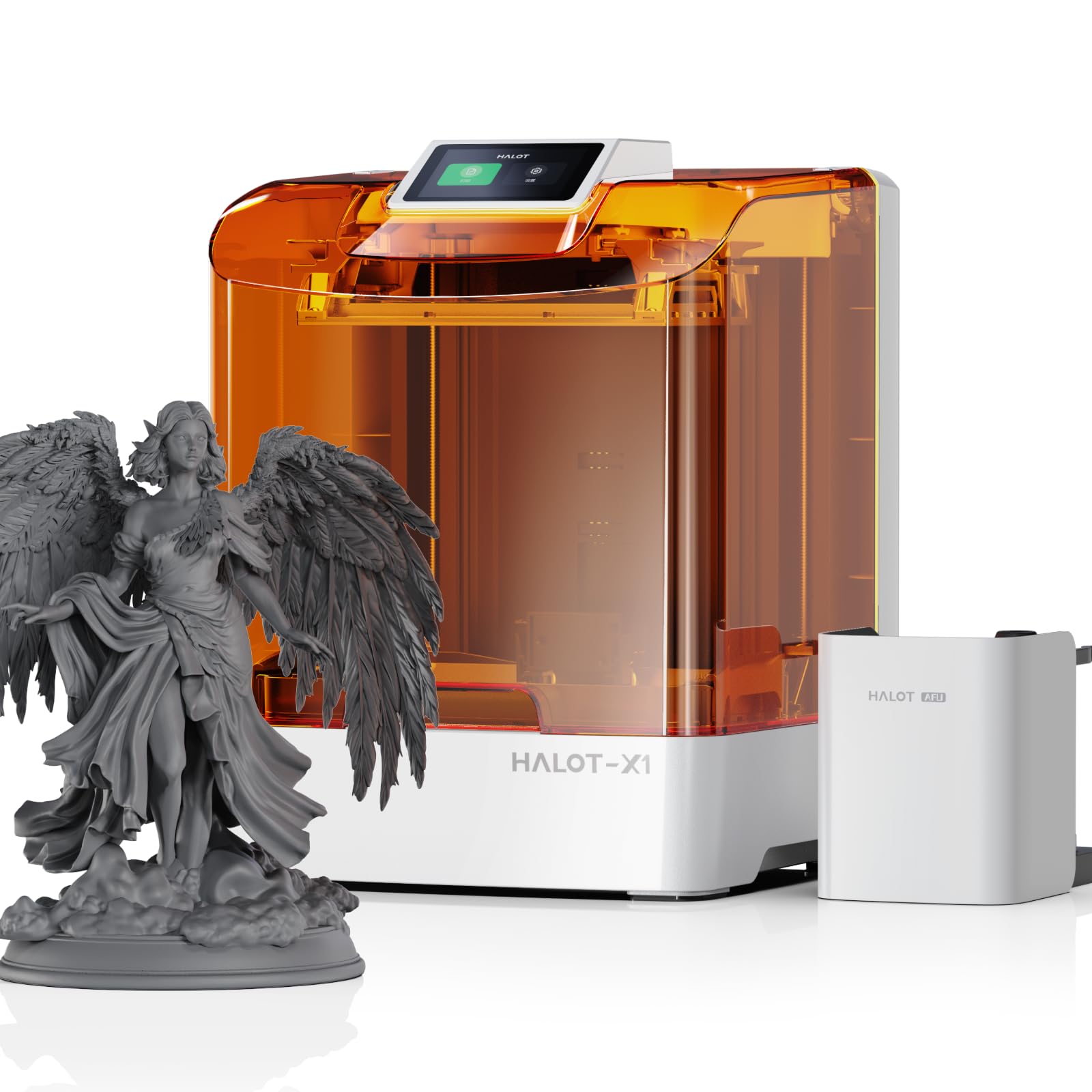
The Halot-X1 Combo pushes the upper boundary of consumer resin printing with a 10.1-inch 16K mono LCD screen. The 14 × 19 μm pixel size creates prints that look clean under a magnifying loupe — essential for dental models and museum-grade miniatures. Creality also integrated an Intelligent AFU Resin Management System that heats the resin to between 30 and 45°C in three minutes, automatically loading material parameters via RFID tags on compatible bottles.
What makes this printer stand out for miniature enthusiasts is the structural innovation: the build plate remains stationary while the optical module and vat move vertically. This design eliminates the common issue of Z-wobble on tall models like spears or wizard staves, achieving 0.01 mm positioning precision. The twist-to-release build plate also means no scraping, which protects your freshly printed bases from accidental gouges.
The 92 independent light zones only activate UV LEDs where the model sits on the screen, extending the LCD lifespan by avoiding unnecessary exposure on empty screen areas. Some users have reported that the Halot Box slicing software crashes during complex slicing operations, but once you switch to a third-party slicer like Lychee or Chitubox, the printer delivers outstanding results. The build volume of 8.33 by 4.66 by 7.87 inches is generous for a mid-premium printer.
Why it’s great
- 16K screen at 14 μm XY makes it the sharpest consumer-grade option
- Smart resin heating reduces viscosity failures in cold environments
- Stationary build plate eliminates Z-wobble on tall prints
Good to know
- Proprietary Halot Box slicer can crash; prefer Lychee or Chitubox
- Heavy unit at 37.4 pounds needs a sturdy table
3. Creality Halot Mage S 14K

The Halot Mage S 14K is Creality’s answer to the demand for larger miniatures without sacrificing resolution. Its 10.1-inch 14K screen (13320 × 5120 pixels) delivers a 16.8 × 24.8 μm pixel size, and the large print area of 8.78 by 4.96 by 9.06 inches can accommodate a fully assembled dreadnought or a full squad of 10 infantry models in a single run. The Dynax+ mode pushes print speed to 150 mm/h using a closed-loop motor and dual linear rails.
Creality’s Integral Light Source 3.0 uses Fresnel lenses to achieve uniform UV distribution, so each layer cures at the same rate across the entire build plate. A laser-carved build plate offers aggressive adhesion for the first few layers, which is crucial when printing large-diameter parts that generate strong peel forces. The Pictor speed-release film reduces peel force by 35%, further boosting success rates.
The printer runs the Halot OS, which supports remote printing via phone or PC and integrates with Creality Cloud for model libraries. An included air purifier with an activated carbon filter helps manage the odor of photopolymer resin. Some users have reported screen spotting after six months of heavy use, and replacement screens cost nearly as much as a new printer, so this purchase is best for users who value short-term speed and detail over long-term consumable costs.
Why it’s great
- Large build volume fits full squads or large single models
- Dynax+ mode prints a 15 cm tall model in about one hour
- Free 3-month Chitubox PRO membership included
Good to know
- Screen replacements are expensive, near the cost of a new budget printer
- Some users report screen spotting after months of use
4. Flashforge Adventurer 5M Pro

The Flashforge Adventurer 5M Pro is an FDM printer, not a resin printer, but it deserves a mention for miniature painting enthusiasts who prefer filament over messy resin. The Core XY all-metal structure allows 600 mm/s travel speed with 20,000 mm/s² acceleration, making it one of the fastest entry-level FDM printers available. The nozzle heats to 200°C in 35 seconds, and the detachable 0.25 mm nozzle option can produce layer lines fine enough for tabletop-ready miniatures.
The printer includes pressure sensing auto leveling, a dual-sided PEI build plate, and a fully enclosed body with a dual circulation filtration system to reduce dust and fumes. The Flash Maker mobile app supports remote monitoring, real-time progress tracking, and filament detection with auto shutdown. The print volume is a standard 220 × 220 × 220 mm, sufficient for terrain tiles and large vehicle hulls.
Beginners will appreciate the 10-minute unbox-to-print experience, but the FlashPrint 5 software can be finicky on macOS, requiring an older Mac for the initial setup. The printer supports PLA, ABS, PETG, TPU, and composite filaments like PLA-CF, giving you material flexibility that resin cannot match. However, FDM layer lines will always be visible at 0.1 mm layer height, so resin remains the superior choice for character detail.
Why it’s great
- Enclosed design with HEPA filtration reduces fume exposure
- 0.25 mm nozzle option allows finer detail than standard FDM printers
- Core XY structure provides stability for fast printing
Good to know
- FDM layer lines are visible; resin printers produce smoother surfaces
- Software installation can be problematic on newer macOS versions
5. ANYCUBIC Photon Mono 4 Ultra 10K

The Photon Mono 4 Ultra is the best entry point into high-resolution miniature printing without overspending. Its 7-inch 10K monochrome screen packs a 9024 × 5120 resolution with a pixel pitch of only 17 × 17 μm — a phenomenal number at this price bracket. The XY resolution is effectively the same as many 14K screens because the smaller screen compresses the same number of pixels into a tighter area, meaning you get elite detail on a compact build plate of 6.04 by 3.42 by 6.49 inches.
Anydrop uses a new-generation ACF film combined with an Intelligent Release Algorithm to hit 120 mm/h printing speeds. The COB light source with Fresnel lenses ensures light angle stays within 3°, eliminating stray light that would otherwise soften edges. Five intelligent detection systems cover auto-inspection, residual resin detection, leftover resin monitoring, failed print detection, and release film lifespan management.
Users highlight the easy setup and excellent print quality for the price, though several mention that resin odor is strong and recommend adding an enclosure with a filter. The FEP film is fragile, so take care when removing prints or buy pre-mounted replacement film sets. The 4.3-inch touchscreen UI is simple and supports eight languages, making this a truly beginner-friendly machine that still produces display-quality 28mm infantry models.
Why it’s great
- 17×17 μm pixel size matches printers costing twice as much
- Fast 120 mm/h speed with ACF film reduces print times
- Five smart detection systems simplify troubleshooting
Good to know
- Build plate is smaller than mid-range options; limits batch size
- Strong resin odor; an enclosure with filtration is recommended
6. ELEGOO Mars 5 Ultra 9K

ELEGOO’s Mars 5 Ultra integrates an AI camera and smart mechanical sensor to detect printing issues in real time — an invaluable feature for miniatures that require delicate support structures. The 9K LCD screen (8520 × 4320 pixels) delivers 18 × 18 μm XY resolution, and the Tilt Release Innovation reduces Z-axis movement to achieve up to 150 mm/h print speed. The build plate size of 6.04 by 3.06 by 6.49 inches is compact but sufficient for standard infantry and small monsters.
The AI camera monitors the build plate for empty prints and model warping, sending alerts to your phone via WiFi. WiFi cluster printing lets you manage multiple printers on the same LAN, useful for commission painters running a small print farm. The printer supports both 2.4G and 5G networks for reliable file transfer and OTA firmware upgrades.
For miniature painters, the Mars 5 Ultra produces clean, crisp models out of the box, but resin and build plate temperature are critical — one reviewer noted that a 67°F room caused adhesion failures until they preheated both. The Chitubox slicer has a learning curve, but once dialed in, the printer delivers Warhammer-compatible quality. Some users report that light supports struggle under heavy parts, requiring denser support structures for large objects.
Why it’s great
- AI camera provides real-time failure detection and time-lapse recording
- Tilt Release Innovation enables faster print cycles
- WiFi cluster printing scales well for multiple machines
Good to know
- Cold environments below 70°F require active resin and plate heating
- Light supports may fail on larger models without reinforcement
7. Phrozen Sonic Mini 8K S

The Phrozen Sonic Mini 8K S is the definitive gateway printer for resin miniatures. It offers a 7.1-inch 8K monochrome LCD with a 22 μm XY resolution — not the absolute sharpest on this list, but more than enough to reveal the texture on a scale mail coat and the eye sockets of a skeleton warrior. The build volume of 6.5 by 2.8 by 6.7 inches is tight, but ideal for single character models or small diorama bases.
Phrozen designed this printer for reliability with a precise Z-axis calibration that ensures even layers from the first to the last. The printer works with open-source slicers like Lychee, Chitubox, and Tango, so you are not locked into proprietary software. The compact footprint (11.4 × 11.4 × 16.9 inches) fits on a standard desk without requiring permanent installation.
Users consistently call this printer a workhorse for its reliability and value. The included build plate is durable but the included scraper is metal and bent during first-use pressure, damaging the plate — handle the scraper gently or buy a plastic spatula. One limitation is that file transfer requires a USB stick; there is no WiFi or network printing. For beginners who want to start printing high-quality miniatures today without breaking the bank, the Sonic Mini 8K S is a safe choice.
Why it’s great
- 22 μm XY resolution produces clean miniature details
- Open-source slicer compatibility avoids software lock-in
- Compact and reliable, ideal for beginners
Good to know
- No WiFi printing; files must be transferred via USB
- Metal scraper can damage the build plate if used with force
8. Phrozen Sonic Mega 8K S

The Sonic Mega 8K S is designed for production volume, not casual hobby printing. Its 15-inch 8K mono LCD delivers a 43 μm XY resolution — less sharp than smaller screens, but acceptable for 28mm miniatures at tabletop viewing distance. The massive build plate of 12.99 by 7.28 by 11.81 inches can batch-print 80 1/32 scale miniatures in under 90 minutes, making it ideal for professional studios fulfilling army commissions.
Phrozen integrates ACF film with TR300 High-Speed Resin to hit print speeds up to ten times faster than standard mid-size printers. The lift-up lid design minimizes the clearance required for operation, fitting into tight workshop corners. A built-in metal drip hanger lets excess resin flow back into the vat, reducing waste and mess during post-processing.
While the Mega 8K S is a beast for output, it has notable compromises. The 43 μm pixel size means fine details like engraved runes or eyelashes will be less defined compared to a 22 μm screen. The auto-fill mechanism does not always work reliably, and the large build plate cannot accommodate a flex plate due to its hole pattern. Some users have reported LCD ribbon cable failures after minor movement, and power supply issues after extended use. This printer is a serious investment for users who need batch quantity over single-model perfection.
Why it’s great
- Enormous build plate prints 80 models per batch for commercial output
- ACF film and high-speed resin deliver up to 10x faster printing
- Drip hanger reduces resin waste and cleanup time
Good to know
- 43 μm XY resolution is less detailed than smaller screens
- Auto-fill mechanism can be unreliable in practice
9. ELEGOO Jupiter 2 16K
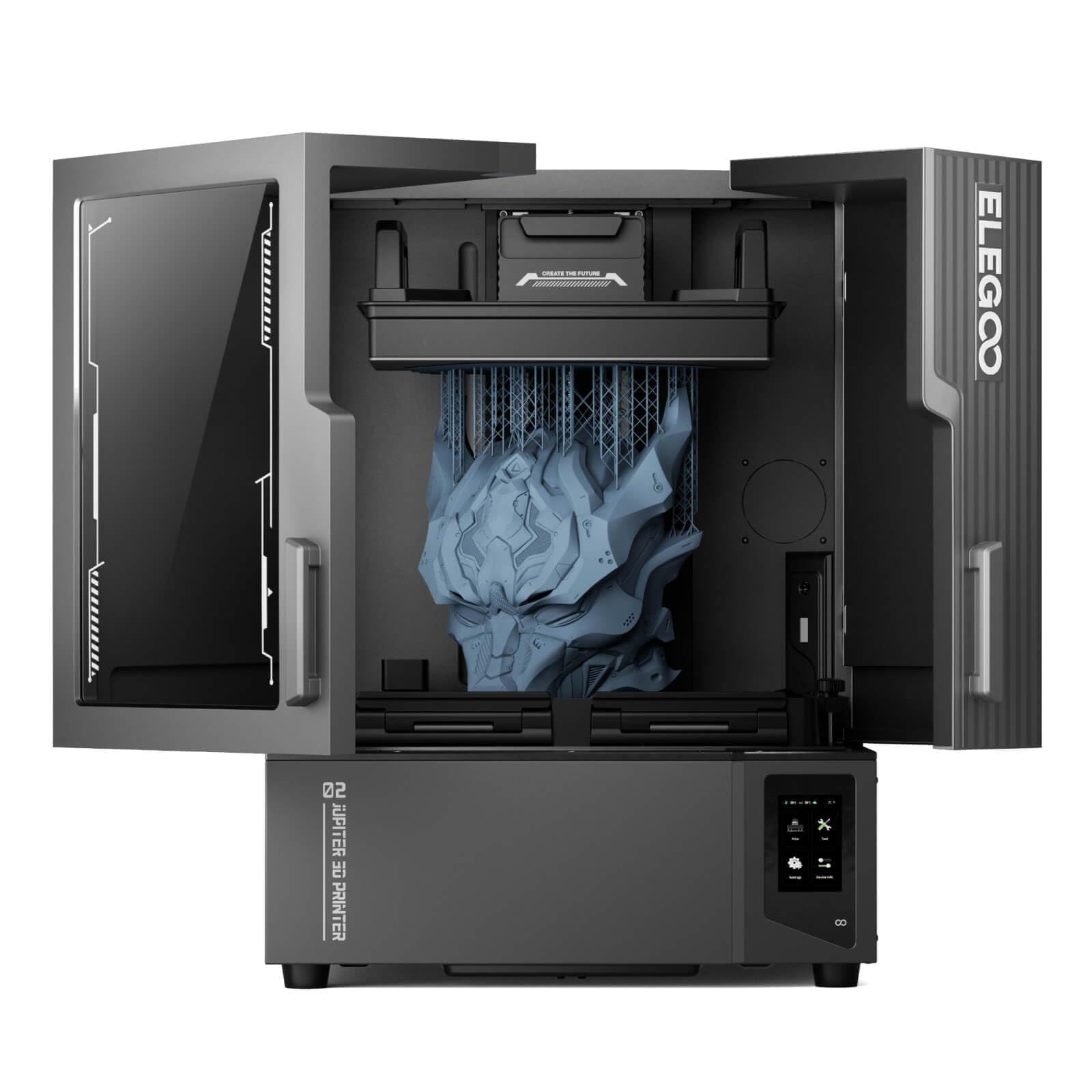
The Jupiter 2 is ELEGOO’s flagship large-format resin printer with a 16K screen (15120 × 6230 resolution) and a massive build volume of 302.4 by 161.98 by 300 mm — 2.5 times larger than the Saturn 4. The XY resolution of 20 × 26 μm is impressive for a printer of this scale, allowing full-sized busts, diorama terrain, and multiple squads to print in a single run without sacrificing the fidelity of individual faces or pauldron insignias.
The fully enclosed light source eliminates light leaks, ensuring uniform exposure across the enormous build plate. Multi-point auto leveling, smart tank heating that maintains a precise 30°C, and an automated resin feed system keep the printer running through long batches unattended. A built-in resin drip tray and tool-less quick-swap release film make maintenance manageable despite the size.
Current owners praise the Jupiter 2 as the best large-format printer currently available, with durable LEDs and beautiful detail at scale. The printer prioritizes quality over speed, so print times for full build-plate batches are longer compared to smaller units. It is not recommended for beginners due to the scale of troubleshooting and the increased resin cost per failed print. Users also note that the carbon filter is nearly useless, and many pair it with a separate exhaust system for fume management.
Why it’s great
- 16K resolution on a large format produces elite detail at scale
- Automated resin feed and tank heating enable unattended long prints
- Tool-free quick-swap film reduces downtime
Good to know
- Heavy at 63.8 pounds; requires a dedicated sturdy table
- Carbon filter is ineffective; an external exhaust is recommended
FAQ
What is the best XY resolution for printing 28mm miniatures?
Do I need a heated resin vat for miniature printing?
Can I print Warhammer-scale miniatures on a budget resin printer?
How does build plate size affect miniature printing workflow?
What is ACF film and why does it matter for miniatures?
Final Thoughts: The Verdict
For most users, the best 3d resin printer for miniatures winner is the ANYCUBIC Photon Mono M7 Pro because it delivers a 14K screen with 16.8×24.8 μm pixels, a heated vat for consistent adhesion, and 170 mm/h speed in a build plate large enough for squad printing. If you want the absolute highest resolution for display-grade single models, grab the Creality Halot-X1 Combo. And for batch production or large terrain pieces on a budget, nothing beats the value of the ANYCUBIC Photon Mono 4 Ultra.