
Hitting a steel bearing or punch with a hammer is noisy, imprecise, and risky—one glancing blow can mar the workpiece or send a tool flying. An arbor press replaces that uncontrolled impact with a slow, powerful, perfectly vertical squeeze, giving you repeatable results for riveting, stamping, bending, and bearing installation. The choice, however, comes down to frame rigidity, tonnage, and how much slop the rack-and-pinion mechanism allows.
I’m Min — the co-founder and writer behind Gadgets Feed. I’ve spent countless hours analyzing the construction, gear precision, and real-word torque capacities of arbor presses to separate the tight, long-lasting models from the ones that wobble under load.
This guide evaluates nine models ranging from compact 1‑ton units to heavy 3‑ton bench anchors, focusing on frame material, ram alignment, and throat depth to help you find the best arbor press for your shop, craft bench, or dental lab.
How To Choose The Best Arbor Press
Picking the right arbor press isn’t just about how many tons it claims on the box. You need to match the press’s mechanical leverage, frame material, ram travel, and anvil adjustability to the specific tasks you perform most often—whether that’s pressing bearings for a motorcycle swing‑arm or stamping leather belts. Below are the critical factors to weigh before you bolt one to your bench.
Frame Material & Rigidity
Cast‑iron frames dampen vibration and resist flexing under heavy loads better than welded steel plate, especially during repetitive pressing. The trade‑off is weight: a 1‑ton cast‑iron press can weigh 25–35 lbs, while a steel‑frame unit of the same rating may be 10‑15 lbs lighter. Check for thick web sections around the throat—thin castings can crack if you habitually use a cheater bar on the handle.
Leverage Ratio & Handle Design
The lever‑ratio (often 20:1 on common 1‑ton models) determines how much force your arm actually delivers to the ram. A higher ratio lets you apply more pressure with less effort, but also increases the length of each handle stroke. Some presses include a second, shorter handle for quicker alignment before the final press—this speeds up workflow considerably if you’re doing high‑volume stamping.
Ram Alignment & Side‑to‑Side Play
Even a minor wobble in the ram will produce off‑center force, bending pins or marring dies. The best presses use a gib (an adjustable wear strip) that lets you tighten the fit as the ram and frame bed in over years of use. Budget models often omit gibs and rely only on set‑screws, which can loosen and cause slop that is difficult to dial out completely.
Quick Comparison
On smaller screens, swipe sideways to see the full table.
| Model | Category | Best For | Key Spec | Amazon |
|---|---|---|---|---|
| KAKA INDUSTRIAL AP-2S | 2-Ton Steel | Repeated medium‑duty bearing work | 4,400 lbs force, 35 lbs weight | Amazon |
| HHIP 8600-0033 | 2-Ton Cast Iron | Precision press‑fit & broaching | 8.47″ max height, 12″ work dia | Amazon |
| VEVOR 3‑Ton | 3-Ton Cast Iron | Heavy stamping & forming | 12.2″ stroke, 86 lbs | Amazon |
| KAKA INDUSTRIAL AP-1 | 1-Ton Steel | Compact hobbyist bench | 2,200 lbs force, 4″ height | Amazon |
| PALMGREN 9661101 | 1-Ton Steel | Leather stamping & alignment work | Depth stop, dual‑handle option | Amazon |
| HHIP 8600-0032 | 1-Ton Cast Iron | Long‑term durability on light tasks | Cast‑iron frame, 24 lbs | Amazon |
| NOOBECR / Central Machinery | 1-Ton Metal | Budget bearing pressing | 20:1 leverage, 5.5″ height | Amazon |
| PNBO 1 Ton | 1-Ton Cast Iron | Leather craft & light riveting | Ratchet handle, 5.5″ height | Amazon |
| JET JWDP-12 | Drill Press | Rotary drilling & boring (not pressing) | Variable speed 530–3,100 RPM | Amazon |
In‑Depth Reviews
1. KAKA INDUSTRIAL AP-2S
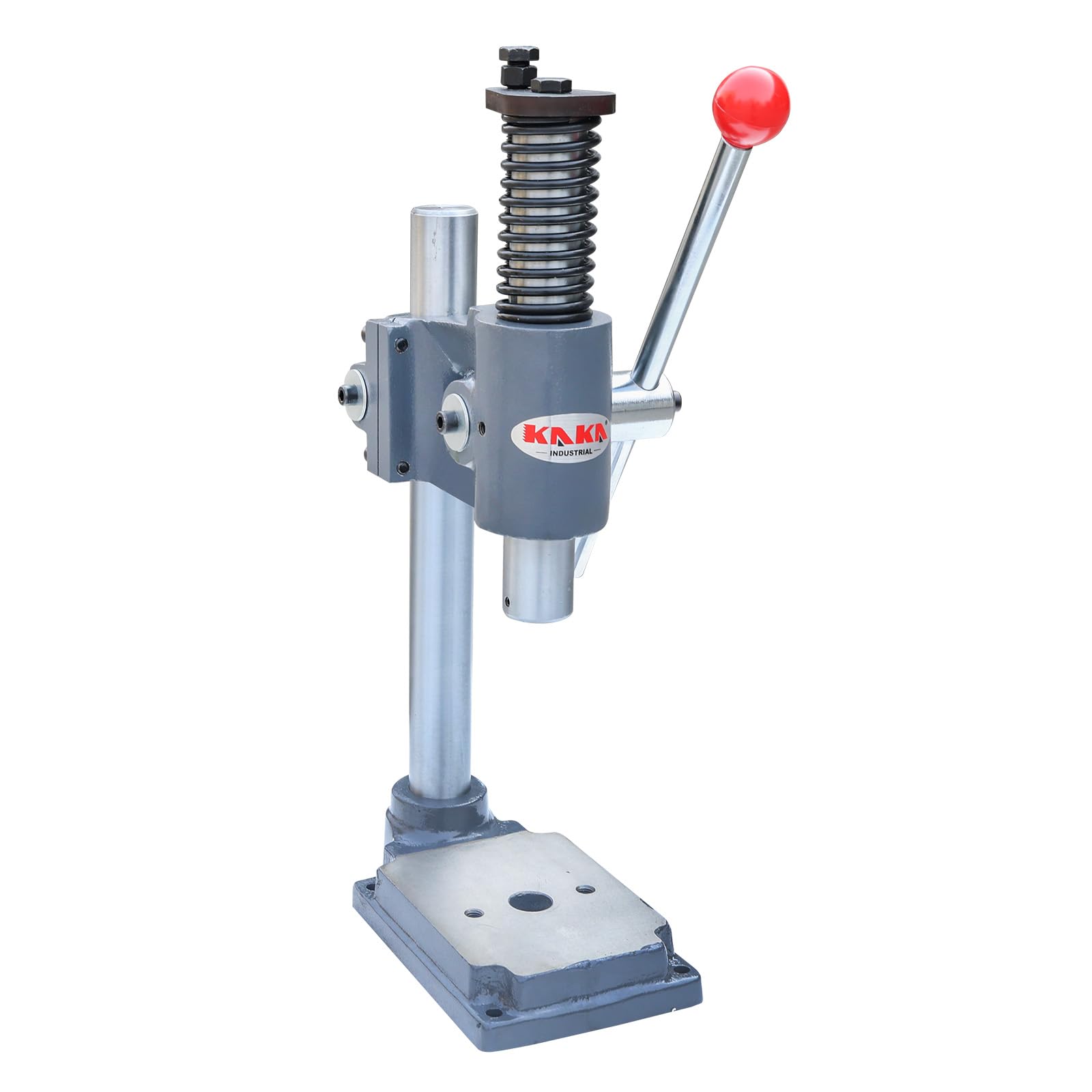
The KAKA AP-2S delivers 4,400 lbs of pressing force through a steel frame that feels noticeably stiffer than the cast‑iron alternatives in the same tonnage class. Its adjustable ram height reaches up to 8 inches, which is generous for a bench‑top press—you can fit tall bushings or stacked dies without removing the work support. The lever action is smooth, and the compact footprint (15 by 6 inches) leaves room for other tools on crowded workbenches.
Users in dental and jewelry labs report using this press daily for precise blanking and forming, with no detectable ram wobble after months of service. The manual lever gives you tactile control that a hydraulic press cannot match, making it suitable for thin‑wall components where a sudden surge of force would cause deformation. The base mounting holes line up with standard bench bolt patterns, so installation is straightforward with a drill and a wrench.
One recurring note in customer feedback is the absence of detailed written instructions—the included diagram is adequate for mechanical assembly but does not cover adjustment of the ram gib. Owners who took the time to clean and lightly grease the rack saw a marked improvement in smoothness. For shops that need a mid‑range press that bridges hobbyist and light‑industrial demands, the AP-2S provides the best combination of force, adjustability, and build consistency.
Why it’s great
- Full 2‑ton capacity with a rigid steel frame
- 8‑inch height accommodates large workpieces
- Compact bench footprint
Good to know
- No printed step‑by‑step assembly guide
- Factory grease may be thick—recommend cleaning before first use
2. HHIP 8600-0033

The HHIP 8600-0033 employs a heavy cast‑iron frame that soaks up vibration and keeps the ram tracking straight under the full 2‑ton load. With a maximum work height of 8.47 inches and a 12‑inch work diameter, it handles tasks like broaching keyways and pressing large sealed bearings that smaller 1‑ton models simply cannot reach. The four‑position steel anvil rotates to four different heights, giving you quick adjustment without shimming.
Precision‑cut steel pinions engage the rack with minimal backlash, which translates to predictable ram travel—critical when you are pressing a bearing onto a shaft that must seat at a specific depth. The bench‑mountable base measures 16 by 6 inches with pre‑drilled holes, and the 20 by 20 inch overall footprint fits a typical garage bench. Owners note that the finish is clean, with no sharp edges on the anvil plate, and the paint resists chipping during heavy use.
The main downside reported by users is the comically bad instruction sheet (one warning mentions not to abuse the power cord on a manual press). Assembly is intuitive for anyone mechanically inclined, but first‑time press buyers should reference a YouTube video for the gear sleeve alignment. If you need a durable 2‑ton press that will outlive its owner and handle professional tool‑room duty, the HHIP 8600-0033 is a solid investment.
Why it’s great
- Massive cast‑iron frame for stability
- 4‑position anvil for fast height changes
- Smooth rack‑and‑pinion with minimal slop
Good to know
- Assembly instructions are borderline useless
- Heavy—plan for a sturdy bench location
3. VEVOR 3‑Ton Arbor Press

The VEVOR 3‑Ton is the highest‑capacity press in this lineup, with an enormous 12.2‑inch stroke that suits forming operations on sheet metal, aluminum, and thick leather stacks. It comes with three molds (flat, pointed, and round drifts) that cover basic deformation and extrusion tasks right out of the box. The lengthening lever uses a labor‑saving principle that lets you apply the full 6,000 lbs of force without excessive handle effort.
Build quality is typical for the value tier: the cast‑iron body is robust, but the factory packs it in heavy grease to prevent rust during shipping. Multiple user reports mention that the ram and gears require a full degreasing and re‑lubrication before the press operates smoothly. A few owners noted that the ram‑to‑base alignment was slightly off and needed shimming—a common issue on budget‑priced arbor presses that more expensive units correct with adjustable gibs.
For occasional shop use where the sheer tonnage and long stroke matter more than precision down to the thousandth of an inch, the VEVOR 3‑Ton delivers undeniable value. Those performing high‑volume, tight‑tolerance work should budget an afternoon for cleaning, adjusting, and perhaps adding a shim or gib to dial out the runout. After that setup, the press performs well for heavy stamping, jewelry forming, and small forging operations.
Why it’s great
- Highest 3‑ton capacity with 12.2‑inch stroke
- Three drifts included for immediate use
- Labor‑saving lever reduces effort
Good to know
- Heavily greased from factory—needs thorough cleaning
- Ram alignment may require minor shimming
4. KAKA INDUSTRIAL AP-1

KAKA’s AP-1 is a 1‑ton press built from a sturdy steel body that strikes a solid balance between portability (33 lbs) and rigidity. The maximum height under the ram is 4 inches, which is sufficient for most small bearing press‑fit jobs, leather stamping, and light metal bending. The four‑position adjustable plate provides versatility for different workpiece heights, and the base dimensions (10.5 by 7.5 inches) fit easily on any workbench.
Customer feedback from dental lab technicians and leathercrafters is overwhelmingly positive, with several users noting that the press operates far more smoothly than they expected at this price point. The gear sleeve and rack engage with a satisfyingly tight mesh, and the paint finish resists chipping even when tools are dragged across the anvil. Assembly requires a hex key set and a wrench, neither of which is supplied, so plan accordingly before opening the box.
The biggest knock against the AP-1 is the lack of printed instructions beyond a basic diagram. A small number of units have arrived with surface rust or minor scratches suggesting returns, but KAKA’s restocking fee can make returns painful. For buyers who want a dependable 1‑ton press for hobbyist through light‑professional use, the AP-1 offers better build quality than generic imports for a modest premium.
Why it’s great
- Sturdy steel frame with good rigidity
- Four‑position adjustable anvil
- Smooth gear mesh out of the box
Good to know
- No tools or detailed instructions included
- Some units show signs of prior return/rust
5. PALMGREN 9661101 1‑Ton

The Palmgren 1‑Ton stands out for its integrated depth stop, a feature that lets you set a precise ram travel limit for repetitive stamping and riveting. Leathercrafters and jewelers appreciate the ability to lock the stroke length so every impression is identical without eyeballing the handle position. The press comes with a side handle for easy alignment before applying force, reducing the fumbling that slows down production work.
Initial out‑of‑box impressions are excellent: the finish is well‑applied, the ram surfaces are smooth, and the frame feels dense. However, multiple owners advise disassembling, cleaning the factory grease, and re‑lubricating with a quality grease to achieve optimum smoothness. A common mod is to add a thin brass strip behind the faceplate to improve friction bolt grip—a minor tweak that eliminates any wobble that develops over time.
Palmgren also offers a free pair of curved jaw pliers upon warranty registration, a nice bonus that speaks to their customer‑service approach. The only functional limitation is that the ram ships installed upside down (flat end facing down), so if you need the pointed end for punching, you will have to flip it during assembly. For precise, repeatable 1‑ton work where depth control matters, the Palmgren is a cut above the commodity presses.
Why it’s great
- Adjustable depth stop for repeatable strokes
- Side handle speeds alignment
- High fit‑and‑finish with good customer support
Good to know
- Needs cleaning and re‑greasing on arrival
- Ram orientation may need flipping depending on intended use
6. HHIP 8600-0032 1‑Ton
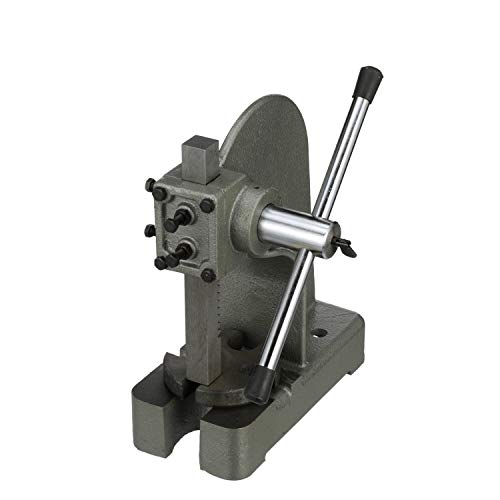
The HHIP 8600-0032 is a classic cast‑iron 1‑ton press that many owners describe as a “buy it for life” tool. The heavy‑duty frame weighs 24 lbs and provides excellent vibration damping, making it suitable for bench‑top work where noise and tool movement are concerns. The four‑position steel anvil offers flexibility for different workpiece heights, and the steel pinions provide smooth engagement throughout the ram’s travel.
Users report using this press for everything from bending silverware for jewelry to replacing scroll‑saw needle bearings, and the consistent feedback is that it exceeds expectations for the price. The anvil plate is slotted for various applications, and the ram bore accepts standard dies without modification. The cast‑iron construction does a good job of absorbing side loads if you occasionally apply off‑center pressure—a mistake that would bend a lighter steel frame.
The instructions are famously bad (mentioning a power cord for a manual press), but assembly is straightforward for anyone with basic mechanical sense. Some units have arrived with minor cosmetic blemishes or missing hardware, but HHIP’s customer service is generally responsive. If you want a no‑nonsense 1‑ton press that will still be working for your grandkids, the HHIP 8600-0032 is a worthy choice.
Why it’s great
- Cast‑iron frame absorbs vibration effectively
- Four‑position anvil for height variation
- Simple, long‑lasting design
Good to know
- Instructions are comically poor
- May require sourcing replacement hardware in rare cases
7. NOOBECR / Central Machinery 1‑Ton
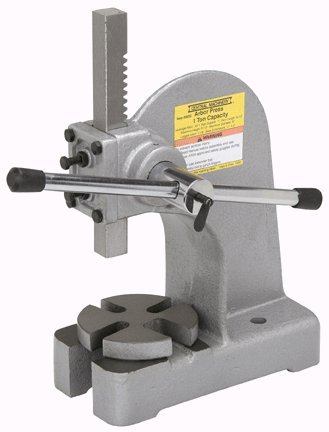
The Central Machinery 1‑Ton press (sold under the NOOBECR and Harbor Freight brands) is one of the most widely owned entry‑level arbor presses. Its 20:1 leverage ratio makes pressing bearings and bending small parts relatively effortless, and the 5.5‑inch maximum height is adequate for most small automotive and jewelry tasks. The grey metal finish is utilitarian, and the overall weight is light enough to move between benches without a hoist.
User satisfaction is high for the price, with many buyers remarking that it does exactly what an arbor press should do—apply controlled vertical force. The design requires being bolted down to prevent tipping during heavy presses, and the base’s fixing holes make this straightforward. Some users note that the same press is available for less at Harbor Freight if you have one locally, so consider shipping cost when purchasing online.
Fit and finish are basic: the paint is thin, and the rack teeth may have slight burs from the casting process that can be cleaned up with a file. A few owners have reported that the handle threads can strip if overtightened, so use hand‑tight plus a quarter turn. For a first arbor press or an occasional‑use tool, the Central Machinery unit delivers reliable service at a budget‑friendly price point.
Why it’s great
- Excellent 20:1 leverage reduces effort
- Light weight and easy to mount
- Low cost of entry for occasional users
Good to know
- Must be bolted down to stay stable
- Basic finish and potential for casting burs
8. PNBO 1‑Ton Arbor Press

The PNBO 1‑Ton arbor press targets leatherworkers and light craft users who need precise control for stamping and riveting. It includes a handwheel alongside the main handle, giving you fine height adjustment before applying full leveraged force. The cast‑iron body weighs about 25 lbs and feels solid on the bench, with four base‑fixing holes for permanent mounting.
Leathercrafters have praised this press for making stamping patterns consistent—a task that is tedious and error‑prone with a mallet. The 5.5‑inch maximum height accommodates stacked stamps and medium‑thickness leather pieces. The movable machined steel anvil provides accurate support at four slot positions, and the anvil plate is slotted for various applications, including die cutting and light forming of thin metal sheet.
The most significant criticism from owners is that the press does not actually ratchet, despite “Ratchet Leverage Press” appearing in the title. The mechanism operates as a standard rack‑and‑pinion press without a true ratcheting function. This was confusing to several buyers who expected incremental advancement of the ram. If you are not specifically seeking a ratchet mechanism, the PNBO press performs well as a simple manual press at a very competitive price.
Why it’s great
- Includes handwheel for fine height adjustment
- Cast‑iron body provides good stability
- Well‑suited for leather stamping and light riveting
Good to know
- Misleading “ratchet” claim—does not actually ratchet
- Mounting requires clamps or drilling
9. JET JWDP-12 Drill Press

The JET JWDP-12 is not an arbor press—it is a 12‑inch benchtop drill press with variable speed from 530 to 3,100 RPM. It appears in this guide as a high‑price outlier and serves as an important reminder of category distinction. Unlike an arbor press, which applies controlled static force for pressing, this tool rotates a cutting bit to remove material. It cannot press a bearing onto a shaft or stamp a leather pattern.
The JET is a well‑regarded drill press with a cast‑iron base, XACTA laser for accuracy, and an LED work light. Users praise its minimal runout and smooth speed adjustment on the fly. It is ideal for woodworking, metal drilling, and any task requiring a precisely located, rotating hole. The quill travel is crisp, and the depth stop is reliable for repetitive drilling to a fixed depth.
If you need to drill accurate holes, the JET JWDP-12 is an excellent choice. If you need to press bearings, rivets, or stamps, you need an arbor press. This listing highlights why it is vital to match the tool to the job: a drill press and an arbor press look similar but perform fundamentally different operations. Do not purchase this expecting it to replace a 1‑ton or 2‑ton arbor press.
Why it’s great
- Smooth variable‑speed motor (530–3,100 RPM)
- XACTA laser for precise hole positioning
- Cast‑iron build with minimal runout
Good to know
- This is a drill press, NOT an arbor press
- Cannot be used for pressing bearings or stamping—wrong tool for those jobs
FAQ
What does the tonnage rating on an arbor press actually mean?
Can I use a cheater bar on an arbor press handle for more force?
Why does my arbor press handle not stay in position when I release it?
Do arbor presses need lubrication, and if so, how often?
Final Thoughts: The Verdict
For most users, the best arbor press is the KAKA INDUSTRIAL AP-2S because its 2‑ton capacity, rigid steel frame, and 8‑inch adjustability cover the widest range of garage and workshop tasks without breaking the bank. If you need the brute force of a 3‑ton machine for heavy forming work, the VEVOR 3‑Ton delivers that power, though it requires careful setup. And for hobbyists who prioritize a depth stop and smooth feel for leather stamping, the PALMGREN 9661101 offers unmatched control in the 1‑ton class.