
True 5.1 surround sound on a desktop isn’t just about more speakers; it’s about creating a precise audio bubble that drops you directly into the action, whether you’re tracking a footstep in a competitive shooter or feeling the rumble of an explosion in a blockbuster movie. The challenge is finding a system that balances physical driver quality, amplifier power, and spatial imaging without overwhelming your workspace.
I’m Min — the co-founder and writer behind Gadgets Feed. I’ve analyzed dozens of these systems, dissecting specs like subwoofer cone size, satellite driver materials, and amplification topologies to separate true surround solutions from mere stereo-fillers.
After reviewing the market, this guide cuts through the noise to help you find the best 5.1 desktop speakers that deliver immersive, room-filling audio from a single USB connection or a dedicated receiver setup.
How To Choose The Best 5.1 Desktop Speakers
Selecting a 5.1 system for your desk requires balancing a few key pillars. You aren’t just buying speakers; you are buying a soundstage architecture. The core factors to weigh are the true nature of the surround signal, the power and size of the subwoofer, the build quality of the satellite drivers, and the connectivity matrix that ties it all to your PC or console.
True 5.1 vs. Virtualization and Upmixing
The most critical distinction is whether the system processes a discrete 5.1 audio stream or if it relies on virtual surround processing. Systems like the SteelSeries Arena 9 use a single USB connection to deliver discrete 5.1 channels from your PC, positioning sounds accurately in 3D space. Many soundbar-based solutions or cheaper kits often use stereo upmixing to fool the rear speakers into firing, which can create a diffuse, less accurate sound field. For competitive gaming and critical movie watching, a discrete 5.1 path is non-negotiable.
Subwoofer Performance and Placement
The ‘0.1’ channel is the foundation of the experience. An 8-inch subwoofer, like those found in the Monoprice and Bobtot systems, can move more air and produce deeper bass (down to 40-50 Hz) compared to a 5.25-inch or 6.5-inch driver. However, a larger sub isn’t always better for a desktop. A powerful 8-inch sub can easily overpower a small room, causing muddy bass. Look for adjustable crossover frequency and volume controls to tune the sub to your space. The amplifier wattage driving the sub is also key—a 60-watt RMS amp is adequate for near-field, while a 100-watt or higher amp provides more headroom and tighter control.
Satellite and Center Channel Driver Quality
The clarity of dialogue and the precision of directional cues depend on the satellite drivers. A center channel with two 3-inch mid-range cones, as seen on the Monoprice system, is ideal for clear vocal reproduction. For the satellites, look for systems that separate tweeter and woofer duties. 2-way designs with a dedicated silk dome tweeter (for high frequencies) and a paper or aluminum cone woofer (for mids) will deliver far more detail than a single full-range driver. The ADAM Audio D3V’s use of a ribbon tweeter and aluminum woofer is a standout example of high-end desktop sonic precision.
Connectivity and Control
Your setup dictates the required inputs. For a modern PC, a single USB connection that carries both audio data and power for 5.1 is the most elegant solution, as seen with the SteelSeries Arena 9. Older systems may require a separate AV receiver or a sound card with optical output. Systems like the Bobtot and HiPulse offer ARC and Optical inputs, making them more versatile for TV use alongside a PC. A dedicated control pod or remote for volume, bass, and input switching is a massive convenience, allowing you to adjust the audio profile without reaching behind the subwoofer.
Quick Comparison
On smaller screens, swipe sideways to see the full table.
| Model | Category | Best For | Key Spec | Amazon |
|---|---|---|---|---|
| SteelSeries Arena 9 | 5.1 Gaming | Discrete PC 5.1 Immersion | 6.5″ Sub & Wireless Satellites | Amazon |
| KRK RP5G5 Rokit 5 | Studio Monitors | Accurate Audio Production | 5″ Kevlar Woofer, Silk Tweeter | Amazon |
| Kanto ORA | Reference Desktop | Near-Field Reference Sound | 100W Bi-Amp, 3″ Woofer | Amazon |
| ADAM Audio D3V | Desktop Monitoring | Professional Mixing & Analysis | D-ART Ribbon Tweeter, 45Hz Extension | Amazon |
| Edifier QR65 | Desktop Active | Aesthetic & Tech Integration | 70W RMS, LDAC, 65W GaN Charging | Amazon |
| JBL C1 Pro | Passive Bookshelf | Modular High-Fidelity Setup | 150W Peak, 5.25″ Woofer | Amazon |
| Monoprice 5.1 System | Budget Modular | Entry-Level True 5.1 Setup | 8″ Sub, 125W Capable Satellites | Amazon |
| Bobtot 5.1/2.1 System | All-in-One 5.1 | Integrated Value & Versatility | 8″ Sub with Built-in Receiver | Amazon |
| HiPulse N512 | Soundbar 5.1.2 | Space-Saving Atmos-Like Sound | Solid Wood Cabinet, Up-Firing Drivers | Amazon |
In‑Depth Reviews
1. SteelSeries Arena 9 Illuminated 5.1 Desktop Gaming Speakers

The SteelSeries Arena 9 is the gold standard for a true 5.1 desktop experience, circumventing the need for a chunky AV receiver by delivering discrete surround sound over a single USB cable. Its 2-way satellite speakers, featuring dedicated silk dome tweeters and organic-fiber woofers, provide articulate mids and crisp highs that are a cut above typical gaming sets. The 6.5-inch subwoofer, while not the largest, produces tight, room-filling bass that is perfectly calibrated for near-field listening, and the wireless rear satellites eliminate the headache of running cables across the room.
The inclusion of a central control pod is a masterstroke for desktop ergonomics, offering instant access to volume, EQ presets, and source switching between USB, Bluetooth, and optical. The PrismSync RGB lighting on the front satellites adds a layer of immersive ambiance that can be customized to react to in-game events. For a pure PC or Mac gamer who wants authentic 5.1 positional audio without a complex setup, this system is the most complete and polished package on the market.
While the sound signature is neutral with a slight warmth, making it excellent for gaming and movies, it may not satisfy audiophiles looking for the last 5% of resolution for critical music listening. Users looking for deep, sub-30Hz bass for home theater applications will also want a more powerful sub. Despite these minor compromises in absolute peak fidelity, the Arena 9’s integration, ease of use, and genuine 5.1 performance make it the top choice for the majority of desktop users.
Why it’s great
- Delivers true discrete 5.1 over a single USB connection with excellent positional audio.
- Wireless rear satellites and a central control pod make for a clean, cable-free desktop setup.
- 2-way satellite design with silk dome tweeters provides far more detail than single-driver competitors.
Good to know
- The 6.5-inch subwoofer lacks the deep, chest-pounding extension for dedicated sub-bass enthusiasts.
- The exposed driver design on satellites offers no physical protection for the cones.
- The price point is premium, placing it firmly in the high-end of the desktop speaker market.
2. KRK RP5G5 ROKIT 5 Generation Five 5″ Powered Studio Monitor Pair

The KRK Rokit 5 G5s are a staple in project studios for good reason, and they translate that pedigree directly to a powerful desktop listening experience. The star of the show is the custom 5-inch Kevlar woofer, which provides incredibly tight and punchy bass definition, far exceeding the muddy output of many consumer speakers. Paired with a newly designed 1-inch silk dome tweeter, the G5s deliver a balanced, detailed soundstage that reveals layers in your music and precise cue placement in games, though you’ll need a separate amplifier or audio interface to drive them.
KRK has included a DSP-driven room tuning system that allows you to compensate for the specific acoustics of your desk placement, a feature that is exceptionally rare and valuable for a desktop setup. This lets you dial in the ideal frequency response, mitigating common issues like bass buildup near a wall. The included Iso-Foam isolation pads are a thoughtful addition, decoupling the monitors from the desk to reduce resonance and improve clarity. For audio production, mixing, or simply hearing your content with studio-grade accuracy, these monitors are in a league of their own.
The main hurdle is cost and complexity; these are passive speakers that require an external amplifier or audio interface, adding to the overall expense. The lack of Bluetooth or consumer-friendly features like a built-in volume knob on the front of each monitor can be a minor inconvenience. However, for the user who demands professional-level clarity and bass articulation, and who already has a DAC or audio interface, the KRK Rokit 5 G5s represent an unbeatable value on the path to a truly high-fidelity desktop system.
Why it’s great
- The 5-inch Kevlar woofer delivers incredibly tight, detailed bass response without distortion.
- DSP-driven room correction software allows precise acoustic tuning for near-field desk placement.
- Class-D amplification and included isolation pads enhance clarity and reduce unwanted resonance.
Good to know
- These are passive monitors, requiring a separate amplifier or audio interface to function.
- The price is high for just a pair, and a subwoofer is highly recommended for full-range 5.1 configuration.
- No Bluetooth or consumer-friendly connectivity; designed for professional XLR/TRS inputs.
3. Kanto ORA 100W Powered Reference Desktop Computer Speakers

The Kanto ORA redefines what is possible in a compact desktop speaker, packing a staggering 100 watts of bi-amplified, DSP-tuned power into a chassis barely larger than a soda can. It achieves this through a masterful blend of a 3-inch paper cone woofer and a 3/4-inch silk dome tweeter, producing a sound that is incredibly linear and detailed for its size. The bass response is shockingly full, and when you connect a subwoofer, a built-in 100Hz crossover automatically engages, allowing the ORAs to focus on vocals and highs while the sub handles the low-end, resulting in a seamless and powerful 2.1 system.
For desktop users, the connectivity is perfect: a standard USB-C connection delivers the best sound from a PC or Mac, while Bluetooth 5.0 and RCA inputs provide flexibility for other sources. The speakers are also magnetically shielded, meaning you can place them directly next to an older CRT monitor or a high-end PVM without any interference. This makes the ORA an exceptional choice for anyone who prioritizes sound quality and a clean, small-footprint setup, be it for a high-end gaming rig, a minimalist design studio, or a vintage arcade cabinet.
The main compromises are inherent to their size. The 3-inch woofers cannot physically move the air required for truly deep sub-bass, making a subwoofer an eventual necessity for many. The plastic enclosure, while well-built, can feel less premium than higher-end studio monitors, and the lack of an optical input limits some TV connectivity options. At its premium price point, the ORA competes on engineering and miniturization, making it the best choice for those who refuse to sacrifice desktop space for top-tier sound.
Why it’s great
- 100W of bi-amplified power in an incredibly compact form factor for desktop space saving.
- Seamless automatic 100Hz subwoofer crossover integration for a clear upgrade path to 2.1.
- Magnetically shielded drivers allow worry-free placement next to sensitive displays or audio gear.
Good to know
- The 3-inch woofers inherently lack deep sub-bass extension, making a subwoofer highly recommended.
- Plastic build quality may not suit users expecting a premium metal or wood enclosure at this price.
- The fixed 80Hz sub output crossover cannot be adjusted to suit different subwoofers perfectly.
4. ADAM Audio D3V Active Desktop Monitoring System
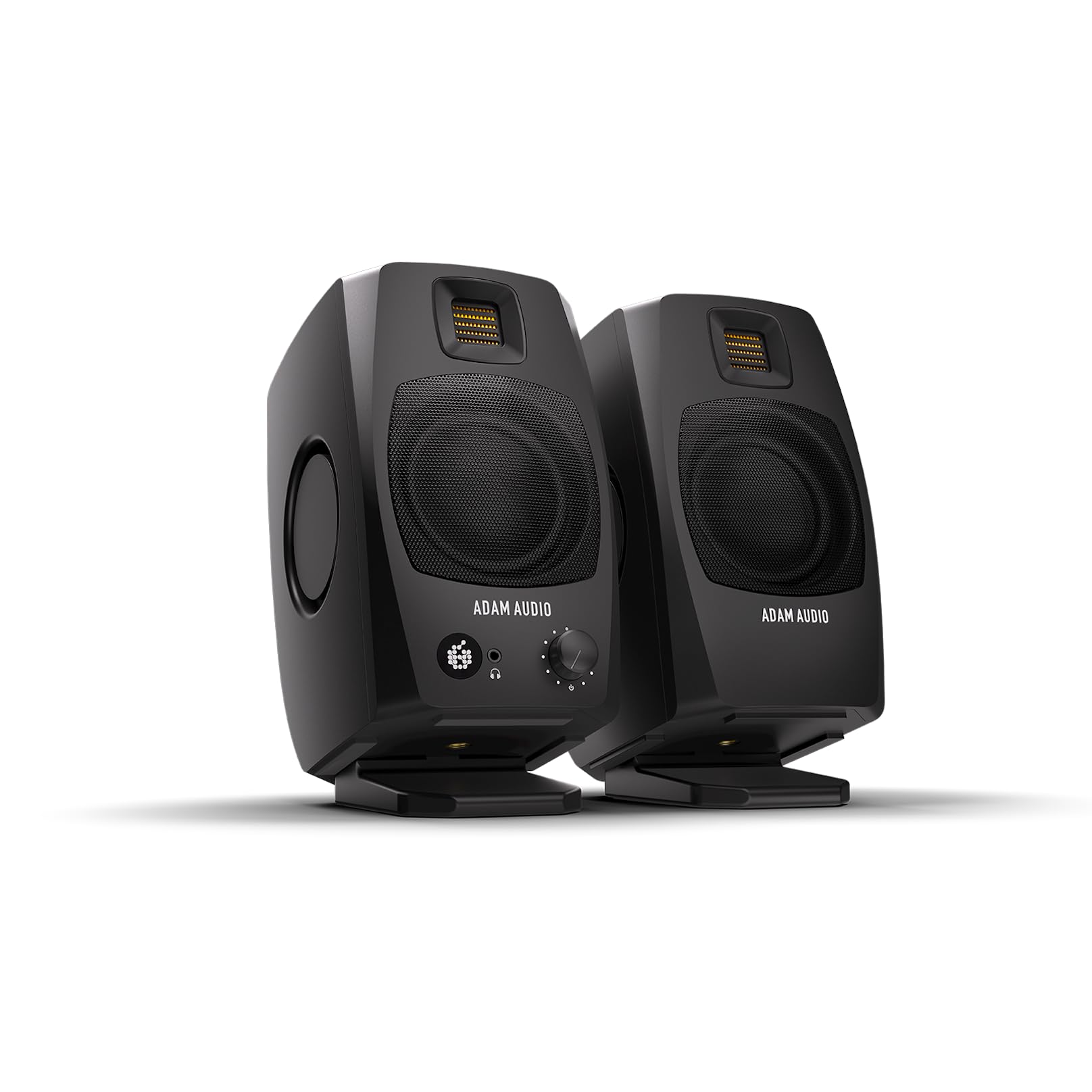
The ADAM Audio D3V brings pro studio technology to the desktop with its inclusion of a handmade D-ART (Desktop Accelerated Ribbon Tweeter). This tweeter provides a level of high-frequency detail and transient response that is simply unmatched by conventional dome tweeters, making it an exceptional tool for mixing, mastering, and critical listening. The bass extension down to 45Hz, powered by dual-sided passive radiators and a 3.5-inch aluminum woofer, is nothing short of astonishing for such a small enclosure, delivering a full-range sound that can fill a small room without a dedicated subwoofer.
The system is designed for plug-and-play convenience for the pro user, with a USB-C connection that powers the monitors and carries a high-resolution audio signal. The included angled stands are perfectly calibrated for a desktop listening position, ensuring the tweeter fires directly at your ears for the most accurate soundstage. DSP-controlled switches on the back panel address common desk placement issues, allowing you to tame boundary bass reflections and achieve a flatter response. For the content creator who demands absolute clarity and precision, the D3V is a dedicated tool, not just a speaker.
The major limitation is its singular focus. There is no Bluetooth, no remote control, and the input is limited to USB-C and a single 1/4-inch TRS jack. This system is for the person who wants ultimate analytical sound on their desk, not convenience features. The proprietary interconnect cable between the two monitors is also a point of potential failure. If your primary use is immersive gaming or casual background music, the D3V’s revealing nature may be overly critical, but for unmatched sonic transparency in a desktop form, it is peerless in this list.
Why it’s great
- The handmade D-ART ribbon tweeter delivers extraordinary high-frequency detail and transient accuracy.
- Bass extension to 45Hz from passive radiators is remarkable for this size, offering impressive full-range sound.
- DSP placement switches and angled stands are engineered for optimal near-field desktop acoustics.
Good to know
- Limited to USB-C and a single 1/4-inch input with no Bluetooth, remote, or consumer-friendly features.
- The proprietary interconnect cable linking the two speakers is a single point of potential failure.
- Its revealing, analytical sound profile may be too critical for casual entertainment listening.
5. Edifier QR65 Desktop Active Monitor

The Edifier QR65 is the most feature-rich and visually striking desktop monitor on this list, blurring the line between high-fidelity audio and a tech accessory. The sound is driven by a 1.25-inch silk dome tweeter and a 2.75-inch long-throw aluminum diaphragm mid-low driver, delivering a crisp, balanced sound with a surprising amount of punch for its size. The 70W RMS Class-D amplification provides plenty of clean headroom for a desktop environment, and the inclusion of LDAC Bluetooth codec allows for high-resolution wireless streaming (24-bit/96kHz) from compatible devices.
Its standout features are the integrated 65W TurboGaN USB-C fast charging ports and the mesmerizing “TempoAbyss” light effects. The built-in GaN charger is a genuine quality-of-life addition for a desk, allowing you to charge a laptop or phone directly from the speaker. The backlighting is more than just RGB; it creates layered, ribbon-like light patterns that can be customized via the Edifier ConneX app, making it a centerpiece for any modern desk aesthetic. The included aluminum stands that angle the speakers towards your ears are a thoughtful touch that improves soundstage precision.
The primary drawback is its price, which is premium for a 2.0 system, especially when you consider that it lacks a dedicated subwoofer for deep bass. The volume output is also moderate, and for those who listen at very high levels, it may feel a bit reserved. The app control, while useful, can sometimes have connectivity quirks. For the user who values a stunning design, integrated charging, and high-quality wireless audio above all else, the Edifier QR65 is the ideal choice.
Why it’s great
- Integrated 65W TurboGaN USB-C fast charging ports are a game-changer for desktop cable management.
- LDAC high-resolution Bluetooth codec support ensures top-tier wireless audio streaming quality.
- Customizable “TempoAbyss” light effects and a sleek aluminum build make it a true centerpiece.
Good to know
- Lacks deep sub-bass extension that a dedicated subwoofer would provide for a true 5.1 experience.
- Maximum volume output is limited compared to some larger, more powerful desktop competitors.
- The premium price reflects the design and integrated tech as much as the raw audio performance.
6. JBL Professional C1PRO 2-Way Bookshelf Speakers

The JBL Control 1 Pro is a legendary passive speaker that has been a staple in professional installations and high-fidelity desktop setups for decades. Its rugged, molded enclosure houses a 5.25-inch woofer and a 3/4-inch tweeter, producing a remarkably neutral, clear, and dynamic sound that is built to last. These are not “multimedia” speakers; they are serious audio tools that require an external amplifier, but their performance when paired with a quality amp is superb, delivering a soundstage that is far larger than their size suggests.
For the 5.1 desktop enthusiast, a set of these can form the basis of a truly high-end custom system. You can use three pairs for the front and rear channels, plus a center, and pair them with a quality subwoofer and a multi-channel amplifier. The included mounting brackets, SonicGuard overload protection, and magnetically shielded drivers make them incredibly versatile for placement on desk or wall. Their frequency response of 100Hz to 18kHz means they handle the crucial midrange with excellent articulation, leaving the sub-100Hz duties to a subwoofer.
The main barrier is the need for a separate amplifier, which increases the total cost and setup complexity. They also lack deep bass on their own, making a subwoofer mandatory for a full-range 5.1 system. Sourcing a matching set of three pairs and a center channel can be a challenge. However, for the DIY audiophile who wants to build a modular, upgradeable, and truly high-performance 5.1 system, the JBL C1 Pro offers a level of build quality and sonic potential that no all-in-one kit can match.
Why it’s great
- Professional-grade build and legendary sound quality that performs well above its price point.
- Versatile mounting options and SonicGuard protection make them ideal for custom desktop installations.
- Magnetically shielded for safe placement next to sensitive monitors or vintage CRT displays.
Good to know
- Requires an external amplifier and subwoofer, increasing total system cost and complexity.
- Lacks bass extension below 100Hz; a subwoofer is essential for any home theater or music application.
- Finding a matching set for a 5.1 configuration (5 satellites + center) can be challenging.
7. Monoprice 5.1 Channel Home Theater Satellite Speakers

The Monoprice 5.1 system is the definitive “get what you pay for, but way more” champion of the budget category. It offers a genuine 5.1 channel setup with an 8-inch powered subwoofer and four satellite speakers that can handle up to 125 watts each. This is a real, discrete surround system that, when connected to a quality AV receiver, produces a sound that is far superior to any soundbar for movies and games. The subwoofer, in particular, provides a satisfying low-end punch that can shake a small room.
Its value proposition is undeniable. It offers a clear path to upgrading from TV speakers or a basic 2.1 PC setup to a true home theater experience without breaking the bank. The sound is neutral and detailed after a short break-in period, and the speakers are robust enough to handle daily use. For a gamer or movie fan on a tight budget who already has or is willing to buy a receiver, this system is the most compelling entry-level 5.1 solution available.
The compromises are clear in the details. The spring-loaded connectors are fiddly, the mounting hardware is a nightmare according to multiple users, and the center channel is notably weaker than the satellites. The subwoofer, while powerful, lacks the finesse and deep extension of more expensive units, and the system requires a dedicated receiver, which is not included. It is a system that requires patience and a bit of DIY know-how, but it rewards that effort with unbeatable value for true 5.1 sound.
Why it’s great
- Provides a true, discrete 5.1 channel soundstage that demolishes any soundbar at a similar price.
- The 8-inch powered subwoofer delivers impressive, room-shaking low-frequency performance.
- Satellites are robust and 125W capable, offering a great foundation for a scalable high-value system.
Good to know
- Requires a separate AV receiver, which significantly increases the total system cost and complexity.
- Mounting hardware and spring clip connectors are notoriously frustrating to work with.
- The center channel speaker is noticeably less detailed than the satellites, impacting vocal clarity.
8. Bobtot 1000W Surround System 5.1/2.1 Channel
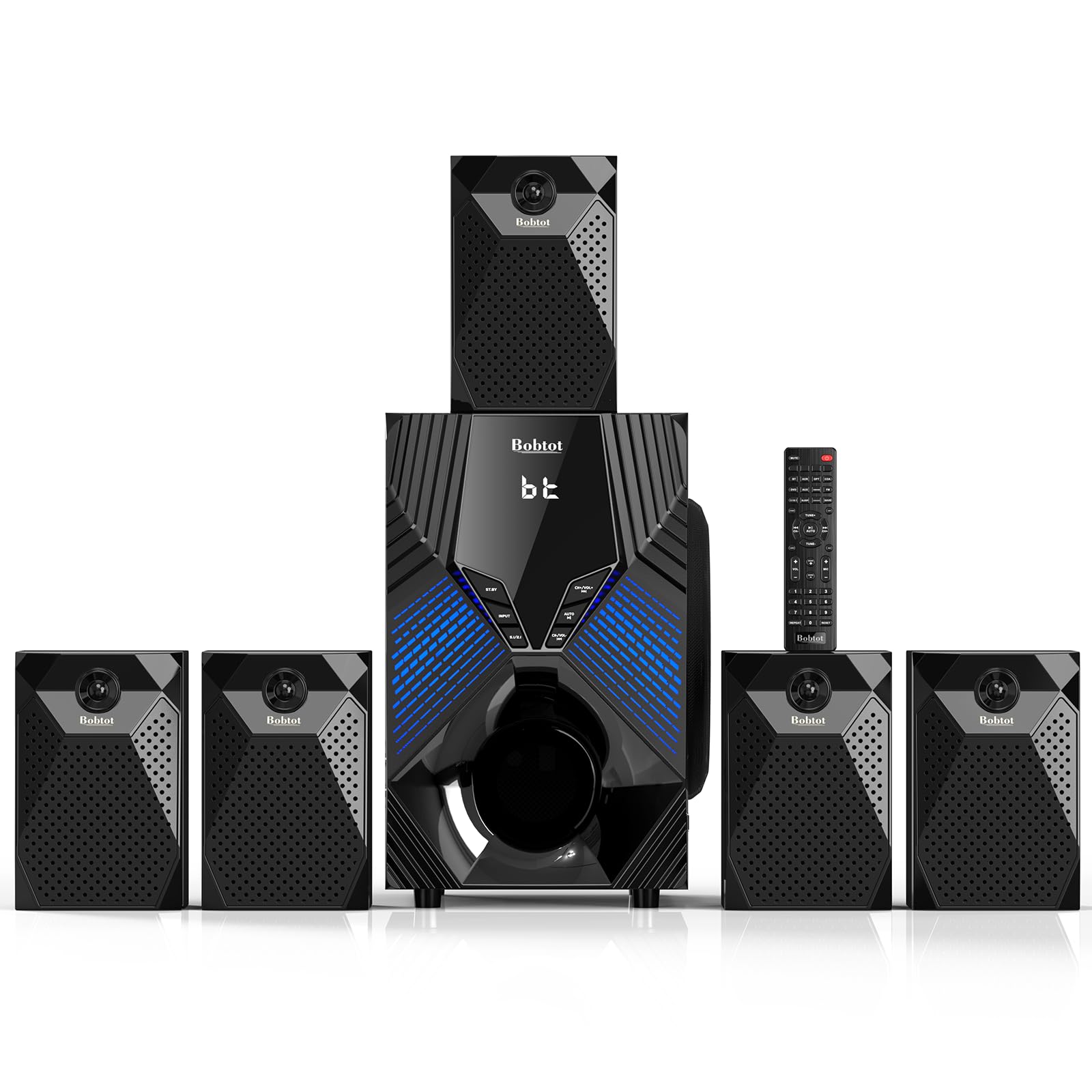
The Bobtot system is the most straightforward “out of the box” 5.1 solution, integrating the amplifier directly into the 8-inch subwoofer enclosure. This eliminates the need for a separate receiver, making the setup process as simple as plugging in the five wired satellite speakers. It offers a claimed 1000W peak power, and while that number is a peak marketing figure, the system produces genuinely loud, impactful sound with a “theater-in-a-box” feel that can easily fill a medium-sized room.
Its versatility is another key strength. It supports a massive range of inputs, including TV ARC, Optical, Coaxial, AUX, USB, Bluetooth, and even SD card playback. The inclusion of two microphone inputs for karaoke makes it an instant party starter, a feature rarely found in PC-focused systems. For a family room, dorm, or a gaming room where simplicity and versatility are paramount, this system delivers a huge amount of functionality for a very accessible entry point.
However, the audio fidelity does not match the feature set. The sound, while loud and bass-heavy, can be less refined than the competition, with a tendency towards a boomy, less articulate low end. The wired satellite speakers have built-in, non-detachable cables that can be a challenge to manage and limit placement flexibility. Bluetooth connectivity is only for the subwoofer, not the entire system. It is a fun, powerful, and incredibly easy-to-use system that is best for those who prioritize impact and ease over audiophile detail.
Why it’s great
- Built-in receiver in the subwoofer makes it a true plug-and-play 5.1 system with no extra gear needed.
- Features a massive array of inputs (ARC, Optical, Coax, USB, BT) and dual karaoke microphone support.
- Delivers powerful, room-shaking bass and very high volume for an immersive movie/game experience.
Good to know
- Audio fidelity is a bit rough around the edges, with less clarity and a boomy low-end compared to pricier kits.
- Satellite speakers have permanently attached cables, making cable management and placement less flexible.
- Bluetooth connectivity is limited to the subwoofer, not the entire 5.1 channel audio system.
9. HiPulse N512 5.1.2 Soundbar and Surround System
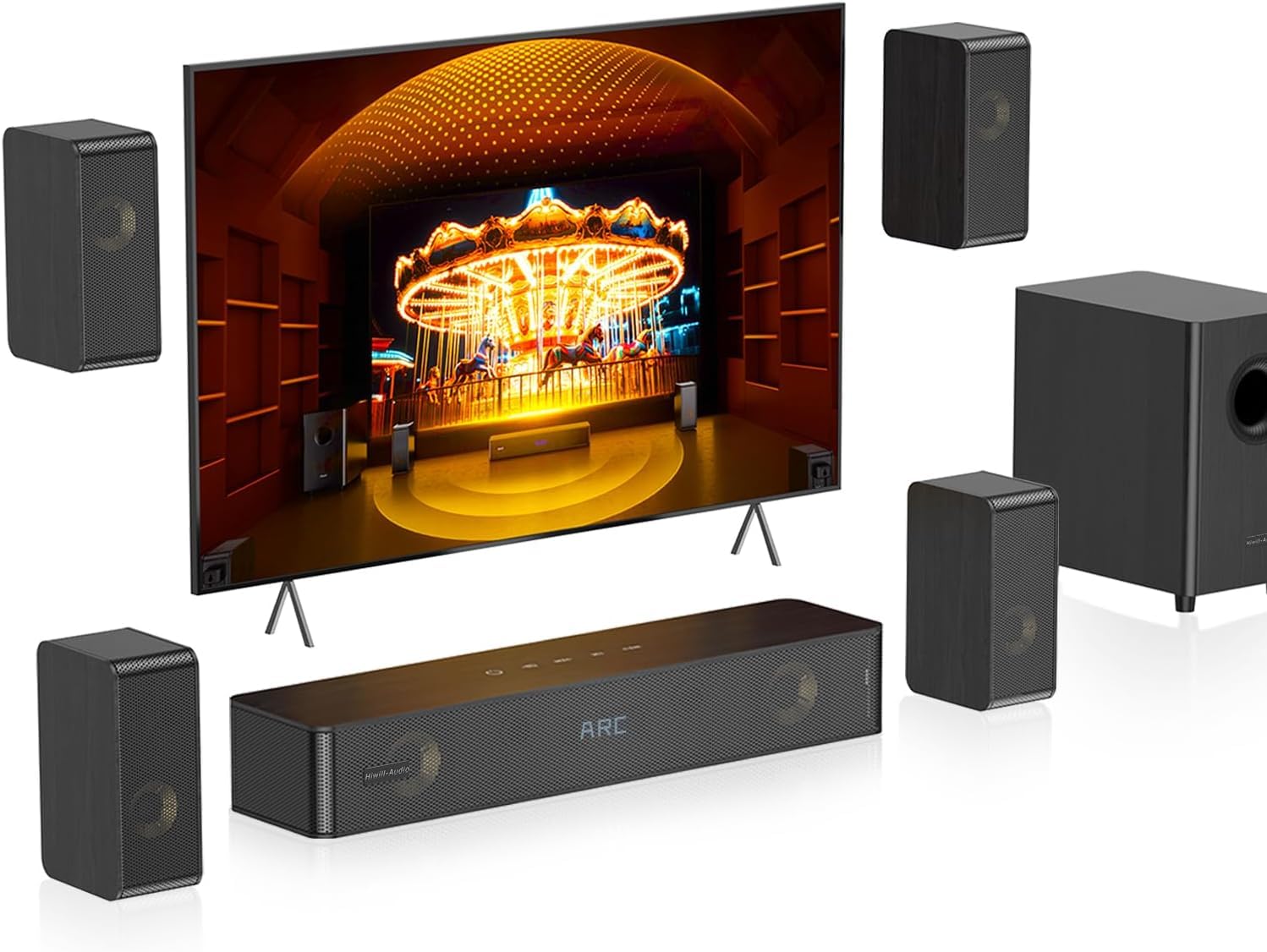
The HiPulse N512 is a clever hybrid that combines a soundbar with a 5.1.2 channel configuration and wired rear speakers, offering an immersive surround experience for those who want to avoid the clutter of multiple front satellites. The key differentiator is its build: real solid wood cabinets for the main unit and upgraded aluminum-magnesium alloy drivers, which is a massive step up from the plastic shells of typical soundbars. This material choice leads to a cleaner, more natural sound with less cabinet resonance.
Its “Discrete Spatial Expansion Technology” and two upward-firing drivers create a tall, wide soundstage that enhances the sense of height and ambiance. The included wired rear speakers hook up to a central unit, providing a true surround channel without total wireless dropouts. This system is an ideal choice for the desktop user who wants a significant upgrade from a soundbar but doesn’t have the desk or wall space for the traditional five separate satellite speakers. The clear dialogue output is also exceptional for movies and streaming content.
The main challenge is that it is not a true discrete 5.1 system in the traditional sense; it uses its 11 drivers and DSP processing to create an immersive soundscape rather than a pinpoint location-based one. This means it works best for movies and general gaming, but may not satisfy purists who want exact positional audio for competitive shooters. The five-inch subwoofer also lacks the chest-pounding power of an 8-inch unit. It is a premium, well-constructed solution for the user who values space-saving and a high-quality soundbar experience over a full satellite array.
Why it’s great
- Solid wood cabinets and metal alloy drivers provide a significant build quality upgrade over plastic soundbars.
- Up-firing drivers and spatial expansion tech create an immersive, ambient soundstage with height effects.
- Provides a clearer, less cluttered desktop footprint compared to a full set of five separate satellite speakers.
Good to know
- It uses DSP virtualization for surround height rather than discrete physical channels for pinpoint audio placement.
- The 5.25-inch subwoofer is competent but lacks the deep power and extension of larger dedicated subwoofers.
- The rear satellite speakers have occasional popping or connection issues reported by some users.
FAQ
What does the 0.1 channel in 5.1 refer to?
Can I use a 5.1 speaker system for regular stereo music?
What is the difference between a subwoofer and a passive radiator?
Final Thoughts: The Verdict
For most users, the best 5.1 desktop speakers winner is the SteelSeries Arena 9 because it offers the most complete, polished, and feature-rich discrete surround solution that integrates perfectly with a PC over a single USB cable. If you want absolute clarity and top-tier audio production capabilities, grab the Kanto ORA or ADAM Audio D3V for their superior driver technology and reference-quality sound in a compact form. And for the budget-conscious user who wants to build a powerful, modular system from the ground up, nothing beats the value offered by the Monoprice 5.1 Channel System.