
When a window shatters at 2 AM, the only thing standing between your family and an intruder is the alarm system you picked. A good system doesn’t just make noise—it buys you time, deters the threat, and sends the right alert to the right person. That gap between a wire-free entry sensor and a wired multi-camera NVR is wider than most shoppers realize, and picking wrong means either paying for monitoring you never use or leaving a blind spot right where it counts.
I’m Min — the co-founder and writer behind Gadgets Feed. I’ve spent hundreds of hours researching home security technology, comparing sensor radio protocols, battery life claims, and monitoring contract fine print so you don’t have to guess which system actually secures your perimeter.
This guide breaks down the best self-installed panels, sensor kits, and camera-based setups on the market to help you find the best alarm system for homes that matches your home’s layout and your tolerance for false alerts.
How To Choose The Best Alarm System For Homes
Every home security system follows the same basic architecture: sensors detect an event, a hub processes the signal, and a siren or notification is triggered. Yet the execution varies wildly in sensor range, false alarm filtering, and whether a monitoring company gets involved. Focus on these four factors before buying.
Sensor Selection and Radio Protocol
The contact and motion sensors in your kit communicate on specific radio frequencies. Systems using 433MHz (common in lower-cost DIY kits like the LWOHSI and OSI) offer excellent wall penetration through concrete and rebar, making them reliable in larger homes. Z-Wave and proprietary 900MHz protocols (used by Ring and SimpliSafe) have shorter effective range but lower interference. Check whether the system includes a range extender in the kit or supports one—otherwise a sensor in a detached garage may never trigger the base station.
Communication Failover: Cellular and Battery
An alarm system that relies solely on home Wi-Fi and wall power is a sitting duck. If an intruder cuts the main line or a storm knocks out the grid, your system should still sound and notify you. Look for a base station with a built-in cellular modem (operating on 4G LTE or 4G GSM) and a backup battery rated for at least 24 hours. The Ring Alarm base station, SimpliSafe base, and OSI panel all include cellular backup as a core feature, while the LWOHSI unit uses a 4G GSM module for SMS and voice calls when Wi-Fi fails.
Self-Monitoring vs. Professional Monitoring
The tradeoff between paying nothing per month and having a dispatcher call police is real. Self-monitoring (Blink, OSI, LWOHSI, and Arlo without a plan) means push notifications land on your phone and you decide what to do—fine if you are always reachable. Professional monitoring (Ring Protect, SimpliSafe Core, and Arlo Secure) adds a monitoring center that can verify an alarm within seconds and dispatch emergency services. Some systems, like the OSI and Arlo, allow you to start with self-monitoring and upgrade later without hardware changes.
Number of Zones and Partitioning
Mid-range and premium panels support multiple arming zones, meaning you can keep downstairs sensors armed while disabling the upstairs bedroom zone at night. Budget kits with a single arming mode treat every sensor as all-or-nothing. If you plan to use your system in a multi-story home, apartment, or rental property with separate access areas, check whether the system supports zone-specific arming or a “home” mode that leaves certain sensors active.
Quick Comparison
On smaller screens, swipe sideways to see the full table.
| Model | Category | Best For | Key Spec | Amazon |
|---|---|---|---|---|
| Ring Alarm 8-Piece Kit | Smart Home Hub | Ecosystem integration with cameras and locks | Cellular + Wi‑Fi + battery backup | Amazon |
| SimpliSafe 11pc Gen 3 | Pro Monitoring | 5‑second police dispatch with video verification | 95 dB siren + cellular backup | Amazon |
| OSI Alarm Gen 2 (4G) | DIY Touchscreen | Expansion up to 160 sensors | 1024×600 touch panel | Amazon |
| eufy ExpertSecure E10 | Hybrid Camera/Alarm | Local AI + 4G failover | 32 GB local storage | Amazon |
| Arlo Home Security SS1501 | Wire‑free Sensors | All‑in‑one 8‑function sensors | SecureLink connectivity | Amazon |
| Reolink RLK16-1200D8-A | Professional Wired | 12MP continuous recording with 4TB storage | 12MP UHD + 4TB HDD | Amazon |
| Reolink RLK8-410B6-5MP | PoE Camera System | Wired 5MP coverage with night vision | 5MP PoE + 2TB HDD | Amazon |
| Blink Outdoor 4 + Doorbell (6‑cam) | Battery Camera | Long battery life video doorbell + outdoor cams | 2‑year battery life | Amazon |
| LWOHSI PG108 4G | Budget 4G | No monthly fees with SMS alerts | Wi‑Fi + 4G GSM | Amazon |
In‑Depth Reviews
1. Ring Alarm 8-Piece Kit (newest model)
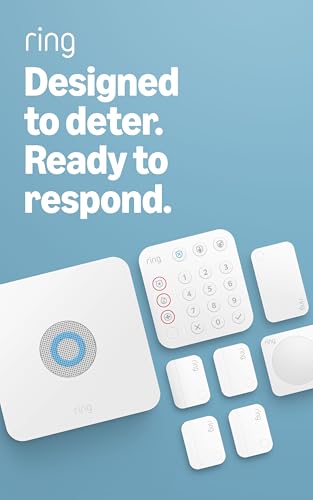
The Ring Alarm 8-Piece Kit strikes the best balance between a fully integrated smart home hub and a traditional security system. The base station connects via Ethernet and Wi‑Fi, and it maintains cellular backup through AT&T’s LTE network, meaning an intruder cannot silence your alarm by cutting the internet cable. The kit ships with one base station, one keypad, one motion detector, and four contact sensors—enough to cover most 1-2 bedroom homes right out of the box.
Setup is genuinely fast: each component has a unique 5‑digit pairing number, and the Ring app guides you through naming each sensor and assigning it to a zone. The keypad includes dedicated emergency buttons for police, fire, and help, which is rare in this price range. The system integrates natively with Ring’s video doorbell lineup, Schlage smart deadbolts, and Amazon Alexa voice commands, so you can arm the system simply by saying a command.
The optional Ring Protect plan (/year) adds professional monitoring, cellular backup, and cloud video storage for your Ring cameras. Without a subscription the system is still fully functional as a local alarm. The only catch is that the 8‑piece kit ships as separate orders that can arrive days apart, which frustrates impatient installers. For a seamless ecosystem that grows with your smart home, this is the most cohesive mid-range option available.
Why it’s great
- Multi‑path connectivity (Wi‑Fi, Ethernet, cellular) keeps the alarm online when any single link fails
- Three‑button SOS keypad offers instant police, fire, and medical dispatch with a monitoring plan
- Works with Amazon Alexa for voice‑based arming and disarming
Good to know
- No glass‑break sensor included—add a contact sensor to window glass as a workaround
- Kit components may ship separately over several days
- Subscription required for cellular backup coverage
2. SimpliSafe 11 Piece Wireless Home Security System Gen 3
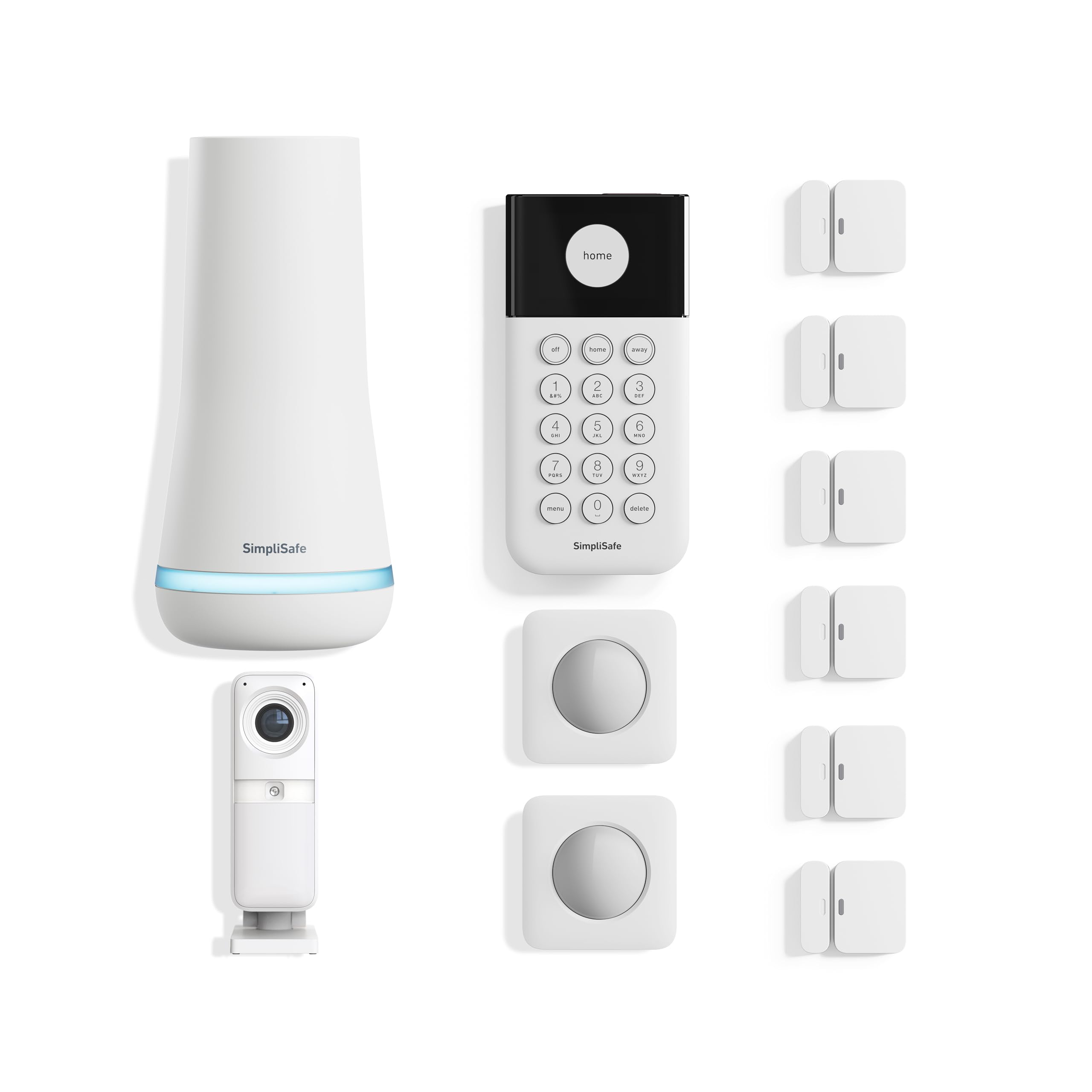
SimpliSafe Gen 3 is purpose-built for homeowners who want professional monitoring without a long-term contract. The 11‑piece kit includes a base station, keypad, two motion sensors, six entry sensors, and a wireless indoor HD camera. The base station runs on a 24-hour backup battery and uses cellular as its primary monitoring link (Wi‑Fi is optional for app control), so the system functions independently of your home internet.
The standout feature here is the Fast Protect Monitoring plan, which enables video verification: when a sensor triggers the camera, SimpliSafe agents can see the intruder in real time through two-way audio and dispatch police with eyewitness confirmation. The company claims agents can act on an alarm within 5 seconds during the false alarm grace period. The motion sensors have a 35‑foot range with a 90‑degree field of view and ignore pets under 60 lbs, reducing nuisance alerts.
Installation is genuinely wireless—peel-and-stick adhesive on the sensors and a plug-in base station. The keypad includes a smash-safe feature: even if an intruder destroys the keypad, the base station still triggers the alarm. The indoor camera’s resolution is not class-leading (1080p), and without a subscription the system only logs major events, but the core intrusion detection is rock-solid. For families prioritizing fast emergency dispatch, SimpliSafe delivers the shortest verified-response loop at this price tier.
Why it’s great
- Fifth‑second alarm response with video verification and priority police dispatch
- Cellular‑primary design means the system works even without Wi‑Fi
- Smash‑safe keypad prevents intruders from disabling the alarm by destroying the panel
Good to know
- Camera quality is adequate but not crisp compared to dedicated security cameras
- Custom sensor names are not used in voice alerts—only generic chimes sound
- Professional monitoring requires a paid subscription starting around /month
3. OSI Alarm System Gen 2 (4G), 11pc
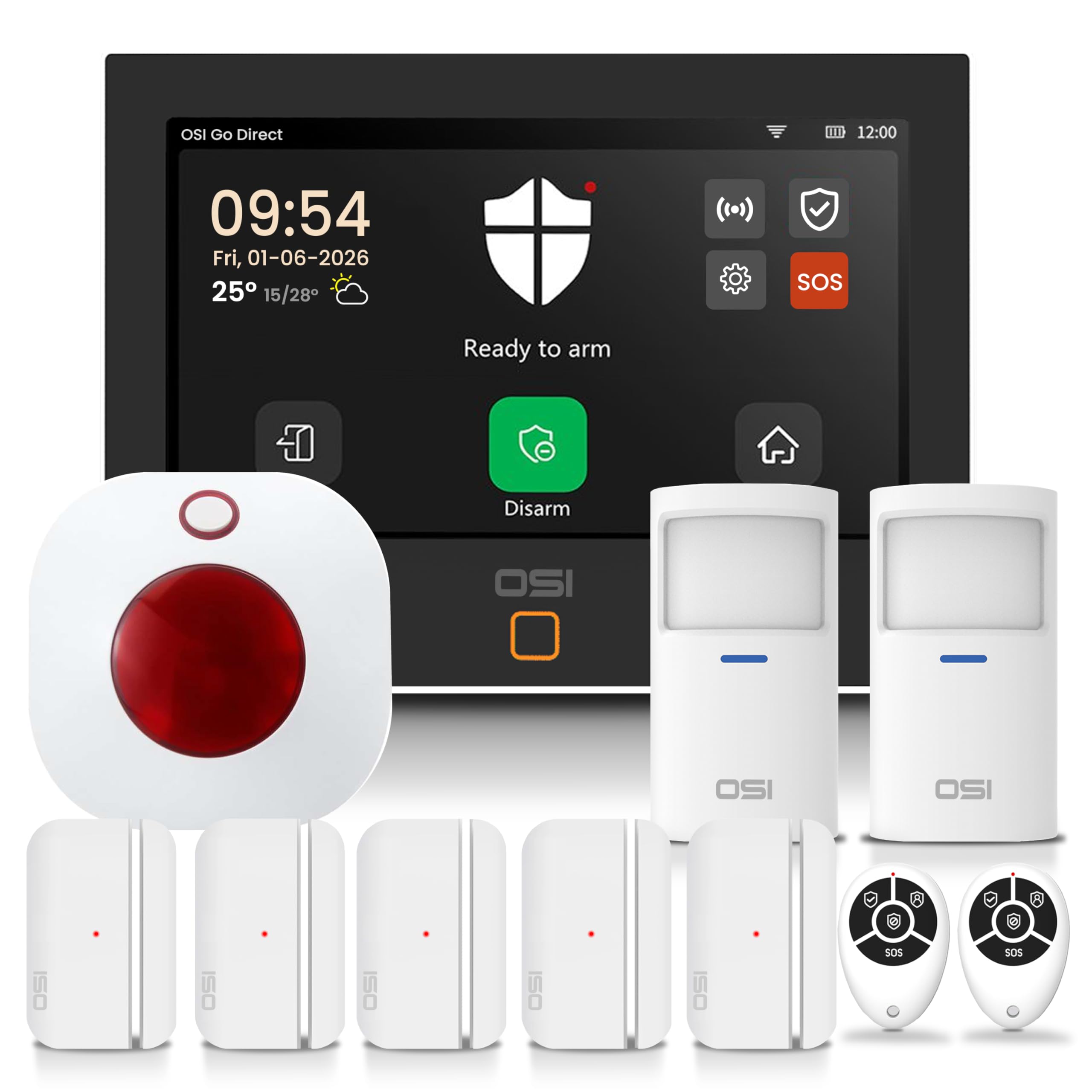
The OSI Alarm Gen 2 is a DIY system that does not look or feel like a budget kit. The centerpiece is a 7‑inch 1024×600 anti-fingerprint touchscreen that walks you through an interactive setup wizard—no guesswork about which sensor belongs to which zone. The 11‑piece bundle includes two motion sensors, five contact sensors, one wireless strobe siren, and two remote controllers, giving you comprehensive coverage for a typical three‑bedroom home.
What sets this system apart is its scalability. The panel supports up to 160 sensors, 6 remote controllers, 6 doorbells, and 6 keypads, making it viable for a large house or even a small business. The 433MHz radio frequency penetrates concrete and rebar without needing a range extender, a major advantage over 2.4 GHz‑only systems in multi‑story buildings. The 24‑hour backup battery and optional 4G SIM card (sold separately) ensure the alarm sounds even during a power cut.
Self-monitoring is free, but you can opt into 24/7 professional monitoring through OSI for a low monthly fee. The touchscreen interface includes multiple user access levels (one admin, five user accounts), which is ideal for Airbnb rentals or households with children. The only downsides are that the siren plug occupies two wall‑outlet spaces and the app (Smart Life) lacks a delete‑history function. For a future‑proofed panel that grows with your property, this is a standout pick.
Why it’s great
- Massive 160‑sensor capacity with 433MHz radio that penetrates concrete walls reliably
- Interactive HD touchscreen with setup wizard eliminates configuration confusion
- Multiple user access levels—ideal for rental properties or multi‑occupant homes
Good to know
- No voice announcement for which door or window triggered the alarm
- Plug‑in siren takes two AC outlet spaces on a power strip
- Smart Life app lacks a history delete feature and tablet‑optimized layout
4. eufy ExpertSecure System E10
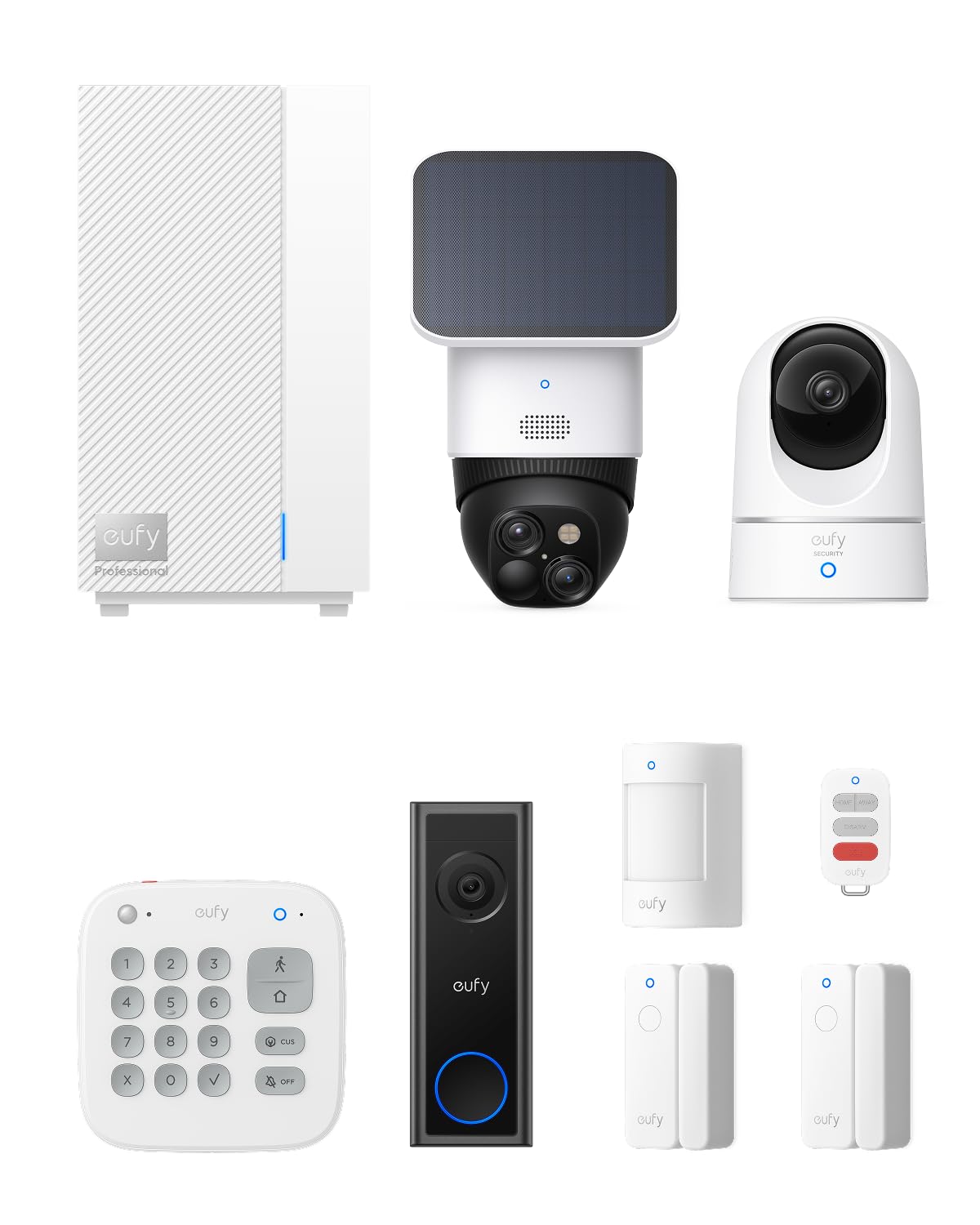
Eufy’s ExpertSecure E10 is the rare system that packs a full‑featured alarm panel, multiple cameras, and local AI processing into a single box without forcing a subscription. The bundle includes a HomeBase S1 with 32 GB of built‑in storage (expandable up to 16 TB), a keypad, key fob, two entry sensors, one motion sensor, a solar‑powered outdoor camera (SoloCam S340), a video doorbell (C30), and an indoor camera (E220). The pre‑configured pairing means you can set up the entire system in under an hour.
The 4G connectivity and 24‑hour battery backup in the HomeBase keep the alarm and cameras running through power and internet outages. All detection runs locally on the HomeBase’s AI engine, so person, vehicle, and pet alerts send instantly without any cloud dependency. The solar‑powered outdoor camera charges quickly and covers the yard, while the doorbell’s battery lasts for weeks on a single charge. The PTZ 360‑degree indoor camera tracks motion across a room with minimal lag.
The tradeoff is that the eufy mobile app feels cluttered with promotional cards, and the optional monitoring service (affordable but separate) requires a small monthly fee. Some users report that the wireless cameras occasionally drop the connection to the HomeBase and then reconnect after a few minutes. Still, for a homeowner who wants local storage, no monthly fees, and integrated video alarms, the E10 delivers the most hardware per dollar at the mid‑premium boundary.
Why it’s great
- All devices pre‑paired in the box—fastest out‑of‑box experience in this group
- Local AI storage (32 GB native, up to 16 TB expandable) eliminates cloud fees
- 4G failover plus 24‑hour battery keeps video recording active during outages
Good to know
- Wireless cameras may randomly disconnect from the HomeBase and then re‑pair
- Mobile app contains ad‑style promotional content that slows navigation
- Optional professional monitoring requires a separate subscription fee
5. Arlo Home Security System SS1501
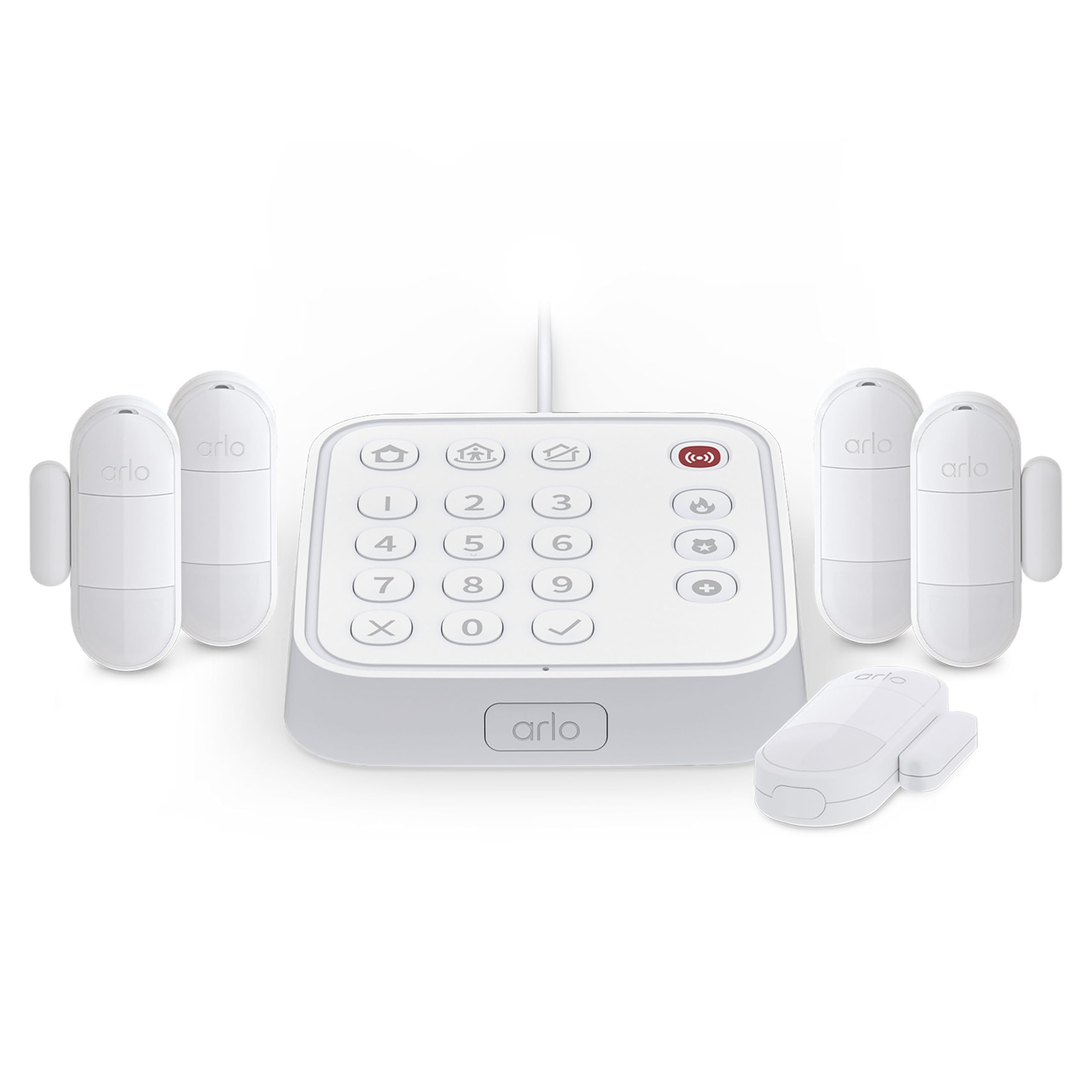
The Arlo SS1501 rethinks the traditional alarm by combining all sensor functions into a single 8‑in‑1 device. Each All‑In‑One Sensor can detect motion, door/window opening, water leaks, temperature changes, and more, all within a compact puck that attaches with adhesive. The kit includes five such sensors plus a wired keypad sensor hub that also functions as the hub, siren, and control panel with one‑tap emergency buttons for fire, police, and medical responders.
Arlo’s SecureLink technology extends the wireless range beyond typical Wi‑Fi sensors, and the sensors run on lithium metal batteries that last up to several months. The hub connects to your router via Ethernet for a stable backhaul, and the entire system is managed through the Arlo Secure App. Setup is straightforward: peel the adhesive, mount the sensors, pair them via the app, and choose between arm away, arm home, and standby modes.
The optional Arlo Secure Plan adds 30‑day video cloud storage, object detection, and professional monitoring, but the system is fully functional without it as a self-monitored alarm. The main drawback is that upgrading from an older Arlo system disables some advanced automation features like cross‑camera triggers. For homeowners who want a single sensor type that handles multiple threats, the SS1501’s versatility is unmatched in the mid‑range segment.
Why it’s great
- Each sensor handles eight different detection modes—motion, door, water leak, temperature, and more
- One‑tap emergency buttons on the keypad hub for police, fire, and medical response
- SecureLink technology provides extended wireless range compared to standard Wi‑Fi sensors
Good to know
- Upgrading from an older Arlo system removes certain advanced automation features
- Subscription required for cloud video storage and object detection after the free trial
- Keypad hub must be wired via Ethernet—no wireless connection option for the hub itself
6. Reolink 12MP PoE Security Camera System RLK16-1200D8-A
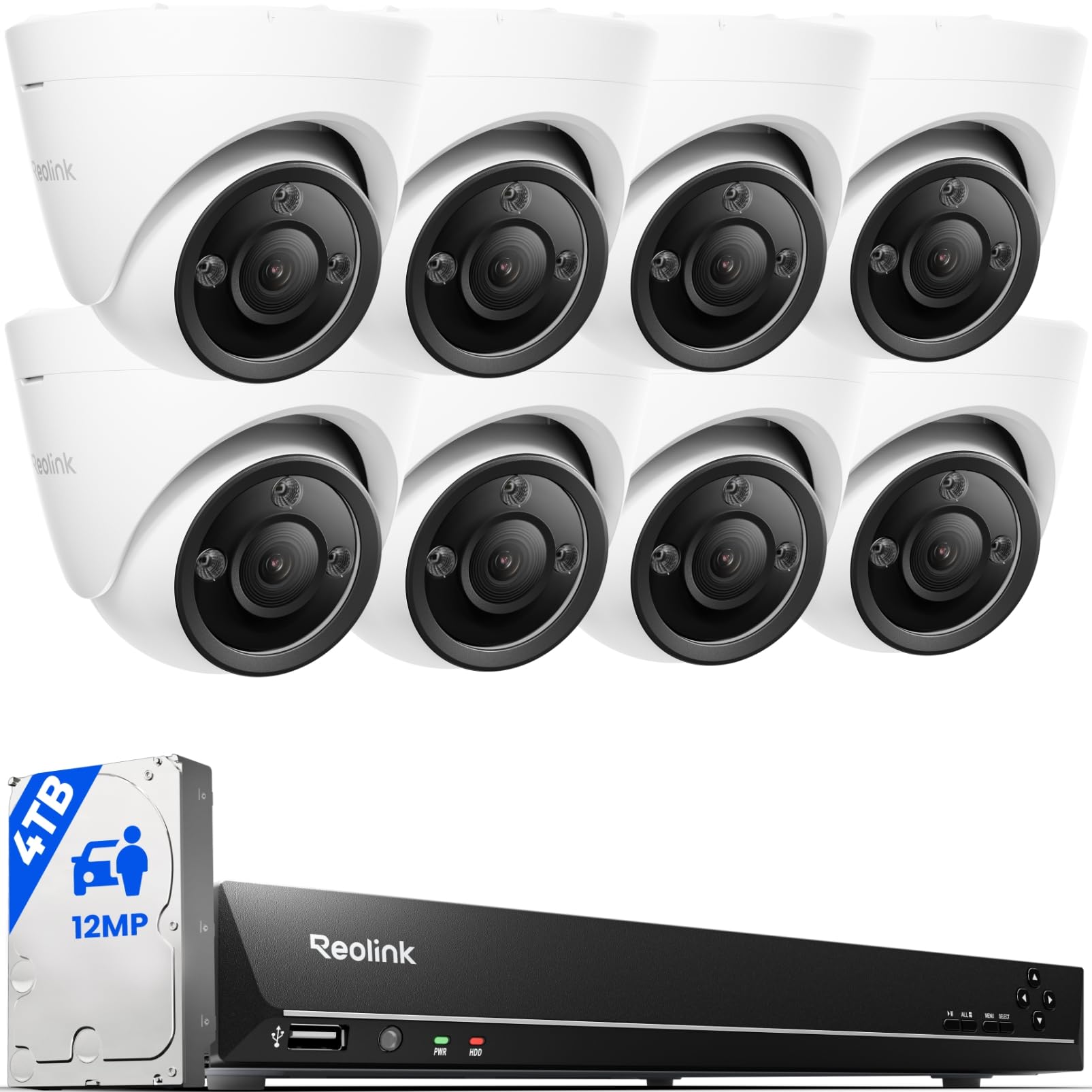
If your priority is forensic‑grade video evidence rather than simple intrusion alerts, the Reolink RLK16-1200D8-A is a professional‑level surveillance system that happens to be sold at a prosumer price. The 16‑channel NVR ships with a 4TB hard drive and eight 12MP PoE cameras that deliver 4K‑plus resolution (3840×2160 equivalent) at 20 frames per second. The level of detail is stunning: license plates, facial features, and small package labels are legible from significant distances.
Each outdoor camera includes a motion‑activated spotlight for full‑color night vision, plus a speaker for two‑way talk. The smart detection uses AI to differentiate people, vehicles, and pets, sending filtered push alerts to the Reolink app. The PoE (Power over Ethernet) setup requires running a single Cat5 or Cat6 cable to each camera for both power and data, which means attic work and wall drilling—but the result is a zero‑lag, always‑recording system that never relies on Wi‑Fi congestion.
The NVR supports a maximum of 16 PoE cameras plus additional Wi‑Fi and battery cameras for expansion. The 4TB HDD holds roughly 5 days of 24/7 continuous recording at 12MP; adding a 6TB drive extends that to about 12 days. The main reliability concern is that a small number of units shipped with a failing HDD within the first year. For a homeowner willing to invest in wiring, this system delivers image quality that commercial installations charge three times as much for.
Why it’s great
- 12MP resolution captures license plates and facial details that 1080p systems miss entirely
- PoE wiring provides zero‑lag video with no Wi‑Fi interference or battery changes
- Smart AI detection (person, vehicle, pet) with customizable push alerts
Good to know
- Installation requires running Ethernet cables through attics or crawl spaces
- 4TB HDD fills quickly at 12MP continuous recording—upgrade storage for longer retention
- Some units have reported HDD failure within the first year of normal use
7. Reolink 8CH 5MP PoE System RLK8-410B6-5MP
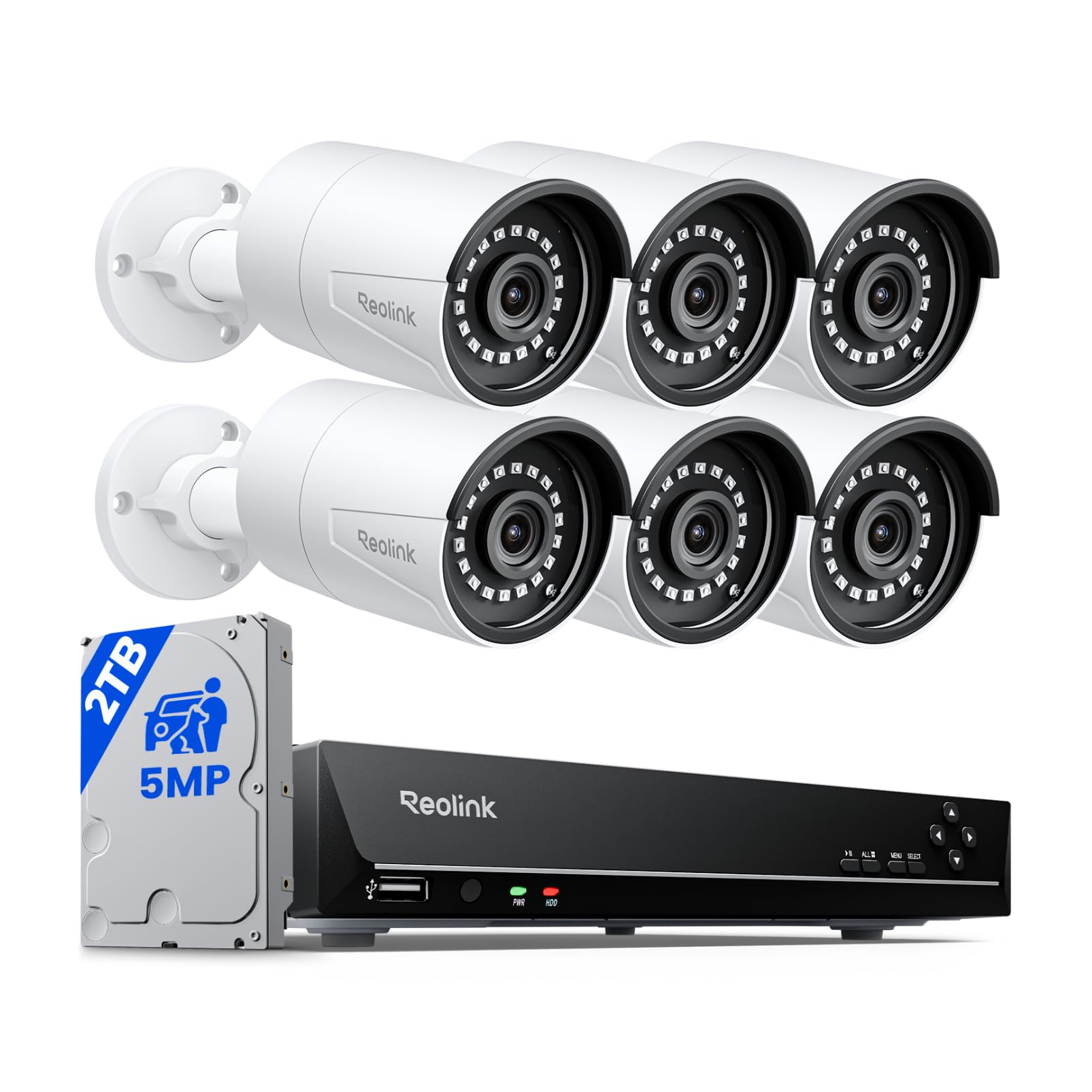
For homeowners who want the reliability of a wired PoE system but do not need the extreme resolution of 12MP, the Reolink RLK8-410B6-5MP offers a practical middle ground. The 8‑channel NVR comes with a 2TB hard drive and six 5MP cameras that deliver crisp 2560×1920 video with excellent night vision up to 100 feet thanks to 18 infrared LEDs. The motion‑activated spotlights on the cameras provide full‑color night vision when triggered.
Each camera includes a built‑in microphone for ambient audio recording, adding another layer of situational awareness. The smart detection can identify people, vehicles, and pets separately, minimizing false alerts from passing cars or neighborhood animals. The PoE setup uses a single Ethernet cable per camera, and the included 60‑foot cables are sufficient for most single‑story homes but may be short for larger properties.
The biggest complaint from users is that the PC client software can be slow and occasionally freezes, and the NVR firmware sometimes requires manual updates that can cause menu display glitches. The 2TB drive holds roughly one week of continuous recording at 5MP. For a wired system that does not break the bank, this is the most reliable entry into PoE security.
Why it’s great
- Reliable PoE connection eliminates battery anxiety and Wi‑Fi dropout issues
- 5MP resolution with 100‑ft infrared night vision covers most residential perimeters
- Smart detection distinguishes people, vehicles, and animals to reduce false alerts
Good to know
- NVR firmware updates can cause temporary menu display issues requiring reconfiguration
- 60‑foot Ethernet cables included may be too short for larger homes—extra Cat5 needed
- PC client software can be slow and prone to freezing during live playback
8. Blink Video Doorbell + Outdoor 4 (5‑Camera System)

The Blink bundle combines a second‑generation Video Doorbell with five Outdoor 4 cameras, all powered by AA Energizer lithium batteries that the company claims last up to two years. For renters or homeowners who cannot drill for wiring, this is the most hassle‑free way to cover a property with both door‑level and perimeter video. The Video Doorbell delivers a head‑to‑toe HD view (so you can see packages on the ground), while each Outdoor 4 camera shoots 1080p with infrared night vision and dual‑zone enhanced motion detection.
The Sync Module Core (included) manages the local video storage and connects to your Wi‑Fi. Two‑way audio works clearly on both the doorbell and the cameras, and the Blink app provides a unified feed for all devices. The 30‑day free trial of the Blink Subscription Plan gives you cloud storage and person detection alerts, but without a subscription the system still records motion clips locally and sends basic notifications.
Build quality is the weakest point: some units arrive with defective cameras that fail to sync to the module, and returns can be slow to process. The proprietary nature of the Blink ecosystem means you cannot mix and match with non‑Blink sensors or third‑party hubs. For a wire‑free, battery‑powered video alarm solution that installs in minutes, the Blink bundle is unbeatable in convenience but carries a small quality‑control gamble.
Why it’s great
- AA lithium batteries last up to two years—no recharging or hardwiring required
- Video Doorbell provides head‑to‑toe HD view to monitor packages at your doorstep
- Dual‑zone motion detection on Outdoor 4 cameras reduces false leaf and shadow alerts
Good to know
- Quality control is inconsistent—some cameras arrive defective and cannot sync
- Requires Blink Subscription Plan for person detection alerts and cloud storage
- Proprietary ecosystem limits integration with non‑Blink security sensors or hubs
9. LWOHSI PG108 Alarm System 4G DIY Kit
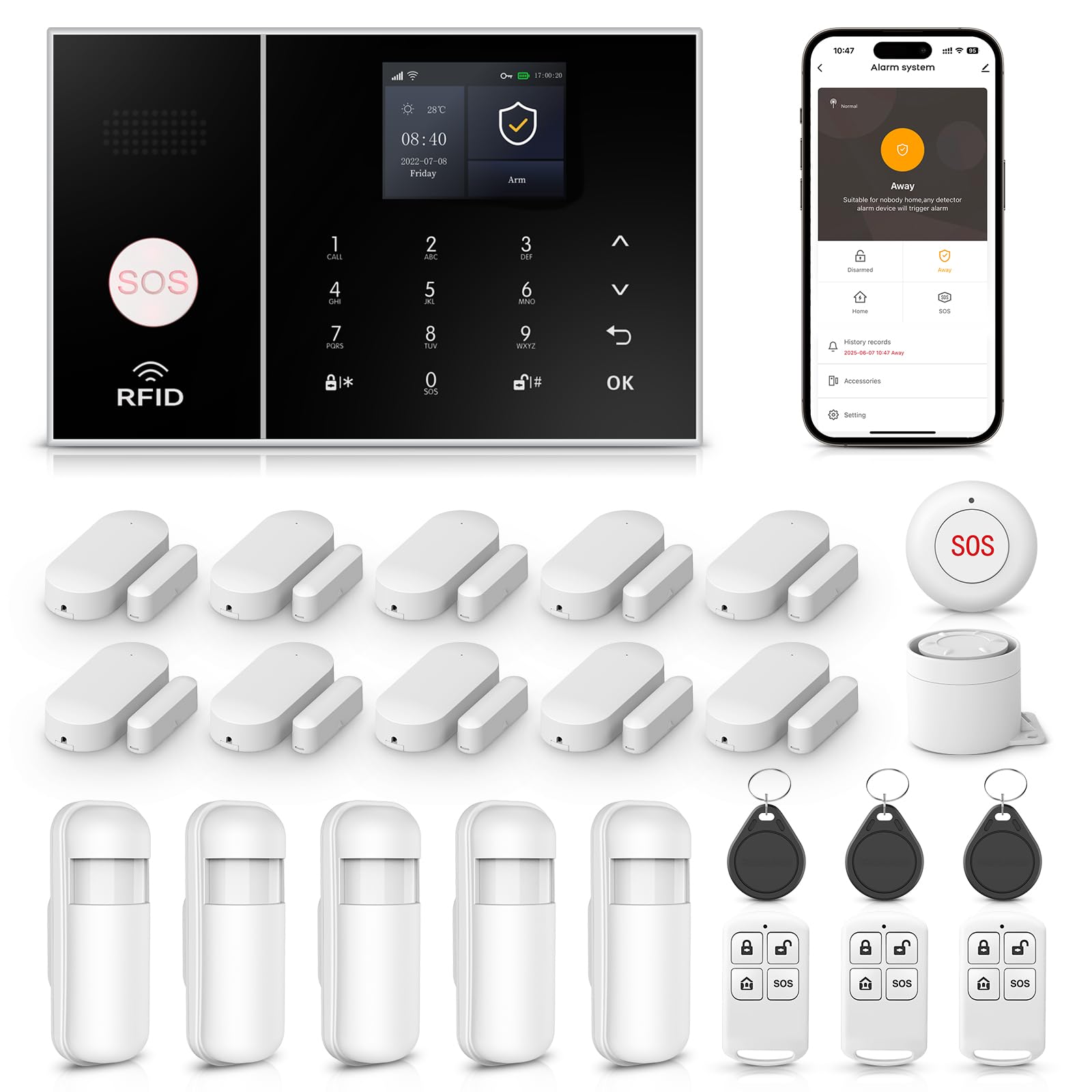
The LWOHSI PG108 is the most affordable way to get a truly dual‑network alarm system (Wi‑Fi plus 4G GSM) without any monthly monitoring cost. The control panel includes a SIM card slot for a standard talk/text plan, and it can send SMS and voice call alerts to up to five preset phone numbers when a sensor triggers. The kit ships with door/window sensors and a remote, and it can learn up to 100 wireless detectors total—covering every entry point in a large house.
The system uses the Tuya/Smart Life app for remote arming and push notifications, and it is compatible with Amazon Alexa and Google Assistant for voice control. The 32‑bit Cortex‑M3 processor handles multiple alarm zones separately, allowing you to name zones (front door, bedroom, garage) and set different arming schedules. The backup battery ensures the panel stays operational during power failures, and the 4G module can be used as a primary alarm path if you remove the Wi‑Fi connection.
The user interface is the biggest hurdle. The system does not have a dedicated app—it relies on the generic Smart Life platform, which can be confusing for non‑tech users. The alarm siren sounds the same tone as the door chime notification, and zone‑specific arming (arming only one floor, for example) is not supported—it is all or nothing. For a technically inclined homeowner who wants dual‑network alerts at the lowest entry cost, this is a functional solution with a steep learning curve.
Why it’s great
- Dual‑network (Wi‑Fi + 4G GSM) alerts with SMS and voice calls to five preset numbers
- Learns up to 100 wireless detectors, making it scalable for very large homes
- Compatible with Tuya, Alexa, and Google Assistant for smart home integration
Good to know
- Uses generic Smart Life app with confusing menu navigation and no dedicated app
- Alarm siren and door chime are the same tone—easy to misidentify which event occurred
- No zone‑specific arming; the system arms all sensors or none
FAQ
Do I need an indoor motion sensor if I already have door and window contact sensors?
Can I use a home alarm system in an apartment without drilling holes?
What happens if my alarm system’s cellular backup runs out of data?
Final Thoughts: The Verdict
For most users, the best alarm system for homes winner is the Ring Alarm 8-Piece Kit because it combines multi-path connectivity, a reliable ecosystem, and easy expansion with the best balance of features and price. If you want professional monitoring with video verification and the fastest police dispatch, grab the SimpliSafe 11pc Gen 3. And for a large property that needs room to grow without monthly fees, nothing beats the OSI Alarm Gen 2 (4G) with its 160‑sensor capacity and HD touchscreen panel.