
Sweltering in a parked car, truck cab, or van on a scorching summer day isn’t just uncomfortable—it can be genuinely draining. A dedicated 12V cooling solution offers a lifeline, using your vehicle’s existing electrical system to deliver a targeted blast of cold air where you need it most, turning a stifling cabin into a bearable space for work, rest, or transit.
I’m Min — the co-founder and writer behind Gadgets Feed. I’ve spent countless hours analyzing the technical specifications, user reports, and performance claims across dozens of portable 12V air conditioning units to separate evaporative coolers from true compressor-based AC and find the models that actually deliver measurable temperature drops.
Whether you’re equipping a work truck, building out a camper van, or just need a way to survive long hauls, finding the right best 12v portable car air conditioner means understanding BTUs, power draw, and whether an evaporative cooler or a compressor unit best matches your real-world conditions.
How To Choose The Best 12V Portable Car Air Conditioner
Selecting the right unit for your vehicle begins with a clear head about how these devices actually cool. The single biggest mistake buyers make is confusing an evaporative cooler—which requires low humidity to function—with a sealed compressor-based air conditioner that can cool even in muggy conditions. Understanding this primary distinction, along with power requirements and physical installation constraints, will save you from buying a unit that simply pushes warm, damp air.
Evaporative Cooler vs. Compressor AC
Evaporative coolers (often called swamp coolers) pull air through a wet pad to lower temperature through evaporation. They are highly effective in dry climates like the Southwest U.S., consume less power, and don’t require a vent hose. However, they add significant humidity to the cabin and fail entirely in high-humidity environments. Compressor-based units, like the 12V RV rooftop AC, use a refrigerant cycle to produce cold air regardless of ambient humidity—they are true air conditioners. They require more power, are heavier, and almost always need a vent hose to exhaust hot air outside the vehicle.
BTU Rating and What It Means for a Small Cabin
BTU (British Thermal Unit) measures cooling capacity. For a small car cabin (roughly 100–150 cubic feet), a unit rated between 3,400 and 5,000 BTU is generally sufficient to drop the temperature noticeably. For larger spaces like a van or truck sleeper, units in the 10,000 BTU range provide more aggressive cooling. It is critical to match BTU to the insulated volume of your space—too few BTU and the unit will run constantly without a meaningful temperature drop; too many BTU and you waste battery capacity and pay a premium for unnecessary power.
Power Draw and Battery Compatibility
Every 12V cooling unit draws current measured in amps. A typical evaporative cooler may draw 5–10 amps, while a 3,500 BTU compressor unit might draw 30–50 amps at startup before settling to 10–20 amps for continuous operation. To calculate runtime, divide your battery’s usable amp-hours (Ah) by the unit’s amp draw. A 100Ah battery running a 15-amp unit gives roughly 5–6 hours of runtime before reaching a 50% depth of discharge. If you plan to run the unit while the engine is off, you need a deep-cycle battery bank or a lithium battery pack. If you run it while driving, the alternator handles the load, making power draw less of a constraint.
Quick Comparison
On smaller screens, swipe sideways to see the full table.
| Model | Category | Best For | Key Spec | Amazon |
|---|---|---|---|---|
| OutEquip 12V Roof AC | Rooftop | Off-grid van life | 10,000 BTU / 650W max | Amazon |
| ZAFRO 16,000 BTU Inverter | Inverter | Home/RV hybrid | 16,000 BTU / Dual Hose | Amazon |
| BougeRV PC35 3500BTU | Compressor | Tent / small cabin | 3,500 BTU / 34 lbs | Amazon |
| WISHILO 3400 BTU | Compressor | 2-person tent / truck | 3,400 BTU / 45dB sleep | Amazon |
| Hessaire MC37M Evap | Evaporative | Dry climate garages | 3,100 CFM / 10.3 gal | Amazon |
| Saihisday Evap Unit | Evaporator | Custom AC install | 12V 7.6A / 16,297 BTU cool | Amazon |
| CUXPOXTU 4-in-1 | Evaporative | Desk / bedside | 7W / 1,600ml tank | Amazon |
In‑Depth Reviews
1. OutEquip 12V RV Rooftop Air Conditioner with Heater
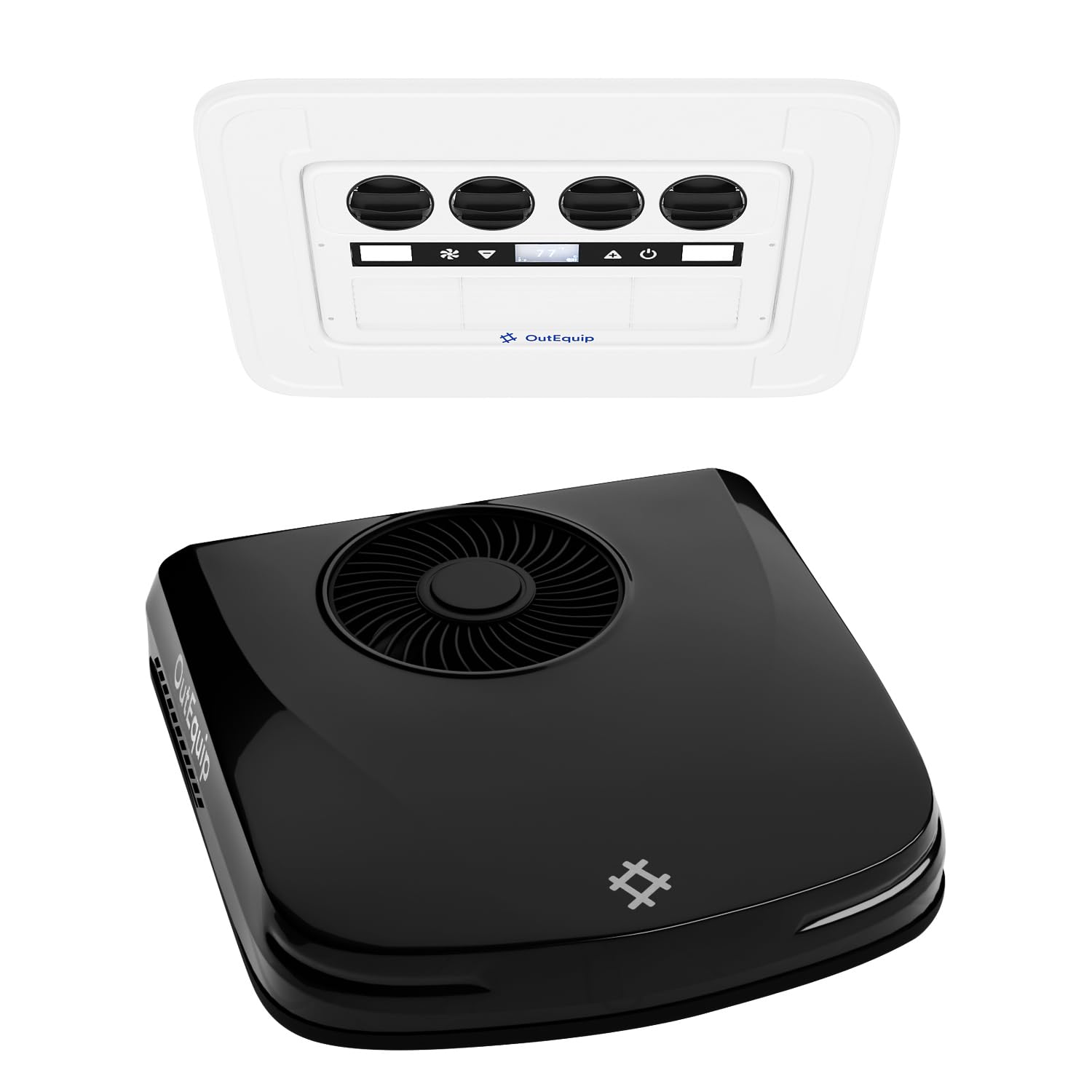
This rooftop unit is the gold standard for true 12V compressor cooling in a van or RV. Its 10,000 BTU rating and dual brushless copper motor fans produce strong, quiet airflow that can drop a cabin temperature noticeably in about 15 minutes. Build quality is clearly a priority here—the UV-resistant ABS housing, zinc-coated condenser, and EPDM foam gasket are engineered for long-term outdoor exposure.
For off-grid users, the power efficiency is a standout: maximum draw hovers around 650 watts, and the unit can run for roughly 8 hours on a 480Ah battery bank. The included wireless remote and multiple modes (Eco, Sleep, Turbo) give you fine-grained control over power consumption versus cooling intensity. It also supports running while the vehicle is driving, which is a huge bonus for over-the-road comfort.
The integrated heater is functional but noisy and not a primary selling point—most users will rely on a separate heating source. Installation requires a roof cutout and is not a simple plug-and-play process, but the lower profile and significantly lighter weight compared to Dometic units make it a favorite among upfitters and DIY van builders. Customer support is responsive and has been praised for handling installation questions personally.
Why it’s great
- True compressor AC with 10,000 BTU for serious cooling
- Very low power draw for its class (~650W max)
- Sleeker, lighter, and quieter than Dometic rooftop units
Good to know
- Requires significant roof modification for installation
- Heater is noisy and not very effective
- High entry price for a single-use vehicle AC
2. ZAFRO 16,000 BTU Inverter Portable AC
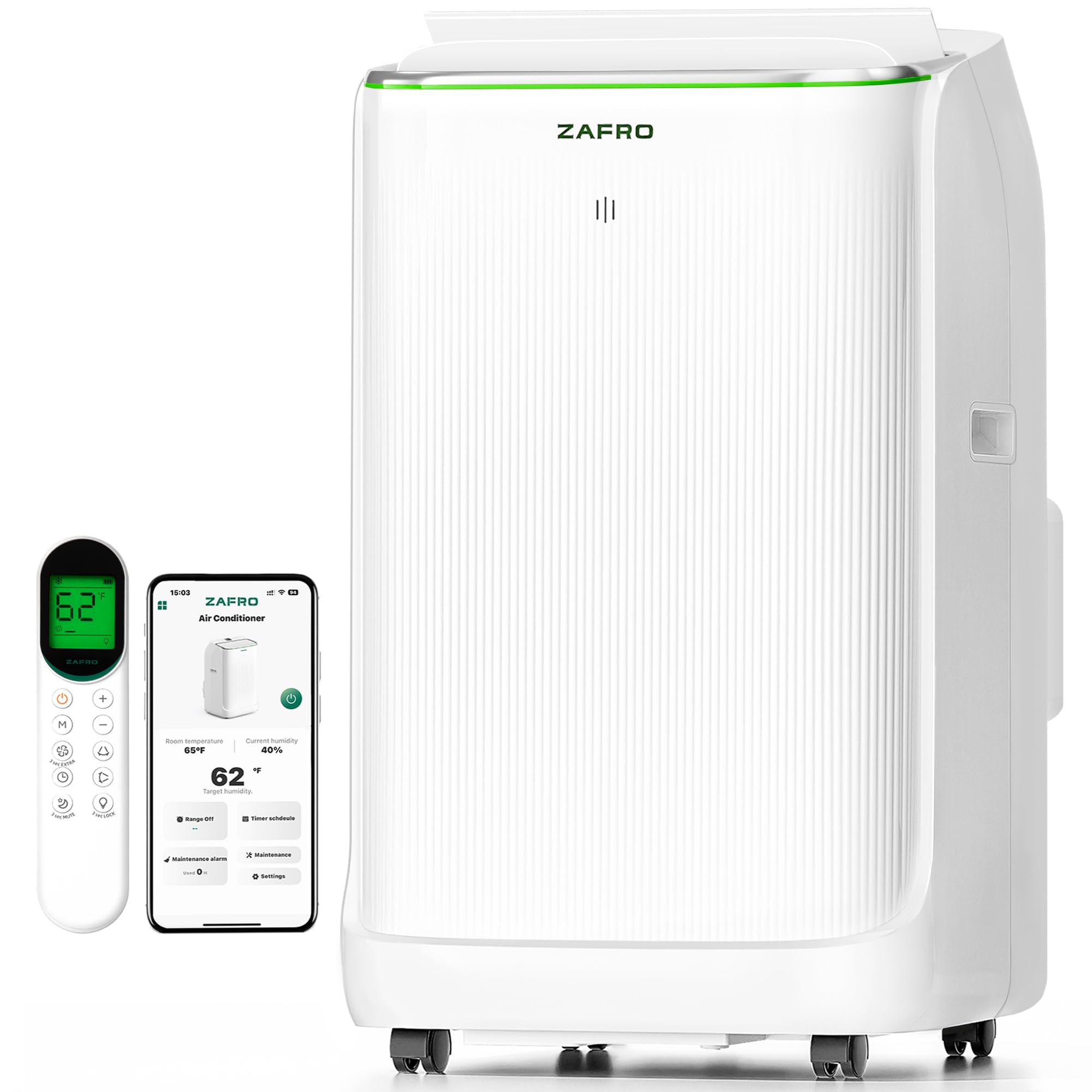
The ZAFRO is a home-grade 16,000 BTU inverter AC that happens to be perfectly portable for larger RVs, camper vans with shore power, or even a home garage workshop. Its dual-hose system ensures that hot exhaust air is expelled efficiently without creating negative pressure in the room, which dramatically improves cooling efficiency over single-hose units.
The inverter compressor is the key here—it ramps up slowly rather than cycling on/off, which makes it ideal for generator or power station use due to the low inrush current. In Eco mode, it runs at 38 dB, which is genuinely whisper-quiet, and the self-evaporating system means you don’t have to manually drain condensate for up to 72 hours in most conditions. The smart app control is responsive and well laid out.
At 800 square feet of coverage, this unit is overkill for a small car cabin, but for a spacious RV or truck camper, it provides room-filling, consistent cooling that smaller units cannot match. The only real drawback is the included window panel kit, which some users found too narrow to seal properly. It also requires a 110V AC outlet or a power station with at least 1,200W continuous output.
Why it’s great
- Inverter compressor for quiet operation and low startup surge
- Dual-hose system for superior cooling efficiency
- No condensate draining for up to 72 hours
Good to know
- Requires 110V AC power; not a direct 12V unit
- Window panel may need modification for a tight seal
- Large and heavy for true portable use in a car
3. WISHILO 3400 BTU Portable AC
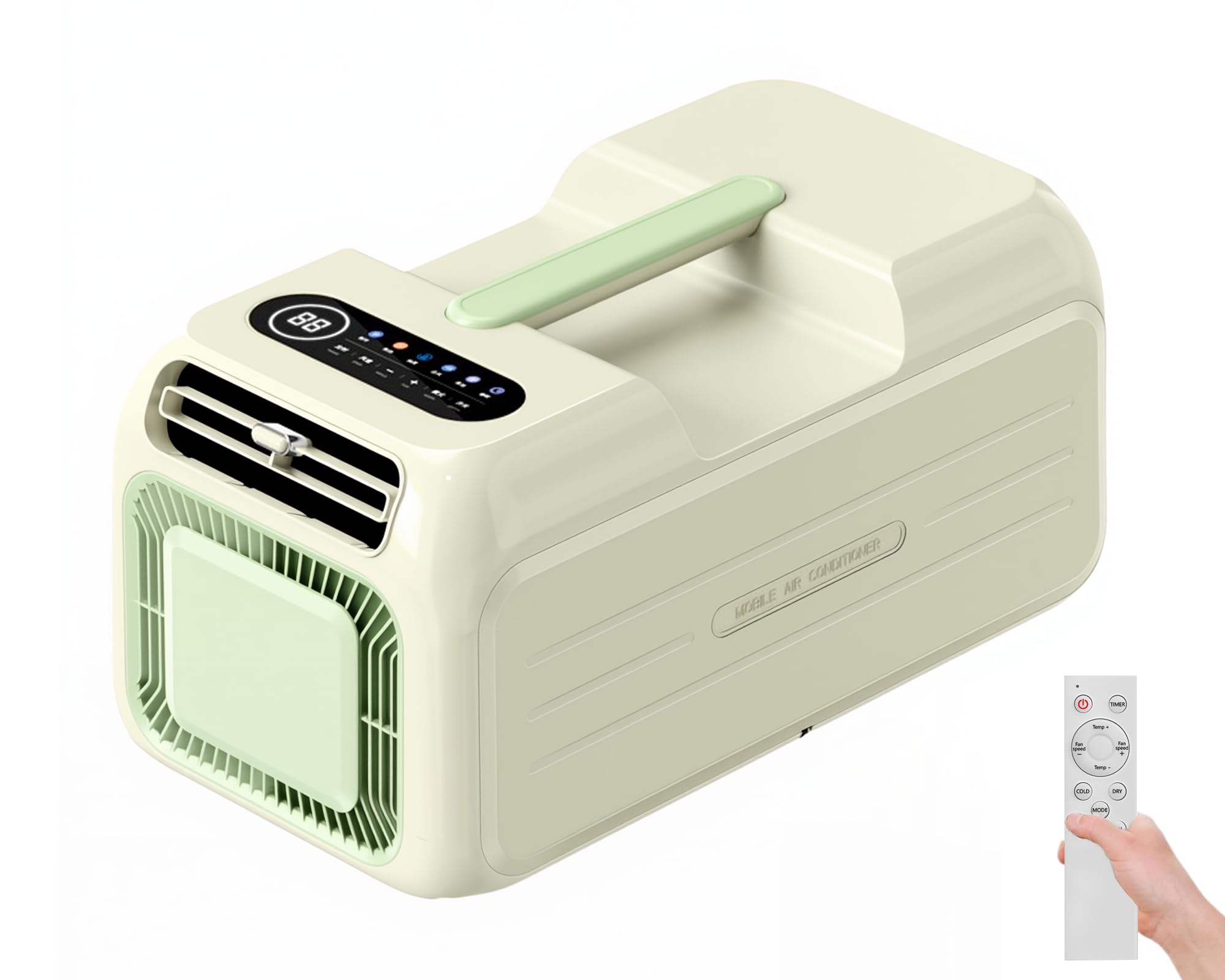
This small but mighty compressor AC is designed specifically for a 2-person tent, truck cab, or small RV cabin up to 86 square feet. What sets it apart is the Panasonic compressor and the “perfusion air duct” design that throws cool air up to 10 feet—roughly 3–5 times farther than most units in this size class. Turbo mode drops temperature by 18°F in 15 minutes.
The drainless design is a clever engineering touch: moisture from the evaporator is routed to the condenser and expelled through the exhaust fan, so you don’t have to constantly empty a drip tray. In sleep mode, it operates at just 45 dB, which is quiet enough for uninterrupted rest. The unit is also solar-ready and uses R290 refrigerant, which is more environmentally friendly than traditional refrigerants.
Startup draw spikes to about 1,500W before settling to 400–600W for continuous operation, so you need either a 1,000W+ power station or a standard household outlet. A small number of users reported unit failure after a few months, but the Boston-based company offers a 1-year warranty with stock in U.S. warehouses, and customer support is reportedly responsive and helpful with replacements.
Why it’s great
- Real compressor cooling in a compact, portable form factor
- Drainless design for hassle-free camping use
- Quiet 45dB sleep mode is genuinely restful
Good to know
- Requires 1,000W+ power station or 110V outlet
- 33 lbs is heavy for a tent AC
- A few reports of early compressor failure
4. BougeRV PC35 3500BTU Portable AC
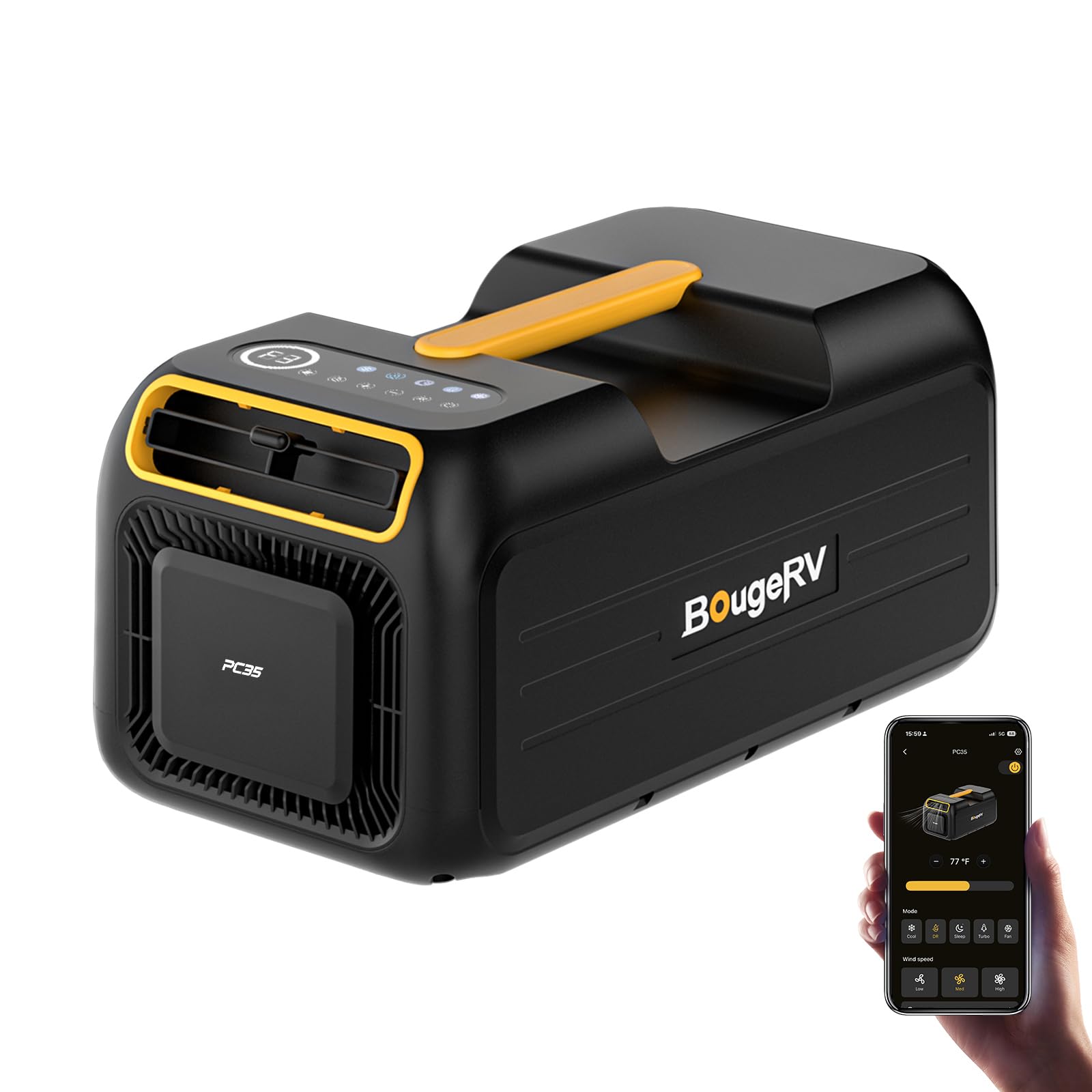
The BougeRV PC35 is a 3,500 BTU compressor-based portable AC pitched at tent campers and van dwellers who need real cooling without a huge power draw. It drops temperature by 18°F in 15 minutes in strong mode and is controllable via a dedicated smartphone app from up to 33 feet away—so you can pre-cool the tent before crawling into your sleeping bag.
At 34 pounds, it’s not lightweight, but the ergonomic handle makes it manageable for short carries. The 5-in-1 functionality covers cooling, dehumidifying, fan-only, sleep mode, and a 24-hour timer. It’s designed for small spaces up to 65 square feet, making it appropriate for a 2-person tent or the cab of a truck. The exhaust duct and window kit are included.
The main concern is reliability in extreme heat. Several users reported that the compressor shuts down with an E3 error code in ambient temperatures above 105°F, which is a deal-breaker for southwest desert camping. It also demands a serious power station—around 900–2,000 watts of inverter capacity—which adds to the total cost and weight. For moderate summer conditions, it works well, but it is not the right choice for extreme environments.
Why it’s great
- Fast temperature drop in strong mode (18°F in 15 min)
- Smart app control from 33 ft away
- Compact footprint for tent or RV use
Good to know
- Compressor may fail in ambient temps over 105°F
- Requires high-capacity power station (1,000W+)
- Heavy at 34 lbs for portable use
5. Hessaire MC37M Evaporative Cooler

The Hessaire MC37M is the standard-bearer for evaporative cooling in dry climates. With 3,100 CFM of airflow and a 10.3-gallon water tank, it can cool large spaces—up to 950 square feet—by as much as 25°F in low-humidity conditions. The three-panel intake system and the 80% larger evaporation surface than typical portable coolers mean it moves a serious volume of cool, moist air.
This unit is best suited for an open garage, patio, or workshop in Arizona, Utah, Colorado, or any place where humidity stays below 30–40%. The locking casters make it easy to roll around, and the knob controls are dead simple: fill the tank, plug it in, and flip the switch. It consumes about 1 gallon of water every 15 minutes on high, so continuous water hookup via the garden hose adapter is strongly recommended.
The biggest trade-offs are noise and build quality. It is loud, even on low—comparable to a box fan—and the plastic components feel cheap, with some users reporting broken fill door latches and warping of the water tank. It also adds significant humidity to the air, which is uncomfortable in any climate that isn’t bone-dry. For its intended use case in the arid Southwest, it is an effective and energy-efficient cooling machine.
Why it’s great
- Massive airflow (3,100 CFM) for large areas
- Effective 25°F temperature drop in dry climates
- Locking casters and simple knob operation
Good to know
- Completely ineffective in humid conditions
- Loud operation; not suitable for quiet spaces
- Plastic build feels flimsy in places
6. Saihisday Universal Evaporator Assembly Unit 12V

This is not a plug-and-play cooler—it is an under-dash evaporator unit designed for custom installation in vehicles that lacked factory AC, such as classic cars, older trucks, or custom builds. The 4-way coil design and 12V 7.6A power draw provide substantial cooling capacity (16,297 BTU cooling) and heating capacity (14,360 BTU heating) when paired with an external compressor, condenser, and dryer.
Users who have installed this unit in vehicles like 1970s C10 pickups report that it produces ice-cold output, capable of making the cab uncomfortably cold even in 90°F weather. The heating function works well too—almost too well for some, as it can warm the cab significantly on long drives. The value proposition compared to name-brand evaporator kits from RedDot or Vintage Air is excellent, often costing a fraction of the price.
The downsides are significant for anyone seeking a simple solution. There is no blend door, so heating and cooling are separate functions. The evaporator tubes are 50mm in diameter, which is non-standard for U.S. vehicles (standard is 46mm), making it difficult to find compatible directional vents without sourcing parts from Europe. A few units arrived with defective fan motors, so inspect thoroughly upon receipt.
Why it’s great
- Extremely powerful cooling for a custom install
- Includes both cooling and heating in one unit
- Massive cost savings over brand-name evaporator kits
Good to know
- Requires full AC system (compressor, condenser, lines)
- 50mm vent tubes are non-standard in the US
- Some units arrive with fan defects; inspect immediately
7. CUXPOXTU 4-in-1 Portable Air Conditioner
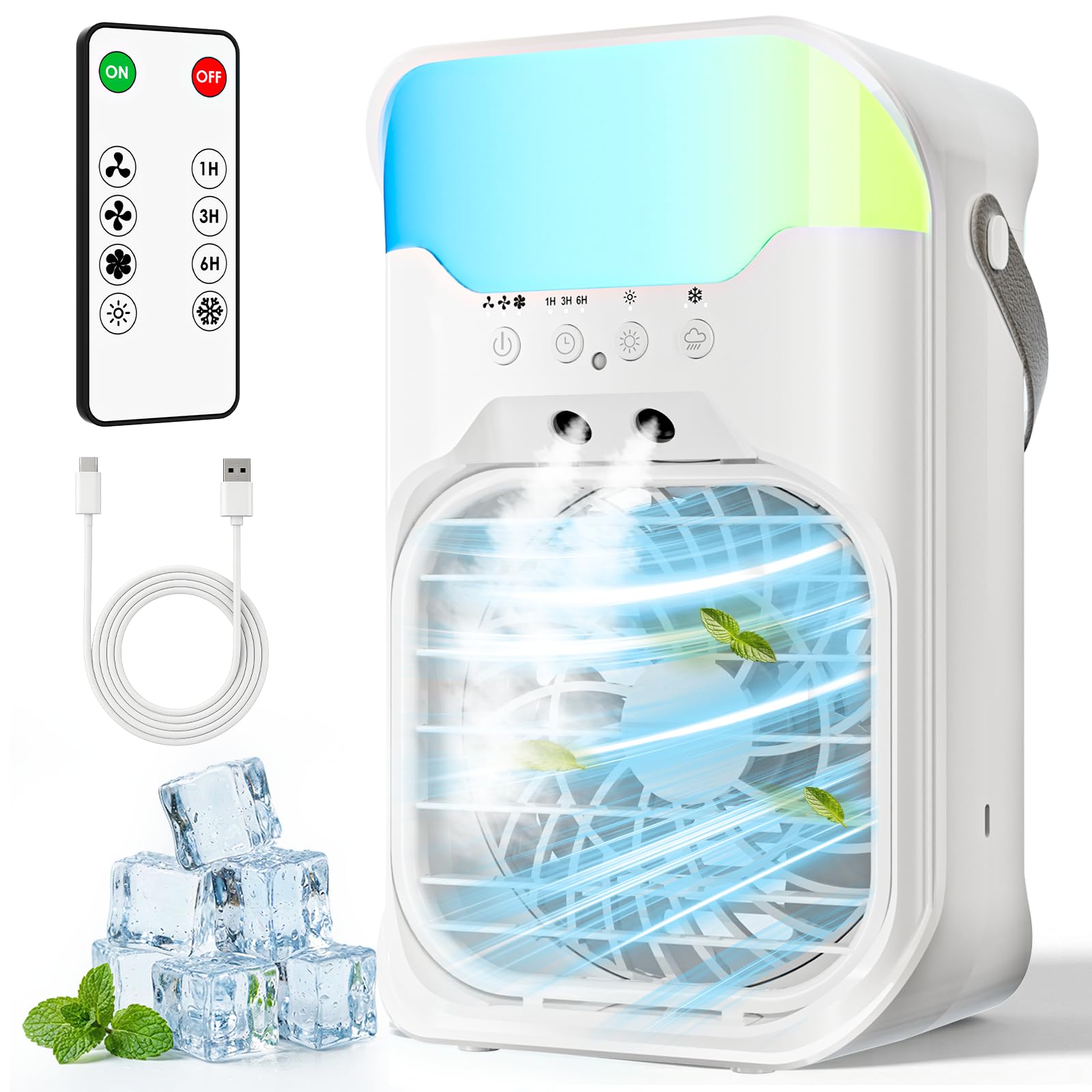
This compact evaporative cooler is best understood as a personal desk fan with a misting function rather than a true air conditioner. It draws just 7 watts of power, meaning it can run off any USB power bank or car USB port without draining your battery. The 1,600ml water tank lasts up to 6–10 hours on a single fill, and the dual mist nozzles provide a noticeable cooling sensation when filled with ice water.
The 10-color RGB night light and remote control from up to 10 meters away add a surprising level of comfort and ambiance, making it a nice companion for bedside use or in a small office. The fan blades are magnetic and easily removable for cleaning, which helps maintain performance over time. The unit is very compact at 7.4 x 5.2 x 11.2 inches.
This unit does not produce cold air using a compressor or refrigerant—it only feels cool when the evaporation of water pulls heat from the skin. In humid conditions, the effectiveness drops dramatically, and even with ice, the air temperature exiting the unit is only marginally cooler than ambient. It is a fine personal comfort device for very small spaces, but it will not meaningfully cool a vehicle cabin. Buy it for a gentle breeze with light mist, not for replacing automotive AC.
Why it’s great
- Extremely low power consumption (7W)
- Large 1,600ml tank for long runtime
- Quiet operation and useful night light
Good to know
- Evaporative cooling only; does not produce cold air
- Ineffective in high humidity
- Too small to cool a full car cabin
FAQ
Can a 12V portable car AC cool the entire cabin of a sedan?
Will a 12V air conditioner drain my car battery if the engine is off?
What’s the difference between a 12V evaporative cooler and a 12V AC compressor unit?
Final Thoughts: The Verdict
For most users, the best 12v portable car air conditioner winner is the OutEquip 12V RV Rooftop AC because it offers true compressor cooling with excellent power efficiency and a low-profile design that works for real van life and off-grid adventures. If you want quiet, portable compressor cooling for a tent or truck cab, the WISHILO 3400 BTU AC is a compact powerhouse. And for the budget-conscious builder adding AC to a classic car or work truck, the Saihisday evaporator unit delivers incredible value for a custom install.