
Waking up to a smartphone alarm is a daily compromise—the screen glares in the dark, the notification buzz tempts a scroll, and the battery drain leaves you hunting for a charger by noon. A dedicated bedside unit solves all of that with a single, focused purpose: reliable wake-up on a schedule that actually works for you.
I’m Min — the co-founder and writer behind Gadgets Feed. I’ve spent countless hours digging through spec sheets, decoding customer reliability patterns, and comparing FM reception, backup battery behavior, and display readability across the current market to separate the clocks that last from the ones that flicker out.
Whether you need a simple backup for travel or a nightly radio companion, finding the right best am/fm alarm clock radio means choosing between tuner quality, display clarity, and alarm customization that matches your sleep style.
How To Choose The Best AM/FM Alarm Clock Radio
Not all clock radios are built the same. The difference between a great bedside companion and a frustrating one often comes down to three overlooked factors: display brightness range, FM tuner sensitivity, and backup battery behavior during a power outage.
Display Brightness & Reading Distance
A display that’s too bright in a dark room can suppress melatonin and disrupt sleep cycles. Look for models with a dimmer that goes down to near-zero visibility (0% or “off” setting) rather than just three coarse levels. The best units use a continuous dial dimmer instead of fixed buttons, letting you dial in exactly the glow you want.
FM Tuner Sensitivity & Station Presets
Radio reception depends heavily on the antenna design and tuner chip. Models with a long external wire antenna generally pull in distant stations better than units with a built-in loop. If you listen to a specific station every morning, confirm the clock can save it as a preset—some budget models only offer auto-scan and no manual tuning capability.
Battery Backup Type & Reliability
The most common failure point in this category is the battery backup. AAA-battery backups keep time and alarm settings active but drain fast if left as a primary power source. CR2032 coin-cell backups last years but only retain clock memory—they won’t power the alarm during an outage. For uninterrupted wake-up, choose a model that explicitly states the alarm can sound on backup batteries.
Quick Comparison
On smaller screens, swipe sideways to see the full table.
| Model | Category | Best For | Key Spec | Amazon |
|---|---|---|---|---|
| Soundfreaq Sound Rise II | Premium | Audio quality & design | Passive radiator + Bluetooth | Amazon |
| iTOMA CKS718 | Mid-Range | Auto-set convenience | 1.4″ white LED + Bluetooth | Amazon |
| Sharp AccuSet | Mid-Range | Extra-large display | 8.9″ tilt/swivel screen | Amazon |
| Sonnet by Ken-Tech | Mid-Range | Charging station combo | 2 AC outlets + Bluetooth | Amazon |
| Dekala Sunrise | Mid-Range | Sunrise simulation | 20-level brightness ramp | Amazon |
| uscce Digital Dual Alarm | Budget-Friendly | Weekday/weekend alarms | 0-100% LCD dimmer | Amazon |
| HOUSBAY Glow | Budget-Friendly | Compact all-in-one | 7-color nightlight + nap timer | Amazon |
In‑Depth Reviews
1. Soundfreaq Sound Rise II

The Sound Rise II is the most complete bedside clock radio on the market, combining a large dimmable LCD with a genuinely impressive speaker system. A custom monophonic driver paired with a passive radiator delivers balanced audio and low-end presence that far exceeds the typical tinny alarm speaker. The FM tuner is sensitive enough to pull in distant stations with the external wire antenna, and 6 level dimmer goes sufficiently dark for pitch-black sleepers.
The alarm customization stands out: you can wake to Bluetooth audio, FM radio, nature sounds (bird chirping, ocean waves, forest sounds), or the built-in chime, and the progressive wake-up volume ramps from gentle to your preset level. Three fast USB ports—including a 20W USB-C and a QC3.0 port—charge a phone and smartwatch simultaneously. The minimalist design with textured finish and metal accents feels premium without taking up much nightstand real estate.
The main compromise is the button layout—Alarm 1 and Alarm 2 buttons are flush and hard to distinguish by touch in a dark room, and the display lacks an auto-dimming ambient sensor. A few users also report the nature sound selection is limited to six options. Still, for the combination of audio quality, charging speed, and reliable alarm behavior, this is the easiest recommendation in the category.
Why it’s great
- Audio quality with passive radiator far exceeds competitors
- Three fast USB ports including 20W USB-C
- Progressive wake-up volume avoids jarring starts
- Six nature sounds for sleep aid
Good to know
- Buttons hard to distinguish by feel in low light
- No auto-dimming ambient sensor
- Nature sound library is limited
2. iTOMA Alarm Clock Radio CKS718

The iTOMA CKS718 stakes its reputation on convenience: it automatically sets itself to the correct time, date, and day the moment you plug it in, and it re-syncs after every power interruption. The 1.4-inch white LED display is crisp and legible from across the room, and the 3-level brightness plus auto-dimmer function (which uses an ambient light sensor) keeps the glow appropriate for daytime and near-dark at night.
Bluetooth streaming works reliably for music and podcasts, and the manual or auto FM tuning handles 20 programmable presets across the 87.5–108.0 MHz band. The external FM wire antenna provides solid reception, though the auto-tune skips weaker stations. Dual alarms can be set to everyday, weekday-only, weekend-only, or single-day modes—flexibility that matches most schedules. The two-level orange night light adds a warm accent without blasting the room.
A few users report that the power adapter can fail after 1–2 years, and the Bluetooth connection produces a loud jingle when pairing that can be startling. The buzzer alarm sound increases volume jarringly fast compared to the gradual ramp of pricier models. For the auto-set convenience and clean aesthetic at a mid-range price, it’s a strong contender for anyone who hates fiddling with time settings.
Why it’s great
- Auto-set time syncs at plug-in and after power loss
- 3-level brightness with ambient light sensor
- 20 FM presets with manual tuning
- Flexible dual alarm scheduling
Good to know
- Power adapter has reported failure after extended use
- Loud Bluetooth connection chime
- Buzzer alarm rises too quickly compared to gradual ramp
3. Sharp Digital Alarm Clock AccuSet

Sharp brings its television engineering pedigree to the bedside with the AccuSet, a clock radio built around an 8.9-inch LED screen with 3-inch tall digits that can be read from across the room without glasses. The tilt-and-swivel display lets you angle the screen to eliminate glare or align with your head position, a thoughtful feature for shared bedrooms or hotel desks where viewing angle isn’t fixed.
The AccuSet system pre-programs the time based on your selected time zone, so plugging it in yields the correct time without button-pushing. The FM radio stores up to 10 presets and produces notably clear sound from its larger internal speaker—a benefit of the generous cabinet size. Dual alarms with independent settings and a 9-minute snooze cover the basics, and the 2-amp USB rapid charge port delivers faster charging than the 1-amp standard found on most clocks.
The main drawback is the 3-level brightness control (Off, Low, High) without a continuous dimmer dial—some users find Low still too bright for a completely dark room. A few units have shown time drift of about 5 minutes per week, and the AccuSet does not auto-adjust for Daylight Saving Time, requiring a manual flip of a rear switch. The red display is easier on night-seeing eyes than blue or white, but the limited dimming range will bother sensitive sleepers.
Why it’s great
- Extra-large 8.9″ display readable from across the room
- Tilt-and-swivel mechanism eliminates glare
- Auto time set via AccuSet system
- 2-amp USB charge port for fast charging
Good to know
- Only 3 brightness levels, no continuous dimmer
- Some units report minor time drift
- Daylight Saving Time requires manual switch
4. Sonnet Digital Alarm Clock Radio by Ken-Tech
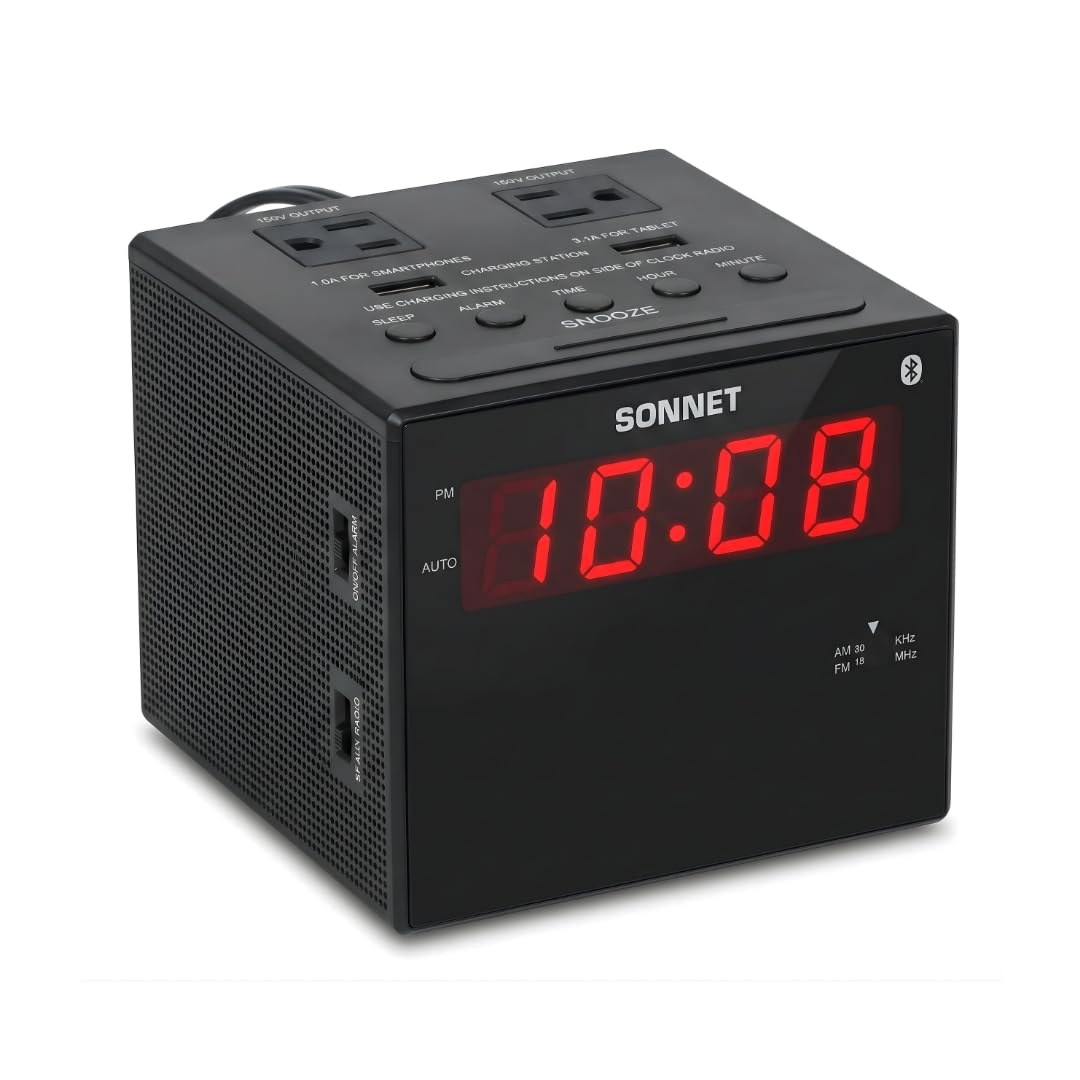
The Sonnet reimagines the clock radio as a bedside power station: two 110V AC outlets on top free up wall space for a lamp or CPAP machine, while two USB-A ports (1A and 3.1A) charge phones and tablets simultaneously. This makes it ideal for nightstands that are short on outlets, eliminating the need for a separate power strip.
Beyond its charging utility, the Sonnet includes an AM/FM tuner, Bluetooth streaming, and an AUX input. The red LED display is clear and readable from across the room with a classic look that blends into most bedroom decor. Dual alarms with snooze, a sleep timer, and battery backup (3 AAA batteries, not included) cover the essential alarm features. The compact cube shape fits in tight spaces while still offering full-sized charging ports.
The speaker quality is deliberately “old school”—adequate for talk radio and news but lacking bass for music listening. A few users report the Bluetooth or volume knob can fail, and the operation is less intuitive than some competitors, requiring a brief learning curve to switch between aux, Bluetooth, and FM sources. For those who prioritize bedside organization and charging capacity over high-fidelity audio, the Sonnet delivers unique value.
Why it’s great
- Two AC outlets and two USB ports clear nightstand clutter
- Bluetooth and AUX input for versatile streaming
- Compact cube fits tight spaces
- Classic red LED display easy to read
Good to know
- Speaker quality is basic, suitable for talk radio only
- Button and source operation requires learning curve
- Some units have reported knob or speaker failure
5. Dekala Sunrise Alarm Clock

The Dekala Sunrise Alarm Clock uses gradual light simulation to align your circadian rhythm with your wake-up time. Over 30 minutes before the alarm, the light ramps from 10% to 100% brightness with a warm color gradient, mimicking a natural dawn. The effect is particularly effective for heavy sleepers who struggle with sudden buzzer alarms—the light itself often brings you out of REM sleep before the sound even triggers.
Beyond the sunrise simulation, the sunset feature does the reverse: it dims from full brightness to zero over a duration you set, helping signal your body to produce melatonin. The FM radio covers the 76–108 MHz range (including Japanese band), and there are 8 soothing nature sounds including rain, ocean, and forest ambience for sleep aid. The dual alarms with separate schedules let partners maintain different wake times, and the 4-level display dimmer plus a separate night mode keeps the clock face dark during sleep hours.
The main limitation is that the sunrise simulation is most effective in a completely dark room—any ambient light from windows or hallway lights reduces its impact. The plastic construction feels lighter than the price suggests, and the snooze button’s top-mounted position can be pressed accidentally while fumbling for it. For anyone who dreads morning alarms and wants a gentler transition to wakefulness, the Dekala is a proven behavioral tool.
Why it’s great
- Gradual sunrise simulation aligns with natural circadian rhythm
- Sunset simulation aids falling asleep
- 8 nature sounds for versatile sleep aid
- Dual alarms with independent weekday/weekend scheduling
Good to know
- Light simulation requires completely dark room for best effect
- Plastic build feels lighter than price suggests
- Snooze button can be pressed accidentally during fumbling
6. uscce Digital Dual Alarm Clock Radio

The uscce punches above its price point with a 0-to-100% continuous dial dimmer that lets you dial the LCD brightness down to complete darkness—a feature typically reserved for premium models. The 3.4-inch LCD displays the time, day, temperature (in °F or °C), alarm status, and ringtone icons, all on a single screen that’s readable without reading glasses.
Dual alarms offer separate weekday/weekend/all-7-day scheduling, and you can wake to 5 built-in tones (beep, piano, buzzer, bird, soft music) or FM radio, with 15 volume levels and a gradual crescendo that starts soft. The FM radio saves up to 40 stations with auto-scan, and the sleep timer runs from 10 to 150 minutes. Two USB ports (1A each) handle overnight device charging, and the 3.5mm headphone jack lets you listen privately without disturbing a partner.
The biggest frustration is the FM auto-tuner: it only scans and stores the first 30 strongest stations, and manual tuning is cumbersome (requires removing batteries and unplugging). The alarm-off button is small and sits close to other controls, leading to occasional mis-presses in the morning. The AAA battery backup drains quickly if used regularly, so treat it as emergency-only. For the price, the dimmer range and alarm flexibility are exceptional.
Why it’s great
- Continuous 0-100% dimmer reaches true darkness
- Dual alarms with weekday/weekend scheduling
- 40 FM presets with auto-scan
- Two USB ports and headphone jack
Good to know
- FM auto-tune only captures first 30 strongest stations
- Alarm-off button is small and easy to miss
- Battery backup drains quickly during regular use
7. HOUSBAY Glow Small Alarm Clock Radio

The HOUSBAY Glow packs an impressive feature set into a compact oval body that occupies minimal nightstand space. Its defining feature is the 7-color nightlight with 5 brightness levels for each color, letting you set a warm amber for reading or a soft blue for sleep ambience. The LED full-array display is clear and offers a continuous dial dimmer that lets you dial the brightness from full visibility to near-zero glow.
The FM radio includes an auto-off sleep timer (simultaneously controlling both the nightlight and radio), and the dual alarm offers three wake sounds: radio, built-in beep, or birds chirping. The alarm volume increases gradually to avoid startling you awake. A dedicated nap timer button sets a single-press nap from 10 to 120 minutes without affecting your regular alarm programs—a genuinely useful feature for shift workers or weekend nappers.
The radio lacks manual tuning—only preset scanning is available, and the current frequency isn’t permanently displayed on screen. The snooze button is small and can be hard to locate by touch in the dark. Some early units showed time drift of 3–5 minutes per week, though recent production seems to have resolved this with a standard power cord design. For its compact footprint and nightlight versatility, it’s a strong choice for kids’ rooms and travel.
Why it’s great
- 7-color nightlight with 5 brightness levels per color
- Nap timer with single-button 10-120 min operation
- Continuous dial dimmer for display brightness
- Compact oval shape fits small spaces
Good to know
- No manual FM tuning, only preset scanning
- Station frequency not permanently displayed
- Early units had time drift; newer units fixed
FAQ
Will an AM/FM alarm clock radio work without an internet connection?
Can a clock radio automatically update for Daylight Saving Time?
What battery backup is best for keeping alarm settings during power outages?
Final Thoughts: The Verdict
For most users, the best am/fm alarm clock radio winner is the Soundfreaq Sound Rise II because it combines the best audio quality, fast USB-C charging, nature sounds, and a reliable dual alarm system in a compact design that feels like a proper bedside instrument. If you want the best display readability without glasses, grab the Sharp AccuSet with its 8.9-inch tilt-and-swivel screen. And for the budget-conscious buyer who wants a 0-100% dimmer and weekday/weekend alarm scheduling, the uscce Digital Dual Alarm delivers exceptional value without compromising on the features that matter most for a good night’s sleep.