
An arm bike machine converts a simple pedaling motion into targeted upper-body rehabilitation, low-impact cardio, or full-body conditioning — all from a seated position. Unlike traditional stationary bikes that lock you into a leg-dominant workout, these machines let you isolate the arms, shoulders, and core, making them indispensable for stroke recovery, post-surgery therapy, or simply maintaining mobility while working at a desk. The key differentiator comes down to magnetic resistance smoothness, build stability, and whether the unit also accommodates lower-body work.
I’m Min — the co-founder and writer behind Gadgets Feed. For this guide, I spent hundreds of hours cross-referencing resistance mechanisms, crank-arm lengths, frame weights, and real-world user feedback from physical therapy and general fitness contexts to separate the machines that genuinely hold up from those that slide across the floor under tension.
Whether you need gentle assisted rotation for muscle weakness or a rigged magnetic flywheel for progressive overloading, this roundup of the best arm bike machine options covers every meaningful spec, stability quirk, and rehab-friendly feature you can expect.
How To Choose The Best Arm Bike Machine
Buying an arm bike machine is different from picking a standard stationary bike because the physics of upper-body pedaling places unique demands on stability, resistance control, and range of motion. The wrong choice will slide across the floor when you push hard or offer too little resistance to rebuild atrophied muscles. Here are the three factors that separate effective rehab tools from frustrating clutter.
Resistance Type: Magnetic vs. Felt-Pad vs. Motorized
Magnetic resistance is the gold standard for any arm bike machine used in therapy or daily conditioning. It delivers smooth, silent pedaling without the jerky start-stop feel of felt-pad systems, and it never wears out no matter how many sessions you log. Felt-pad friction units are cheaper but degrade quickly and introduce uneven drag at low speeds. Motorized models, like the Nobol PhysioPedal, add an active assist mode that literally turns the pedals for users who lack the strength to initiate motion — a critical feature for severe muscle weakness or early-stage stroke recovery.
Stability and Anti-Slip Design
An arm bike that wanders across the floor during a set of shoulder rotations is dangerous and demoralizing. Look for a high frame weight (15 lbs or more) paired with rubber or suction-cup feet that dig into carpet or tile. Machines with a U-shaped base or wide triangular stance resist tipping better than narrow four-point frames when you apply upper-body torque. Several budget-friendly models in this review — particularly the MDODM and NISDOKR units — rely on suction cups that work on smooth floors but may require a rug or mat on carpet.
Dual-Use Capability and Crank Geometry
Many arm bike machines double as leg exercisers, but the transition quality varies widely. Dedicated hand pedals with textured grips are preferable to pulling off foot pedals and attaching them to a handlebar post. Pay attention to crank-arm length: shorter cranks (around 3 inches) limit range of motion for tall users and reduce the effectiveness of arm workouts, while longer cranks (5 to 6 inches) engage the full shoulder and elbow arc. Premium units like the DeskCycle MagneTrainer let you buy separate hand-pedal attachments that clip in instantly, preserving the dedicated design for each use case.
Quick Comparison
On smaller screens, swipe sideways to see the full table.
| Model | Category | Best For | Key Spec | Amazon |
|---|---|---|---|---|
| DeskCycle MagneTrainer-ER | Premium | Ultra-smooth shoulder rehab | 23 lbs frame, infinite magnetic resistance | Amazon |
| VANSWE Recumbent Elliptical | Premium | Full-body low-impact cardio | 400 lbs capacity, 8-level magnetic, Bluetooth | Amazon |
| pooboo W216 Recumbent | Premium | Recumbent arm & leg training | 80 lbs, belt drive, 8 resistance levels | Amazon |
| Nobol PhysioPedal Motorized | Premium | Motorized assist for weakness | 6 motorized speeds, 8 manual levels, remote | Amazon |
| pooboo Under Desk (E355008) | Mid-Range | Quiet desk-based arm cycling | 16 magnetic levels, <15 dB, 18.9 lbs | Amazon |
| YOSUDA Under Desk Bike | Mid-Range | Quiet office-friendly workouts | 16 magnetic levels, <10 dB, 17.9 lbs | Amazon |
| MDODM Full Body Pedal Exerciser | Mid-Range | Adjustable height for arm rehab | 264 lbs capacity, 5-level height, bands | Amazon |
| ZIDAFIT Adjustable Pedal Exerciser | Budget | Entry-level rehab value | 265 lbs capacity, 13.2 lbs, magnetic quiet | Amazon |
| NISDOKR Pedal Exerciser | Budget | Budget pick with foot massage | 14 lbs, carbon steel, ABS foot rollers | Amazon |
In‑Depth Reviews
1. DeskCycle MagneTrainer-ER

The DeskCycle MagneTrainer-ER is the benchmark that other arm bike machines are measured against, and for good reason. Its magnetic resistance is genuinely stepless — you turn a dial from zero to maximum drag with no mechanical notches, so shoulder rehab patients can dial in the exact tension that doesn’t provoke pain. The 23-pound frame absorbs upper-body torque without creeping across the floor, and the optional hand-pedal attachment (sold separately) snaps in via quick-connects for a dedicated arm-bike experience that doesn’t require stripping foot pedals.
Physical therapists and surgeons frequently recommend this unit precisely because the resistance range spans from buttery-light passive motion to a level that challenges even strong individuals. The Velcro pedal straps are more adjustable than the plastic-notch competitors, and the forward/reverse pedaling capability engages different muscle planes — crucial for breaking up scar tissue after rotator cuff surgery. The LCD display reads speed, distance, time, and calories, though it lacks a backlight and the resistance dial has no printed markings, so you’ll need to add your own tape indicators for repeatable sessions.
At 23 lbs, this is not a machine you toss in a closet after every use, but the weight is exactly what keeps it planted during aggressive arm cycling. Some users report slight wandering on hard floors at high resistance (above 2.5 turns on the dial), but placing it on a rubber mat solves that instantly. If you need one arm bike that performs at institutional quality without commanding a hospital price, the MagneTrainer-ER is the victor by a clear margin.
Why it’s great
- Stepless magnetic resistance is silk-smooth and infinitely adjustable
- Heavy steel frame stays planted during strenuous arm workouts
- Dedicated hand-pedal attachment upgrades to a true upper-body machine
Good to know
- Resistance dial lacks printed markings for repeatable settings
- LCD display is functional but feels basic and lacks backlight
- Optional hand pedals add to the already premium investment
2. VANSWE Recumbent Elliptical Cross Trainer
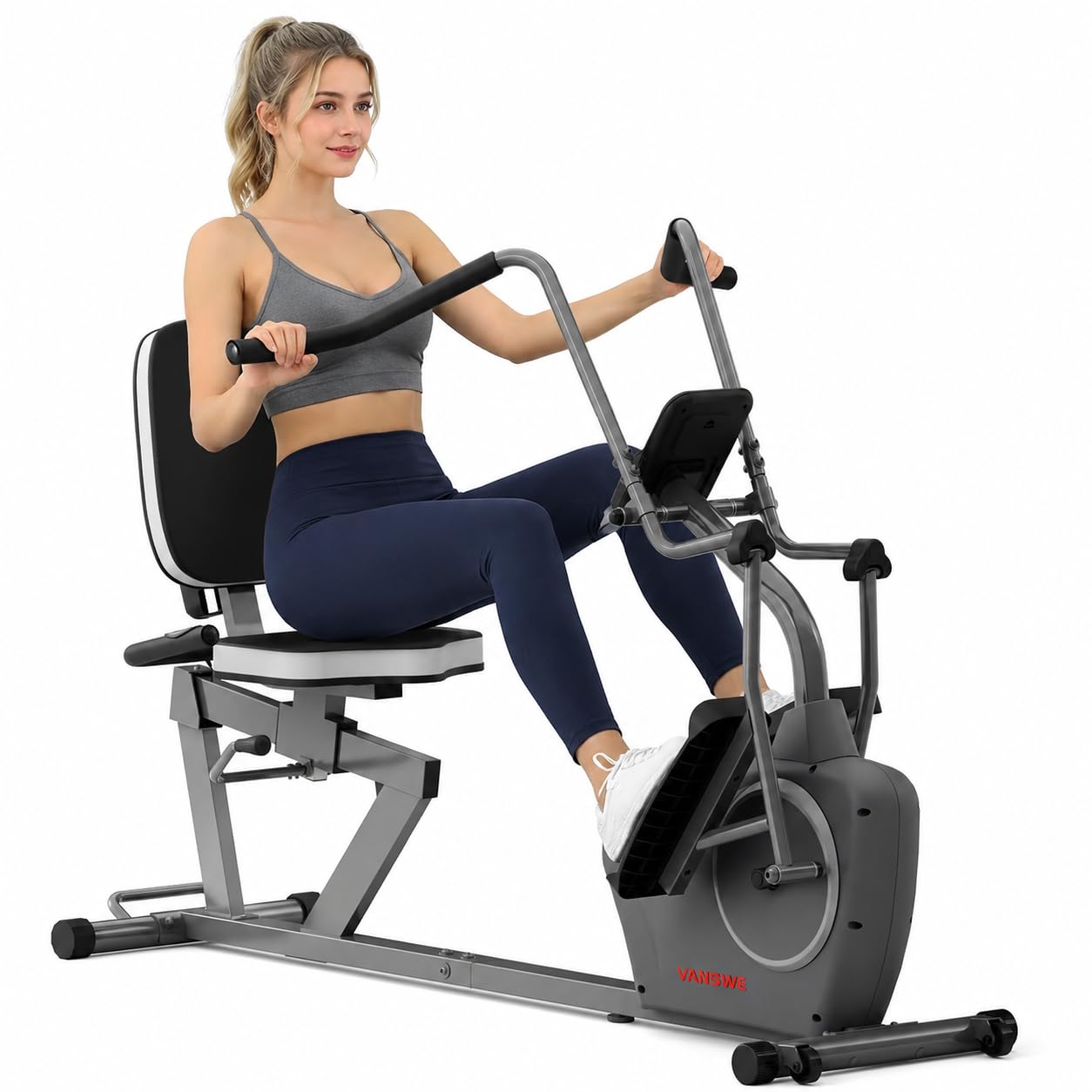
The VANSWE blurs the line between an arm bike and a recumbent elliptical by integrating moving arm handles that track with the elliptical stride pattern — not just independent pedaling. This means your upper body works in natural opposition to your legs, engaging the lats, shoulders, and triceps through a full rotational arc. The 8-level magnetic resistance system is whisper-quiet (users with neighbors in apartments report zero complaints), and the heavy-duty steel frame supports up to 400 lbs with no wobble.
What makes this machine distinct for arm-focused users is the handlebar design. Unlike a standard recumbent bike where the arms rest stationary, the VANSWE’s levers force reciprocal motion that recovers shoulder external rotation and builds endurance without loading the spine. The infinite seat slider accommodates inseams from 29 to 37 inches, so a 5-foot-2 user and a 6-foot-5 user can share the same unit without compromising arm reach. The LED backlit monitor displays time, speed, distance, calories, and heart rate, and Bluetooth syncs with Kinomap and Zwift for structured workouts.
Assembly is about 30 minutes and the machine arrives 80% pre-assembled. The 75-pound weight makes it a permanent fixture rather than a portable unit, but the front transport wheels let you roll it across a room without strain. If your goal is to combine arm conditioning with full-body metabolic work in a single seated session, the VANSWE delivers a combination of build quality and versatility that cheaper recumbent bikes simply cannot match.
Why it’s great
- Elliptical arm handles provide natural reciprocal upper-body motion
- 400 lb capacity and heavy steel frame feel bombproof
- Bluetooth app integration adds structure and motivation
Good to know
- 75 lb weight makes it a dedicated home fixture, not portable
- Pedal zip tie must be removed before first use — easy to miss
- Premium-tier investment relative to basic pedal machines
3. pooboo W216 Recumbent Exercise Bike
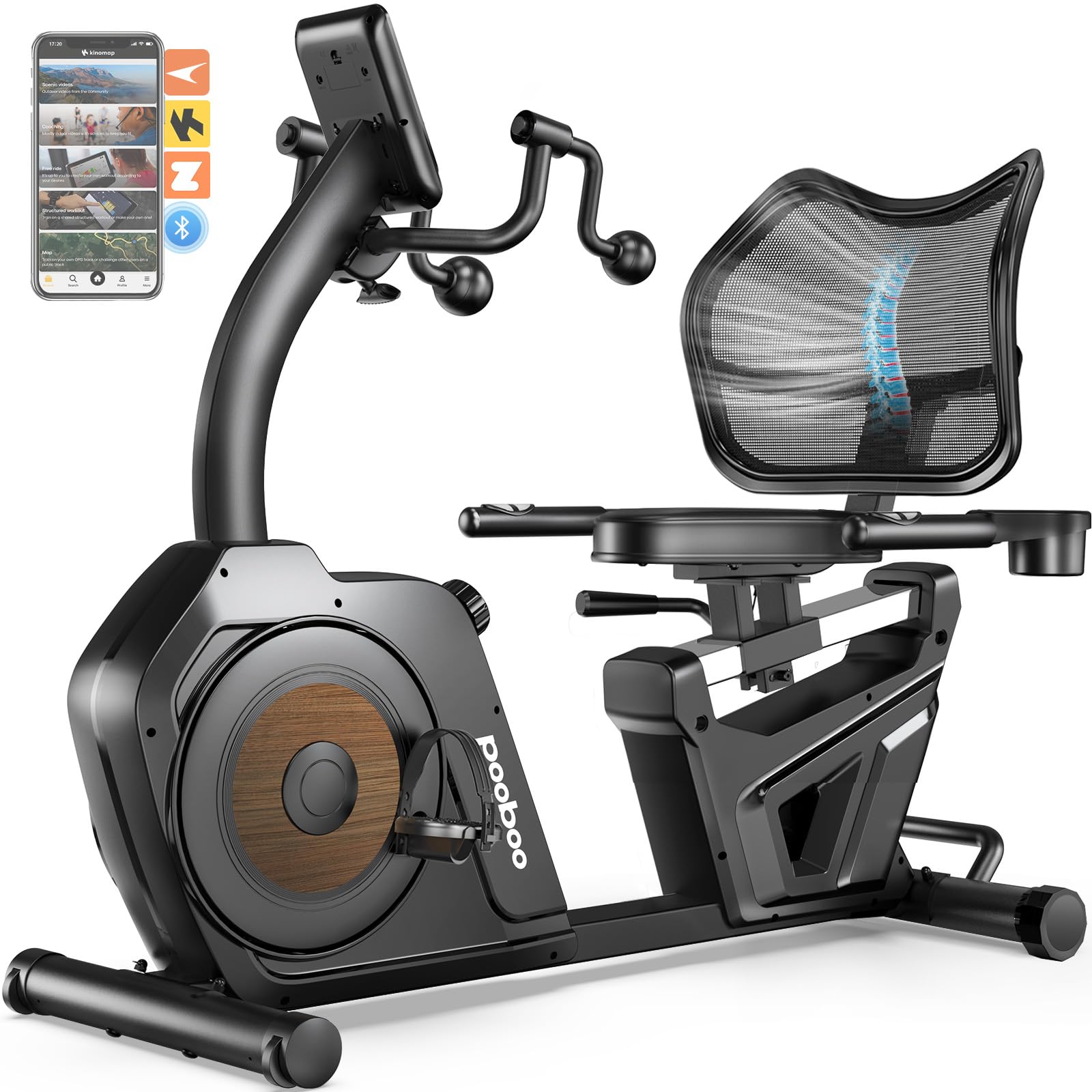
The pooboo W216 is a recumbent stationary bike with a dedicated hand crank armrest that converts it into a genuine arm bike machine — not an afterthought attachment. The front armrest rotates independently from the pedals, so you can work your arms while your legs rest, or synchronize both for a full-body session that raises heart rate without pounding joints. The 15-lb flywheel and belt drive produce sub-20 dB noise levels, making this viable for late-night rehab sessions in shared living spaces.
Ergonomics are a strong suit here. The breathable mesh backrest follows the natural curve of the spine, reducing lower back fatigue during extended arm-dominated sessions. The seat rail adjusts up to 18.5 inches fore-aft, accommodating users up to 6-foot-3, and the eight resistance levels progress from a gentle warm-up (levels 1-2) through brisk cardio (3-5) up to simulated climbing (6-8) for arm endurance. The LCD monitor tracks speed, distance, time, calories, odometer, and pulse via hand-grip sensors, and the built-in tablet holder lets you follow guided rehab videos.
At 80 pounds, this is the heaviest unit in this roundup and requires a designated workout area. Assembly is straightforward with 80% pre-assembly, taking roughly one hour. A few users noted that the pulse sensors are less accurate than a chest strap, but for general heart-rate trending they are adequate. If you need a machine that functions as both a recumbent bike for leg recovery and a dedicated arm bike for upper-body work, the W216 bridges that gap more effectively than any other hybrid in this tier.
Why it’s great
- Independent hand-crank armrest provides true upper-body isolation
- Whisper-quiet belt drive works in shared living spaces
- Ergonomic mesh backrest reduces fatigue during arm-focused sessions
Good to know
- 80 lb weight requires a permanent home spot
- Pulse sensors are less accurate than dedicated monitors
- Resistance only has 8 levels versus 16 on dedicated arm bikes
4. Nobol PhysioPedal Motorized Exercise Bike

The Nobol PhysioPedal is the only arm bike machine in this list that actively rotates the pedals for you. Its motorized mode operates at six speed settings (20 to 90 RPM), allowing users who cannot initiate pedaling due to stroke or severe weakness to receive assisted motion that rebuilds neural pathways and muscle memory. The transition to manual mode is seamless — eight resistance levels provide progressive overload once the user regains enough strength to contribute their own power.
This unit comes with detachable pedals that swap for arm handles in seconds, so you can place it on a tabletop for upper-body motorized cycling or on the floor for leg work. The wireless remote control lets you adjust speed, direction (forward or reverse), and on/off without bending over — a critical usability feature for wheelchair users or those with limited trunk mobility. The LED display tracks time, count, calories, and speed, and the 19-pound design is portable enough to move between a living room recliner and an office desk.
Where the PhysioPedal stands apart is its medical-grade intention. The motor is steady and quiet, the resistance in manual mode is smooth rather than ratchety, and the base uses a heavy rubberized pad that does not slide on tile or hardwood. The remote is the sole control interface — there are no buttons on the unit itself — so losing the remote means losing all functionality. For anyone in a formal rehab program where passive range-of-motion is prescribed alongside active strengthening, this machine is a category unto itself.
Why it’s great
- Motorized mode provides assisted rotation for users who cannot self-pedal
- Detachable pedals convert to arm handles for tabletop upper-body use
- Wireless remote enables adjustment without bending or reaching
Good to know
- All control depends on the remote — losing it disables the unit
- Maximum user capacity is 250 lbs, lower than most manual units
- Motorized mode is premium-priced compared to passive-only bikes
5. pooboo Under Desk Bike (E355008)
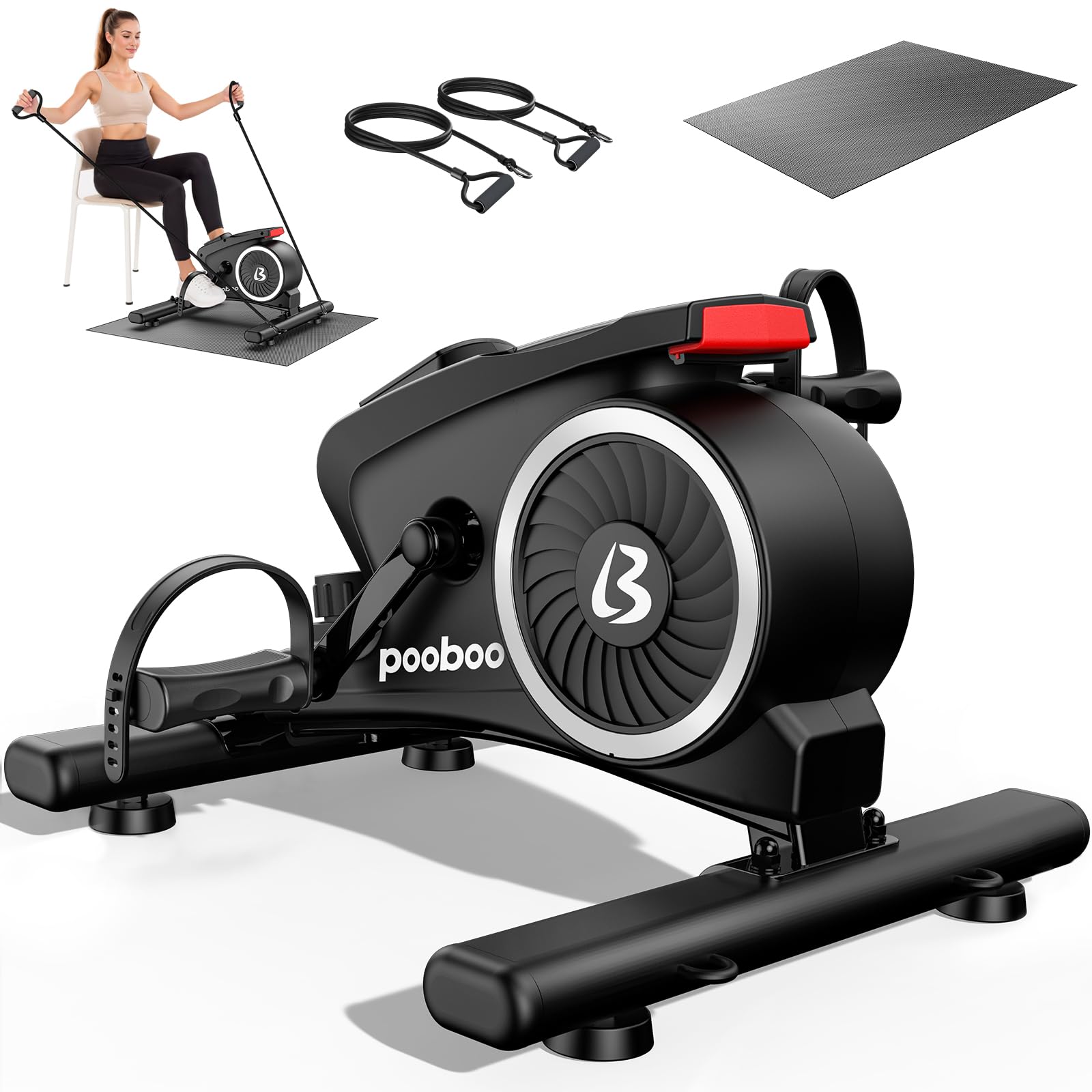
The pooboo under-desk bike delivers a remarkable 16 levels of magnetic resistance in a compact 18.9-pound package that works equally well as an arm bike on a tabletop or a leg pedaler under a desk. The magnetic system produces less than 15 dB of noise — quieter than a whisper — meaning you can cycle your arms during Zoom calls without anyone hearing the mechanism. The belt drive is sealed and maintenance-free, and the forward/reverse pedaling capability targets different upper-body muscle groups.
Two included resistance bands attach to the frame for simultaneous arm pulling while you pedal, transforming an under-desk unit into a whole-body tension workout. The LCD monitor tracks time, speed, distance, calories, and odometer, and the anti-slip foot pads plus included floor mat keep the machine secure on hardwood or tile — critical when you’re using it as an arm bike on a desk where any drift could knock over a monitor. The 300-pound weight capacity is generous for this form factor.
The trade-off is that the 16 resistance levels are not as finely gradated as the stepless DeskCycle MagneTrainer — each click represents a noticeable jump in tension. Also, the unit is light enough that aggressive arm cycling at higher resistance levels can lift the base off the table if you don’t have it centered. For an affordable, library-quiet arm cycling experience that integrates into a work-from-home setup, this is a standout value with genuine muscle-building potential.
Why it’s great
- 16 magnetic resistance levels in a compact 18.9 lb design
- Near-silent operation (<15 dB) perfect for open offices
- Resistance bands included for simultaneous arm pulls
Good to know
- Resistance clicks are stepped, not infinitely adjustable
- Light base can lift on tabletops during aggressive arm cycling
- Pedal straps may catch on resistance band loops during use
6. YOSUDA Under Desk Bike Pedal Exerciser
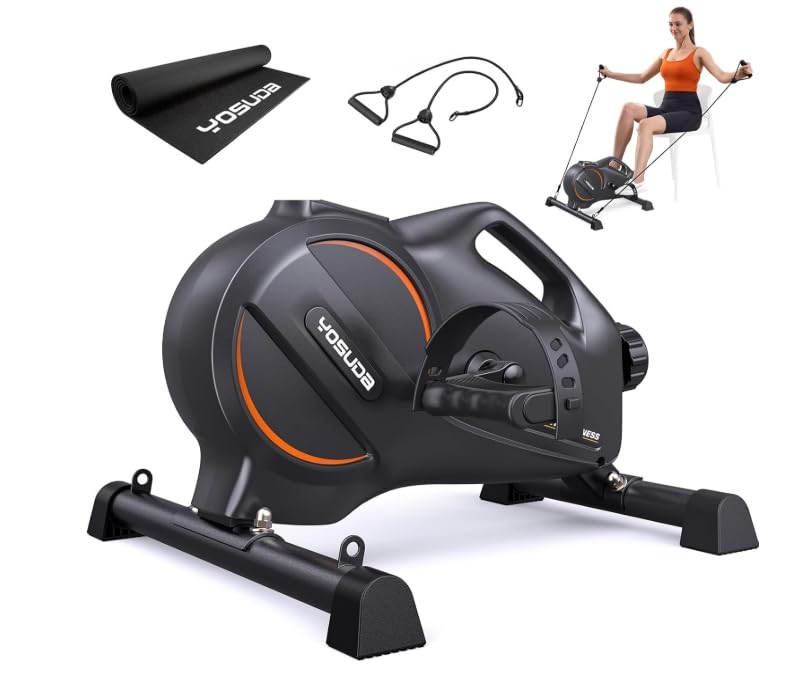
The YOSUDA under-desk bike competes directly with the pooboo E355008 but pushes the noise floor even lower — under 10 dB — making it arguably the most discreet arm bike machine for shared workspaces. Its 16 levels of magnetic resistance span from zero-drag passive motion to challenging tension for arm endurance work, and the gripper feet plus included non-slip mat ensure the unit stays planted on any flooring. Short 3-inch crank arms limit the pedaling radius, which is more noticeable during arm use than leg use, but the smoothness of the magnetic drag compensates for the reduced range of motion.
A standout feature is app compatibility with Kinomap and Zwift, allowing you to follow virtual arm-cycling routes or structured interval sessions. The LCD display pairs with the app for time, speed, distance, and calorie tracking, though the screen is hard to read in low light without backlighting. The 3-in-1 design includes two resistance bands for simultaneous upper-body pulling, similar to the pooboo, but the bands attach more securely without interfering with the pedal straps.
Assembly takes about 10 minutes, and the 17.9-pound weight is light enough to carry between a desk and a sofa but heavy enough to stay put during moderate arm sessions. Some tall users report that the short crank arms make the arm cycling feel constrained, and the belt-driven mechanism can emit a faint rubbing sound when pedaling backward. For a mid-range arm bike that prioritizes workplace silence and app-based tracking, the YOSUDA is a polished option that trades raw power for discretion.
Why it’s great
- Under 10 dB noise makes it invisible in quiet offices
- Kinomap and Zwift app integration for structured arm cycling
- Dual anti-slip design keeps it stable on any floor surface
Good to know
- Short 3-inch crank arms limit upper-body range of motion
- LCD display lacks backlight, hard to read in dim lighting
- Belt may produce a faint rubbing noise during reverse pedaling
7. MDODM Full Body Pedal Exerciser

The MDODM pedal exerciser addresses the most common complaint about budget arm bikes — inadequate height adjustment — by offering five positions for the handlebar and center pillar, giving a total height range from 31 to 43 inches. This matters enormously when using the machine as an arm bike, because aligning the pedal axis with your shoulder height prevents compensatory shrugging that strains the neck. The base also extends from 15.7 to 21.5 inches to accommodate different chair distances.
The unit includes two resistance bands for pulling exercises, and the tension on both handles and pedals is adjustable via a manual knob. Construction uses thickened steel tubing with a triangular base and four non-slip suction cups, though several users note that on carpet the suction cups do not grip firmly — the frame can slide during arm work unless you weigh it down with your feet. The LCD display shows time, counts, total counts, and calories, and the one-button interface is simple enough for elderly users to operate without confusion.
At 15.6 pounds, this is light enough to move but light enough to drift during high-tension arm sets, especially on smooth floors. The included foam handle grips are comfortable for hand cycling, and the foot massager rollers on the base add a recovery element for post-workout relaxation. For users who need a highly adjustable, low-cost arm bike frame that allows proper ergonomic positioning from a standard chair, this is the most flexible option in the mid-range tier.
Why it’s great
- Five height adjustments allow proper shoulder alignment for arm cycling
- Extendable base fits different chair distances and body sizes
- Includes resistance bands and foot massage rollers
Good to know
- Suction cups fail on carpet — requires a mat or hardwood floor
- Lightweight frame can slide during intense arm workouts
- Assembly instructions are poorly translated and confusing
8. ZIDAFIT Adjustable Pedal Exerciser

The ZIDAFIT pedal exerciser is the entry point for anyone who wants to test whether an arm bike machine fits their rehab or fitness routine without a major commitment. Despite its budget-friendly position, it offers genuine magnetic resistance — not felt pads — resulting in quiet operation that many reviewers describe as a significant upgrade over friction-based mini bikes. The frame supports up to 265 lbs, and four suction cups keep it stable on tile or hardwood during both arm and leg exercises.
Included accessories set this apart from other budget options: you get two special gloves with textured palms that improve grip during hand cycling, plus the machine itself weighs only 13.2 lbs, making it genuinely portable between rooms. The LCD monitor tracks time, distance, calories, and counts with a single-button interface that is intuitive for elderly users. Height and tension are adjustable, and the 17 by 20.5 by 35.8-inch dimensions fit under most desks or tables when not in use as an arm bike.
The compromises are what you would expect at this tier. The digital display requires a long press to reset, which some users find finicky, and the assembly instructions are reversed from the product photos, causing initial confusion. The pedals are small and the included mitts are difficult to fit onto large hands. For gentle daily rehabilitation and basic cardiovascular maintenance, however, the ZIDAFIT delivers surprising value for a fraction of the investment of premium units.
Why it’s great
- Genuine magnetic resistance at the most accessible entry point
- Ultra-portable 13.2 lb design with included rehab gloves
- 265 lb weight capacity exceeds many budget competitors
Good to know
- Assembly instructions are incorrectly reversed from product photo
- Included mitts are too small for larger hands
- LCD reset procedure is not intuitive for all users
9. NISDOKR Pedal Exerciser Upgraded Version

The NISDOKR pedal exerciser differentiates itself in the budget tier with an integrated foot massage roller built into the base of the frame — a unique recovery feature for users who spend extended periods in a seated position. The carbon steel construction and ABS components give it a sturdier feel than its 14-pound weight suggests, and the adjustable tension plus height settings allow basic arm cycling from any chair height. The included pair of special gloves aids grip for those with reduced hand strength.
The LCD monitor displays time, distance, calories, counts, and total counts in sequence with a single button press, and users can set their preferred metric to display permanently. The knob-style tension control is simple to operate, and the four suction cups help anchor the unit on smooth floors. Several rehabilitation patients report using this successfully after neck, shoulder, and lumbar spine surgeries to prevent muscle atrophy without provoking pain.
Where the NISDOKR falls short is pedal smoothness — the mechanism is not as glassy as magnetic-only units, and some users note a slight catch or resistance inconsistency during each revolution. The bike also tends to lift off the floor during pedaling because the 14-pound frame is not heavy enough to counteract upper-body torque; placing a weight on the base solves this. For a budget arm bike with the bonus of foot massage and a simple display, it serves its purpose as a low-cost therapy tool for light daily use.
Why it’s great
- Built-in foot massage rollers add recovery value during cycling
- Carbon steel frame feels denser than weight suggests
- Special gloves included for users with weak hand grip
Good to know
- Pedal motion can feel slightly uneven with a catch per revolution
- 14 lb frame lifts during aggressive arm cycling without added weight
- Suction cups work poorly on carpeted floors
FAQ
Can I use an arm bike machine if I have had a shoulder replacement?
How does arm cycling compare to rowing for upper body fitness?
Do I need a motorized arm bike or is manual resistance enough?
Why does my arm bike slide when I pedal hard and how do I fix it?
Final Thoughts: The Verdict
For most users, the best arm bike machine winner is the DeskCycle MagneTrainer-ER because its stepless magnetic resistance, 23-pound stability, and optional hand-pedal attachment deliver institutional-grade quality that supports everything from gentle rehab to aggressive conditioning. If you want motorized assist for progressive recovery, grab the Nobol PhysioPedal. And for full-body recumbent training with dedicated arm handles, nothing beats the pooboo W216.