
LED face masks have dropped from a four-figure dermatologist-exclusive tool to a – at-home device you can wear while answering emails or watching TV. The catch is that the cheap end of the market is littered with plastic shells that barely glow, remotes that die after three charges, and wavelength claims that sound good on the box but deliver nothing to your dermis. Finding a mask that actually puts out the right nanometers (630nm–660nm for red, 810nm–850nm for near-infrared, 415nm–460nm for blue), packs enough LED chips to matter, and holds a charge for a full week of daily use requires separating marketing from physics.
I’m Min — the co-founder and writer behind Gadgets Feed. I track the engineering specs, user longevity reports, and component quality behind hundreds of consumer devices to separate the legitimate hardware from the placebo-grade stuff.
After comparing LED chip counts, battery capacities, wavelength accuracy, and real-user durability across seven masks, here is the definitive guide to find your budget led face mask that actually works.
How To Choose The Best Budget LED Face Mask
A cheap LED face mask isn’t a bargain if it uses low-power 5mW LEDs that can’t penetrate past your stratum corneum. The first filter is raw optical power — look for masks that quote a specific irradiance value (measured in mW/cm²) rather than vague “high-intensity” claims. Budget masks with at least 200 LEDs spread across the face panel and a minimum 2000mAh battery in the controller are the baseline for seeing any real change in skin texture, fine lines, or acne over six to eight weeks of consistent use.
Wavelength Accuracy Over LED Count
A mask boasting 400 LEDs is useless if half of them emit at 590nm (yellow) instead of the therapeutic 630nm–660nm (red) or 810nm–850nm (near-infrared) ranges. Budget masks often cut costs by using broad-spectrum LEDs with loose tolerances. The cheap workaround is to look for masks that explicitly print the nanometer values (e.g., “630nm Red + 850nm NIR”) rather than just colors. If the product page only says “red light mode,” assume the wavelength is unverified.
Battery Life and Remote Durability
The single most common failure point in budget-friendly LED face masks is the detachable remote that houses the rechargeable battery. A 2000mAh or larger battery will give you 4–7 sessions per charge depending on session length. Check customer reviews for complaints about the remote failing after three to six months — that is the telltale sign of cheap USB charging ports or undersized battery cells.
Quick Comparison
On smaller screens, swipe sideways to see the full table.
| Model | Category | Best For | Key Spec | Amazon |
|---|---|---|---|---|
| INIA Red Light Therapy Mask | Mid-Range | Best Overall Value | 2600mAh Battery | Amazon |
| Lifepro Vizacure | Entry-Level | Best Entry-Level Starter | Red + Blue + Amber | Amazon |
| Led-Face-Tool 7-in-1 | Mid-Range | 7 Color Modes | 287 LED Beads | Amazon |
| YOEYOU Red Light Therapy Mask | Mid-Range | 660nm+850nm Wavelengths | 3 Intensity Levels | Amazon |
| NVBOTY 400 LED Mask | Premium | Highest LED Density | 400 LEDs + 2000mAh | Amazon |
| Shark CryoGlow | Premium | Unique Cooling Feature | Under-Eye Cryo + USB-C | Amazon |
| iRestore Illumina | Premium | Most Powerful 360 LEDs | Triple-Wavelength 635/830/415nm | Amazon |
In‑Depth Reviews
1. INIA Red Light Therapy Mask

The INIA mask sits right in the sweet spot of the budget LED mask market — it delivers dual-wavelength (630nm red + 850nm NIR) therapy from 220 high-energy LED chips that put out up to 105mW/cm² of irradiance. That irradiance figure is the actual measure of light power reaching your skin, and it is higher than many masks that cost three times as much. The 2600mAh rechargeable controller is the largest battery in this comparison, giving you roughly six to eight 20-minute sessions between charges.
You get four customizable modes (Red-L at 620nm, Red-H at 630nm, Blue at 460–470nm for acne, and a Red+Blue combination), and the NIR button lets you layer near-infrared onto any mode for deeper penetration. The timer offers 10, 20, or 30-minute sessions with auto shut-off, which is rare at this price tier. The flexible silicone shell and adjustable Velcro straps hold the mask securely against the face contour without pressure points.
Real users report brighter, more even skin tone after four to six weeks of consistent 5x/week use, and the removable eye shields block enough light to watch TV or read during sessions. The one durability concern is a small number of reports about the right light setting failing after 12+ months, but the INIA customer service team has been quick to honor the one-year warranty with replacements. For the price, you get the best combination of battery life, irradiance output, and wavelength specificity in this tier.
Why it’s great
- 2600mAh battery is the largest capacity at this price point, lasting a full week on a single charge for daily 20-minute sessions.
- 105mW/cm² irradiance with explicit 630nm red + 850nm NIR wavelengths printed on the spec sheet — no vague “light therapy” claims.
- Four dedicated light modes plus an optional NIR overlay, giving you anti-aging, blemish, and combination treatments from one device.
Good to know
- A small number of units have experienced LED failure on one side after 12–14 months, though warranty support has been responsive for verified buyers.
- The mouth opening is generous, but the mask is slightly bulkier than the ultra-light YOEYOU alternative for travel.
2. Shark CryoGlow LED Face Mask
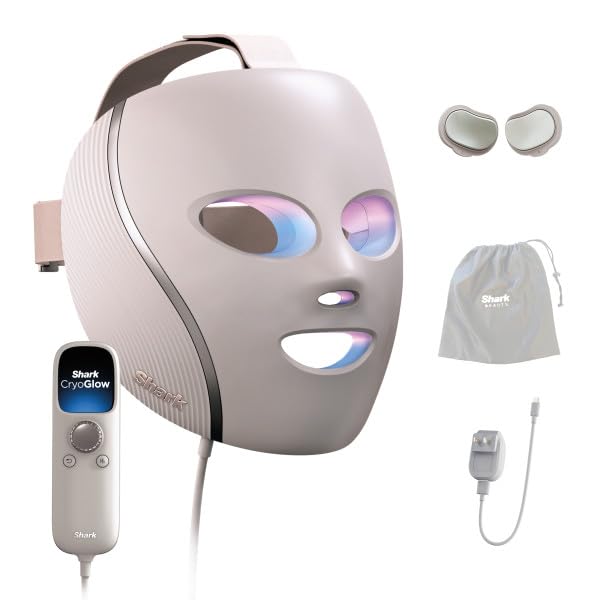
SharkNinja’s entry into the LED mask space is the CryoGlow, and it is the only mask on this list that integrates under-eye cryotherapy with LED therapy. The under-eye cooling pads use Shark’s InstaChill Cold technology, delivering a temperature-controlled 5–15 minute treatment that physically reduces puffiness while the LEDs work on fine lines and blemishes. The mask uses tri-wick iQLED sequencing that rotates red, blue, and infrared beams to avoid hot spots — a genuine engineering differentiator.
Clinically, Shark claims a 12-week study with 60 subjects showing reduced fine lines and firmer skin from the 6-minute Better Aging mode (Red + Infrared), and an 8-minute Skin Clearing mode (Blue + Infrared) for acne reduction backed by a separate 59-subject study. The sessions are short — 4 minutes for Skin Sustain, 6 minutes for anti-aging, 8 minutes for clearing — which makes it easier to fit into a daily routine than the typical 20-minute masks. The USB-C charging is a welcome modern standard.
The remote control is wireless with a clear display, and the adjustable straps keep the mask snug without feeling tight. The cooling eye pads require a short prep to activate the cold technology, but the effect is immediate and noticeably different from any other mask in this category. The build quality feels dense and premium, though the mask is slightly bulkier for travel than the silicone-based alternatives. Real user feedback consistently mentions seeing smoother texture and reduced redness after two to three weeks of daily use, with the under-eye cooling being the standout feature that keeps them coming back.
Why it’s great
- Under-eye cryotherapy is a unique feature not found in any other consumer LED face mask — it delivers visible de-puffing that complements the LED treatment.
- Short 4–8 minute session times make it practical for daily use without carving out 20 minutes per session.
- USB-C charging means one cable for your mask, phone, and laptop, reducing clutter.
Good to know
- The premium price is three to seven times higher than the other masks reviewed here, making it a luxury rather than a budget pick.
- The cooling pads produce a faint mechanical noise during operation, which some users find distracting in a quiet room.
3. iRestore LED Face Mask (Illumina)

iRestore is a dermatologist-recommended brand with over 20 years of R&D in light therapy, and the Illumina mask packs 360 LEDs into a lightweight frame. That LED count translates to 2x the power density of many competitors, with scientifically validated wavelengths — Red at 635nm for collagen stimulation, Infrared at 830nm for deeper tissue repair, and Blue at 415nm for acne-causing bacteria. The triple-wavelength approach means you can target wrinkles, dark spots, and acne with one device rather than buying separate tools.
Session time is a short 10 minutes, 3–5 times per week, which is the most time-efficient protocol in this comparison. The mask is designed to hover slightly above your face with dual straps, so there is no direct pressure on your skin, and the eye shields block direct light so you can safely watch a show or scroll through your phone. The included portable battery pack makes it truly wireless for the full 10-minute session, and the auto shut-off prevents over-treatment.
User reviews consistently note immediate improvements in skin softness and brightness after the first week, with cumulative effects on fine lines and pore appearance visible around the four-week mark. The build quality is excellent, with a curved silicone design that feels less claustrophobic than some rigid-shell masks. The only real complaint is the price, which sits at the top end of the market, but you are paying for the higher LED density and the decades of clinical backing from the brand.
Why it’s great
- 360 LEDs with three specific therapeutic wavelengths (635nm, 830nm, 415nm) provide the broadest treatment coverage of any mask reviewed.
- 10-minute sessions are the shortest effective protocol available, making it the most convenient option for busy schedules.
- Dermatologist-recommended brand with over 500,000 customers and 20+ years of light therapy research.
Good to know
- The premium price places it in the investment category, not the budget tier — expect to spend significantly more than entry-level masks.
- Some users report that the mask must be fully positioned and adjusted before turning on the lights to avoid a direct flash to the eyes.
4. NVBOTY 400 LED Mask

The NVBOTY mask distinguishes itself with 400 LEDs — more than double the count of most masks in the budget-friendly and mid-range tiers. That density matters because more LEDs packed into the same surface area means higher energy delivery to the skin per session, potentially reducing the time needed to see results. The mask uses four wavelength modes: Infrared at 850nm, Red at 630nm, Orange at 605nm, and Blue at 460nm, plus a 4-color cycle that rotates through all options automatically.
The rechargeable 2000mAh remote is detachable and controls the timer with short presses for 10, 15, 20, 25, or 30-minute sessions. The mask is made from soft, skin-friendly silicone with an all-in-one design that eliminates the need for separate straps — the mask itself holds its shape around your face. The specially designed eye shield blocks enough light to keep your eyes comfortable while still allowing you to see out, which is helpful for multitasking.
Real-world feedback is overwhelmingly positive, with users reporting dramatic improvements in acne scarring and skin glow within weeks. The most common durability complaint is the remote failing after five to six months, but NVBOTY’s customer service has been responsive, replacing defective units promptly. The consistent advice from long-term users is to use the mask 3–4 times per week for 20-minute sessions for optimal results, and the 400-LED array makes that protocol feel productive rather than wasted time.
Why it’s great
- 400 LEDs is the highest count in this comparison, delivering 2x the power density of typical 200-LED masks for faster cumulative results.
- Four dedicated wavelength modes plus a cycle option give you red, infrared, orange, and blue therapy in a single session if desired.
- All-in-one silicone design with no separate straps simplifies wear and eliminates the “losing parts” problem common with multi-strap masks.
Good to know
- The remote has been reported to fail after 5–6 months in a small but consistent subset of units, though replacement support is available.
- At 400 LEDs, the mask is slightly heavier than lower-count alternatives, which may feel noticeable during a full 30-minute session.
5. YOEYOU Red Light Therapy Mask
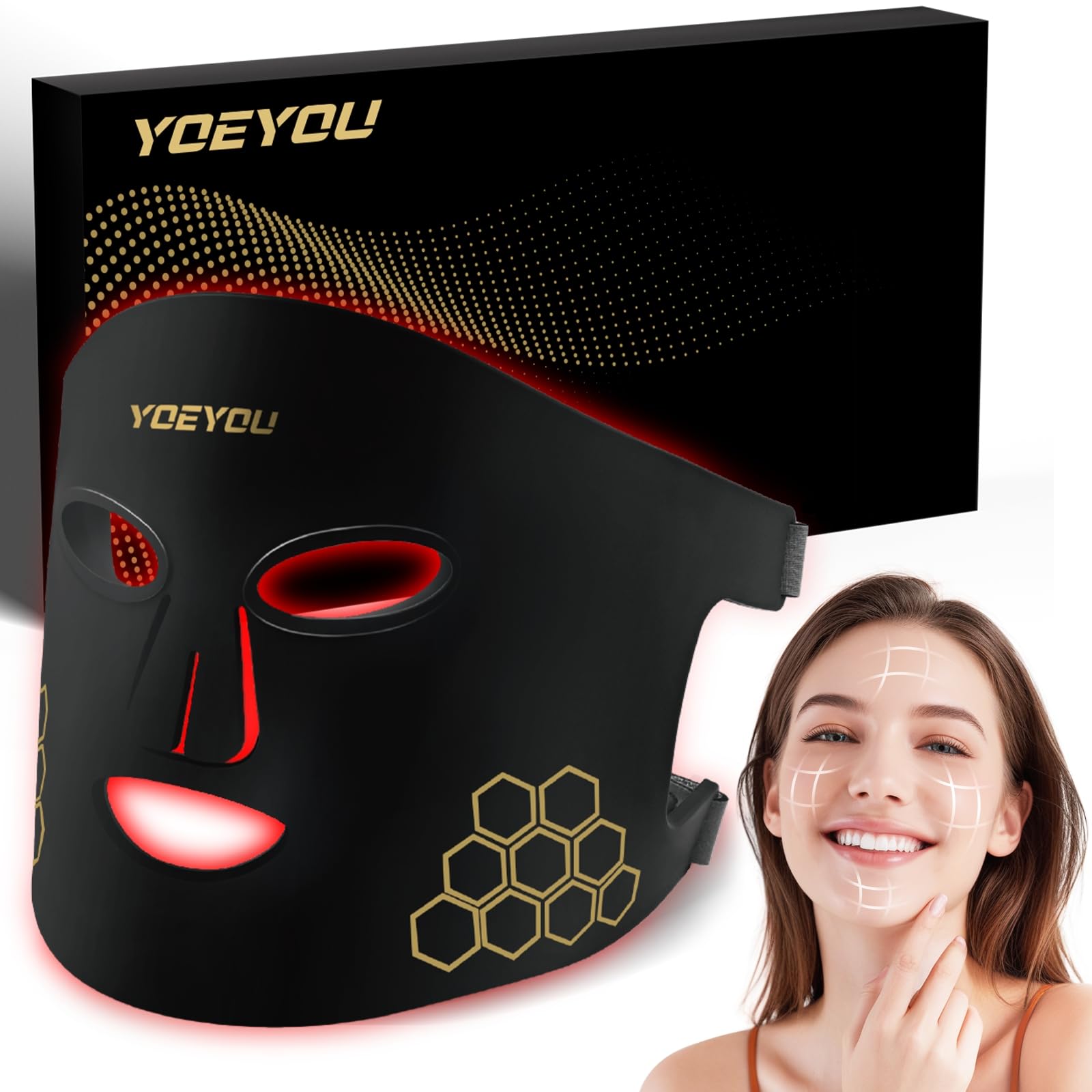
The YOEYOU mask is one of the few entry-level masks that explicitly publishes its dual therapeutic wavelengths — 660nm red and 850nm near-infrared — which are the gold-standard penetration depths for collagen stimulation and tissue repair. Most budget masks just say “red light” without specifying the nm value, which is a red flag for wavelength accuracy. The YOEYOU also uses upgraded 3-in-1 chip technology that boosts light wave aggregation by 3x, improving energy efficiency compared to single-chip LED masks.
The mask has three adjustable intensity levels and four color options (red, blue, and combination modes), with 216 intense beams of light. It is made from soft, flexible silicone that folds flat for travel and fits comfortably against facial contours. The controller connects via a USB cable, which means you are tethered during sessions — a trade-off for the lower price point but something to consider if you want to walk around during treatment.
User feedback highlights the excellent battery life as a standout feature, with some users reporting a week or more of daily 20-minute sessions between charges. The larger eye protectors block more peripheral light than most competitors, making it comfortable to keep your eyes open for reading or watching videos during treatment. The only consistent negative is that the battery life does degrade noticeably after a year of heavy use, with some users dropping to 3–4 sessions per charge by month 14. Still, for the price, the YOEYOU delivers the most honest wavelength specificity in this tier.
Why it’s great
- Explicitly specified 660nm red + 850nm NIR wavelengths — rare at this price and critical for anyone who wants clinically meaningful light penetration.
- Three adjustable intensity levels let you ramp up power as your skin acclimates, reducing the risk of irritation during early sessions.
- Foldable silicone design makes it the most portable option for travel, packing flat in a carry-on without damage.
Good to know
- The mask requires a USB cable connection to the controller to function, tethering you to a power bank or wall outlet during use.
- Battery capacity degrades noticeably after 12–14 months of regular use, shortening the window between charges.
6. Lifepro Vizacure
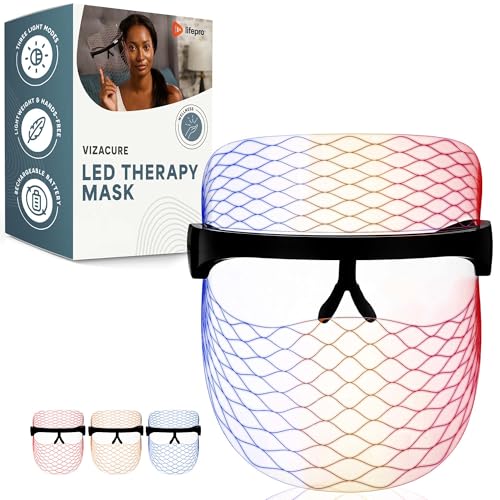
Lifepro’s Vizacure mask is the entry-level gateway to LED light therapy at a price that makes it almost risk-free to try the technology. It weighs just 2.56 ounces, making it the lightest mask in this comparison, and it cycles through red, blue, and amber light modes. The red mode targets fine lines and tightening, the blue mode addresses acne-causing bacteria, and the amber mode focuses on skin brightness and even tone.
The mask is cordless and rechargeable, with a single-button interface that cycles through the three modes automatically. Sessions are 20 minutes, and the mask shuts off automatically when the timer expires. The lightweight construction means you can wear it comfortably while walking around the house or lying in bed without feeling like you are strapped into a device. The material feels natural and high-quality despite the low price point.
User reviews highlight real improvements in inflammation and puffy eyes, with one 62-year-old user reporting noticeable reduction in allergy-related facial swelling after one month of daily use. The most common criticism is that the long-term skin improvement is subtle rather than dramatic — you are unlikely to see the collagen-boosting results of a high-LED-count premium mask. But for someone who has never tried LED therapy and wants to validate whether it works for their skin type before investing in a more powerful device, the Vizacure is the ideal low-barrier entry point.
Why it’s great
- At just 2.56 ounces, it is the lightest mask tested — you can wear it in bed, on the couch, or while doing chores without fatigue.
- Red, blue, and amber modes give you anti-aging, acne, and brightening treatments from a single lightweight device.
- Entry-level price makes it the most affordable way to test whether LED therapy produces results for your specific skin concerns.
Good to know
- LED count and power output are lower than mid-range options, so cumulative results for fine lines and deep wrinkles may be modest compared to higher-density masks.
- A small number of negative reviews cite difficulty with returns and customer service, so purchase from a retailer with a solid return policy.
7. Led-Face-Tool 7-in-1

The Led-Face-Tool mask offers a staggering seven distinct light colors — red, green, yellow, blue, cyan, purple, and white — which is more color options than any other mask in this review. The 287 LED beads are arranged in large rows that cover the face, neck, hands, and body, making this one of the few masks that explicitly supports body treatment beyond just the face. The 180-degree light source angle ensures even coverage without dark spots.
Each color targets a different skin concern: red for anti-aging and collagen, blue for acne bacteria, green for pigment and brightness, yellow for redness reduction and lymphatic drainage, cyan for sensitivity, purple for oxygenation, and white for overall rejuvenation. The mask is powered by a wired controller with a timer that auto-shuts off after 10–20 minutes depending on the setting. The build is a rigid plastic shell with padded interior, weighing 4.17 pounds — substantially heavier than the silicone masks.
Real users — including an esthetician who uses it on clients — report that it is effective for facials, reducing inflammation, targeting wrinkles, and fading age spots when used consistently. The main drawback across reviews is the loud, jarring beep when the timer ends, which startles some users. The fan noise during operation is also noticeable in a quiet room. For the price, the 7-color versatility and body coverage make it a compelling option for anyone who wants to treat both their face and neck/chest areas with a single device.
Why it’s great
- Seven distinct light colors (red, green, yellow, blue, cyan, purple, white) give you the widest range of targeted treatments from a single mask.
- 180-degree light coverage with 287 LED beads can treat neck, hands, and body in addition to the face area.
- Rigid shell construction feels more substantial and durable than flexible silicone masks that can deform over time.
Good to know
- At 4.17 pounds, it is significantly heavier than silicone alternatives and may feel bulky during extended sessions.
- The timer’s loud beep has been a consistent complaint across user reviews, startling both the user and anyone nearby.
FAQ
How many times per week should I use a budget LED face mask to see results?
Can I use a budget LED face mask with serums or moisturizer on my skin?
Why do some budget LED masks require a USB cable connection to the controller?
Are all LED face masks FDA-cleared or FDA-registered?
Final Thoughts: The Verdict
For most users, the budget led face mask winner is the INIA Red Light Therapy Mask because it combines the largest battery capacity (2600mAh), explicit 630nm+850nm wavelengths, and four customizable treatment modes at a price that fits the budget tier without sacrificing real optical power. If you want the unique dual benefit of under-eye cooling plus LED therapy and are willing to spend more, grab the Shark CryoGlow. And for the sheer highest LED density in the mid-range zone — 400 LEDs that deliver 2x the power of typical masks — nothing beats the NVBOTY 400 LED Mask.