
A projector screen is the single most important accessory you will buy for your home theater, yet most buyers spend all their time on the projector and grab the cheapest screen they can find. An 80-inch diagonal is the sweet spot—it delivers a genuinely cinematic experience without requiring a dedicated home theater room, fitting standard wall spaces and living room ceilings. The wrong screen will wash out contrast, introduce visible ripples, and turn your 4K projector into a frustrating blur. The right screen makes every pixel count, regardless of whether you are watching movies, gaming, or giving presentations.
I’m Min — the co-founder and writer behind Gadgets Feed. I’ve spent countless hours digging through the material science, gain ratings, and frame designs that separate a great projection surface from a wasted wall covering, analyzing how each screen’s weave and backing actually perform under real room lighting conditions.
This guide cuts through the noise to help you find the best 80 projector screen that matches your specific space, projector, and viewing habits.
How To Choose The Best 80 Projector Screen
Choosing an 80-inch projector screen is about balancing screen material, gain, mounting style, and your specific projector’s brightness. The biggest mistake buyers make is ignoring gain and material, then wondering why their expensive projector looks dim and washed out.
Screen Material and Gain
The material determines how light reflects off the screen. Matte white screens with a gain of 1.0 deliver accurate colors and wide 160-degree viewing angles, making them ideal for dedicated dark rooms. PVC screens with a gain of 1.5 boost brightness, which helps combat ambient light in living rooms or outdoor settings, but they can narrow the sweet spot for viewing. A higher gain is not automatically better—it narrows the viewing cone and can introduce hot-spotting if your projector is bright.
Mounting Type: Fixed, Pull-Down, or Portable
Fixed-frame screens offer the flattest surface with no wrinkles, perfect for dedicated home theaters. Manual pull-down screens like the Elite Screens M80UWH or VIVOHOME save wall space and retract when not in use, but they rely on internal springs that can lose tension over time. Portable tripod screens from brands like KODAK or PARIS RHÔNE let you take movie night anywhere, but they trade some stability and flatness for flexibility. Floor-rising pull-up screens like the LIHONG offer a middle ground—no wall mounting required, but they take up floor space and can lean forward without a sturdy base.
Black Backing and Ambient Light Rejection
A fully black-backed screen prevents light from passing through the material, which is essential for keeping contrast high when sunlight or room lights are present. For ultra-short-throw (UST) projectors, a dedicated Ambient Light Rejection (ALR) screen with a micro-toothed structure is required to reject overhead light while keeping the image bright. Standard screens will wash out badly with UST projectors, so matching screen type to projector type is a non-negotiable step.
Quick Comparison
On smaller screens, swipe sideways to see the full table.
| Model | Category | Best For | Key Spec | Amazon |
|---|---|---|---|---|
| ALR Screen for UST Projector | Fixed Frame | UST projector owners | 0.8 gain, ALR micro-tooth structure | Amazon |
| LIHONG Pull Up Screen | Floor Rising | No-drill setups | 178° viewing angle, scissor cross support | Amazon |
| Kodak Tripod Screen | Portable | Travel and presentations | 1.0 gain, 160° viewing angle | Amazon |
| Pyle Tripod Screen | Portable | Quick indoor/outdoor setup | Black masking borders, alloy steel stand | Amazon |
| SCREENMAX Pull Up Screen | Portable | Indoor movie nights | Fiberglass/PVC build, wrinkle-free | Amazon |
| Elite Screens Manual Series | Pull Down | Fixed wall installation | 1.1 gain, MaxWhite 2 material | Amazon |
| VIVOHOME Pull Down Screen | Pull Down | Budget-friendly fixed setup | 3-layer PVC fabric, 160° viewing angle | Amazon |
| PARIS RHÔNE Tripod Screen | Portable | Outdoor movie parties | 1.5 gain, PVC multi-layer material | Amazon |
| HYZ Tripod Screen | Portable | Versatile indoor/outdoor use | 1.5 gain, 160° viewing angle | Amazon |
In‑Depth Reviews
1. ALR Screen for UST Projector, 80 inch Fixed Frame
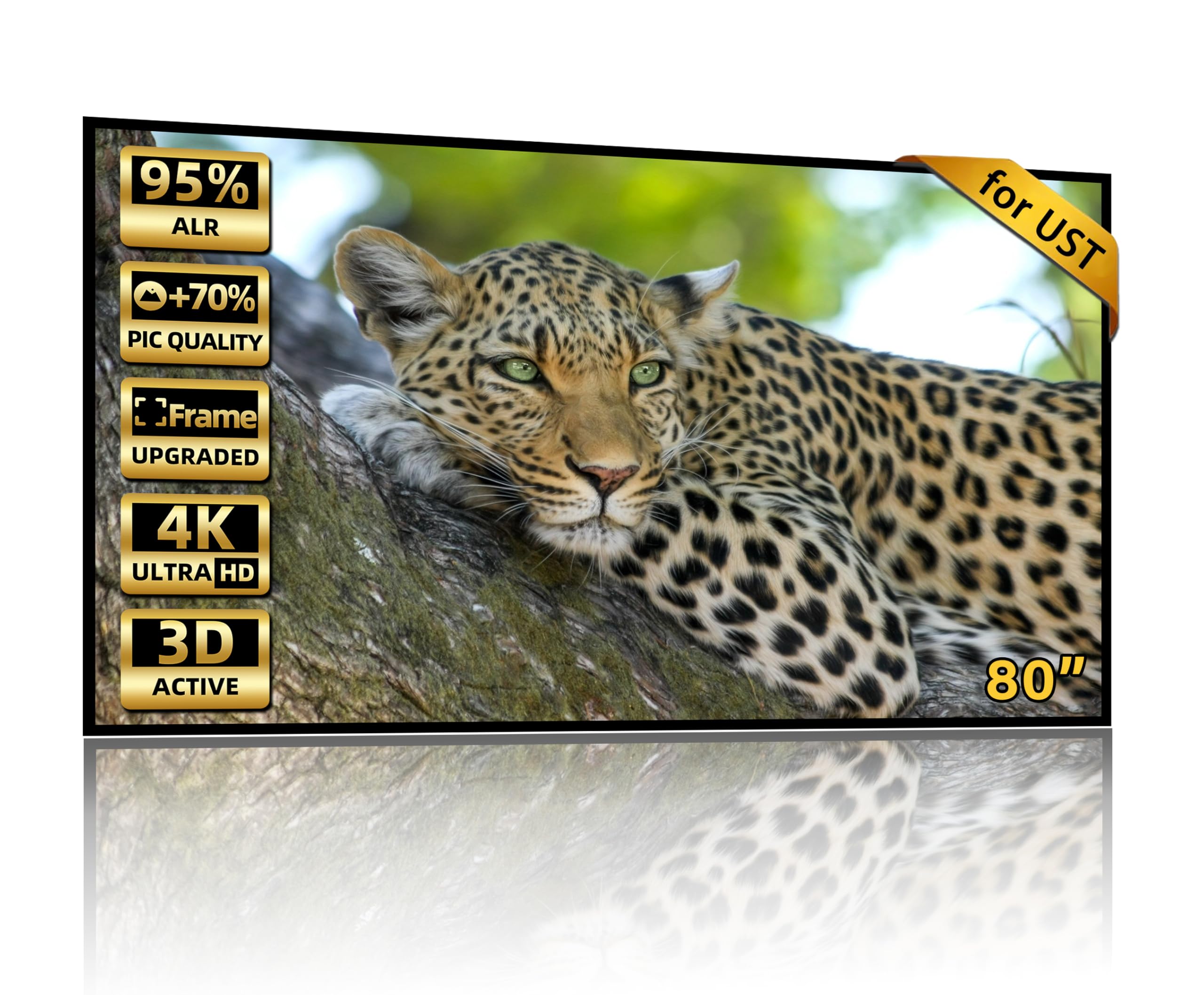
This fixed-frame ALR screen is a specialist tool designed specifically for ultra-short-throw projectors. Instead of a standard white surface, it uses a grey micro-toothed 3D structure with a 0.8 gain that physically redirects light from the projector upwards toward the audience while rejecting ambient light from above. The result is dramatically better black levels and color saturation in rooms that are not completely dark—something a standard matte screen simply cannot achieve.
The build quality is serious. The aluminum alloy frame uses a dual-frame design with adaptive spring tension to keep the 69.72-inch by 39.21-inch surface perfectly flat. Velvet trim around the bezel absorbs stray light to prevent reflections. Setup takes about an hour for one person, and the self-healing PVC material resists deformation over time. This is not a budget screen, but for a + UST projector, it prevents the washed-out image that would otherwise ruin the investment.
The 0.8 gain is intentionally lower than standard screens—this is correct for ALR technology, as it trades raw brightness for contrast and ambient light rejection. Users report excellent daytime performance with projectors like the Epson LS300, with crisp images even with windows open. A small number of users experienced minor sagging after several months, so careful initial tension adjustment is recommended.
Why it’s great
- Superior ambient light rejection for UST projectors
- Aluminum frame and spring tension maintain flatness
- Velvet bezel eliminates distracting light reflections
Good to know
- Only compatible with ultra-short-throw projectors
- Assembly requires careful spring adjustment
2. Elite Screens Manual Series M80UWH

The Elite Screens M80UWH is the gold standard for manual pull-down screens at this size. Its MaxWhite 2 material uses a multi-layer weave with a matte white finish at 1.1 gain, providing a 180-degree viewing angle and fully black-backed construction that blocks light penetration. The ISF certification confirms the material’s color accuracy in dark-room environments—a rare stamp of approval at this price tier.
Installation is straightforward with both wall and ceiling mounting options. The auto-locking system engages at roughly one-inch intervals, letting you stop the screen at any height. The black case measures 76 inches wide and 49.4 inches tall overall, with a viewing area of 69.7 by 39.2 inches. The metal housing is a weak point—it is made of thin sheet metal that can bend during shipping or installation, though users report the screen itself performs flawlessly.
Elite Screens backs this with a 2-year warranty and lifetime tech support. For a dedicated dark room with a standard or short-throw projector, this is the most reliable pull-down option available at this size.
Why it’s great
- ISF-certified matte white material with accurate color reproduction
- Auto-locking system allows variable height positioning
- Full black backing prevents light bleed-through
Good to know
- Metal housing is thin and can bend easily
- Spring durability has occasional failure reports
3. VIVOHOME 80 Inch Pull Down Screen
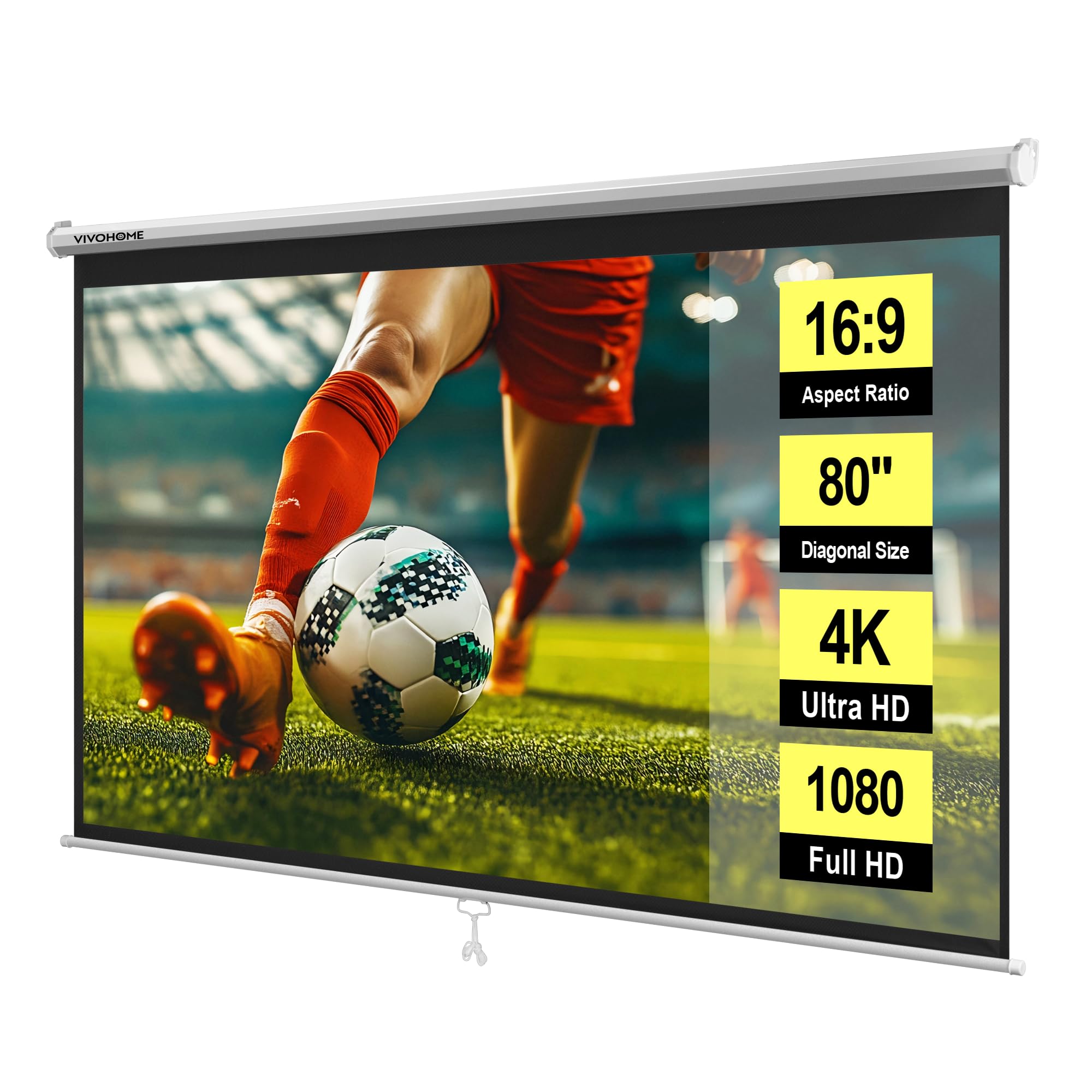
The VIVOHOME manual pull-down screen hits a price point that undercuts most competition while delivering a genuine 80-inch viewing area (70 inches wide by 40 inches high). The 3-layer waterproof PVC fabric resists creases and humidity changes, and the matte white surface provides a 160-degree viewing angle that minimizes glare. It supports 3D, 1080p, 4K, and even 8K content, making it future-proof for projectors you may upgrade to later.
Setup takes about ten minutes for a single person. The metal casing protects the screen during shipping and mounting, though it is not designed for frequent relocation. The self-locking mechanism works smoothly and holds the screen securely at any height. A common first-use complaint is a strong chemical smell from the PVC—this fades within a day after airing out. A few users also note a slight edge curl on the sides, which does not affect the central viewing area.
For a budget-friendly entry into an 80-inch screen, this model does the fundamental job well. It is best suited for a standard-throw projector in a living room or home theater where you want a retractable screen without spending on premium features. The anchors included are designed for concrete mounting, so drywall installers will need to supply their own wall anchors.
Why it’s great
- Very affordable for a genuine 80-inch pull-down screen
- Waterproof PVC resists humidity and creases
- Supports 4K and 8K content without visible pixelation
Good to know
- Strong PVC smell on first use
- Edge curl can occur on sides
4. LIHONG 80 inch Floor Rising Pull Up Screen
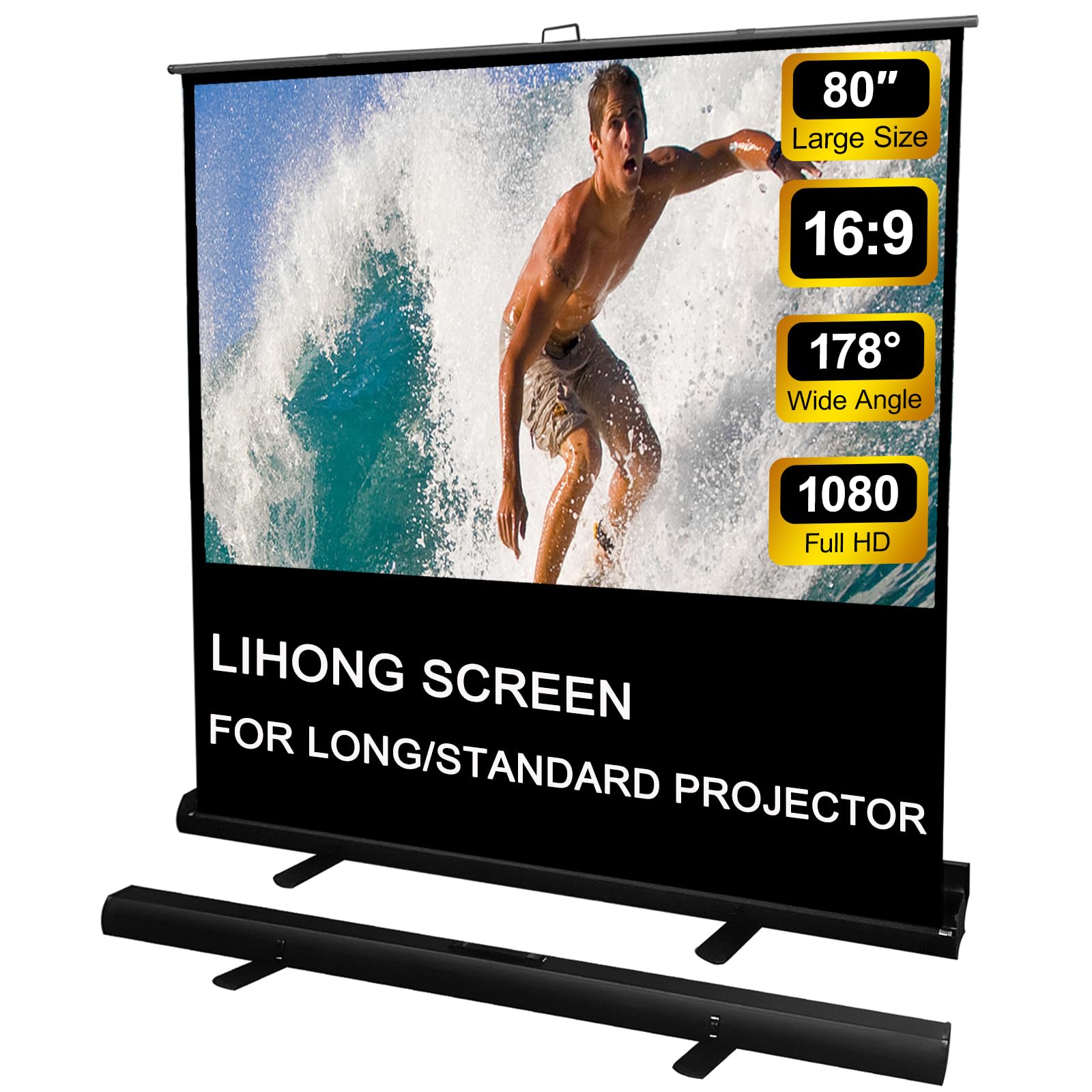
The LIHONG floor-rising screen solves the installation problem: no drilling, no wall mounts, and no permanent commitment. It uses a scissor-cross support frame with a hydraulic rod to lift the screen from its aluminum case, providing a 69.68-inch by 39.17-inch matte white surface. The 178-degree viewing angle is the widest in this lineup, making it suitable for large groups watching from extreme side angles.
The nano white fiberglass material is designed specifically for standard (long-throw) projectors, not UST models. It delivers high contrast and accurate color reproduction, with a recommended viewing distance of 2 to 2.5 meters. The unit weighs 24.25 pounds, which is hefty but ensures stability. The aluminum case doubles as a carrying handle, and the screen retracts fully for compact storage—ideal for apartment dwellers who cannot mount hardware.
Multiple users praise the image quality and ease of use, but there are durability concerns. Reports of the screen leaning forward and a rivet breaking after four months suggest the build quality is not as robust as the fixed-frame alternatives. The 1-year manufacturer warranty covers defects, but frequent movers may want to consider a lighter portable tripod screen instead.
Why it’s great
- No wall mounting required
- Excellent 178-degree viewing angle for large groups
- Retracts into compact aluminum case
Good to know
- Some reports of leaning forward over time
- Not suitable for UST projectors
5. Kodak 80 Inch Tripod Screen

The Kodak tripod screen is built for people who take their projector on the road. The matte white surface is made from lightweight PVC and Terylene fabric with a 1.0 gain, providing accurate color reproduction and a 160-degree viewing angle. The setup is genuinely fast: unfold the tripod, attach the screen bar, pull the screen up, and you are ready in under five minutes. The included carry bag holds the entire system compactly.
The tripod is a black metal alloy design with nonslip feet that does a decent job of reducing shake, but it is not rock-solid in outdoor wind conditions—users report the screen can pivot easily. The adjustment knobs are plastic and feel less robust than spring-loaded alternatives found on older models. At 15.8 pounds, it is not ultralight, but it is manageable for trunk transport.
Image quality is a clear step up from using a bedsheet or budget generic screen, with good contrast and sharpness for a portable solution. It is compatible with 8K/4K Ultra HD and 3D content. The main trade-off is the frame’s stability: in a calm indoor setting it works great, but for outdoor use you will need to anchor it or choose a windier day.
Why it’s great
- Fast setup and takedown in under five minutes
- Good image quality for a portable screen
- Includes storage carry bag for travel
Good to know
- Not stable in outdoor wind conditions
- Plastic adjustment knobs feel flimsy
6. Pyle 80 Inch Tripod Screen

The Pyle PRJTP80 stands out for its rigid build in a portable package. The alloy steel tripod and frame provide noticeably more stiffness than many competing tripod screens, reducing the flapping and wobble that plague outdoor setups. The matte fabric includes a full black backing to block light penetration, and the black masking borders around the screen help with focus and alignment by providing a clear framing edge.
The stand adjusts from 50 to 83.46 inches in height, accommodating different viewing positions and floor types. Setup is quick, and the roll-up design makes storage simple. At 14.11 pounds, it is slightly heavier than some alternatives, but that weight translates directly into stability. Users consistently highlight the easy assembly and the solid feel of the tripod lock mechanisms.
The maximum usable height for the screen surface tops out around 71 inches for the 80-inch model, which may be a limitation if you need the screen higher for a raised audience. The carrying case is included and well-constructed. For anyone who needs a portable screen that can handle occasional outdoor breezes without constant adjustment, this is a strong contender.
Why it’s great
- Rigid alloy steel tripod reduces wind flutter
- Full black backing for better contrast
- Black masking borders aid focus and alignment
Good to know
- Maximum height may be lower than expected
- Heavier than some portable alternatives
7. SCREENMAX 80 Inch Pull Up Screen

The SCREENMAX pull-up screen uses a hybrid fiberglass and PVC construction that resists wrinkles better than pure PVC alternatives. The matte finish provides a 160-degree viewing angle and the black backing effectively blocks ambient light. The pull-up mechanism is straightforward: pull the screen up from the base, attach the telescopic rod to hold it in place, and you are done in about two minutes.
The tripod base is designed with height adjustability to prevent line-of-sight obstructions from furniture, which is a practical detail often overlooked in portable screens. At 11 pounds, it is lighter than the LIHONG floor-rising screen, but users note that the tolerances on the frame can be loose, leading to the screen tilting or swaying slightly. A common workaround is using string or a level to correct the tilt.
Image clarity is a noticeable upgrade over direct wall projection, with colors appearing more saturated and blacks deeper. The screen is stable enough for indoor use with cats and kids moving around, but outdoor use may require additional anchoring. The carrying bag is included and fits the folded unit. Overall, it is a solid indoor-focused portable option with a few fit-and-finish compromises.
Why it’s great
- Wrinkle-resistant fiberglass/PVC material
- Quick two-minute setup
- Lightweight at 11 pounds
Good to know
- Frame tolerances can cause tilting
- Not ideal for frequent outdoor use without anchoring
8. PARIS RHÔNE 80 Inch Tripod Screen

The PARIS RHÔNE screen is built around its 1.5 gain PVC material, which makes it the brightest screen in this roundup. That gain level is particularly useful for projectors with lower lumens, or for rooms where you cannot fully control the lighting. The cinema-grade multi-layer construction with five layers of polymer material helps maintain color accuracy despite the high gain, though the viewing cone is narrower than a 1.0 gain matte screen.
The X-shaped aluminum alloy tripod is reinforced and includes ground nails for outdoor stability, which is a rare inclusion at this price tier. The screen can be used with the tripod or wall-mounted separately. Setup takes roughly three minutes for one person, and the included carry bag keeps everything organized. The screen is wrinkle-free out of the box, a meaningful advantage over budget PVC screens that sometimes arrive with crease lines.
User feedback emphasizes the excellent build quality and premium feel compared to cheaper options. The 1.5 gain creates a noticeably punchier image in semi-lit conditions, but owners with very bright projectors in dark rooms may experience some hot-spotting. For outdoor movie nights or living rooms with windows, the extra brightness headroom is a genuine asset.
Why it’s great
- 1.5 gain boosts brightness for low-lumen projectors
- Reinforced tripod with ground nails for outdoor use
- Wrinkle-free PVC material out of the box
Good to know
- Narrower viewing angle due to high gain
- May show hot-spotting with bright projectors
9. HYZ 80 Inch Tripod Screen
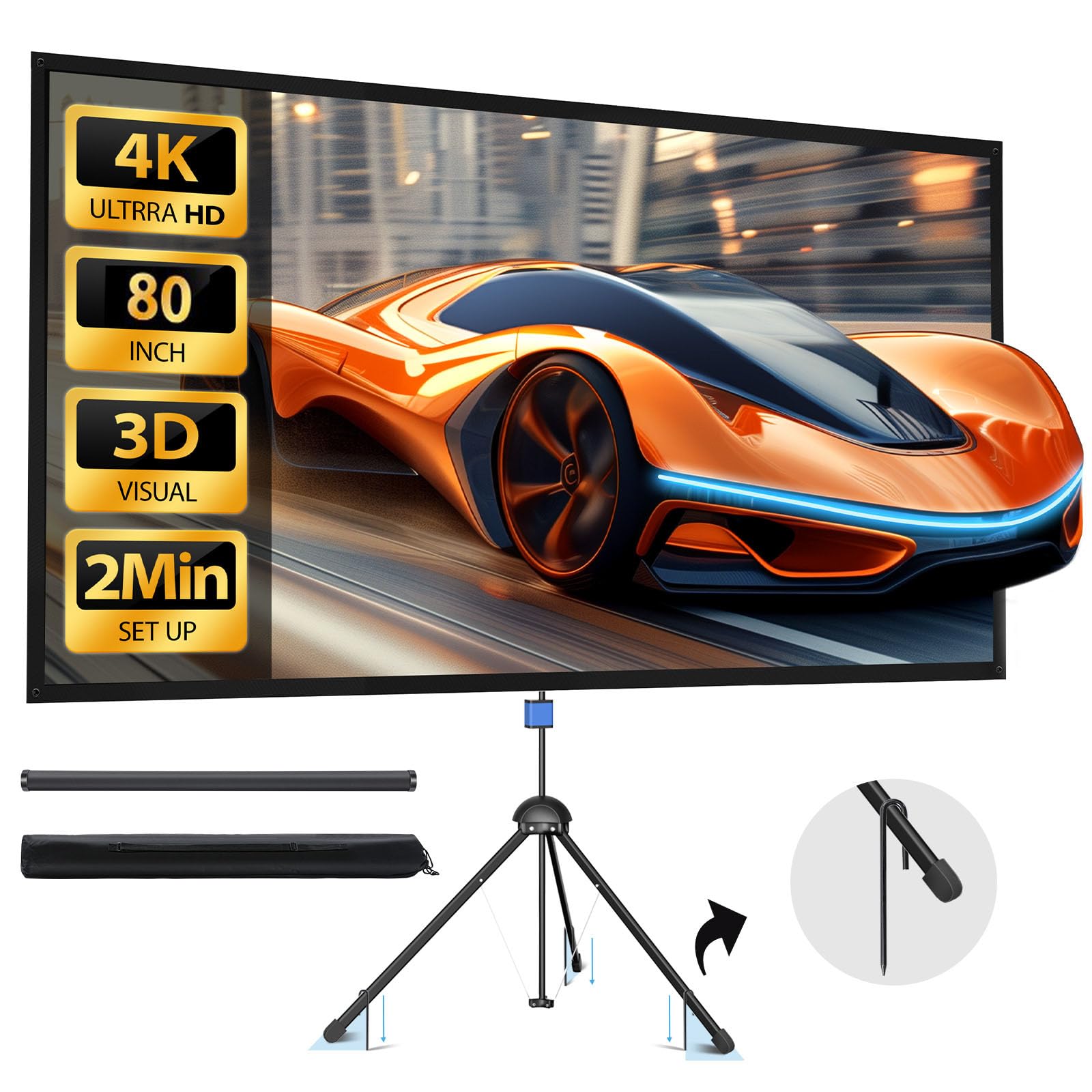
The HYZ screen delivers a 1.5 gain cinema-grade projection surface at an entry-level price point that is hard to ignore. The five-layer PVC material is designed to resist creasing and rolling edges, and the matte finish provides a 160-degree viewing angle. The screen can be used with the included tripod or wall-mounted, giving you flexibility depending on your setup.
The aluminum alloy X-type tripod is reinforced for stability and adjusts from 59 to 80.3 inches in height. The screen itself is thick and opaque, with a black backing that blocks light penetration effectively. Setup is straightforward, and the storage tube and carrying bag make transport practical. At this price point, the compromises are in the small details: the plastic clips that attach the screen to the frame feel fragile, and the carrying case is long, making it slightly awkward to transport.
Users who have used the screen over multiple camping trips report that the crease-free tension system holds up well after repeated setup and takedown. The image quality is a massive upgrade over a bare wall or sheet, with improved brightness and contrast. For budget-conscious buyers who need a functional 80-inch screen that works indoors and out, the HYZ is a capable starting point.
Why it’s great
- Very affordable entry into 1.5 gain screens
- Works with tripod or wall-mounted
- Resists creases after repeated setup cycles
Good to know
- Plastic frame clips feel fragile
- Carrying case is long and bulky
FAQ
Can I use a standard 80-inch screen with an ultra-short-throw projector?
How do I fix minor wrinkles or waves on my portable tripod screen?
Final Thoughts: The Verdict
For most users, the best 80 projector screen is the Elite Screens Manual Series M80UWH because it combines ISF-certified material, a reliable auto-locking mechanism, and a 1.1 gain matte white surface that works perfectly with standard projectors in dark rooms. If you need a portable screen for outdoor movies, grab the Pyle PRJTP80 for its rigid alloy steel tripod and black masking borders. And for UST projector owners who want proper image quality with ambient light, nothing beats the 80 inch ALR Fixed Frame Screen.