
Choosing the right power source for your boat, trolling motor, or fish finder is the difference between a full day on the water and an early trip back to the dock. A 12V marine battery isn’t just a box of energy — it’s a reliability decision that determines whether your electronics run clean, your motor pulls strong, and your battery box stays corrosion-free season after season.
I’m Min — the co-founder and writer behind Gadgets Feed. I’ve spent hundreds of hours analyzing marine battery chemistries, reserve capacity ratings, and BMS configurations to separate the real performers from the over-hyped specs so you can buy with confidence.
This guide ranks the most reliable deep-cycle, dual-purpose, and lithium options currently on the market to help you find the best 12v marine battery for your specific setup and budget.
How To Choose The Best 12V Marine Battery
Marine batteries face a brutal environment: constant vibration, temperature swings, humidity, and deep discharge cycles that would kill a car battery in weeks. Choosing the right chemistry and capacity starts with understanding three fundamental specs and how they apply to your boat.
Amp-Hours (Ah) vs Reserve Capacity (RC)
Amp-hours tell you the total energy stored — a 100Ah battery can deliver 5 amps for 20 hours. Reserve capacity, measured in minutes, tells you how long the battery can deliver 25 amps before dropping to 10.5 volts. For trolling motors and fish finders, reserve capacity is often the more practical spec because it simulates real-world draw better than the theoretical Ah rating.
LiFePO4 vs AGM: Chemistry Trade-Offs
Lithium iron phosphate (LiFePO4) batteries weigh roughly 60% less than AGM, deliver 4,000 to 15,000 deep cycles, and maintain flat voltage until nearly empty. AGM batteries cost less upfront, handle high-cranking loads better, and tolerate cold temperatures more gracefully — but they lose capacity after 300 to 500 cycles and punish deep discharges hard. If you fish daily or run a serious trolling motor, lithium’s weight savings alone can change how your boat handles.
Starting vs Deep Cycle vs Dual Purpose
A starting battery delivers a short burst of high current to crank an engine, then gets recharged immediately by the alternator. A deep cycle battery is built to discharge down to 50% or more repeatedly without damage. Dual-purpose batteries, like the OPTIMA BLUETOP, walk the middle line — they offer enough cold cranking amps for reliable starts and enough deep cycle capacity to run electronics. For most boats with a single battery bay, dual-purpose is the practical default.
Quick Comparison
On smaller screens, swipe sideways to see the full table.
| Model | Category | Best For | Key Spec | Amazon |
|---|---|---|---|---|
| Litime 12V 100Ah TM LiFePO4 | Lithium | Trolling Motor & Marine | 100Ah, 22.16 lbs, 4000+ cycles | Amazon |
| DC HOUSE 12V 100Ah Bluetooth | Lithium | Bluetooth Monitoring | 100Ah, Bluetooth APP, 15000 cycles | Amazon |
| HumsiENK 12V 100Ah LiFePO4 | Lithium | Group 24 Replacement | 100Ah, 19.73 lbs, IP67, 15000 cycles | Amazon |
| DUMFUME 12V 150Ah LiFePO4 | Lithium | High Capacity Solar/Off-Grid | 150Ah, 1920Wh, 22.05 lbs | Amazon |
| WEIZE 12V 100Ah Deep Cycle AGM | AGM | Budget Deep Cycle Backup | 100Ah, 63 lbs, 3% self-discharge | Amazon |
| Newport 12V50Ah Deep Cycle AGM | AGM | Lightweight Trolling Motor Value | 50Ah, 32 lbs, sealed AGM | Amazon |
| GOLDENMATE 12V 20Ah LiFePO4 2-Pack | Lithium | Fishfinder/Camper Accessories | 20Ah each, 5.3 lbs, 5000+ cycles | Amazon |
| OPTIMA 34M BLUETOP AGM | AGM | Starting & Dual Purpose | 800 CCA, 50Ah, SpiralCell | Amazon |
| OPTIMA D31M BLUETOP AGM | AGM | Heavy-Duty Dual Purpose | 900 CCA, 75Ah, 155 min RC | Amazon |
In‑Depth Reviews
1. Litime 12V 100Ah Trolling Motor LiFePO4 Battery

The Litime 100Ah LiFePO4 stands out because it was specifically engineered for trolling motors — it meets the ABYC E-13 marine standard with extra triple protection against dust, water, and salt spray. That coastal corrosion resistance is something most lithium batteries lack, and it directly addresses the failure point that kills standard batteries on saltwater boats. At 22.16 pounds, it shaves over 40 pounds off a comparable AGM battery, which translates to noticeable performance gains — users report speed improvements of 4 mph after swapping out lead-acid.
This battery delivers 4000+ cycles at 100% depth of discharge, which translates to a 10-year lifespan versus the 3-year ceiling on AGM. The built-in TVS diode protects your trolling motor from voltage spikes, and the smart low-temperature protection cuts charging below 32°F and discharging below -4°F to prevent cold damage. The Group 31 form factor is standard, but the weight reduction alone makes it a compelling upgrade for any jon boat, bass boat, or kayak setup.
Real-world performance matches the spec sheet — users running 45lb thrust trolling motors for 8-hour sessions on windy lakes report minimal discharge, and a 36V Minnkota Ultrex setup consumed only 10% of the 100Ah capacity over 5 hours of active fishing. The only catch is that batteries can arrive in sleep mode and require a LiFePO4-compatible charger with a force mode to wake them up, so plan your first charge accordingly.
Why it’s great
- ABYC E-13 marine certified with salt spray protection
- 64% lighter than equivalent AGM batteries
- TVS diode prevents voltage spike damage to motors
Good to know
- May arrive in sleep mode requiring a force-charge wake-up
- Flat voltage curve can be confusing — 12.8V at rest means near empty
2. DC HOUSE 12V 100Ah LiFePO4 Trolling Motor Lithium Battery
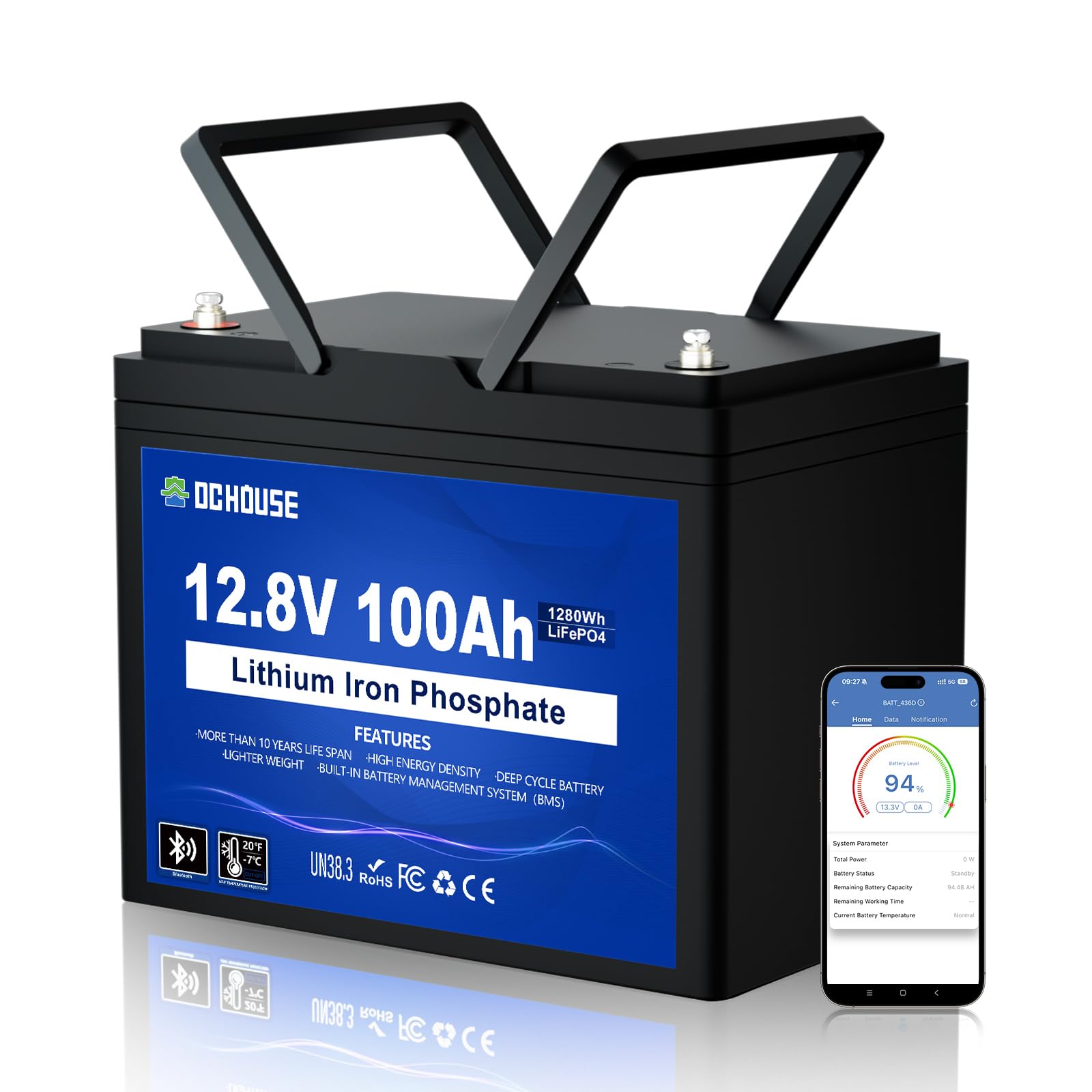
The DC HOUSE 100Ah lithium battery brings Bluetooth monitoring to the marine market at a very accessible price point. The proprietary app connects within a 5-10 meter range and gives you per-cell voltage, SOC percentage, current draw, and a dedicated fault display page for troubleshooting. For trolling motor users, knowing exactly how many amp-hours remain versus estimating based on voltage is a genuine game-changer — especially because LiFePO4 has that flat discharge curve that makes voltage-based estimation unreliable.
This battery is built around Class A LiFePO4 cells certified to UL and UN38.3 standards, rated for up to 15,000 cycles and a 10-year service life. Low-temperature protection kicks in below 19.4°F for charging and -4°F for discharging, with automatic recovery above 32°F. The dimensions are close to BCI Group 24 — about 0.32 inches taller — which means it fits most standard battery trays without modification. It supports expansion up to 4 in series or 4 in parallel, with a maximum of 8 batteries total.
On the water, one user ran a 45lb thrust trolling motor on high settings in strong winds for 8 hours and left the lake with 52% charge remaining. Another user camps with a CPAP machine drawing through a 750W inverter and only consumes 25-30% of capacity per night. The Bluetooth functionality adds real convenience, but the app is proprietary and range-limited — you won’t be monitoring from the helm if your battery is mounted in the stern compartment 15 feet away.
Why it’s great
- Real-time Bluetooth monitoring of SOC, voltage, per-cell status
- UL/UN38.3 certified Class A cells with 15,000 cycle rating
- Low-temp cutoff protects battery in winter storage
Good to know
- Bluetooth range limited to 5-10 meters
- 0.32 inches taller than standard Group 24 dimensions
3. HumsiENK 12V 100Ah LiFePO4 Battery

The HumsiENK 100Ah LiFePO4 battery is engineered for the tightest installs, with a BCI Group 24 footprint (8.4 x 6.6 x 10.2 inches) and a shock-resistant, IP67 waterproof enclosure. That IP67 rating is rare in the marine lithium category — it means the battery is fully dust-tight and can survive submersion in up to 1 meter of water for 30 minutes. For a battery mounted low in a bilge or an open fishing kayak, that waterproofing is the difference between a multi-year investment and a single-season casualty.
HumsiENK uses A+ grade LiFePO4 cells with 999 laboratory tests cited per battery, supporting 15,000+ deep cycles and a 10-year lifespan. The built-in 100A BMS covers overcharge, over-discharge, over-current, short circuit, and high-temperature protection, with low-temperature protection that shuts down below -4°F. Expansion is flexible — up to 4 batteries in series or 4 in parallel, or a combination of both for up to 20.48kWh total capacity. Charging is fast, with a full 100Ah recharge possible in just 2 hours with the right charger, compared to 14 hours for a comparable AGM battery.
Users consistently report measured capacities exceeding the rated spec — one owner testing a 4kWh system found 4150 Wh of real capacity. In a 36V golf cart conversion, replacing six 6V lead-acid batteries with three 12V HumsiENK units cut weight dramatically and extended runtime. The nylon carrying handle is a thoughtful touch for transport, but note that the battery does not support 4P4S configurations, so plan your expansion within the series/parallel limits.
Why it’s great
- IP67 waterproof and dust-tight for marine environments
- Ultra-light 19.73 lbs in Group 24 footprint
- 2-hour fast charging from grid or solar
Good to know
- Does not support 4P4S expansion configurations
- BMS can enter sleep mode requiring low-current wake-up
4. DUMFUME 12V 150Ah LiFePO4 Deep Cycle Battery
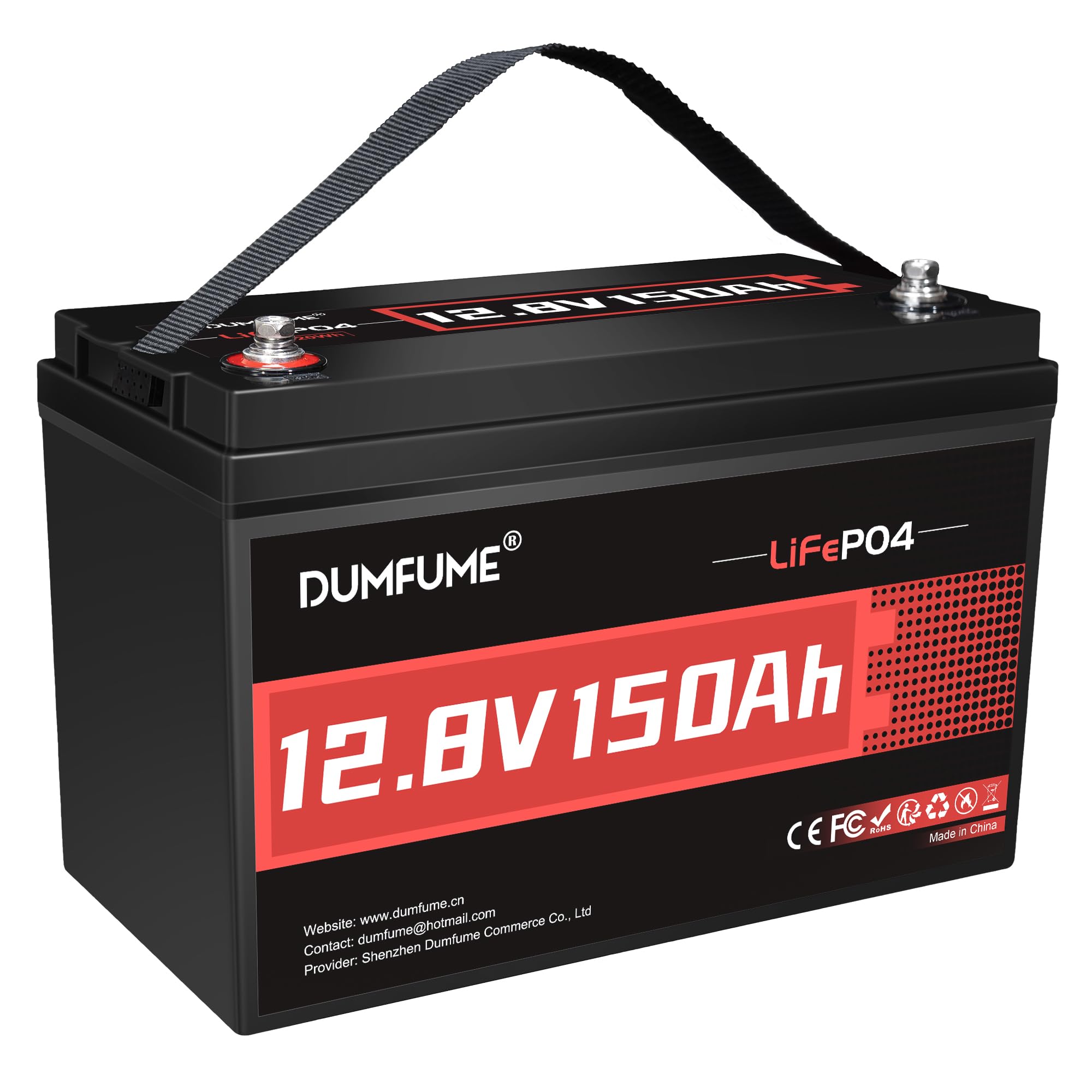
The DUMFUME 150Ah LiFePO4 packs 1920 watt-hours of energy into a Group 31 case weighing just 22.05 pounds. That’s 50% more capacity than a 100Ah battery for only slightly more weight, making it the density leader in this lineup. The 4000+ cycle rating at 80% depth of discharge translates to roughly 11 years of daily use before capacity degrades, backed by a 5-year warranty that adds a layer of confidence for buyers committing to a lithium upgrade.
The built-in 100A BMS covers overcharge, over-discharge, short circuit, and overheating, though this battery is explicitly designed for energy storage — not engine starting. Series and parallel expansion supports up to 4S4P configurations, which means you can build a 48V 600Ah system with 4 units in series and 4 parallel strings. Temperature protection enables reliable operation from -4°F to 158°F for discharging, though charging below 41°F is not recommended, so northern users will need to plan for cold-weather charging.
Independent testing shows these batteries consistently exceed their rated capacity — one owner tested four 150Ah units and found each delivered roughly 7Ah above spec. In a solar home setup, a single 150Ah unit running a 2000W inverter powered major kitchen appliances and an 8000 BTU air conditioner for 11 hours before reaching 50% discharge. However, quality control is inconsistent — roughly 50% of units in one batch arrived below optimal voltage and required a parallel jump charge to wake the BMS, so inspect and test immediately upon delivery.
Why it’s great
- Excellent energy density — 1920Wh at just 22.05 lbs
- Consistently tests above rated 150Ah capacity
- 5-year warranty and expandable to 4S4P
Good to know
- Some units arrive with BMS in sleep mode needing a jump charge
- Not designed for high-cranking starting applications
5. WEIZE 12V 100Ah Deep Cycle Battery

The WEIZE 100Ah AGM is the right choice when you need reliable deep-cycle power but aren’t ready to make the jump to lithium pricing. At 63 pounds, it’s heavy — more than double the weight of a comparable lithium battery — but that weight comes with a proven AGM design that’s maintenance-free, spill-proof, and tolerant of standard lead-acid charging infrastructure. The 3% self-discharge rate means you can store it over the winter and still have usable voltage come spring without a tender.
The sealed AGM construction handles deep discharge down to 50% depth of discharge better than flooded lead-acid, and the valve-regulated design means zero fluid checks or corrosion cleanup. Dimensions are 12.99 x 6.73 x 8.34 inches, which replaces common UB121000 and Renogy 100Ah footprints. The screw-in terminal posts accept standard ring terminals, and the battery orientation is flexible — AGM’s absorbed glass mat design keeps electrolyte in place regardless of mounting angle.
In real-world use, two WEIZE 100Ah batteries powering an off-grid RV with 300W of solar have run reliably for two years with no issues, driving a 700W inverter for cooking and TV loads. Another user built a 4-battery parallel bank feeding a 2000W inverter for home backup, delivering 4.8 kWh of emergency power for lights, fans, and garage doors. The value proposition is straightforward: you get genuine 100Ah AGM capacity at a fraction of lithium pricing, but you’ll sacrifice 40 pounds and accept a 3-year lifespan versus 10+ from lithium.
Why it’s great
- Reliable 100Ah AGM capacity at a very accessible price point
- Spill-proof and maintenance-free with low self-discharge
- Compatible with standard lead-acid chargers and solar controllers
Good to know
- Weighs 63 pounds — difficult to move and install solo
- Limited to 200-500 deep cycles before capacity degrades
6. Newport 12V50Ah Deep Cycle Marine Battery
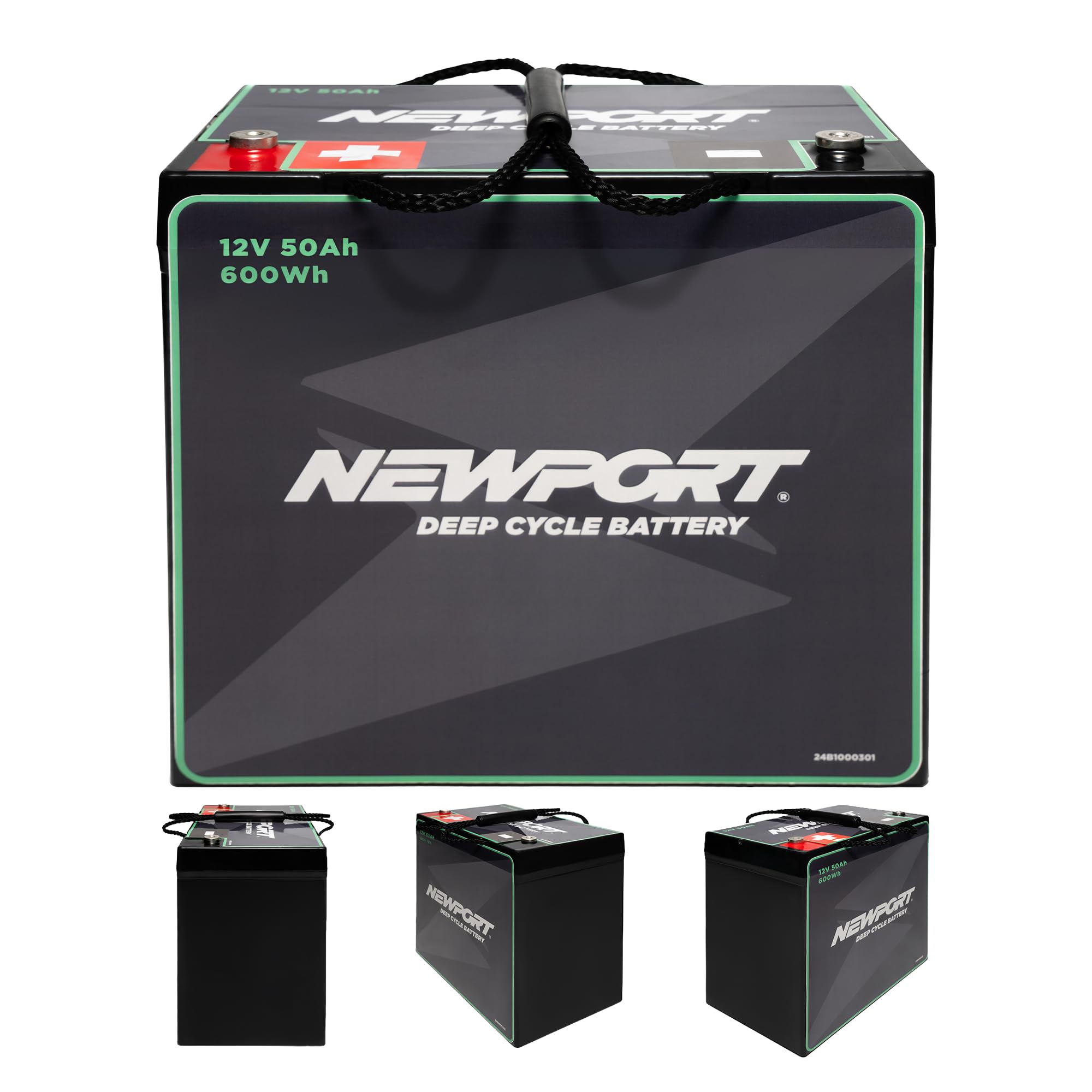
The Newport 12V50Ah is the entry-level sweet spot for kayak fishermen and small boat owners who need a dedicated trolling motor battery without overspending on capacity they won’t use. At 32 pounds, it’s roughly half the weight of a 100Ah AGM, making it genuinely one-hand portable — critical for kayak anglers who have to lift gear in and out of a cockpit. The sealed AGM construction is leak-proof and vibration-resistant, which matters when you’re bouncing across chop or trailering your vessel.
The 50Ah capacity is rated for deep-cycle use with trolling motor compatibility listed directly on the spec sheet. Real-world testing shows this battery delivers approximately 4+ hours on a 55lb thrust trolling motor at moderate speeds, or roughly 7 hours half-day use on a 25lb thrust motor at full power. That runtime is adequate for afternoon fishing sessions but falls short of full-day expectations — one user upgraded to lithium after expecting longer runtime from the 50Ah rating.
Durability is a strong point: one owner reported the battery tumbling from a truck bed at 20 mph onto asphalt, suffering only minor cosmetic damage with no swelling, charging, or output issues afterward. The marine terminal design accepts standard wing nut connectors, and the compact footprint fits easily into most battery boxes. The lack of a built-in charge indicator is the main practical gripe — owners recommend pairing it with an external voltmeter or battery monitor to avoid unexpected discharge on the water.
Why it’s great
- Lightweight 32 lbs — easy to carry and install solo
- Survived a 20 mph tumble without functional damage
- Sealed AGM is leak-proof and maintenance-free
Good to know
- 50Ah capacity limits runtime for full-day trolling sessions
- No built-in charge indicator — external monitor recommended
7. GOLDENMATE 12V 20Ah LiFePO4 Battery 2-Pack

If your marine electrical needs are modest — a fish finder, LED navigation lights, a small bilge pump — the GOLDENMATE 20Ah LiFePO4 2-pack offers two batteries for a price that undercuts most single 100Ah units. At 5.3 pounds each, these are absurdly portable, and the LiFePO4 chemistry delivers 5000+ deep cycles versus the 200-500 of lead-acid. The built-in BMS prevents overcharging, over-discharging, over-current, overheating, and short circuits, meaning you can install these in tight spaces without constant monitoring.
The 12.8V nominal voltage stays flat throughout discharge — a 20Ah LiFePO4 delivers usable power down to roughly 10% SOC, whereas a 20Ah AGM would be functionally dead at 50% discharge. This gives you effectively more usable capacity from the same amp-hour rating. The batteries support series connections up to 4 identical units for 48V systems and parallel connections for increased capacity, making them flexible for expanding solar setups, UPS backups, or small off-grid loads.
Users report impressive real-world performance: one owner used a single 20Ah battery to replace a dead SLA in a Cyberpower UPS, increasing runtime from 396 to 420 minutes at 1.5% load with faster recharge (5A vs 2.7A). Another dropped a pair into a 4WD kid’s Jeep and found the current output high enough to blow a 30A fuse. The compact size and terminal spacing work well in tight electronics bays, but the 20Ah capacity means these are strictly for accessory loads — running a trolling motor would drain them in under an hour.
Why it’s great
- Incredibly lightweight at 5.3 lbs per battery
- 5000+ deep cycles — 10x longer than SLA
- Strong current output for their size — hit 30A+ easily
Good to know
- 20Ah capacity is only suitable for accessories, not trolling motors
- Slow shipping reported by multiple buyers
8. OPTIMA 34M BLUETOP Sealed AGM Starting Battery

The OPTIMA 34M BLUETOP is the gold standard for marine starting batteries, and for good reason — it delivers 800 cold cranking amps from a sealed AGM design with SpiralCell technology that wraps 99.99% pure lead plates into a vibration-resistant spiral. This construction makes it 15 times more resistant to vibration than standard flooded batteries, which is critical for outboard engines that shake hard at idle. The dual SAE and 5/16-inch stainless steel stud terminals give you flexibility for connecting both engine cables and accessory wires.
Despite being primarily a starting battery, the 34M is labeled dual-purpose with a C20 capacity of 50Ah and a reserve capacity of 100 minutes. That’s enough to run a bilge pump, radio, and lights for an afternoon without depleting the starting reserve. The faster charging capability means the battery recovers quickly once your outboard’s alternator kicks in. At 38.4 pounds, it’s weighty but reasonable for the power density, and the sealed case allows mounting in any orientation — including upside down in tight engine compartments.
Longevity is the headline story here: owners routinely report 10+ years of service from OPTIMA BLUETOPs. One boat owner replaced his after a decade only because of age, not failure — the original was still starting the engine and running bilge pumps. The abuse tolerance is equally impressive: these batteries handle off-road vibration in backhoes and travel trailers without leaking or shedding plates. The one recurring complaint is that Amazon’s packaging is inconsistent — some units arrive with damaged cases from inadequate padding, so inspect the plastic carefully on delivery.
Why it’s great
- 800 CCA for reliable outboard starting in cold conditions
- SpiralCell AGM handles extreme vibration without damage
- Multiple owners report 10+ year lifespan
Good to know
- 50Ah capacity limits deep-cycle use compared to dedicated lithium
- Amazon packaging can be inadequate — inspect case on arrival
9. OPTIMA D31M BLUETOP Dual Purpose AGM Battery

The OPTIMA D31M BLUETOP is the larger, more capable sibling of the 34M, offering 900 cold cranking amps, a C20 capacity of 75Ah, and a massive 155-minute reserve capacity. This is the battery you choose when your boat needs both reliable starting power and meaningful deep-cycle capacity from a single unit — for example, running downriggers, a livewell pump, and electronics for a full day of fishing while still having enough CCA to crank a big outboard at the end of the day.
The SpiralCell design is the same proven technology — 99.99% pure lead spirals wrapped for maximum surface area and vibration resistance — but the D31M packs more lead into a larger Group 31 case measuring 12.81 x 6.56 x 9.38 inches and weighing 59.8 pounds. The dual SAE and 5/16-inch stainless steel stud terminals accommodate both automotive-style clamps and marine ring terminals. The reserve capacity of 155 minutes at 25 amps means you can run a moderate load for over 2.5 hours before the battery drops to 10.5 volts.
The lifespan stories on the D31M are remarkable — one user reported two D31Ms in service since 2009 on a boat, with both still starting the engine and powering downriggers for 4-hour fishing sessions after 14 years. Another owner ran two D31Ms in parallel to power a 1500W inverter load drawing 137.5 amps for 27 minutes without issue. The per-year cost of ownership becomes absurdly low when a battery lasts 10+ years. However, the same packaging criticism applies — Amazon ships these in inadequate cardboard boxes, and cracked cases from shipping damage are a known risk. Additionally, customer support from OPTIMA for warranty claims is reportedly weak, so confirm return policies before purchase.
Why it’s great
- 900 CCA plus 155-minute reserve capacity for true dual-purpose use
- 14+ year reported lifespan in real marine service
- SpiralCell AGM handles heavy vibration and deep cycles
Good to know
- Very heavy at 59.8 pounds — two-person lift recommended
- Warranty support from OPTIMA is inconsistent
FAQ
What is the difference between a starting battery and a deep cycle marine battery?
How many amp-hours do I need for a trolling motor?
Can I charge a LiFePO4 battery with my existing marine charger?
Is AGM or lithium better for saltwater boats?
Final Thoughts: The Verdict
For most users, the best 12v marine battery winner is the Litime 12V 100Ah TM LiFePO4 because it combines ABYC E-13 marine certification, genuine trolling motor-specific engineering, and a 64% weight reduction over AGM at a price that undercuts premium lithium competitors. If you want Bluetooth monitoring and cell-level data, grab the DC HOUSE 12V 100Ah with Bluetooth. And for a heavy-duty dual-purpose battery that can start your outboard and run your electronics for a decade, nothing beats the OPTIMA D31M BLUETOP.